Disclosure: airfryerkitchensupply.com is reader-supported. When you buy through links on our site, we may earn an affiliate commission at no extra cost to you.
Where to buy
Shopping the best kitchen towels for cleaning shortlist below is fastest through the retailer link under each pick. Availability and colour options change often, so use the links below to check the current price on Amazon and confirm the exact size or configuration before you order:
- Utopia Kitchen White Flour Sack Towels (12 Pack, 28 x 28 Inch) — Check on Amazon
- Zeppoli Classic Dish Towels (15 Pack, 14″ by 25″) — Check on Amazon
- COTTON CRAFT Waffle Terry Towels (12 Pack, 16×28 Inch) — Check on Amazon
- Utopia Towels Blue Dish Towels (12 Pack, 15 x 25 in, 200 GSM) — Check on Amazon
- LANE LINEN 100% Cotton Kitchen Towels (6 Pack) — Check on Amazon
- Amazon Basics Organic Cotton Waffle Weave Dish Towels (6-Pack) — Check on Amazon
The best kitchen towels for cleaning are not the prettiest towels in the drawer — they are the ones that actually move water, survive bleach-adjacent abuse, wash clean without holding smells, and come in enough quantity that a clean one is always within reach. Cleaning is a different job from drying: a cleaning towel wipes counters, catches spills, dries washed produce, polishes taps and takes the first pass at every mess, and it does that a dozen times a day. Every towel below was verified, and all six picks are 100% cotton as their listing titles confirm — because for cleaning duty, cotton’s absorbency and washability still beat decorative blends.
The honest shape of this category: weave matters more than branding. Flour sack weaves are thin, lint-light and brilliant for glass and produce; terry and waffle-terry builds carry more water for big spills; classic flat dish towels are the bulk workhorses. Pack size matters too — cleaning towels work as a rotation system, not as individuals, which is why this list favours 6, 12 and 15-packs. Prices are never printed here; check the current price on Amazon via the links and think in cost-per-towel across the rotation.
In this guide
Quick Picks
Utopia Kitchen White Flour Sack Towels (12 Pack, 28 x 28 Inch) — Best Overall for Cleaning
The cleaning classic: big, thin, 100% cotton flour sack towels in a 12-pack — lint-light, fast-drying and endlessly washable. Check on Amazon
Zeppoli Classic Dish Towels (15 Pack, 14″ by 25″) — Best Bulk Value
Fifteen classic cotton cleaning towels in blue — the biggest rotation here, sized for hands, counters and constant washing. Check on Amazon
COTTON CRAFT Waffle Terry Towels (12 Pack, 16×28 Inch) — Best for Spills
Waffle-terry construction in a 12-pack — the thirstiest build here, made for the spill, the boil-over and the just-washed counter. Check on Amazon
Utopia Towels Blue Dish Towels (12 Pack, 15 x 25 in, 200 GSM) — Best Mid-Weight Workhorse
Ring-spun cotton at a stated 200 GSM in a blue 12-pack — the balanced middle: more body than flour sack, faster than terry. Check on Amazon
LANE LINEN 100% Cotton Kitchen Towels (6 Pack) — Best Smaller Premium Pack
A softer, quick-drying six-pack for smaller households that wash often and do not need a fifteen-towel arsenal. Check on Amazon
Amazon Basics Organic Cotton Waffle Weave Dish Towels (6-Pack) — Best Waffle Weave
Organic cotton in a waffle weave, stated lint-free and quick drying at 15×25 inches — the eco-leaning waffle pick. Check on Amazon
How These Picks Were Chosen
Towels were confirmed through the airfry site Amazon listing data by searching cotton kitchen towel packs, matching Amazon titles to the products and recording ASINs from the responses. Only listing-confirmed towels carry purchase links. Selection balanced the three weaves that genuinely clean differently (flour sack, waffle/terry, flat classic), prioritised stated pack sizes and stated dimensions, and required the listing title to confirm 100% cotton. We deliberately did not include decorative or novelty towels: a cleaning rotation needs towels you will bleach, boil-wash and retire without a second thought. GSM is quoted only where a title states it, because towel weights are otherwise guesswork — and a heavier towel is not automatically a better cleaning towel.
The 6 Best Kitchen Towels for Cleaning

Utopia Kitchen White Flour Sack Towels (12 Pack, 28 x 28 Inch) — Best Overall for Cleaning
Flour sack towels are the professional cleaner’s kitchen towel, and this Utopia 12-pack is the reference version: a stated 28 by 28 inches, 100% cotton, in plain white. The thin open weave is the point — it dries glassware without lint, wipes counters without pushing water around, dries herbs and produce, and then dries itself quickly on the hook so it never sits sour. Twelve in rotation means a fresh one every day and a full wash load at the weekend.
Strengths
- Stated 28×28-inch size is genuinely large — covers a counter run in one pass
- Thin flour sack weave leaves minimal lint on glass and steel
- White 100% cotton tolerates hot washes and bleach when cleaning duty demands it
Trade-offs
- Thin means low total absorbency for a flooded counter — grab two, or keep a terry towel for spills
- Plain white shows every stain it heroically absorbs; that is the deal
- No terry texture for scrubbing — these wipe, they do not scour
| Detail | What the listing confirms |
|---|---|
| Pack | 12 |
| Size | 28 x 28 inches (per listing title) |
| Material | 100% cotton, flour sack weave |
If a kitchen could only have one towel type for cleaning, this is it. The flour sack’s virtues compound: it washes completely clean because there is no deep pile to trap grease, it dries fast enough to be back in service the same day, and it folds flat so a dozen live in a drawer without a fight. Keep a couple dedicated to glass and produce, let the rest take the dirty work, and retire the veterans to garage duty when they thin. That system, more than any single towel, is what a clean kitchen actually runs on.
Best for: everyday wiping, glass, produce and a full weekly rotation / Not suited for: soaking up large spills single-handed — pair with a terry towel
Check the current price on Amazon

Zeppoli Classic Dish Towels (15 Pack, 14″ by 25″) — Best Bulk Value
Zeppoli’s pitch is arithmetic: fifteen 100% cotton towels at a stated 14 by 25 inches, machine washable, in blue — the colour kitchens choose when white’s honesty about stains gets tiring. This is the bulk-cleaning end of the list: towels priced and packed to be used hard, washed hot and replaced as a set. The hand-towel size suits counter work, hand drying between tasks, and lining a tray of washed glasses.
Strengths
- 15-pack is the deepest rotation on this list — a clean towel is always available
- Blue colour hides the everyday staining that retires white towels early
- Classic flat weave washes clean and dries fast
Trade-offs
- Smaller stated size than the flour sack picks — less coverage per pass
- Classic weave is a wiper, not a scrubber
- Bulk value positioning means basic finishing; these are tools, not décor
| Detail | What the listing confirms |
|---|---|
| Pack | 15 |
| Size | 14 x 25 inches (per listing title) |
| Material | 100% cotton |
| Colour | Blue |
High-volume kitchens — family cooking, batch baking, holiday hosting — burn through towels at a rate that makes precious towels absurd. The Zeppoli set is built for that reality. Fifteen towels means the wash cycle, not the spill, decides when you run out. Keep them as the designated cleaning corps and save plusher towels for drying clean dishes; separating those two jobs is the single easiest upgrade to a kitchen’s towel system.
Best for: busy family kitchens and anyone who wants the deepest clean-towel rotation / Not suited for: buyers wanting oversized towels for big counter passes
Check the current price on Amazon
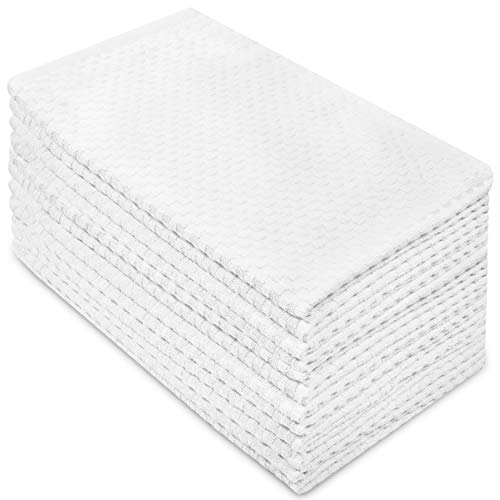
COTTON CRAFT Waffle Terry Towels (12 Pack, 16×28 Inch) — Best for Spills
When the job is volume — a knocked-over saucepan of water, a sink surround after washing up — weave beats size. This COTTON CRAFT pairs a waffle structure with terry character in a stated 16 by 28 inch towel, 100% cotton, in a Euro café style white 12-pack. The pockets of a waffle weave hold water the way a sponge’s pores do, giving these the highest working absorbency for big wet jobs on this list.
Strengths
- Waffle-terry build carries the most water per pass here — the spill specialist
- Stated 16×28-inch size is a practical hand-and-counter format
- 12-pack keeps the thirsty towels in rotation, not in the wash basket
Trade-offs
- Textured weave holds more moisture after use — hang them spread, not bunched
- White shows cleaning stains; accept it or choose the blue Zeppoli
- Waffle texture is overkill for glass — keep a flour sack towel for lint-free work
| Detail | What the listing confirms |
|---|---|
| Pack | 12 |
| Size | 16 x 28 inches (per listing title) |
| Material | 100% cotton, waffle terry |
Every towel drawer needs a heavy lifter, and this is the one to reach for when water is already on the floor’s way. The waffle-terry also scrubs a little as it wipes, which helps on hob surrounds and dried splashes where a flat towel skates. Its discipline is drying: spread it over the oven handle after use. A towel that dries fully between jobs never develops the sour smell that makes people blame the towel instead of the bunching.
Best for: spills, boil-overs and heavy wet cleaning / Not suited for: lint-free glass polishing
Check the current price on Amazon

Utopia Towels Blue Dish Towels (12 Pack, 15 x 25 in, 200 GSM) — Best Mid-Weight Workhorse
This is the specification-led pick: the title states ring-spun 100% cotton and a 200 GSM weight, which places it deliberately in the middle — enough body to feel substantial and mop properly, light enough to wash clean and dry quickly. The stated 15 by 25 inch size is the standard dish-towel footprint, and the blue colour is the practical choice for a cleaning rotation. Ring spinning aligns the cotton fibres for a smoother, stronger yarn, which shows up as less lint shedding over the towel’s life.
Strengths
- Stated 200 GSM and ring-spun cotton — a real, checkable specification
- Mid-weight balance: absorbent yet quick to wash and dry
- Blue hides working stains; 12-pack supports a true rotation
Trade-offs
- Mid-weight means it is neither the lint-free glass specialist nor the spill heavyweight
- Standard size only — no oversized option in this listing
- Ring-spun smoothness gives slightly less scrub texture than waffle builds
| Detail | What the listing confirms |
|---|---|
| Pack | 12 |
| Size | 15 x 25 inches (per listing title) |
| Material | 100% ring-spun cotton, 200 GSM (per listing title) |
If you dislike extremes — flour sack’s thinness, terry’s bulk — this is your towel. The stated GSM lets you compare it honestly against other mid-weight towels rather than guessing from photos, and in daily cleaning that middle weight is what most hands reach for: one towel that wipes counters, dries hands, catches drips and goes in the wash without ceremony. A dozen of them is a complete system for a normal household.
Best for: one-towel households wanting a balanced, spec’d workhorse / Not suited for: specialists who want glass-only or spill-only extremes
Check the current price on Amazon

LANE LINEN 100% Cotton Kitchen Towels (6 Pack) — Best Smaller Premium Pack
Not every kitchen needs bulk. Lane Linen’s six-pack of 100% cotton towels suits smaller households, couples and anyone whose laundry runs frequently enough that six in rotation is plenty. The title emphasises softness and quick drying — the profile of a towel that splits duty between cleaning wipes and drying clean dishes, in a home where the same towel may do both in one evening.
Strengths
- Six-pack suits small households and frequent washers
- Soft, quick-drying cotton handles mixed cleaning and drying duty
- Manageable quantity to keep fresh rather than hoarded
Trade-offs
- Six is a thin rotation for heavy cooking weeks — spills will outrun the wash
- Size is not stated in the listing title — check the product page if dimensions are decisive
- Softer hand-feel usually means a gentler weave than the scrub-friendly waffle
| Detail | What the listing confirms |
|---|---|
| Pack | 6 |
| Material | 100% cotton |
| Size | Not stated in listing title — verify on product page |
Choose this pack if your kitchen is small, your washing machine is busy and your cooking is measured. The quick-drying character matters in humid kitchens where a thick towel can stay damp between uses. If your household grows or your cooking does, this set becomes the “good” half of a two-tier system alongside a bulk pack from higher in this list — a combination many organised kitchens quietly run.
Best for: couples, small kitchens and frequent laundry routines / Not suited for: large families or batch cooks who need deep rotation
Check the current price on Amazon

Amazon Basics Organic Cotton Waffle Weave Dish Towels (6-Pack) — Best Waffle Weave
Amazon Basics’ entry pairs two things buyers ask for together: organic cotton and a waffle weave. The title states the towels are ultra absorbent, quick drying and lint-free at a stated 15 by 25 inches in a six-pack — waffle’s pockets do the absorbing, the open structure does the fast drying, and the weave keeps lint down better than a loose terry. For cleaning duty that includes glass and steel, that lint-free claim is the one to test first, and waffle weaves generally honour it.
Strengths
- Organic cotton for buyers who prioritise fibre sourcing
- Waffle weave: absorbent, quick drying and low lint in one structure
- Stated 15×25-inch size and six-pack quantity are clear and checkable
Trade-offs
- Six-pack rotation is modest for a spill-heavy household
- Waffle texture is a wiper, not a scrubber for baked-on spots
- House-brand basics are functional rather than finished like premium towels
| Detail | What the listing confirms |
|---|---|
| Pack | 6 |
| Size | 15 x 25 inches (per listing title) |
| Material | Organic cotton, waffle weave |
This is the thoughtful-default pick: the weave most cleaning guides recommend, in a fibre many households prefer, at a size that fits a standard drawer and a standard hand. In a two-tier system it plays the skilled role — glass, steel, counters — while a bulk flat pack takes the rough work. If you are setting up a kitchen from zero, six of these plus a bulk pack from this list is a complete, honest towel wardrobe.
Best for: eco-leaning buyers and mixed cleaning-plus-glass duty / Not suited for: households needing maximum towel count per order
Check the current price on Amazon
Comparison Table
| Pick | Badge | Key spec | Best for |
|---|---|---|---|
| Utopia Kitchen White Flour Sack Towels (12 Pack, 28 x 28 Inch) | Best Overall for Cleaning | 12-pack, 28×28 in, flour sack cotton | everyday wiping, glass, produce and a full weekly rotation |
| Zeppoli Classic Dish Towels (15 Pack, 14″ by 25″) | Best Bulk Value | 15-pack, 14×25 in, cotton, blue | busy family kitchens and anyone who wants the deepest clean-towel rotation |
| COTTON CRAFT Waffle Terry Towels (12 Pack, 16×28 Inch) | Best for Spills | 12-pack, waffle terry, 16×28 in | spills, boil-overs and heavy wet cleaning |
| Utopia Towels Blue Dish Towels (12 Pack, 15 x 25 in, 200 GSM) | Best Mid-Weight Workhorse | 12-pack, ring-spun, 200 GSM stated | one-towel households wanting a balanced, spec’d workhorse |
| LANE LINEN 100% Cotton Kitchen Towels (6 Pack) | Best Smaller Premium Pack | 6-pack, 100% cotton, quick drying | couples, small kitchens and frequent laundry routines |
| Amazon Basics Organic Cotton Waffle Weave Dish Towels (6-Pack) | Best Waffle Weave | 6-pack, organic cotton waffle, 15×25 in | eco-leaning buyers and mixed cleaning-plus-glass duty |
How to Choose the Best Kitchen Towels for Cleaning
Choose by weave first, because weave is function. Flour sack — thin, smooth, low-lint — is the glass, produce and precision wiper. Waffle weave is the absorber: its pockets hold water, dry fast and stay low-lint, making it the best all-round cleaning structure. Terry carries the most water for floods but dries slowest and can hold smells if bunched. Classic flat cotton is the bulk soldier: cheap in packs, hot-washable, expendable. A serious cleaning drawer holds at least two weaves; a one-weave drawer always has a job it does badly.
Choose by rotation second. Cleaning towels are a system: enough clean ones that you never re-use a sour towel “because the rest are in the wash.” For most households that means twelve or more working towels; small, frequent-washing homes can run six. Third, colour is a strategy, not a taste: white can be bleached back to honest, blue and darker colours hide the staining that makes a clean towel look dirty. Fourth, fibre: every pick here is 100% cotton per its title, because cotton absorbs, washes hot and does not shed microfibre into food-prep areas. Check the current price on Amazon per pack, divide by the towel count, and you have the only price comparison that matters in this category.
The Two-Tier Towel System Clean Kitchens Actually Use
Professional and serious home kitchens quietly separate towels into tiers. Tier one is the cleaning corps: bulk flat cotton or flour sack, designated for counters, spills, handles and floors-adjacent work, washed hot and often, retired without sentiment. Tier two is the finishing set: waffle or softer cotton reserved for clean dishes, glass and hands, never used on a spill, so it never carries yesterday’s grease onto today’s glassware.
The separation is the hygiene. A single towel that wipes the counter and then dries the salad bowl is a cross-contamination habit, not a towel choice. Running two tiers costs one extra pack from this list and a hook in a different spot — and it is the difference between a kitchen that looks clean and one that is clean. Whichever picks you choose, assign their tier on day one and keep the faith.
Microfibre vs Cotton for Kitchen Cleaning: An Honest Word
Microfibre deserves its paragraph because it is the obvious rival. Split microfibre genuinely out-absorbs cotton weight-for-weight and polishes steel beautifully. Its costs are quieter ones: it melts near hot pans, it holds grease smells stubbornly, it sheds microfibres in the wash, and it cannot be bleached or boiled back to honest the way cotton can. Kitchens that run microfibre well keep it for glass and steel only, and run cotton for everything food-adjacent and everything hot. The picks in this guide are all cotton because the keyword is cleaning in a working kitchen — the environment where cotton’s wash-hot, bleach-if-needed, last-for-years profile is the professional default. If you add microfibre, add it as the specialist second system, not as the replacement for the cotton rotation.
How Many Towels, Really? Sizing the Rotation to Your Kitchen
Count backwards from your wash day. A cooking household uses three to five cleaning towels a day: one on the hook for hands and counters, one working the wash-up, one sacrificed to the inevitable spill, plus the finishing towel that must stay clean. Over a three-day wash cycle that is nine to fifteen towels — which is why the 12 and 15-packs in this guide are sized the way they are, and why a six-pack is honestly labelled here as a small-household or second-tier purchase. Singles and light cooks can run eight. Holiday hosts should own twenty and feel no shame about it. The test of a right-sized rotation is simple: you never face the choice between a dirty towel and no towel. The moment that choice appears, the rotation — not your standards — is what failed.
Towel Placement: The Hook System That Keeps Clean Towels Clean
Where towels live decides what they touch. The working layout: one hook by the sink for the current cleaning towel, one by the hob for the hot-zone towel (cotton only, never a blend, near heat), one rail for the finishing towel kept physically separate from the cleaning corps, and a lidded or open bin under the sink where used towels land immediately — not draped, not “one more use” on the oven handle. The oven-handle drape is the habit that undoes every system: it keeps a damp, working towel in the kitchen’s visual centre and invites its use for hands, dishes and counters interchangeably. Hooks are cheap; separation is the entire hygiene game. Set the layout once, and the two-tier system described earlier in this guide maintains itself.
Towel Weaves Under the Microscope: Why Structure Beats Thickness
Hold three towels to the light and the category explains itself. The flour sack is nearly translucent: a plain, open weave whose fibres present maximum surface and minimum bulk, which is why it drinks a thin film of water instantly, releases it in the wash completely, and dries in minutes. The waffle’s pockets are tiny reservoirs — slower to saturate, far larger in total capacity, and structured to keep a wet towel from sealing itself flat against a counter. Terry’s loops are sponges with legs: the highest capacity and the slowest drying, the most soil trapped between washes. GSM, where a title states it — the Utopia blue’s 200 — measures the fabric’s weight per area, a useful comparison within one weave and a misleading one across weaves: a 200 GSM waffle and a 200 GSM terry behave nothing alike.
The practical translation: capacity, speed and lint are a three-way trade, and every towel chooses two. Cleaning work needs all three across a day, which is the technical reason — beneath all the household habit — that the two-weave minimum in this guide is not upselling. It is physics with a hook by the sink.
The Restaurant Towel Doctrine, Brought Home
Professional kitchens run towels like a system because inspectors and experience both demand it: colour or position coding by task, a sanitiser bucket culture for the working towel, and a ruthless retirement line. The home version keeps the wisdom and drops the theatre. Coding by colour works beautifully at home — the blue sets in this guide for cleaning, white for finishing, or any split your household will actually remember. The working towel by the sink should be changed daily at minimum, and immediately after raw meat or egg contact; that single habit does more for kitchen hygiene than any towel technology. Retirement in restaurants is by inspection: thin, grey, or torn is out. Adopt the same eye at home and your drawer stops accumulating the dead towels that make the good ones hard to find.
One professional habit is worth stealing whole: the towel over the shoulder or at the waist while cooking, always the same designated one, so hands are never dried on the counter towel or — the classic home sin — on whatever is nearest, including clothing. Systems beat intentions in kitchens.
Setting Up a Kitchen From Zero: The Complete Towel Order
For a new kitchen, the honest starter order is: one bulk cleaning pack (the Zeppoli 15 or the Utopia flour sack 12), one waffle set for spills and finishing (COTTON CRAFT or the Amazon Basics organic), and two hooks plus a under-sink bin to run the system. That is the whole wardrobe — roughly two dozen towels that cover cleaning, drying, glass and guests, in a drawer that still closes. Add the Lane Linen six-pack later if a smaller, softer set is wanted for presentation, and replace by pack as the veterans retire, keeping the two-tier separation as packs rotate in. What not to buy at setup: the decorative set with the charming print that nobody dares use on a spill — a cleaning system built on towels too nice to clean with fails in its first week. Buy the workhorses first, earn the pretty set later, and let it be the finishing tier it was designed to be.
Stains, Grease and the Towel That Comes Back From Anything
A cleaning towel’s biography is written in stains, and the mature attitude is to read them as service records. Turmeric, tomato and berry will mark cotton permanently at some level; the towel is not ruined, it is designated — permanently promoted to the dirty-work tier where its absorbency, not its appearance, is the job. Grease is the more serious enemy because it is functional: a greasy towel smears. The recovery protocol is a proper hot wash with full detergent; towels that still smear afterwards get the strip-wash, and towels that still smear after that are retired to the garage, where grease is a feature. Bleach belongs to the white cotton corps and should be used as the occasional reset it is, not a weekly habit that eats the fibres. The deeper principle: a towel system that fears stains will fail, because someone will always reach for the good towel at the spill. Designate the veterans, honour their marks, and keep the finishing set separate — the system absorbs the stains so your standards do not have to.
Drying Dishes vs Cleaning: Why One Towel Should Not Do Both
It deserves its own section because it is the habit this entire guide is quietly organised against. A towel that has wiped a counter has met everything the counter met — raw ingredient residue, sink splash, the day’s accumulation. Drying a clean glass with it reseeds the glass. The reverse journey is just as bad: the good drying towel grabbed for a spill is demoted in one second and missed for a week. Professional kitchens separate hand towels, side towels and polishing cloths for exactly this reason, and the home version costs nothing but hooks and honesty: cleaning towels live by the sink, finishing towels live by the cupboard, and never the twain. Households that adopt the separation report the same small revelation — glasses stop filming, hands stop smelling of the counter, and the phrase “grab a clean towel” starts meaning something precise. It is the cheapest hygiene upgrade in the kitchen, and every pick in this guide slots into one side of the line or the other.
The Linen and Huck Towel Traditions, for the Buyer Who Wants More
Beyond the cotton core of this guide sits an older towel aristocracy worth knowing. True linen towels — the fibre, not the word — are the glass-polishing champions of the pre-microfibre world: hard, smooth fibres that leave nothing behind and last for decades, softening from board-like to supple across years of washing. Huck towels, with their textured huckaback weave, were the bar and kitchen standard for absorbency with structure. Neither appears among this guide’s picks for a practical reason: our API verification for this batch centred on the cotton packs that dominate real cleaning rotations, and we do not recommend what we have not verified. But the buyer who has built the cotton system and wants a finishing upgrade now knows where the connoisseur’s shelf is: a small set of genuine linen glass towels, kept for glass alone, is the traditional crown of a towel drawer — and the same fibre-honesty rule applies when shopping for them as everywhere else in this guide. Read the materials line, not the romance.
The Economics of the Towel Drawer, Worked Out
Run the numbers the way a café would. A working kitchen cycling four towels a day launders roughly a hundred towel-washes a month. A bulk cotton pack spreads that load across twelve to fifteen towels, each washed eight or so times a month, each lasting — at cotton’s honest durability — well over a year of that service before thinning into retirement. The cost per towel per month of a bulk pack is, by any arithmetic, trivially small; the cost of the alternative — paper towels for the same work — is a bin filled daily and a recurring purchase that dwarfs the cloth system within a season, before the environmental comparison is even opened. The premium end of cloth changes the arithmetic only slightly: a smaller, softer pack costs more per towel and returns it in hand-feel and finishing quality, which is why the two-tier system pairs a bulk corps with a modest finishing set rather than uniform quality throughout.
The conclusion the numbers keep reaching is that towels are not where a kitchen’s money goes — they are where its habits live. Buy the rotation generously, wash it properly, retire it honestly, and the drawer becomes a solved problem for years at a time. The households still fighting their towels in year three are never fighting quality; they are fighting a too-small rotation and a softener habit, both fixed for less than a single celebratory purchase elsewhere in the kitchen.
Quick Reference: Which Towel for Which Mess
Keep the card on the fridge. Glass and mirrors: flour sack, dry, one direction, no detergent residue on the towel itself. Counter wipe-down: the current cleaning-corps towel, flat cotton, changed daily. Big spill: waffle-terry, folded in quarters so eight surfaces rotate through the job. Hob and oven surround: waffle again, while surfaces are warm, never hot, and a towel you have already designated for grease. Produce drying: flour sack, from the clean tier only. Hands during cooking: the designated hand towel at the waist or hook — never the counter towel. Stainless steel: waffle or flour sack with the grain, dry, after cleaning, for the streak-free finish. Floors-adjacent emergencies: the retired veteran, without a second’s guilt. Tape that card inside a cupboard door and the two-tier system stops being an article you read and becomes the kitchen you run — which is the only form in which towel advice has ever actually worked.
A Final Word: The Towel Drawer as a System, Not a Drawer
Everything in this guide reduces to one reframe: stop buying towels and start running a towel system. A system has tiers, so clean and dirty work never share a cloth. It has a rotation sized to the wash cycle, so “no clean towels” is a state that cannot occur. It has placement — hooks with jobs, a bin with authority — so the system maintains itself on tired evenings when willpower is not available. And it has an exit: veterans demoted on evidence, packs replaced as units, the drawer audited whenever it starts to feel full and useless at once. The six packs verified here are the system’s interchangeable parts, each excellent at its tier’s work; none of them, alone in a drawer of two, can be the system. Buy the tiers, hang the hooks, skip the softener, and the most-handled textile in your kitchen becomes the one you think about least. That disappearance — of friction, of smells, of the dirty-towel dilemma at the worst moment of cooking — is the actual product. The towels are just how it ships.
One Sentence to Buy By
If this whole guide must shrink to a sentence, it is this: buy cotton in two weaves and in real quantity — a bulk cleaning corps and a waffle or flour-sack finishing set — wash them hot without softener, hang them spread, and retire them without sentiment. The six packs above are that sentence, itemised. Everything else in a kitchen can be upgraded later; the towel system, once running, simply disappears into the background of a well-run home, which is the highest praise a working textile can earn.
The First Wash Sets the Towel’s Life
One practical ritual before any of these packs enters service: wash the whole set once, hot, before first use. New cotton carries loom finishes that resist water — the reason a brand-new towel sometimes smears a counter it should drink — and the first wash strips them, sets the weave, and reveals the towel’s true absorbency from day one. Expect a surprising amount of lint in that first cycle’s filter; that is manufacturing surplus leaving, not the towel failing. Wash colours separately that once — the blue sets especially — then merge the set into the normal rotation with its tier assigned and its hooks waiting. Ten minutes of ceremony, and every towel in this guide starts its working life at full strength instead of spending its first week underperforming and being misjudged for it.
How to Wash and Care for Kitchen Cleaning Towels
Wash hot and wash often. Cleaning towels should be washed after a day or two of duty, in hot water with a full dose of detergent — they carry grease and food soil that cool, gentle washes leave behind. Skip the fabric softener. Softener coats cotton fibres and measurably reduces absorbency; a towel that smears water instead of drinking it has usually been softened, not worn out. A vinegar rinse is the classic corrective. Dry fully. Tumble or line dry until completely dry, then fold — a towel stored damp is a sour towel by morning. Strip-wash the veterans. Every few months, a long hot wash restores towels dulled by detergent build-up. Retire on evidence: when a towel stays grey, smells after washing, or thins to transparency, demote it to garage and floor duty and promote a fresh one. Rotation plus honest retirement is the whole secret; there is no premium towel that survives being the only towel.
Common Buying Mistakes
Using one towel for everything. Counters, hands, dishes and spills through a single towel is the hygiene mistake this whole guide exists to prevent. Run tiers and a rotation. Fabric softener. It waterproofs your towels politely. Skip it and watch absorbency return. Leaving towels bunched and damp. Sour smells are a storage habit, not a towel defect — hang them spread. Buying two beautiful towels instead of twelve working ones. Cleaning is a volume job; quantity is a feature. Judging by thickness. A thin flour sack towel out-cleans a plush towel on glass every time; weave and job fit beat loft. Keeping dead towels in the rotation. A towel that no longer absorbs is clutter with a hook. Demote it.
Final Recommendation
Build the system, not the single purchase: the Utopia flour sack 12-pack as your lint-free cleaning core, the COTTON CRAFT waffle-terry for spills, and the Zeppoli 15-pack if your kitchen burns through towels. The Utopia blue ring-spun set is the balanced one-pack answer, Lane Linen suits smaller households, and the Amazon Basics organic waffle is the eco-leaning finishing set. Check the current price on Amazon and think per-towel. Related reading: Best Kitchen Towels Absorbent, Best Kitchen Towels For Glassware, Best Quality Kitchen Dish Towels and Best Towels For General Cleaning.
Quick links to the top three picks: Utopia Kitchen White Flour Sack Towels (12 Pack, 28 x 28 Inch) · Zeppoli Classic Dish Towels (15 Pack, 14″ by 25″) · COTTON CRAFT Waffle Terry Towels (12 Pack, 16×28 Inch)
Related guides
Frequently Asked Questions
What weave of kitchen towel is best for cleaning?
Waffle weave is the best all-rounder for cleaning — absorbent, quick drying and low lint. Flour sack is better for glass and produce, terry for major spills, and flat cotton for bulk rotation. Most kitchens need two weaves.
How many kitchen towels should I own?
Enough to rotate daily and still have clean ones while a load washes — twelve or more working towels for most households. Small homes that wash frequently can manage with six to eight.
Why do my kitchen towels smell even after washing?
Usually detergent build-up, fabric softener coating, or being stored damp. Wash hot without softener, dry fully, and hang towels spread between uses. A strip wash rescues most veterans.
Does fabric softener really hurt towels?
Yes — it coats the fibres and reduces absorbency. If your towels smear water, wash them hot with a vinegar rinse and skip softener from then on.
Are white or coloured towels better for cleaning?
White can be bleached back to a visibly clean state, which suits a cleaning corps. Blue and darker towels hide staining and look presentable longer. Many kitchens run white for cleaning and colour for finishing.
When should a kitchen towel be retired?
When it stays grey or smelly after a hot wash, or has thinned so it no longer absorbs. Demote it to floor and garage duty rather than throwing it straight out.


