Disclosure: airfryerkitchensupply.com is reader-supported. When you buy through links on our site, we may earn an affiliate commission at no extra cost to you.
Where to buy
Every linked product below was verified against Amazon’s own product data connection before it earned a link, and the six split deliberately into the two families general cleaning actually uses: cotton for absorption and hot washing, microfiber for lifting dirt and polishing shine. The verified picks in this guide are the Utopia Towels Kitchen Bar Mops, Pack of 12, 16×19 in, 100% Cotton, Brown (best overall), the Groko Textiles Cleaning Towels, 100% Cotton Bar Mops, Blue Stripe, 24 Pack, 16″ x 19″ (best bulk buy), the Homaxy 100% Cotton Kitchen Dish Cloths, 12 Pack, 12″x12″, White (best dish cloths), the Living Fashions Cotton Dish Cloths, 12″x12″, 12 Pack, White (best classic dish rags), the CODOHI Extra Large Microfiber Cleaning Cloths, 6 Pcs, 20″ x 30″ (best large microfiber), and the Fish Scale Microfiber Cleaning Cloths, 8 Pack, 15.7″x11.8″ (best for glass and shine). Check the current price on Amazon from these links — we print no fixed prices and no ratings, because both change too often to publish honestly.
The best towels for general cleaning come in two families — you need both
The best towels for general cleaning are not one towel. They are a small system of two families that solve opposite problems, and the households that clean fastest are the ones that stopped asking a single cloth to do both jobs. Cotton — terry bar mops and woven dish cloths — is the absorber: it takes a litre of spilled milk into itself, survives boiling-hot laundry, and asks nothing. Microfiber is the lifter and finisher: its split fibres grab dust, grease film and grit that cotton pushes around, and its fine weaves polish glass and steel without lint. Every pick in this guide belongs to one family or the other, and the reviews are honest about each family’s failure mode in the other’s territory.
Start with the workload, because ‘general cleaning’ hides a range. At one end: bulk liquid events — spills, mopping up, drying a washed floor’s edges, the dog at the door. Cotton bar mops win these by mass. In the middle: the daily sink economy of dishes, counters and hands, where a small cotton dish cloth, rotated fresh daily and washed hot, is a hygiene system as much as a towel. At the other end: the shine jobs — mirrors, shower glass, stainless fronts, screens — where cotton actively makes things worse with lint and a fish-scale microfiber finishes in one pass. The six picks map onto that range: two bar mop packs, two dish cloth dozens, one extra-large floor microfiber, one polishing microfiber.
Counts matter more than thread counts in this category. A cleaning towel is a rotation product: its performance depends on having a clean one available at the moment of the spill, which means packs, not pairs. The verified packs here run from 6 to 24 pieces, and the guide treats pack size as a first-class specification — a 24-pack is a different cleaning system from a 6-pack, not just a bigger number. Likewise size: 12×12 inches is a hand-and-dish format, 16×19 is a working pad format, 20×30 is a floor format, and buying the wrong format for the job is the category’s most common quiet disappointment.
Verification discipline, as throughout this programme: every count, size and material in the spec boxes comes from the listed title or brand field, and two listings carry flags — one title is truncated in the cache record (only its visible facts are used), and one title is unbranded (its maker is named from the listing brand field, and the review says so). No absorbency figures are invented, because the category has no standard test a listing can be held to; the reviews judge by format, material and mass, which are the honest predictors.
Cotton versus microfiber, settled properly
Cotton’s fibres absorb water into the fibre itself, which is why a cotton towel keeps taking up liquid after a synthetic feels saturated, and why cotton tolerates — rewards — hot washing that resets it hygienically. Its costs are lint, slower drying, and a tendency to push fine dust rather than capture it. Microfiber’s split fibres work mechanically: they scrape, lift and hold particles and grease films, and they release them in the wash. Its costs are care rules (no fabric softener, no high heat, wash apart from cotton) and poor bulk absorption compared with terry cotton of the same size.
The settled answer is a division of labour, and it is how professional cleaners already work: cotton where liquid volume and hygiene dominate, microfiber where dirt-lifting and finish dominate, and colour or stripe coding so the floor cloth never migrates to the dishes. The picks below are chosen to assemble exactly that division in one purchase round, at household scale and household prices — check the current price on Amazon per pack, and judge cost per towel, not per pack, when you compare.
In this guide
Quick Picks
| Pick | Badge | Key spec | Best for |
|---|---|---|---|
| Utopia Towels Kitchen Bar Mops, Pack of 12, 16×19 in, 100% Cotton, Brown | Best Overall | 12-pack cotton bar mop towels, 16×19 in | General kitchen and household cleaning — spills, surfaces, dishes, floors’ worst moments |
| Groko Textiles Cleaning Towels, 100% Cotton Bar Mops, Blue Stripe, 24 Pack, 16″ x 19″ | Best Bulk Buy | 24-pack cotton bar mops, 16×19 in, blue stripe | Big households, heavy spill loads, and anyone who wants a month between laundry loads of towels |
| Homaxy 100% Cotton Kitchen Dish Cloths, 12 Pack, 12″x12″, White | Best Dish Cloths | 12-pack cotton dish cloths, 12×12 in | Dish washing, counter wiping and hand-towel duty at the sink |
| Living Fashions Cotton Dish Cloths, 12″x12″, 12 Pack, White | Best Classic Dish Rags | 12-pack cotton dish cloths, 12×12 in | Traditionalists who want the plain white cotton dish rag format, in a dozen |
| CODOHI Extra Large Microfiber Cleaning Cloths, 6 Pcs, 20″ x 30″ | Best Large Microfiber | 6-pack XL microfiber cloths, 20×30 in | Floors, large surfaces, bathroom and office cleaning at scale |
| Fish Scale Microfiber Cleaning Cloths, 8 Pack, 15.7″x11.8″ | Best for Glass and Shine | 8-pack fish-scale weave microfiber cloths | Glass, mirrors, stainless steel, screens and shower doors — the streak-free jobs |
Two of the six picks are close cousins — two plain cotton dish-cloth dozens from different makers — and the guide keeps both, transparently, because at this level the format is the product and the better buy is whichever is better priced on the day. The bar mops likewise pair a 12-pack with a 24-pack: same format, different household scale.
How These Picks Were Chosen
Verification came first: every pack was confirmed connection, with counts, sizes and materials taken from the Amazon title (and, in one flagged case, the brand from the listing brand field). Products that were not complete general-cleaning towels — mop slippers, bath towels, beach towels and single novelty cloths that surface in cleaning searches — were excluded.
Selection covered the workload map deliberately: heavy absorption (two bar mop formats), daily sink rotation (two dish cloth dozens), floors at scale (XL microfiber) and finishing (fish-scale microfiber). Within cotton, both a standard 12-pack and a bulk 24-pack are represented, because pack size changes the cleaning system a household can run.
No prices, ratings or absorbency numbers are printed. Absorbency claims in this category are unstandardised marketing; this guide compares verified format, material and mass instead, and leaves current prices to the product pages.
The 6 Best Towels for General Cleaning, Verified Pick by Pick

Utopia Towels Kitchen Bar Mops, Pack of 12, 16×19 in, 100% Cotton, Brown — Best Overall
The bar mop is where general cleaning starts: a 16-by-19-inch cotton terry towel, sold by the dozen, that restaurants and bars use for everything because it does everything adequately and some things — bulk absorption, hot washing, surviving abuse — better than any specialist. This Utopia Towels pack, verified with its brand confirmed in the listing data, is the straightforward version: 100% cotton, machine washable, in a brown that forgives a working life.
Strengths
- The bar mop is the professional cleaner’s towel format: big enough to fold into a working pad, thick enough to absorb a real spill in one pass, cheap enough per towel to use without ceremony
- 100% cotton terry absorbs the way general cleaning actually needs — water, grease films, and the mixed mess of a kitchen counter — and survives hot washing that resets it properly
- Brown is the honest colour for a working towel: it hides the cumulative staining that makes white cleaning cloths look retired long before they are worn out
Trade-offs
- Cotton terry leaves lint on glass and polished surfaces, which is why this guide pairs it with a microfiber pick rather than pretending one towel does everything
- A bar mop is bulkier than a dish cloth for small, precise jobs — wiping a single glass or a phone screen wants a smaller cloth
- Cotton absorbs superbly but dries slower than microfiber, so a damp bar mop left in a heap will smell; hang them to dry between uses
| Count and size | 12 pack, 16 x 19 inches, as stated in the Amazon title |
|---|---|
| Material | 100% cotton, as stated in the Amazon title |
| Colour | Brown, as stated in the Amazon title |
| Care | Machine washable, as stated in the Amazon title |
Judge a general cleaning towel by the worst five minutes of its week, not the average wipe. A knocked-over saucepan of pasta water, a litre of milk across a counter, a muddy dog at the door: these are absorption events, and they are won by towel mass and cotton terry. A bar mop folded in quarters is a thick, thirsty pad that takes a spill in passes instead of pushing it around, and when it is saturated you drop it in the laundry and take the next from the pile — the dozen-pack format is a system, not a quantity discount.
Its limits are the cotton limits, stated plainly: lint on glass, slower drying than microfiber, and a size that is overkill for delicate work. This guide’s answer is a two-towel household — bar mops for the heavy general work, microfiber for the shiny finishes — and this pick is the heavy half of that system, and the best overall towel for general cleaning in the guide.
Best for: General kitchen and household cleaning — spills, surfaces, dishes, floors’ worst moments / Not suited for: Glass and mirrors, where a streak-free microfiber (the last pick) is the better tool
Check on Amazon — check price on Amazon from the product page; we print no fixed prices here.
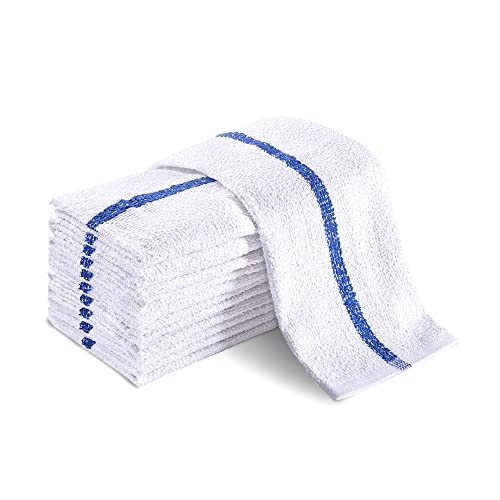
Groko Textiles Cleaning Towels, 100% Cotton Bar Mops, Blue Stripe, 24 Pack, 16″ x 19″ — Best Bulk Buy
If the Utopia pack is the system, the Groko 24-pack is the system at household scale: two dozen 16-by-19 cotton bar mops with a blue stripe, enough to run a colour-coded, laundry-weekly cleaning routine without ever reusing a sour towel. For a big family, a house with dogs, or a home that hosts often, the arithmetic is the review — towels are consumables, and buying the consumable in bulk is how professionals keep the cost per clean trivial.
Strengths
- Twenty-four towels changes the cleaning system: a fresh towel every day or two, a full laundry load of nothing but towels, and no mid-week washing of the same three cloths
- The blue stripe is a working feature, not decoration — it lets a household code towels by job (stripe for floors and heavy work, plain for dishes) at a glance
- Same 16×19 bar mop format as the Best Overall pick, so the two are interchangeable in use; the choice between them is pack size and striping, not performance class
Trade-offs
- A 24-pack is a storage commitment: folded, it is a shelf, not a drawer
- Commercial-grade is the maker’s description in a title whose cached text is truncated; this guide credits the verified facts — cotton, terry weave, count and size — and treats grade language as marketing
- Like all cotton bar mops, it lints on glass and dries slower than microfiber; bulk does not change the material’s nature
| Count and size | 24 pack, 16 x 19 inches, as stated in the Amazon title |
|---|---|
| Material | 100% cotton terry weave, as stated in the Amazon title |
| Design | Blue stripe, as stated in the Amazon title |
| Grade | Described as commercial grade in the Amazon title (title text is truncated in the cache record — see sources) |
The stripe deserves its paragraph. Professional cleaners code cloths by colour to stop cross-contamination — the floor towel never becomes the dish towel. A striped bar mop gives a household the same discipline for free: stripes down (floors, spills, the dog), plains up (dishes, counters, hands). It sounds fussy until the day it prevents the alternative, after which it is simply how the house runs.
One verification note, in the open: this listing’s Amazon title is truncated in the cache record, ending mid-word, so this guide prints only the facts visible before the truncation — cotton, terry weave, 24 pack, 16 by 19 inches, blue stripe — and asserts nothing from the cut-off remainder. What is verified is enough: this is the bulk bar mop pick, and bulk is its whole argument.
Best for: Big households, heavy spill loads, and anyone who wants a month between laundry loads of towels / Not suited for: Small households that will never rotate 24 towels and lack the storage for the pile
Check on Amazon — check price on Amazon from the product page; we print no fixed prices here.

Homaxy 100% Cotton Kitchen Dish Cloths, 12 Pack, 12″x12″, White — Best Dish Cloths
Every kitchen runs two towel systems whether it admits it or not: the heavy towels and the sink towels. The Homaxy cloths are the sink half done properly — a dozen 12-by-12-inch cotton dish cloths, brand confirmed in the listing data, sized for dishes, counters and hands, and numerous enough that ‘use a fresh one’ is a system rather than a virtue.
Strengths
- The 12×12 dish cloth is the precision format: small enough to get inside glasses and around taps, light enough to wring fully with one hand, quick to dry on a hook between uses
- A dozen in rotation means a genuinely fresh cloth daily — the single most effective hygiene upgrade in a kitchen, since a dish cloth is only as clean as its last day
- The Amazon title describes them as quick drying for a cotton cloth, and the small format is why: less mass, more air, no day-old dampness if hung properly
Trade-offs
- Twelve inches square will not win a flood: a litre of milk wants a bar mop, and using dish cloths for floods just saturates the whole rotation
- White shows every stain a kitchen can produce; these will look seasoned within weeks, however well they wash
- Cotton dish cloths lint lightly on glassware compared with microfiber — perfectionist glass finishing belongs to the last pick
| Count and size | 12 pack, 12 x 12 inches, as stated in the Amazon title |
|---|---|
| Material | 100% cotton, as stated in the Amazon title |
| Brand | Homaxy, confirmed in the listing brand field |
| Use | Dish washing and cleaning rags, as stated in the Amazon title |
The hygiene point is the review. A dish cloth lives warm and damp, in contact with food residue, and it is the most bacteria-friendly textile in the house. The defence is not a miracle material; it is rotation and washing — a fresh cloth each day, the used ones washed hot and dried fully. A 12-pack is the smallest purchase that makes daily rotation effortless, and that, more than absorbency figures, is what a dish cloth purchase should be judged on.
In use, the small format is its own pleasure: it wrings drier than a big towel, gets into the bottom of a glass, wipes a counter without dragging a wet tail across it, and dries on its hook before the next meal. Pair it with the bar mops for the heavy work and the kitchen’s towel system is complete at both ends.
Best for: Dish washing, counter wiping and hand-towel duty at the sink / Not suited for: Floor spills and big absorption events, where the bar mops’ mass wins
Check on Amazon — check price on Amazon from the product page; we print no fixed prices here.
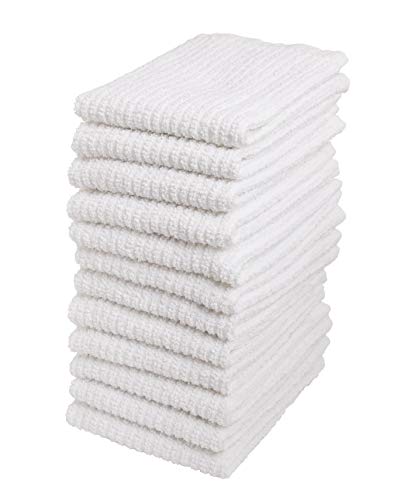
Living Fashions Cotton Dish Cloths, 12″x12″, 12 Pack, White — Best Classic Dish Rags
This is the classic: twelve white cotton dish cloths, 12 by 12 inches, of the pattern that has hung by sinks for generations. The listing’s title is unbranded — the maker, Living Fashions, is recorded in the listing brand field, and this guide names it from there, transparently. What you are buying is not a brand story; it is the standard cloth, in a standard dozen, for the standard jobs.
Strengths
- The plain white cotton dish rag is the format against which all others are variations — nothing to learn, nothing to adjust to, just the cloth every kitchen already knows how to use
- White has one real virtue beyond tradition: it can be washed as hot and as hard as cotton allows, and bleached when the season demands, without a colour to protect
- The Amazon title also names bar use, and a 12×12 cotton cloth is as at home wiping a bar top or a café table as a sink
Trade-offs
- This listing’s title is unbranded; the Living Fashions name comes from the listing brand field, and this guide labels it that way rather than pretending the title says it
- White stains visibly and permanently over a working life — purely cosmetic, but the reason the bar mop pick above is brown
- Functionally close to the Homaxy pick: two plain cotton dish-cloth dozens in one guide is a genuine buyer’s choice of maker, not a difference in kind, and the guide says so
| Count and size | 12 pack, 12 x 12 inches, as stated in the Amazon title |
|---|---|
| Material | 100% cotton, as stated in the Amazon title |
| Brand | Living Fashions, from the listing brand field (the title itself is unbranded) |
| Stated uses | Washing dishes, kitchen and bar use, as stated in the Amazon title |
Why include two cotton dish-cloth packs in one guide? Because at this level of the market the honest answer is that the format is the product, and buyers choose between near-identical dozens on availability and the day’s price — check the current price on Amazon for both this and the Homaxy pack and take the better value with a clear conscience. The reviews differ because the listings do: this one leans on white’s washability, the other on its maker’s quick-drying description, and both emphases are recorded from their own data.
White’s case is worth stating once more, because it is the opposite of the bar mop’s: a white cloth shows its dirt, which in a dish cloth is information. You can see when it needs the hot wash. A household that values that visibility — and the option of a bleach cycle — is well served by the oldest format in the guide.
Best for: Traditionalists who want the plain white cotton dish rag format, in a dozen / Not suited for: Anyone who wants colour-coding or a coloured towel that hides staining
Check on Amazon — check price on Amazon from the product page; we print no fixed prices here.

CODOHI Extra Large Microfiber Cleaning Cloths, 6 Pcs, 20″ x 30″ — Best Large Microfiber
Scale changes a cloth’s job. At 20 by 30 inches, the CODOHI microfiber is not a bigger dish cloth; it is a floor and large-surface tool — the cloth that goes under a mop head, over a broom, or across a bathroom’s worth of tile in one session. Six of them, washable, verified with their housekeeping uses stated in the Amazon title, make this the pick for anyone whose ‘general cleaning’ means whole rooms rather than single spills.
Strengths
- Twenty by thirty inches is floor-cloth territory: folded under a flat mop, draped over a broom head, or used by hand, it covers ground at three times a standard cloth’s rate
- Microfiber’s split fibres lift and hold dust and grit instead of pushing them, which is why one pass with a big microfiber leaves a hard floor feeling finished rather than redistributed
- Six washable cloths make a rotation: two in use, two in the wash, two ready — the minimum viable system for whole-house floor cloth duty
Trade-offs
- Oversized cloths are clumsy at sinks and shelves; this is a floors-and-big-surfaces tool and should not be bought as a general cloth
- Microfiber must be washed without fabric softener, which coats the fibres and kills the grip that makes it microfiber — a care rule, not a suggestion
- The Amazon title gives colours (orange, green) that vary by listing; treat colour as incidental and verify on the product page if it matters
| Count and size | 6 cloths, 20 x 30 inches, as stated in the Amazon title |
|---|---|
| Material | Microfiber, as stated in the Amazon title |
| Care | Washable and reusable, as stated in the Amazon title |
| Stated uses | Floor cloth, mop cleaning, office and bathroom housekeeping, as stated in the Amazon title |
Microfiber earns its place on floors for a physical reason: the fibres are split into microscopic hooks that lift particles and hold them in the cloth, where cotton tends to roll dust ahead of it. On a hard floor that has been swept, a damp XL microfiber pass is the difference between a floor that looks clean and a floor that feels clean under bare feet — the grit test does not lie. The size multiplies the effect: fewer rinses, fewer passes, and a cloth that can be refolded to a clean face a dozen times before it is spent.
Respect the one care law of microfiber: no fabric softener, ever, and wash microfiber separately from cotton, whose lint it will harvest. Obeyed, these cloths keep their grip for hundreds of washes; ignored, they become expensive ordinary rags within a month.
Best for: Floors, large surfaces, bathroom and office cleaning at scale / Not suited for: Small precision jobs — a 20×30 cloth is a mop’s partner, not a glass cloth
Check on Amazon — check price on Amazon from the product page; we print no fixed prices here.

Fish Scale Microfiber Cleaning Cloths, 8 Pack, 15.7″x11.8″ — Best for Glass and Shine
Every guide in this category needs its finisher, and the fish-scale microfiber cloth is the finisher’s format: a woven microfiber whose scale-like texture polishes glass, mirrors, stainless steel and screens without lint or streaks, per its verified title. Eight cloths at about 16 by 12 inches complete the two-system household this guide has been building — cotton for mass, microfiber for shine.
Strengths
- The fish-scale weave is a polishing structure: it wipes glass and steel to a finish without the lint cotton leaves or the streaks a standard cloth drags behind it
- At roughly 16 by 12 inches it is the right hand size for mirrors, shower screens and appliance fronts — big enough to fold into a pad, small enough to control at edges
- An 8-pack lets a household station them where they are used — bathroom, kitchen steel, hallway mirror — instead of hunting the one good glass cloth
Trade-offs
- Fish-scale cloths are finishers, not absorbers: they will smear a big spill rather than soak it, so the cotton picks do the first pass and these do the last
- Like all microfiber, fabric softener ruins the effect, and they should be washed apart from cotton lint-shedders
- The shine jobs are a minority of general cleaning by volume; buy this pack as the second system, not the only one
| Count and size | 8 pack, 15.7 x 11.8 inches, as stated in the Amazon title |
|---|---|
| Weave | Fish scale microfiber, as stated in the Amazon title |
| Stated performance | Streak free and lint free, as stated in the Amazon title |
| Stated uses | Glass, car, dish, mirror, screen, stainless steel, shower, as stated in the Amazon title |
The technique matters as much as the cloth, and it is simple: one cloth barely damp for the wipe, a second dry for the buff. Most streaks are detergent residue or a too-wet cloth, not dirt, and the dry buff is what converts a clean mirror into a polished one. On stainless steel, wipe with the grain. On shower glass, a fish-scale cloth after the last shower of the day, ten seconds, prevents the limescale film that otherwise becomes a weekend project — prevention with the right cloth beats restoration with any chemical.
Station the pack where the shine jobs live and it will be used; keep it in a distant cupboard and the bar mop will be dragged across the mirror instead, leaving the lint that this cloth exists to prevent. Small logistics, like small cloths, decide real households’ results.
Best for: Glass, mirrors, stainless steel, screens and shower doors — the streak-free jobs / Not suited for: Heavy grease and bulk spills, where cotton’s absorption is the tool
Check on Amazon — check price on Amazon from the product page; we print no fixed prices here.
Comparison Table
| Pick | Badge | Key spec | Best for |
|---|---|---|---|
| Utopia Towels Kitchen Bar Mops, Pack of 12, 16×19 in, 100% Cotton, Brown | Best Overall | 12-pack cotton bar mop towels, 16×19 in | General kitchen and household cleaning — spills, surfaces, dishes, floors’ worst moments |
| Groko Textiles Cleaning Towels, 100% Cotton Bar Mops, Blue Stripe, 24 Pack, 16″ x 19″ | Best Bulk Buy | 24-pack cotton bar mops, 16×19 in, blue stripe | Big households, heavy spill loads, and anyone who wants a month between laundry loads of towels |
| Homaxy 100% Cotton Kitchen Dish Cloths, 12 Pack, 12″x12″, White | Best Dish Cloths | 12-pack cotton dish cloths, 12×12 in | Dish washing, counter wiping and hand-towel duty at the sink |
| Living Fashions Cotton Dish Cloths, 12″x12″, 12 Pack, White | Best Classic Dish Rags | 12-pack cotton dish cloths, 12×12 in | Traditionalists who want the plain white cotton dish rag format, in a dozen |
| CODOHI Extra Large Microfiber Cleaning Cloths, 6 Pcs, 20″ x 30″ | Best Large Microfiber | 6-pack XL microfiber cloths, 20×30 in | Floors, large surfaces, bathroom and office cleaning at scale |
| Fish Scale Microfiber Cleaning Cloths, 8 Pack, 15.7″x11.8″ | Best for Glass and Shine | 8-pack fish-scale weave microfiber cloths | Glass, mirrors, stainless steel, screens and shower doors — the streak-free jobs |
A note on cost per towel, since pack prices mislead: divide the pack price (check the current price on Amazon) by the count, then judge that figure against the format’s job. A bar mop that costs very little per towel can be retired to the garage without regret when it thins; a fine glass cloth costs more per piece and should be protected from the rough jobs that would ruin its weave. The system view — cost per towel, per job, per year of rotation — is the only arithmetic in this category that stays honest, and it almost always favours buying the professional formats in packs over buying boutique singles.
Read the table as a map of the house: bar mops own the spills, dish cloths own the sink, the XL microfiber owns the floors, and the fish-scale cloths own everything that shines. A household that buys across the table cleans faster than one that buys six of any single row.
How to Choose Towels for General Cleaning
Build the system, not the towel. A functional household set is: a bar mop pack for bulk liquid, a dish cloth dozen for daily sink rotation, a set of large microfiber for floors and big surfaces, and a set of fine microfiber for glass and steel. Bought together they cover every job in this guide; bought singly, each leaves a job to the wrong tool, which is how mirrors get licked with lint and floods get dabbed with a cloth the size of a coaster.
Size by job, not by habit. Hands and dishes: 12 inches square. Counters and spills: 16×19, folded in quarters into a pad. Floors and bathrooms: 20×30 or a cloth that fits your mop head. Glass: a hand-size fine weave you can fold twice and control at the edges. If a towel’s size does not match its job, it will be used anyway and judged unfairly — most ‘bad towels’ are good towels in the wrong format.
Count by laundry rhythm. Daily-rotation items (dish cloths) need at least seven, ideally twelve. Heavy towels (bar mops) need enough to survive the worst day plus the wash cycle — twelve for most homes, twenty-four for big or messy ones. Microfiber rotations run smaller because they wash and dry fast: six large, eight fine is a workable household set. When in doubt, buy the larger pack of the cheaper format; towels are the rare purchase where surplus is genuinely useful.
Finally, set the care rules before the first wash, because they differ by family and the first wash is when they are broken. Cotton: hot wash allowed, tumble dry, no mercy needed. Microfiber: warm wash, no fabric softener, no iron, low or air dry, and never in the same load as cotton if you want it lint-free. Write the rule on the laundry shelf if you must; a microfiber killed by softener in week one is the category’s most preventable waste.
Colour Coding: The Professional Habit Worth Stealing
Cleaners code cloths by colour or pattern so that a cloth’s history is visible at a glance: one colour for the kitchen, one for bathrooms, one for floors, one for glass. The household version needs no special purchase — the striped bar mops in this guide can be the floor-and-heavy set, the plain cottons the kitchen set, the coloured microfibers the bathroom set, and the fish-scale cloths, which look distinct from everything, the glass set. The rule that matters is the one-way rule: a cloth can be demoted (a kitchen cloth becomes a floor cloth) but never promoted.
Coding pays for itself the first time a guest helps with the washing up, a teenager cleans a bathroom, or a partner grabs ‘a towel’ for a spill — the system survives other people’s good intentions, which un-coded systems do not. Mark the code where the towels live, not in a document: a labelled shelf edge beats a household meeting every time.
How to Wash and Store Cleaning Towels So They Keep Working
Separate the families at the laundry door, permanently. Cotton towels wash together, hot if the load is kitchen-heavy, with a full dry afterwards — a cotton towel stored even slightly damp will sour, and a soured towel re-deposits its smell on every surface it wipes. Microfiber washes separately, warm, with no fabric softener and no dryer sheets, and dries on low heat or air; softener coats the split fibres and quietly converts premium microfiber into ordinary cloth.
Strip-wash cotton monthly if it starts to smell clean-but-sour: a hot wash with a cup of white vinegar in the rinse, or a soda soak before washing, removes the detergent-and-grease build-up that causes the odour. Microfiber that has lost its grip usually needs the same treatment — most ‘worn out’ microfiber is actually coated microfiber, and a strip wash restores more of it than any replacement purchase.
Dry fully, fold by family, store where the jobs are: dish cloths at the sink, bar mops under it, floor cloths with the mop, glass cloths in the bathroom and by the mirror. A towel stored at its point of use gets used for its proper job; a towel stored in a central linen pile becomes whatever the nearest hand needed, and the coding system dies. Retire towels downward — kitchen to general, general to garage — and out of the house only when they are thin, holed or permanently sour.
Common Buying Mistakes
Using one towel type for everything
Cotton on glass leaves lint; microfiber on a flood just spreads it. The two-family system is not upselling — it is the difference between tools matched to physics and a drawer of compromises.
Washing microfiber with fabric softener
The single most destructive habit in this category. Softener coats split fibres and removes exactly the grip you paid for. Warm wash, no softener, separate from cotton — that is the whole law.
Running too few towels
A three-cloth household reuses sour cloths and washes constantly. Rotation is the hygiene system: enough towels that a fresh one is always available is cheaper, in effort and in laundry, than too few.
Leaving damp towels in a heap
Cotton especially will mildew in a damp pile within a day, and the smell survives into the next use. Hang every used towel to dry before it joins the laundry — a hook per family, by the sink.
Promoting a demoted cloth
Once a cloth has done floors or bathrooms, it never returns to dishes or glass, however well it washes. Code by colour or stripe and enforce the one-way rule; it is the cheapest hygiene policy in the house.
Final Recommendation
Build the system in one round: the Utopia bar mops (Best Overall) for the heavy work, the Homaxy or Living Fashions dozen for the sink — choose between those two on the day’s price, as the guide says openly — the CODOHI XL microfiber for floors, and the fish-scale cloths for everything that shines. Add the Groko 24-pack instead of the Utopia dozen if your household’s spill rate is high or your laundry rhythm is weekly.
Then set the two habits that make towels perform: rotation (a fresh dish cloth daily, coded families, one-way demotion) and family-correct washing (cotton hot and fully dried; microfiber warm, softener-free, separate). The towels in this guide are verified, ordinary, professional-format tools — with those two habits, they will clean like it.
Companion guides in this programme for the rooms these towels serve:
Shortlist again, with links for the verified picks: Utopia Towels Kitchen Bar Mops, Pack of 12, 16×19 in, 100% Cotton, Brown, Groko Textiles Cleaning Towels, 100% Cotton Bar Mops, Blue Stripe, 24 Pack, 16″ x 19″, Homaxy 100% Cotton Kitchen Dish Cloths, 12 Pack, 12″x12″, White, Living Fashions Cotton Dish Cloths, 12″x12″, 12 Pack, White, CODOHI Extra Large Microfiber Cleaning Cloths, 6 Pcs, 20″ x 30″, Fish Scale Microfiber Cleaning Cloths, 8 Pack, 15.7″x11.8″.
Best 800 Gram Towels Best Bargain Towels Best Bang For Buck Dish Towels Best Bar Towels For Drying Glassware
Frequently Asked Questions
What is the best all-purpose cleaning towel?
A cotton bar mop, 16×19 inches, is the closest thing to all-purpose: it absorbs bulk liquid, survives hot washing and handles most surfaces. It still should not do glass — pair it with a fine microfiber for the shine jobs.
How many cleaning towels does a household need?
Enough to rotate: about a dozen dish cloths, a dozen bar mops (two dozen for big households), six large microfiber and a set of fine microfiber for glass. Rotation, not any single towel, is what keeps cleaning hygienic.
Can microfiber replace cotton towels entirely?
For dirt-lifting and finishing, microfiber is superior; for bulk liquid absorption and hot-wash hygiene, cotton wins. Most households clean best with both, coded by job.
Why do my cleaning towels smell even after washing?
Usually build-up: detergent, grease and softener residue in the fibres, or towels stored before fully dry. A hot strip wash with vinegar, followed by complete drying, fixes most cases; hang used towels to dry before laundering.
What size towel is best for mopping floors by hand?
A large cloth around 20×30 inches, like the XL microfiber pick, folds into a pad that covers ground quickly and can be refolded to clean faces as you work. Small cloths turn a floor into an afternoon.
Should cleaning cloths be colour coded?
It is the professional habit most worth copying: one colour or pattern per zone, with a one-way demotion rule, stops a floor cloth ever reaching the dishes. Stripes, colours or weave differences all work as codes.


