Disclosure: airfryerkitchensupply.com is reader-supported. When you buy through links on our site, we may earn an affiliate commission at no extra cost to you.
Where to buy
Every towel set linked below was matched verification, so each link lands on the exact pack, size, and weave described. Kitchen towels are consumables in slow motion — they thin, stain, and lose absorbency over a year or two of hard use — so check the current price on Amazon per pack and think in cost per towel, not cost per order.
- Zeppoli Classic Dish Towels, 15 Pack — Check the current price on Amazon
- Utopia Kitchen White Flour Sack Towels, 12 Pack — Check the current price on Amazon
- Amazon Basics Organic Cotton Waffle Weave Kitchen Dish Towels, 6-Pack — Check the current price on Amazon
- COTTON CRAFT Waffle Terry Kitchen Towels, 12 Pack — Check the current price on Amazon
- All-Clad Dual-Purpose Kitchen Towels — Check the current price on Amazon
- LANE LINEN 100% Cotton Kitchen Towels, 6 Pack — Check the current price on Amazon
The best kitchen towels absorbent enough for real cooking share an embarrassing secret: absorbency is mostly decided before the towel ever touches water. Weave, fiber, and finishing determine whether a towel drinks a spill or pushes it around the counter, and the decorative towels that look best in product photos — smooth, printed, tightly finished — are frequently the worst performers at the sink. Shoppers searching for the best kitchen towels absorbent enough to replace paper towels are really asking three separate questions: which towel dries a full load of dishes without going limp, which one soaks up a stovetop spill in one pass, and which one polishes glassware without leaving lint behind. No single towel wins all three jobs, which is why this roundup is organized by weave and task rather than by brand.
All six picks are 100% cotton in their verified listings — a deliberate filter. Cotton remains the most absorbent everyday fiber for kitchen work; microfiber absorbs well too but behaves differently (it grabs, it can melt near heat, and many cooks dislike its hand feel), so this roundup stays with cotton and separates the winners by construction: flat flour-sack weave for glass and baking, waffle weave for speed, terry loops for volume, and dual-purpose weaves for households that want one towel to do everything adequately. Every product below was verified — brand, model, pack size, and the manufacturer’s own claims — before it earned a link.
In this guide
Quick Picks
- Best Overall: Zeppoli Classic Dish Towels, 15 Pack — 100% cotton, a generous 14″ by 25″ format, and a bulk count that lets you rotate fresh towels daily without laundry anxiety. Check the current price on Amazon
- Best for Glassware and Baking: Utopia Kitchen Flour Sack Towels, 12 Pack — a flat 28″ by 28″ flour-sack weave that dries glass lint-free and doubles as the baker’s proofing and straining cloth. Check the current price on Amazon
- Best Waffle Weave: Amazon Basics Organic Cotton Waffle Weave Towels, 6-Pack — the listing claims ultra absorbent, quick drying, and lint-free, in a 15″ by 25″ organic cotton waffle. Check the current price on Amazon
- Best Terry: COTTON CRAFT Waffle Terry Towels, 12 Pack — a 16″ by 28″ waffle-terry hybrid that combines loop pile thirst with waffle structure. Check the current price on Amazon
- Best Premium: All-Clad Dual-Purpose Kitchen Towels — 17″ by 30″ of 100% cotton from a cookware-grade brand, positioned as highly absorbent and long-lasting. Check the current price on Amazon
- Best Everyday Set: LANE LINEN Kitchen Towels, 6 Pack — soft, quick-drying 100% cotton dish towels sized and priced for daily rotation. Check the current price on Amazon
How These Picks Were Chosen
We began with the physics of absorbency. A towel absorbs through capillary action: water climbs into the spaces between fibers and yarns. Terry loops multiply that surface area enormously, which is why terry drinks the most water per pass. Waffle weave creates pockets that trap water and, just as importantly, release heat and moisture quickly afterward, so the towel dries between uses instead of souring in a heap. Flat weaves like flour sack hold less total water but make full contact with a surface, which is why they win on glass, mirrors, and polished steel where a looped towel skates over a thin film and leaves it behind.
Fiber came second. Every pick here is listed as 100% cotton, because cotton’s absorbency improves over the first several washes as spinning and weaving finishes wash out, and because cotton tolerates hot water, bleach alternatives, and the general abuse of a working kitchen. We excluded printed decorative towels whose listings emphasize artwork over construction, and novelty towels whose absorbency claims could not be matched to a weave that plausibly delivers them.
Each product was then verified run for this site: searched by brand and model, title matched to the intended product, ASIN taken from the listing response. Pack counts, dimensions, and material claims in this article come from those verified titles. Where a listing does not state a specification — a towel’s weight in grams per square meter, for instance, which most listings omit — we do not invent one; we describe the weave and let the construction speak.
Finally, we weighted rotation economics. Absorbency collapses when a towel is used damp-on-damp for three days straight, so the best towel is partly the one you can afford to own in quantity. Bulk packs feature prominently here for a practical reason: a household with twelve towels in rotation keeps a fresh, fully absorbent towel within reach far more reliably than a household guarding two premium towels — though we included a premium pick for cooks who prefer exactly that approach.
The 6 Best Absorbent Kitchen Towels

Zeppoli Classic Dish Towels, 15 Pack — Best Overall
The Zeppoli Classic earns Best Overall by understanding the assignment: absorbency is a rotation game, and fifteen 100% cotton towels at 14″ by 25″ means a fresh towel every day of the week with a full laundry cycle to spare. The listing positions them as reusable bulk cleaning cloths as much as dish towels, and that dual identity is their strength — they are absorbent enough for dish duty, cheap enough in bulk to demote to spill duty without regret, and plain enough (the verified listing is the Blue colorway) to suit kitchens that do not want their towels performing as decoration.
Strengths
- Fifteen-towel count sustains a fresh-towel rotation, which preserves absorbency better than any single premium towel can.
- 100% cotton construction that improves over the first washes as factory finishes rinse out.
- Mid-size 14″ by 25″ format handles dishes, counters, and hands without the drag of an oversized towel.
Trade-offs
- A workhorse flat-to-medium weave: good on dishes and spills, not the lint-free polisher a flour sack is on glass.
- Bulk white-and-stripe styling is functional, not decorative; design-led kitchens may want a prettier front-of-house towel alongside.
- As with all value cotton, expect gradual thinning over a year or two of hot washes — the pack size anticipates exactly that.
The deeper case for the Zeppoli is behavioral. Most absorbency complaints trace back not to the towel but to the rotation: a single towel used for hands, dishes, and spills across three days becomes a damp, finish-clogged rag that smears. Fifteen towels break that cycle by making the fresh towel the path of least resistance. When a spill happens, you grab a dry Zeppoli, and dry cotton is absorbent cotton. If your kitchen currently runs on two tired towels and a paper-towel habit you want to break, this pack is the cheapest structural fix on this page.
Best for: households breaking a paper-towel habit and anyone who wants a fresh towel daily. / Not suited for: glassware perfectionists, who should add the flour sack pick below. Check the current price on Amazon

Utopia Kitchen White Flour Sack Towels, 12 Pack — Best for Glassware and Baking
Flour sack towels are the oldest technology in this roundup and still the best at two specific jobs: drying glassware without lint, and serving as the baker’s all-purpose cloth. The Utopia listing confirms a 12-pack of 100% cotton flour sack towels at a generous 28″ by 28″ — large enough to line a proofing bowl, strain yogurt, cover rising dough, dry a full rack of glasses, or wrap a warm loaf. The listing itself claims “Highly Absorbent,” and for a flat weave that claim has a specific meaning: flour sack absorbs quickly and completely across a surface rather than holding maximum volume, which is exactly the profile glass and proofing work reward.
Strengths
- Flat flour-sack weave dries glass and polished surfaces without the lint terry leaves behind.
- Oversized 28″ by 28″ format covers dough bowls, drapes over a shoulder, and wraps produce for the fridge.
- Twelve-pack count suits bakers who go through several cloths in one baking day.
Trade-offs
- Thin flat weave saturates faster than terry on big liquid spills; you will swap towels mid-flood.
- White only in this listing — it shows every turmeric and tomato stain, though it also tolerates whitening washes.
- Too large and drapey for cooks who prefer a compact hand towel at the waist.
Every serious baker eventually discovers that flour sack is not a compromise towel but a specialist tool, and the Utopia pack is the economical way to stock the specialty. Keep four in the baking drawer, four at the sink for glass, and four in rotation for produce and general wiping, and the set covers jobs no looped towel can do at all. The absorbency story is honest here: for a quart of spilled stock, reach for terry; for everything involving glass, dough, or a clean finish, reach for these.
Best for: bakers, glassware households, and anyone who strains, proofs, or polishes. / Not suited for: big-spill duty as a solo towel. Check the current price on Amazon

Amazon Basics Organic Cotton Waffle Weave Kitchen Dish Towels, 6-Pack — Best Waffle Weave
Waffle weave is the engineer’s answer to the kitchen towel: the recessed pockets multiply surface area, channel water off a surface, and — the underrated benefit — let the towel itself dry quickly between uses, which keeps it fresher and more absorbent across a day of repeated work. The Amazon Basics listing specifies organic cotton in a 15″ by 25″ format and claims ultra absorbent, quick drying, and lint-free performance. Organic certification speaks to how the cotton was grown rather than how the towel performs, but the weave claim is the one your sink will judge, and waffle is the fastest-drying construction in this roundup.
Strengths
- Waffle structure dries fastest between uses, resisting the sour, damp-towel smell that kills absorbency habits.
- Listing claims lint-free performance, making it a credible second glass towel after flour sack.
- Organic cotton in a tidy 15″ by 25″ everyday size.
Trade-offs
- Six-pack is the smallest rotation in this roundup; heavy cooks will want two packs.
- Waffle holds less total water per pass than terry — it is a speed towel, not a flood towel.
- House-brand availability and colorways rotate; check the current listing before planning a matched set.
Choose the waffle if your kitchen’s towel problem is freshness rather than volume: the towel that never quite dries on its hook, the one that smells faintly sour by Wednesday. Waffle’s structure attacks that problem directly, and a towel that dries fully between uses starts every task at maximum absorbency. In humid climates and small kitchens without good airflow, that property alone can make this the best-performing pick on the page.
Best for: humid kitchens, small households, and freshness-first cooks. / Not suited for: high-volume dish operations on a six-towel rotation. Check the current price on Amazon
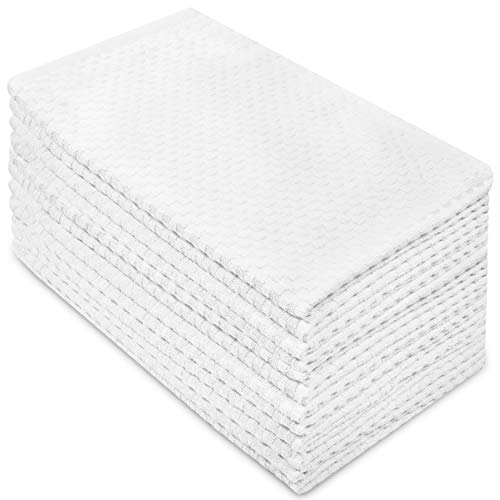
COTTON CRAFT Waffle Terry Kitchen Towels, 12 Pack — Best Terry
The COTTON CRAFT entry is the hybrid: a waffle-terry construction in a 16″ by 28″ “Euro Cafe” format, in a 12-pack of 100% cotton. Terry loops are the thirstiest structure in textiles — each loop is a tiny reservoir — and combining them with a waffle ground gives the loops structure so the towel keeps its shape and dries faster than a pure terry slab. This is the towel for the dish rack that never empties and the stockpot spill that covers half the counter: maximum water per pass, in a count that supports real rotation.
Strengths
- Terry loops deliver the highest per-pass absorbency in this roundup for dishes and spills.
- Waffle-terry hybrid dries faster and holds shape better than pure terry.
- Twelve-pack at a generous 16″ by 28″ supports a working rotation.
Trade-offs
- Loops can snag on knife edges, rough crate corners, and Velcro; keep a sacrificial towel for rough duty.
- Terry sheds some lint early in its life — wash before first use and keep it off the good glassware until it settles.
- Thicker towels take more drawer and washer space than flat weaves.
If your household’s towel workload is measured in full sinks and big spills, terry’s capacity advantage compounds daily: fewer towel swaps per dish session, fewer passes per spill. The COTTON CRAFT’s hybrid weave answers terry’s two classic weaknesses — slow drying and shape loss — well enough that it functions as the heavy-duty anchor of a mixed towel drawer. Pair it with the flour sack pick and the two cover essentially every absorbency job a kitchen generates.
Best for: big households, heavy dish loads, and spill-prone stovetops. / Not suited for: lint-critical glass polishing in its first weeks. Check the current price on Amazon

All-Clad Dual-Purpose Kitchen Towels — Best Premium
All-Clad built its name on cookware, and its towel entry applies the same fewer-but-better logic: a 17″ by 30″ 100% cotton towel the listing describes as highly absorbent, super soft, and long lasting, with a dual-purpose design — one face for drying, the other suited to handling and wiping tasks. At this tier you are buying density and finishing: a towel that feels substantial, keeps its edges, and survives years of washing with its absorbency intact, rather than a pack priced for annual replacement.
Strengths
- Largest format in this roundup at 17″ by 30″ — a true over-the-shoulder, two-hand towel.
- Dual-purpose construction covers drying and handling in one towel, reducing drawer clutter.
- Premium cotton build aimed at multi-year service rather than seasonal replacement.
Trade-offs
- Premium tier pricing per towel; check the current price on Amazon and budget for a working set, not a single towel.
- A smaller count in the drawer means rotation discipline matters — this is not the careless bulk strategy.
- Cooks who bleach everything white may prefer the sacrificial economics of the bulk packs.
The premium towel case is about hand feel and longevity, and it is real: a dense, well-finished cotton towel absorbs superbly in year two, when a thin towel has gone papery. Buy this pick if you cook daily, dislike drawer clutter, and prefer owning four excellent towels to fifteen adequate ones — then honor the strategy by washing them properly (no fabric softener; see the care section) and rotating strictly.
Best for: daily cooks who prefer a small set of excellent towels. / Not suited for: bleach-heavy or loss-prone households. Check the current price on Amazon

LANE LINEN 100% Cotton Kitchen Towels, 6 Pack — Best Everyday Set
The LANE LINEN set is the middle path: six 100% cotton dish towels the listing describes as soft, quick drying, and absorbent, positioned squarely as the everyday kitchen set — drying dishes, wiping counters, handling warm (not hot) items, and looking presentable hanging on the oven door while doing it. Where the Zeppoli wins on count and the All-Clad on refinement, the LANE LINEN wins on balance: enough towels for a small household’s rotation, soft enough for hand-drying duty all day, and styled like a towel set rather than a janitorial supply.
Strengths
- Balanced everyday profile: absorbent for dishes, soft for hands, presentable on the hook.
- Quick-drying cotton keeps the set fresher between laundry days.
- Six-pack sizing suits singles, couples, and small kitchens without drawer overflow.
Trade-offs
- Six towels is a floor, not a cushion — big cooking days will exhaust the rotation.
- Everyday weave, not a specialist: flour sack beats it on glass, terry beats it on floods.
- Softness-forward cotton thins gradually with very hot washing; warm washes extend its life.
Think of this set as the default answer for a normal kitchen: the apartment dweller, the couple, the cook who does dishes once a day and wants the towel drawer solved without a spreadsheet. It also layers well — many households will run a LANE LINEN set as the daily driver, add flour sacks for baking days, and consider the absorbency problem permanently closed.
Best for: small households wanting one balanced, good-looking set. / Not suited for: very heavy daily cooking volume on six towels alone. Check the current price on Amazon
Comparison Table
| Pick | Badge | Key spec | Best for |
|---|---|---|---|
| Zeppoli Classic, 15 Pack | Best Overall | 100% cotton, 14″ x 25″ | Daily rotation, paper-towel replacement |
| Utopia Flour Sack, 12 Pack | Best for Glassware and Baking | 100% cotton flat weave, 28″ x 28″ | Glass, proofing, straining |
| Amazon Basics Waffle, 6-Pack | Best Waffle Weave | Organic cotton waffle, 15″ x 25″ | Fast drying, humid kitchens |
| COTTON CRAFT Waffle Terry, 12 Pack | Best Terry | 100% cotton waffle-terry, 16″ x 28″ | Heavy dishes, big spills |
| All-Clad Dual-Purpose | Best Premium | 100% cotton, 17″ x 30″ | Small set of long-life towels |
| LANE LINEN, 6 Pack | Best Everyday Set | 100% cotton, soft, quick dry | Small households, daily use |
How to Choose the Best Absorbent Kitchen Towels
Match the weave to the job before you match anything else. Terry loops hold the most water and win on dishes and spills. Waffle trades some capacity for drying speed and freshness. Flat weaves — flour sack above all — hold the least but finish surfaces cleanest, which is why glassware and baking belong to them. A complete kitchen runs at least two weaves; a one-weave drawer always has a job it does badly. If you can only buy one set today, buy the weave that matches your most frequent task, and add the second weave next order.
Count is a performance feature. Absorbency depends on starting dry, and starting dry depends on rotation depth. For a household doing daily dishes, six towels is a minimum, twelve is comfortable, and fifteen-plus makes freshness automatic. That is why bulk packs dominate this roundup: the marginal cost of towels seven through fifteen is small, and the absorbency payoff is large. Conversely, a premium strategy only works with discipline — four excellent towels washed every other day outperform fifteen towels left damp in a pile, but they demand the laundry habit to match.
Size shapes how a towel gets used. Compact towels (around 14″ by 25″) live at the sink and in the hand. Oversized towels (17″ by 30″ and the 28″ square flour sack) live on the shoulder, line bowls, and handle sheet pans. Most cooks gravitate to one size and use it for everything; if that is you, stock your size deeply rather than sampling every format. And check fiber before all of it: for this category, 100% cotton listings are the safe default — blends with polyester absorb less with every percentage point of synthetic added, and listings that hide the fiber content entirely should be treated as blends until proven otherwise.
How to Wash Kitchen Towels So They Stay Absorbent
- Wash new cotton towels before first use, two or three times — factory and spinning finishes coat fibers and repel water until they rinse out. Absorbency noticeably improves over the first washes.
- Skip fabric softener and dryer sheets entirely. They work by coating fibers, and coated fibers cannot absorb; this single habit is the most common reason “absorbent” towels stop absorbing.
- Wash in warm to hot water with a thorough rinse; detergent residue left in the weave clogs capillary action the same way softener does. An occasional extra rinse cycle restores tired towels.
- A cup of white vinegar in the rinse, used occasionally, helps strip built-up residue and odors without coating the fibers.
- Dry fully before folding away. Towels stored even slightly damp sour, and sour towels get retired to rag duty while still mechanically sound.
- Retire by demotion, not disposal: sink towel becomes counter towel, counter towel becomes floor and garage towel. The bulk packs in this roundup are priced for exactly this lifecycle.
Absorbency Claims, Translated: How to Read a Towel Listing
Towel listings compete on adjectives because absorbency has no enforced standard for kitchen textiles — there is no kitchen-towel equivalent of a vacuum’s air watts or a purifier’s AHAM rating. That means the shopper’s defense is construction literacy. When a listing says “ultra absorbent,” ask what structure would make that true: loops (terry), pockets (waffle), or fine flat cotton with full surface contact (flour sack). All three mechanisms are real, and every pick in this roundup names its mechanism in its verified title or is a known construction from its product line. When a listing offers only adjectives — thick, luxurious, premium — with no weave, no fiber content, and no dimensions, treat the absorbency claim as unproven and the towel as decorative until evidence appears.
Weight is the second signal, and it cuts both ways. Textile weight is often expressed in GSM (grams per square meter) for bath towels, but kitchen towel listings rarely publish it — none of the verified titles in this roundup state a GSM, and we have not invented any. In the absence of GSM, use format and construction as proxies: a 17″ by 30″ dual-purpose cotton towel from a cookware brand is built to a heavier hand than a bulk flat-weave cloth, and both facts are visible in the listings themselves. What you should not do is equate thickness with absorbency in a one-to-one way: an over-twisted, tightly finished thick towel can absorb worse than a lofty medium one, because absorbency lives in open fiber structure, not in bulk alone. A lofty terry or waffle of medium thickness routinely out-absorbs a dense, tightly finished thick towel at the sink, and the thick towel also dries more slowly between uses, which quietly costs absorbency across a working day. Judge every towel by weave first, fiber second, and thickness a distant third — and be suspicious of any listing that leads with thickness because it has nothing better to say.
Third, read pack economics honestly. A 15-pack and a premium single towel are not rivals; they are different strategies for the same physics, and the right one depends on your laundry rhythm. Households that wash twice a week can run a deep bulk rotation effortlessly. Households that wash daily in small loads can run a premium rotation of four. The failure mode is mismatching strategy to rhythm — premium towels with a weekly wash, or bulk towels bought and then hoarded damp. Every pick above was chosen to make one of those strategies work cleanly.
One Towel, Many Jobs: Assigning Roles in the Kitchen
Professional kitchens assign towels roles and enforce them ruthlessly, and home kitchens absorb better when they borrow a light version of the system. The sink towel dries dishes and glass and touches nothing else — that exclusivity is what keeps it lint-behaved and grease-free. The hand towel lives by the sink or on the oven handle and is replaced most often, because it sees the most soil. The spill towel is the demoted veteran, the one that has already lost its looks and can meet tomato sauce and stovetop grease without a pang. The baker’s cloth — flour sack, always — never touches a greasy pan, so it stays fit for dough and straining. Color or stripe differences make the system self-policing: several picks here come in distinguishable colorways or stripe patterns precisely so a household can assign roles at a glance.
This role system is also why “the best absorbent kitchen towel” is a slightly false question, and why this roundup refuses to crown a single construction. The terry that wins the spill war is the wrong tool for the wine glass; the flour sack that polishes the glass wilts in the flood. Absorbency is a property of a system — weave matched to job, count matched to laundry, care matched to fiber — and the six picks above were chosen as components of that system, not as six attempts at the same throne. Buy two complementary picks from this list and you will outperform any single “winner” bought alone.
How Long Absorbent Towels Last, and When to Replace Them
A working cotton kitchen towel in daily rotation typically gives one to two years of strong absorbency before the fibers thin, the weave opens, and water starts skating instead of soaking. The decline is gradual and easy to miss because the towel still looks like a towel. The practical test: lay the towel flat on a measured spill of water on the counter. A healthy towel drinks it in one unhurried pass. A tired towel pushes a bow wave ahead of itself and leaves the surface gleaming wet behind. When two towels in the rotation fail that test in the same week, the set is due — replace the role, demote the veterans to spill and garage duty, and start the fresh set with the three-wash break-in described in the care section.
Lifespan stretches with three habits: fully drying towels between uses (damp storage degrades cotton and breeds the sour smell that forces early retirement), keeping softener out of the wash permanently, and reserving the hottest, harshest washes for the towels that genuinely need sanitizing rather than cooking the whole rotation weekly. It shortens fastest in households that use one towel for everything — heat, grease, bleach, and glass — which is the final argument for the role system above: towels that do one job age at that job’s pace, not at the pace of the hardest job in the kitchen.
Kitchen Towel Sizes and Formats, Decoded
The picks in this roundup span four formats, and the format quietly decides how each towel will actually be used. The compact workhorse format — roughly 14″ by 25″, the Zeppoli’s dimensions, with the Amazon Basics close behind at 15″ by 25″ — is the sink-side towel: big enough to dry a dinner plate in two passes, small enough to work one-handed and to hang without dragging on the counter. This is the format to stock deepest, because it is the format hands reach for without thinking.
The large format — 16″ by 28″ in the COTTON CRAFT, 17″ by 30″ in the All-Clad — is the two-handed towel: sheet pans, stockpots, roasting trays, and the full dish-rack session. A large towel also works as an impromptu landing pad for hot cookware and as a shoulder towel during long prep, which is why cooks who mise en place for an hour tend to standardize on it. The square format belongs to flour sack alone: 28″ by 28″ drapes a proofing bowl without bunching, lines a colander evenly, and wraps a head of lettuce or a bundle of herbs for the crisper. Squares fold awkwardly for hand drying and excel at everything flat — buy them for the flat jobs and do not judge them by hand-towel standards.
Hanging loops, mentioned in several listings across this category, sound like a triviality until a household’s towels live on hooks rather than bars; a loop keeps the towel aired and off the counter, which is an absorbency feature in disguise, since a towel that dries fully between uses starts every job at full capacity. If your kitchen has bars, loops matter less. If it has hooks, knobs, or an oven handle, they matter every day.
Finally, consider drawer geometry before ordering a 15-pack of the largest format: thick terry at 16″ by 28″ consumes roughly three times the folded volume of flat flour sack. Mixed-format drawers — a stack of compact daily towels, a few large terry, a flat stack of flour sacks — fit more working absorbency into the same drawer than any single-format stock, and they put the right tool within reach for each job, which is the entire point of the system this article keeps returning to.
Replacing Paper Towels With Cloth: A Realistic Plan
Most households searching for absorbent kitchen towels are really trying to fire their paper towels, and the honest news is that cloth wins most jobs and loses a few. Cloth wins on dishes, hands, counters, produce, and the everyday spill — the high-frequency tasks that consume the bulk of a paper roll. Paper keeps an edge on raw-meat juice cleanup, pet accidents, and grease disposal, where throwing the mess away is the point. A realistic plan keeps one paper roll for those jobs and lets cloth take everything else; households that attempt a total ban usually relapse entirely within a month, while the 90-percent plan tends to stick.
The transition mechanics matter more than the towels themselves. Put the cloth where the paper used to be — a stack at the sink, a hook by the stove — and move the paper roll somewhere mildly inconvenient, like a high shelf. Behavior follows friction: the towel that is closer gets used. Keep a small laundry bin or bag in the kitchen so a soaked towel has an obvious destination that is not the counter; the absence of that bin is the silent killer of cloth systems, because a used towel with nowhere to go becomes a damp towel reused all week, which then “proves” cloth does not work. Wash the rotation on your normal rhythm, dry fully, and restock the stack in one motion.
Expect the payoff to show up as a changed shopping list rather than a dramatic moment: paper purchases stretch from monthly to a few times a year, the sink area stays tidier because cloth towels hang instead of wadding, and the absorbency of a fresh cotton towel on a routine spill will quietly embarrass the paper it replaced. The six picks in this roundup were chosen with this plan in mind — bulk counts for the daily stack, specialists for glass and baking, and constructions that survive the washing rhythm the plan requires.
Common Buying Mistakes
Buying the prettiest towel. Printed, decorative towels prioritize artwork; their smooth surfaces are often the least absorbent in the store. Buy decoration for the oven-door hook if you like, but buy performance for the sink.
Using fabric softener. One softener habit can undo every absorbency advantage a good weave provides. It is the highest-impact mistake on this list and the easiest to fix.
Owning too few towels. Two towels cannot rotate. Damp-on-damp use makes even excellent cotton feel useless, and the fix is count, not brand.
Expecting one weave to do everything. Terry on glass leaves lint and streaks; flour sack on a flood saturates instantly. The two-weave drawer is not upselling — it is how the physics works.
Judging absorbency on day one. New cotton towels underperform until their finishes wash out. Judge any pick here after three washes, not out of the package.
Final Recommendation
Start with the Zeppoli 15-pack if your kitchen needs a structural fix — count plus honest cotton absorbency solves most towel complaints in one order. Add the Utopia flour sacks if you bake or care about glassware, and choose the COTTON CRAFT terry if your workload is heavy dishes and big spills. The Amazon Basics waffle is the freshness specialist, the All-Clad is the buy-it-for-years premium, and the LANE LINEN set is the balanced default for smaller kitchens. Whichever you choose, wash before use, banish fabric softener from the towel load permanently, hang every towel to dry fully between uses, and check the current price on Amazon per pack before ordering.
One closing thought for the undecided: towel regret is almost never about the towel. It is about buying a single set to do four jobs, washing it with softener, and owning too few to rotate. Fix any one of those three and the towels you already have will seem better; fix all three with the picks above and the absorbency question closes for a year or more. Start with count and weave, keep the care rules, and let the drawer system do the rest.
Related reading in this program: Best Kitchen Towels Blue, Best Kitchen Towels For Cleaning, Best Kitchen Towels Glassware, Best Quality Kitchen Dish Towels, Best Organic Dish Towels.
A Note on Colors, Stains, and Keeping Towels Presentable
Absorbency is colorblind, but kitchens are not, and the color decision has practical consequences worth one short section. White towels — the Utopia flour sacks and the COTTON CRAFT set among these picks — tolerate the most aggressive refreshing washes and show you honestly when they are dirty, which is why professional kitchens standardize on them; the cost is that turmeric, tomato, and berry stains become part of the towel’s permanent record. Striped and colored towels — the Zeppoli’s classic stripe pattern is the example here — hide the working stains of a real kitchen and look presentable on the hook far longer, at the price of hiding soil you might prefer to see before drying a clean glass with it. The pragmatic household runs both: whites for the jobs where cleanliness must be visible, stripes and colors for front-of-house and hand duty. Whichever palette you choose, the absorbency rules in this article do not change — weave, fiber, count, and care decide performance; color only decides how honestly the towel reports its own condition.
To put the whole system in one sentence: buy cotton, buy the weave that matches the job, buy enough of it to rotate, wash it without softener, and replace it when the flat-spill test says so — the six sets above simply make each of those five decisions easy.
Frequently Asked Questions
What makes a kitchen towel absorbent?
Capillary action in the fiber structure. Cotton fibers and looped or pocketed weaves create countless tiny channels that pull water in and hold it. Terry loops offer the most capacity, waffle adds drying speed, and flat weaves make the cleanest surface contact — which is why weave choice matters as much as material.
Why did my absorbent towels stop absorbing?
Almost always residue: fabric softener, dryer-sheet coating, or detergent buildup waterproofs the fibers. Strip-wash with hot water and an occasional vinegar rinse, and stop using softener on towels. If the cotton itself has worn thin and papery, the towel has simply reached end of life.
Are flour sack towels really absorbent?
Yes, in the way that matters for their jobs: they absorb quickly and completely across a surface and release water readily, and they do it without lint. They hold less total volume than terry, so they are the wrong choice for a large spill and the right choice for glass, dough, and produce.
How many kitchen towels should I own?
For daily cooking and dishes, twelve is a comfortable rotation and six is a workable minimum for a small household. Count matters because absorbency depends on starting each task with a dry towel.
Cotton or microfiber — which absorbs better?
Both absorb well but behave differently. Microfiber grabs aggressively and can be excellent for glass, but it melts near heat, picks up odors, and many cooks dislike its feel on hands and dishes. Cotton is heat-safe, improves with washing, and handles every kitchen job — which is why this roundup is all cotton.
How often should kitchen towels be washed?
Daily for towels used on dishes and hands in a busy kitchen; a towel should never start a third day of service. Hanging towels to dry fully between uses stretches that safely, but damp, bunched towels should go straight to the laundry.


