Disclosure: airfryerkitchensupply.com is reader-supported. When you buy through links on our site, we may earn an affiliate commission at no extra cost to you.
Where to buy
All six towel sets in this guide are sold through Amazon, and each name below links to its listing so you can check the current price on Amazon, confirm the pack size and dimensions, and see the colors in stock. Dish towels are a repeat purchase for most households, so it is worth noting which listing you bought from — reordering the exact towel you already like beats gambling on a lookalike.
- Zeppoli Classic Dish Towels, 15 Pack — Check on Amazon
- Homaxy 100% Cotton Oversized Waffle Weave Kitchen Towels, 4-Pack — Check on Amazon
- All-Clad Dual-Purpose Kitchen Towels — Check on Amazon
- COTTON CRAFT Waffle Terry Kitchen Towels, 12 Pack — Check on Amazon
- Aunt Martha’s Flour Sack Dish Towels, Set of 7 — Check on Amazon
- Honest Weave Organic Cotton Kitchen Towels, 6-Pack — Check on Amazon
Introduction: what “quality” actually means in a dish towel
The best quality kitchen dish towels are not the thickest, the softest, or the prettiest towels in the drawer — they are the ones that still dry a sink full of dishes properly after a hundred washes. Quality in this category is a short list of measurable things: a weave that actually absorbs water instead of pushing it around, edges that do not curl or fray in the wash, cotton that does not shed lint onto clean glassware, and enough size to wrap a hand safely around a hot pan handle or dry a large sheet pan without a second towel. Everything else — stripes, colors, rustic packaging — is decoration.
That definition matters because the dish towel market is full of towels optimized for the photograph instead of the sink. Microfiber towels that feel silky and repel water. Decorative towels printed so heavily they barely absorb. Oversized “premium” towels made from fabric so loose they stretch out of shape in a month. The six sets in this guide were chosen the opposite way: every pick is 100% cotton per its verified listing, every pick comes from a maker whose product is a working towel first, and the picks span the four constructions that actually earn a place in a kitchen — flat-weave workhorses, waffle weave, terry-backed dual-purpose towels, and flour sack.
Every product below was confirmed through Amazon’s catalog data before earning a link here. Where a specification such as a towel’s weight is not published, we do not invent it; the guide explains how to judge the towel by the specs that are published — fiber, weave, dimensions, and pack count.
In this guide
Quick Picks
| Pick | Badge | Why it stands out | Link |
|---|---|---|---|
| Zeppoli Classic Dish Towels, 15 Pack | Best for Stocking Up | 100% cotton, 14″ by 25″, a true bulk workhorse pack for busy kitchens | Check on Amazon |
| Homaxy Waffle Weave Kitchen Towels, 4-Pack | Best Waffle Weave | Oversized 20 x 28 inch waffle weave that drinks water and dries fast between uses | Check on Amazon |
| All-Clad Dual-Purpose Kitchen Towels | Best Premium | 17″x30″ dual-purpose construction from a cookware-grade brand, built for heavy daily use | Check on Amazon |
| COTTON CRAFT Waffle Terry Kitchen Towels, 12 Pack | Best Waffle-Terry Hybrid | 16×28 inch waffle terry in a generous 12-pack, Euro cafe styling | Check on Amazon |
| Aunt Martha’s Flour Sack Dish Towels, Set of 7 | Best Flour Sack | 28-inch square, premium 130 thread count flour sack — the glassware and baking towel | Check on Amazon |
| Honest Weave Organic Cotton Kitchen Towels, 6-Pack | Best Organic Cotton | 100% organic cotton, 20×30 in, mitered corners and hemmed edges | Check on Amazon |
If you buy one set from this guide, buy the one that matches your most common job: bulk drying, glassware, baking, or heavy daily cooking. The sections below explain which is which.
How These Picks Were Chosen
We started with fiber. Every pick is 100% cotton according to its verified catalog listing, because cotton remains the most absorbent, heat-tolerant, and washable fiber for kitchen work, and because blends in this category usually trade absorbency for a lower price or a softer first touch. Synthetic decorative towels, microfiber sets, and towels whose listings did not state their fiber content were excluded rather than assumed.
Next we sorted by construction, because construction decides the job. Flat and lightly textured weaves (the Zeppoli) are the generalists: cheap enough to own in rotation, tough enough for counters and spills. Waffle weave (the Homaxy and the COTTON CRAFT waffle terry) pockets water in its grid and dries quickly between uses, which matters in humid kitchens and busy households. Terry-backed dual-purpose towels (the All-Clad) put a thirsty looped side against the dishes and a flatter side against the hands. Flour sack (the Aunt Martha’s) is a thin, tight, lint-free weave that is the specialist for glassware, proofing dough, and straining.
Finally, we checked the unglamorous details that separate a quality towel from a pretty one: dimensions large enough to be useful (every pick here is at least 14 x 25 inches, and most are larger), finished edges — hemmed edges and mitered corners are called out where the listing states them — and pack sizes that support a real rotation. A single beautiful towel is a decoration; a rotation of towels you can wash in batches is a system.
The 6 Best Quality Kitchen Dish Towels

Zeppoli Classic Dish Towels, 15 Pack — Best for Stocking Up
The Zeppoli Classic is the towel equivalent of buying the big box of a staple you know you will use: fifteen 100% cotton towels, each 14 by 25 inches, in a reusable bulk pack. This is the set that fixes the most common kitchen towel problem, which is not quality per towel but quantity in rotation. With fifteen towels, you can use a fresh one daily, wash a load weekly, and never find yourself drying dishes with yesterday’s damp towel — the single biggest hygiene and performance upgrade most kitchens can make.
Strengths
- Fifteen towels make a true rotation possible — the foundation of towel hygiene
- 100% cotton in a classic flat style that dries dishes, wipes counters, and lines bread baskets equally well
- 14 by 25 inches is a practical working size: big enough to dry a sheet pan, small enough to handle quickly
Trade-offs
- A classic flat weave is a generalist — it will not match flour sack for lint-free glassware or waffle for raw absorbency
- Bulk white-and-classic styling is functional rather than decorative
- Like all cotton, the towels improve after the first few washes as sizing washes out; judge them from wash three onward
Buy the Zeppoli pack if your kitchen currently runs on three tired towels and a paper-towel habit. It is the least glamorous pick in this guide and the one most likely to change how your kitchen actually works day to day. Households that cook in volume — big families, frequent bakers, anyone who hosts — should start here and add a specialist set later if a specific job demands it.
Best for: busy family kitchens, first-apartment stocking, and anyone replacing a whole drawer at once. Not suited for: shoppers who want a decorative statement towel or a specialist glassware towel.
Check on Amazon to check the current price on Amazon.

Homaxy 100% Cotton Oversized Waffle Weave Kitchen Towels, 4-Pack — Best Waffle Weave
Waffle weave earns its place in a kitchen for a physical reason: the grid of recessed squares gives water somewhere to go, so the towel absorbs quickly and — just as important — dries quickly afterward, hanging light instead of staying damp and sour between uses. The Homaxy set does waffle properly and at an oversized 20 x 28 inches, in 100% cotton, in a 4-pack. The size is the headline: at 20 x 28, one towel covers a large cutting board, wraps a mixing bowl, or dries a roasting pan in a couple of passes.
Strengths
- Oversized 20 x 28 inch format handles the biggest drying jobs with one towel
- Waffle structure absorbs fast and air-dries fast — a genuine advantage in humid kitchens
- 100% cotton keeps it heat-tolerant for handling warm pans (with the usual care any towel deserves near heat)
Trade-offs
- A 4-pack is a starter set; high-volume kitchens will want two packs for a full rotation
- Waffle weave’s texture can drag slightly on very delicate glassware compared with flour sack
- Oversized towels need hook or bar space to hang fully open, or the quick-dry advantage is wasted
Mini spec box
- Fiber: 100% cotton
- Weave: waffle
- Size: 20 x 28 inches
- Pack: 4 towels (navy blue version confirmed)
Choose the Homaxy set if your current towels stay damp, smell tired by mid-week, or are simply too small for the pans you actually cook in. The waffle structure plus the generous cut solves all three complaints at once, and the towels double as excellent hand towels during long cooking sessions because they dry your hands as fast as they dry the dishes.
Best for: humid kitchens, big-pan cooks, and anyone whose towels never seem to dry. Not suited for: lint-critical glassware work or very small kitchens with no hanging space.
Check on Amazon to check the current price on Amazon and see the color options.

All-Clad Dual-Purpose Kitchen Towels — Best Premium
All-Clad built its name on cookware, and its kitchen towels follow the same philosophy: a dual-purpose construction, generously sized at 17 by 30 inches, in 100% cotton, designed to be worked hard daily rather than saved for guests. “Dual-purpose” describes the two working faces of the towel — one side optimized for absorbency, the other for a smoother wipe — which in practice means one towel handles both the drying rack and the countertop pass without swapping. This is the premium pick: the towel you buy fewer of, use constantly, and expect to keep for years.
Strengths
- Dual-purpose faces cover drying and wiping with one towel
- 17 by 30 inches is a professional-feeling size that protects hands well around hot cookware
- Cookware-brand build quality: dense, long-lasting cotton per the listing’s positioning
Trade-offs
- Premium tier pricing per towel means most households will own a few, not a drawerful — plan your rotation accordingly (we do not print prices; check the listing)
- A heavier, larger towel is slower to dry on the hook than a thin flour sack
- White premium towels show every stain; they are working tools, and they will look like it
The All-Clad is for the cook who has stopped buying cheap towels every year and would rather own a small set of excellent ones. Pair a few of these as your primary drying and handling towels with a bulk pack like the Zeppoli for spills and messy jobs, and you have the two-tier system most professional kitchens quietly run on.
Best for: serious home cooks who want a few excellent towels for daily duty. Not suited for: anyone outfitting a whole kitchen on a tight budget, or households that bleach everything aggressively.
Check on Amazon to check the current price on Amazon.
COTTON CRAFT Waffle Terry Kitchen Towels, 12 Pack — Best Waffle-Terry Hybrid
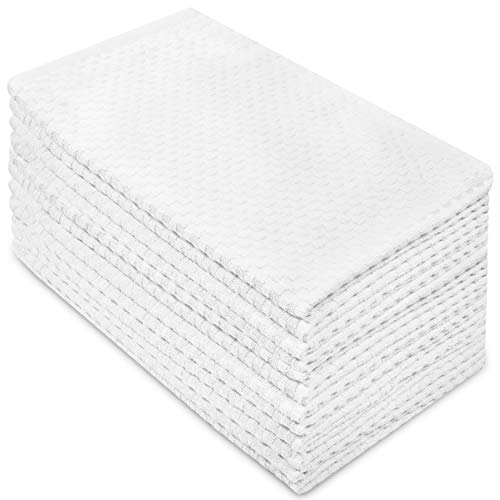
COTTON CRAFT’s towel splits the difference between the two great drying weaves: a waffle face for quick pickup and structure, and terry character for raw absorbency, in a 16×28 inch towel sold twelve to a pack in a white Euro cafe style. The hybrid construction is the pragmatic choice for kitchens that do a bit of everything — the waffle side keeps the towel from feeling soggy, the terry side drinks the big spills — and the 12-pack count means the rotation math works without a second purchase.
Strengths
- Waffle terry hybrid balances quick absorption with total capacity
- 12-pack supports a real wash rotation for a family kitchen
- 16×28 inch Euro cafe format is a proven restaurant-style working size
Trade-offs
- A hybrid is a compromise by design: pure flour sack still wins on glassware, pure waffle dries a touch faster
- White cafe styling shows stains readily — these are meant to be worked, not displayed
- Terry character means a little more lint in the first washes than a flat weave; wash before first use
This is the set we would hand to a household that cannot decide between waffle and terry, because it refuses to make them decide. It is also the natural upgrade path from a worn-out mixed drawer: one uniform set, one wash routine, no sorting. Restaurants and cafes standardized on this style of towel for a reason — it survives commercial laundry habits, and home laundry is gentler than that.
Best for: all-round family kitchens and anyone replacing a mixed drawer with one uniform set. Not suited for: perfectionists about lint-free glassware or decorative kitchens.
Check on Amazon to check the current price on Amazon.
Aunt Martha’s Flour Sack Dish Towels, Set of 7 — Best Flour Sack
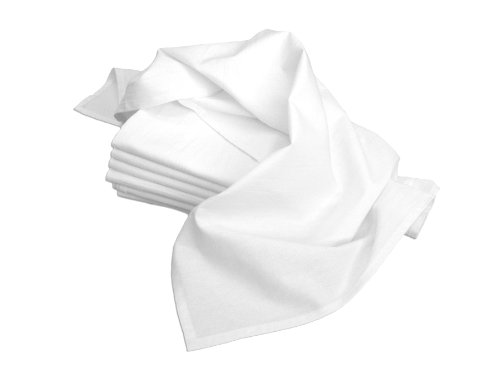
Flour sack is the oldest working towel in the American kitchen, and Aunt Martha’s version is the reference example: a 28-inch square of premium 130 thread count cotton flour sack, sold seven to a set. The weave is thin, tight, and smooth, which makes it the lint-free specialist — the towel that dries wine glasses and stemware without leaving fibers behind. Bakers know it as the proofing cover that does not stick or shed; home canners know it for straining; anyone who polishes glass knows nothing else in the drawer does the job as cleanly.
Strengths
- Lint-free tight weave is the best in this guide for glassware and polishing
- 28-inch square covers rising dough, lines baskets, and strains with room to spare
- 130 thread count premium flour sack washes soft and stays strong; a heritage product with a long track record
Trade-offs
- Thin by design: a flour sack towel will not absorb a big spill the way terry or waffle does
- Too thin to use as a hot-pad substitute — never rely on a single layer of flour sack against a hot pan
- Plain white utility look; these live in the drawer, not on display
Every serious kitchen should own one flour sack set even if it owns nothing else from this guide, because it does the two jobs — glassware and baking — that no other weave does as well. Buy the Aunt Martha’s set for those jobs, and let the generalists handle the rest.
Best for: bakers, home canners, and anyone who hand-dries glassware. Not suited for: heavy spill duty or as your only towel set.
Check on Amazon to check the current price on Amazon.

Honest Weave Organic Cotton Kitchen Towels, 6-Pack — Best Organic Cotton
Honest Weave’s towels are made from 100% organic cotton per the listing, in a striped kitchen towel format at a generous 20×30 inches, with the finishing details that signal careful manufacturing: mitered corners and hemmed edges, plus hidden hanging loops. The mitered corners matter more than they sound — they are the corners that stay flat after fifty washes instead of curling into points — and the 20×30 size puts these among the largest towels in this guide.
Strengths
- 100% organic cotton, for buyers who prioritize how the fiber was grown
- Mitered corners and hemmed edges — the finishing details that predict a long, flat-lying life
- Large 20×30 inch size with hidden hanging loops for tidy storage
Trade-offs
- A 6-pack is a mid-size rotation; heavy-use kitchens will want a second set
- The listing describes the cotton as organic; it does not state a third-party certification name in the catalog data we verified, so buyers who require a specific certification should confirm it on the listing (see the certification note in the buying guide below)
- Striped styling limits color matching to the offered palette
Choose Honest Weave if fiber sourcing is part of your definition of quality and you still want a genuinely large, well-finished working towel. It is the pick that treats “quality” as both how the towel performs and how it was made, without sacrificing size or construction to get there.
Best for: buyers who prioritize organic fiber and careful finishing. Not suited for: anyone who needs a certified-organic label verified for a specific program, or bulk-buy shoppers.
Check on Amazon to check the current price on Amazon and confirm certification details.
Comparison Table
| Pick | Badge | Key spec | Best for | Link |
|---|---|---|---|---|
| Zeppoli Classic, 15 Pack | Best for Stocking Up | 100% cotton, 14″ x 25″, 15 towels | Full-drawer replacement, big households | Check on Amazon |
| Homaxy Waffle Weave, 4-Pack | Best Waffle Weave | 100% cotton waffle, 20 x 28 in | Fast drying, oversized jobs | Check on Amazon |
| All-Clad Dual-Purpose | Best Premium | 100% cotton, 17″ x 30″, dual-face | Serious daily cooking | Check on Amazon |
| COTTON CRAFT Waffle Terry, 12 Pack | Best Waffle-Terry Hybrid | 100% cotton waffle terry, 16×28 in, 12 towels | Uniform all-round sets | Check on Amazon |
| Aunt Martha’s Flour Sack, Set of 7 | Best Flour Sack | 130 thread count, 28″ square | Glassware, baking, straining | Check on Amazon |
| Honest Weave Organic, 6-Pack | Best Organic Cotton | 100% organic cotton, 20×30 in, mitered corners | Organic fiber, fine finishing | Check on Amazon |
How to Choose Quality Kitchen Dish Towels
Match the weave to the job. This is the whole game. Flat and classic weaves are generalists for drying and wiping. Waffle weave absorbs quickly and dries quickly, which suits humid kitchens and heavy hand-towel duty. Terry loops maximize total absorption for big drying loads and spills. Flour sack is the lint-free specialist for glassware, polishing, proofing, and straining. Most kitchens need two constructions: a generalist for daily work and flour sack for glass and baking. The picks above are organized so you can build exactly that pairing.
Read size like a professional. Towels under about 14 x 25 inches are hand-towel sized and will frustrate you on sheet pans and stockpots. The working range for a dish towel is roughly 16 x 28 up to 20 x 30 inches — large enough to dry big items and to fold into a safe pad for a warm pan handle, small enough to wring out and handle fast. Every pick in this guide sits in or near that range, and the flour sack’s 28-inch square is its own special case: the square shape is what makes it useful for covering dough and lining baskets.
Check the finishing, because that is where cheap towels die. A towel’s center almost never wears out first; its edges do. Hemmed edges, and especially mitered corners like the Honest Weave’s, keep a towel flat and intact through years of laundry. When a listing does not mention its edging at all, assume the simplest rolled hem and budget the towel’s life accordingly.
Understand the certification words before paying for them. Two labels appear often in this category and they mean different things. GOTS (Global Organic Textile Standard) certifies organic fiber and its processing chain — it is the organic claim. OEKO-TEX Standard 100 certifies that a finished textile has been tested for harmful substances — it is a safety-of-chemicals claim, and it is not an organic certification. A towel can carry either, both, or neither. The Honest Weave pick is described in its listing as 100% organic cotton; where a listing does not name a certification, this guide says so rather than upgrading the claim. If a specific certification matters to you, verify it on the listing before ordering.
Buy the rotation, not the towel. Quality includes quantity. A household should be able to use a fresh towel every day or two and wash a full load weekly, which means owning somewhere between seven and fifteen working towels. That arithmetic is why two of the picks here are bulk packs and why the premium strategy is a few excellent towels plus a bulk pack for the dirty jobs.
How to Wash and Care for Cotton Dish Towels
New cotton towels should be washed before first use, and then washed two or three more times before you judge them: manufacturers apply sizing and finishes that temporarily reduce absorbency, and cotton reaches its real performance after several washes. Wash kitchen towels in hot water with a regular detergent, and keep them in their own load or with other sturdy cottons — kitchen towels carry food soils and grease that you do not want sharing a delicate cycle.
Skip the fabric softener and dryer sheets. Softener works by coating fibers, and a coated fiber absorbs less water — it is the single most common reason a good towel starts pushing water around instead of drinking it. If your towels have already been softened into uselessness, a wash with a cup of white vinegar in the rinse can strip some of the buildup and restore performance. Tumble dry on medium or line dry; cotton tolerates both, and line drying is gentler on edges over the years.
Rotate honestly. Retire towels in stages: a towel that has thinned or torn moves to garage and cleaning duty rather than the bin, and the drawer gets a fresh set when the working rotation drops below a week’s worth. Stains on a working white towel are cosmetic, not a performance failure — judge a towel by whether it still absorbs and whether its edges still hold, not by whether it photographs well.
Common Buying Mistakes
Buying microfiber for dish drying. Microfiber excels at cleaning glass and counters, but for drying a load of dishes, quality cotton absorbs more and tolerates heat better. Match fiber to job.
Judging a towel on day one. New cotton is coated with sizing and absorbs poorly until it has been washed several times. Reviews written after one use mislead in both directions.
Using fabric softener. It coats the fibers and quietly ruins absorbency. It is the most common self-inflicted towel problem in home kitchens.
Buying decorative prints for working duty. Heavy prints sit on the surface and reduce absorption, and printed towels fade unevenly. Decorative towels are for the oven-door photograph; working towels are for work.
Owning too few towels. Three towels cannot rotate. Damp reuse is unhygienic and makes any towel smell sour regardless of quality. Buy the pack size your laundry rhythm requires.
Using a thin towel as a potholder. A single layer of flour sack or flat cotton is not insulation. Fold a substantial towel into quarters for warm handles, use a proper mitt for anything genuinely hot, and never use a damp towel against heat — wet fabric conducts heat to your hand fast.
Final Recommendation
For most kitchens, start with the Zeppoli 15-pack as the rotation backbone and add the Aunt Martha’s flour sack set for glassware and baking — that pairing covers nine-tenths of kitchen towel work. If your towels never dry between uses, choose the Homaxy waffle set; if you want one uniform hybrid system, take the COTTON CRAFT 12-pack. Cooks who prefer a few excellent tools should invest in the All-Clad dual-purpose towels, and buyers who prioritize organic fiber should take the Honest Weave set.
Related guides: Best Dish Towels Ever, Best Organic Dish Towels, Best Quality Flour Sack Dish Towels, Best Bang For Buck Dish Towels, and Best Dish Towels And Washcloths.
The Two-Tier System: How Working Kitchens Organize Towels
Professional kitchens do not use one towel for everything, and the home version of their system is simple enough to copy. Tier one is the towel on your shoulder or apron: a quality drying and handling towel — the All-Clad, the Homaxy, or the Honest Weave in this guide — that stays relatively clean, dries dishes and hands, and handles warm pans. Tier two is the utility towel: a bulk-pack towel from the Zeppoli or COTTON CRAFT sets that wipes counters, catches spills, goes under cutting boards to stop them sliding, and gets swapped the moment it is soiled. The flour sack set forms a small third tier of specialists that only come out for glassware, proofing, and straining, which is why they stay lint-free and last for years.
The system works because it protects the good towels from the dirty jobs. A premium towel used to mop a turmeric spill is a premium towel ruined; a bulk towel used for the same spill is a bulk towel doing its job. It also fixes the hygiene problem quietly: the towel that dries your clean dishes is never the towel that wiped the counter where raw chicken sat. Color or stripe differences between tiers make the system self-enforcing — in this guide’s picks, the navy Homaxy or striped Honest Weave can be tier one while the white bulk packs are tier two, and nobody in the household has to memorize anything.
Setting the system up costs one decision: designate a hook or bar for the clean tier and a different spot for the utility towel, and a small bin or hook near the laundry for towels leaving rotation. Kitchens that adopt the two-tier habit consistently report the same surprise — they use fewer paper towels, because a real towel is always within reach and always in the right state for the job.
A Practical Map of Towel Jobs
It helps to see the whole category as a set of jobs rather than a set of products. Drying dishes rewards absorbency and size: terry, waffle terry, and generous flat weaves lead. Drying glassware rewards a lint-free surface above all: flour sack, full stop. Hand drying during cooking rewards fast self-drying, because the towel is used wet-handed forty times in an evening: waffle weave leads. Wiping counters and catching spills rewards cheap replaceability and total capacity: bulk flat weave and terry. Handling warm cookware rewards size and dry cotton thickness — folded, never damp. Baking splits into two jobs: covering dough, where flour sack’s light, non-stick drape is ideal, and lining baskets and trays, where any clean flat towel works. Straining stocks and squeezing grated vegetables belong to flour sack alone, because it is the only weave here that is both strong and fine.
Read the map and your own cooking honestly, and the shopping list writes itself. A household that bakes weekly and drinks wine nightly needs flour sack depth. A household that cooks big family dinners needs drying capacity and rotation count. A small apartment kitchen with one hook needs the waffle set’s quick self-drying more than it needs fifteen of anything. Quality, in the end, is fit: the right weave, in the right size, in the right quantity, washed the right way. Every pick in this guide is a quality towel; the guide’s real job is matching them to the work your kitchen actually does.
Cotton, Linen, and Blends: an Honest Fiber Comparison
Every pick in this guide is cotton, and that choice deserves its reasoning rather than being assumed. Cotton’s virtues for kitchen work are absorbency, heat tolerance, and laundry forgiveness: it drinks water readily, it does not melt or glaze when it brushes a hot pan the way synthetics can, and it survives hot washes indefinitely. Its weaknesses are real too — cotton dries slowly compared with synthetics, which is why weave (waffle) and hanging space matter, and it wrinkles, which matters only if you iron your dish towels, in which case this guide cannot help you.
Linen is the credible challenger. True linen towels absorb well, dry faster than cotton, release stains more easily, and are famously durable — the heirloom kitchen towel is usually linen. They cost significantly more per towel, feel stiff until broken in over many washes, and are uncommon in the pack formats that make a rotation affordable. A household that wants linen should buy a few for hand and glass duty and keep cotton for volume; the reason no linen set appears in this guide is that none of the linen candidates we checked carried a listing we could verify to the standard this guide requires, and we do not recommend what we cannot verify.
Blends and microfiber sit in a different role. Cotton-polyester blends dry faster and wrinkle less but absorb less per gram and can develop a stubborn odor over time. Microfiber is a cleaning tool — superb on glass, stainless, and counters with just water — but a poor dish dryer and a poor hot-pan handler. The mature kitchen owns all three fiber families and assigns each its job; the mistake is expecting any one of them, at any quality level, to do all the jobs. This guide’s cotton six are the foundation; add specialists as your cooking demands them.
Kitchen Towel Safety Notes Worth the Minute They Take
Towels cause a small, steady number of kitchen injuries every year, and nearly all of them come from three habits. The first is the shoulder towel that drifts toward the flame: a towel worn while cooking at a gas burner should be cotton (all picks here are), kept short, and never left hanging beside an open flame. The second is the damp potholder substitution — wet fabric conducts heat almost instantly, so the towel you grab for a hot handle must be dry, folded thick, and used for handles and lids rather than as a full oven mitt; for casserole dishes and sheet pans coming out of a hot oven, use real mitts. The third is cross-contamination: the towel that wiped hands after handling raw meat must go straight to the laundry, not back to drying dishes. The two-tier system in this guide exists partly to make that rule effortless. None of this is exotic — it is the ordinary discipline that lets a simple cotton towel be the safest tool in the drawer.
What Quality Looks Like After a Year of Washing
The fairest test of a dish towel is not the day it arrives but the state of the drawer a year later, so it is worth knowing what aging looks like for each construction in this guide — and which changes are failures and which are just cotton being cotton. All cotton towels soften with washing; that is desirable. All white towels accumulate some staining in a working kitchen; that is cosmetic. The failures that matter are structural: edges that curl so hard the towel will not fold flat, hems that open and unravel, weave that thins until light shows through, and terry loops that snag and pull into runs.
Against that standard, the constructions age predictably. Flat bulk towels like the Zeppoli fade gracefully and fail last at the center; their edges are the watch point, and a towel whose hem opens goes to utility duty rather than being mended — at bulk-pack economics, mending costs more time than the towel is worth. Waffle towels hold their structure remarkably well because the weave itself is the texture; the Homaxy’s grid will look nearly new when a printed towel of the same age looks tired, though the waffle’s raised threads can snag on rough drawer hardware. Terry and waffle-terry towels like the COTTON CRAFT gradually lose loft; a towel that no longer drinks is usually suffering softener buildup rather than death, and a vinegar rinse is worth trying before demotion. Flour sack is the marathon runner: Aunt Martha’s style of towel famously outlasts fancier rivals because there is almost nothing in it to fail — no pile to crush, no print to fade, just a tight plain weave that gets softer and more absorbent for years before it thins.
The premium All-Clad and the carefully finished Honest Weave justify themselves in this timeframe rather than the first week: mitered corners still flat, dual faces still distinct in performance, cotton still dense. That is the real meaning of “quality” in this category — not a luxurious first touch, but a drawer that still works, towel after towel, a year of laundry later. Buy for the year, not the unboxing.
Frequently Asked Questions
Why are my new cotton towels not absorbing water?
Almost certainly sizing and factory finish. Wash them three or four times before judging, and do not use fabric softener, which coats fibers and makes the problem permanent. Cotton towels reach full absorbency after several washes.
How many dish towels should a household own?
Enough for a fresh towel every day or two plus a wash cycle in reserve — for most households, between seven and fifteen working towels. Bulk packs exist because this arithmetic is real. Count your own kitchen honestly: the cook’s hand towel, the drying towel, and the utility towel are three different towels on any busy day, and a household that cooks twice a day can work through six before the weekend. That is why the two-tier system in this guide pairs a bulk pack with a specialist set instead of asking one beautiful set of four to do everything — the four will be damp, soiled, or in the wash exactly when you need them, and no quality of cotton fixes a quantity problem.
What is the difference between waffle weave and terry?
Waffle weave has a recessed grid that absorbs quickly and lets the towel dry quickly afterward. Terry has looped pile that maximizes total water capacity. Waffle suits hand drying and humid kitchens; terry suits big drying loads and spills; hybrids like the COTTON CRAFT split the difference.
Are flour sack towels good for everyday dish drying?
They are excellent for glassware and light drying, and unmatched for baking tasks like proofing and straining. They are thin by design, so they saturate quickly on heavy loads. Most kitchens use them as the specialist alongside a generalist towel.
What does OEKO-TEX mean, and is it the same as organic?
No. OEKO-TEX Standard 100 means the finished textile was tested for harmful substances. Organic claims are certified under standards such as GOTS, which covers the fiber’s organic production and processing chain. The two labels answer different questions, and a listing that names neither should not be assumed to hold either.
Should kitchen towels be washed separately from other laundry?
Ideally, yes — or at least with other sturdy cottons. Kitchen towels carry grease, food soil, and whatever they wiped, and they benefit from hot water that delicates cannot tolerate. A dedicated towel load also keeps lint-heavy new towels away from dark clothing during their first washes. If a separate load is impractical, wash them with bath towels rather than with clothes you wear against skin all day.
Is a heavier towel always a better towel?
No. Weight helps total absorbency, which is why terry feels so capable, but a heavy towel also dries slowly, handles clumsily when wet, and takes longer in the laundry. The best towel for a job is the lightest one that completes it: flour sack for glass, waffle for hands, terry for floods. Judging towels by weight alone is how drawers end up full of impressive towels nobody reaches for.
Can I use these cotton towels on cast iron and carbon steel?
Yes — cotton towels are the traditional choice for wiping and seasoning cast iron, because they tolerate the pan’s heat in brief contact and do not leave synthetic residue. Use a dedicated towel for the job, since seasoning oil will stain it permanently, and keep it in the utility tier rather than the drying tier. For carbon steel and cast iron that are ripping hot from the oven, the same rule as always applies: dry towel, folded thick, or a proper mitt.
Do dish towels need to be replaced on a schedule?
Replace by condition, not by calendar. A towel retires from dish duty when its weave has thinned enough to see light through, when its edges have opened beyond a trim, or when it no longer absorbs after a vinegar-strip wash. In a busy kitchen that is often somewhere between one and three years for bulk towels and longer for the premium and flour sack sets in this guide — after which the towel graduates to cleaning duty rather than the bin, and the rotation gets a fresh set.
How do I keep white kitchen towels from looking dingy?
Wash them hot, in their own load, without fabric softener, and treat grease stains promptly. An occasional oxygen-based soak helps. Accept, though, that working towels earn some staining; performance — absorbency and intact edges — is the quality that matters.


