Disclosure: airfryerkitchensupply.com is reader-supported. When you buy through links on our site, we may earn an affiliate commission at no extra cost to you.
Where to buy
Every towel below was verified against Amazon listing data as a genuine cotton flour sack towel — pack size, dimensions and cotton content quoted exactly as the verified listings state them. Flour sack quality lives in three checkable things: the cotton, the weave’s density and finish, and the hemming that decides whether the towel survives its fiftieth wash. Use the links to check the current price on Amazon, and note the one organic pick is labelled as organic because its listing says so — not as a compliment we hand out.
Utopia Kitchen White Flour Sack Towels, 12-Pack (28 x 28 Inch) — check price on Amazon
Simpli-Magic Flour Sack Kitchen Towels, 12-Pack (24″ x 24″) — check price on Amazon
Aunt Martha’s Flour Sack Dish Towels, Set of 7 (28″ x 28″) — check price on Amazon
HIC Kitchen Jumbo Flour Sack Set, 4-Pack (32 x 38 Inches) — check price on Amazon
Honest Weave Organic Cotton Flour Sack Towels, 12-Pack (27 x 27 in) — check price on Amazon
Avalon Kitchen Flour Sack Towels, 15-Pack (28 x 28 Inch) — check price on Amazon
Best Quality Flour Sack Dish Towels: Cotton, Weave and Honest Absorbency
The best quality flour sack dish towels are a study in doing a simple thing properly. A flour sack towel is, by design, almost nothing: a flat, lint-free square of woven cotton, descended from the sacks flour was once sold in, kept in kitchens because that plain weave dries glassware without leaving lint, absorbs spills without pushing them around, and doubles as a proofing cloth, a produce wrap and an embroidery blank. With a product this simple, quality is not features. It is fibre, weave, hemming and honesty about all three.
That simplicity is also why the category rewards scepticism. One listing’s ‘premium’ is another’s standard, pack photos hide skimpy dimensions, and a towel that feels thick in the hand can be loosely woven air that collapses in the wash. The six picks below were chosen on the verifiables their listings actually publish: 100% cotton (and in one case organic cotton, stated as such), named dimensions from 24-inch squares to a 32×38 jumbo, thread count where the maker states it, hemmed edges, and pack sizes from a heavyweight 4-pack to a working 15-pack.
A note on what quality means at the sink. The best flour sack towel is not the softest or the thickest — it is the one that dries a wine glass without lint, drinks a counter spill in one pass, survives weekly hot washes without its hems curling into ropes, and is cheap enough per towel that you actually use it instead of saving it. The picks span that definition deliberately: a heavyweight jumbo for big jobs, ring-spun and premium-thread-count classics, an organic option, and honest bulk packs for kitchens that go through towels like a bakery — which, historically, is exactly where these towels earned their name.
In this guide
Quick Picks
| Pick | Badge | Why it made the list |
|---|---|---|
| Utopia Kitchen White Flour Sack Towels, 12-Pack (28 x 28 Inch) — check price on Amazon | Best Overall | The category benchmark: 100% cotton, a full 28 x 28 inches, in a 12-pack — the size, fibre and count most kitchens actually need. |
| Simpli-Magic Flour Sack Kitchen Towels, 12-Pack (24″ x 24″) — check price on Amazon | Best Compact Size | A 100% cotton 12-pack at a smaller 24 x 24 inches, described as lint-free and high absorbent, for dishes, baking and crafting. |
| Aunt Martha’s Flour Sack Dish Towels, Set of 7 (28″ x 28″) — check price on Amazon | Best Premium Weave | The heritage pick: premium 130 thread count flour sack towels at the full 28-inch square, from the name embroiderers have trusted for generations. |
| HIC Kitchen Jumbo Flour Sack Set, 4-Pack (32 x 38 Inches) — check price on Amazon | Best Heavyweight / Jumbo | A heavyweight cotton 4-pack at an oversize 32 x 38 inches — described as super absorbent and lint-free, machine washable, for the biggest jobs in the kitchen. |
| Honest Weave Organic Cotton Flour Sack Towels, 12-Pack (27 x 27 in) — check price on Amazon | Best Organic | Organic cotton flour sack towels — the listing says organic, and that is the claim we repeat — in a 12-pack at 27 x 27 inches with mitered corners. |
| Avalon Kitchen Flour Sack Towels, 15-Pack (28 x 28 Inch) — check price on Amazon | Best Bulk Pack | The volume pick: 15 towels of 100% cotton at the full 28 x 28 inches, for drying, baking, proofing, crafting and embroidery. |
How These Picks Were Chosen
Selection ran with a strict identity filter: the product had to be a flour sack towel — the flat woven cotton cloth — not a terry towel, microfibre cloth or waffle weave wearing the keyword. Terry and microfibre are fine products and different ones; a shopper searching flour sack wants the lint-free flat weave, and every pick here is that cloth. Within the filter, we required the listing to state its cotton content and dimensions, because a maker who will not publish either is telling you something.
Quality signals were then ranked: ring-spun cotton where stated, thread count where stated (the Aunt Martha’s picks publish 130 thread count), hemmed or fully hemmed edges, and dimensions generous enough for real work — a flour sack towel under about 24 inches is a napkin with ambitions. Pack composition was treated as a use-case choice rather than a quality axis: heavyweight small packs and economical large packs both appear, labelled for the kitchens they suit.
One certification distinction is kept sharp in this guide, because the category blurs it constantly. The Honest Weave pick is organic cotton because its listing says ‘Organic’ — that is a claim about how the cotton was grown. No other pick is described as organic, and no pick is credited with certifications its listing does not state. Absorbency language is likewise the makers’ own; where a listing says lint-free or highly absorbent, we report it as the listing’s claim and judge the towel on its published construction.
Two near-misses are worth recording for transparency. A sage-green colourway of the Utopia Kitchen towel exists in the same catalogue; it is the benchmark towel in a colour, and we counted the white original once rather than pretending the colourway was a second product. And an embroidered novelty line of flour sacks — charming, giftable, decorated — was passed over for the plain quality picks, because decoration is not the quality this search asks about; the Aunt Martha’s pick serves the embroiderer better as a blank anyway.
The 6 Best Quality Flour Sack Dish Towels

Utopia Kitchen White Flour Sack Towels, 12-Pack (28 x 28 Inch) — Best Overall
If a stranger asked what a flour sack towel is, this is the listing you would show them: 100% cotton, 28 x 28 inches — the classic full square — in a 12-pack, sold for cleaning and drying and described by its maker as highly absorbent. Utopia Kitchen’s white 12-pack is the reference product of the modern category, and it earns Best Overall by getting every fundamental right at once: real cotton, full dimensions, a working quantity, and no gimmicks competing for your money.
Strengths
- 100% cotton at the full classic size, 28 x 28 inches
- 12-pack is the quantity a working kitchen actually rotates
- White cotton tolerates hot washes and brightening that colours cannot
Trade-offs
- White shows every stain history; these are working towels, not display towels
- No thread count is published, so weave density must be judged in hand
| Spec | Detail (as stated in the verified listing) |
|---|---|
| Material | 100% cotton |
| Size | 28 x 28 inches |
| Pack | 12-pack |
| Colour | White |
The 28-inch square is the size the design settled on over a century, and it is worth understanding why. Folded in quarters it is a hand towel with four dry faces; opened flat it covers a proofing bowl, wraps a loaf, lines a produce drawer, or dries a whole roasting pan in one pass. Smaller towels force mid-task swaps; larger ones bunch. Utopia’s adherence to the classic dimension, in honest cotton, is the kind of unglamorous correctness that defines quality in this category.
The 12-pack count matters for the same practical reason: flour sack towels earn their keep in rotation. Six in use, six in the wash is a rhythm that keeps a dry, lint-free towel always at hand — the condition under which these towels outperform paper and terry alike. Buy the benchmark first if you are new to the category; the more specialised picks below make most sense once you know how your kitchen uses the standard.
Best for: Most kitchens: the first and benchmark flour sack purchase / Not suited for: Anyone wanting coloured towels, or the heaviest weave available

Simpli-Magic Flour Sack Kitchen Towels, 12-Pack (24″ x 24″) — Best Compact Size
Not every kitchen wants the full square. The Simpli-Magic pack keeps the fundamentals — 100% cotton, a 12-pack, lint-free and high-absorbent positioning from its listing — and trims the towel to 24 x 24 inches. That smaller square is a deliberate tool: it handles glassware and dish-drying with less cloth bunching in the hand, stacks smaller in a drawer, and suits bakers who use flour sacks as bench and proofing cloths at a scale where 28 inches drapes where it is not wanted.
Strengths
- Compact 24-inch square is handier for glassware and small hands
- 100% cotton with lint-free positioning — the flour sack essentials
- 12-pack keeps the rotation rhythm of the benchmark at a smaller footprint
Trade-offs
- Less coverage for big pans, big spills and full-bowl proofing
- Smaller towels are easier to lose into the laundry’s odd-sock dimension
- As with Utopia, no thread count is published to judge density by
| Spec | Detail (as stated in the verified listing) |
|---|---|
| Material | 100% cotton |
| Size | 24 x 24 inches |
| Pack | 12-pack |
| Positioning | Lint-free, high absorbent (per listing) |
Size is a genuine preference in this category, not a hierarchy, and the 24-inch case is stronger than it first looks. A dish towel spends much of its life bunched in one hand around a glass or a plate edge; the extra four inches of the classic square is, in that grip, mostly surplus that drags through the sink water. The compact square stays in the hand, dries the glass, and goes back over the oven handle without trailing. Kitchens with small drawers and small sinks feel the difference daily.
Where the smaller towel loses is coverage work: proofing a large bowl, lining a big salad spinner’s worth of greens, or mopping a serious spill wants the full square or the jumbo below. Many experienced kitchens run both sizes — compact for the daily dish rhythm, classic and jumbo for the big jobs — and this pack is the compact half of that system at an honest specification.
Best for: Small kitchens, glassware-heavy drying, and bakers wanting a bench-size cloth / Not suited for: One-size households — the classic 28-inch square is the better single purchase
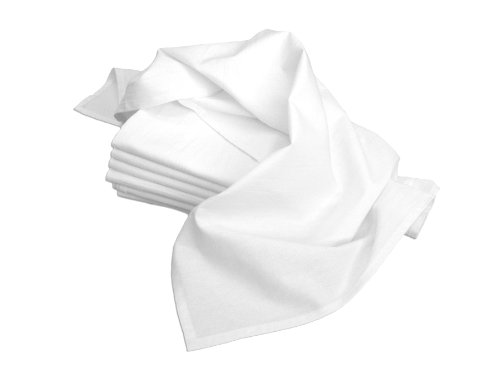
Aunt Martha’s Flour Sack Dish Towels, Set of 7 (28″ x 28″) — Best Premium Weave
Aunt Martha’s is the name this category grew up with, and its verified listing publishes the spec most makers hide: premium 130 thread count, at the full 28 x 28 inches, in a set of 7. Thread count in a flat weave is a density statement — more threads per inch means a tighter, smoother, more durable cloth with a finer surface for drying glass and, not incidentally, for the embroidery work this brand is famous for. If quality in your definition starts with the weave itself, this is your pick.
Strengths
- 130 thread count published — a real, checkable density spec
- Full 28-inch square in a heritage maker’s premium line
- The smooth, tight surface is the embroidery and glass-polishing favourite
Trade-offs
- A set of 7 is a smaller rotation than the 12 and 15-packs
- Premium weave sits at a premium tier per towel
- White only in this listing — working stains will show
| Spec | Detail (as stated in the verified listing) |
|---|---|
| Weave | Premium 130 thread count |
| Size | 28 x 28 inches |
| Pack | Set of 7 |
| Colour | White |
Density is the invisible half of absorbency. A loose weave feels thick because it traps air, but it holds less cotton per square inch, pushes water around before drinking it, and frays at the hems as its sparse threads give up. A 130 thread count cloth puts more fibre in the water’s path and holds its structure through the hot washes that kitchen hygiene demands. It also dries flatter and smoother — which is why generations of embroiderers chose this exact cloth as their canvas, and why a stitched Aunt Martha’s towel is a fixture of American farmhouse kitchens.
Buy this set when the towels themselves are the point: for a kitchen where glassware is polished properly, for the crafter who will embroider half the set as gifts, or as the quality reference against which cheaper packs are judged. The per-towel tier is the highest of the standard-size picks, and the honest framing is that you are paying for weave density — a real thing, measurable in the hand the first time you dry a wine glass with it.
Best for: Quality-first buyers, embroiderers, and glassware perfectionists / Not suited for: Bulk buyers outfitting a high-volume kitchen

HIC Kitchen Jumbo Flour Sack Set, 4-Pack (32 x 38 Inches) — Best Heavyweight / Jumbo
Sometimes the right towel is simply more towel. HIC Kitchen’s jumbo set is heavyweight cotton at 32 x 38 inches — a third again the area of the classic square — in a 4-pack, positioned as super absorbent and lint-free for cleaning, cooking and food storage. This is the flour sack scaled for the jobs that defeat standard towels: draining a stockpot’s worth of greens, covering a full sheet pan of proofing dough, wrapping a watermelon’s worth of produce, or serving as the under-cloth for a serious canning session.
Strengths
- 32 x 38 inches: the largest coverage in the guide by a wide margin
- Heavyweight cotton for the absorbency big jobs demand
- Machine washable, lint-free positioning — the flour sack virtues at jumbo scale
Trade-offs
- Only 4 towels — a specialist set, not a rotation
- Oversize cloth is unwieldy for ordinary dish-drying; this is not your everyday towel
- Heavyweight cotton dries slower on the line than standard weave
| Spec | Detail (as stated in the verified listing) |
|---|---|
| Material | Heavyweight cotton |
| Size | 32 x 38 inches |
| Pack | 4-pack |
| Positioning | Super absorbent, lint-free (per listing) |
Every working kitchen has three or four jobs a year — then three or four a month, once the tool exists — that want a cloth this size. A jumbo flour sack is a produce wrap that actually wraps, a proofing cover that seals a full tray, a draining cloth for blanched greens that does not leave half of them on the counter. Heavyweight cotton suits the scale: at 32 x 38, a flimsy weave would tear at the corners under a wet load, and the heavier cloth carries the water it absorbs without sagging through your fingers.
Treat the set as the specialist drawer, not the everyday one. Pair it with a standard 12-pack for the daily rhythm and the jumbos will last for years, because they only come out when their size is the point. HIC’s food-storage positioning is worth taking seriously, too: a breathable cotton wrap is the traditional, effective way to keep greens and herbs in the crisper, and at this size one towel does the whole market haul.
Best for: Canners, bakers with full trays, produce-heavy kitchens, big-batch cooks / Not suited for: Everyday dish-drying — pair it with a standard pack instead

Honest Weave Organic Cotton Flour Sack Towels, 12-Pack (27 x 27 in) — Best Organic
The Honest Weave pick exists for the buyer who asks where the cotton came from. Its verified listing states organic cotton, in a 12-pack at 27 x 27 inches, with mitered corners, positioned for bread proofing and embroidery as well as kitchen work. We describe it exactly that way — organic, because the listing claims organic cotton — and we do not dress any other pick in this guide with the word. Within the organic brief, the details are right: near-classic dimensions, a working pack size, and finished corners that sit flat.
Strengths
- Organic cotton, as stated in the verified listing — the only organic pick here
- 27 x 27 inches is effectively the classic square
- Mitered corners are a finishing detail that keeps edges flat and neat
Trade-offs
- Organic cotton carries a tier premium over conventional equivalents
- One inch under the classic size — trivial, but noted for exactness
- Off-white organic cloth shows its natural character; perfectionists wanting bleached white should look elsewhere
| Spec | Detail (as stated in the verified listing) |
|---|---|
| Material | Organic cotton (per listing) |
| Size | 27 x 27 inches |
| Pack | 12-pack |
| Finish | Mitered corners |
Organic claims deserve precision, so here is the whole of it: this listing describes its towels as organic cotton flour sack towels. That is a claim about the cotton’s cultivation, made by the maker, and it is the reason this pick exists in the guide — for buyers who weight sourcing in their definition of quality, it is the only candidate that even makes the claim. We do not extend the claim further than the listing does, and we do not borrow it for the conventional picks, however good their weave.
On the cloth itself, the 27-inch square and mitered corners mark a maker thinking about finishing. Mitered corners fold the hem at forty-five degrees so the corner sits flat instead of stacking four layers of cloth into a lump — a small thing on a drying towel, a real thing on a proofing cloth or an embroidery blank, both of which this listing names. It is the organic pick and a well-finished pick, in that order, and buyers who want both qualities in one towel have exactly one choice in this guide.
Best for: Buyers who define quality to include how the cotton was grown / Not suited for: Anyone seeking the lowest per-towel cost, or bleached-white perfection

Avalon Kitchen Flour Sack Towels, 15-Pack (28 x 28 Inch) — Best Bulk Pack
Some kitchens do not rotate towels; they consume them — bakeries-in-miniature, big families, holiday cooking headquarters, anyone running a home business from a kitchen counter. Avalon’s 15-pack is built for that reality: 100% cotton, the full 28 x 28 inch square, fifteen of them, positioned across drying, baking, bread proofing, crafting and embroidery. It is the benchmark specification at the largest count in the guide, and for high-throughput kitchens that combination is the quality that matters.
Strengths
- 15-pack: the deepest rotation here — a clean towel is always available
- Full classic size and 100% cotton, no spec compromises for the count
- The count suits households that also craft, proof and preserve
Trade-offs
- Bulk value per towel means a standard weave, not the Aunt Martha’s density
- Fifteen white towels is a laundry commitment as well as an asset
- Storage: a 15-pack needs a real drawer, not a hook
| Spec | Detail (as stated in the verified listing) |
|---|---|
| Material | 100% cotton |
| Size | 28 x 28 inches |
| Pack | 15-pack |
| Uses | Drying, baking, proofing, crafting, embroidery (per listing) |
There is a quality that only quantity provides: the quality of always having a dry towel. A cook with fifteen towels uses one for the dishes, abandons it the moment it is damp, takes a fresh one for the greens, another for the proofing bowl — and every task gets the lint-free, fully absorbent performance that a tired, damp towel cannot give. Kitchens with three towels, however fine their weave, spend most of the day using compromised ones. For high-volume homes, the Avalon pack is therefore not the cheap option; it is the performance option.
The honest limit is weave ambition: at this count, expect a sound standard cloth rather than a premium density, and inspect the hems on arrival as you should with any bulk pack — hemming consistency is where bulk towels vary. Washed hot and rotated evenly, a 15-pack also wears remarkably evenly, ageing as a set rather than leaving you with two good towels and thirteen ghosts. For the household that goes through towels like a working kitchen, this is the system purchase.
Best for: Big households, home bakers, preservers and kitchen-based businesses / Not suited for: Small kitchens with one drawer and two cooks
Comparison Table
| Pick | Badge | Key spec | Best for |
|---|---|---|---|
| Utopia Kitchen White Flour Sack Towels, 12-Pack (28 x 28 Inch) | Best Overall | 100% cotton; 28×28; 12-pack | Most kitchens: the first and benchmark flour sack purchase |
| Simpli-Magic Flour Sack Kitchen Towels, 12-Pack (24″ x 24″) | Best Compact Size | 100% cotton; 24×24; 12-pack | Small kitchens, glassware-heavy drying, and bakers wanting a bench-size cloth |
| Aunt Martha’s Flour Sack Dish Towels, Set of 7 (28″ x 28″) | Best Premium Weave | 130 thread count; 28×28; set of 7 | Quality-first buyers, embroiderers, and glassware perfectionists |
| HIC Kitchen Jumbo Flour Sack Set, 4-Pack (32 x 38 Inches) | Best Heavyweight / Jumbo | Heavyweight cotton; 32×38; 4-pack | Canners, bakers with full trays, produce-heavy kitchens, big-batch cooks |
| Honest Weave Organic Cotton Flour Sack Towels, 12-Pack (27 x 27 in) | Best Organic | Organic cotton; 27×27; 12-pack; mitered corners | Buyers who define quality to include how the cotton was grown |
| Avalon Kitchen Flour Sack Towels, 15-Pack (28 x 28 Inch) | Best Bulk Pack | 100% cotton; 28×28; 15-pack | Big households, home bakers, preservers and kitchen-based businesses |
How to Choose Quality Flour Sack Towels
Judge a flour sack towel by the three things its maker cannot fake in a listing: fibre, dimensions and finishing. Fibre first: 100% cotton is the standard, ring-spun cotton is a refinement one of the shortlisted makers in this category publishes, and organic cotton is a sourcing choice exactly one pick here claims. Anything blended with polyester will dry worse and lint differently, however it is photographed. Dimensions second: the classic square is 28 inches; 27 is effectively equivalent, 24 is a deliberate compact tool, and anything much smaller is not a flour sack towel in any useful sense.
Finishing third, because it predicts lifespan. Hemmed edges — fully hemmed, in the better listings — keep the cloth from fraying into strings by the tenth wash, and mitered corners keep the towel lying flat. A towel’s hems are where cheapness announces itself first: run a thumbnail along them on arrival, wash the pack once before judging absorbency (new cotton carries finishing that washes out), and return anything whose hems are already waving.
Then match the pack to the kitchen’s throughput. A couple cooking nightly thrives on a 12-pack rotation; a household that bakes, proofs, preserves and crafts should think in fifteens or pair a standard pack with the jumbo set. Per-towel price is the last consideration, not the first — a towel that survives two hundred washes is cheaper than one that frays at thirty, whatever the pack prices say.
Colour is the last variable, and it is a laundry decision in disguise. White cotton takes the hottest, most hygienic washes and any brightening treatment the kitchen demands, and shows you honestly when a towel is due for the wash — which is why professionals standardised on it. Coloured and printed flour sacks exist and cheer up a kitchen, but they ask for gentler washing and hide their soil. For a quality-first brief, white is not the boring choice; it is the maintainable one, and every pick in this guide is white or natural for exactly that reason.
Flour Sack Towels Beyond the Sink: Proofing, Produce and Craft
The dish-drying fame undersells this cloth. In baking, a flour sack is the traditional proofing cover — light enough not to weigh on rising dough, breathable enough not to sweat it, lint-free enough not to decorate it — and several listings here name bread proofing outright. Dampen the towel lightly for proofing in a dry kitchen, and keep one towel dedicated to baking so it never carries detergent fragrance to the dough.
In the crisper, a flour sack wrap is the old, correct way to store greens, herbs and mushrooms: breathable cotton buffers moisture instead of sealing it in as plastic does, and the jumbo pick exists at exactly the size a market haul needs. In the craft room, the same flat, tight, white cloth is the embroidery and printing blank that built Aunt Martha’s name — the 130 thread count surface takes a needle and a stamp better than any terry ever will.
Keeping the roles separate is the one discipline worth adopting: mark or store baking, produce and craft towels apart from the sink rotation. A towel that dried dishes with detergent on Monday should not proof Tuesday’s sourdough. The generous pack sizes in this guide make that separation affordable — which is, in the end, the strongest argument for buying flour sacks by the dozen.
Thread Count, Ring-Spun and Other Words on Towel Listings
Towel listings speak a dialect worth translating. Thread count, published by the Aunt Martha’s picks at 130, counts the threads in a square inch of the woven cloth; in a flat weave it is a density measure, and density is absorbency’s quiet half — more cotton in the water’s path, a smoother drying surface, and a cloth that holds together at the hems. It is not the whole story — fibre quality and finishing matter as much — but a maker who publishes a thread count is submitting to measurement, and that willingness is itself a quality signal in a category full of adjectives.
Ring-spun describes how the cotton yarn was made: fibres twisted continuously as they are spun, producing a smoother, stronger yarn than open-end spinning. In a towel it shows up as a cleaner surface — fewer stray fibres to lint onto glassware — and better resistance to the fraying that ends towel lives. Where a listing states ring-spun cotton, as the Aunt Em’s listings in our research did, it is a legitimate mark in the maker’s favour; where a listing is silent on spinning, judge the towel on the remaining checkables rather than assuming the worst.
The remaining vocabulary sorts quickly. ‘Lint-free’ in this category means the flat weave sheds almost nothing onto glass — a property of the weave type itself, which is why every genuine flour sack towel can claim it honestly. ‘Hemmed’ and ‘fully hemmed’ describe edges finished on all sides; ‘mitered corners’, on the Honest Weave pick, describe hems folded at the diagonal so corners lie flat. And ‘heavyweight’, on the HIC jumbo, describes a denser cloth for heavier work. Learn these half-dozen terms and you can read any listing in this category the way a baker reads a flour label — for content, not for poetry.
Setting Up a Kitchen Towel System That Works
A towel system sounds grand for a drawer of cotton squares, but the kitchens where flour sacks perform best share a structure. There is a working rotation at the sink — enough towels that a damp one is always retired without regret. There is a separated set for food work: proofing, produce, covering, kept apart from detergent duty. And there is a demotion path, sink to utility to garage, that extracts the full value from every towel before it leaves the house. The pack sizes in this guide map onto that structure almost suspiciously well: a 12 or 15-pack builds the rotation, a second smaller set serves the food work, and the jumbo set covers the occasions.
Storage is the system’s quiet half. Towels stored folded flat in a drawer stay smooth, dry evenly and keep their hems straight; towels balled into a cupboard corner hold creases and, worse, hold damp. If the drawer is near the oven, so much the better — ambient warmth keeps the rotation genuinely dry between uses, which is the state in which a flour sack towel performs its lint-free, one-pass drying at its best.
Finally, audit the system twice a year. Pull the whole rotation, wash it hot, and sort honestly: towels that still dry glass cleanly stay in the premier set; towels thinning at the centre demote; towels fraying at the hems retire. The audit takes twenty minutes and keeps the average quality of the drawer permanently high — which, for a product category defined by quiet, provable quality, is exactly the point.
How to Wash and Break In Flour Sack Towels
New cotton towels underperform for a simple reason: mill finishes coat the fibres. The first washes are not cleaning — they are commissioning.
- Wash the pack before first use, in warm water, without fabric softener. Softener coats cotton fibres and measurably reduces absorbency — it is the enemy of this entire category.
- Expect absorbency to climb over the first three to five washes as finishes leave the cloth. Judge a towel in week two, not on day one.
- Wash kitchen rotations hot enough for hygiene, and keep whites white-only so the pack can take the wash it needs without colour anxiety.
- Dry until fully dry — line drying keeps the weave crisp and is traditional for a reason — and fold flat rather than balling into a drawer, which sets creases into the hems.
- Retire towels by demotion, not disposal: sink towels become floor towels, floor towels become garage towels. A flour sack’s last job is still a useful one.
If a towel ever develops a sour smell that washing does not shift, a strip wash — a long hot soak before a normal cycle — usually resets it. And keep one rule absolute across the whole rotation: no softener, ever. It is the single most common way good cotton towels are quietly ruined.
Label the roles if your household shares the drawer — a small stitched mark, a coloured thread in one corner, or simply separate shelves for sink, food and craft sets. Systems survive when everyone in the kitchen can follow them at a glance, and a proofing towel that smells faintly of washing-up liquid is the signature of a system that existed only in one person’s head.
Keep the commissioning washes in mind when gifting a pack, too — a note in the parcel telling the recipient to wash before judging is the mark of someone who actually knows this cloth.
Common Buying Mistakes
Using fabric softener
Softener works by coating fibres — the opposite of absorbency. It is the fastest way to make a quality towel perform like a cheap one, and the damage accumulates with every wash.
Judging a towel before breaking it in
Mill finishes make new cotton nearly waterproof for the first wash or two. Condemning a pack on day one throws away towels that would have peaked in week two.
Buying by pack price alone
A 24-pack of loose, fraying cloth costs more per year than a 12-pack of sound weave. Fibre, dimensions and hemming are the value; the count is arithmetic.
Expecting terry behaviour
Flour sack is a flat weave: it will never feel plush, and it is not meant to. Its virtues are lint-free drying, fast absorption and versatility — judge it on those.
Mixing roles carelessly
The towel that mopped a spill should not proof the sourdough. Generous packs exist so roles can be separated; use the separation.
Storing towels damp in a closed drawer
Cotton folded away with any damp left in it mildews quietly and permanently. Dry fully, fold flat, and let the drawer breathe — the system in the guide above exists to make that the default, not the exception.
Final Recommendation
Start with the Utopia Kitchen 12-pack if you want the benchmark — full size, honest cotton, the rotation most kitchens need. Choose Aunt Martha’s when weave density is your definition of quality, the HIC jumbo set for the big jobs no standard towel covers, and the Honest Weave pack when organic sourcing is part of your brief. Take the Simpli-Magic compacts for small kitchens and glassware, and the Avalon 15-pack when your kitchen runs at volume. Wash them hot, skip the softener, break them in before judging — and a cloth this simple will repay you for years.
A closing thought on value: a flour sack towel is one of the few kitchen tools that gets better after you buy it — more absorbent with washing, softer in the hand, shaped by use to the work of your kitchen. Buy the cloth with the provable specs, set up the rotation, and let time do the rest.
And when the first pack has been washed five times and starts performing the way the old hands promise — glassware spotless, spills gone in a pass, dough rising under a cloth that weighs nothing — you will understand why this category has survived a century of kitchen reinvention essentially unchanged.
Keep exploring the cluster: Best Bang For Buck Dish Towels Best Bar Towels For Drying Glassware Best Lightweight Travel Towels Best Absorbent Gym Towels Best 800 Gram Towels
Frequently Asked Questions
What makes a flour sack towel “quality”?
Fibre, weave and finishing that a listing can prove: 100% cotton, full dimensions, a stated thread count where the maker publishes one, and hemmed edges that survive washing. Marketing adjectives are not quality; those four checkables are.
Why are flour sack towels better for glassware?
The flat weave has no loops to shed, so it dries glass without leaving lint, and the thin cloth reaches into rims and stems that terry cannot. It is the traditional bar and bakery choice for exactly this reason.
Do flour sack towels get more absorbent over time?
Yes — noticeably. Mill finishes wash out over the first several cycles and the cotton opens up. This is also why fabric softener is forbidden in this category: it re-coats the fibres you just freed.
What size should I buy?
The classic 28-inch square for general use. Choose 24-inch compacts for glassware-focused small kitchens, and add the 32×38 jumbo for proofing trays, produce and big-batch work. Many kitchens run two sizes happily.
Are organic flour sack towels worth it?
That depends on whether sourcing is part of your definition of quality. The Honest Weave pick is the one listing here that states organic cotton, with sound dimensions and finishing besides. On pure drying performance, the premium-weave conventional picks compete strongly.
How long should a good flour sack towel last?
A sound cotton towel in rotation should serve for years of weekly washing, demoting gradually from glassware to general duty. Fraying hems and thinning patches are the retirement signals — usually long after cheap towels have been replaced twice.
Can flour sack towels replace paper towels?
For most drying, wiping and covering jobs, yes — that is their historical role, and a washed cotton towel outperforms paper on absorbency per use. Keep paper for the genuinely unpleasant jobs if you prefer, and let the cotton rotation carry the other ninety percent.
Why do my new towels repel water?
Mill finishing. The coating that makes new cloth look crisp also makes it resist water for the first few washes. Wash before use, skip softener, and judge the towels from the third wash onward — that is the cloth you actually bought.
Should I iron flour sack towels?
Only the embroidery-bound ones benefit — a pressed blank takes a needle and a design better. Working towels gain nothing from ironing; folded flat from the line or dryer, they are ready. Save the effort for the craft set.


