Disclosure: airfryerkitchensupply.com is reader-supported. When you buy through links on our site, we may earn an affiliate commission at no extra cost to you.
Where to buy
All six towels below were verified, and they split into two honest families: microfiber towels that pack to almost nothing and dry in hours, and one thin Turkish cotton towel for travellers who refuse microfiber’s hand-feel. Sizes matter more than brand here — each review states what the listing confirms about dimensions, and the buying guide explains how to choose between body, hand and multi-size sets. Use the links to check the current price on Amazon in the size and colour you want.
PackTowl Personal Ultralight Towel, Body Size — check price on Amazon
PackTowl Luxe Towel, Body Size — check price on Amazon
Rainleaf Microfiber Towel, 48 x 24 in — check price on Amazon
OlimpiaFit Quick Dry Towel, 3 Size Pack — check price on Amazon
4Monster Quick Dry Microfiber Towel with Case — check price on Amazon
Cacala Turkish Cotton Travel Towel, 37 x 70 in — check price on Amazon
Best Lightweight Travel Towels: Pack Small, Dry Fast, Choose Honestly
The best lightweight travel towels earn their place in a bag three ways: they fold or roll to a fraction of a bath towel’s bulk, they dry fast enough to pack the morning after a swim or shower, and they absorb enough to actually dry a person rather than move water around. Microfiber dominates this category for good engineering reasons — split fibres drink water and release it quickly — and five of our six verified picks are microfiber, from an ultralight backpacking towel to a three-size set that covers a whole trip. The sixth is a thin Turkish cotton towel, included deliberately, because some travellers will trade pack size for a natural-fibre feel every time and deserve a verified option.
Set expectations before the picks. A travel towel is not a bath towel, and judging it by bath-towel standards — plushness, heft, spa softness — guarantees disappointment. The microfiber hand-feel is smooth and slightly grabby on skin; the technique is to pat and press rather than rub. What you get in exchange is a towel that weighs a few ounces, dries on a hostel bunk rail overnight, and never turns a suitcase musty. The reviews below are frank about which travellers each towel suits and which it will annoy.
Every pick was matched to its Amazon title before earning a link. Where listings confirm a size, a case or a carabiner, we say so; where a detail is not stated in the title, we do not invent it. Colour and size variants of the same towel were counted once — several of these towels sell in many colours that are one product, not six.
In this guide
Quick Picks
PackTowl Personal Ultralight Towel, Body Size — Best Overall. The category benchmark in its purest form: an ultralight microfiber body towel from the brand that defined travel towels, built for people who count ounces and trips alike. Check the current price on Amazon.
PackTowl Luxe Towel, Body Size — Best Feel. The soft-feel branch of the PackTowl family: still lightweight microfiber, still Body size, but with a plusher hand for travellers who found classic microfiber too clinical. Check the current price on Amazon.
Rainleaf Microfiber Towel, 48 x 24 in — Best Value Single Towel. A generously sized 48-by-24 microfiber towel whose listing confirms the full travel brief — compact, super absorbent, lightweight, fast drying — at the accessible end of the category. Check the current price on Amazon.
OlimpiaFit Quick Dry Towel, 3 Size Pack — Best Set. A three-size microfiber system with a carry bag: body, hand and face coverage in one purchase, for travellers who like a place for everything. Check the current price on Amazon.
4Monster Quick Dry Microfiber Towel with Case — Best Packed Design. A microfiber towel sold with its own compact case and carabiner — clip it to the outside of a pack and it stops competing for space inside it. Check the current price on Amazon.
Cacala Turkish Cotton Travel Towel, 37 x 70 in — Best Cotton Alternative. The natural-fibre dissent: a thin, lightweight 100% Turkish cotton towel at a full 37 by 70 inches, for travellers who want cotton’s feel and a wrap-sized sheet of it. Check the current price on Amazon.
How These Picks Were Chosen
We searched the API for microfiber travel towels and for the category’s benchmark brand, PackTowl, then verified each candidate’s returned title. Selection favoured true travel design: compact pack size, quick-dry construction, and a carry solution — several listings confirm a bag or case. We deliberately spread the six across the real decision space: the ultralight backpacking choice, the soft-feel upgrade, the value multi-size set, the cased all-rounder in two executions, and the cotton alternative.
We excluded bath and beach towels that merely call themselves travel towels, gym towels with no pack advantage, and duplicate colour or size variants masquerading as separate products. The Cacala cotton towel stayed in because its verified title confirms the two properties that matter — lightweight and thin in a full 37-by-70-inch size — giving natural-fibre travellers one honest, verified option instead of a token mention.
The 6 Best Lightweight Travel Towels

PackTowl Personal Ultralight Towel, Body Size — Best Overall
PackTowl is the name experienced travellers reach for first, and the Personal Ultralight in Body size shows why. The listing keeps the promise in the name — ultralight microfiber, sized for the body — and the design philosophy is discipline: a smooth, fast-drying towel that packs to a small roll, works for shower, swim and camp, and dries on a line or a chair back while you eat breakfast. The Midnight colourway in the verified listing is the practical choice, hiding travel grime between laundry stops better than any pale colour.
Strengths
- The benchmark ultralight design — minimal bulk in the bag
- Body size covers shower and swim duty in one towel
- Microfiber dries fast enough for daily-move itineraries
Trade-offs
- Smooth microfiber feel divides opinion — pat dry, don’t rub
- One towel, one size: no bundled hand towel in this listing
- Premium positioning within the travel towel category
| Detail | What the listing confirms |
|---|---|
| Type | Microfiber, ultralight (per Amazon title) |
| Size | Body (per Amazon title) |
| Colour verified | Midnight |
This is the towel for carry-on-only travellers, backpackers and anyone whose itinerary moves daily. Its whole value is reliability across hundreds of uses: it packs the same small roll on day forty as on day one, and it is dry when the bag needs closing. If your travel is hotel-to-hotel with checked bags, you may prefer the softer Luxe below; if your travel is a rucksack and a rail pass, this is the correct default.
Care is simple and matters: wash microfiber without fabric softener, which coats the fibres and kills absorbency, and hang it whenever the day allows. Treated that way, an ultralight towel like this outlasts several cotton travel towels. Check the current price on Amazon in the Body size before comparing against the multi-size sets.
Best for: backpackers, carry-on travellers and daily-move itineraries / Not suited for: travellers who judge a towel by plush bath-towel softness

PackTowl Luxe Towel, Body Size — Best Feel
The Luxe exists for a specific complaint — that ultralight microfiber feels like wiping with a chamois. PackTowl’s answer, per the listing, is a lightweight microfiber towel that ‘delivers soft, quick-drying comfort’, trading a little of the Ultralight’s minimalism for a surface that feels closer to a real towel against skin. For hotel travellers, road-trippers and anyone whose towel use is a daily shower rather than a river swim, that trade is usually worth it: the pack penalty is small and the morning experience is better every single day of the trip.
Strengths
- Softest hand-feel among the microfiber picks here
- Still lightweight and quick-drying by design
- Body size suits daily shower use on long trips
Trade-offs
- Packs slightly larger than the Ultralight sibling
- Softness still is not cotton — manage the expectation
- Costs more than basic microfiber sets
| Detail | What the listing confirms |
|---|---|
| Type | Microfiber, lightweight (per Amazon title) |
| Size | Body (per Amazon title) |
| Colour verified | Lake |
Choose the Luxe when the towel is part of your daily comfort rather than emergency kit: long hotel stays, van life, gym-to-office routines and slow travel. It also makes the better gift of the two PackTowls, because the recipient feels the upgrade immediately. The Lake colourway in the verified listing is a calm blue that reads clean even after weeks on the road.
Same microfiber rules apply: no fabric softener, hang to dry, and expect it to be ready again by morning in most climates. In humid tropics, give any microfiber moving air — a fan or an open window — rather than a sealed bathroom.
Best for: slow travellers and daily-shower routines wanting a softer feel / Not suited for: ultralight backpackers counting every ounce

Rainleaf Microfiber Towel, 48 x 24 in — Best Value Single Towel
Rainleaf’s towel is the straightforward recommendation for most people: a large-body microfiber at 48 by 24 inches, with a listing that confirms each property a travel towel is bought for. The size deserves attention — many travel towels skimp, and 48 inches of length wraps and dries a body properly rather than adequately. The Army Green of the verified listing is a travel-practical colour that tolerates campsite and hostel life without showing every mark.
Strengths
- Full 48 x 24 in size confirmed in the listing
- Listing confirms absorbent, lightweight and fast drying together
- One towel covers beach, bath, gym and trail per the listing
Trade-offs
- Single towel — no hand or face companion included
- Microfiber pat-dry technique still applies
- Large size packs bigger than ultralight minimal towels
| Detail | What the listing confirms |
|---|---|
| Size | 48 x 24 in (per Amazon title) |
| Type | Microfiber, quick dry (per Amazon title) |
| Colour verified | Army Green |
This is the towel to buy when you want one towel that does everything on the trip and you do not want to think about systems and sets. Swimmers and gym travellers get the most from it: big enough after a pool session, quick enough to be dry for the evening, compact enough for a gym bag’s side pocket. Backpackers watching every litre of pack space may still prefer the PackTowl Ultralight’s smaller roll.
Rainleaf sells this towel in other sizes and colours as variants of the same product; the verified pick here is the 48-by-24 Army Green. Whichever variant you choose, wash before first use to wake the fibres up, and skip softener thereafter.
Best for: swimmers, gym travellers and one-towel packers / Not suited for: minimalists wanting the smallest possible packed roll

OlimpiaFit Quick Dry Towel, 3 Size Pack — Best Set
Sets solve the problem singles cannot: a body towel is a clumsy face towel, and a face towel is a hopeless body towel. OlimpiaFit’s verified listing bundles three sizes of lightweight microfiber with a bag, which makes it the natural pick for organised packers, families splitting a set across bags, and campers who want a wash-day rotation. The listing’s use list — camping, beach, gym, backpacking, sports, yoga, swim — is broad because a size system genuinely does cover all of them without forcing one towel into every job.
Strengths
- Three sizes cover body, hand and face in one purchase
- Carry bag confirmed in the listing
- Lightweight microfiber across the set
Trade-offs
- Total packed bulk exceeds a single ultralight towel
- Set value depends on using all three sizes
- Microfiber care rules apply to the whole set
| Detail | What the listing confirms |
|---|---|
| Contents | 3 size pack with bag (per Amazon title) |
| Type | Microfiber, quick dry (per Amazon title) |
On a family trip the set divides beautifully: the large towel to the beach bag, the mid to the bathroom, the small to a daypack for hands and face. Solo travellers get a rotation — one in use, one drying, one clean in reserve — which is the real luxury on a long trip. The bag keeps damp towels corralled away from dry clothes, a small thing that matters daily.
Label or colour-code the sizes in your own system if your set arrives uniform, because a three-towel rotation only works if you can tell them apart at a glance. Check the current price on Amazon for the set against buying singles — the arithmetic usually favours the set when you need more than one size.
Best for: families, organised packers and campers wanting a rotation / Not suited for: solo ultralight travellers carrying one towel only
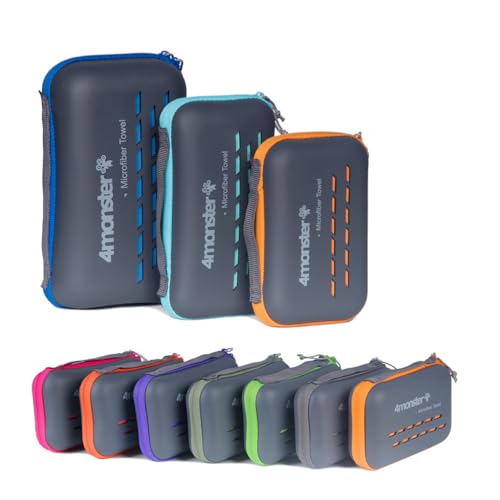
4Monster Quick Dry Microfiber Towel with Case — Best Packed Design
4Monster’s design insight is about where a towel lives. The verified listing confirms a compact case with a carabiner, which means the towel rides outside the bag — clipped to a pack strap, a gym bag handle or a beach tote — drying in the open air instead of sweating inside a compartment. For hikers and festival travellers that is a genuine system advantage: the towel dries between uses without any discipline from you, and it is always reachable for a stream, a spill or a sudden swim.
Strengths
- Case and carabiner confirmed — clips outside the pack
- Listing confirms absorbent, lightweight, fast drying
- Outside carry keeps damp fabric away from dry kit
Trade-offs
- Case adds a little weight versus a bare towel roll
- External carry exposes the towel to trail dust
- Size options are variants — confirm your size at listing
| Detail | What the listing confirms |
|---|---|
| Carry | Compact case with carabiner (per Amazon title) |
| Type | Microfiber, quick dry (per Amazon title) |
Day hikers get the most from this design: towel clipped on in the morning, used at the lake, clipped back on to dry on the walk out. Gym users can clip it to a bag rather than burying it with shoes. The case also disciplines the pack-down — a towel with a home gets packed; a loose towel gets left on a bunk.
4Monster sells multiple sizes under this listing family; they are variants of one product, so choose by the job — larger for swim and beach duty, smaller for gym and trail — rather than treating sizes as different towels.
Best for: hikers, festival-goers and gym travellers who clip gear outside the bag / Not suited for: travellers who keep everything sealed inside a suitcase

Cacala Turkish Cotton Travel Towel, 37 x 70 in — Best Cotton Alternative
Every roundup needs its honest dissenter, and the Cacala is ours. Its verified title confirms 100% cotton, lightweight and thin, in an extra-large 37-by-70 format — a peshtemal-style towel that wraps like a sarong, spreads like a beach sheet and feels like cotton because it is cotton. Travellers who dislike microfiber’s grab on skin, or who want one item that works as towel, wrap, light blanket and picnic cloth, will accept its larger packed size as the fair price of that versatility.
Strengths
- 100% cotton feel — no microfiber grab on skin
- Huge 37 x 70 in format doubles as wrap or beach sheet
- Thin weave dries far faster than a terry bath towel
Trade-offs
- Packs larger and dries slower than any microfiber here
- Thin cotton absorbs less per pass than microfiber
- Beach-first design is oversized for a gym bag
| Detail | What the listing confirms |
|---|---|
| Material | 100% Turkish cotton (per Amazon title) |
| Size | 37 x 70 in (per Amazon title) |
| Build | Lightweight and thin (per Amazon title) |
Beach holidays are this towel’s home turf: sand shakes off a flat weave in a way it never leaves terry loops, and the size means two people can sit on it or one person can truly wrap in it. Slow travellers in warm climates also love the type — it is the towel that becomes a scarf on a cold bus and a curtain in a bright hostel dorm.
Just do not buy it for a backpacking trip and blame the towel: cotton is the comfort choice, microfiber is the pack choice, and this guide’s job is to make that trade explicit rather than to pretend it away. Wash it like the cotton it is, and expect it to soften further with use.
Best for: beach travellers and cotton loyalists wanting a wrap-size towel / Not suited for: backpackers and carry-on minimalists
Comparison Table
| Pick | Badge | Key spec | Best for |
|---|---|---|---|
| PackTowl Personal Ultralight Towel, Body Size | Best Overall | Ultralight microfiber, Body size | backpackers, carry-on travellers and daily-move itineraries |
| PackTowl Luxe Towel, Body Size | Best Feel | Microfiber, Body size, soft finish | slow travellers and daily-shower routines wanting a softer feel |
| Rainleaf Microfiber Towel, 48 x 24 in | Best Value Single Towel | Microfiber, 48 x 24 in | swimmers, gym travellers and one-towel packers |
| OlimpiaFit Quick Dry Towel, 3 Size Pack | Best Set | Microfiber 3-size set with bag | families, organised packers and campers wanting a rotation |
| 4Monster Quick Dry Microfiber Towel with Case | Best Packed Design | Microfiber with case and carabiner | hikers, festival-goers and gym travellers who clip gear outside the bag |
| Cacala Turkish Cotton Travel Towel, 37 x 70 in | Best Cotton Alternative | 100% cotton, 37 x 70 in, thin weave | beach travellers and cotton loyalists wanting a wrap-size towel |
Microfiber vs Cotton: The Only Decision That Really Matters
Everything else in travel towels is detail; fibre is destiny. Microfiber wins on the metrics travellers measure: it absorbs several times its weight in water, wrings out nearly dry, packs to a small roll and dries in hours. Its costs are feel and technique — a smooth, slightly clingy hand that works by patting and pressing, and a need to avoid fabric softener, which coats the fibres and quietly destroys absorbency. If your trips involve daily movement, wild swimming, hostels or carry-on limits, microfiber is not a compromise; it is the correct tool.
Cotton travel towels — thin peshtemal weaves, not terry — trade those metrics for familiarity and versatility. They feel like towels, work as wraps and sheets, and improve with washing. They also pack two to three times larger, dry more slowly, and sulk in humid climates. Choose cotton for beach holidays, road trips and slow travel where the bag has room and the towel has time to dry. Choose microfiber for everything else, and do not let anyone sell you a thick terry ‘travel towel’ — that is a bath towel with a passport fantasy.
- Microfiber: smallest pack, fastest dry, pat-dry technique, no softener
- Thin cotton: best feel and versatility, bigger pack, slower dry
- Avoid thick terry sold as travel towels — bulk without benefit
Choosing the Right Travel Towel Size
Travel towels come in face, hand, body and oversized formats, and the right size depends on the job, not your height alone. Body sizes around 48 by 24 inches dry a person properly after a shower or swim. Larger formats earn their bulk only when the towel doubles as a beach sheet or wrap. Hand and face sizes are not luxuries on long trips — a small towel that lives in the daypack handles sweat, spills and hand-drying daily, and keeps the body towel cleaner for longer.
Sets like the OlimpiaFit three-pack exist because most travellers eventually want two sizes minimum. If you buy a single towel, buy the body size and accept the clumsiness at the sink; if you buy two, pair body with hand. Ultralight travellers invert the logic: one mid-size towel, used for everything, washed often — which is why the PackTowl Ultralight’s discipline appeals to them. Whichever system you choose, decide it before the trip, not at the shop: towel systems fail by accumulation, one ‘just in case’ towel at a time.
Care That Keeps a Travel Towel Absorbent
Microfiber’s enemy is coating. Fabric softener and dryer sheets lay a film over the split fibres, and a coated towel smears water instead of drinking it. Wash travel towels separately or with other synthetics, skip softener entirely, and if a towel has already lost its thirst, a wash with a little white vinegar helps strip residue. Hang-drying is both the travel reality and the fibre’s preference; microfiber forgives the occasional dryer on low, cotton peshtemals soften happily in one.
On the road, the routine is rinse, wring, hang — in that order, daily in humid climates. A towel packed damp ‘just for one flight’ arrives smelling like a swamp and teaches the lesson permanently. Use the case or bag only for transport, never for storage, and give any towel one full air-dry before the bag closes. These small disciplines are the entire difference between a towel that serves for years and one that gets replaced every trip.
The Travel Towel System: One, Two or Three Towels?
Solo travellers argue about towel counts the way they argue about pack size, and the honest answer depends on trip rhythm. The one-towel system — a single body-size microfiber, washed in sinks and dried nightly — is the ultralight orthodoxy, and it works because microfiber forgives it: the towel is dry by morning, every morning, so one is genuinely enough. Its failure mode is the rainy rest day, when nothing dries and the system’s only towel is a damp companion. Travellers who fear that day carry the second towel — usually a hand size — as insurance that weighs almost nothing.
The three-towel system, which the OlimpiaFit set formalises, is not about luxury but about separation: one towel for the body, one for hair or face, one in reserve or in the wash. Long hair alone justifies the second towel for many travellers, and families naturally drift to three-plus because towels specialise by person rather than by job. The weight penalty across a whole family is trivial against the organisational calm, which is why sets outsell singles to everyone except the gram-counters.
Decide by your drying reality, not your aspirations. Hotel travellers with daily housekeeping can run one towel forever. Hostel and camp travellers, facing shared rails and humid bathrooms, benefit from the rotation a second towel gives. Beach travellers should count the cotton option separately — it is not part of the microfiber system but a different tool that happens to share a name, chosen for the days when the towel is also the picnic blanket, the wrap and the shade.
Travel Towels Beyond Travel: Gym, Pool and Home Duty
A good travel towel’s second career is at home, and for many owners it becomes the primary one. Gym bags are the obvious posting: a microfiber towel that packs to a roll leaves room for shoes and kit, dries in the locker-room hour, and never turns the bag into a swamp on the drive home. Swimmers get the same arithmetic poolside, with the bonus that microfiber’s flat surface sheds the deck grit that terry collects. The 4Monster’s case-and-carabiner design was practically drawn for both postings.
At home, travel towels solve specific rooms. A guest bathroom gains a hand towel that dries between guests instead of souring on the rail. A small flat gains a bath towel that stores in a drawer rather than a cupboard. Hot yoga, sauna sessions, festival weekends, dog drying after wet walks — the list of jobs that reward a fast, small, absorbent towel keeps growing once one lives in the house, which is why so many travellers end up owning two systems: one that travels and one that never leaves home.
The cotton Cacala plays this game differently: at home it is the throw-over-the-sofa, garden-picnic, car-boot towel, the big thin sheet of cotton that every household uses weekly without ever calling it a travel towel again. Both fibres earn their drawer. The mistake is only ever buying the wrong one for the job in front of you.
Drying Strategy on the Road: Making Any Towel Fast Enough
A travel towel’s rated dry time assumes a rail, a breeze and a traveller who wrings. Real trips offer a bathroom hook, still air and a departure at dawn, so technique closes the gap. Wringing is the whole game: a microfiber towel wrung hard holds so little water that even a still bathroom cannot keep it damp past morning, while the same towel hung dripping will still be wet at checkout. Wring in sections, twist in both directions, and give the towel a shake-out afterwards to reopen the fibres before it goes on the rail.
Where you hang matters as much as how. Over a door beats in a steamy bathroom; near a window’s airflow beats both; the carabiner-and-case design of the 4Monster exists to put the towel outside — on a pack, a balcony rail, a tent line — where moving air does the work for free. In hotel rooms, the veteran’s spots are the air-conditioning’s outflow path and the chair back by the window, never the sealed bathroom where every shower re-wets it. On night trains and buses, a towel draped over your own seat’s headrest dries by your warmth and the cabin’s dry air while you sleep.
Humid tropics are the honest exception, where even microfiber slows and cotton sulks. The countermeasures are rhythm and redundancy: wash and wring in the morning so the towel gets the full day, choose the sun patch over the shade, and let the two-towel rotation earn its grams — one in use, one always drying. Travellers who master the rhythm stop thinking about drying at all, which is the true destination of every system in this guide.
Travel Towel Longevity: Getting Years From a Few Ounces
Travel towels die two deaths: coating and neglect. The coating death — softener film, sunscreen transfer, the slow glaze of hard-water minerals — is reversible for a long while with a strip wash: hot water, a little white vinegar, no detergent theatrics. The neglect death is the damp bag week, after which no wash fully retires the smell; it is prevented by the single habit of never sealing a damp towel, and it is the reason experienced travellers treat the last air-dry before a flight as a ritual rather than a preference.
Physical wear is kinder. Microfiber thins gracefully and stays absorbent long after it stops looking new; its edges fray before its function fails, and a frayed travel towel graduates to gym, car and dog duty for years more. Cotton peshtemals improve for their first dozen washes, hold for years, and fail by tearing at the fringe or the fold lines — a tailor’s ten-minute repair, if the towel has earned the sentiment. Both fibres, in other words, reward the traveller who buys once and maintains, over the traveller who replaces annually and wonders why the new one smells by March.
Store the towel clean, dry and unsealed — a drawer, a hook, its own case left open. The kit you maintain between trips is the kit that performs on them, and a travel towel asks for almost nothing: one proper wash, one full dry, and a home that breathes.
A Short History of the Travel Towel, and Why It Looks Like This
The travel towel was born in the backpacking hostels of the late twentieth century, when the alternative was a cotton bath towel that filled a third of a rucksack and dried sometime next week. The first microfiber towels felt like a trick — thin, smooth, faintly suspicious — until the first morning one was dry and its cotton neighbour was not, at which point the argument ended for a generation of travellers. The category has since split into the two families in this guide: the engineered microfibers, refined into ultralight and luxe branches by makers like PackTowl, and the rediscovered peshtemal, the thin cotton towel that Mediterranean bathers had used for centuries before it was ever called a travel towel.
That history explains the category’s manners. Microfiber’s pat-dry technique is not a flaw to apologise for but the physics of split fibres doing exactly what they were split to do. The peshtemal’s versatility — towel, wrap, sheet, shade — is not a marketing list but a memory of what a travelling household cloth always was. Even the accessories carry the history: cases and carabiners exist because hostel rails were scarce, and the towel that could hang off its own bag dried while its owner was still arguing about bunks.
Knowing which family your trip belongs to is the whole purchase, and it is why this guide refused to crown one fibre for everyone. The ultralight microfiber is the correct answer for the moving traveller; the luxe is the same answer with the mornings made pleasant; the sets and cased designs are systems for families and the organised; and the cotton sheet is the beach holiday’s old, correct friend. Buy your trip, not the category’s loudest claim, and the towel will feel less like equipment and more like the oldest travel wisdom there is: carry the thing that dries.
Choosing Colours and Sizes Like a Traveller, Not a Shopper
Colour is a working decision in travel gear, and towels prove it. Dark and mid-tone towels — the Midnight PackTowl and the Army Green Rainleaf in this guide — hide the road’s evidence between laundry stops: the sunscreen shadow, the hostel-rail dust, the faint grey that hard water paints. Pale towels look wonderful in the shop and honest by day nine, which is why experienced travellers buy dark for the towel that works daily and save the light colours for the home bathroom, where the washing machine is a room away rather than a town away. Patterned and printed variants, which several of these makers offer, split the difference and hide marks best of all.
Size discipline is the companion virtue. The temptation in the shop is the largest towel, because it feels like the most towel; on the road, the correct size is the smallest that does the job with dignity, because every extra inch is packed, carried and dried a thousand times. Body size around forty-eight by twenty-four inches is that point for most adults — which is why so many listings in this guide converge on it — and the traveller who genuinely needs wrap-sized coverage has the Cacala’s honest acreage to choose, knowingly, at its packed-size price. Buy the job, in the colour the job survives, and the towel disappears into the trip the way good equipment should: unnoticed, until the morning it is dry and everything else is not.
One Towel, Checked Properly Before You Buy
A two-minute listing audit prevents the classic travel-towel regrets. Confirm the size in inches, not adjectives — ‘large’ has described everything from a hand towel to a bedsheet in this category — and match it to the job using the sizes in this guide. Confirm the fibre: microfiber for pack-and-dry travel, cotton for the beach brief, and no terry anywhere near a suitcase. Confirm the carry: a bag, a case or a hanging loop is the difference between a towel with a home and a towel that migrates to the bottom of the pack and stays damp there. And confirm the care line — a towel that cannot survive your laundry routine will not survive your itinerary either. Four checks, all answerable from any honest listing, and the towel that arrives is the towel the trip described.
How to Pack and Use a Travel Towel Like a Minimalist
Technique matters more with travel towels than with any bath towel. Microfiber absorbs best pressed against skin rather than rubbed across it, and a travel towel packs best rolled tight rather than folded — rolling expels air and gives you a cylinder that fills dead space in a bag’s corners. Set up your system once, at home, and the road routine becomes automatic.
- Wash a new microfiber towel before first use to open the fibres
- Dry yourself by patting and pressing, not rubbing, with microfiber
- Wring the towel firmly after use — microfiber releases most water here
- Hang it at every stop; use the carabiner or case loop when no rail exists
- Roll, don’t fold, for the smallest packed size in your bag
- Keep the damp towel in its case or a separate pocket, never loose with dry clothes
- Wash without fabric softener; add vinegar occasionally to strip residue
- Give the towel one full air-dry before any long sealed journey
The last habit is the one veterans swear by: the towel is the last thing packed and the first thing hung. Last in, because it was drying until departure; first out, because the next dry starts immediately. Build that rhythm and even the cotton pick in this guide keeps up with a moving itinerary — break it, and even the best microfiber eventually smells like the trip instead of serving it.
Common Buying Mistakes
Packing a damp towel into a sealed bag. One sealed damp journey breeds a smell that survives washing for weeks. Air-dry fully before the bag closes, every time.
Using fabric softener on microfiber. Softener coats the fibres and kills absorbency. Wash plain; strip residue with a vinegar wash if a towel stops drinking.
Rubbing with microfiber and declaring it useless. Microfiber works by pressing and patting. Rubbing skates water around and convinces thousands of travellers a good towel is bad.
Buying one huge towel for every job. Oversize towels pack big and dry slowly. Match size to job, or buy a two-size system instead of one giant compromise.
Treating colour variants as different towels. Most travel towels sell in many colours and sizes under one product. Compare constructions and sizes, not colour counts.
Final Recommendation
Start with the PackTowl Personal Ultralight if your travel moves daily and your bag is small — it is the benchmark for a reason. Take the PackTowl Luxe if you want that discipline with a softer daily feel, the Rainleaf if you want one big do-everything towel at an accessible tier, the OlimpiaFit set if you pack like a system, the 4Monster if your gear rides outside the bag, and the Cacala cotton if your heart belongs to natural fibre and your trip is a beach. Check the current price on Amazon in your size before ordering.
Neighbouring guides in this programme cover the towels waiting at home and at the beach: Best High Quality Beach Towels, Best Large Beach Towels, Best Home Gym Towels, Best High Quality Towels and Best Kids Hooded Towels.
Best High Quality Beach Towels Best Large Beach Towels Best Home Gym Towels Best High Quality Towels Best Kids Hooded Towels
Related guides
Frequently Asked Questions
Are microfiber travel towels really absorbent?
Yes — used correctly. Split microfiber fibres absorb several times the towel’s weight in water, but the technique is pressing and patting rather than rubbing. A new towel also absorbs better after its first wash, and fabric softener will quietly ruin absorbency, so wash plain.
What size travel towel do I need?
A body size around 48 by 24 inches dries a person properly after showers and swims. Add a hand size for the daypack if your trip is long. Oversized formats only earn their bulk when the towel doubles as a beach sheet or wrap, like the 37-by-70 cotton pick in this guide.
How fast do travel towels dry?
Microfiber typically dries in a few hours hung in moving air, and overnight almost anywhere — that is the point of the category. Thin cotton dries more slowly and needs airflow in humid climates. Wringing firmly after use is the single biggest factor in dry time.
Can I use a travel towel at the beach?
Yes, and thin weaves have an advantage there: sand shakes out of a flat microfiber or peshtemal surface instead of lodging in terry loops. Oversized cotton and large microfiber formats double as beach sheets; compact body sizes are swim-and-go tools.
How do I stop a travel towel smelling?
Never store it damp or sealed. Rinse, wring and hang daily on the road; wash regularly without softener; and give it a full air-dry before any flight. A towel that already smells benefits from a hot wash with a little white vinegar to strip residue from the fibres.
Is one travel towel enough for a long trip?
For ultralight travel, one mid or body-size microfiber towel washed often is a proven system. Most travellers are happier with two sizes — body plus hand — or a rotation set, because one towel can be drying while the other works. Decide your system before departure rather than accumulating towels on the road.


