Disclosure: airfryerkitchensupply.com is reader-supported. When you buy through links on our site, we may earn an affiliate commission at no extra cost to you.
Where to buy
Every towel below was confirmed against Amazon listing data before earning a link, so the pack size, dimensions and weave in each review are the ones in the listing you will open. ‘Ever’ is a big word for a dish towel, so these reviews argue it on evidence — absorbency, drying speed, lint behaviour and how the towel feels after fifty washes, not after one — then you can check price on Amazon knowing what the claim rests on.
- Utopia Kitchen Flour Sack Towels, 12 Pack (28×28) — check price on Amazon
- Zeppoli Classic Dish Towels, 15 Pack — check price on Amazon
- Premium Kitchen Towels, 6 Pack, Flat & Terry (20×28) — check price on Amazon
- Williams-Sonoma All Purpose Pantry Towels, Set of 4 — check price on Amazon
- All-Clad Dual-Purpose Kitchen Towels — check price on Amazon
- COTTON CRAFT Waffle Terry Kitchen Towels, 12 Pack — check price on Amazon
The best dish towels ever have to survive a harder test than absorbency on day one: they have to be the towel you still reach for after a year of daily soaking, wringing, hot washing and being used for jobs towels are not supposed to do. Most dish towels fail quietly — they turn into pushers that move water around a plate instead of drinking it, or they shed lint onto every glass, or they sour in the drawer. The six picks below earned the word ‘ever’ by avoiding those deaths, each in a different weave and for a different kind of kitchen.
Weave is destiny in this category. Flour sack cotton is thin, smooth and lint-free — the glass-polishing specialist. Terry loop drinks the most water per swipe and handles the big drying loads. Waffle weave splits the difference, absorbing well, drying fast and resisting the sour smell that thick towels grow. Flat-weave pantry towels are the traditional all-rounders that chefs have used for a century, as towels, trivets and tools.
No single weave wins every job, which is why serious kitchens run two types — and why this list is organised by what each towel is the best ever at, rather than pretending one pack replaces thought. Read the verdicts, match them to your kitchen’s real work, and the ‘ever’ claim will take care of itself.
One last vocabulary of quality before the picks, because towel listings will use every soft word in the language: heft in the hand, tidy hems, a weave you can read with your fingers, and dimensions that survive being measured. A towel that arrives lighter, smaller and limper than its description is telling you its whole story on day one — believe it, and let the verified picks here, whose measurements were checked against the listing record, set your baseline.
In this guide
Quick Picks
Best Ever for Glassware — Utopia Kitchen Flour Sack Towels, 12 Pack (28×28). The thin, smooth, lint-free classic at a generous 28 inches square — the towel that leaves glasses and screens genuinely spotless.
Check the current price on Amazon
Best Ever Workhorse Pack — Zeppoli Classic Dish Towels, 15 Pack. Fifteen honest cotton towels that turn towel shortage — the real cause of bad drying — into a solved problem.
Check the current price on Amazon
Best Ever All-Rounder — Premium Kitchen Towels, 6 Pack, Flat & Terry (20×28). One pack, both working surfaces — flat weave on one side for glass, terry on the other for volume — at a full 20×28.
Check the current price on Amazon
Best Ever Premium — Williams-Sonoma All Purpose Pantry Towels, Set of 4. The chef-shop classic: dense, flat-weave pantry towels that dry, grip, carry and endure — the connoisseur’s towel.
Check the current price on Amazon
Best Ever Textured Performer — All-Clad Dual-Purpose Kitchen Towels. A long, dual-textured towel from a cookware house — one face for drying, one for scrubbing grip — at an oversized 17×30.
Check the current price on Amazon
Best Ever Waffle Hybrid — COTTON CRAFT Waffle Terry Kitchen Towels, 12 Pack. Waffle structure over terry absorbency in a cafe-sized 16×28 — the fast-drying hybrid that refuses to go sour.
Check the current price on Amazon
How These Picks Were Chosen
Every pack here was verified: brand and pack searched, listed title matched — including dimensions and counts, which are where towel listings most often mislead — and only then given links. That verification matters because ‘dish towel’ listings range from genuine kitchen workhorses to decorative tea towels that absorb almost nothing, and the photographs cannot tell them apart.
Selection criteria were functional and long-term. Absorbency measured by behaviour — drinking a spill rather than skating it — and by material: 100% cotton in every pick, because microfibre and blends have their uses but the classic towel jobs belong to cotton. Drying speed between uses, since a towel that stays damp turns sour. Lint discipline for glassware. And construction: hemmed edges, honest dimensions large enough to dry a roasting pan, and weaves that survive hot, frequent washing.
The six cover the working map of a kitchen: the flour sack polisher, the bulk terry workhorse, the large flat-and-terry all-rounder, the premium pantry towel, the dual-purpose textured towel, and the waffle-terry hybrid. Between them they represent the strongest documented claims to ‘best ever’ that verification could confirm.
The 6 Best Dish Towels Ever

Utopia Kitchen Flour Sack Towels, 12 Pack (28×28) — Best Ever for Glassware
Flour sack towels are the insider’s answer to ‘best ever’, and Utopia’s pack shows why. The weave is thin and smooth, so it absorbs without leaving a fibre behind — the only construction that truly polishes glassware, mirrors and screens instead of decorating them with lint. At 28 inches square they are big enough to cushion a stack of plates, line a bread basket, or dry a full-size sheet pan without the corners running out.
They are not the thirstiest towel here per swipe — terry drinks more — but they wring out nearly dry, dry on the hook fast, and wash back to white with a plain hot cycle, which is why restaurants and bakers buy them by the dozen. In a home kitchen they become the towel for everything except the biggest spills, and at a twelve-pack count, there is always a clean one — the most underrated feature a towel can have.
Wash before first use to reach full absorbency, and skip fabric softener permanently: softener coats cotton and turns any towel into a water-pusher. These improve over their first washes, the opposite trajectory of most kitchen textiles.
Flour sacks carry one more professional secret: they are the towel of record for tasks beyond drying. They strain, they wrap dough, they line trays, they become the clean surface under resting meat and the cloth under a cutting board that stops it skating. A pack of twelve is really a small linen system for the whole kitchen, and households that discover this stop thinking of them as dish towels at all — they are the kitchen’s general-purpose cloth, of which drying dishes is merely the most frequent job.
A final flour-sack caution: their thinness makes them poor pan-grabbers — never use one folded as your only insulation against a roasting tin, because heat passes through a single flour-sack layer faster than through terry or pantry weave. Keep them for drying, polishing and food work, and let the thicker picks take the heat. Specialists earn their status by knowing their limits too.
Strengths
- Lint-free polishing for glass and screens
- Large 28-inch square, endlessly versatile
- Wrings dry, dries fast, washes white
Trade-offs
- Thinner drink per swipe than terry
- Plain white shows every stain’s story
- Too large for small drying racks folded once
Key specs: 12 pack; 100% cotton flour sack; 28×28 inches (per Amazon listing).
Best for: glassware, baking and lint-free drying / Not suited for: soaking up the largest spills single-handed
Check the current price on Amazon

Zeppoli Classic Dish Towels, 15 Pack — Best Ever Workhorse Pack
Ask line cooks what makes a towel the best ever and they will not name a weave; they will say ‘a clean, dry one, always within reach’. The Zeppoli pack is built on that truth: fifteen 100% cotton towels in a practical size, at a count that lets you use a towel properly — one for hands, one for dishes, one retired to the wash the moment it is soaked — instead of nursing one damp rag through a whole evening’s cooking.
Individually they are classic, competent cotton towels: absorbent, sturdy, quick to wash and quick to dry. Collectively they are a system, and systems beat specimens in working kitchens. This is the pack that equips a new kitchen, a big family or a holiday cooking marathon without a second thought, and the one most likely to be reordered — the sincerest verdict the category offers.
Run them as a rotation with a hot wash weekly. Because the count is generous, retire the most worn towel to garage duty every few months and the drawer always feels new — a trick restaurants use that homes rarely bother with.
There is a behavioural truth inside the Zeppoli pack: abundance changes technique. With fifteen towels, you dry your hands on a towel, not on your trousers or the dish towel; you retire a soaked towel instead of wringing it six times; you grab a fresh one for the glasses without rationing anxiety. Kitchens run better — cleaner, calmer — on that abundance, and it costs less than a single premium towel set. If your kitchen’s towel problem has always felt like a quality problem, test whether it is actually a quantity problem wearing a disguise.
Zeppoli’s bulk logic has one more beneficiary: households with a dishwasher that is not really one — the student house, the holiday let, the boat, the renovation kitchen washing up in a utility sink for a month. In those kitchens towel consumption triples, and a fifteen-pack stops being generous and starts being the minimum viable system.
Strengths
- 15-pack count ends towel shortage
- 100% cotton, wash-and-dry workhorse build
- Practical size for hands and dishes alike
Trade-offs
- Competent rather than luxurious per towel
- Smaller than the flour sack and flat-weave picks
- Bulk value depends on using the rotation
Key specs: 15 pack; 100% cotton; 14×25 inches (per Amazon listing).
Best for: busy family kitchens and new-kitchen setups / Not suited for: buyers wanting one premium statement towel
Check the current price on Amazon

Premium Kitchen Towels, 6 Pack, Flat & Terry (20×28) — Best Ever All-Rounder
Most kitchens need two towel types; this pack asks why they cannot be two sides of one towel. The flat side handles drying and light polishing with a smooth pass; flip to the terry side and the loops drink up the real water — a drained pasta pot’s worth, a counter spill, a stack of washed pans. At 20 by 28 inches there is enough towel to work with, and the grey colourway hides the working stains that white towels advertise.
Six towels of this size and dual build cover a normal household’s rotation comfortably. They are the answer for smaller kitchens that cannot store three specialist packs, and for cooks who think in terms of one tool kept within reach. If ‘best ever’ means the towel a stranger could run your kitchen with, this is the strongest candidate here.
The dual construction washes best in a full, hot load with no softener. Hang by the loop or over a rail terry-side out after heavy use; it is the fastest-drying face and keeps the towel sweet between washes.
The dual-sided design teaches a habit worth stealing even if you buy other towels: dedicate faces to jobs. Flat for finishing, texture for work. Cooks who internalise that split stop polishing glasses with the crumb side and stop scrubbing with the smooth side, and every towel they own performs better for it. The grey colourway deserves its mention too — it is the rare towel colour that looks intentional in modern kitchens while hiding the honest evidence of work, a small daily pleasure out of proportion to its cost.
The dual pack’s compromise deserves its final framing: it is the best single purchase and the second-best everything. Perfectionists will graduate to specialists on both sides; everyone else may simply stop shopping, which for most households is the actual definition of ‘best ever’ — the product that ends the search.
Strengths
- Two working surfaces in one towel
- Full 20×28 working size
- Grey hides working stains gracefully
Trade-offs
- Compromise weave — specialists beat each side narrowly
- Six-pack rotation is tighter than bulk packs
- Terry side sheds a little in early washes
Key specs: 6 pack; 100% cotton; 20×28 inches; flat and terry sides (per Amazon listing).
Best for: small kitchens wanting one towel for everything / Not suited for: glass-polishing perfectionists
Check the current price on Amazon

Williams-Sonoma All Purpose Pantry Towels, Set of 4 — Best Ever Premium
Pantry towels are the format professional kitchens settled on generations ago, and this set is the premium domestic expression of it: a dense, flat cotton weave that absorbs steadily, releases water when wrung, grips a hot pan handle securely, and lies flat as a work surface for everything from draining fried food to lining a proving basket. They feel substantial in the hand in a way bulk towels do not, and they keep that substance through years of hot washing.
Four towels is a connoisseur’s count, not a family’s — this set suits cooks who wash often and value each towel’s quality over the drawer-filling quantity game. As a gift for a serious cook, nothing on this list lands better; as a daily system for a household of six, pair it with a bulk pack and use these for the work that matters.
These reward the classic care routine: hot wash, no softener, line or tumble dry. They soften gradually over the first dozen washes while keeping their structure — the rare towel that genuinely improves into middle age.
Pantry towels reward one more skill: the fold. Folded in thirds lengthwise, a pantry towel becomes a heat pad with real insulation for carrying roasting tins; folded as a band, it is the grip professionals use on pan handles without a word of thought. No novelty towel format does this — it requires exactly this size, weight and flat weave. Buying this set is partly buying into a century-old kitchen technique, and cooks who learn the fold understand within one Sunday roast why the format never died.
Pantry towels also hold a presentation role no other pick matches: draped over a shoulder, lining a basket, under a board on a table, they signal a kitchen that knows what it is doing. For cooks who entertain from the kitchen — guests gathered around while dinner finishes — that quiet theatre is part of the product, and it is priced into this set knowingly.
Strengths
- Dense professional pantry weave
- Grips pans and works as a tool, not just a dryer
- Improves with washing over years
Trade-offs
- Premium tier for four towels
- Count suits small households or pairing with bulk
- White shows stains despite washing well
Key specs: Set of 4; 100% cotton pantry towels (per Amazon listing).
Best for: serious cooks and gifts for them / Not suited for: large households on a budget tier
Check the current price on Amazon

All-Clad Dual-Purpose Kitchen Towels — Best Ever Textured Performer
All-Clad approached the towel as cookware-adjacent equipment, and the dual-purpose design shows it: two distinct textures in one long towel, so the same cloth that dries a pan can turn and grip it, wipe a rim, or scrub a board. The 17 by 30 inch length is the quiet luxury — enough to fold into a proper pad for a hot roasting tin, or to keep one dry end in hand while the other works.
Cotton quality is the other claim: soft without being delicate, absorbent without staying sodden, and built to the long-lasting standard the name asserts. In a kitchen built around heavy pans and real cooking, this is the towel that feels engineered rather than merely sewn.
The textured faces pick up crumbs and fibres in the wash; wash with similar cottons, not with fleece or microfibre. Folded lengthwise over an oven rail, it dries fastest and stays in its working shape.
The All-Clad’s length has a second use cooks discover quickly: worn over the shoulder or tucked at the waist, a 30-inch towel stays with you through a whole cooking session instead of migrating to whichever counter you visited last. Professional kitchens run on the shoulder towel for a reason — the tool is present at the moment of need. If your cooking involves moving between stove, board and sink with wet hands and hot pans, that portability is a genuine performance feature, not a chef costume.
The All-Clad’s textured face carries a scrubbing caution: use it on boards, rims and robust pans, not on non-stick coatings or delicate glazes, where any textured cotton can be more abrasive than intended. Dual-purpose means two careful purposes — match the face to the surface and the towel stays a tool rather than becoming a risk.
Strengths
- Dual textures for drying and gripping
- Oversized length folds into a pan pad
- Soft, absorbent, long-lasting cotton
Trade-offs
- Premium-brand tier
- Texture traps lint in mixed wash loads
- Long format overwhelms small rails and racks
Key specs: 100% cotton dual-purpose towels; 17×30 inches (per Amazon listing).
Best for: heavy-pan kitchens and keen cooks / Not suited for: minimalist small kitchens
Check the current price on Amazon
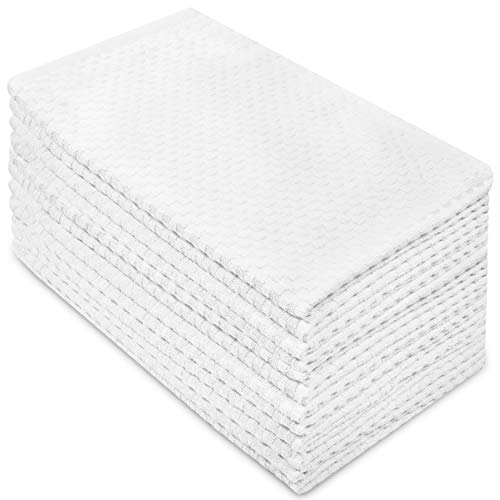
COTTON CRAFT Waffle Terry Kitchen Towels, 12 Pack — Best Ever Waffle Hybrid
The waffle-terry hybrid exists to fix the terry towel’s one real flaw: thickness that stays damp and turns sour in the drawer. The waffle structure creates air channels through the towel, so it dries between uses at a pace flat terry cannot match, while the terry component keeps the absorbency that made you choose a thirsty towel in the first place. The result is the towel for humid climates, small kitchens and anyone whose towels live on a hook rather than a heated rail.
The cafe sizing — 16 by 28 — is the European working format: long enough for pans and hands, narrow enough to hang and dry without folding. Twelve in the pack keeps the rotation generous. If your current towels’ problem is smell rather than absorbency, this is the most likely ‘best ever’ on the page for you.
Waffle weaves tighten slightly in early washes, which improves their structure; wash warm, skip softener as always, and hang them spread rather than bunched to exploit the fast-drying design you paid for.
Waffle weave has a final, visual virtue: it looks like a working textile. In open-shelved and cafe-styled kitchens where towels are part of the decor whether you planned it or not, the waffle’s structure reads as intentional and artisanal where flat towels read as laundry. The Euro cafe format is sized for that display as much as for the hand. If your kitchen is photographed by guests as often as it is cooked in, this pick is doing two jobs for you and charging for one.
Close the waffle case with its laundry virtue: these towels wash and dry faster than any other pick, which in a household doing frequent small loads — or line-drying in a damp climate — compounds into real convenience. The best towel in a laundrette-powered life is the one that completes the cycle fastest, and here the waffle wins outright.
Strengths
- Air-channel waffle dries fast, resists souring
- Terry absorbency retained
- Cafe size hangs and dries without folding
Trade-offs
- Narrower than the big flat towels
- White shows working stains
- Hybrid weave polishes glass less cleanly than flour sack
Key specs: 12 pack; 100% cotton waffle terry; 16×28 inches (per Amazon listing).
Best for: humid kitchens and sour-towel sufferers / Not suited for: glass-polishing specialists
Check the current price on Amazon
Comparison Table
| Pick | Badge | Key spec | Best for |
|---|---|---|---|
| Utopia Kitchen Flour Sack Towels, 12 Pack (28×28) | Best Ever for Glassware | Flour sack, 28×28, 12-pack | glassware, baking and lint-free drying |
| Zeppoli Classic Dish Towels, 15 Pack | Best Ever Workhorse Pack | 15-pack cotton workhorse | busy family kitchens and new-kitchen setups |
| Premium Kitchen Towels, 6 Pack, Flat & Terry (20×28) | Best Ever All-Rounder | Dual flat/terry, 20×28 | small kitchens wanting one towel for everything |
| Williams-Sonoma All Purpose Pantry Towels, Set of 4 | Best Ever Premium | Premium pantry weave, set of 4 | serious cooks and gifts for them |
| All-Clad Dual-Purpose Kitchen Towels | Best Ever Textured Performer | Dual texture, 17×30 in | heavy-pan kitchens and keen cooks |
| COTTON CRAFT Waffle Terry Kitchen Towels, 12 Pack | Best Ever Waffle Hybrid | Waffle-terry hybrid, 12-pack | humid kitchens and sour-towel sufferers |
How to Choose the Best Dish Towel: Weave Is Destiny
Choose by the job you do most. If your sink fills with glasses and your standard is spotless, flour sack’s smooth, lint-free weave is the specialist and nothing else is close. If your drying is volume — family dinners, big pans, constant throughput — terry loops drink the most per pass. If your towels sour or your kitchen is humid, waffle’s air channels are the engineering answer. If you cook seriously and use the towel as a tool — gripping pans, carrying tins, lining baskets — the flat pantry weave is the professional’s format, proven over a century.
Most kitchens honestly need two: a working towel and a finishing towel. The dual-purpose picks here try to be both in one cloth and come closer than you would expect, but the classic pairing — terry or waffle for volume, flour sack for finishing — remains the connoisseur’s setup. Buy the pair before buying a second pack of either.
Material discipline simplifies everything: 100% cotton for the classic jobs. Synthetics and blends have niches, but cotton absorbs, withstands heat, washes hot and improves with age. Every pick in this guide is all-cotton for exactly those reasons.
Size, Count and the Rotation System
Size by the largest thing you dry. A towel under about 15 inches in its short dimension cannot wrap a roasting pan or cushion a stack of plates; the working sweet spot is 16 to 20 inches by 25 to 30. Oversized flour sacks earn their keep in baking and batch cooking. Too large is a real failure too — a towel that must be folded twice to hang will dry slowly and sour, whatever its weave.
Count is a feature, not packaging. The right system is a rotation: towels in use, towels in the wash, towels resting clean. For most households that means eight to fifteen working towels. Scarcity forces the damp-towel compromise that makes drying bad and kitchens smell faintly of it. This is why two of the six picks are bulk packs: the ‘best ever’ towel is partly a logistics decision.
Assign roles visibly — a colour, a hook, a drawer section for hand towels versus dish towels versus floor-emergency towels. Kitchens that separate roles keep each towel in its best condition longer, and nobody dries a glass with the towel that just mopped the floor.
The Sour Towel Problem and Other Care Truths
A towel sours because it stays damp in a warm, dark place with bacteria for company — a care problem wearing a product costume. Fast-drying weaves help, but the habits decide: spread towels to dry fully between uses, never ball them in the drawer, wash hot and often, and retire a towel from kitchen duty the moment a wash no longer brings it back sweet.
Fabric softener is the category’s quiet saboteur. It coats cotton fibres with a water-resistant film, converting an absorbent towel into a water-pusher over a dozen washes. If your towels have stopped drinking, a hot wash with no detergent — or a vinegar rinse cycle — can strip much of the build-up and resurrect them. It is the first thing to try before replacing any towel, including the ones that inspired this search.
Replace on function, not appearance: when a towel stays thin and slick after a proper strip-wash, or its hems have gone and it frays into the food zone, it is done. Working towels that reach that point after years of service have earned their ‘ever’ honestly.
Building the Complete Towel Drawer: A System, Not a Pack
The complete drawer, for a household that cooks daily, looks like this: a bulk working pack for volume and rotation, a finishing set for glass and presentation, and two or three veterans demoted to floor and spill duty so good towels never mop. Total investment is modest; the effect is that every drying task meets the right cloth at the right dryness, which is the entire lived experience of ‘best towels ever’.
Label the demotion path, literally if needed: once a towel is stained past presentation or thinned past absorbency, it moves down a tier rather than out of the house. That cascade is how professional kitchens extract full value from every cloth they buy, and it is why their towel budgets buy more performance per unit of money than home kitchens that replace in panic. Build the system once and the category stops being a recurring disappointment.
Tea Towels, Dish Towels and Dish Cloths: Clearing Up the Vocabulary
Three different tools share one drawer and much confusion. The dish towel — every pick in this guide — is the large, flat drying and working cloth. The tea towel is its close relative, traditionally linen or cotton, used for drying and presentation; in modern listings the words are used interchangeably, which is why this guide verified dimensions and weave rather than trusting names. The dish cloth is the smaller, thicker, often knitted square that lives wet at the sink for wiping and washing up — a different tool with a different lifespan and hygiene rhythm.
Confusing them causes real purchasing errors: cloths bought as towels disappoint on absorbency-per-towel, and towels cut down as cloths waste their size. When a listing’s dimensions are closer to a napkin than a hand towel, it is a cloth whatever the title claims — another reason the verification behind this guide checked measurements, not adjectives.
Complete the vocabulary with the bar towel and the side towel of professional kitchens: the bar towel is the narrow, ribbed workhorse for counters and spills, and the side towel is the cook’s personal pan-gripping cloth. Home kitchens rarely need the full taxonomy, but knowing it explains the shapes in serious shops — and stops you buying a beautiful tea towel to do a bar towel’s honest, grubby work.
How to Use and Care for Dish Towels Like a Professional Kitchen
Professionals are not fussier than home cooks; they are more systematic. This routine — roles, rotation, washing — is the entire difference between towels that perform for years and towels that disappoint in months.
- Set up three roles from day one: a hand towel by the sink, a drying towel for dishes and glass, and a working towel for pans, spills and surfaces. Never let one towel drift across all three jobs in a day.
- Use the right technique for drying: pat and draw the towel across glass rather than rubbing in circles, which spreads moisture and lint; for pans, dry the moment they are washed, while warmth helps the last moisture leave.
- Change the drying towel the moment it is saturated — a wet towel cannot dry anything, and pushing on with one is how streaks and lint happen. This is why pack count matters more than any single towel’s spec.
- Hang every used towel spread fully over a rail or hook in moving air, never bunched, and never draped over the oven door’s inner side where it stays warm and damp.
- Wash kitchen towels hot and separately from clothing, with no fabric softener, ever. Add a periodic strip-wash — hottest safe cycle, minimal detergent — if absorbency fades.
- Dry fully before folding away, store in an airy drawer or open shelf, and rotate stock so the same three towels are not doing every shift while the rest sit pristine.
Follow that system and any of the six picks here will feel like the best towel you have owned — because in a working kitchen, ‘best ever’ is a system with a good towel at its centre, not a towel asked to survive a bad system.
One professional habit deserves its own line: the end-of-day reset. Before the kitchen closes, hang the day’s towels spread to dry, put tomorrow’s clean set on the hooks, and send the day’s set to the wash basket — never back to the drawer half-damp. Two minutes nightly is what keeps a drawer of good towels smelling like a kitchen instead of a locker room.
The last professional habit: keep one towel sacred. In every kitchen there should be a single finishing towel — flour sack or pantry — that never touches a spill, a hand or a pan, reserved for glass and presentation alone. Guard its role and your glasses will always look like a restaurant’s, whatever chaos the rest of the drawer contains.
The towel drawer has one more professional division worth adopting: the visible and the invisible. Towels that hang in guest sight — the rail by the sink, the hook by the hob — carry the kitchen’s presentation, and the pantry and flour-sack picks hold that role with dignity. Towels that live in the drawer and the wash rotation carry the volume, and the bulk packs hold that role without complaint. Assign the roles when the packs arrive, not after a month of drift, because a towel’s first job tends to become its permanent one — and a bulk workhorse hung for guests, or a pantry towel demoted to spills, is a small daily waste of exactly the qualities you paid for.
Common Buying Mistakes
Using fabric softener on towels
The single most common cause of ‘my towels stopped working’. Softener films the fibres; the towel pushes water instead of drinking it. Strip-wash to recover, then never again.
One towel for every job
Hands, dishes, pans and floors through one cloth is how glasses get greasy and towels get sour. Roles and rotation are free; use them.
Judging a towel on its first day
Cotton towels reach full absorbency after several washes, as manufacturing finishes leave the fibres. A towel that disappoints on day one may be the best on this page by week two — and vice versa for coated showpieces.
Buying decorative tea towels for work
Printed, thin, pretty towels are for show and light duty. They absorb little and fade fast. Keep them for the oven-door photograph and buy working towels for working.
Letting towels stay damp
Bunched on a hook, left in the machine, folded wet into a drawer — each is a sourness appointment. Spread, dry, then store; the habit takes ten seconds.
Hanging good towels on the oven door to die
The oven door is where towels go to be scorched at the edges, soaked by the sink’s splash zone and used as the household’s universal rag. Give working towels a rail of their own, away from heat, and they will stay towels instead of becoming cautionary tales.
Final Recommendation
If ‘best ever’ means one recommendation, take the Premium flat-and-terry pack: it is the towel a stranger could run your kitchen with. For glassware and baking, the Utopia flour sacks are unbeatable; for sheer working rotation, the Zeppoli fifteen; for the connoisseur, the Williams-Sonoma pantry set; for engineered performance, the All-Clad; and for humid kitchens that fight sour towels, the COTTON CRAFT waffle-terry. Most kitchens will end happiest with two of these — a worker and a finisher.
Set up the role-and-rotation system in the how-to section and whichever you choose will perform like the best towel you have owned. Related kitchen guides are linked below.
Final steer, and it is the whole guide in one line: the best dish towel ever is the one that is clean, dry and within reach at the moment of need, in the weave that suits the job in your other hand. Buy the system that guarantees that moment — roles, rotation, no softener — and any of these six will feel like destiny.
Best Dish Towels Ever Best Bang For Buck Dish Towels Best Dish Towels And Washcloths Best Flour Sack Dish Towels Best Cotton Waffle Weave Kitchen Towels
Frequently Asked Questions
What is the most absorbent dish towel material?
Cotton terry absorbs the most per pass, with waffle-terry close behind and drying faster. Flour sack absorbs less per swipe but leaves no lint. All the picks here are 100% cotton; weave, not fibre, is the choice.
Why do my dish towels push water around instead of absorbing it?
Almost always fabric softener build-up or manufacturing finish on a new towel. Strip-wash hot with minimal detergent, skip softener permanently, and give new towels several washes before judging them.
How many dish towels should a kitchen have?
Enough for a rotation — typically eight to fifteen working towels — so a saturated towel can always be swapped for a dry one. Scarcity, not quality, is the most common cause of bad drying.
Are flour sack towels really better for glassware?
Yes. Their smooth, lint-free weave polishes without depositing fibres, which no looped or textured towel can match. They are the finishing towel; terry remains the volume towel.
How often should dish towels be washed?
Working towels every one to three days of use, hand towels daily in busy kitchens, always hot and softener-free. A towel that smells after washing is telling you it stayed damp too long, too often — retire it to non-food duty.
Can one towel really be the best ever for everything?
No single weave wins every job, which is why this guide names a best-ever per role and one all-rounder. The honest answer for most kitchens is two types: one for volume, one for finishing.
Do white towels stay white in a working kitchen?
Mostly, with hot washing and prompt treatment of the staining usual suspects — tomato, turmeric, red wine. But be honest about your kitchen: if stains distress you, the grey dual-sided pick exists precisely so the evidence of work stops being a laundry grievance.
Are expensive dish towels worth it over bulk packs?
For the jobs premium towels do — gripping, carrying, presenting, lasting a decade — yes, in small counts. For rotation volume, bulk wins. The complete drawer uses both, which is why this guide refuses to crown a single price tier as ‘ever’.
Are linen towels better than cotton for drying?
Linen is the traditional tea-towel fibre: strong, smooth and increasingly absorbent with age, and beloved for glass. Cotton wins on availability, softness and price, and every pick here is cotton. If you find a true linen towel at a fair price, it belongs in the finishing role beside the flour sacks.
How can I tell if a towel is good quality in a shop?
Hold it to the light: a dense weave shows little light through it. Check the hems are stitched, not glued or raw; check the size against your own hands; and wring it mentally — quality cotton feels substantial dry and promises to drink. Then verify the dimensions, because listings exaggerate size more than any other spec.
Should dish towels match my kitchen?
Working towels should match your system first and your decor second — but the visible rail is a legitimate exception. Keep one presentable set for the rail and guests, in colours that suit the room, and let the drawer rotation be as plain as it likes.


