Disclosure: airfryerkitchensupply.com is reader-supported. When you buy through links on our site, we may earn an affiliate commission at no extra cost to you.
Where to buy
Every cloth set in this guide to towels for cleaning bathroom surfaces was verified against Amazon’s catalog data for this site before it earned a link. Pack counts and sizes shift between listings, so use the links to check the current price on Amazon and confirm the exact pack configuration you are ordering for your home.
- CODOHI Extra Large Microfiber Cleaning Cloths, 6 Pack (20″ x 30″) — check price on Amazon
- HOMERHYME Microfiber Glass Cleaning Cloths, 10 Pack (16″ x 14″) — check price on Amazon
- Niveaya Microfiber Fish Scale Cleaning Cloths, 8 Pack — check price on Amazon
- Utopia Towels Cotton Bar Mops, 12 Pack (16″ x 19″) — check price on Amazon
- Zeppoli Classic Dish Towels, 15 Pack (14″ x 25″) — check price on Amazon
- Groko Textiles Cotton Bar Mops, 24 Pack (16″ x 19″) — check price on Amazon
The right towels for cleaning bathroom surfaces are not bath towels at all — they are a small, deliberate system of cloths, each one matched to a surface and a soil type. This guide to the best towels for cleaning bathroom mirrors, showers, tubs, and fixtures is built on that idea: microfiber for glass and smooth surfaces, textured weaves for showers, and cotton terry for scrubbing and soaking, all verified.
That system matters because a bathroom is the worst room in the house for a one-cloth approach. The cloth that scrubs a tub will streak a mirror; the cloth that polishes chrome cannot soak up a sink overflow; and any cloth reused across every zone just moves grime around. The six picks below divide the work properly — and each one is a complete, verified product, not a filler pick. Read the picks for the products, then read the zone and laundry sections for the method that makes them work.
In this guide
Quick Picks
| Pick | Badge | Why it stands out | Amazon |
|---|---|---|---|
| CODOHI Extra Large Microfiber Cleaning Cloths, 6 Pack (20″ x 30″) | Best Overall | Oversized 20×30 microfiber cloths whose listing explicitly names bathrooms and housekeeping — big enough for tubs, shower walls, and floors. | Check on Amazon |
| HOMERHYME Microfiber Glass Cleaning Cloths, 10 Pack (16″ x 14″) | Best for Mirrors and Glass | Dedicated streak-free, lint-free polishing cloths sized for mirrors, glass shower doors, and chrome. | Check on Amazon |
| Niveaya Microfiber Fish Scale Cleaning Cloths, 8 Pack | Best for Showers and Fixtures | Fish-scale weave microfiber whose listing names shower and stainless steel — a texture that polishes and lightly scrubs at once. | Check on Amazon |
| Utopia Towels Cotton Bar Mops, 12 Pack (16″ x 19″) | Best Cotton Workhorse | 100% cotton terry bar mops — the absorbent, bleach-tolerant scrubbing cloth for tubs, sinks, and counters. | Check on Amazon |
| Zeppoli Classic Dish Towels, 15 Pack (14″ x 25″) | Best Flat-Weave Cotton | Flat-weave 100% cotton towels sold as reusable bulk cleaning cloths — the low-lint cotton option for counters and drying. | Check on Amazon |
| Groko Textiles Cotton Bar Mops, 24 Pack (16″ x 19″) | Best Bulk Pack | The same commercial bar-mop idea as the Utopia pick, doubled: 24 cotton terry cloths with a blue stripe for color-coding. | Check on Amazon |
How These Picks Were Chosen
We screened cleaning towels the way a housekeeper would: by job. Every candidate had to map to a real bathroom task — polishing glass, maintaining a shower, scrubbing a tub, drying fixtures, or bulk rotation — and every ASIN was matched to its listed title connected to this site before it was written up. Sizes, pack counts, and materials quoted in the spec boxes come from those verified titles only; where a title does not state a spec (one pick’s dimensions, another’s GSM), we say so rather than inventing numbers.
We excluded bath towels, hand towels, and beach or gym towels marketed for bodies rather than surfaces, even when they appeared in the same searches — a soft bath towel is a poor cleaning tool and a hygiene mismatch. We also deduplicated the many near-identical microfiber bulk packs that flood this category, keeping only cloths with a distinct role: an oversized housekeeping cloth, a dedicated glass polisher, a fish-scale maintenance cloth, and three cotton options split by weave and pack scale.
Two of the cotton picks are the same product type — 100% cotton terry bar mops — and we say so in their reviews rather than pretending otherwise. They differ in brand, pack size (12 versus 24), and detailing, and pack scale is a genuine decision for cleaning cloths, so both earned a slot with the overlap disclosed. Prices were used only as an internal sanity check and are never printed in this guide.
One more screening note: several large microfiber bundles in this category are sold primarily for car detailing or workshop use, with weaves too aggressive or sizes too awkward for bathroom surfaces. We kept the focus on cloths whose verified titles or weaves genuinely suit bathroom work — glass, shower, stainless, and housekeeping uses are named in the titles of our microfiber picks — rather than padding the list with automotive cloths that happen to be absorbent.
The 6 Best Towels for Cleaning Bathroom Surfaces

1. CODOHI Extra Large Microfiber Cleaning Cloths, 6 Pack (20″ x 30″) — Best Overall
Most cleaning cloths are sized for kitchen counters, and a bathroom exposes that immediately: a tub, a shower enclosure, and a tiled floor eat small cloths alive. The CODOHI set fixes the size problem first — each cloth is 20 by 30 inches — and its listing-verified title is one of the few that actually names bathrooms and housekeeping among its uses, which is why it leads this guide.
Strengths
- Extra-large 20×30 format covers shower walls and tub surrounds in a few passes instead of a dozen
- Microfiber grabs soap scum and toothpaste residue better than cotton on smooth surfaces
- Six-pack is enough to dedicate cloths by zone — glass, fixtures, tub, floor — which is the hygienic way to clean a bathroom
Trade-offs
- The large size is clumsy for small jobs like faucet bases and tap handles — pair it with a smaller cloth
- Microfiber needs proper laundering (no fabric softener) to keep its grab; see the care section
- Assorted bright colors (orange and green in the listing) are practical, not decorative
| Material | Microfiber (per Amazon title) |
| Size | 20″ x 30″ (per Amazon title) |
| Pack | 6 cloths (per Amazon title) |
| Stated uses | Mop cleaning, office, bathrooms, housekeeping (per Amazon title) |
The honest reason this pick wins is workflow. Bathroom cleaning fails when one small cloth gets loaded with grime and starts redistributing it. With six oversized cloths you can run a rotation — one for the mirror and glass, one for the sink and fixtures, one for the tub and shower, one for the floor and the toilet exterior — and retire each to the laundry instead of rinsing and reusing a dirty cloth. The 20×30 size also drapes over a flat mop head, which the title’s ‘mop cleaning’ note points at, turning floor duty into a quick pass rather than hands-and-knees work.
Microfiber quality varies, and the Amazon title does not state a GSM weight for this set, so we are not printing one. What the size and material together guarantee is absorbency headroom: a cloth this large can take up a full sink-splash or a shower-door’s worth of water without going soggy halfway. For most households this set, plus the glass cloth below, covers ninety percent of bathroom cleaning; the cotton picks further down are for people who prefer natural fiber or need serious scrubbing texture.
Size has one more subtle benefit: folding. A 20×30 cloth folds into quarters with a clean face still large enough for a full palm, so one cloth gives you eight working faces before it needs rinsing — on a shower wall, that is the difference between finishing the enclosure and stopping twice to rinse. The orange and green colors in the listing also make accidental zone-mixing obvious at a glance, a small practical gift in a category where all cloths tend to look identical in the laundry pile. If your bathroom is small and storage is tight, the pack still earns its place: six cloths fold into a stack no bigger than two bath towels.
Best for: deep-clean days and large bathrooms with big surfaces / Not suited for: mirror polishing, where a dedicated glass cloth does better
Check on Amazon — check the current price on Amazon before you buy, since sizes and colors change the listing options.

2. HOMERHYME Microfiber Glass Cleaning Cloths, 10 Pack (16″ x 14″) — Best for Mirrors and Glass
Every bathroom has one surface that exposes a bad cloth instantly: the mirror. General-purpose towels leave lint and streaks on glass no matter how clean they are, because their pile is built for absorbing, not polishing. HOMERHYME’s cloths are the opposite tool — a flat polishing weave, sold in a ten pack, and positioned by their Amazon title for glass and delicate surfaces.
Strengths
- Streak-free, lint-free finish on mirrors and glass — the one job ordinary towels reliably fail
- Ten-pack pricing logic: keep two in the bathroom, rotate the rest through laundry without running out
- Also the right cloth for chrome faucets and stainless steel, which spot and streak like glass
Trade-offs
- Thin polishing cloths absorb little — they are finishers, not spill cloths
- Too smooth to scrub soap scum or grout; pair with a textured cloth for the tub
- Small size (16×14) is wrong for floors and large shower walls
| Material | Microfiber, glass/polishing weave (per Amazon title) |
| Size | 16″ x 14″ (per Amazon title) |
| Pack | 10 cloths (per Amazon title) |
| Stated uses | Delicate surfaces, glasses, stainless steel, windshield (per Amazon title) |
The two-cloth method is the professional secret this pick enables: clean the mirror with a damp general cloth first, then buff dry with a glass cloth, and the streaks that plague single-cloth cleaning simply do not form. The same pairing transforms glass shower doors, which are the highest-maintenance surface in most bathrooms — a quick buff after the weekly clean keeps water spots from baking into visible scale. Because the pack holds ten, you can treat these as consumables-in-rotation rather than precious items, which is how they actually get used.
One caution from the listing’s own positioning: these are for delicate surfaces. Using them as your scrubbing cloth wastes their weave and shortens their life. In the system this guide recommends, HOMERHYME handles everything shiny — mirror, glass door, chrome, stainless — while the CODOHI or cotton cloths handle everything grimy. That division of labor is the real product being recommended here, and this ten-pack is its cheapest component.
Best for: mirrors, glass shower doors, and chrome fixtures / Not suited for: heavy scrubbing or soaking up big spills
Check on Amazon — check the current price on Amazon before you buy, since sizes and colors change the listing options.

3. Niveaya Microfiber Fish Scale Cleaning Cloths, 8 Pack — Best for Showers and Fixtures
Fish-scale weave is the middle path between a flat glass cloth and a scrubby sponge: the overlapping scale pattern gives microfiber a light texture that lifts water spots and soap film while still finishing streak-free. Niveaya’s eight pack earns its slot because its Amazon title names the two bathroom surfaces this weave suits best — shower and stainless steel.
Strengths
- Fish-scale texture polishes glass and chrome while lifting light soap film in the same pass
- Quick-drying weave suits a cloth that lives in the shower area between cleans
- Eight-pack supports the zone system — one for the shower, one for fixtures, spares in rotation
Trade-offs
- Texture is light-duty: baked-on scale and grout grime still need a brush or a stronger cleaner
- The weave can snag on rough stone or damaged grout — test before heavy use
- No size is stated in the Amazon title, so check the listing if cloth dimensions matter to you
| Material | Microfiber, fish-scale weave (per Amazon title) |
| Pack | 8 cloths (per Amazon title) |
| Stated uses | Window, kitchen, shower, stainless steel, auto (per Amazon title) |
Where this cloth earns its keep is maintenance cleaning — the five-minute weekly wipe that prevents the two-hour monthly scrub. Run it over shower glass and tile while surfaces are still damp from use, and water spots and soap film come off before they mineralize. On stainless steel — towel bars, flush plates, modern fixtures — the same weave buffs out fingerprints without the lint a cotton towel leaves behind. It is, in effect, the bridge pick between the HOMERHYME polisher and the heavy cloths.
We flag one data gap honestly: the verified Amazon title does not give this cloth’s dimensions, so we have left size out of the spec box rather than guessing. Everything else claimed here — the weave type, the pack count, the shower and stainless positioning — comes straight from the title. If your bathroom’s main enemy is the shower enclosure, start with this pack; if it is the mirror, start with HOMERHYME; most households end up wanting both, which is why both are on the list.
Best for: shower glass, tile, and stainless fixtures between deep cleans / Not suited for: grout scrubbing or very rough surfaces that can snag the weave
Check on Amazon — check the current price on Amazon before you buy, since sizes and colors change the listing options.

4. Utopia Towels Cotton Bar Mops, 12 Pack (16″ x 19″) — Best Cotton Workhorse
Bar mops are the unglamorous cloth that restaurants and bars rely on, and a bathroom benefits from the same logic: a thick cotton terry cloth that absorbs a lot, scrubs with real texture, and can be bleached back to white when it gets grim. Utopia’s twelve pack is the cotton anchor of this list — its Amazon title confirms 100% cotton, the 16×19 size, and the pack count.
Strengths
- Cotton terry loops give genuine scrubbing texture for tub rings, sink grime, and countertop residue
- White cotton tolerates hot washes and bleach — the easiest cloth on this list to sanitize fully
- Absorbency suits the wet jobs: mopping up sink splash, drying a washed floor, wiping down a tub after scrubbing
Trade-offs
- Cotton leaves lint on mirrors and glass — keep it away from polishing duty
- Slower to dry than microfiber, so a used cloth left in a heap will smell; hang or launder promptly
- White shows every stain even when the cloth is hygienically clean
| Material | 100% cotton, terry weave (per Amazon title) |
| Size | 16″ x 19″ (per Amazon title) |
| Pack | 12 cloths (per Amazon title) |
| Color | White (per Amazon title) |
The microfiber-versus-cotton debate has a simple resolution in a bathroom: use both, for different jobs. Microfiber wins on smooth, shiny surfaces. Cotton terry wins when the job involves texture and chemistry — scrubbing a tub with a powdered cleanser, wiping down grout lines, or soaking up the grey water a deep clean produces. Cotton also shrugs off the harsh treatments that degrade microfiber: bleach, boiling-hot washes, and powdered abrasives are all fine here, which matters in the one room where sanitation is the point.
A twelve pack at this size creates a sustainable rotation: a fresh cloth for each cleaning session, a laundry load when the stack runs out. That rotation is what keeps a bathroom cloth system hygienic in practice rather than in theory. If you only buy one cotton pick from this list, this is the one — the Groko pack below is the same idea at commercial scale for bigger households and heavier use.
Best for: scrubbing duty and anyone who prefers natural fiber / Not suited for: mirrors and glass, where cotton terry leaves lint
Check on Amazon — check the current price on Amazon before you buy, since sizes and colors change the listing options.

5. Zeppoli Classic Dish Towels, 15 Pack (14″ x 25″) — Best Flat-Weave Cotton
Zeppoli sells this fifteen pack as dish towels, and its Amazon title also calls them reusable bulk cleaning cloths — which is exactly how they earn a bathroom slot. A flat cotton weave behaves very differently from terry: it leaves far less lint, dries faster, and lies flat for wiping down counters, drying a sink surround, or protecting a shelf. Think of it as the cotton counterpart to the glass cloth.
Strengths
- Flat weave means low lint — the only cotton pick here that can finish a countertop or dry a fixture respectably
- Generous 14×25 towel size covers a vanity counter in one layout
- Fifteen-pack bulk makes them easy to dedicate — a stack that lives in the bathroom only
Trade-offs
- Flat weave has little scrubbing texture; tub grime needs the terry picks instead
- Thinner than terry, so absorbency per cloth is lower — swap cloths on big wet jobs
- Marketed for kitchens; bathroom use is our tested-logic recommendation, stated openly
| Material | 100% cotton (per Amazon title) |
| Size | 14″ x 25″ (per Amazon title) |
| Pack | 15 towels (per Amazon title) |
| Positioning | Reusable bulk cleaning cloths (per Amazon title) |
We are transparent about this pick: it is a kitchen towel by marketing, and a bathroom cleaning cloth by physics. Bathrooms need a low-lint drying cloth more than kitchens do — for the final wipe of a vanity, for drying chrome after cleaning, for laying under toiletries on a clean counter. Cotton terry cannot do that job without leaving fibers; this flat weave can. The fifteen-count pack also solves a storage reality: bathroom cleaning cloths should live in the bathroom, in quantity, or they will not be there when a quick wipe is needed.
Used this way, the Zeppoli towels become the finishing and drying layer of the system: scrub with Utopia terry, polish glass with HOMERHYME or Niveaya, and dry and finish with these. They launder like any cotton — hot wash, no special handling — and the blue colorway in the listing hides the cosmetic staining that makes white cloths look tired before they are actually worn out.
Best for: drying surfaces, counter wipe-downs, and lining shelves and drawers / Not suited for: scrubbing, where terry texture works better
Check on Amazon — check the current price on Amazon before you buy, since sizes and colors change the listing options.
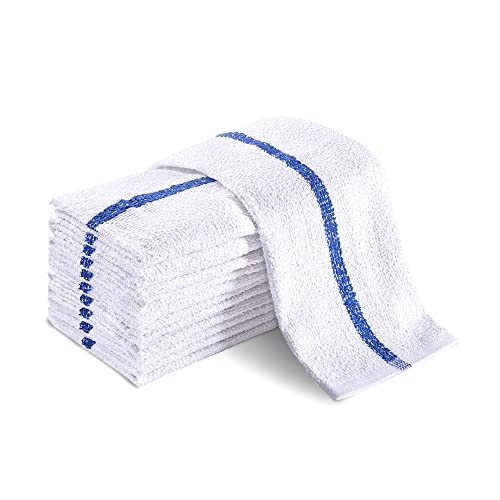
6. Groko Textiles Cotton Bar Mops, 24 Pack (16″ x 19″) — Best Bulk Pack
Full disclosure up front: this is the same product category as the Utopia pick — a 100% cotton terry bar mop at the same 16×19 size — and we include both deliberately, because pack scale is a real buying decision in cleaning cloths. Groko’s version doubles the count to 24 and adds a blue stripe, and its Amazon title positions it as commercial grade, aimed at exactly the heavy-rotation use this slot represents.
Strengths
- 24-pack supports a true laundry rotation for big families or multi-bathroom homes
- Blue stripe makes color-coding easy — stripe cloths for bathrooms, plain for kitchen — preventing cross-use
- Commercial-grade positioning suits rental turnovers and Airbnb-style cleaning kits
Trade-offs
- Functionally overlaps the Utopia pick; most single-bathroom homes only need one of the two
- Bulk pack is a bigger upfront commitment for a cloth you may want to test first
- Same cotton limits as any terry: lint on glass, slower drying than microfiber
| Material | 100% cotton, terry weave (per Amazon title) |
| Size | 16″ x 19″ (per Amazon title) |
| Pack | 24 cloths (per Amazon title) |
| Grade | Commercial grade (per Amazon title) |
Who actually needs twenty-four cleaning cloths? Anyone cleaning more than one bathroom, anyone running a short-term rental, and anyone who has learned that a cleaning system fails at the laundry step — when all the cloths are dirty at once, the system collapses back to paper towels. A 24-pack means a full week of zone-based cleaning (glass, fixtures, tub, floor, per bathroom) fits in one laundry load with spares left over. The blue stripe is a small feature with outsized value: it visually separates bathroom cloths from kitchen cloths in a shared laundry, which is a hygiene rule worth enforcing by design rather than by memory.
If your household is small, buy the Utopia twelve pack instead and spend the difference on the glass cloths — the system matters more than the stack height. But for the heavy-use end of the market, this is the honest bulk answer, verified like every other pick here against its Amazon title: cotton, terry, 16 by 19, twenty-four to a pack.
Best for: large households, rental properties, and heavy cleaning rotations / Not suited for: small bathrooms where a 12-pack already covers the rotation
Check on Amazon — check the current price on Amazon before you buy, since sizes and colors change the listing options.
Comparison Table
| Pick | Badge | Key spec | Best for | Amazon |
|---|---|---|---|---|
| CODOHI Extra Large Microfiber Cleaning Cloths, 6 Pack (20″ x 30″) | Best Overall | Microfiber; 20″ x 30″; 6 pack; washable and reusable | deep-clean days and large bathrooms with big surfaces | Check on Amazon |
| HOMERHYME Microfiber Glass Cleaning Cloths, 10 Pack (16″ x 14″) | Best for Mirrors and Glass | Microfiber glass cloth; 16″ x 14″; 10 pack; streak-free, lint-free | mirrors, glass shower doors, and chrome fixtures | Check on Amazon |
| Niveaya Microfiber Fish Scale Cleaning Cloths, 8 Pack | Best for Showers and Fixtures | Microfiber fish-scale weave; 8 pack; quick drying | shower glass, tile, and stainless fixtures between deep cleans | Check on Amazon |
| Utopia Towels Cotton Bar Mops, 12 Pack (16″ x 19″) | Best Cotton Workhorse | 100% cotton terry; 16″ x 19″; 12 pack | scrubbing duty and anyone who prefers natural fiber | Check on Amazon |
| Zeppoli Classic Dish Towels, 15 Pack (14″ x 25″) | Best Flat-Weave Cotton | 100% cotton flat weave; 14″ x 25″; 15 pack | drying surfaces, counter wipe-downs, and lining shelves and drawers | Check on Amazon |
| Groko Textiles Cotton Bar Mops, 24 Pack (16″ x 19″) | Best Bulk Pack | 100% cotton terry; 16″ x 19″; 24 pack; blue stripe | large households, rental properties, and heavy cleaning rotations | Check on Amazon |
Microfiber vs. Cotton: The Only Comparison That Matters
Microfiber’s split fibers grab and hold fine particles, soap film, and water spots, which is why it dominates on glass, chrome, tile, and smooth tub surfaces. Used damp, it cleans many bathroom surfaces with water alone; used dry, it buffs. Its weaknesses are laundering fussiness — fabric softener coats the fibers and kills the grab — and a shorter tolerance for bleach and very hot water.
Cotton, especially terry, is the opposite profile: absorbent, textured, and chemically bulletproof. It scrubs, it soaks, it survives bleach and hot washes that would degrade microfiber. Its weaknesses are lint on glass and slower drying. The professional answer is not choosing one material but assigning each its zone, which is exactly how this guide’s six picks are organized: microfiber trio for smooth and shiny, cotton trio for scrubbing, soaking, and drying.
The Zone System: How Professionals Assign Cloths
Glass and mirror zone
One dedicated glass cloth (HOMERHYME) or fish-scale cloth (Niveaya), used for nothing else. Keeping a cloth glass-only is what keeps it lint-free and streak-free over time.
Fixtures and sink zone
A microfiber cloth for faucets, handles, and the sink basin — surfaces that need polish and light soil removal, not abrasion.
Tub and shower zone
The scrubbing zone: cotton terry for texture, or the oversized CODOHI cloths for walls and surrounds. This zone’s cloths get the dirtiest and should be laundered after every deep clean.
Floor and toilet exterior zone
Always last, always separate. The oversized CODOHI cloths draped over a flat mop keep hands off the floor; the toilet exterior gets its own cloth that never travels to any other zone. Color or stripe coding — like the Groko pack’s blue stripe — makes the system self-enforcing.
Sizes and Pack Counts, Translated
Cloth size decides workflow more than cloth material does. Small polishing cloths (the HOMERHYME at 16×14) are for finishing. Mid-size terry (16×19 bar mops) is the scrubbing standard — big enough to fold into quarters, giving you eight clean faces per cloth. Oversized cloths (the CODOHI at 20×30) are for area work: shower walls, tub surrounds, and floors. Buying only one size means every job is done with the wrong tool half the time.
Pack counts decide whether your system survives laundry day. A workable minimum for one bathroom is two cloths per zone in rotation — one in use, one in wash — which is why the packs here start at six and run to twenty-four. If you are setting up from zero, the efficient buy is one microfiber set, one glass set, and one cotton set; that trio covers every zone with rotation to spare.
How to Launder Cleaning Cloths Without Ruining Them
Wash microfiber separately from cotton — cotton lint migrates into microfiber and reduces its grab. Skip fabric softener and dryer sheets entirely for microfiber; both coat the fibers. Warm water and a plain detergent are enough, and tumble drying on low or line drying preserves the weave. Cotton cloths are the opposite: hot water is fine, bleach is fine on whites, and they actually get more absorbent over the first several washes as manufacturing finishes wash out.
Two habits protect the whole system. First, rinse and hang cloths after use instead of leaving them in a wet heap — mildew smell in a cleaning cloth is a laundering failure, not a product failure. Second, retire cloths by zone: when a glass cloth gets worn, demote it to fixture duty, and let the scrubbing cloths be the ones that finally become rags. A cloth system maintained this way lasts many months per pack.
When to Replace Cleaning Cloths — and What a Cloth System Saves
Cleaning cloths do not wear out all at once; they fade by function. A microfiber cloth is done for glass duty when it starts leaving streaks even after a proper wash — the split fibers have worn or clogged — but it usually has a second life on fixtures and a third on floors. Cotton terry is done when the loops flatten and absorbency drops; you will notice you are pushing water around instead of picking it up. Building this demotion ladder into your routine means a pack purchase cascades through the zones for months before anything is truly thrown away, and only the floor-and-toilet cloths should ever leave the system directly.
The economics are worth stating plainly, because they are the reason this category exists. A household that cleans a bathroom weekly with paper towels burns through rolls continuously, and paper is genuinely bad at several of these jobs — it shreds on textured tile, leaves lint on glass, and goes soggy on a wet floor. A cloth system built from the packs in this guide costs roughly what a few months of paper towels cost, then keeps working for a year or more with nothing but laundry. The environmental math follows the financial math: fewer rolls bought, less waste bagged, and cloths that end their lives as garage rags rather than landfill after a single wipe.
One more replacement trigger is hygiene rather than performance. The cloth assigned to the toilet exterior lives the hardest life in the system; replace or boil-wash it more often than the others, and never let it migrate to another zone no matter how clean it looks. Cotton’s tolerance for hot water and bleach — the Utopia and Groko picks — is a genuine advantage here, and it is why we recommend cotton, not microfiber, for that specific assignment.
How to Clean a Bathroom Top to Bottom With This Cloth System
With the zone system stocked, a full bathroom clean follows a fixed order — dry work before wet, clean zones before dirty ones:
- Ventilate and declutter. Open a window or run the fan, clear the counters, and shake the bath mat outside. Every cloth works better on a clear surface.
- Dry-dust first. With a dry microfiber cloth, wipe light fixtures, vents, the top of the mirror, and baseboards. Dust removed dry does not turn into mud later.
- Glass and mirror. Mist the mirror, wipe with the CODOHI or a general microfiber, then buff dry with the HOMERHYME glass cloth in an S-pattern. Do the glass shower door the same way.
- Sink, counters, and fixtures. Wipe counters with the flat-weave Zeppoli or a microfiber, then polish chrome with the fish-scale Niveaya or the glass cloth until water spots disappear.
- Tub and shower. Apply your cleaner, let it dwell, then scrub with a cotton terry bar mop (Utopia or Groko) for texture. Rinse and wipe walls down with an oversized CODOHI cloth.
- Toilet exterior. Use its own dedicated cloth, top to bottom: tank, lid, seat exterior, bowl exterior, base. That cloth goes straight to the laundry afterward.
- Floors last. Drape a CODOHI cloth over a flat mop for the main floor, and use a folded cotton cloth for the corners and behind the toilet.
- Launder by material. Microfiber in one load without softener, cotton in another with hot water. Hang anything that still smells and rewash — a cloth should leave the laundry smelling like nothing.
Worked in this order, a standard bathroom takes fifteen to twenty minutes, and the cloths — not paper towels — do all of it. That is the entire point of buying the right towels for the job.
Common Buying Mistakes
Mistake 1: Using one cloth for the whole bathroom. A single cloth redistributes grime from the toilet zone to the sink zone. The zone system exists precisely to prevent that — assign cloths by area and launder the dirtiest zones after every use.
Mistake 2: Polishing mirrors with terry towels. Cotton terry leaves lint and drags moisture into streaks on glass. Mirrors need a flat polishing weave; terry is for scrubbing. Using each where it belongs ends the streak problem immediately.
Mistake 3: Washing microfiber with fabric softener. Softener coats split fibers and quietly destroys the absorbency and grab you paid for. Wash microfiber plain, separately from cotton, and it will perform for many months.
Mistake 4: Buying only small cloths. A 12-inch cloth on a shower wall or bathroom floor means endless wringing and re-wiping. One oversized set — the 20×30 CODOHI pattern — changes deep-clean day completely.
Mistake 5: Using bath towels as cleaning towels. Retired bath towels are too large, too plush, and too lint-prone for surface cleaning, and mixing body towels into cleaning duty is a hygiene muddle. Purpose-bought cleaning cloths are cheap and work dramatically better.
Mistake 6: Letting used cloths sit wet. A damp cloth left in a bucket or heap mildews fast, and then your ‘clean’ cloth smells worse than the bathroom. Rinse, hang, and launder on rotation.
Final Recommendation
If you are building the system from scratch, buy in this order: the CODOHI oversized microfiber set as your foundation, the HOMERHYME glass cloths for mirrors and chrome, and the Utopia cotton bar mops for scrubbing. That trio covers every zone in a typical bathroom. Add the Niveaya fish-scale cloths if your shower is glass-heavy, the Zeppoli flat-weave towels if counters and drying are your weak spot, and the Groko 24-pack if you are stocking multiple bathrooms or a rental.
Check the current price on Amazon for each set before ordering — pack counts and color options change — and remember that with cleaning cloths, the system is the product: six specialized cloths used in their zones will outperform a drawer of identical towels every single week. Start with the trio, run the top-to-bottom routine twice, and you will know exactly which zone in your own bathroom needs reinforcements; the remaining three picks are mapped to those specific gaps, so a second order — if you need one at all — is a targeted fix rather than another guess.
Shortlist again, with direct links: CODOHI Extra Large Microfiber Cleaning Cloths, 6 Pack (20″ x 30″) — check price on Amazon; HOMERHYME Microfiber Glass Cleaning Cloths, 10 Pack (16″ x 14″) — check price on Amazon; Niveaya Microfiber Fish Scale Cleaning Cloths, 8 Pack — check price on Amazon; Utopia Towels Cotton Bar Mops, 12 Pack (16″ x 19″) — check price on Amazon; Zeppoli Classic Dish Towels, 15 Pack (14″ x 25″) — check price on Amazon; Groko Textiles Cotton Bar Mops, 24 Pack (16″ x 19″) — check price on Amazon.
Keep exploring the same topic with these related guides from our team: Best Bar Towels For Drying Glassware Best Bath Towels For Small Bathrooms Best Bath Towels For Rv Best Beach Towels For Boats Best Bath Towels For Infants
Frequently Asked Questions
What kind of towel is best for cleaning a bathroom overall?
There is no single best cloth — there is a best cloth per zone. Microfiber wins on glass, chrome, and smooth surfaces; cotton terry wins for scrubbing and soaking; flat-weave cotton is best for drying and finishing. If forced to start with one purchase, an oversized microfiber set like the CODOHI 20×30 covers the most jobs, then add a glass cloth and a cotton scrubbing set as budget allows.
Can I use microfiber cloths on a glass shower door?
Yes — glass is one of microfiber’s best surfaces. Use a damp microfiber cloth to clean, then a dry glass cloth to buff, and water spots come off without streaks. The fish-scale weave (Niveaya) adds light texture for soap film, while flat glass cloths (HOMERHYME) are the finishers. Avoid abrasive pads on coated glass; microfiber gives you the result without the scratch risk.
How many cleaning cloths do I need for one bathroom?
A practical minimum is eight to ten cloths in rotation: two for glass and fixtures, two for the tub and shower, two for scrubbing and counters, and two for floors and the toilet exterior — so one set can be in the laundry while the other works. The packs in this guide are sized around that math, from the 6-pack oversized set to the 24-pack bulk option for multi-bathroom homes.
Why do my cleaning cloths smell even after washing?
Usually because they were left damp before washing, washed with fabric softener (for microfiber), or washed in a load that was too cool and crowded. Rinse and hang cloths after use, wash microfiber separately without softener, wash cotton hot, and make sure cloths dry fully before storing. A cloth that still smells after a proper hot wash has reached retirement — demote it to garage duty.
Are cotton or microfiber cloths better for scrubbing a tub?
Cotton terry is better for scrubbing: its loops give texture that works with a cleanser to lift tub rings and soap scum, and it tolerates powdered abrasives and bleach. Microfiber is better at the rinse-and-wipe stage and on the tub’s smooth surfaces once the grime is loose. The strongest routine uses both in sequence — terry to scrub, microfiber to finish.
How do I stop cleaning cloths from spreading germs around the bathroom?
Assign cloths by zone and never move a cloth from a dirtier zone to a cleaner one during a clean — work mirror first, toilet last. Launder the tub, floor, and toilet cloths after every deep clean, rinse and hang cloths between uses so they dry fully, and wash cotton cloths hot. Color-coding or a stripe (as on the Groko pack) makes the separation automatic. The system, followed consistently, is what keeps cleaning from becoming redistribution.
Can these cleaning towels be used in the kitchen too?
Most can — microfiber and cotton bar mops are general housekeeping cloths. The important rule is one-way traffic: keep bathroom cloths and kitchen cloths separate sets, permanently. Color-coding (like the Groko pack’s blue stripe) or simply storing a dedicated bathroom stack in the bathroom makes the separation automatic, which is the hygienic way to run both rooms.


