Disclosure: airfryerkitchensupply.com is reader-supported. When you buy through links on our site, we may earn an affiliate commission at no extra cost to you.
Where to buy
Every machine among the best heavy duty vacuum food sealers was verified against Amazon’s catalog data before inclusion, and the heavy-duty claim in each case rests on something checkable in the verified listing — motor wattage, a fan-cooled motor, a wide 5mm seal bar, or a chamber design — never on the word “professional” in a product name alone. All six are sold on Amazon; use the review links to check price on Amazon, because these machines are frequently bundled with different bag and roll starter supplies. The short version: the Weston Pro-2300 is the heavy-duty benchmark for home and small-batch commercial work, the Weston Pro-3000 adds programmable control on the same heavy platform, and the VacMaster VP210 is the chamber answer when liquids and volume enter the picture.
Introduction: what “heavy duty” has to mean before it means anything
The best heavy duty vacuum food sealers are not simply stronger versions of the sealer in a typical kitchen drawer. Heavy duty is a workload claim: the machine can run seal after seal — a whole deer broken down into cuts, a warehouse-club haul portioned for the freezer, a day of farmers-market produce — without the cool-down pauses that ordinary sealers impose after a handful of consecutive bags, and it can do that workload again next week and next season. Three engineering features separate that class from household machines, and this guide only awards the heavy-duty label where the verified listing supports at least one of them. The first is a fan-cooled motor, which sheds heat during long runs instead of shutting down to protect itself. The second is serious motor power — the Weston Pro machines in this guide are verified at 1020 watts, several times the draw of a basic home sealer — paired with a wide, thick 5mm seal bar that lays a broad, forgiving seam on bags up to 15 inches wide. The third is the chamber design itself, where the whole bag sits inside an evacuated chamber, the pump never ingests liquid, and duty is limited by the operator rather than the machine. Anything below that standard — including some perfectly good home sealers with “pro” in the name — is described in this guide for what it is, with its badge scoped to the work it can honestly repeat. If your sealing is a few bags a week, every machine here is more than you need, and the honest advice is to buy down. If your sealing arrives in seasonal mountains, read on.
In this guide
Quick Picks: the best heavy duty vacuum food sealers at a glance
- Best Overall Heavy Duty: Weston Pro-2300 Vacuum Sealer
- Best Programmable Heavy Duty: Weston Pro-3000 Vacuum Sealer
- Best Compact Heavy Duty: Weston Pro-1400 Vacuum Sealer
- Best for Serious Home Processing: Weston Professional Advantage Vacuum Sealer (65-0501-W)
- Best for Liquids and Marinades: VacMaster VP210 Chamber Vacuum Sealer
- Best Compact Chamber for Wet Foods: Avid Armor USV20 Chamber Vacuum Sealer
Four external sealers and two chamber machines, split by the two honest routes to heavy work: a fan-cooled, high-wattage edge sealer that eats bags in sequence, or a chamber that removes the edge sealer’s limits altogether. Weston’s Pro line anchors the external side at three sizes; the Professional Advantage is the step-down for serious home use; VacMaster and Avid Armor cover the wet, liquid, and high-volume work that edge sealers structurally cannot do.
How These Picks Were Chosen
Candidates were verified through the Amazon catalog data available to this site — exact model, current listing title, and the specifications the listing itself states. The heavy-duty screen was then applied strictly: a machine needed a fan-cooled motor, verified high wattage, a commercial chamber design, or an equivalently concrete workload feature in its own listing to carry a heavy-duty badge. Machines whose listings offered only adjectives were either excluded or, in one case, included with a deliberately narrower badge and an explicit note about what its listing does not claim. Beyond that screen, picks were judged on seal bar width and thickness, because wide bags and thick seams decide what food you can process; on bag format, since 15-inch capacity changes what a hunter or bulk buyer can seal whole; on control, from simple one-touch runs to the Pro-3000’s programmable settings; and on the chamber-versus-external divide for liquid work. No prices and no fixed ratings appear in this guide — check price on Amazon at each listing, where both change. Where a specification is not in the verified listing, this guide says so rather than borrowing numbers from elsewhere. That discipline costs a few impressive-sounding claims along the way, and it is worth the cost: a sealer bought on specifications its maker actually published is a sealer whose performance you can predict on the one day of the year when prediction matters most.
The 6 Best Heavy Duty Vacuum Food Sealers Reviewed

Weston Pro-2300 Vacuum Sealer — Best Overall Heavy Duty
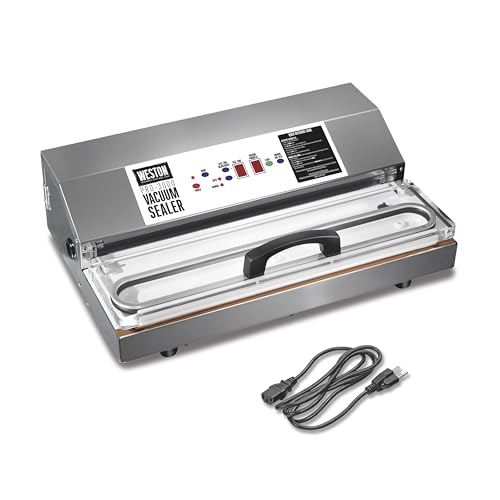
The Pro-2300’s verified listing reads like a checklist written by someone who has burned out a lesser sealer mid-harvest: 1020 watts, a fan-cooled motor, an extra-wide 5mm seal bar, capacity for bags up to 15 inches wide, and a stainless steel body, under model number 65-0220-W. Each element answers a known failure of household machines. The fan-cooled motor answers thermal shutdown during long runs. The wattage answers weak vacuum on dense, large cuts. The 15-inch width answers the roasts, whole fish, and racks that simply do not fit an 11-inch machine. And the 5mm bar answers the pinhole leak: a seam five millimeters wide forgives the small wrinkle or moisture trace that defeats a hair-thin seal, which matters most on the fortieth bag of the day, when operator attention is not what it was on the first. It suits hunters and anglers processing seasonal volume, bulk buyers portioning club-store hauls, gardeners freezing a harvest, and small food businesses sealing product for sale where local rules allow. It is more machine than a weekly leftovers routine will ever touch.
Strengths
- Fan-cooled 1020-watt motor is built for consecutive sealing runs without thermal rest stops
- Extra-wide 5mm seal bar lays a thick, forgiving seam — the single best defense against slow leaks on big batches
- 15-inch bag capacity handles whole roasts, fish, and racks that 11-inch machines force you to cut down
Trade-offs
- Size and weight claim real counter or storage space; this is equipment, not a drawer gadget
- Premium-tier machine with premium-tier bag consumption at volume — rolls become a real line item
- External design still cannot seal liquids flat; soups and marinades need the chamber picks below
Key specs (from the verified listing)
- Power: 1020 watts, fan-cooled motor (per listing)
- Seal bar: Extra-wide 5mm bar; bags up to 15 inches wide
- Body: Stainless steel
- Model: 65-0220-W
The Pro-2300 earns Best Overall because it removes the three anxieties of a big sealing day in order: will it keep running (the fan-cooled motor says yes), will the seals hold in month three (the 5mm seam is the best insurance an external sealer offers), and will the food fit (15 inches says almost always). Its remaining limits are the limits of its type. It pulls vacuum from outside the bag, so liquids creep toward the seal area and demand the usual discipline — pre-freeze wet foods, leave headroom, wipe the seal zone. And it is unapologetically industrial in footprint and intent; on a small apartment counter it will feel like a bench tool wandered into the kitchen. For the workloads in its badge, though, this is the machine the rest of the category is measured against, and the one to buy when a failed sealing day costs more than the price difference ever will.
Best for: hunters, bulk buyers, and gardeners running long consecutive sealing sessions / Not suited for: small kitchens, light weekly use, or anyone sealing mainly liquids
Weston Pro-3000 Vacuum Sealer — Best Programmable Heavy Duty
The Pro-3000 shares the Pro-2300’s heavy platform — the verified listing confirms the same 1020 watts, fan-cooled motor, extra-wide 5mm bar, and 15-inch bag capacity in stainless steel, model 65-0420-W — and adds the word that justifies its separate existence: programmable. Programmability in a sealer means stored, repeatable settings for vacuum and seal behavior rather than one fixed cycle judged by eye each time. That matters when a sealing day mixes jobs: delicate items that a full-power cycle would crush, moist cuts that need a longer seal, dry goods that need neither. Instead of babysitting each bag type, the operator dials the stored program and keeps the line moving, which is exactly the difference between a heavy machine and a heavy workflow. It suits the same processors as the Pro-2300, plus the subset who seal varied foods in one session — a farm stand packing greens, cheese, and meat in rotation, or a serious home processor who hates re-judging settings bag by bag. If your sealing is one food type in one long run, the Pro-2300 does the same work with less to think about.
Strengths
- Same verified heavy platform as the Pro-2300: 1020 watts, fan-cooled, 5mm bar, 15-inch bags
- Programmable settings make mixed workloads repeatable instead of re-judged on every bag
- Stainless build and commercial intent suit semi-professional routines, not just seasonal peaks
Trade-offs
- You pay for control you may never use if your sealing is single-food bulk runs
- More settings mean a learning curve before the machine disappears into the workflow
- Still an external sealer: liquids and very wet foods need pre-freezing or a chamber machine
Key specs (from the verified listing)
- Power: 1020 watts, fan-cooled motor (per listing)
- Seal bar: Extra-wide 5mm bar; bags up to 15 inches wide
- Controls: Programmable (per listing)
- Body: Stainless steel
- Model: 65-0420-W
Think of the Pro-3000 as the Pro-2300 for people whose sealing day has chapters. The hardware story is identical and equally convincing — the fan-cooled motor for endurance, the wide bar for seam security, the width for whole cuts. The programmable layer pays off precisely when variety enters: vacuum pressure that treats cheese gently and venison firmly in the same hour, seal times stored rather than guessed. Processors who run one product in volume will find that layer idle, and this guide says so plainly rather than pretending programmability is universally valuable. Processors who run a mixed table will find it is the feature that turns a powerful machine into a consistent one, and consistency — every bag sealed like the last — is what heavy duty actually means at the end of a long day.
Best for: processors sealing mixed food types in one session who want repeatable stored settings / Not suited for: single-product bulk runs where the Pro-2300’s simpler control is enough

Weston Pro-1400 Vacuum Sealer — Best Compact Heavy Duty
The Pro-1400 is the proof that Weston’s Pro line scales down without going soft. Its verified listing states 720 watts, the same extra-wide 5mm seal bar concept, bags up to 11 inches wide, commercial-grade positioning, and a stainless body under model 65-0301-W. The 720-watt figure matters because it sits far above household-sealer territory while the machine stays in an 11-inch format that fits ordinary kitchens and ordinary cuts. What you give up against the Pro-2300 and Pro-3000 is width, not seam quality: the 5mm bar still lays the thick, forgiving seal that defines the line, and 11 inches still swallows the steaks, chops, fillets, and portioned vegetables that make up most real sealing. What you keep is the Pro build and intent in a footprint a normal counter tolerates. It suits serious home processors — the bulk buyer, the meal-prepper sealing a week of proteins, the angler with a cooler of fillets — whose food fits 11 inches and whose kitchen cannot host the 15-inch machines. It does not suit whole-roast and rack-of-ribs work, which is a width question no motor can answer.
Strengths
- 720 verified watts and the line’s 5mm seal bar bring genuine Pro performance to an 11-inch format
- Commercial-grade stainless build in a size ordinary kitchens can store and lift
- The rational heavy-duty entry point: most home processing never needs 15-inch width
Trade-offs
- 11-inch ceiling excludes whole large cuts that the Pro-2300 and Pro-3000 take in stride
- Listing does not headline programmability — mixed workloads get less stored-setting help than the Pro-3000
- Still external: wet foods and liquids need the usual pre-freeze discipline
Key specs (from the verified listing)
- Power: 720 watts (per listing)
- Seal bar: Extra-wide 5mm bar; bags up to 11 inches wide
- Body: Stainless steel, commercial grade
- Model: 65-0301-W
The Pro-1400 is where this guide expects most heavy-duty buyers to land, and that is a compliment to its judgment rather than a consolation. Heavy duty, honestly assessed, is usually about seal integrity and session endurance at home scale, not about the widest bag on the market. A 5mm seam on a well-built 720-watt machine will out-seal and out-last the thin-bar household units that give vacuum sealing a bad name, and it will do so on the cuts that actually pass through home kitchens. Buy up to the 2300 or 3000 when width or programmability names a real job in your life; buy the 1400 when the job is serious volume of ordinary-sized food, and spend the difference on the rolls of bag stock you are about to consume in quantity.
Best for: serious home processors whose cuts fit 11 inches and who want Pro seam quality / Not suited for: whole large cuts, or buyers who need the 15-inch platform
Weston Professional Advantage Vacuum Sealer (65-0501-W) — Best for Serious Home Processing
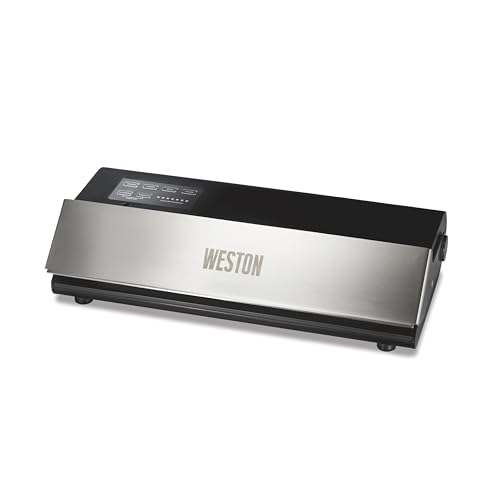
This pick carries the guide’s most carefully scoped badge, and the scoping is the point. The Professional Advantage’s verified listing confirms an 11-inch Weston sealer in stainless steel and black, model 65-0501-W — a professional-line machine from the same maker as the Pro series above. What the listing does not do is publish the wattage and fan-cooling claims that earned its bigger siblings their heavy-duty badges, so this guide does not lend it theirs. What it offers instead is the step between household sealers and the Pro platform: Weston’s professional build intent, an 11-inch format, and a long-established model that has served home game and bulk processors for years. It suits the buyer who wants professional-line construction for regular, substantial home use — weekly bulk portioning, a season’s fish or game in moderate quantity — without the counter footprint or commitment of the 1020-watt machines. Buyers planning truly long consecutive runs should take the listing’s silence seriously and step up to the fan-cooled Pro models, which state their endurance outright.
Strengths
- Professional-line Weston build in an 11-inch stainless format that suits regular substantial home use
- Long-established model (65-0501-W) with the accessory and bag ecosystem of a major sealing brand
- A genuine step up from household sealers for buyers not ready for the full Pro platform
Trade-offs
- Its verified listing does not publish wattage or fan-cooling, so no heavy-duty endurance claim is made for it here
- 11-inch width only — no path to the 15-inch bags of the Pro-2300 and Pro-3000
- Shoppers running marathon sessions are better served by the models above that state their cooling explicitly
Key specs (from the verified listing)
- Seal width: 11 inch (per listing)
- Body: Stainless steel and black
- Model: 65-0501-W
- Note: Wattage and duty specifications are not stated in the verified listing
In a category inflated with adjectives, the Professional Advantage is a useful honesty test, and it passes as what it is: a professional-line home machine. For the large middle of serious home sealing — the Saturday portioning run, the fishing trip’s fillets, the garden’s beans blanched and bagged — it has the build and the brand support to work for years, and its 11-inch format matches the food. The line this guide draws is only about proof: heavy duty in these pages means a listing that states its endurance hardware, and by that standard the Advantage stands one rung below the Pro trio, clearly labeled. Buy it with that understanding and it will not disappoint; buy any machine in this category without that understanding and disappointment is a matter of workload.
Best for: regular, substantial home processing in a professional-line 11-inch machine / Not suited for: marathon consecutive runs, where the fan-cooled Pro models state their case explicitly

VacMaster VP210 Chamber Vacuum Sealer — Best for Liquids and Marinades
The VP210 changes the physics of the problem. Instead of pulling air from outside a bag, a chamber machine places the whole bag inside a sealed chamber, evacuates the chamber, and seals the bag before air returns — which is why liquids stop being a problem: nothing is being sucked toward a seal bar, so soups, sauces, marinades, and oily fish seal flat and calm. VacMaster’s verified listing describes the VP210 as a maintenance-free commercial chamber sealer with a 10.25-inch seal bar for bags up to 10 by 13 inches, positioned for sous vide, liquids, and food storage. Maintenance-free is the load-bearing phrase for home buyers: the chamber category’s traditional oil pumps demand oil changes and care, and a maintenance-free design removes the main reason home users fear chamber machines. It suits high-volume households, sous vide devotees, marinade-heavy cooks, and anyone whose sealing list is half liquids — plus small commercial kitchens working within local rules. Its constraint is geometry: food must fit the chamber and the 10-by-13 bag, so the whole roasts that justify a 15-inch external machine are outside its world.
Strengths
- Chamber design seals liquids, sauces, and marinades flat — work no external sealer in this guide can do
- Maintenance-free commercial design removes the oil-pump upkeep that deters home chamber buyers
- Chamber cycle is inherently repeatable: no liquid ingestion, no seal-area contamination, bag after bag
Trade-offs
- Chamber and bag dimensions cap food size at what fits a 10 x 13 inch bag — no whole large cuts
- Chamber bags are a specific consumable; they are inexpensive per bag but must be the right type
- Counter footprint and weight are commercial-class; this machine lives where it works
Key specs (from the verified listing)
- Type: Chamber vacuum sealer, commercial
- Pump: Maintenance-free design (per listing)
- Seal bar: 10.25 inch; bags up to 10 x 13 inches
- Listing focus: Sous vide, liquids, and food storage
The VP210 is the pick that reframes what a sealing day can include. Stock day, sauce day, and marinade day — the jobs external sealers make miserable — become ordinary, and the per-bag cost of chamber pouches quietly undercuts textured roll bags over a season of volume. The maintenance-free design is what moves it from commercial curiosity to home recommendation: the performance story of a chamber without the ownership story of an oil pump. Its ceiling is written in its chamber dimensions, and buyers should measure their ambitions against a 10-by-13 bag before ordering. Inside that rectangle, for wet and high-volume work, it is not merely the best pick in this guide; it is the only type of machine that does the job properly at all.
Best for: liquids, marinades, sous vide prep, and high-volume sealing within chamber size / Not suited for: oversized whole cuts that need a 15-inch external machine
Avid Armor USV20 Chamber Vacuum Sealer — Best Compact Chamber for Wet Foods
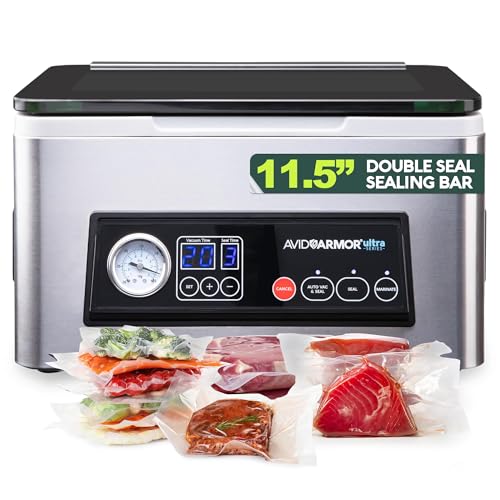
Avid Armor built its name by shrinking the chamber concept toward home kitchens, and the USV20’s verified listing states the formula directly: a chamber sealer with an 11.5-inch seal bar and a compact 4-liter chamber, described as high-volume and aimed squarely at wet foods — soups, sauces, and marinades — for home kitchens and serious food prep. Against the VP210 it trades some chamber presence for a friendlier footprint and a slightly wider seal bar, and it makes the same essential promise: liquids sealed flat, cycles repeated without the machine drinking your dinner, and marinade work that external sealers cannot touch. It suits serious home preservers whose sealing is wet and frequent — the stock maker, the sauce batcher, the sous vide household — and who want chamber behavior in the smallest honest package. It shares the category’s geometry limit: the chamber decides what fits, and wide or tall items belong to the external Pro machines above.
Strengths
- True chamber sealing of soups, sauces, and marinades in a compact 4L footprint
- 11.5-inch seal bar is generous for the compact chamber class
- Positioned and built for high-volume home use with wet foods, per its listing
Trade-offs
- Chamber capacity still caps portion size — bulky items will not fit regardless of the seal bar
- A smaller brand than VacMaster or Weston, so weigh long-term support in the decision
- Like all chambers, it is a counter resident, not a store-away appliance
Key specs (from the verified listing)
- Type: Chamber vacuum sealer
- Chamber: Compact 4L chamber (per listing)
- Seal bar: 11.5 inch
- Listing focus: Wet foods: soups, sauces, marinades; sous vide and bulk storage
Choose between the two chambers by footprint and feel. The VP210 brings the commercial VacMaster lineage and a maintenance-free pitch; the USV20 brings a compact 4-liter chamber and an 11.5-inch bar in a machine designed from the start for home kitchens doing serious volume. Both end the external sealer’s oldest frustrations — the creeping liquid, the fouled seal, the pre-freezing chore — and both replace them with the chamber’s single discipline: the food must fit. For households whose sealing is dominated by wet foods and who found the VP210’s commercial stance more than they wanted, the USV20 is the chamber idea at its most domestic, without giving up the high-volume intent its listing claims.
Best for: wet-food-heavy home sealing in the most compact true chamber here / Not suited for: oversized items, or buyers who prefer the largest brands’ support networks
Comparison Table
| Pick | Badge | Key spec | Best for |
|---|---|---|---|
| Weston Pro-2300 | Best Overall Heavy Duty | 1020W fan-cooled, 5mm bar, 15-inch bags | Long consecutive bulk and game processing |
| Weston Pro-3000 | Best Programmable Heavy Duty | 1020W fan-cooled, programmable, 15-inch bags | Mixed workloads needing stored settings |
| Weston Pro-1400 | Best Compact Heavy Duty | 720W, 5mm bar, 11-inch bags | Serious home volume in a normal footprint |
| Weston Professional Advantage | Best for Serious Home Processing | 11-inch, stainless, model 65-0501-W | Regular substantial home use |
| VacMaster VP210 | Best for Liquids and Marinades | Chamber, maintenance-free, 10.25-inch bar | Liquids, sous vide, high volume |
| Avid Armor USV20 | Best Compact Chamber for Wet Foods | Chamber, 4L, 11.5-inch bar | Wet foods in a compact chamber |
The table divides cleanly in two. The four external machines compete on power, cooling, and width; the two chambers compete on footprint and chamber size. Decide which half of the table your food belongs to before comparing within it — no wattage figure makes an external sealer good at soup, and no chamber makes an oversized roast fit.
How to Choose a Heavy Duty Vacuum Food Sealer
Begin with your worst sealing day, not your average one, because heavy duty is bought for the peak: the day the deer comes home, the club-store run lands, or the garden gives up its harvest all at once. Count the bags in that day and be honest about their size and wetness. Long runs of dry or merely moist food in large cuts point to the fan-cooled external machines. Peaks dominated by liquids, marinades, and portioned wet foods point to a chamber, where the peak stops being a fight. Peaks that are large but occasional, in ordinary-sized cuts, are the Pro-1400’s home ground.
Duty cycle and cooling: the real heavy-duty specification
Household sealers protect their motors and seal bars with rest: run too many consecutive cycles and the machine needs to cool, right in the middle of your batch. A fan-cooled motor exists to erase that pause, which is why this guide treats stated fan cooling as the clearest heavy-duty evidence an external sealer can offer. When a listing states wattage and fan cooling together — as the Pro-2300 and Pro-3000 do at 1020 watts — the endurance claim is concrete. When a listing is silent, as with the Professional Advantage, assume a serious home workload rather than a marathon one, and choose accordingly. Seal-bar heat matters too: a thick 5mm bar holds and recovers temperature across a long run better than a thin wire, which is part of why the Pro line’s seams stay consistent at bag forty.
Width and seam: match the machine to the food
Bag width is a hard gate. Eleven inches covers steaks, chops, fillets, cheese blocks, and portioned vegetables — most of home processing. Fifteen inches adds whole roasts, whole fish, racks, and large primal cuts sealed intact. Measure your ambitions literally: the widest thing you seal whole sets the machine class, and no other specification compensates for a bag that does not fit. Seam width is the softer variable with hard consequences: the 5mm seams of the Pro line forgive the wrinkles and moisture traces of fast, real-world bagging, and forgiveness at volume is worth more than peak vacuum figures, because the seal that fails in month two wastes more food than a slightly softer vacuum ever will.
External or chamber: the wet-food divide
External sealers pull air out of the bag from outside, so liquid in the bag migrates toward the vacuum and the seal. Discipline manages this — headroom, patting dry, pre-freezing liquids into slabs — but it never disappears. Chamber machines evacuate the space around the bag, so liquids stay put and seal flat, marinades work in the bag, and per-bag costs drop because chamber pouches need no textured channels. The chamber’s price is geometry and footprint: the food must fit the chamber, and the machine lives on a counter. Wet-food households should start their shortlist in the chamber half of this guide; dry bulk processors should start with the fan-cooled externals; households with both peaks should admit it and prioritize the peak that happens more often.
Bags and running costs at volume
At heavy-duty volumes, the machine is the smaller purchase. External sealers consume textured bags or rolls — rolls cut to length waste less and cost less per seal — while chambers consume smooth pouches that are typically the cheapest per bag in the category. Either way, a serious season uses hundreds, so check the price and availability of your machine’s consumables qualitatively before buying, favor standard sizes with multiple suppliers, and keep a full season’s stock on hand: running out of bags on processing day is the most preventable failure in this entire category.
How to Run a Long Sealing Session Without Failed Seals
Set up like a production line, because that is what a heavy day is. Stage food portioned and, for wet items, pre-chilled or pre-frozen into flat slabs; stage bags cut and opened in order; and keep a dry towel at the seal station exclusively for wiping bag interiors above the food line, since a dry seal zone is the difference between a 5mm seam that holds and one that channels. Work in a rhythm the machine can sustain: fill, wipe, seal, inspect, stack — and actually inspect, holding each seam to the light for channels or wrinkles while the next bag fills, because catching a bad seal now costs ten seconds and catching it in the freezer costs the food. Rotate your own attention rather than the machine’s settings: most late-session failures are operator failures, a hurried wipe or an overfilled bag, not equipment failures. For chamber work, keep liquid levels below the seal bar, leave the lid’s gasket clean, and let the chamber’s consistency carry the day. Finish by labeling everything — contents, cut, date, and weight where it matters — while the session’s knowledge is fresh; vacuum bags in a freezer are anonymous by design, and the label is the only memory they will ever have. Finally, let a fan-cooled machine idle a few minutes after the last bag and wipe the seal area and drip zones before storage; the next session’s reliability is decided at this session’s cleanup.
Seal Integrity: Why Seams Fail at Volume and How the Pro Features Prevent It
Almost every vacuum-sealing disappointment traces back to the seam, and heavy workloads attack the seam from three directions at once. The first is contamination: moisture, fat, and fine particles in the seal zone prevent the plastic layers from fusing, leaving a microscopic channel that admits air slowly — the bag looks sealed on the day and relaxes within weeks. The second is geometry: a wrinkle or fold crossing the seal bar creates the same channel at larger scale, and wrinkles multiply as bags get bigger and operators get tired. The third is heat drift: a thin seal element run back-to-back can run too cool to fuse fully or too hot and thin the plastic, which is why household machines ration consecutive cycles. The heavy features in this guide map one-to-one onto those failure modes. A 5mm bar widens the fused band so a small wrinkle or a trace of moisture is more likely to be sealed around rather than through — it converts many would-be channels into dead ends. Fan cooling stabilizes the whole thermal system, motor and seal area alike, so bag forty receives the same treatment as bag one. Chamber machines sidestep the contamination mode entirely, because nothing is drawn across the seal zone during evacuation; the liquid stays in the bag’s belly while the seam forms in still air. Understanding this mapping is the practical core of choosing well: you are not buying wattage for its own sake, you are buying insurance against the specific ways your own busiest day degrades a seam.
Chamber Ownership: Pouches, Gaskets, and Placement
Chamber machines ask a different ownership routine than external sealers, and it is worth knowing before the VP210 or USV20 takes up counter residence. Pouches come first: chambers use smooth, non-textured pouches sized to the chamber, and while they are typically the cheapest bags in vacuum sealing per unit, they are also a specific stock item — measure your chamber, standardize on one or two pouch sizes, and keep them in depth. The lid gasket is the machine’s quiet wear part: it seals the chamber against the lid every cycle, so keep it clean, keep food splash off it, and inspect it when cycles begin to sound longer than they used to, because a tired gasket taxes the pump on every bag. Placement matters more than with any external sealer, since the lid needs full swing clearance and the machine’s weight discourages relocation; choose its counter home once, near the prep area where liquids are portioned, and let it live there. The maintenance-free design of the VP210 removes oil changes from this routine, which is precisely why this guide is comfortable recommending a chamber to home users at all — the remaining care is wiping, gasket attention, and pouch stock, a list any serious kitchen already knows how to keep.
Order the batch: driest first, wettest last
Within a mixed session, sequence is free quality. Run dry goods and firm, dry-surfaced cuts first, when the seal area, the towel, and your own technique are at their cleanest; run moist cuts next; and run anything requiring pre-frozen slabs or special care last, when a pause to manage one difficult bag does not hold up a queue of easy ones. Grouping by bag size pays the same dividend — a run of identical bags lets hands learn one motion — and grouping by destination, freezer versus sous vide versus gifts, keeps the labeling honest at the end of a tiring day. None of this requires a better machine; it is the discipline that lets a good machine perform like a heavy-duty one, and its absence is how capable machines acquire undeserved reputations.
Common Buying Mistakes
The first mistake is buying adjectives: “professional,” “commercial-style,” and “heavy duty” appear on machines with no cooling, no wattage, and no seam to back them — demand the specification, as this guide does. The second is buying width you never use while skimping on the seam and cooling you use every session. The third is forcing an external sealer to live on liquids and blaming its seals, when the chamber design exists precisely for that work. The fourth is ignoring consumables: a season’s bags can rival the machine’s cost, and an exotic bag size with one supplier is a hostage situation. The fifth is under-buying for a genuine peak — a household machine rested every few bags turns processing day into processing weekend — and its mirror, over-buying a 15-inch fan-cooled platform for a few bags a week. The sixth is sealing wet food against a dry-seal machine without pre-freezing, then concluding vacuum sealing does not work. The seventh is skipping labels, which converts a well-run session into a freezer of mysteries by spring.
Final Recommendation
For the classic heavy workload — long runs of substantial cuts — buy the Weston Pro-2300: fan-cooled, 1020 watts, a 5mm seam, and 15 inches of width cover the peak days completely. Add mixed food types and a wish for stored settings and the Pro-3000 justifies itself on the same platform. Keep the workload serious but the cuts ordinary and the Pro-1400 is the rational heavy-duty buy. The Professional Advantage serves regular substantial home use one rung below, honestly labeled. And when the food is wet — stocks, sauces, marinades, sous vide prep at volume — stop comparing wattage and buy a chamber: the VacMaster VP210 for the commercial maintenance-free route, the Avid Armor USV20 for the compact home route. For the rest of the category, see Best Handheld Vacuum Sealers for drawer-sized pumps, Best Chamber Vacuum Sealers for the full chamber field, Best Commercial Vacuum Sealers and Best Commercial Grade Vacuum Sealers for business-grade machines, and Best Food Vacuum Sealers for the general food-sealing roundup.
Frequently Asked Questions
What makes a vacuum sealer “heavy duty”?
Endurance hardware, verifiably stated: a fan-cooled motor that avoids thermal shutdowns during long runs, high motor power, a wide and thick seal bar that stays consistent across dozens of bags, or a chamber design whose duty is set by the operator. A badge or adjective alone, without one of those in the listing, is marketing rather than specification.
Can a heavy duty external sealer seal liquids?
Not directly. Liquids migrate toward the vacuum and foul the seal area on any external machine, however powerful. Pre-freeze liquids into flat slabs and seal them as solids, or use a chamber machine, which seals liquids flat by design. Marinades follow the same rule: container or chamber, not an open external bag.
Do I need 15-inch capacity?
Only if you seal whole large items — roasts, whole fish, racks — intact. Eleven inches covers the great majority of home processing: steaks, chops, fillets, and portioned foods. Measure the widest item you genuinely seal whole; that measurement, not ambition, should set the machine class.
Are chamber bags cheaper than external sealer bags?
Generally yes per bag, because chamber pouches are smooth and need no textured vacuum channels, while external sealers require embossed bags or rolls. At heavy-duty volumes that per-bag difference compounds into a real seasonal saving, which is one of the chamber design’s quieter advantages.
How long can I run a fan-cooled sealer continuously?
Fan cooling exists precisely to extend consecutive operation far beyond a household machine’s handful of bags, and the Pro models here are built for session-length work. Sensible practice still applies: work at a steady rhythm, keep the seal area clean, and let the machine idle briefly between batches of bags rather than treating any motor as literally tireless.
Is a chamber sealer better than a Pro external sealer?
Neither is better outright; they peak in different places. Chambers win on liquids, marinades, bag cost, and cycle consistency, and lose on item size. Fan-cooled externals win on width and whole large cuts, and lose on wet food. Match the machine to the food that dominates your heaviest days.

