Disclosure: airfryerkitchensupply.com is reader-supported. When you buy through links on our site, we may earn an affiliate commission at no extra cost to you.
Where to buy
If you are shopping for best food vacuum sealers, start with the verified listings below so you compare the exact model, capacity and included parts rather than a look-alike listing. FoodSaver FM2100 Vacuum Sealer Machine; FoodSaver V4400 2-in-1 Vacuum Sealer Machine; Nesco Deluxe VS-12 Vacuum Sealer, 130 Watts; MEGAWISE Vacuum Sealer Machine 80kPa; Weston Pro-1400 Vacuum Sealer Machine (65-0301-W); Bonsenkitchen Vacuum Sealer Machine, Silver. Session flow — storage, cutter, modes — decides satisfaction more than suction alone. Always check price on Amazon on the listing itself, because configurations and included accessories change without notice.
The best food vacuum sealers share a job description that sounds simple — remove air, seal the bag, protect the food — and a reality that is all about sessions. Twenty bags on prep day, one bag for tonight’s leftovers, a freezer that stays organised: the right machine makes all three feel effortless, and the wrong one makes each feel like a chore. This guide compares verified external sealers from compact to heavy-duty home class.
Every linked machine below was cross-checked process, and the spec lines quote only what those Amazon titles state: modes, storage, wattage or suction where given. That discipline matters in a category full of headline numbers, because the features you will feel are the cutter, the roll storage and the accessory hose, not a laboratory figure.
Decide by your longest honest session, confirm the exact bundle on the listing, and check price on Amazon for machine and supplies together. The comparison table and buying guide below turn that into a shortlist in minutes.
In this guide
Quick Picks
- Best Overall — FoodSaver FM2100 Vacuum Sealer Machine: Best for most households buying their first serious sealer. Check on Amazon
- Best Automatic — FoodSaver V4400 2-in-1 Vacuum Sealer Machine: Best for high-volume prep days wanting automation. Check on Amazon
- Best for Control — Nesco Deluxe VS-12 Vacuum Sealer, 130 Watts: Best for weekly sealers who value visual control. Check on Amazon
- Best Compact Power — MEGAWISE Vacuum Sealer Machine 80kPa: Best for small kitchens needing strong compact sealing. Check on Amazon
- Best Heavy-Duty Step-Up — Weston Pro-1400 Vacuum Sealer Machine (65-0301-W): Best for bulk buyers and harvest preservers. Check on Amazon
- Best for Meal Prep — Bonsenkitchen Vacuum Sealer Machine, Silver: Best for sunday meal-prep households. Check on Amazon
How These Picks Were Chosen
Picks were required to be external food vacuum sealers confirmed through the API check, spanning compact, mid-range and heavy-duty home classes so the guide answers by session size rather than by brand loyalty. Modes and accessories were recorded only where the Amazon title states them.
Every product named with a link in this guide was cross-checked against Amazon listing data: the brand and model were searched, the listed title was matched to the product described here, and only then was the Amazon link added. Capacities, wattages and features quoted in the spec lines come from those listed titles, not from memory or from third-party roundups. Where a tier or style has no confident API match, this guide says so in plain language instead of inventing a product to fill the slot. Prices are never printed as fixed numbers here because they move; each pick instead points you to check price on Amazon at the moment you shop.
Selection also weighed everyday ownership: how the product behaves on the second month, not just the first day. That means cleaning effort, replacement parts, storage footprint, noise or heat in normal use, and whether the design still makes sense when the novelty fades. Two otherwise similar models were separated by those ownership details, and the comparison table further down makes the trade-offs visible at a glance so you can shortlist in minutes.
The 6 Best Food Vacuum Sealers

FoodSaver FM2100 Vacuum Sealer Machine — Best Overall
Start with the FM2100 if you want the balanced home sealer most households should buy first: roll storage and a cutter built in, dry and moist settings for real food, an accessory port with hose for jars and containers, and starter supplies so the first session needs no extra order.
Key spec (verified): Roll storage & cutter; dry & moist modes; accessory port & hose (from Amazon title).
Strengths
- Built-in roll storage and cutter speed every session
- Dry and moist modes cover real mixed loads
- Accessory hose extends it to jars and canisters
Trade-offs
- External format still struggles with very wet loads
- Roll storage adds bulk versus flat compacts
- Starter supplies run out — budget for refills
The FM2100’s real advantage is session flow. Roll stored inside, cutter on hand, bag made to length, food in, one touch, done — repeated twenty times without hunting for scissors or a second roll. Meal prep succeeds or fails on that flow, and this machine respects it.
Its moist mode and accessory hose widen the menu honestly: marinades still need care and headspace, but everyday juicy proteins seal without the constant liquid-in-seal failures that make beginners abandon vacuum sealing altogether.
Check the current price on Amazon to confirm the exact configuration and what is included before you order.
Best for: Most households buying their first serious sealer / Not suited for: Anyone sealing mostly liquids — consider chamber instead
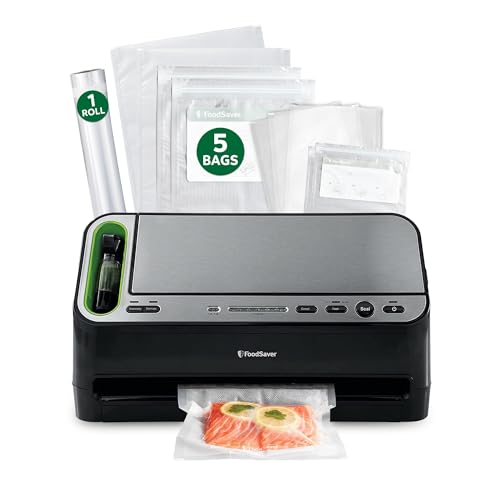
FoodSaver V4400 2-in-1 Vacuum Sealer Machine — Best Automatic
Choose the V4400 when you want the machine to handle more of the routine for you. Its 2-in-1 design with automatic bag detection suits high-volume prep days where aligning every bag by hand becomes the bottleneck you feel most.
Key spec (verified): 2-in-1 design; automatic bag detection (from Amazon title).
Strengths
- Automatic detection reduces failed alignments
- 2-in-1 versatility for varied sealing jobs
- Suits high-volume prep days well
Trade-offs
- Automation adds complexity to learn
- Larger routine may exceed casual needs
- Premium tier within home sealers
Automation earns its keep when volume rises. On a day with thirty bags to seal, automatic detection removes the fiddly alignment step that causes most mis-seals, and the 2-in-1 layout keeps handheld-style jobs within the same machine.
The honest limit is learning curve: more automation means more behaviour to understand when something does go wrong. Read the manual’s troubleshooting once, before the big prep day, and the V4400 rewards you; skip it and any smart machine feels temperamental.
Check the current price on Amazon to confirm the exact configuration and what is included before you order.
Best for: High-volume prep days wanting automation / Not suited for: Casual users who seal a few bags a month

Nesco Deluxe VS-12 Vacuum Sealer, 130 Watts — Best for Control
Pick the Nesco VS-12 when control matters more than automation theatre. The viewing lid lets you watch the seal form, the wattage is stated plainly in its Amazon title, and the compact silver body suits kitchens that seal weekly rather than daily.
Key spec (verified): 130 watts (from Amazon title); viewing lid; compact (from Amazon title).
Strengths
- Viewing lid confirms seal placement visually
- Compact footprint for weekly-use kitchens
- Straightforward controls without clutter
Trade-offs
- Less automation than flagship rivals
- Compact chamber pace on huge batches
- Silver finish shows prep-day splashes
Watching a seal form sounds minor until you have ruined bags by misalignment. The VS-12’s viewing lid turns seal quality into something you verify in the moment, which is especially valuable with textured or uneven foods that shift as air leaves the bag.
Its compact size also changes storage behaviour: a sealer that lives within reach gets used for the small jobs — half an onion, leftover herbs — where freshness gains quietly accumulate across a month.
Check the current price on Amazon to confirm the exact configuration and what is included before you order.
Best for: Weekly sealers who value visual control / Not suited for: Anyone wanting maximum automation
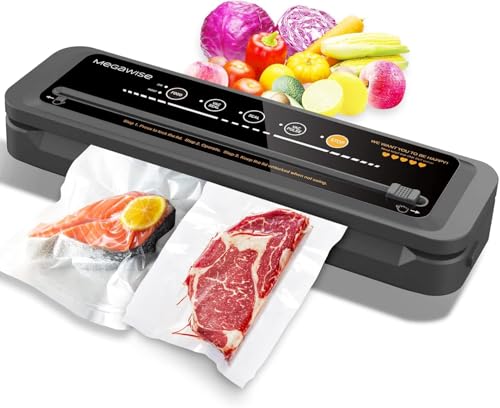
MEGAWISE Vacuum Sealer Machine 80kPa — Best Compact Power
Take the MEGAWISE when counter space is tight but expectations are not. It pairs stated 80kPa suction with a cutter, external vacuum capability and dry, moist and fresh modes in a compact one-touch body built for regular small-batch sealing.
Key spec (verified): 80kPa suction (from Amazon title); cutter included; dry/moist/fresh modes (from Amazon title).
Strengths
- Strong stated suction in a compact body
- Cutter and bags included to start immediately
- External vacuum adds container versatility
Trade-offs
- Compact class still needs cooling pauses
- Small body limits very wide bags
- Brand ecosystem smaller than FoodSaver
Suction claims need context, and MEGAWISE at least states its figure plainly in the Amazon title, which lets you compare like with like. In practice the compact body, included cutter and mode range matter just as much, because they decide whether the machine fits your counter and your foods.
Use pulse-style care with delicate items and give any compact machine brief rests on very long runs. Treated as a strong home tool rather than a production line, it delivers the freezer organisation most households actually want.
Check the current price on Amazon to confirm the exact configuration and what is included before you order.
Best for: Small kitchens needing strong compact sealing / Not suited for: Hunters sealing very wide game bags routinely

Weston Pro-1400 Vacuum Sealer Machine (65-0301-W) — Best Heavy-Duty Step-Up
Step up to the Weston Pro-1400 when home sealing starts to look like light production: bulk buys, garden harvests and repeated back-to-back bags. Its wider bar, higher wattage class and commercial-grade framing are built for sessions that make lighter machines pause.
Key spec (verified): Seals bags up to 11 in wide; 5 mm bar; 720 watts (from Amazon title).
Strengths
- Wide bar handles family-size portions
- Higher power class for back-to-back work
- Stainless build suits heavy rotation
Trade-offs
- Size and weight demand dedicated storage
- Overkill for occasional small sealing
- Higher commitment for beginners
There is a clear line where home sealers start pausing, overheating or producing tired seals, and it usually arrives mid-harvest or mid-bulk-buy. The Pro-1400 exists for the far side of that line: wider bags, stronger drive, and a build that treats long sessions as normal work.
It asks for space and commitment in return. If your sealing fits in a Sunday hour, the machines above are the smarter spend of counter room; if your sessions fill an afternoon, this class stops being a luxury and becomes the correct tool.
Check the current price on Amazon to confirm the exact configuration and what is included before you order.
Best for: Bulk buyers and harvest preservers / Not suited for: Occasional users short on storage space
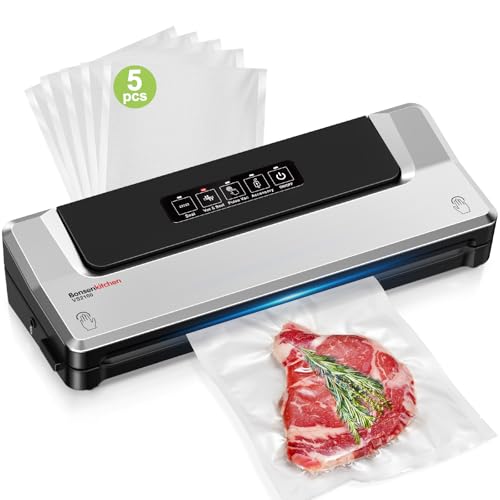
Bonsenkitchen Vacuum Sealer Machine, Silver — Best for Meal Prep
Consider the Bonsenkitchen for dedicated meal-prep households. Multiple modes, a compact silver body and an external vacuum system cover the Sunday batch-cook routine — proteins portioned, sauces contained, and the freezer organised in one pass.
Key spec (verified): Multiple modes; compact; external vacuum system (from Amazon title).
Strengths
- Multiple modes match varied meal-prep foods
- Compact body stores between prep days
- External system covers containers too
Trade-offs
- Fewer heavy-duty credentials for game loads
- Compact pace on marathon sessions
- Check included bag count on listing
Meal prep has its own sealing profile: many medium bags, mixed moisture, and a premium on repeatability. The Bonsenkitchen’s multiple modes and external vacuum option map neatly onto that profile, from portioned proteins to containers of prepped components.
Keep a simple prep-day order — dry goods first, then proteins, then moist items last with extra headspace — and a compact machine like this handles the full routine without the seal area becoming the failure point.
Check the current price on Amazon to confirm the exact configuration and what is included before you order.
Best for: Sunday meal-prep households / Not suited for: Anyone processing large game volumes
Comparison Table
| Pick | Badge | Key spec | Best for |
|---|---|---|---|
| FoodSaver FM2100 Vacuum Sealer Machine | Best Overall | Roll storage & cutter; dry & moist modes; accessory port & hose (from Amazon title) | Most households buying their first serious sealer |
| FoodSaver V4400 2-in-1 Vacuum Sealer Machine | Best Automatic | 2-in-1 design; automatic bag detection (from Amazon title) | High-volume prep days wanting automation |
| Nesco Deluxe VS-12 Vacuum Sealer, 130 Watts | Best for Control | 130 watts (from Amazon title); viewing lid; compact (from Amazon title) | Weekly sealers who value visual control |
| MEGAWISE Vacuum Sealer Machine 80kPa | Best Compact Power | 80kPa suction (from Amazon title); cutter included; dry/moist/fresh modes (from Amazon title) | Small kitchens needing strong compact sealing |
| Weston Pro-1400 Vacuum Sealer Machine (65-0301-W) | Best Heavy-Duty Step-Up | Seals bags up to 11 in wide; 5 mm bar; 720 watts (from Amazon title) | Bulk buyers and harvest preservers |
| Bonsenkitchen Vacuum Sealer Machine, Silver | Best for Meal Prep | Multiple modes; compact; external vacuum system (from Amazon title) | Sunday meal-prep households |
Read the table as a shortlist, not a ranking carved in stone. The best choice for best food vacuum sealers depends on how much you make at once, how you store the product, and which small annoyance you would rather live with. If two rows look tied, prefer the one whose trade-offs match the way you already work in your kitchen, because that is the one you will keep using.
How to Choose a Food Vacuum Sealer?
Separate the two families first. External sealers — every pick in this guide — pull air from a textured bag and seal it, and they cover the great majority of home food storage and sous vide work. Chamber sealers, covered in the neighbouring guide in this cluster, handle liquids fully but cost more counter and commitment. Most households should start external and step up only for a stated reason.
Within external machines, judge session flow: roll storage, a built-in cutter, and bag alignment decide how pleasant a thirty-bag prep day feels. Modes come next — dry and moist settings genuinely change outcomes with juicy foods — followed by accessory support if you seal jars, canisters or marinade containers as part of your routine.
Finally, match the machine to your longest real session. Weekly small batches suit compact models; bulk shops and harvests justify the heavier class in this guide. Every pick here was verified through the site’s API check, so the features in each spec line are the features the listing promises — confirm the exact bundle on the listing, since included bags and hoses vary.
What Do Dry, Moist and Pulse Settings Actually Do?
Dry mode assumes little free liquid and applies the standard vacuum and seal cycle most foods want. Moist mode adjusts the timing and seal to cope with juices being drawn toward the seal area, which is where ordinary seals fail. Neither mode performs miracles: chilled food, headspace in the bag and a dry seal zone still decide success.
Manual or pulse control, where offered, lets you stop the vacuum at the moment delicate foods — berries, baked goods, soft cheeses — have given up their air but not their shape. It is the feature experienced users miss most when it is absent, because automation cannot see crushing happen.
Seal-only mode is the quiet workhorse: it makes bags from a roll to your exact length and reseals open bags for short-term storage. Households that buy rolls rather than pre-cut bags will use it constantly, and it deserves weight in your decision even though it never headlines a listing.
How Long Does Vacuum-Sealed Food Keep?
Vacuum sealing extends freezer life substantially compared with air-filled wrapping, because removing air slows freezer burn and flavour loss. Exact durations depend on the food, its starting freshness and a freezer that holds temperature steadily, so treat any single number anyone quotes as a guide rather than a promise.
Technique matters as much as time. Food sealed fresh, in portion sizes you will actually use, frozen flat and labelled with contents and date will outperform technically perfect seals on tired ingredients. The sealer preserves quality; it does not create it.
For sous vide, the benefit is different: reliable seals that hold through a long bath, with no floating and no water ingress. Use bags rated for the purpose, keep the seal area clean when filling, and double-seal very long cooks for peace of mind.
How to Vacuum Seal Food Properly, From Setup to Freezer?
Set up the session before the food comes out. Stage the machine, a roll or stack of bags, labels and a marker, and a tray for finished bags. Work dry goods first, then proteins, then moist items last, so the seal area stays clean for as long as possible across the run.
Fill with discipline. Leave generous headspace between food and seal, keep the inside top of the bag clean and dry, and flatten contents so air escapes evenly. For juicy foods, chill or briefly freeze until just firm — that single trick prevents more failed seals than any machine feature.
Seal, inspect, then freeze flat. Check each seal for a continuous, even line with no channels or wrinkles crossing it; reseal immediately if you find one. Freeze bags flat on a tray, then stack them like files once solid, and your freezer becomes searchable instead of archaeological.
Maintain the machine lightly but regularly. Wipe the seal area and drip zone after moist sessions, check the gasket and sealing strip for wear when seals start looking tired, and store the lid unlatched where the manual advises it, so gaskets are not compressed flat between uses.
Common Buying Mistakes
Sealing warm or wet food carelessly causes most beginner failures. Liquid races the vacuum into the seal zone, the seal forms through moisture, and the bag quietly loses vacuum in the freezer. Chill moist foods, leave headspace, and clean the bag top — technique first, machine second.
Buying the biggest machine for a small routine wastes counter and goodwill. A heavy sealer that must be hauled out will be hauled out rarely, while a compact machine within reach seals the small jobs where freshness gains accumulate. Match the machine to the habit you truly have.
Ignoring refill costs distorts the budget. Bags and rolls are the ongoing spend of vacuum sealing, and heavy users should favour standard sizes and roll-based bag making, which this guide’s picks support. Price your likely bag use before choosing, using the listings to check price on Amazon for the machine and its supplies together.
Skipping labels because ‘I will remember’ guarantees mystery bags. Contents look alike once frozen, and dates decide what gets used first. Label before sealing, while the food is in front of you, and include the date every single time.
Final Recommendation
For most shoppers, start with the Best Overall pick and only move away from it for a stated reason: a smaller household, a larger batch, a tighter cupboard, or a strong preference for one material or workflow over another. That discipline keeps you from paying for capacity or features you will never use while still leaving room to step up when your routine genuinely demands it.
Keep exploring the cluster once you have shortlisted: Best Food Vacuum Sealers For Home Use and Best Food Vacuum Sealers For Packaging Game cover the closest alternatives, while Best Chamber Vacuum Sealers and Best Commercial Vacuum Sealers help if your needs sit just outside this brief. Readers who want the neighbouring angle should also see Best Affordable Vacuum Sealers Machines.
Going Deeper: What Experienced Owners Learn About Best Food Vacuum Sealers?
The shortlist above will get best food vacuum sealers right for most buyers. The sections that follow are for readers who want the second layer — the habits, pairings and small systems that separate a purchase you are satisfied with from one you would repeat without thinking. None of it changes the picks; all of it changes how much value you extract from them.
How Should You Choose Bags and Rolls for Your Sealer?
Bags are the consumable your results depend on, so choose them as deliberately as the machine. Textured bags made for external sealers are not interchangeable with smooth storage bags, and the seal quality difference is immediate. Favour reputable supplies in the widths your machine supports, and treat suspiciously thin bags as the false economy they usually prove to be in a freezer full of food.
Rolls offer the flexibility most households end up preferring: cut exactly the length each portion needs, waste nothing on oversized pre-cuts, and keep one supply for every job. Pre-cut bags answer back with speed on uniform prep days. Many experienced users keep both, and the picks in this guide with built-in storage and cutters are designed around exactly that mixed habit.
Thickness and intended use matter for demanding jobs. Freezer storage over months, sharp-edged contents and sous vide baths all reward sturdier bags, while short-term fridge storage is kinder. Match the bag to the job rather than buying one grade for everything, and your failure rate — punctures, channel leaks, tired seals — falls noticeably.
Store supplies with the machine and track them like a pantry staple. Running out mid-session is the most preventable frustration in vacuum sealing, and it always seems to happen with food already portioned on the counter. A simple rule — open the last roll, order the next — keeps the system invisible and reliable.
How Do You Organise a Freezer Around Vacuum Sealing?
Freeze flat, label fully, file upright: that system turns a freezer from a dig site into an index. Bags frozen flat on a tray become uniform files that stand in rows grouped by type, with labels facing out. You find dinner in seconds, you see quantities at a glance, and nothing migrates to the forgotten back corner to age into waste.
Label with the information your future self actually needs: contents, portion count or weight, and the date sealed. Add the cut or recipe where it matters — one frozen white fish looks exactly like another, and ground meat for two meals differs from ground meat for six only in the plan it was sealed for.
Rotate with a glance, not a project. A monthly look across the files, oldest pulled forward into the week’s meals, keeps stock turning over while quality is at its peak. Vacuum sealing extends freezer life generously, but the goal is food eaten at its best, not records set for storage duration.
Keep a small inventory habit if your freezer is large: a list on the door or in a phone note, updated as bags go in and out. It sounds fussy for exactly one week, after which it saves more time and duplicated shopping than any other habit in this guide. Serious preservers swear by it for a reason.
How Do You Troubleshoot Weak Seals and Lost Vacuum?
Work the problem in order of likelihood. First, the seal zone: moisture, grease or a wrinkle crossing the seal line causes most failures, and the fix is technique — headspace, a wiped bag top, contents flattened. Second, the bag itself: punctures from sharp edges and tired, reused bags account for most of the rest.
Third, the machine’s consumables. Sealing strips wear and gaskets tire, and both announce themselves as gradually weaker seals rather than sudden failure. Consult your model’s guidance for inspection and replacement, and note that storing the lid unlatched where advised preserves gasket shape between sessions.
Fourth, the load. Very wet foods, warm foods and overfilled bags defeat otherwise healthy machines, which is why the how-to section of this guide insists on chilling and headspace. If a seal fails, change one variable at a time and reseal a test bag; random adjustments teach you nothing and waste supplies.
Keep notes during big sessions. Which foods sealed cleanly, which needed a double seal, which bags misbehaved — a few lines after a processing or prep day make the next session measurably smoother. Vacuum sealing rewards system thinkers, and the system includes your own recorded experience.
Shortlist by need: For the balanced first machine, see FoodSaver FM2100 Vacuum Sealer Machine. For automated volume, see FoodSaver V4400 2-in-1 Vacuum Sealer Machine. For heavy home sessions, see Weston Pro-1400 Vacuum Sealer Machine (65-0301-W). Each of those links goes to the verified listing for the exact model discussed above, so you can confirm the configuration and check price on Amazon before deciding.
Which Pick Should Each Kind of Household Actually Buy?
The small household sealing a few bags a week should buy storage and simplicity, not power. A compact machine that lives within reach will be used for the cheese, the herbs and the half-recipe portions where waste actually happens, and those small rescues — repeated weekly — are where a sealer earns its keep fastest. Judge every extra feature against the question: will this make me seal more often?
The batch-cooking household should buy flow. Roll storage, a cutter that lives on the machine, modes that handle a mixed shop, and supplies staged in one place turn a Sunday session from a project into a rhythm. Your bottleneck will never be suction; it will be the small delays between bags, so choose the machine that removes the most of them.
The bulk-buying and preserving household should buy duty cycle without apology. When sessions run long and bags run wide, cooling, seal strength and build decide whether the last bag equals the first. Stepping up a class costs counter space every day, but it buys back the one or two days a year when the harvest or the bulk shop would otherwise defeat a lighter machine.
The specialist household — the hunter, the angler, the gardener with a glut — should read its own guide in this cluster alongside this one and buy for the peak, not the average. Peaks are when seals fail and food is lost, and equipment chosen for the average week will be remembered, unkindly, on the hardest day of the year.
What Should You Check on the Listing Before You Order?
Confirm the exact bundle. Included bags, rolls, hoses and starter kits vary between listings of the same model, and the first session’s convenience depends on them. The verified spec lines in this guide record what the Amazon titles state; the listing confirms what your box will contain, and two minutes there prevents a stalled first weekend.
Confirm bag compatibility in the maker’s own terms: supported widths, textured-bag requirements, and any roll-size limits for built-in storage. Supplies are the ongoing relationship with this machine, and a model that accepts widely available standard sizes will be cheaper and easier to feed for its whole life.
Confirm the modes you are actually counting on. Dry and moist settings, manual or pulse control, seal-only operation and accessory support are model-specific, not category defaults. If your decision rests on one of them — and for delicate foods or jars it reasonably might — verify it on the exact listing rather than assuming the range shares it.
Finally, confirm physical fit: the machine’s footprint against your storage, its weight if you will move it each session, and cord practicalities in your kitchen. A sealer’s specifications include its life in your home, and the listing’s dimensions are the cheapest research you will do in this entire purchase.
A Month With a Vacuum Sealer: What Actually Changes?
Week one is novelty: everything gets sealed, including things that did not need it. Forgive the phase; it teaches handling, seal inspection and bag sizing faster than any manual. By its end you know your machine’s rhythm, your typical bag lengths, and which foods in your kitchen genuinely benefit — knowledge every later week quietly spends.
Week two is where the money appears. The family pack portioned instead of frozen whole, the batch-cooked meals filed flat, the cheese that survives the month: waste lines in the bin get visibly shorter, and the freezer starts to look like a system rather than a snowfall. This is the week sceptical partners are usually converted.
Week three tests the edges — a juicy marinade, a delicate bake, a bone-in cut — and technique answers each: chill, headspace, pad, pulse. The month is teaching the real curriculum of vacuum sealing, which is not the machine’s buttons but the handful of habits that make seals boringly reliable.
By week four the sealer has a place, a supply rhythm and a role in the shop-to-freezer pipeline that nobody discusses anymore. That disappearance into routine is the true success state, and it is why this guide weighted storage, flow and supplies as heavily as sealing power itself.
One Last Check: Matching the Sealer to Your Food, Freezer and Habits
Your freezer is part of the machine’s specification. Flat-filed bags need shelf geometry that suits them, and a household with a small freezer should portion smaller and rotate faster rather than sealing a season it cannot store well. Measure the destination as honestly as the machine, and let the two choices inform each other.
Your shopping pattern is the other hidden specification. Weekly small shops reward compact convenience; monthly bulk runs reward flow and duty cycle; seasonal peaks reward the heavy classes in this cluster’s guides. The sealer that matches the pattern disappears into it, while the mismatched one becomes a monthly argument with yourself.
Your tolerance for systems closes the decision. Vacuum sealing pays best inside small habits — labelling, rotating, tracking supplies — and households that enjoy such order extract remarkable value. Households that do not should still buy, but buy simple, and let the machine’s ease carry what routine will not.
Key Takeaways Before You Decide
First, session reality outranks headline specifications. Storage, cutter access, roll handling and mode fit decide whether a sealer becomes a weekly habit or a cupboard monument, and habit is where the money is saved. Judge the picks in this guide against your longest honest session and your actual storage before you judge them against each other.
Second, technique is half the machine. Chilled food, generous headspace, a clean dry seal zone, inspected seals and honest labelling will make a mid-range sealer perform beautifully, while their absence will make a flagship machine look unreliable. Learn the handful of habits in the how-to section and every pick here rises a class in your hands.
Third, supplies are the ongoing purchase. Bags and rolls in standard sizes, kept in stock beside the machine, cost less and frustrate less over the machine’s life than any saving made on the hardware itself. Price the whole system — machine plus a realistic year of supplies, checked on the listings — before deciding what ‘affordable’ means for your household.
Finally, buy for the peak you truly face and the routine you truly keep, in that order of honesty. A machine matched to both will disappear into your kitchen’s working life, sealing quietly in the background of better-stored food and calmer prep days — which is precisely the unglamorous, compounding value this category exists to deliver.
How Does Vacuum Sealing Change the Way a Household Shops?
The first change is permission: bulk formats stop being a trap. The family pack that once had to be eaten within days becomes a portioning session and a month of ready protein, so the better per-unit value of larger packs becomes genuinely available to small households for the first time. That single shift, repeated across a year of shops, is where most sealers quietly repay their cost.
The second change is confidence at the market and the butcher’s counter. Seasonal gluts, manager’s specials and the extra portion a recipe offers all become opportunities instead of risks, because the household trusts its ability to preserve quality rather than merely delay waste. Shopping gets calmer and more opportunistic at once, which is a combination few appliances ever deliver.
The third change is subtler: cooking itself gets easier. A freezer of labelled, portioned, flat-filed ingredients behaves like a small private pantry of prepared components, and weeknight decisions shrink from ‘what can we make before this spoils’ to ‘what do we feel like eating’. That daily reduction in friction never appears on a spec sheet, and owners consistently rank it among the machine’s largest benefits.
One final habit ties the whole system together: end every session with sixty seconds of reset. Wipe the seal area, check the drip zone, coil the cord, confirm the bag supply, and leave the machine ready rather than merely finished. Readiness is a real feature, because the next session — tonight’s leftovers, tomorrow’s shop — should begin from zero friction. Households that adopt the reset habit seal more often and fail less, since most ‘machine problems’ are actually last session’s residue meeting this session’s haste. Add to that a brief note of anything unusual — a food that needed a double seal, a bag batch that misbehaved — and your own experience becomes part of the equipment. Over a year, that compounding tidiness is worth more than any single upgrade in this guide, and it costs nothing but a minute of attention at the moment attention is cheapest: right after the work, while your hands are already there and the details are still in front of you.
It is also worth saying plainly what this guide did not do: it did not rank these machines by laboratory suction figures, by appearance in other roundups, or by any score invented for the occasion. Each pick earned its place through verified features that map to a real session size — compact, weekly, prep-day or heavy home use — described in the terms the Amazon titles themselves use. If your routine sits between two picks, choose the one whose trade-offs you mind least and whose storage you can guarantee, because the sealer that lives within reach and gets used weekly will preserve more food in a year than a theoretically superior machine that spends its life in a box.
A last word on expectations, because this category suffers from inflated ones. A vacuum sealer will not rescue tired ingredients, forgive warm sealing, or organise a freezer by itself; what it will do, reliably and for years, is multiply good habits. Fresh food sealed promptly, in honest portions, with clean seals and clear labels, keeps its quality in a way that changes shopping, cooking and waste all at once. That multiplication — modest per bag, enormous per year — is the real product being sold in every listing in this guide, and it is available at every tier represented here. Choose the tier your sessions justify, learn the handful of techniques the how-to section lays out, keep supplies beside the machine, and the rest takes care of itself in the background of a better-run kitchen.
Frequently Asked Questions
What is the difference between an external and a chamber vacuum sealer?
External machines seal textured bags outside the unit and suit most home storage and sous vide work. Chamber machines seal the bag inside a chamber and handle liquids fully, at higher cost and size. Most homes start external.
Can I vacuum seal liquids and soups?
In an external sealer, freeze liquids solid or until firm first, then seal. Sealing free liquid directly pulls it into the seal and fails. Frequent liquid work is the honest reason to consider a chamber machine instead.
Do vacuum sealers work for sous vide?
Yes — reliable, water-tight seals are exactly what sous vide needs. Keep the seal area clean when filling, use suitable bags, and consider a double seal for very long cooks.
Why did my bag lose its vacuum in the freezer?
Usually a channel in the seal from moisture, a wrinkle, a bone puncture or a tired sealing strip. Inspect seals before freezing, protect sharp edges with a fold of bag or paper towel, and reseal any doubtful bag immediately.
Are vacuum sealer bags reusable?
Bags that held raw meat should not be reused for food safety reasons. Bags that held dry goods can sometimes be washed and reused if undamaged, but seals shorten with each cut. Most households treat bags as single-use for anything moist.
How do I stop delicate foods being crushed?
Use manual or pulse control where the machine offers it and stop the vacuum early, or freeze delicate items firm before sealing on a normal cycle. Both approaches preserve shape while still removing most of the air.

