An opened bottle of wine starts changing the moment the cork comes out. Oxygen in the headspace above the liquid goes to work on the aromas and flavours within hours, and a bottle that was vivid at dinner can taste flat and tired two evenings later. A wine vacuum sealer attacks that problem at its source: a rubber or silicone stopper with a one-way valve is pushed into the neck, a pump draws the air out of the bottle, and the reduced pressure slows the oxidation that would otherwise spoil the remaining wine. This guide compares six pump-and-stopper systems built for exactly that job, and it explains the differences that decide whether a system stays in daily use or migrates to the back of a drawer.
One disclosure before the picks. This site may earn an affiliate commission when readers buy through links on the page, at no extra cost to the reader. That commission is the business model, and it is stated plainly so the reasoning below can be judged on its merits. The selections come from research: manufacturer documentation, published stopper and pump specifications, stated set contents, and the chemistry of what oxygen does to wine in an opened bottle. Nothing here rests on a popularity score, and no preservation claim in this article goes beyond what the individual makers themselves publish.
A naming warning matters more in this category than in most. This site also covers vacuum sealers for food: countertop machines that pull air from bags and canisters so meat, cheese, and leftovers keep longer in a freezer. Those appliances share two words with the products below and nothing else. A food sealer cannot help an opened bottle, because its whole design assumes a flexible bag that collapses around the contents, and a wine pump cannot seal a bag of chicken, because its stopper only fits a bottle neck. Every pick in this guide is a bottle system for still wine. If the shopping list actually says freezer bags and bulk meat, the machine guide is the right page and this one is not.
In this guide
Quick picks: best wine vacuum sealers
| # | Product | Where to buy |
|---|---|---|
| 1 | Vacu Vin Wine Saver | Check on Amazon |
| 2 | Vacu Vin Wine Saver Concerto | Check on Amazon |
| 3 | Rabbit Wine Preserver | Check on Amazon |
| 4 | OWO Wine Vacuum Pump with 4 Stoppers | Check on Amazon |
| 5 | WOTOR Wine Saver Vacuum Pump with 20 Stoppers | Check on Amazon |
| 6 | Suncoo Wine Vacuum Sealer Set | Check on Amazon |
What a vacuum actually does for opened wine
Wine deteriorates after opening mainly through oxidation. Oxygen dissolves into the liquid at the surface, reacts with phenolic compounds and aroma molecules, and pushes flavours toward stewed fruit, nuts, and eventually the sharp note of acetaldehyde that drinkers recognise as a bottle gone over. The reaction rate depends on how much oxygen is available, which is why a nearly full bottle survives a night far better than a bottle with two glasses left in it: the smaller the headspace, the smaller the oxygen supply. A vacuum pump does not remove the oxygen already dissolved in the wine, and no pump at this price level produces anything like a perfect vacuum. What it does is cut the oxygen in the headspace down to a fraction of its starting amount, which slows the chemistry meaningfully and buys the bottle extra days of drinkable life.
That framing matters because it keeps expectations honest. Vacuum sealing is a brake, not a time machine. Delicate whites and older, fragile reds fade faster than young, tannic reds whatever system is used, and temperature and light keep working on the wine while it waits. Makers of these systems typically describe the benefit in days rather than weeks, and the figures they publish come from their own documentation, so this guide reports preservation in those terms instead of promising a universal number. The realistic goal for most households is simpler: open a good bottle on Tuesday, pour again on Thursday or Friday, and taste the same wine rather than its shadow.
One boundary is absolute, and every maker in this roundup states it in some form: these systems are for still wine only. Sparkling wine holds carbon dioxide under pressure, and that pressure is the preservation system the wine arrived with. Drawing a vacuum on a bottle of prosecco or champagne pulls the gas out of solution and flattens the wine faster than leaving it open would, while the stoppers are not shaped to hold pressure pushing outward in any case. Sparkling bottles need a clamp-style champagne stopper that grips the neck and resists the pressure from inside. Anyone whose leftovers are mostly sparkling should skip this entire category and buy that different, simpler tool instead.
Three preservation routes, and why the picks are pumps
The hand pump is the original route and still the centre of the category. A stopper with a slit or valve sits in the neck, the pump barrel slides over it, and a handful of strokes pulls the air out. The better designs tell the user when to stop: Vacu Vin builds an audible click into its pumps that sounds when the maker’s target vacuum is reached, while other systems rely on a button on the stopper that sinks or changes appearance under vacuum, or simply on the rising resistance of the pump handle. Hand pumps have no batteries to die and no seals in the pump body that age quickly, and the stoppers are cheap enough to own in multiples. Their cost is effort and ambiguity: a few strokes per bottle, every time, and on the plainest systems no confirmation beyond feel.
Electric pumps automate the same physics. A small motorised unit sits on a matching stopper, evacuates the bottle at the press of a button, and in the more sophisticated designs monitors the seal and tops the vacuum up if it decays. They suit drinkers who open bottles frequently or who find hand pumping genuinely difficult. The trade-offs are a second device to charge or feed batteries, proprietary stoppers that tie the user to one brand’s replacements, and more to go wrong in a tool that lives near sinks and drips. Electric wine pumps remain a minority of the market, and the six picks below are hand systems, because for most households the manual route offers the same preservation with fewer dependencies; the electric option is worth knowing about mainly so its absence here reads as a decision rather than an oversight.
Ownership cost separates the routes more clearly than shelf price does. A hand pump asks for stoppers and nothing else, and a household that seals a bottle most days will spend its money slowly, a few replacement stoppers a year at the busy end. An electric pump adds a battery that will eventually stop holding a charge, which converts a permanent tool into a device with a service life. A gas system inverts the shape of the spending entirely: the hardware can be modest while the cartridges become a standing grocery item, and the cost of each saved bottle is visible in a way vacuum never makes it. None of these profiles is wrong, but they suit different temperaments, and the buyer who hates consumables on principle will be happiest inside the pump economy this guide covers.
The third route does not use vacuum at all. Inert-gas systems blanket the wine with argon or a similar gas heavier than air, either from a spray canister through a simple spout or, in the case of needle-through-the-cork devices, by replacing each poured glass with gas so the cork is never removed. Gas systems can protect wine for longer than vacuum can, and the needle devices serve collectors keeping special bottles in play for weeks. They are excluded from this roundup by design, not by quality: they are a different technology with ongoing consumable costs, and a buyer comparing pump prices against cartridge prices is really choosing between two philosophies. This guide is about the vacuum philosophy, judged on its own terms.
What to look for in a wine vacuum sealer
Start with the stopper, because the stopper is where the seal lives or dies. The working part is a flexible skirt or plug that expands against the inside of the neck, plus a one-way valve that lets air out under the pump and refuses to let it back in. Rubber and silicone both serve; what matters is the quality of the moulding and the resilience of the material over years of compression. A stopper that feels loose in the neck before pumping will not hold a vacuum worth having, and a valve slit clogged with dried wine will leak silently. Makers who sell replacement stoppers separately, in modest packs, are telling the truth about the category: stoppers are consumables on a long fuse, and a system whose stoppers cannot be replaced becomes a pump with an expiry date.
Feedback is the second axis, and it separates thoughtful systems from generic ones. Pumping blind invites two failure modes: stopping early with a weak vacuum, or heaving away long after the seal is set and achieving nothing. An audible click, a visible indicator button, or at minimum a clear change in handle resistance turns sealing into a repeatable act rather than a guess. This matters most in households where several people seal bottles, because a shared signal produces a shared standard. When comparing listings, look for the signal described in the maker’s own words; a pump with no stated feedback mechanism is asking the user to develop the judgement that the better designs simply build in.
Date marking sounds like a gimmick until a fridge door holds three stoppered bottles. Several systems build a rotating date dial or a day scale into the top of the stopper, set when the bottle is sealed, so the question of which bottle was opened when answers itself at a glance. The alternative is a marker pen on a label or a good memory, both of which fail in real kitchens. A date dial does not improve the seal by one molecule; it improves the rotation of bottles, which in practice protects more wine than a marginal difference in vacuum strength. Households that rarely have more than one bottle open can discount this feature. Households with a standing crowd of half-finished bottles should weight it heavily.
Count the stoppers in the box and price the spares before judging value. One pump serves every bottle it will ever meet, but each open bottle needs its own stopper for as long as it stays sealed, so the stopper count is the true capacity of the system. Sets range from a pump with a single stopper to bundles with four or more, and the per-stopper cost of a generous set is usually kinder than buying replacements later. Compatibility cuts the other way: stoppers and pumps are brand systems, not a universal standard, with the notable exception that long-running lines tend to keep their stoppers interchangeable across pump generations. A household replacing a worn pump should check whether its drawer of existing stoppers still fits before assuming a clean slate is required.
Bottle fit is narrower than the marketing suggests. These stoppers are designed around the internal neck diameter of standard still-wine bottles, the familiar 750 ml format and its close relatives. Most ordinary bottles comply, but the category has edges: very narrow decorative necks, wide-mouth bottles, and the flanged, pressure-shaped necks of sparkling wine all sit outside the design brief. Screw-capped bottles can usually be vacuum sealed once opened, since the stopper grips the neck itself rather than depending on the original closure, though an unusually short or flared neck can defeat the skirt. The honest check is the maker’s stated compatibility rather than a listing’s enthusiasm, and a stopper that must be forced is a stopper that will not seal.
Ergonomics deserve a paragraph of their own, because a pump is a tool used in a small, repeated motion. The work per bottle is a short burst of strokes against rising resistance, trivial for most hands and genuinely awkward for anyone with weak grip or arthritic joints. Barrel diameter, handle shape, and the smoothness of the action decide whether sealing feels like a reflex or a chore, and a chore performed nightly is a chore eventually skipped. Drinkers who know their hands will struggle should weight the shaped handles of the design-led systems heavily, or revisit the electric route discussed earlier with clear eyes. Everyone else can treat ergonomics as a tiebreaker, but nobody should treat it as nothing: the best preservation system is the one that gets used on tired evenings, not the one admired in theory.
Finally, consider storage and hygiene together, because they interact. Bottles sealed under vacuum should stand upright: makers warn that a bottle lying on its side can let wine reach the stopper, foul the valve, and break the seal, and wine drawn into the pump during sealing can make the mechanism sticky if it is not cleaned. Stoppers themselves need washing, since the skirt that grips the neck also contacts wine every time; warm soapy water and a proper dry are the usual instructions, and some stoppers are stated to tolerate a dishwasher while others are hand-wash only. A system that lives by the sink and gets rinsed as a habit will outlast a theoretically better one that is put away sticky.
How different wines answer a vacuum
Not every bottle spends its saved days equally, and matching expectations to the wine in hand prevents most disappointment with any system in this guide. Young, tannic reds are the strongest candidates for sealing. Their structure gives them reserves against oxidation, and many are still improving on the second day as the harshest edges soften, which is why a sealed bottle of young cabernet or syrah can pour a genuinely better glass on day two than it did on day one. The vacuum does not cause that improvement, but by throttling the oxygen supply it lets the wine evolve slowly instead of collapsing, and the fridge does the rest.
Aromatic whites sit at the other end of the tolerance scale. The appeal of a fresh sauvignon blanc or riesling lives in volatile aroma compounds, exactly the molecules most eager to react and escape, so these wines fade fastest even under a good seal. Expect the vacuum to protect the second evening confidently and the third with diminishing returns, and expect refrigeration to matter even more for whites than for reds, since cold is doing as much of the work as the pump. Rosé behaves like the whites it resembles: its freshness is the product, and the product is perishable. Sealed and chilled, a rosé holds its character across a couple of days; left warm, no stopper in this roundup will save it.
Older wines ask for gentleness of a different kind. A mature bottle opened for a special dinner has already spent years in slow negotiation with the tiny oxygen supply through its cork, and its remaining fruit is a finite account. Vacuum sealing still helps, because the headspace oxygen is the enemy regardless of age, but the honest window is short, a day or two rather than the better part of a week, and the wine should be finished while its subtleties remain. Fortified wines such as port and sherry play by separate rules entirely: their alcohol and, in many styles, deliberate oxidation during production make them far hardier once opened, often keeping for weeks with nothing more than their original stopper replaced. They are the one common case where buying a vacuum system for their sake alone makes little sense.
Fill level quietly governs all of the above. A bottle with a single glass missing carries a small headspace and a modest oxygen debt, and sealing it is nearly a formality. A bottle with a single glass remaining is mostly air by volume, and even after pumping, the ratio of oxygen to wine stays unfavourable, because the pump removes a share of a large problem rather than nearly all of a small one. The practical consequence is a drinking order: finish the emptiest bottles first, seal the fullest ones with the most confidence, and treat the last glass of any bottle as tonight’s glass rather than next week’s project.
Sweet wines split the difference. A late-harvest dessert wine has sugar and concentration working in its favour, and sealed cold it can hold for several days with its richness intact, though its aromatics dim on the same schedule as other whites. The pattern across all these styles is the real buying guidance: a vacuum sealer delivers its full value to households drinking young reds and everyday whites across a working week, and delivers a smaller, still worthwhile margin to everyone else. No pick below changes that arithmetic, which is why the picks are separated by feedback, stoppers, and ownership rather than by promises about particular wines.
The six wine vacuum sealers worth comparing

Vacu Vin Wine Saver: the original system everything else copies
Vacu Vin invented this category in the Netherlands in 1986, and the current Wine Saver is the direct descendant of that first pump: a hand barrel, a set of grey rubber stoppers with a slit valve, and one refinement that still defines good design in the category. When the pump reaches the vacuum level the maker targets, it clicks. That sound removes the central guesswork of hand sealing, because the user pumps until the signal rather than until an arbitrary stroke count, and a bottle sealed by a cautious teenager ends up at the same vacuum as one sealed by an enthusiast. The brand supports the system with an unusually deep trail of documentation, including the care instructions and compatibility notes that smaller labels never bother to publish.
The ecosystem is the second argument. Vacu Vin states that its stoppers work across its pump generations, old stoppers with new pumps and the reverse, so a household that has owned any version inherits compatibility instead of starting over. Replacement stoppers are sold widely in small packs, which keeps the per-bottle capacity of the system easy to expand when a household graduates from one open bottle to three. Sets are sold in several configurations, from a pump with a single stopper up to multi-stopper bundles, and the stopper count in the specific box matters more than the pump itself when comparing offers, because the pumps across those sets are functionally the same tool.
Strengths
- Audible click confirms the target vacuum, so sealing technique stops mattering.
- Stoppers are interchangeable across the brand’s pump generations, per the maker.
- Replacement stoppers are inexpensive, widely stocked, and sold in small packs.
- Four decades of production behind the design, with thorough published guidance.
Trade-offs
- The plain grey stoppers carry no date dial, so bottle rotation relies on memory.
- Set contents vary widely between listings, and a one-stopper box is easy to buy by mistake.
- The pump is functional rather than decorative, and looks it on an open counter.
Who it suits: the drinker who wants the reference design, the clearest feedback signal in the category, and a stopper supply that will still exist in ten years. It is the system against which the rest of this page is measured, so check price on Amazon.
Check price on Amazon: Vacu Vin Wine Saver


Vacu Vin Wine Saver Concerto: the same vacuum in a tailored suit
The Concerto is Vacu Vin’s design-led edition of the same preservation system. Underneath the sleeker, heavier-feeling pump body sits the familiar mechanism: the same style of rubber stopper, the same one-way valve, and the same click that announces the target vacuum has been reached. Nothing about the Concerto preserves wine measurably differently from the standard Wine Saver, and the maker does not claim otherwise. What the extra money buys is an object that sits comfortably in a dining room rather than a utility drawer, plus the ergonomics of a pump shaped to be displayed and grabbed rather than stored and forgotten.
Because the stoppers are shared with the wider Vacu Vin line, the Concerto also works as an upgrade path: a household that already owns stoppers from an older set can adopt the prettier pump without orphaning them, and a Concerto buyer who later needs six more stoppers buys the same standard replacements as everyone else. Concerto sets most commonly pair the pump with two stoppers, which covers the classic pattern of one red and one white open at once. Gift buyers gravitate to this version for understandable reasons, and the boxed presentation reflects that role. The preservation, though, remains the honest hand-pump kind: a few strokes, a click, an upright bottle, and a few extra days of life.
Strengths
- Same click-signalled vacuum as the standard saver, in a display-worthy body.
- Full stopper compatibility with the rest of the Vacu Vin system.
- Two-stopper sets match the common one-red-one-white household pattern.
- The natural gift option in a category short on presentable objects.
Trade-offs
- The premium buys appearance and feel, not stronger preservation.
- Still no date marking on the stoppers, despite the higher tier.
- Two stoppers can feel thin once a third bottle enters rotation.
Who it suits: the host who seals bottles at the table, gives wine gifts, or simply refuses to keep an ugly tool in a beautiful kitchen. The vacuum is identical to the original’s; the pleasure of using it is the upgrade, so check price on Amazon.
Check price on Amazon: Vacu Vin Wine Saver Concerto

Rabbit Wine Preserver: the indicator that reports back days later
The Rabbit line from Metrokane built its name on lever corkscrews, and its wine preserver applies the same design-first thinking to the sealing problem. The hand pump works with proprietary stoppers, and the stoppers carry the idea that earns this set its place: a vacuum indicator in the top of the stopper that shows whether the seal is still holding. Metrokane patented stopper designs around exactly this principle, a visible signal tied to the pressure inside the bottle. Where a click confirms the moment of sealing, an indicator keeps reporting afterwards, so a bottle pulled from the fridge on day three announces whether its vacuum survived or quietly leaked away overnight.
That distinction suits a particular drinking pattern. A household that seals a bottle and finishes it the next evening gains little from an indicator, because the interval is too short for seals to fail unnoticed. A household that keeps a cooking red open all week, or rotates several bottles across a long weekend of guests, gains real information: re-pump the bottle whose indicator has flagged, and leave the holding seals alone. The pump itself follows the Rabbit house style, with the weight and finish of a bar tool rather than a gadget. The cost of the design is lock-in, since the stoppers are the brand’s own and replacements come from the same source, at the brand’s prices and pack sizes.
Strengths
- Stopper indicators show whether a seal is still holding, days after sealing.
- Bar-tool build and finish from an established wine-accessory maker.
- Indicator feedback helps manage several bottles on different schedules.
- Hand pump needs no charging, batteries, or counter space of its own.
Trade-offs
- Proprietary stoppers tie replacements to one brand’s catalogue.
- No date dial, so the indicator answers “sealed?” but not “since when?”.
- Design-led pricing sits above the plainest pump-and-stopper sets.
Who it suits: the drinker who keeps bottles open across most of a week and wants evidence, not hope, that each seal is intact. For slow, deliberate bottle rotation it offers the most informative stopper here, so check price on Amazon.
Check price on Amazon: Rabbit Wine Preserver
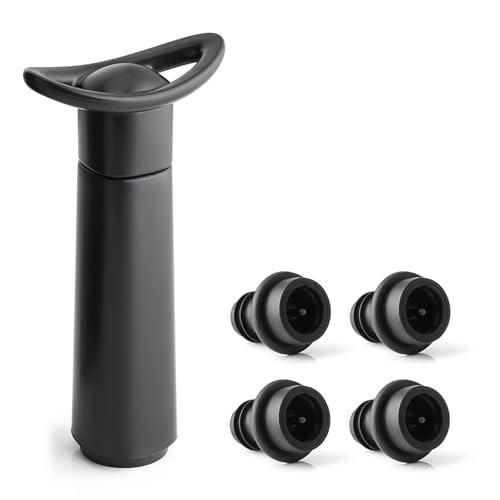
OWO Wine Vacuum Pump with 4 Stoppers: the straightforward four-stopper kit
OWO sells the vacuum idea without decoration. The set is a hand pump and four stoppers, the stoppers made from food-grade silicone, and the whole kit does exactly one job: pull the air out of an opened bottle and keep it out. Silicone is a sensible choice for the part that lives in the bottle neck. It seals against glass with a gentle grip, it washes clean easily after contact with red wine, and it does not take on flavours or stain the way harder plastics can. Four stoppers is the count that matches how these systems are actually used once the novelty fades: one bottle is an event, but two or three open bottles is a lifestyle, and a set that seals four covers a household’s real pattern from day one.
Sealing feedback comes from the pumping itself, with resistance building as the vacuum takes hold. There is no click and no indicator button, so the endpoint is judged by hand, which rewards a consistent routine: seat the stopper fully, centre the pump, and pump in steady strokes until the handle firms up. The pump is the simple barrel type, with no parts that need charging, pairing, or updating, and the stoppers are the system’s own pattern, so buyers who expect to expand beyond four bottles should confirm that spare OWO stoppers are obtainable before committing, rather than discovering the constraint with a fifth bottle open.
Strengths
- Four food-grade silicone stoppers in the set, covering realistic multi-bottle households.
- Silicone stoppers wash clean easily and do not stain or hold flavours.
- Simple hand pump with nothing to charge or maintain.
- Reusable design with no consumables beyond the stoppers themselves.
Trade-offs
- No audible click or indicator; the endpoint is judged by handle resistance.
- No date marking on the stoppers, so bottle rotation relies on memory.
- Replacement stoppers are brand-specific and worth sourcing in advance.
Who it suits: the household with several bottles open at once that wants a simple, complete kit with no learning curve. As a straightforward four-stopper set it is hard to fault, so check price on Amazon.
Check price on Amazon: OWO Wine Vacuum Pump with 4 Stoppers

WOTOR Wine Saver Vacuum Pump with 20 Stoppers: the bulk bundle for many bottles
WOTOR answers a different question from every other pick in this guide: not how good the seal is, but how many bottles you can seal before you run out of stoppers. The set pairs a black hand pump with twenty stoppers, a count that turns the stopper from a scarce resource into something you stop counting. For the entertainer, that arithmetic is the whole argument. A dinner-party pattern, where a white, two reds, and something sweet might all stand open by the end of the evening, consumes stoppers the way it consumes glasses, and a twenty-stopper set seals the whole aftermath without triage, then still has spares for the week after.
The pump itself is the simple barrel type, and sealing feedback is resistance alone, with no click or indicator to standardise technique between users. That puts the emphasis on routine: seat the stopper fully into the neck with a firm push, centre the pump so the barrel sits square, and pump in steady strokes until the handle firms up. The stoppers are the system’s own pattern, so the sensible ownership strategy is to treat the included twenty as the system’s life and to buy while matching spares are easy to find, instead of assuming a decade-long parts trail. Twenty stoppers also need a home: they are small, they roll, and a drawer without a bag or a box will scatter them exactly when a bottle needs one.
Strengths
- Twenty stoppers in the set, the largest supply in this roundup by a wide margin.
- Reusable bottle sealer with no consumables beyond the stoppers themselves.
- Simple hand pump with no parts that need charging, pairing, or updating.
- Black pump and stoppers suit households that seal bottles in volume.
Trade-offs
- Resistance-only feedback, so sealing quality depends on the user’s hand.
- No date marking on the stoppers, so bottle rotation relies on memory.
- Twenty stoppers need storage, and spares are brand-specific.
Who it suits: the entertainer or the household that opens several bottles a week and is tired of rationing stoppers. For sheer capacity in one box it has no rival here, so check price on Amazon.
Check price on Amazon: WOTOR Wine Saver Vacuum Pump with 20 Stoppers
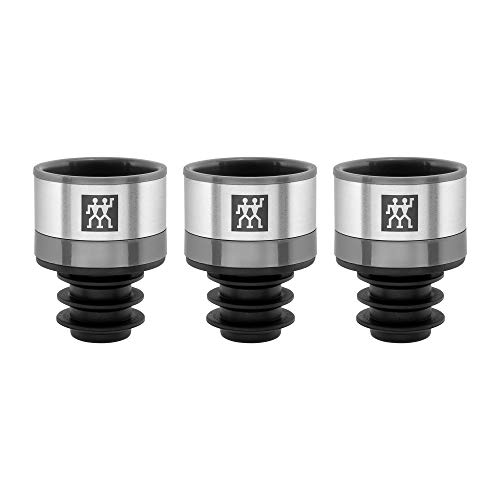
Suncoo Wine Vacuum Sealer Set: the generous bundle for many bottles
Suncoo sells the vacuum idea as a complete kit rather than a pump with accessories. The set centres on a hand pump and a row of reusable stoppers, commonly four, with a date-recording scale built into the stopper tops so each sealed bottle carries its own opened-on reminder. The stoppers use the familiar valve principle, and the pump is the simple pull-and-push barrel type that asks for a handful of strokes per bottle. Nothing in the design chases novelty. The appeal is arithmetic: more stoppers in the box, the date feature included rather than reserved for a premium tier, and a total outlay at the accessible end of the category.
That arithmetic fits households whose bottle traffic is social. A dinner-party pattern, where a white, two reds, and something sweet might all stand open by the end of the evening, consumes stoppers the way it consumes glasses, and a four-stopper set seals the whole aftermath without triage. The trade-offs are those of the value tier generally: the pump’s feedback is resistance alone, with no click or indicator to standardise technique between users, and the finish of the components is workmanlike rather than handsome. Long-term support is the open question with any smaller label, so the sensible ownership strategy is to treat the included stoppers as the system’s life and to buy while matching spares are easy to find, instead of assuming a decade-long parts trail.
The kit format also changes who should consider it. A first-time buyer with no pump at all gets the complete working system in one box, which is precisely the purchase the accessory-only listings elsewhere fail to deliver. A household graduating from a single-stopper set of another brand, by contrast, should notice that switching to Suncoo means starting a new stopper collection, since nothing in the drawer will fit this pump. The set therefore makes its strongest case at the beginning of a household’s sealing habit or at the moment a clear-out replaces everything at once, and its weakest case as an incremental addition to a rival system that still works.
Strengths
- Multi-stopper kit seals a whole evening’s worth of opened bottles.
- Date scale on the stoppers, included at the accessible end of the range.
- Simple pump with no parts that need charging, pairing, or updating.
- Silicone stoppers wash clean easily after contact with red wine.
Trade-offs
- Resistance-only feedback, so sealing quality depends on the user’s hand.
- Smaller brand, with a shorter track record behind its spare parts.
- Utilitarian finish that belongs in a drawer rather than on display.
Who it suits: the entertainer whose problem is volume, several bottles sealed on the same night and finished across the following week. As a complete, date-aware kit for that pattern it is hard to fault, so check price on Amazon.
Check price on Amazon: Suncoo Wine Vacuum Sealer Set
The six systems side by side
| System | Pump type | Seal feedback | Date marking | Stopper supply | Best read on it |
|---|---|---|---|---|---|
| Vacu Vin Wine Saver | Hand pump | Audible click at target vacuum | None | Sets from one stopper up; spares sold widely | The reference system |
| Vacu Vin Wine Saver Concerto | Hand pump | The line’s click signal | None | Two stoppers in most sets; spares shared with the range | The design edition |
| Rabbit Wine Preserver | Hand pump | Indicator shows the seal still holding | None | Proprietary stoppers from the maker | The long-week monitor |
| OWO Wine Vacuum Pump with 4 Stoppers | Hand pump | Resistance builds as air leaves | None | Four food-grade silicone stoppers in the set | The straightforward four-stopper kit |
| WOTOR Wine Saver Vacuum Pump with 20 Stoppers | Hand pump | Resistance builds as air leaves | None | Twenty stoppers in the set | The bulk bundle |
| Suncoo Wine Vacuum Sealer Set | Hand pump | Resistance felt in the handle | Date ring on stopper tops | Four-stopper kit as standard | The party-volume kit |
Read the table as a map of philosophies rather than a league ladder. The two Vacu Vin rows sell certainty about the moment of sealing, the Rabbit row sells certainty about the days afterwards, the OWO row sells a straightforward four-stopper kit, and the WOTOR and Suncoo rows sell volume and bookkeeping, WOTOR through sheer stopper count and Suncoo through the date rings on its stoppers. No row preserves wine by a fundamentally stronger vacuum than the others in a way a buyer could verify from published figures, which is exactly why the decision should turn on feedback style, stopper count, and replacement supply. Those are the differences that survive contact with a real kitchen.
Reading a listing without being misled
The category’s listings reward a suspicious reader, because the same pump appears in many costumes. The first trap is the box contents. A headline that promises a wine saver may describe a pump with one stopper, a pump with four, or, in the listings that catch the most buyers, a pack of stoppers with no pump at all, sold as a refill and photographed at an angle that hides the omission. Accessory-only listings are legitimate products and useless purchases for a first-time buyer, so the stopper count and the presence of the pump itself should be confirmed in the set description before any comparison of value begins. Gift sets add a second costume change: the same pump and stoppers reappear in presentation packaging, sometimes with a foil cutter or pourer folded in, at a presentation price. The preservation inside the box is unchanged, which makes the plain set the rational buy for oneself and the boxed set a purchase of wrapping for somebody else.
The second trap is vocabulary. Listings borrow the language of the food-sealer aisle, where vacuum numbers and sealing speeds headline much larger machines, and drape it over a hand pump that has neither. A wine pump’s honest specifications are few: the stopper material, the count in the box, the feedback mechanism, and the maker’s stated bottle compatibility. Anything beyond that list, day counts shouted without a source, universality claimed for every neck ever blown, should be read as decoration. The makers represented in this guide publish the modest version of the truth, and their restraint is itself a selection signal worth trusting more than a rival’s enthusiasm.
Getting the most from whichever system you choose
Technique is short to learn and worth standardising. Seat the stopper fully into the neck with a firm push and a slight twist, centre the pump over it so the barrel sits square, and pump in steady strokes until the system’s signal, click, or firm resistance, says the work is done. Pouring another glass later breaks the vacuum completely, so the bottle needs sealing again afterwards; a stopper left resting on top without pumping is theatre, not preservation. A small practical warning comes straight from the category’s founding maker: if the pump is worked carelessly over a very full bottle, wine can be drawn up into the pump body, where it dries sticky and degrades the action, so leave a little headspace and pump upright.
Storage decides the rest. Sealed bottles stand upright, both because a sideways bottle can push wine against the stopper and weep vacuum away, and because upright storage keeps the wine’s surface area at its smallest. The refrigerator is the right home for every opened bottle, whites and reds alike, since cold slows oxidation chemistry further; a red simply needs its glass poured a little early to climb back toward serving temperature. Heat and light continue their separate damage regardless of the seal, so a stoppered bottle on a sunny counter is losing on two fronts while winning on one. Treat the vacuum as one leg of a three-legged stool, alongside cold and darkness.
Ownership over years follows a predictable curve. The pump, having almost nothing in it to wear, typically outlasts several generations of stoppers, and the stoppers fail in a recognisable order: first the skirt loses the crisp edge that made it grip, then the valve begins to admit air slowly enough that a bottle sealed for three days holds for one, and finally the seal becomes unreliable at any horizon. None of this arrives as a dramatic breakdown, which is why a household can drift into believing vacuum sealing itself has stopped working when only a consumable has retired. Keeping one spare stopper beyond the working set turns that diagnosis into a ten-second test, and keeping the receipt or a note of the brand and model turns the replacement order into an errand rather than an archaeology project. Systems bought as matched sets age as systems; the pump is the heirloom and the stoppers are the subscription.
Cleaning is the maintenance nobody budgets attention for.
Stoppers should be washed after use, warm water with a little soap, and dried fully before they go back in a drawer, because the skirt and valve that touch wine will otherwise carry dried residue into the next bottle’s neck and, eventually, harbour the kind of growth that taints flavour. Check each maker’s instruction on dishwasher suitability rather than assuming it. Stoppers also age: a skirt that has lost its spring, a valve that no longer grips, or a seal that fails within a day on a bottle that used to hold three are all the same message. Replace the stopper, keep the pump, and the system resets to new.
Mistakes that quietly defeat a good seal
The most common failure is also the most avoidable: reaching for the vacuum pump when the bottle sparkles. Prosecco, cava, and champagne are preserved by their own internal pressure, and a vacuum stopper both fails to fit the neck properly and actively pulls the gas that keeps the wine alive out of the liquid. The second failure is patience misplaced, expecting a pump to hold a delicate white in perfect condition for a fortnight. These systems buy days, and the makers describe them in days; a bottle worth finishing should be finished inside the window the category honestly offers. The third failure is the sideways bottle in the fridge door rack, leaking vacuum a molecule at a time until the indicator or the taste confesses.
Two subtler errors deserve mention. Sealing a bottle that is already tired does not revive it, because vacuum slows future oxidation and reverses none of the damage done; the time to pump is the evening the bottle is opened, not the evening its decline is noticed. And decanting cuts both ways: wine poured into a decanter for service has met far more air than a bottle poured by the glass, so leftovers returned from a decanter start their sealed life with a handicap. None of this diminishes the tool. It defines the envelope inside which a modest pump and a rubber stopper perform the small, repeatable rescue that this entire category exists to provide.
Matching the system to the household
The single-glass drinker has the simplest brief in the category. One bottle open at a time, finished across three or four evenings, means one stopper in service and a premium on feedback, because a seal set carelessly on a tired evening is the difference between a good final glass and a poured-away one. The click and the visible indicator were designed for exactly this user, and a modest set from either signalled system outperforms a large box of unmonitored stoppers. Buy the signal, keep the spare stopper in the drawer against the day the working one tires, and let the category stay as small as the habit it serves.
Couples and families splitting bottles across a week live in the middle of the category, with two or three bottles in rotation and more than one pair of hands doing the sealing. Shared feedback matters here for a social reason: a household standard only exists if everyone can produce it, and a resistance-only pump quietly creates two standards, the strong seal and the hopeful one. Date marking earns its keep in this household too, because the question of which bottle to finish first is asked by whoever opens the fridge, not by whoever sealed it. The four-stopper, date-dialled sets exist for this pattern, and the indicator systems serve it nearly as well by answering the freshness question from the other direction.
Hosts and collectors stand at the far end. The host’s problem is the morning after, a row of part-finished bottles and a finite appetite for finishing them, which is a stopper-count problem before it is anything else. The collector’s problem is different in kind: bottles opened for one deliberate glass, where the value at stake in a single failure dwarfs the price of any tool in this guide. Vacuum serves the host completely and the collector partially, and the collector who needs weeks rather than days from an opened bottle is the reader this guide has already pointed toward the gas route, with respect and without apology. Knowing which household is yours is the last specification that matters, and no listing will state it for you.
Frequently asked questions
How long does vacuum-sealed wine actually stay drinkable?
Makers of these systems generally describe the benefit in days, and the founding brand cites independent laboratory work supporting freshness for up to ten days under its test conditions. Treat any figure as a ceiling rather than a promise: a young, sturdy red stored cold will travel further than a delicate white kept on a counter, and a nearly empty bottle fades faster than a nearly full one. The practical reading is that a vacuum sealer turns tonight’s leftover into a reliable glass later in the week, not into cellaring.
Can a wine vacuum sealer be used on sparkling wine?
No, and every maker in this category says so in its documentation. Sparkling wine is preserved by the pressure of its own dissolved carbon dioxide, and drawing a vacuum pulls that gas out, flattening the wine while the stopper fails to grip a neck shaped for pressure from inside. Sparkling bottles need a clamp-on champagne stopper that locks under the neck lip and resists the pressure. The two tools look similar on a shelf and do opposite jobs.
Does the original cork work as well if it is pushed back in?
A replaced cork blocks dust and spills, and for a single night it is better than an open neck, but it removes no air. The headspace above the wine remains full of oxygen at ordinary pressure, and oxidation proceeds at close to its unsealed pace. A stopper alone, without pumping, has the same limitation. The vacuum is the active ingredient in these systems; everything else is plumbing that makes the vacuum possible.
Will stoppers from one brand fit another brand’s pump?
Generally no, and buyers should plan on that basis. Stopper diameters, valve shapes, and pump collars are designed as matched sets, so a drawer of one brand’s stoppers rarely serves another brand’s pump. The consistent exception is within a long-running product line, where makers keep stoppers compatible across their own pump generations. Before replacing a worn pump, check whether the new model accepts the stoppers already in the drawer; staying inside one system is the cheapest upgrade path in the category.
Should red wine go in the fridge once it is vacuum sealed?
Yes. Cold slows the oxidation chemistry that the vacuum has already throttled, and the two measures multiply rather than substitute for each other. The sealed bottle stands upright in the fridge like any other, and the only concession is timing: pour the glass fifteen or twenty minutes before drinking so the wine can climb from fridge cold toward a temperature where its aromas open up. A red left stoppered on the counter gives back much of what the pump won.
Every bottle opened at home is a small wager that the last glass will taste like the first, and a vacuum sealer is how that wager gets hedged with a clear conscience. Choose the feedback signal that matches how honestly you will pump, count the stoppers against the bottles you actually open, and the right system will still be rescuing weeknight glasses long after flashier kitchen gadgets have been forgotten.

