Disclosure: airfryerkitchensupply.com is reader-supported. When you buy through links on our site, we may earn an affiliate commission at no extra cost to you.
Where to buy
The best gas meat smokers are dedicated propane cabinets — no grill pretensions, just a burner, a chip tray, a water pan and racks stacked for meat. Every pick below is a verified current listing, and they divide cleanly by the only questions that matter: how much meat, how steady a temperature, and how much of the work you want the machine’s design to absorb. Start here, then read the reviews for the honest limits of each cabinet.
- Pit Boss 3-Series Propane Gas Vertical Smoker with HVR Controller — check price on Amazon; choose the listing sold or shipped by Amazon or the brand’s own store, and confirm the exact model name before you order.
- Masterbuilt 40-Inch ThermoTemp Propane Gas Vertical Smoker (MB20051316) — check price on Amazon; choose the listing sold or shipped by Amazon or the brand’s own store, and confirm the exact model name before you order.
- Dyna-Glo DGY784BDP 36-Inch Vertical LP Gas Smoker — check price on Amazon; choose the listing sold or shipped by Amazon or the brand’s own store, and confirm the exact model name before you order.
- Masterbuilt MPS 230S Propane Smoker, 30-Inch — check price on Amazon; choose the listing sold or shipped by Amazon or the brand’s own store, and confirm the exact model name before you order.
- Masterbuilt GS30D Propane 2-Door Smoker — check price on Amazon; choose the listing sold or shipped by Amazon or the brand’s own store, and confirm the exact model name before you order.
- PIQUEBAR Propane Smoker with Cover, 3 Removable Racks — check price on Amazon; choose the listing sold or shipped by Amazon or the brand’s own store, and confirm the exact model name before you order.
Ask a room of barbecue cooks about the best gas meat smokers and you will start an argument about charcoal — which misses the point of the format entirely. A propane cabinet smoker exists for one reason: to hold meat in the 225°F to 275°F smoking band for hours, with real flame heat and real wood smoke, while asking almost nothing of the cook. No fire to build, no ash to manage, no cord to run. You set a valve, the burner holds a small blue flame under a chip tray, and the cabinet does the rest. For meat — brisket, shoulder, ribs, sausage, poultry — it is the lowest-effort path to genuinely smoked results that exists.
The format’s honest limits are just as clear. Propane cabinets are thin-steel boxes, and they breathe heat in wind and cold in ways heavy pits do not; their lowest temperatures take a steadier hand than an electric dial; and their smoke, while real, is the mildest of the flame fuels because the chip tray smoulders small loads. None of that stops them producing excellent meat — it defines the technique. This guide rates six current cabinets on capacity, temperature manners and build, and says plainly which cooks each one serves.
A note on what ‘gas’ means here: every pick runs on standard LP propane from a 20 lb tank, the same bottle as a gas grill. Natural-gas conversions exist for a few models through dealer channels but are not the listings verified here, so this guide assumes propane throughout — which is also the format’s portability advantage, since a cabinet and a tank will smoke anywhere from a backyard to a hunting camp.
In this guide
Quick Picks
- Best Overall — Pit Boss 3-Series Propane Gas Vertical Smoker with HVR Controller: the most complete propane cabinet here — a verified 983 square inches across four racks, a stated 100°F to 300°F range that reaches genuinely low for cold-adjacent work, and a proper controller. Check on Amazon
- Best Large Cabinet — Masterbuilt 40-Inch ThermoTemp Propane Gas Vertical Smoker (MB20051316): the big Masterbuilt — 960 square inches in a 40-inch cabinet with a thermostat-style analogue control that holds temperature the way an oven does, by cycling the burner for you. Check on Amazon
- Best Wide-Format Cabinet — Dyna-Glo DGY784BDP 36-Inch Vertical LP Gas Smoker: a long-running 36-inch LP cabinet from a smoker specialist — the wide-format alternative for cooks whose loads are broad rather than tall. Check on Amazon
- Best Compact Cabinet — Masterbuilt MPS 230S Propane Smoker, 30-Inch: the compact classic — a 30-inch propane cabinet that heats fast, sips fuel on small loads and has introduced more people to gas smoking than any other shape. Check on Amazon
- Best Two-Door Design — Masterbuilt GS30D Propane 2-Door Smoker: the genuine two-door cabinet — a lower door for the burner, chips and water, an upper door for the food, so tending the fire never dumps the cooking chamber’s heat. Check on Amazon
- Best Budget Cabinet — PIQUEBAR Propane Smoker with Cover, 3 Removable Racks: the budget door into gas smoking — a three-rack propane cabinet with the cover included in the box, so the total cost of starting is the price of the machine and a tank. Check on Amazon
How These Picks Were Chosen
Each cabinet was verified: the model was searched in the manufacturer’s product data, the returned listing title was matched against the intended machine — size, rack count, temperature range where stated — and only then was a buy link printed. Gas smoker lines are notorious for near-identical model names across different sizes, so the title match is doing real work in this guide.
Selection then weighed what decides meat quality in a propane cabinet: cooking area that survives honest interpretation (rack area versus usable area with airflow), temperature behaviour at the bottom of the range where smoking lives, chip tray and water pan design — the two components you touch mid-cook — and door design, including the one true two-door cabinet in the current market. We also checked the unglamorous essentials: igniter type, thermometer placement, and whether covers and replacement trays exist for the model, because a cabinet is a five-year purchase, not a season’s toy.
The 6 Best Gas Meat Smokers, Cabinet by Cabinet

Pit Boss 3-Series Propane Gas Vertical Smoker with HVR Controller — Best Overall
The Pit Boss 3-Series takes the top badge because it attacks the propane cabinet’s two traditional weaknesses — temperature manners and honest capacity — head-on. The listing states 983 square inches across four racks and a temperature range beginning at 100°F, which matters more than it might appear: a cabinet that can hold genuinely low temperatures opens up sausage, cheese-adjacent and long gentle cooks that cabinets with a high floor simply cannot do. The HVR controller gives the burner a steadier hand than a bare valve, narrowing the gap between propane and electric for set-and-forget cooking.
It suits the widest range of cooks in this guide: families smoking a shoulder and ribs together, sausage makers who need the low end, and anyone who wants one cabinet rather than a compact now and a large one later. It does not suit cooks who need a two-door layout for mid-cook tending without heat loss — that is the GS30D’s specific trick below — or minimalists who will never fill four racks and would rather heat a smaller box.
Strengths
- 983 sq in across four racks — the most usable capacity here
- Stated range from 100°F opens low-temperature work most cabinets cannot do
- Controller-assisted burner steadies the smoking band
Trade-offs
- Larger cabinet burns more propane heating space you may not fill
- Single door — chip and water checks cost heat like any one-door design
- Four racks to clean after big cooks
| Cooking area | 983 sq in (per listing title) |
| Racks | 4 (per listing title) |
| Temperature range | 100°F to 300°F (per listing title) |
| Fuel | Propane |
| Extras | Wood chip tray (per listing title) |
The low end of that range deserves a paragraph of its own, because it changes what the machine is. Most propane cabinets are brisket-and-ribs tools with a floor around the low 200s. A cabinet verified to run down toward 100°F becomes a sausage and jerky tool as well, and with care, a cold-smoking-adjacent box for cheese in cool weather. That versatility is why this pick leads the guide: it is the only cabinet here that covers both the barbecue band and the curing band in one footprint.
Capacity honesty, as always: 983 square inches is the summed rack area. In practice the top rack runs hottest and the load that cooks best is three racks of meat with air between them — still a party-sized amount: two shoulders and ribs, or a brisket with company. Owners who regularly max it out should know the water pan and chip tray are sized for the cabinet, so mid-cook refills on the longest cooks are part of the rhythm, as with every pick here.
Best for: all-round propane smoking, including low-temperature sausage and jerky work / Not suited for: tiny households that will never fill more than two racks
Check on Amazon — check the current price on Amazon before you order.

Masterbuilt 40-Inch ThermoTemp Propane Gas Vertical Smoker (MB20051316) — Best Large Cabinet
The ThermoTemp concept is the propane cabinet’s answer to the electric dial: instead of a bare valve you babysit, a thermostat control cycles the burner to hold the temperature you set, much like an oven. In the 40-inch size verified here — 960 square inches in the listing — that makes this the easiest large cabinet to live with: set it for a shoulder cook, and the machine manages the small corrections that wind and weather would otherwise hand to you. For cooks feeding crowds, that combination of volume and manners is the whole argument.
It suits entertainers, large families, and anyone whose typical load is two briskets, four chickens or a wall of ribs — cooks for whom the compact cabinets are a false economy. It does not suit small-load cooks: heating 40 inches of cabinet for two chicken breasts wastes propane and time on every cook, and the footprint and assembly commitment are real. Buy the size of your actual Saturdays.
Strengths
- Thermostat-style control holds temperature with minimal input
- 960 sq in handles party-scale loads in one cook
- 40-inch height fits long items — ribs and whole fish — without cutting
Trade-offs
- Oversized for small loads; propane use follows cabinet size
- Big footprint and a two-person assembly
- Analogue control is steady, not precise — a probe still earns its place
| Cooking area | 960 sq in (per listing title) |
| Size | 40-inch (per listing title) |
| Control | Analogue temperature control (per listing title) |
| Model | MB20051316 (per listing title) |
The thermostat deserves an honest footnote: analogue controls hold a band, not a number, and the cabinet will wander gently around your setting as the burner cycles. For meat, that is entirely fine — barbecue has always cooked in bands, and the foods in this guide cannot tell a 15-degree wander from a dead-steady hold. What the thermostat removes is the trend — the slow climb on a hot afternoon or sag on a cold morning that a bare valve passes on to you. That is the correction that actually ruins cooks, and it is the one this machine absorbs.
At this size, also plan the logistics: a cover that fits, a level pad with room for the door to swing and a tank to sit safely, and a second set of hands for assembly day. Owners who set the big ThermoTemp up properly tend to keep it for years, because the format’s only real enemies are rust at the seams and a neglected burner — both prevented by the cover and a seasonal brush-down.
Best for: crowd cooks who want large capacity with oven-like temperature manners / Not suited for: small households or small patios
Check on Amazon — check the current price on Amazon before you order.
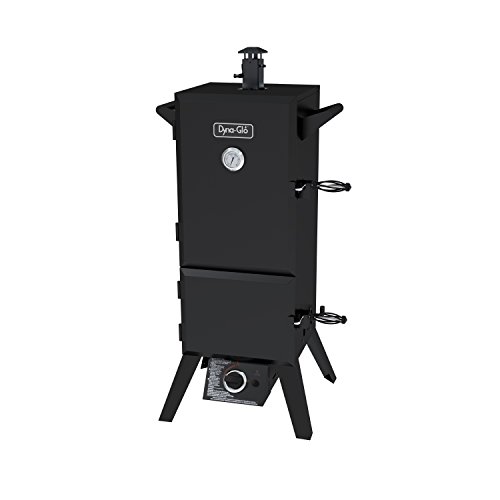
Dyna-Glo DGY784BDP 36-Inch Vertical LP Gas Smoker — Best Wide-Format Cabinet
Dyna-Glo’s 36-inch vertical LP smoker has been a fixture of this category for years, and its appeal is proportion: where many cabinets grow upward, this format suits cooks whose signature loads are wide — full racks of ribs laid flat, trays of wings, whole chickens side by side. The powder-coated cabinet keeps the classic propane layout: burner below, chip tray and water pan in the middle, racks above, with the straightforward valve control that defines the traditional end of the category.
It suits experienced propane cooks who know their technique and want a roomy, uncomplicated box, and rib specialists in particular. It does not suit buyers who want the machine to manage temperature for them — there is no thermostat story here, and the low end takes the practiced hand described in the guide below — or anyone who needs the Pit Boss’s verified low-temperature range for sausage work.
Strengths
- Roomy 36-inch format suits wide loads like full rib racks
- Simple, proven layout with few systems to fail
- From a brand whose whole business is smokers and grills
Trade-offs
- Bare valve control — temperature skill is the owner’s
- No stated ultra-low range for curing-style work
- Single door, so tending costs heat as usual
| Size | 36-inch (per listing title) |
| Fuel | LP gas (per listing title) |
| Finish | Black powder coat (per listing title) |
There is a case for the unassisted cabinet that this guide respects: every control system is also a failure point, and a burner, a valve and a thermometer is a parts list that can be maintained for a decade with a wire brush and the occasional igniter. Cooks who learned on this style of machine often prefer it — the feedback is immediate, the behaviour is predictable, and the technique transfers to any gas cabinet ever made. The Dyna-Glo is the pick for that cook.
Technique notes for this format: preheat longer than you think, because a wide cabinet’s walls drink the first heat; keep the water pan full on long cooks, since the wide surface evaporates steadily; and expect the racks nearest the burner to run hot enough that a mid-cook rotation is part of the recipe for big loads. None of that is hidden cost — it is the standard craft of propane smoking, and this cabinet teaches it cleanly.
Best for: experienced propane cooks and rib-focused loads in a wide format / Not suited for: set-and-forget buyers or low-temperature sausage specialists
Check on Amazon — check the current price on Amazon before you order.

Masterbuilt MPS 230S Propane Smoker, 30-Inch — Best Compact Cabinet
The MPS 230S is the propane cabinet in its most distilled form: 30 inches of vertical cabinet, a burner, a chip tray, a water pan and racks enough for a household’s real cooking — a brisket, two chickens, ribs for six. Its virtues are the compact format’s virtues. It reaches temperature quickly, burns modest propane on weeknight-sized loads, stores in a corner, and costs its owner the least attention of any cabinet here to keep clean and covered.
It suits small households, beginners who want propane rather than electric, and second-smoker roles — the cabinet that lives at a cabin, a camp or a tailgate setup where a tank is easier than power. It does not suit party loads: a full house of guests means cooking in relays, and a very large brisket is a squeeze that compromises the airflow bark needs. Owners who outgrow it tend to keep it anyway, which tells you something about the format.
Strengths
- Fast heat-up and modest fuel use on household loads
- Small footprint; easy to place, cover and store
- Simple layout that teaches propane technique quickly
Trade-offs
- Capacity ceiling shows at party scale
- Bare-bones control — the low end takes practice
- Large briskets fit tightly; airflow needs care
| Size | 30-inch (per listing title) |
| Fuel | Propane |
| Format | Vertical cabinet |
Compact cabinets have one underappreciated advantage: temperature recovery. Every door opening dumps a cabinet’s hot air, and a small box reheats in minutes where a large one lumbers. For cooks who baste, spritz or rearrange — the interactive styles of smoking — the little Masterbuilt forgives the habit better than its big brothers. The flip side is swing: small thermal mass means wind shows up in the thermometer sooner, so placement out of the breeze matters more here than with any other pick.
As a first propane smoker it also has the gentlest failure modes. Parts are common, the design is understood by every dealer, and the techniques it teaches — chip tray management, water pan discipline, valve control at the low end — are the whole propane curriculum in one inexpensive box. Many owners’ second smoker is bigger; very few regret the first being this one.
Best for: small households, first propane smokers, and portable second-smoker duty / Not suited for: party-scale loads or the largest briskets
Check on Amazon — check the current price on Amazon before you order.

Masterbuilt GS30D Propane 2-Door Smoker — Best Two-Door Design
The GS30D exists to solve the single-door cabinet’s original sin: every chip refill and water check opens the whole box and throws away the heat and smoke you spent an hour building. Its two-door layout — verified in the listing’s own name — separates the fire from the food. The lower door serves the burner, chip tray and water pan; the upper door serves the racks. Tend the fire as often as the cook demands and the chamber above barely notices. For long cooks and interactive cooks, that is a structural advantage no technique can replicate on a one-door box.
It suits long-cook specialists — brisket and shoulder cooks who refill chips on schedule — and anyone who has watched a thermometer crater after a water-pan check and sworn never again. It does not suit buyers who want the newest control systems: the two-door design is a classic layout from the category’s earlier generation, with valve control and honest simplicity, and two-door propane cabinets have become a shrinking niche as makers consolidate lines. If the design speaks to you, that scarcity is itself information.
Strengths
- True two-door layout protects chamber heat during tending
- Fire and food managed independently — the format’s best idea
- Classic, maintainable design with common parts
Trade-offs
- Older-generation controls; no thermostat assistance
- Two-door propane is a shrinking niche — check stock and parts
- Capacity is household-scale, not party-scale
| Layout | 2-door propane smoker (per listing title) |
| Fuel | Propane |
Quantify the benefit and it stops sounding like a gimmick: on a one-door cabinet, a mid-cook opening can cost a visible slice of your temperature and several minutes of recovery, and a brisket cook invites four or five such openings. Multiply that across a twelve-hour cook and the two-door design is not saving minutes — it is removing the main source of temperature instability in the entire format, the cook’s own necessary interventions. The cooks who value it most are the ones who tend most: spritzers, bastors and chip-schedulers.
The honest counterweight is that the market has largely moved on: most current cabinets are one-door with better controls, betting that steadier burners beat separated doors. Both bets are defensible, and this guide carries the GS30D because the bet it makes is still unavailable anywhere else in the current propane market. If you buy it, buy the cover and a spare chip tray with it, and the design will serve for years.
Best for: long cooks and hands-on cooks who tend chips and water on schedule / Not suited for: buyers who prioritise the newest control systems
Check on Amazon — check the current price on Amazon before you order.

PIQUEBAR Propane Smoker with Cover, 3 Removable Racks — Best Budget Cabinet
Every category needs its honest budget pick, and this three-rack propane cabinet earns the badge by including the accessory everyone else sells separately: the cover is in the listing and in the box. The format is the classic one — burner, chip tray, water pan, three removable racks — sized for household loads: a couple of chickens, ribs for a family, a modest shoulder. Removable racks matter more than they sound at this tier, because they are what makes the cabinet cleanable, and a cleanable budget smoker outlives a sealed one.
It suits first-time gas smokers testing the format, gift buyers, and second-location duty — the lake house, the rental, the camp. It does not suit cooks who will smoke weekly for a decade: at the budget tier, steel is thinner, hardware is simpler, and the realistic horizon is seasons rather than the long years the brand-name cabinets target. That is a fair trade when the price of entry is the question — just walk in with the horizon understood.
Strengths
- Cover included — the true starter cost is lower than rivals’
- Three removable racks make cleaning genuinely easy
- Classic layout teaches the same technique as premium cabinets
Trade-offs
- Thinner steel and simpler hardware than the brand-name picks
- Household capacity only
- Value brand — parts support is thinner than Masterbuilt or Pit Boss
| Racks | 3 removable smoking racks (per listing title) |
| Extras | Cover included (per listing title) |
| Fuel | Propane |
The right way to judge a budget cabinet is by what it shares with the expensive ones, and the list is longer than snobbery admits: the same propane physics, the same chip-and-water layout, the same smoking band, and meat that — cooked with the same care — most guests will never distinguish from a flagship’s output. What the money actually buys at higher tiers is thickness, control assistance and longevity, not a different category of result. For a first smoker, that makes the budget pick a rational instrument: learn the craft, discover your real load sizes, and upgrade informed if the hobby sticks.
Protect the investment with the included cover from day one, season the interior before the first cook, and keep the burner ports brushed — budget burners forgive neglect least. Do those three things and this cabinet’s cost-per-cook story is the best in the guide by a wide margin.
Best for: first-time gas smokers and budget-led second-location duty / Not suited for: weekly decade-long smoking or party loads
Check on Amazon — check the current price on Amazon before you order.
Comparison Table
Compare the cabinets on verified figures from their listings — cooking area and temperature range where the maker states them — and on the job each cabinet’s design suits. Door count and tray design, covered in the reviews, matter as much as the numbers.
| Pick | Badge | Key spec | Best for |
|---|---|---|---|
| Pit Boss 3-Series Propane Gas Vertical Smoker with HVR Controller | Best Overall | 983 sq in, 4 racks, 100°F to 300°F range | all-round propane smoking, including low-temperature sausage and jerky work |
| Masterbuilt 40-Inch ThermoTemp Propane Gas Vertical Smoker (MB20051316) | Best Large Cabinet | 960 sq in, 40-inch, analogue temperature control | crowd cooks who want large capacity with oven-like temperature manners |
| Dyna-Glo DGY784BDP 36-Inch Vertical LP Gas Smoker | Best Wide-Format Cabinet | 36-inch vertical LP gas cabinet | experienced propane cooks and rib-focused loads in a wide format |
| Masterbuilt MPS 230S Propane Smoker, 30-Inch | Best Compact Cabinet | 30-inch propane cabinet, compact footprint | small households, first propane smokers, and portable second-smoker duty |
| Masterbuilt GS30D Propane 2-Door Smoker | Best Two-Door Design | Propane 2-door cabinet — separate fire and food doors | long cooks and hands-on cooks who tend chips and water on schedule |
| PIQUEBAR Propane Smoker with Cover, 3 Removable Racks | Best Budget Cabinet | Propane cabinet, 3 removable racks, cover included | first-time gas smokers and budget-led second-location duty |
How to Choose the Best Gas Meat Smokers for Your Loads
Size by racks and loads, not by inches. Cabinet height in the model name — 30, 36, 40 inches — describes the box, not the cooking; what matters is rack area and how your food arranges on it. A brisket needs one rack it can lie flat on with air around it. Ribs need rack length or a rib rack. Sausage and jerky need rack count. The listings in this guide state area where the maker publishes it — 983 square inches for the Pit Boss, 960 for the big ThermoTemp — and where they do not, the reviews size the cabinet by the loads it honestly holds.
Then decide how much temperature help you want, because that is the category’s real price ladder. A bare valve (Dyna-Glo, MPS 230S, GS30D) is simple, repairable and entirely your responsibility. A thermostat control (ThermoTemp) absorbs drift for you. A wide-range controller (the Pit Boss, verified down to 100°F) adds a whole second category of cooking — the low-temperature work. None is best in the abstract; they are answers to how you cook. The beginner who wants brisket without babysitting should pay for control; the experienced cook may prefer the valve’s honesty.
- Count your real load: racks needed on your biggest regular cook, not your biggest imaginable one.
- Match control to temperament: valve for hands-on cooks, thermostat or controller for set-and-forget.
- Check the chip tray and water pan size — small trays mean hourly tending on long cooks.
- Two doors matter if you tend often; they are wasted on cooks who never open the box.
- Confirm cover availability and price it into the purchase — cabinets live outdoors.
Finally, placement: a propane cabinet needs a level, non-combustible spot out of the wind, with the manufacturer’s clearances from walls and eaves, and tank storage upright outdoors. Wind is the propane cabinet’s tax collector — a sheltered corner can be worth more than a model upgrade, because thin steel and moving air are in a constant negotiation that your thermometer reports.
Holding Low Temperatures on Propane: The Skill That Decides Everything
Every propane cabinet can get hot; the craft is staying low. The smoking band’s bottom edge is where valves get twitchy, because a burner turned nearly off is a burner a gust can kill. The techniques are unglamorous and effective: start the burner higher than target and ease down in small steps with ten minutes between adjustments, keep the cabinet out of wind, use the water pan full as thermal ballast that resists swings, and never chase the thermometer minute to minute — judge the trend over fifteen minutes, because cabinet temperature is a slow variable being measured by impatient people.
Flame-out safety belongs in the same conversation. If a burner blows out at a low setting, unburned gas is a hazard, not an inconvenience: turn the valve off, let the cabinet air out fully, and relight according to the manual. Cabinets with thermostat or controller systems manage the low end with less drama, which is a legitimate safety-and-sanity argument for the assisted picks — but the valve cabinets reward the careful cook with the same results, and generations of briskets prove it.
Wood Chips, Chunks and the Water Pan: Smoke Management in a Cabinet
Propane cabinets make smoke in a tray or box over the burner, and the tray’s size sets your tending rhythm: small trays want attention every 45 minutes or so during the first hours, when meat takes smoke most readily. Use dry chips — soaking only delays smoke with steam — and consider a foil pouch with pierced holes as a slower-burning alternative that many cabinet owners swear by. Chunks, where the tray accepts them, burn longer and steadier than chips and are the upgrade most worth trying in your second month.
The water pan is not a garnish. It buffers temperature spikes with its thermal mass, keeps the chamber humid so meat surfaces stay smoke-receptive longer, and catches the drippings that would otherwise flare on the burner. Keep it full on long cooks, expect to top it at the same visits as the chip tray — this is exactly the tending rhythm the two-door GS30D was designed around — and wash it the same day. A neglected water pan is the single most common source of off flavours in cabinet smoking, ahead of wood choice, ahead of everything.
Propane Safety and Running Costs, Plainly
A 20 lb tank runs a cabinet burner for many long cooks — the burners in this guide are small, and a tank that would grill for weeks smokes for longer, because smoking is low-output work. Keep a spare if you cook for guests; check every connection with soapy water at every tank swap; store tanks upright, outdoors, away from ignition sources; and never run any propane appliance in an enclosed space. Carbon monoxide is not a theoretical risk with combustion appliances, it is the reason cabinets live outdoors, full stop.
Running costs beyond fuel are a cover, replacement chip trays and water pans over the years, and the occasional igniter. Against electric cabinets, propane trades pennies of electricity for tank refills; against charcoal, it trades ash and fire-building for a gauge to watch. The honest summary is that propane is the cheapest fuel to start with and the most portable — which is why these cabinets dominate camps, cabins and tailgates wherever they appear.
How to Use a Gas Meat Smoker: First Brisket, Step by Step
A brisket is the propane cabinet’s graduation exam — long, low and unforgiving of temperature drift — so the steps below are written for it, and everything easier (ribs, shoulder, chicken) is the same method with less time. Read your cabinet’s manual first; model specifics always outrank general guides.
- Trim and season the brisket the night before; leave it uncovered in the fridge so the surface dries for bark.
- Fill the water pan, load the chip tray with dry chips or chunks, and confirm the tank is at least half full — or swap in the spare.
- Light the burner per the manual, set the cabinet climbing to the 225°F to 250°F band, and give it a full 30 minutes to stabilise with the meat still in the fridge.
- Place the brisket fat-side toward the heat, probe in the thickest part of the flat, and close the door. Note the time; your next planned opening is the chip-and-water check.
- Tend on schedule, not impulse: chip tray and water pan together, roughly every 60 to 90 minutes in the early hours when smoke matters most.
- Expect the stall in the middle hours. Hold course or wrap in butcher paper — both are legitimate; what matters is not opening the door to fret.
- From the final hours, judge by tenderness: the probe should slide into the flat with little resistance. Temperature is the map; tenderness is the destination.
- Rest wrapped in a cooler for at least an hour — two is better — before slicing against the grain. The rest is part of the cook, not a delay.
Afterwards: pans washed the same day, burner ports brushed once cool, cabinet covered once cold. Then write down the cook — tank use, chip consumption, weather, timing — because a propane cabinet’s personality is mostly about how it behaves in your wind and your seasons, and two cooks of notes will teach you more than any guide, including this one.
Common Buying Mistakes
The classic propane mistake is running the cabinet too hot in the first hour — impatience with the climb leads to an overshoot that takes an hour to bleed off with the meat already inside. Preheat empty, stabilise, then load. Second is chip tray neglect: smoke flavour is built in the first hours, and a tray left to ash over while the cook admires the thermometer is flavour left on the table.
- Chasing the thermometer with constant valve adjustments — judge trends over fifteen minutes.
- Letting the tank run dry mid-cook; weigh or gauge the tank before long cooks.
- Skipping the water pan to ‘save cleanup’ and losing temperature stability and moisture.
- Opening the door to show guests the brisket — every viewing is paid for in recovery time.
- Placing the cabinet in open wind and blaming the burner for the swings.
- Ignoring a yellow, lazy flame — that is a burner asking for its ports to be cleaned.
And the safety mistake that outranks all others: relighting a blown-out burner without airing the cabinet first. Gas appliances reward respect and punish shortcuts; the manual’s relight procedure is not bureaucracy, it is the accumulated memory of everyone who learned the hard way.
Final Recommendation
Buy the Pit Boss 3-Series if you want one cabinet to do the most: the capacity, the controller and that verified low range make it the guide’s all-rounder. Buy the ThermoTemp 40 if your loads are large and your patience for valve-tending is small. The Dyna-Glo is the experienced cook’s wide box, the MPS 230S the compact classic, the GS30D the two-door answer to tending without heat loss, and the PIQUEBAR the honest budget door into the format. All six will smoke meat your neighbours ask about; they differ in how much of the work they carry for you.
Whichever cabinet lands on your patio, cook a pork shoulder first, a brisket third, and keep notes from the first day. The best gas meat smokers reward familiarity more than features — the cook who knows their cabinet’s habits in February wind will out-cook a stranger with a flagship, every single time.
- Pit Boss 3-Series Propane Gas Vertical Smoker with HVR Controller — best overall pick; check price on Amazon.
- Masterbuilt 40-Inch ThermoTemp Propane Gas Vertical Smoker (MB20051316) — best large cabinet pick; check price on Amazon.
- Dyna-Glo DGY784BDP 36-Inch Vertical LP Gas Smoker — best wide-format cabinet pick; check price on Amazon.
Keep exploring the cluster: Best Food Smokers Best Gas Grill Smokers Best Gas Meat Smokers For Beginners Best Gas Smokers Under $300 Best 2 Door Gas Smokers
Frequently Asked Questions
Are gas smokers as good as charcoal for meat flavour?
They produce real wood smoke and real flame heat, and the results are genuinely good — most guests will not distinguish a well-run propane brisket from a charcoal one. Charcoal keeps an edge in smoke depth and bark character that dedicated cooks can taste. Propane wins on effort, consistency and cold-weather reliability. It is a trade of a little depth for a lot of ease, and for most households it is the right trade.
How long does a propane tank last in a cabinet smoker?
A long time — cabinet burners are small and smoking is low-output work, so a standard 20 lb tank typically covers many long cooks. The honest answer varies with cabinet size and weather, which is why the working rule is procedural rather than numerical: check the tank before every long cook and keep a spare once you cook for guests.
Can a gas smoker hold 225°F reliably?
Yes, with the techniques in this guide: preheat and stabilise before loading, shelter the cabinet from wind, keep the water pan full as ballast, and adjust the valve in small steps judged over fifteen minutes. Thermostat and controller models — the ThermoTemp and Pit Boss here — hold the band with less input. The bottom of the band is the skill end; the middle is easy on every pick.
What is the difference between a gas smoker and a gas grill with a smoker box?
Dedication. A cabinet smoker is a vertical box designed around low temperatures, water pans and stacked racks; its whole geometry serves smoking. A grill with a chip box is a high-heat appliance borrowing smoke, and it works for light smoke flavour on grilled food but cannot match a cabinet for long, low cooks. If smoking is the main job, buy the cabinet; the combo machines have their own guide.
Do I need to season a new propane smoker?
Yes — run it empty at smoking temperature with a load of chips before food ever goes in. The burn-in clears manufacturing oils and coats the interior with its first layer of smoke seasoning, and it doubles as a rehearsal: you learn the igniter, the valve’s temperament and the thermometer’s habits on a cook that cannot be ruined.
Can I use a gas smoker in winter?
Propane cabinets are arguably the best winter smokers of any fuel: the burner simply opens further, there is no cord to stiffen and no pellets to keep dry. Expect somewhat higher fuel use and slower preheats, shelter the cabinet from wind, and keep the tank’s gauge in mind — cold reduces tank pressure, so a nearly empty tank misbehaves sooner in January than in June.

