Disclosure: airfryerkitchensupply.com is reader-supported. When you buy through links on our site, we may earn an affiliate commission at no extra cost to you.
Where to buy
The best gas smokers under 300 occupy the most interesting ground in the propane market: enough budget for the features that change daily life — a true two-door cabinet, a wide 36-inch format, a controller-assisted four-rack box — without crossing into the premium tier where money starts buying size more than sense. Every pick below is a current verified listing that our price check placed inside this tier; prices in this segment move, so confirm the current price on Amazon before you order.
- Pit Boss 3-Series Propane Gas Vertical Smoker with HVR Controller — check price on Amazon; choose the listing sold or shipped by Amazon or the brand’s own store, and confirm the exact model name before you order.
- Masterbuilt GS30D Propane 2-Door Smoker — check price on Amazon; choose the listing sold or shipped by Amazon or the brand’s own store, and confirm the exact model name before you order.
- Dyna-Glo DGY784BDP 36-Inch Vertical LP Gas Smoker — check price on Amazon; choose the listing sold or shipped by Amazon or the brand’s own store, and confirm the exact model name before you order.
- Masterbuilt Vertical Smoker, Model MB20051311 — check price on Amazon; choose the listing sold or shipped by Amazon or the brand’s own store, and confirm the exact model name before you order.
- Masterbuilt MPS 230S Propane Smoker, 30-Inch — check price on Amazon; choose the listing sold or shipped by Amazon or the brand’s own store, and confirm the exact model name before you order.
- PIQUEBAR Propane Smoker with Cover, 3 Removable Racks — check price on Amazon; choose the listing sold or shipped by Amazon or the brand’s own store, and confirm the exact model name before you order.
There is a specific pleasure in shopping for the best gas smokers under 300: this is the tier where the propane category stops apologising. The entry tier below it sells the format’s basics bravely, and the premium tier above it sells capacity and automation — but this middle band is where the design ideas live. The two-door cabinet that separates fire from food. The wide-format box built around the rib rack. The controller-assisted all-rounder that strays down from above. If the under-250 tier answers ‘can I smoke properly for as little as possible’, this tier answers a better question: ‘what does the extra money actually buy, and is it worth it?’
This guide answers that question pick by pick, because the step-up buys different things in different cabinets and the differences are the whole story. In one pick it buys a door layout. In another, width. In another, a brand’s deeper model line and the parts trail that follows it. Two picks are deliberate retentions from the tier below — the all-rounder and the budget starter — included so you can see exactly where the extra money stops mattering, which is information a shopper in this tier needs as much as any feature list.
All six picks were price-checked into this tier at verification time, and the sources note the date, because this segment’s prices breathe. A pick that drifts a little above the line by the time you order has not become a bad smoker — it has become next tier’s comparison — and the reviews are written to stay useful either way, by ranking on what each cabinet is rather than on the accident of this week’s tag.
In this guide
Quick Picks
- Best Overall — Pit Boss 3-Series Propane Gas Vertical Smoker with HVR Controller: the tier’s most complete cabinet — four racks, controller assistance and a verified range down to 100°F, priced by our check inside this band rather than the one above. Check on Amazon
- Best Two-Door Step-Up — Masterbuilt GS30D Propane 2-Door Smoker: what the step-up buys, in its purest form: a second door — fire tended below, food undisturbed above, and long cooks transformed. Check on Amazon
- Best Wide-Format Step-Up — Dyna-Glo DGY784BDP 36-Inch Vertical LP Gas Smoker: the step-up buys width — a 36-inch LP cabinet whose proportions fit full rib racks flat, from a brand that builds nothing but outdoor fire. Check on Amazon
- Best Brand- Depth Step-Up — Masterbuilt Vertical Smoker, Model MB20051311: the step-up buys depth of range — Masterbuilt’s vertical line in its larger form, with the maker’s full accessory and parts ecosystem behind it. Check on Amazon
- Best Compact in Tier — Masterbuilt MPS 230S Propane Smoker, 30-Inch: retained from the tier below on merit — the compact classic for buyers whose step-up money is better spent on the kit, the tank and the meat. Check on Amazon
- Best Budget Retention — PIQUEBAR Propane Smoker with Cover, 3 Removable Racks: the tier’s floor, kept deliberately — three removable racks and the cover in the box, for buyers who would rather bank the difference. Check on Amazon
How These Picks Were Chosen
Verification followed the program’s standard with the budget guide’s addition: each model was searched, its listing title matched against the intended cabinet, its buy link printed only on a confident match — and its current price checked against the tier line in the same pass, with the check date recorded in the article’s sources. Where a well-known model could not be matched to a listing, it was not smuggled in; this tier has enough verified choice to fill six honest places.
Ranking then asked the tier’s defining question of every cabinet: what does the step-up buy here? Cabinets were scored on the significance of their answer — a structural advantage (two doors), a format advantage (width, four racks), an assistance advantage (controller), or a support advantage (brand depth) — against the tier’s simpler options. The two retentions from below had to justify themselves against that same scoring, and they do, in opposite ways: one by being more cabinet than the tier requires, one by leaving money for the kit, the tank and the meat.
The 6 Best Gas Smokers Under 300, and What the Step-Up Buys

Pit Boss 3-Series Propane Gas Vertical Smoker with HVR Controller — Best Overall
Start with the cabinet that makes this tier look generous. The Pit Boss brings the segment’s fullest specification into the under-300 band: 983 square inches over four racks, a controller assisting the burner, and a stated temperature range beginning at 100°F, which quietly imports an entire second hobby — sausage, jerky and low-temperature work — into a price band that usually stops at brisket. In the tier below, this machine was the ceiling; in this tier it is simply the standard the others are measured against, and most of them are measured on one dimension each because this one covers all of them.
It suits the buyer who wants the step-up to end the deliberation: family capacity, temperature help, growth room. It does not suit the buyer whose step-up dream is specific — the two-door devotee and the wide-format rib cook both have their machines below, and this cabinet’s single door and vertical proportions do not pretend to be either. All-rounders win by addition, and the honest cost of addition is never being the specialist’s first choice at anything.
Strengths
- Most complete specification in the tier
- Controller assistance plus a genuinely low range
- Four racks of family capacity
Trade-offs
- Single door — tending costs heat, as the two-door pick will remind you
- Largest appetite for propane on small cooks in this guide
- Its price is the tier’s most mobile — confirm before ordering
| Cooking area | 983 sq in (per listing title) |
| Racks | 4 (per listing title) |
| Temperature range | 100°F to 300°F (per listing title) |
| Fuel | Propane |
| Extras | Wood chip tray (per listing title) |
The range deserves repeating in this tier’s context, because here it is a differentiator rather than a bonus: none of the other five picks publishes a comparable low floor, and the cooks that floor enables — the curing-band crafts — are the ones that turn a smoker into a hobby rather than an appliance. A buyer choosing between this cabinet and the specialists below is really choosing between breadth and depth, and the correct answer depends on whether the household’s imagination runs to many foods or to perfect ribs.
Ownership is the mainstream story: a major brand’s covers and trays, a cabinet whose demands are the standard liturgy of covered storage and same-day pans. If your step-up budget buys one machine for the next several years, the arithmetic of this pick — most capability per tier — is difficult to argue with, and this guide does not try.
Best for: buyers who want the step-up to buy completeness / Not suited for: specialists whose step-up dream is a door layout or a wide format
Check on Amazon — check the current price on Amazon before you order.

Masterbuilt GS30D Propane 2-Door Smoker — Best Two-Door Step-Up
If the Pit Boss is the tier’s addition, the GS30D is its argument: that one structural idea can be worth more than a specification sheet. The two-door layout — verified in the listing’s own name — gives the burner, chip tray and water pan their own lower door, and the racks their own upper door. Every mid-cook intervention a smoker actually performs happens downstairs. The chamber upstairs keeps its heat and its smoke, and the temperature trace of a ten-hour brisket stops looking like a mountain range every time the chips need attention.
It suits the hands-on cook whose style is interactive — spritzing, basting, scheduling chips like a ritual — and the long-cook specialist who has felt a single-door cabinet’s recovery lag too many times. It does not suit the automation-minded: this is a valve cabinet of classic design, and the step-up money here buys sheet-metal architecture, not electronics. It also comes with the niche warning: two-door propane is a shrinking category, so the time to buy the design is while it is a current model with current parts.
Strengths
- The only true two-door layout in the tier
- Tending stops costing temperature — a structural, permanent advantage
- Classic design with a long parts history
Trade-offs
- No controller or thermostat assistance
- Shrinking niche — buy the cover and spares with it
- Household capacity rather than party capacity
| Layout | 2-door propane smoker (per listing title) |
| Fuel | Propane |
Put a number on the door’s value and it stops sounding like nostalgia. A long cook invites perhaps half a dozen necessary openings on a one-door cabinet; each costs a visible slice of temperature and several minutes of recovery, and the meat experiences all of them as a stop-start cook. The two-door design deletes most of that cost for the entire life of the machine — not a feature that ages, not a mode to select, just geometry working every minute. Step-up money spent on geometry is rarely wasted, because geometry does not depreciate.
The counterargument is real and should be weighed in the open: modern controller cabinets attack the same instability from the other side, recovering faster and holding steadier after each opening. A cook who tends rarely may genuinely gain more from the Pit Boss’s assistance than from this door. A cook who tends often gains more here. The tier’s job is to offer both answers honestly, and this pick is the tending cook’s.
Best for: hands-on cooks and long-cook specialists who tend on schedule / Not suited for: set-and-forget buyers or party-scale loads
Check on Amazon — check the current price on Amazon before you order.
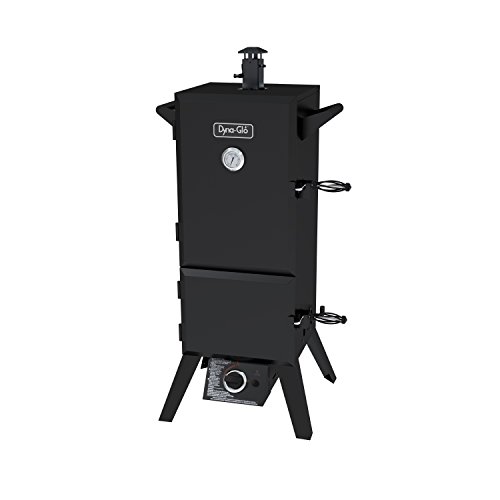
Dyna-Glo DGY784BDP 36-Inch Vertical LP Gas Smoker — Best Wide-Format Step-Up
Most cabinets grow upward; the Dyna-Glo’s step-up is sideways. Its 36-inch LP format is proportioned for the loads that vertical towers handle awkwardly: full racks of ribs laid flat without cutting or curling, trays of wings in a single layer, whole chickens side by side with air between them. For the household whose smoking menu is ribs first and everything else second, that proportion is not a preference — it is the difference between the natural cook and the workaround, repeated every single weekend.
It suits rib specialists and experienced propane hands who want room without automation. The control is a plain valve, the layout is the classic one, and the brand is a smoker specialist whose cabinets have taught a generation the craft. It does not suit the low-temperature experimenter — no published curing-band range here — nor the buyer who wants the machine to manage drift: at this width, in wind, temperature is the cook’s craft, practised with the techniques in the guide below.
Strengths
- Wide format fits full rib racks flat — the tier’s best rib box
- Specialist brand with a long cabinet history
- Simple mechanics with nothing to obsolete
Trade-offs
- Valve-only control at a size that feels weather
- No stated ultra-low range
- Single door, standard tending costs
| Size | 36-inch (per listing title) |
| Fuel | LP gas (per listing title) |
| Finish | Black powder coat (per listing title) |
Width has a thermal personality worth knowing before you buy: a wide cabinet presents more wall to the wind and holds a larger air mass, so it preheats slower than the compacts and rewards a sheltered placement even more. In exchange, the load itself cooks more evenly — no rack is stacked in another’s drip shadow, and the fire’s heat meets a single layer at a time. Rib cooks describe the difference as calm: fewer rotations, fewer compromises, bark that forms on a flat field instead of a crowded tower.
As a step-up purchase it also has the virtue of finality. Households rarely outgrow width the way they outgrow rack count, because the wide cabinet’s constraint is the party, not the family. If your menu is settled — ribs, chicken, the occasional shoulder — this may be the last propane cabinet you buy, and the tier’s money is well spent on a machine with that horizon.
Best for: rib-focused households stepping up for width and room / Not suited for: low-temperature specialists or automation seekers
Check on Amazon — check the current price on Amazon before you order.

Masterbuilt Vertical Smoker, Model MB20051311 — Best Brand- Depth Step-Up
Masterbuilt sells more vertical smokers than anyone, and this model — MB20051311, from the maker’s ThermoTemp-era vertical line — is the tier’s brand-depth play: a step up within the range of the category’s dominant manufacturer, where every cover, tray, rack and igniter in the catalogue is a known quantity and every owner’s question has a decade of answers behind it. The cabinet itself is the full-size vertical format, a clear rung above the compact MPS in working room, aimed at households whose loads outgrew the starter class.
It suits the Masterbuilt loyalist stepping up, the buyer who values the deepest support ecosystem in the category, and families whose typical cook is a brisket plus company. It does not suit the specification hunter — the Pit Boss publishes more numbers — nor the two-door or wide-format specialists, whose shapes this tower does not imitate. Its claim is the oldest one in the category: the big maker’s big cabinet, with everything that follow-through implies.
Strengths
- The category’s deepest parts and accessory ecosystem
- Full-size vertical format above the starter class
- A maker whose smoker line is its core business
Trade-offs
- Listing is spare with published specifications
- Single-door tower format like most of the tier
- Brand depth is the premium — rivals publish flashier numbers
| Model | MB20051311 (per listing title) |
| Fuel | Propane (vertical smoker line) |
| Format | Vertical cabinet |
There is a step-up logic that feature tables miss entirely: the second purchase. A household that starts on a Masterbuilt compact and steps up within the line keeps its covers’ fit knowledge, its tray habits, its dealer’s familiarity — the accumulated fluency of the first machine transfers instead of expiring. Brands know this, which is why their lines are ladders. The buyer who understands the ladder buys the rung they need without pretending the ladder is not there.
Judge this pick by the standard of its class: a roomy, conventional, well-supported tower cabinet for family loads, from the maker most likely to stock its igniter in seven years. In a tier of specialists and bargains, that conventional excellence is a legitimate thing for step-up money to buy — for many households, it is the thing.
Best for: Masterbuilt loyalists and support-first buyers stepping up in size / Not suited for: specification hunters or format specialists
Check on Amazon — check the current price on Amazon before you order.

Masterbuilt MPS 230S Propane Smoker, 30-Inch — Best Compact in Tier
Not every shopper in this tier should spend to its ceiling, and the MPS 230S is in this guide to say so with a straight face. The compact 30-inch cabinet does everything the tier promises at its core — the full smoking band, the classic layout, the category’s biggest brand — while leaving a meaningful share of the budget unspent for the things that actually improve a first year: the spare tank, the good probe, the cover, and a great deal of meat to practise on. A step-up budget spent partly on smoking beats a step-up budget spent entirely on a smoker.
It suits small households in this tier precisely because their loads never ask the question the bigger cabinets answer. It suits the deliberate minimalist and the second-location buyer too. It does not suit the growing family — the ceiling is real, and this guide’s other picks exist because households hit it — nor the cook whose menu is ribs by the tray, where the Dyna-Glo’s width is the honest answer.
Strengths
- Leaves budget for the kit and the meat — the smart step-up for small households
- Fast heat-up, frugal fuel use, corner footprint
- The category’s most proven compact design
Trade-offs
- Capacity ceiling is the whole reason the tier exists
- Valve-only control
- Cover and accessories are separate line items
| Size | 30-inch (per listing title) |
| Fuel | Propane |
| Format | Vertical cabinet |
There is a discipline in buying below your budget that premium guides rarely teach: unspent money is a feature. The household that buys this cabinet and a year of good meat will out-cook the household that buys the tier’s ceiling and economises on briskets. Smoking is a practice hobby; its returns compound with repetitions, and repetitions are bought with the grocery budget as surely as with the hardware budget. This pick is the guide’s respect for that arithmetic.
And if the household grows into the ceiling in year three, the compact loses nothing: it becomes the second cabinet, the cabin box, the jerky-and-sausage specialist beside its bigger successor. Compact classics do not get sold when they are outgrown; they get promoted sideways, which is more than can be said for most first purchases in any category. There is also a resale truth working in its favour: the compact classics are the most liquid smokers in the category, the models every beginner is told to look for used, so the owner who does sell recovers a healthy share of a modest outlay — one more way the below-ceiling strategy protects the household that chose it.
Best for: small households whose step-up is better spent across the whole hobby / Not suited for: growing families or tray-scale rib cooks
Check on Amazon — check the current price on Amazon before you order.

PIQUEBAR Propane Smoker with Cover, 3 Removable Racks — Best Budget Retention
The second retention makes the tier’s other argument: for a defined set of buyers, the correct under-300 purchase costs far less than the tier allows. The PIQUEBAR’s three removable racks and included cover form the complete starter at the band’s floor, and the money it leaves behind is not savings in the abstract — it is the second tank, the probe, the chimney of accessories and the first season’s meat, funded. A guide that only recommends spending to the ceiling is a catalogue; this pick is here because guides are supposed to give advice.
It suits the tentative, the small-household and the second-location buyer exactly as it did a tier below — the analysis does not change, only the context does: in this tier its presence is a measuring stick, showing how much cabinet the floor buys and therefore what the step-ups must justify. It does not suit the buyer who came to this tier for a feature — doors, width, assistance — because this cabinet’s feature is its completeness at a low total, full stop.
Strengths
- Complete starter — cover included — at the tier’s floor
- Removable racks keep the cleaning habit alive
- Frees the rest of the budget for kit and meat
Trade-offs
- Three-rack household capacity
- Value-tier build and seller support
- None of the tier’s step-up features — by design
| Racks | 3 removable smoking racks (per listing title) |
| Extras | Cover included (per listing title) |
| Fuel | Propane |
Measure the step-ups against this pick and the tier becomes legible: the Pit Boss’s premium over it buys racks, range and assistance; the GS30D’s buys a door; the Dyna-Glo’s buys width; the Masterbuilt step-up buys ecosystem. If none of those sentences moves you, this cabinet plus a funded first season is the rational purchase, and no badge in this guide outranks your own arithmetic. That is not a loophole in the tier system — it is the tier system working.
Ownership remains the budget liturgy: season first, cover always, pans same-day, inspection on arrival while returns are free. Run that routine and the floor of this tier is a perfectly respectable place to smoke from — as the growing number of households who never feel the need to leave it can testify.
Best for: buyers who would rather fund the first season than the cabinet / Not suited for: feature shoppers — doors, width and assistance live in the other picks
Check on Amazon — check the current price on Amazon before you order.
Comparison Table
The key spec column carries each listing’s verified facts; the badge column carries this tier’s argument — the specific thing the extra money buys in that cabinet. Read them together and the tier explains itself.
| Pick | Badge | Key spec | Best for |
|---|---|---|---|
| Pit Boss 3-Series Propane Gas Vertical Smoker with HVR Controller | Best Overall | 983 sq in, 4 racks, 100°F to 300°F range | buyers who want the step-up to buy completeness |
| Masterbuilt GS30D Propane 2-Door Smoker | Best Two-Door Step-Up | True 2-door propane cabinet | hands-on cooks and long-cook specialists who tend on schedule |
| Dyna-Glo DGY784BDP 36-Inch Vertical LP Gas Smoker | Best Wide-Format Step-Up | 36-inch LP cabinet, wide proportions | rib-focused households stepping up for width and room |
| Masterbuilt Vertical Smoker, Model MB20051311 | Best Brand- Depth Step-Up | Masterbuilt vertical cabinet, model MB20051311 | Masterbuilt loyalists and support-first buyers stepping up in size |
| Masterbuilt MPS 230S Propane Smoker, 30-Inch | Best Compact in Tier | 30-inch compact cabinet, fast and frugal | small households whose step-up is better spent across the whole hobby |
| PIQUEBAR Propane Smoker with Cover, 3 Removable Racks | Best Budget Retention | 3 removable racks, cover included | buyers who would rather fund the first season than the cabinet |
How to Choose the Best Gas Smokers Under 300: Spend on the Difference You Will Feel
This tier rewards a specific shopping method: name the frustration first. If your current cooking hurts when you open the door to tend, the step-up is the GS30D’s second door. If it hurts when the ribs do not fit, the step-up is the Dyna-Glo’s width. If it hurts in the first hour, chasing temperature, the step-up is the Pit Boss’s controller. If it hurts at the parts counter, the step-up is Masterbuilt’s depth. Every pick in this guide is the answer to one named frustration — and the buyer who cannot name theirs should keep the difference and buy the MPS or the PIQUEBAR, because an unnamed frustration cannot be fixed by furniture.
Second, check the tier’s arithmetic honestly: the distance between this band and the one below is not large, and several cabinets live in both. That overlap is not a defect in the guides; it is the market’s real shape, where a handful of strong cabinets anchor the middle and prices breathe around them. Your defence is the dated price check in this article’s sources and a fresh confirmation at order time — after that, buy the cabinet whose difference you named, and do not look back at the tier tables. They have done their work.
- Name the frustration the step-up must fix before comparing any models.
- Match the fix: doors for tending, width for ribs, controller for stability, brand for support.
- If no frustration names itself, buy below the ceiling and fund the kit and the meat.
- Confirm the current price on Amazon — this segment’s tags move between checks.
- Buy the cover and any model-specific spares in the same order as the cabinet.
Finally, remember what this tier cannot buy, so you do not ask it to: true set-and-forget automation, heavy-gauge steel that ignores weather, and party capacity live above it. A buyer whose real frustration is one of those should read the under-500 guide instead — the honest path up is through the tiers, not through pretending this one stretches further than it does.
Doors, Width, Controllers: The Three Step-Up Ideas, Compared Honestly
The two-door idea buys temperature stability by subtraction: it removes the cook’s own necessary openings from the chamber’s life. Its value scales with how often you tend and how long you cook — immense on a twelve-hour brisket with scheduled chip work, minor on a ninety-minute chicken. The width idea buys cooking geometry: single-layer loads, flat ribs, even bark. Its value scales with your menu — total for the rib household, irrelevant to the sausage maker. The controller idea buys attention: the machine absorbs drift, weather and the first hour’s overshoot. Its value scales with your temperament and your winters.
Notice that none of the three buys better meat in the abstract — each buys the removal of a specific friction between a specific cook and a specific result. That is why this tier confuses shoppers who rank by specification totals: the totals are similar, while the frictions removed are entirely different. The experienced buyer’s question is never ‘which is best’ but ‘which friction is mine’ — and it is the question this guide has been asking, in different words, since its first paragraph.
Staying in Tier: Kit, Tank and the Costs Around the Cabinet
A cabinet at this band still needs its entourage: a cover if one is not included (the PIQUEBAR includes one; the others generally do not), a probe thermometer, a first tank and a spare by the time guests are involved, and chips or chunks in a dry bin. Totalled honestly, the entourage is a meaningful fraction of the tier — which is why two picks in this guide are retentions from below: for some households the correct under-300 spend is a below-tier cabinet plus a complete entourage, and any guide that hides that arithmetic is selling cabinets, not advice.
Running costs then settle into the propane pattern: tank refills across many cooks, replacement trays and pans over the years, an igniter eventually. None of it is large, and all of it is predictable — the middle tier’s final virtue. You are buying known machines with known appetites, and the surprises, such as they are, will come from the weather and the meat, which is exactly where a smoker’s surprises should come from.
A Word About Assembly Day at This Tier
Mid-tier cabinets arrive as flat-packed steel and an afternoon, and the afternoon deserves respect in the budget: two people, a clear floor, every panel checked against the parts list before a single screw turns. Tighten in the sequence the manual gives — cabinets racked square at assembly seal square for years, while cabinets forced together stay leaky at one corner forever. Keep the packaging until after the seasoning burn and the first cook; it is your return insurance and your inspection deadline in cardboard form. None of this is glamorous, and all of it is worth more than the difference between two of this tier’s badges: a well-assembled GS30D will out-smoke a badly assembled anything, because doors only keep their promises when the box beneath them is true.
How to Use a Mid-Tier Gas Smoker: The Long Brisket Cook, Managed Well
This tier’s cabinets earn their money on the long cook, so the how-to is a brisket run as these machines are meant to be used — with the tending rhythm planned, the step-up features (doors, controller, width) doing their specific work, and the cook’s attention spent where it buys flavour.
- The night before: trim, season, and set the brisket uncovered in the fridge. Check the tank by weight or gauge; swap in the spare if there is any doubt.
- Ninety minutes before the meat: fill the water pan, load the chip tray generously, light the burner and bring the cabinet to the working band. Give a mid-tier cabinet its full stabilising preheat — bigger boxes lie about readiness longer than compacts do.
- Load the brisket fat-side toward the heat, probe in the thickest part of the flat. On a wide cabinet, centre it; on a tower, use the middle racks and leave the top for later arrivals.
- First three hours: this is the smoke window. Tend the chip tray on schedule — through the lower door if your cabinet has one — and otherwise leave the chamber sealed. Thin smoke, steady band, no heroics.
- Middle hours: expect the stall. Hold the band, keep the water pan honest, and decide wrapping by bark, not by the clock: when the bark is set and dark, wrapping is a tool; before that, it is impatience.
- Final hours: probe for tenderness, not temperature. The flat should give like warm butter when it is ready, and no two briskets agree on when that is.
- Rest wrapped, in a cooler, for at least an hour and preferably two. Slice against the grain, pencil-thick for the flat, thicker for the point.
- Close the cook properly: pans washed today, burner brushed when cool, cabinet covered when cold, notes written while the memory is fresh.
The note that matters most from a first long cook on a step-up cabinet is where your specific machine spent your attention: the door you opened, the hour the wind rose, the tray that ran dry early. That map — not the specification sheet — is what you actually bought, and knowing it is what makes the second brisket feel less like an event and more like a routine. That transition is the entire return on this tier’s money.
Common Buying Mistakes
The middle tier’s characteristic mistake is feature tourism: buying the door, the width or the controller as a trophy rather than as the answer to a named frustration, then discovering the friction you actually had is still there. Name it first; the guide above is built for exactly that. Second is tier drift — ordering a cabinet that was in-tier at research time without confirming its price at order time, in the segment where prices breathe the most.
- Spending to the ceiling when your frustration was actually the missing spare tank or probe.
- Judging a wide cabinet by tower habits — it preheats slower and cooks flatter; adapt, do not complain.
- Ignoring the two-door’s discipline: the lower door is for tending, and opening the top ‘just to look’ refunds the design.
- Running a controller cabinet on full manual suspicion — or trusting it so completely you stop probing the meat.
- Forgetting that step-up cabinets still live outdoors: cover, pans and burner care are unchanged by price.
- Comparing this tier’s cabinets by summed specification instead of by the friction each removes.
And the quiet mistake: skipping the tier entirely in planning — assuming the choice is between the cheapest cabinet and the flagship. For most households the best propane smoker they will ever own sits in this band, bought for a named reason. The flagship’s extra money buys capacity most patios never use; this tier buys the differences you feel every single cook.
Final Recommendation
Buy the Pit Boss if your step-up should buy completeness — racks, range and assistance in one cabinet. Buy the GS30D if it should buy back your long cooks from the door problem. Buy the Dyna-Glo if it should buy ribs their natural geometry. Buy the Masterbuilt MB20051311 if it should buy the deepest support in the category. And if none of those differences is the one you feel, buy the MPS 230S or the PIQUEBAR and spend the difference on the season — that, too, is a correct under-300 decision, and this guide is proud to contain it.
Whichever cabinet you choose, run the brisket protocol above once before you judge it. The best gas smokers under 300 are not bought on specification sheets; they are revealed on the second long cook, when the friction you paid to remove is simply, permanently, not there.
- Pit Boss 3-Series Propane Gas Vertical Smoker with HVR Controller — best overall pick; check price on Amazon.
- Masterbuilt GS30D Propane 2-Door Smoker — best two-door step-up pick; check price on Amazon.
- Dyna-Glo DGY784BDP 36-Inch Vertical LP Gas Smoker — best wide-format step-up pick; check price on Amazon.
Keep exploring the cluster: Best Gas Smokers Under 250.00 Best Gas Smokers Under $500 Best Gas Meat Smokers Best 2 Door Gas Smokers Best Food Smokers
Frequently Asked Questions
What does the step up from the under-250 tier actually buy?
Specific differences rather than general betterness: a true two-door layout (GS30D), a wide rib-friendly format (Dyna-Glo), a deeper brand line with its parts ecosystem (Masterbuilt MB20051311), and stronger availability of the controller-assisted all-rounder (Pit Boss). The cooking band and the smoke are the same; what changes is which friction disappears from your cooks. Name your friction and the tier chooses for you.
Is the two-door design worth it at this price?
If you tend — chips on schedule, water checks, spritzing — across long cooks, yes: the design removes the temperature cost of every one of those interventions, permanently, by geometry. If you cook short and rarely open the cabinet, the same money buys more in the controller or capacity columns. It is the tier’s most conditional value, and the condition is your own habit.
Why do two picks repeat from the under-250 guide?
Because the tiers overlap in the real market: strong cabinets anchor the middle, and prices breathe around the line. The retentions are labelled and argued, not smuggled — the MPS 230S and PIQUEBAR appear here as deliberate below-ceiling strategies for buyers whose better spend is the kit and the season. A guide that pretends the tiers are sealed boxes would be tidier and less true.
Can a smoker in this tier handle a full packer brisket?
Yes — the Pit Boss, the Masterbuilt step-up and the Dyna-Glo all take a full packer with room for airflow, and the wide Dyna-Glo is the most comfortable fit of the three. The compact MPS can manage a modest packer with care. What this tier asks in return is the long-cook discipline in the how-to: full preheat, scheduled tending, tenderness over temperature.
Do I need the controller, or is a valve enough?
A valve is enough for any cook in this guide — generations of briskets prove it — provided the cook supplies the attention: small adjustments, fifteen-minute trends, sheltered placement. The controller buys that attention back. Decide by temperament and schedule, not by fear: nobody’s brisket was saved by a feature they resented paying for, and nobody’s was ruined by a valve they understood.
How long will a mid-tier propane cabinet last?
With the standard liturgy — cover, same-day pans, seasonal burner care — the brand-name cabinets in this tier are multi-year, typically many-season machines, with igniters and trays as the expected consumables. The two-door and wide formats have the additional virtue of mechanical simplicity: there is very little in them that can become obsolete.


