Disclosure: airfryerkitchensupply.com is reader-supported. When you buy through links on our site, we may earn an affiliate commission at no extra cost to you.
Where to buy
The best gas meat smokers for beginners are not the biggest or the cleverest cabinets — they are the ones whose mistakes are cheap, whose controls forgive, and whose first three cooks build confidence instead of character. Every linked pick below is a verified current listing, and one pick is deliberately unlinked: a classic large two-door design sold through dealers, included so you can see the whole market rather than only the part with buy buttons.
- Masterbuilt MPS 230S Propane Smoker, 30-Inch — check price on Amazon; choose the listing sold or shipped by Amazon or the brand’s own store, and confirm the exact model name before you order.
- PIQUEBAR Propane Smoker with Cover, 3 Removable Racks — check price on Amazon; choose the listing sold or shipped by Amazon or the brand’s own store, and confirm the exact model name before you order.
- Pit Boss 3-Series Propane Gas Vertical Smoker with HVR Controller — check price on Amazon; choose the listing sold or shipped by Amazon or the brand’s own store, and confirm the exact model name before you order.
- Masterbuilt GS30D Propane 2-Door Smoker — check price on Amazon; choose the listing sold or shipped by Amazon or the brand’s own store, and confirm the exact model name before you order.
- Dyna-Glo DGY784BDP 36-Inch Vertical LP Gas Smoker — check price on Amazon; choose the listing sold or shipped by Amazon or the brand’s own store, and confirm the exact model name before you order.
- Smoke Hollow Pro Series 44-Inch Two-Door Propane Smoker — Sold through the maker’s dealer channels rather than a matchable Amazon listing, so no buy link is printed — ask a barbecue dealer for the Pro Series 44-inch two-door and compare its out-the-door price against the linked picks.
Choosing among the best gas meat smokers for beginners is really choosing your first teacher. Propane is a kind first fuel: the smoker lights like a stove, heats in minutes, asks for no fire-building skill and no electrical outlet, and lets a new cook spend their attention on the meat instead of the fire. But cabinets differ sharply in how they treat a beginner. Some hold temperature almost by themselves. Some teach the valve craft gently, in a small box where mistakes are small. One in this guide is here precisely because it is not for your first year — the honest map of a category includes the machines to grow toward.
Here is the beginner truth nobody prints: your first smoker’s job is not to produce competition brisket. Its job is to get you through your first five cooks with results good enough that there is a sixth. That means forgiving temperature behaviour matters more than capacity, a chip tray you can manage matters more than a fourth rack, and a price that does not make every cook feel like an exam matters most of all. Every badge in this guide was assigned against that standard, not against the standards of the experienced-cook guide this one sits beside.
The six picks form a ladder. Two are true starters — one compact classic, one budget cabinet with the cover in the box. Two are step-ups that stay friendly: a controller-assisted cabinet that grows with you, and a two-door design that teaches tending without punishment. One is the roomy box to want in year two. And one is an unlinked classic, written without a buy link because its maker sells through dealers — included because a beginner deserves to know it exists before a salesperson explains it at a markup.
In this guide
Quick Picks
- Best First Smoker — Masterbuilt MPS 230S Propane Smoker, 30-Inch: the starter this guide recommends most — a compact 30-inch cabinet that heats fast, forgives small mistakes, and teaches the whole propane craft at household scale. Check on Amazon
- Best Budget First Smoker — PIQUEBAR Propane Smoker with Cover, 3 Removable Racks: the lowest-risk start in the guide — a three-rack propane cabinet with the cover included, so the first year’s whole cost is visible before you commit. Check on Amazon
- Best Grow-With-You Smoker — Pit Boss 3-Series Propane Gas Vertical Smoker with HVR Controller: the beginner pick that does not expire — controller-assisted temperature, four racks and a verified range down to 100°F, so year three’s ambitions fit the year-one purchase. Check on Amazon
- Best for Learning to Tend — Masterbuilt GS30D Propane 2-Door Smoker: the teacher for hands-on learners — a lower door for chips and water, an upper door for food, so a beginner’s frequent checks stop destroying the temperature they are learning to read. Check on Amazon
- Best Second-Year Target — Dyna-Glo DGY784BDP 36-Inch Vertical LP Gas Smoker: the roomy, unassisted cabinet to grow into — included so beginners can see what year two looks like, and buy it then (or now, if ribs are the whole point). Check on Amazon
- Best Large Two-Door Design (Dealer Channel) — Smoke Hollow Pro Series 44-Inch Two-Door Propane Smoker: the big two-door classic — a 44-inch cabinet with the fire and food fully separated, written unlinked because the maker sells it through dealers rather than a listing we could verify.
How These Picks Were Chosen
Verification matched every other guide in this program: each linked model was searched, the returned listing title was matched word-for-word against the intended cabinet, and only then was a link printed. The unlinked pick is labelled with its reason — no listing could be matched with certainty because the maker sells through dealer channels — following the same honesty rule as the verified picks.
Beginner-specific criteria then did the ranking. We weighted: how the cabinet behaves in its first hour (heat-up speed and overshoot), how visible and simple the controls are, how forgiving the temperature band is at its low end, how much meat fits without crowding a learner’s airflow, and the true starter cost including the cover and a first tank. We also weighted the quality of the learning curve — a beginner smoker should teach skills that transfer to every cabinet you will ever own, and all five linked picks teach the same core craft: chip management, water pan discipline, and reading a cook by trend rather than by the minute.
The 6 Best Gas Meat Smokers for Beginners, from First Cook to Fifth

Masterbuilt MPS 230S Propane Smoker, 30-Inch — Best First Smoker
Begin with the box that makes beginning easy. The MPS 230S is a 30-inch propane cabinet — small enough to heat in minutes, which matters more to a beginner than any other specification, because a fast-heating smoker shortens every lesson: you adjust, you see the result, you learn. Its layout is the classic curriculum in one cabinet — burner, chip tray, water pan, racks — with nothing electronic between you and the fundamentals, and its household capacity is honestly sized for the cooks a first year actually contains: chickens, ribs, a pork shoulder, a modest brisket.
It suits the true beginner completely: first patio, first smoker, first brisket sometime in month three. It also suits the apartment-adjacent and the budget-aware, since the whole starter kit — cabinet, cover, tank, chips — stays the cheapest complete education in this guide. It does not suit the beginner who already cooks for twelve every Sunday; that learner should start one rung up at the Pit Boss, because outgrowing a smoker in a season is the only real waste in this category.
Strengths
- Fast heat-up shortens every learning loop
- Classic layout teaches transferable propane fundamentals
- Household size keeps early mistakes small and cheap
Trade-offs
- Valve control only — you are the thermostat while you learn
- Capacity ceiling appears if your household is large
- Large briskets are a tight fit; expect to learn rack Tetris
| Size | 30-inch (per listing title) |
| Fuel | Propane |
| Format | Vertical cabinet |
What the first month looks like on this cabinet, honestly: cook one is a chicken, because chicken forgives everything and takes ninety minutes. Cook two is ribs, where you learn the chip tray’s rhythm. Cook three is a pork shoulder, your first long cook, where you learn that the thermometer moves slowly and panic is not a technique. By cook four you are adjusting the valve in small steps and judging trends — which is to say, you can now run any propane smoker ever made. That is what a first smoker is for.
One beginner-specific warning belongs to this pick: small cabinets swing more in wind, because there is less hot metal to hold the temperature steady. Place it in a sheltered corner from day one, not after the first frustrating cook. Beginners blame themselves for what the wind did; a sheltered placement removes the variable while the skills form.
Best for: true beginners who want the classic, complete propane education / Not suited for: large households that will outgrow it within a season
Check on Amazon — check the current price on Amazon before you order.

PIQUEBAR Propane Smoker with Cover, 3 Removable Racks — Best Budget First Smoker
Some beginners do not need the best starter; they need the cheapest honest one, because the real question is whether smoking is their hobby at all. This three-rack cabinet answers that question at the lowest complete cost in the guide — the cover is included in the box, which quietly removes the accessory bill that ambushes buyers of every other pick. The layout teaches the identical curriculum as the Masterbuilt above: same burner-and-tray architecture, same smoking band, same techniques, in a budget-built box.
It suits the curious, the cautious and the gift-buyer — anyone whose correct move is a small bet on a new hobby. The removable racks deserve a beginner-specific mention: they come out for washing in a sink, which means the cabinet actually gets cleaned, which means it stays pleasant to use, which is how hobbies survive their first season. It does not suit a beginner who already knows they are committed — that buyer should spend once on a brand-name cabinet — nor anyone expecting a decade of weekly service from budget steel.
Strengths
- Lowest complete starter cost — cover included
- Removable racks make the cleaning habit easy to keep
- Teaches the same fundamentals as every cabinet here
Trade-offs
- Budget steel and hardware set a seasons-long horizon
- Household capacity only
- Thinner parts support than the big brands if something fails
| Racks | 3 removable smoking racks (per listing title) |
| Extras | Cover included (per listing title) |
| Fuel | Propane |
The beginner economics deserve a straight paragraph. A first smoker’s realistic outcomes are two: the hobby sticks, or it does not. If it sticks, this cabinet becomes the second smoker — the cabin box, the loaner, the jerky cabinet — and nothing is wasted. If it does not, the loss is the smallest in the category. What the budget route must never become is a reason the hobby fails: a leaky, rusting, neglected box can talk a person out of smoking entirely, which is why the cover habit and the seasoning burn in the how-to below are not optional garnish for this pick — they are the whole ownership strategy.
Skill-wise, expect one difference from the brand-name starters: temperature manners are a little rougher, so your valve hand learns slightly faster. Treat that as tuition rather than defect. Every technique in this guide was written to work on this cabinet exactly as written.
Best for: curious beginners making a small, reversible bet on the hobby / Not suited for: committed cooks who should buy once at a higher tier
Check on Amazon — check the current price on Amazon before you order.

Pit Boss 3-Series Propane Gas Vertical Smoker with HVR Controller — Best Grow-With-You Smoker
Most beginner advice says buy small and upgrade later. This pick is the respectable exception: a cabinet a beginner can run on day one — because its controller assists the burner and steadies the band that novices struggle to hold — with capacity and range that the same cook will still be using in year three. The listing verifies 983 square inches across four racks and a temperature range from 100°F, which quietly adds sausage and jerky to the curriculum once the basics are habits. If your household is large or your ambition is obvious, starting here skips a purchase.
It suits beginners with big households, beginners who hate the idea of buying twice, and beginners whose interest already includes the low-temperature crafts. It does not suit the tentative — it is a real commitment of money and patio — nor the minimalist learner who benefits from a small box’s fast feedback. Bigger cabinets heat slower and forgive slower; the learning loops are longer here, and that is the honest price of skipping a rung.
Strengths
- Controller assistance flattens the beginner’s hardest lesson
- Capacity and low range grow with the cook for years
- Four racks handle family-scale cooks from the start
Trade-offs
- A commitment — in cost, footprint and assembly
- Slower heat-up means slower feedback while learning
- More racks and space to clean after every cook
| Cooking area | 983 sq in (per listing title) |
| Racks | 4 (per listing title) |
| Temperature range | 100°F to 300°F (per listing title) |
| Fuel | Propane |
| Extras | Wood chip tray (per listing title) |
The controller question, from a teacher’s perspective: does assistance prevent learning? Used passively, it can — a cook who never watches temperature never learns it. Used as training wheels with intent, it does the opposite: it removes the discouraging failures (the runaway first hour, the sagging overnight cook) while the beginner learns everything else, and the valve craft can be practised deliberately on short cooks. This guide’s advice: run the first month assisted, then cook one chicken a week managing temperature as manually as the machine allows. You will arrive at the same skills by a kinder road.
The 100°F floor also changes the beginner’s second year in a way worth picturing now: the first sausages, the first jerky, the first cheese attempted on a cold morning with the burner barely alive. Those are the cooks that turn a smoker owner into a smoking hobbyist, and they are simply unavailable on cabinets whose range starts at brisket temperature. Range is curriculum.
Best for: committed beginners and large households buying once, properly / Not suited for: tentative learners or small households
Check on Amazon — check the current price on Amazon before you order.

Masterbuilt GS30D Propane 2-Door Smoker — Best for Learning to Tend
Beginners open doors. It is not a character flaw; it is how people learn — they look, they spritz, they rearrange, they check the water pan because the guide said to. On a single-door cabinet every one of those lessons costs a chunk of the temperature the cook was supposed to be learning to hold, and the feedback becomes noise. The GS30D’s two-door layout — the lower door serving burner, chips and water, the upper door serving the food — is therefore a genuinely beginner-friendly design wearing an old-school disguise: it separates the tending a beginner must do from the heat they must not lose.
It suits the tactile learner — the beginner who knows they will peek, spritz and fuss, and would rather the machine forgave it structurally. It suits long-cook ambitions too, since tending matters most across ten hours. It does not suit the buyer who wants modern controls — this is a classic valve cabinet from the category’s earlier generation, and two-door propane is a shrinking niche, so buy it as the specific tool it is, with a cover and a spare tray in the same order.
Strengths
- Two doors protect the cook’s temperature from the learner’s curiosity
- Teaches tending as a rhythm instead of a punishment
- Classic layout — every part and technique is well documented
Trade-offs
- Valve-only control from an older design generation
- Shrinking niche — verify stock and spares when ordering
- Household capacity, not party capacity
| Layout | 2-door propane smoker (per listing title) |
| Fuel | Propane |
There is a teaching subtlety here worth naming: on this cabinet, the beginner learns the two halves of smoking as separate crafts, because the doors separate them. Fire craft — chips, water, burner — happens downstairs, on schedule, without consequence. Food craft — placement, probing, patience — happens upstairs, undisturbed. Most cabinets force those crafts into one doorway and one blast of escaping heat. Learners who start on the GS30D often describe the penny dropping faster, and the design is why.
The scarcity note is practical, not nostalgic: two-door propane cabinets were once a category and are now a model or two, as makers chase controller features instead. If the design fits your learning style, that is an argument for buying it while it is current rather than a reason to wait for next year’s version — there may not be one, and the used market prices good examples accordingly.
Best for: hands-on, curious beginners who will tend often and peek honestly / Not suited for: set-and-forget buyers who want modern controls
Check on Amazon — check the current price on Amazon before you order.
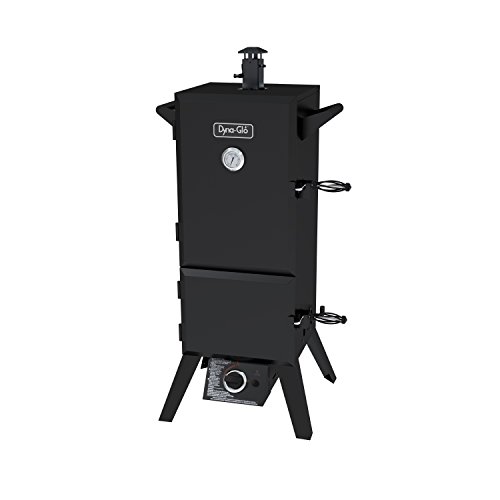
Dyna-Glo DGY784BDP 36-Inch Vertical LP Gas Smoker — Best Second-Year Target
Every beginner guide should show the destination, and in propane cabinets the destination looks like this: a 36-inch LP cabinet in a wide format, with a plain valve, no controller, and room for full racks of ribs laid flat. The Dyna-Glo is not harder to run than the starters — the physics is identical — but it assumes the cook’s hands already know the rhythm, because nothing in the box will catch a drifting temperature for you. That is precisely what makes it a second-year machine: it converts skill into capacity.
It suits the beginner whose first season is already planned around ribs and volume, and who is willing to learn on the bigger box with the guide below as the syllabus. It also suits the graduate of a budget cabinet who knows exactly why they are upgrading. It does not suit the absolute beginner who wants the machine to share the work — start at the MPS 230S or the Pit Boss and let this be the reward — nor the low-temperature experimenter, whose range lives in the Pit Boss pick.
Strengths
- Wide 36-inch format built for full rib racks and trays
- Pure, maintainable mechanics — nothing to obsolete
- Capacity that ends the upgrade question for most households
Trade-offs
- No temperature assistance of any kind
- Bigger box, slower lessons for a true novice
- Single door — tending discipline must be learned, not designed around
| Size | 36-inch (per listing title) |
| Fuel | LP gas (per listing title) |
| Finish | Black powder coat (per listing title) |
Why include a non-beginner pick in a beginner guide at all? Because beginners are adults making a multi-year purchase decision, and the most common beginner mistake in this category is not buying too much machine — it is buying blind, without knowing what the ladder’s top looks like, and then resenting the starter. If the Dyna-Glo’s honest description — roomy, manual, rib-shaped — is the machine you actually pictured, the correct move may be to start here with eyes open and this guide’s how-to as your first-month plan. The ladder is advice, not law.
If you do start here, borrow the starters’ curriculum anyway: chicken first, ribs second, shoulder third, and a sheltered placement from day one. The wide cabinet’s one beginner trap is preheat patience — its walls drink the first heat slowly, and food loaded into a half-warmed box teaches confusing lessons. Give it its full preheat and it behaves like the honest tool it is.
Best for: ambitious beginners and second-year graduates who cook ribs at volume / Not suited for: absolute beginners who want the machine to share the work
Check on Amazon — check the current price on Amazon before you order.
Smoke Hollow Pro Series 44-Inch Two-Door Propane Smoker — Best Large Two-Door Design (Dealer Channel)
The Smoke Hollow Pro Series is the two-door idea at full size: a 44-inch propane cabinet where the lower section — burner, chip tray, water pan — is serviced through its own door while the tall food chamber above stays sealed and smoking. For a beginner it represents the format’s other philosophy: instead of a small box that heats fast, a large insulated space that changes temperature slowly and forgives in the opposite direction. It has been a fixture of the dealer-channel market for years, which is also why it appears here without a link — its maker sells through dealers and seasonal stock, and no listing could be matched with certainty at verification time.
It suits the beginner with a mentor — a family member or club that already smokes — who will cook big from the start and has hands nearby for the first season. It does not suit the solo beginner buying online tonight: dealer purchase means dealer logistics, and a 44-inch cabinet is a great deal of smoker to learn alone on. Treat this entry as market education — the design is real, respected, and worth a dealer’s demonstration — rather than as this guide’s recommendation for a first purchase.
Strengths
- Two-door separation at full 44-inch scale
- Large thermal mass changes temperature slowly and steadily
- Dealer channel means hands-on support where available
Trade-offs
- No verified online listing — purchase takes dealer effort
- Far more cabinet than a solo beginner needs
- Price and stock vary by dealer and season
Why does an unlinked pick belong in a beginner guide at all? Because beginners are the buyers most vulnerable to the dealer’s pitch, and walking in already knowing this machine — its genuine two-door virtue, its real size, and the fact that the linked cabinets above cover the same craft at household scale — is worth more than a buy link. Information is the beginner’s scarcest resource, and a guide that only shows what it can link is a catalogue, not a guide.
If you do pursue it, pursue it properly: see it in person, work both doors, check the chip tray’s size against your hand, and ask the dealer about covers, spare trays and igniters by name. A good dealer is a feature of this purchase — ongoing local support is the channel’s entire argument — so buy the dealer as much as the cabinet, and walk away from any who will not discuss parts.
Best for: mentored beginners cooking big from day one, buying through a good local dealer / Not suited for: solo beginners shopping online for a first smoker
Sold through the maker’s dealer channels rather than a matchable Amazon listing, so no buy link is printed — ask a barbecue dealer for the Pro Series 44-inch two-door and compare its out-the-door price against the linked picks.
Comparison Table
Read this table as a ladder, not a league: the picks are ordered by the role they play in a beginner’s first two years, with the verified key facts from each listing. The right choice is the rung you are actually standing on.
| Pick | Badge | Key spec | Best for |
|---|---|---|---|
| Masterbuilt MPS 230S Propane Smoker, 30-Inch | Best First Smoker | 30-inch propane cabinet, compact and quick to heat | true beginners who want the classic, complete propane education |
| PIQUEBAR Propane Smoker with Cover, 3 Removable Racks | Best Budget First Smoker | 3 removable racks, cover included in the box | curious beginners making a small, reversible bet on the hobby |
| Pit Boss 3-Series Propane Gas Vertical Smoker with HVR Controller | Best Grow-With-You Smoker | 983 sq in, 4 racks, 100°F to 300°F verified range | committed beginners and large households buying once, properly |
| Masterbuilt GS30D Propane 2-Door Smoker | Best for Learning to Tend | True 2-door propane layout, fire and food separated | hands-on, curious beginners who will tend often and peek honestly |
| Dyna-Glo DGY784BDP 36-Inch Vertical LP Gas Smoker | Best Second-Year Target | 36-inch LP cabinet, wide format, unassisted control | ambitious beginners and second-year graduates who cook ribs at volume |
| Smoke Hollow Pro Series 44-Inch Two-Door Propane Smoker | Best Large Two-Door Design (Dealer Channel) | 44-inch two-door design, sold through dealers — no link | mentored beginners cooking big from day one, buying through a good local dealer |
How to Choose the Best Gas Meat Smokers for Beginners: A First-Buyer’s Framework
Forget specifications for the first decision: how sure are you? The tentative beginner’s correct smoker is the cheapest complete one (the PIQUEBAR, cover included), because the risk being managed is not bad barbecue, it is an abandoned hobby. The certain beginner’s correct smoker is the one that fits their household for five years — the MPS 230S for average families, the Pit Boss for large ones — because the risk being managed is buying twice. Both risks are real; only you know which one is yours, and every other criterion in this guide is subordinate to answering that question honestly.
Second decision: how do you learn? Hands-on learners — the peekers and spritzers — should weight the GS30D’s two doors heavily, because its design converts their habit from a fault into a method. Set-and-forget learners should weight the Pit Boss’s controller, because it removes the variable they least enjoy while they learn everything else. The valve-only starters teach the purest craft and suit learners who enjoy machinery. None of these is a personality test with a wrong answer; they are three roads to the same competence, and the best road is the one you will actually stay on for five cooks.
- Decide your certainty first: tentative buys cheap and complete; certain buys once and right-sized.
- Count your household, not your imagination — capacity should fit your real Sundays.
- Include the whole starter kit in the budget: cover, tank, chips, a probe thermometer.
- Prefer the cabinet whose cleaning you will actually do — removable racks and pans win.
- Read the how-to below before ordering; the first cook is already planned for you.
Third, a word about size that contradicts most advice: for a beginner, smaller is not automatically safer. A tiny cabinet heats fast and teaches fast, but it also swings in wind and crowds a brisket into bad airflow. The household-size cabinets in this guide — 30-inch class and the Pit Boss — are the sweet spot where a beginner’s errors stay small and the food still fits. Buy the size of your household, learn on forgiving foods, and let brisket wait until cook three.
The Beginner’s First Five Cooks: A Curriculum That Works
Cook one: a whole chicken, spatchcocked if you are brave, whole if you are not. Ninety minutes at the top of the smoking band, chips in at the start, done when the thigh probes tender and juicy. It teaches lighting, preheat, the chip tray and the probe in a single forgiving session. Cook two: ribs, by the bend test rather than the clock, where you learn the chip rhythm and what thin smoke looks like. Cook three: a pork shoulder, your first long cook — start it in the morning, tend on schedule, and learn the stall by living through it once with a forgiving cut.
Cook four is a repeat of whichever cook taught you the most, done deliberately: same food, notes open, one variable changed. Cook five is the first brisket, attempted only now, with the tank checked, the day cleared and the rest planned. This curriculum works because each cook adds exactly one new demand — time, then tending, then duration, then refinement, then difficulty — and because every food on it forgives the mistakes that teach the lesson. Skip ahead to brisket on day one and the same mistakes cost a brisket.
What Beginners Actually Get Wrong About Propane (It Is Not the Meat)
New propane cooks blame the meat, the rub and the wood for results that were decided by three unglamorous variables: wind, preheat and patience. Wind strips heat from thin cabinet walls and makes the thermometer lie about the cook’s progress; a sheltered corner fixes more beginner cooks than any product upgrade. Preheat is the second: food loaded into a half-warmed cabinet spends its first hour in a temperature swamp, and the cook concludes the machine is erratic when it was merely rushed. Give every cook its full stabilising preheat and the same machine becomes predictable.
Patience is the third, and it is really about measurement: cabinet temperature is a slow variable, and the beginner who adjusts the valve every five minutes is steering by waves. Adjust in small steps, wait fifteen minutes, judge the trend. That single habit — taught by every pick in this guide and impossible to buy as a feature — is the difference between beginners who plateau and beginners who, by cook five, are simply cooks.
How to Use a Gas Smoker for the First Time: Your First Chicken
Your first cook is a whole chicken, chosen because it is short, cheap and nearly impossible to ruin — the perfect first lesson. Everything below applies to every pick in this guide; where your manual differs, the manual wins.
- The day before: salt the chicken and leave it uncovered in the fridge overnight. Dry skin is the beginner’s shortcut to good texture.
- An hour before cooking: fill the water pan, load the chip tray with a handful of dry chips, and check the tank — a beginner’s first lesson is that preparation is half the cook.
- Light the burner exactly as the manual describes, set the cabinet climbing toward the top of the smoking band, and close the door. Now wait — a full 25 to 30 minutes — while it stabilises. Use the time to take the chicken out of the fridge.
- When the temperature has held steady for ten minutes, place the chicken inside, probe in the thickest part of the thigh away from bone, and close the door.
- Resist the door. Your scheduled check is at 45 minutes, for the chip tray and a glance — not a rearrangement. Beginners learn more from one undisturbed cook than from five fussed-over ones.
- The chicken is done when the thigh probes at a safe, juicy doneness and the juices run clear — judge by the probe, not the clock or the colour.
- Rest it 15 minutes before carving. While it rests, close the chip tray’s air down, turn the burner off, and write three lines of notes: what the temperature did, when you added chips, what you would change.
- Once cool: pans out and washed, racks scraped, cabinet covered. The five-minute version of cleanup, done today, is what makes cook two happen.
Read your notes before cook two — ribs, per the curriculum above — and change exactly one thing. That discipline, more than any feature on any cabinet in this guide, is what turns a first smoker into a five-year hobby. Every experienced cook you admire is simply a beginner who kept notes and did not quit in month one.
Common Buying Mistakes
Beginner mistakes in this category are so consistent they can be listed in the order you will meet them. First is the brisket-first error: choosing the hardest, longest, most expensive cook as the debut, and judging the hobby by its hardest exam. The curriculum in this guide exists to prevent exactly that. Second is door discipline — or its absence — where curiosity costs the temperature the cook was trying to learn to read.
- Adjusting the valve constantly and chasing the thermometer minute by minute.
- Soaking the wood chips (it only makes steam) or overloading the tray into thick white smoke.
- Forgetting the water pan, then fighting the temperature swings it would have absorbed.
- Judging doneness by colour or clock instead of a probe.
- Skipping the cover and the same-day cleanup, then meeting rust and rancid pans at cook two.
- Buying the second smoker before the fifth cook — upgrade skill first; it is free and it transfers.
The last beginner mistake is invisible: comparing your first cooks to restaurant barbecue or competition photographs. Those cooks have thousands of hours in their hands. Your benchmark is your own last cook — and by that measure, a beginner with notes improves faster than any other kind of cook there is.
Final Recommendation
Start where you stand. Tentative? The PIQUEBAR, cover in the box, and the curriculum above. Certain, with an average household? The MPS 230S — the classic starter this guide recommends most. Certain, with a big household or low-temperature ambitions? The Pit Boss, bought once. A hands-on learner who knows they will peek? The GS30D’s two doors were designed for you. And keep the Dyna-Glo and the dealer-only Smoke Hollow in view as the map of where this road goes — year two has good machines waiting, and none of them need to be bought today.
Whatever arrives on your patio, cook the chicken first. The best gas meat smokers for beginners are the ones still being used at cook twenty, and that outcome is decided less by the badge on the door than by whether cooks one through five built a habit. They will, if you let them be easy.
- Masterbuilt MPS 230S Propane Smoker, 30-Inch — best first smoker pick; check price on Amazon.
- PIQUEBAR Propane Smoker with Cover, 3 Removable Racks — best budget first smoker pick; check price on Amazon.
- Pit Boss 3-Series Propane Gas Vertical Smoker with HVR Controller — best grow-with-you smoker pick; check price on Amazon.
Keep exploring the cluster: Best Gas Meat Smokers Best Food Smokers Best Gas Smokers Under 250.00 Best Gas Smokers Under $300 Best 2 Door Gas Smokers
Frequently Asked Questions
Is propane a good first fuel for smoking, or should beginners start electric?
Both are kind to beginners, differently. Electric is simpler still — a dial and an outlet — but propane teaches real flame craft that transfers to grills and fireboxes, works without power, and recovers heat faster after door openings. If your home has no convenient outdoor outlet, or you want the skills as much as the food, propane is the better teacher. This guide exists because for many beginners, it is.
How much should a beginner spend on a first gas smoker?
Spend to the level of your certainty, in total-kit terms: the complete start — cabinet, cover, tank, chips, probe thermometer — is the real budget, not the cabinet alone. Tentative beginners should keep the whole kit at the budget tier (the PIQUEBAR route). Certain beginners serve themselves better buying one brand-name cabinet at household size than two cheap ones in two years.
What is the easiest meat to smoke first?
A whole chicken, for the reasons in the how-to: short cook, low cost, forgiving of temperature swings, and it teaches lighting, chips, probing and resting in one session. Ribs second, pork shoulder third. Brisket is deliberately fifth — it is the same skills at maximum duration and cost, and it deserves to meet a cook who has already made the cheap mistakes.
Do I need a separate thermometer, or is the door gauge enough?
Buy the probe thermometer with the smoker. Door gauges read the air near the door, roughly, and beginners steering by them learn a distorted picture of their cabinet. A simple two-probe unit — one at grate level, one in the meat — turns guesswork into information, and it is the cheapest skill upgrade in the entire hobby.
How do I know when I have outgrown a beginner smoker?
By load or by craft, and both are obvious when they arrive: you are cooking relays for guests (capacity), or you are chasing work the cabinet cannot do — very low temperatures, very long unattended cooks (capability). Until one of those is true, the limiting factor is the cook, and the best upgrade available is the next cook. Most households discover the honest answer is ‘not yet’ for several happy years.
Is it safe to leave a gas smoker unattended?
No smoker of any fuel should be left truly unattended — that is the honest answer behind every ‘set and forget’ slogan. Propane cabinets are stable and predictable, and experienced owners check them on a rhythm rather than hovering. As a beginner, stay on the property, keep the checks scheduled, keep children and pets clear, and never run any combustion appliance in an enclosed space.


