Disclosure: airfryerkitchensupply.com is reader-supported. When you buy through links on our site, we may earn an affiliate commission at no extra cost to you.
Where to buy
Start with this shortlist of the best food processors for kneading dough. Every linked pick below was verified against Amazon’s own catalog data for this site before this guide was written, so the model names and capacities in this article match real, current listings. Use the links in this box, in Quick Picks, and under each review to check price on Amazon on the day you buy, because bundles and included accessories change between listings. If a pick is marked as unlinked anywhere in this guide, that means we could not confirm the exact configuration, and you should compare live listings carefully instead of trusting a headline claim.
- Cuisinart 14-Cup Food Processor DFP-14BCNY (Best Overall) — check price on Amazon
- Ninja Professional Plus Food Processor BN601 (Best for Preset Dough Cycles) — check price on Amazon
- Cuisinart Pro Classic 7-Cup Food Processor DLC-10SYP1 (Best Compact Kneader) — check price on Amazon
- KitchenAid 9-Cup Food Processor KFP0921 (Best for Storage and Everyday Baking) — check price on Amazon
- Hamilton Beach Professional Stack & Snap Food Processor 70815 (Best for Big Prep Plus Dough) — check price on Amazon
- Ninja Mega Kitchen System BL770 (Best Blender-Processor Combo for Dough) — check price on Amazon
If you are shopping for the best food processors for kneading dough, start with the fact that kneading is the most violent job a food processor does. A dough blade has to drag a stiff, elastic mass around the bowl dozens of times a minute, and the machine either has the torque, bowl strength, and lid seal for that punishment or it walks across the counter, overheats, and leaves you with a torn, gummy crumb. The six picks below were chosen because their verified listings explicitly confirm kneading or dough work — that wording matters, because it means the manufacturer designed the blade, gearing, and bowl lock for dough loads rather than merely tolerating them.
This guide is deliberately narrow. It does not rank processors as general choppers; it ranks them as kneading machines: how much flour they can realistically handle, how their motors behave when the dough ball starts thumping, and how their bowls and blades suit lean bread dough, enriched dough, pizza dough, and pastry. You will also find the technique that makes processor kneading succeed — hydration order, short bursts, temperature control — because even the best machine produces poor dough when it is overloaded or run too long.
One honest boundary: a food processor kneads fast and well for small-to-medium batches, but it is not a stand mixer. Very large batches, very stiff doughs like bagel dough at scale, and all-day bakery production belong to a mixer. For the home baker making one or two loaves, pizza for the family, or enriched dough for buns, the right processor is faster than a mixer and easier to clean. Every linked pick was verified in this site’s catalog data; check price on Amazon on the day you buy, since prices are never printed here.
In this guide
Quick Picks
Short on time? These six processors all confirm dough work in their own listings — from the 720-watt 14-cup classic to the preset-driven Ninja — ranked by how they actually knead.
- Best Overall — Cuisinart 14-Cup Food Processor DFP-14BCNY: The heavy-duty default for processor dough: a 720-watt motor and a 14-cup bowl whose listing names kneading dough outright. Check on Amazon
- Best for Preset Dough Cycles — Ninja Professional Plus Food Processor BN601: A 1000-watt processor with an Auto-iQ program that explicitly mixes dough — press a button and the cycle manages pulses and rests for you. Check on Amazon
- Best Compact Kneader — Cuisinart Pro Classic 7-Cup Food Processor DLC-10SYP1: The compact classic whose listing also names kneading dough — a 600-watt, 7-cup machine sized for one good loaf and small kitchens. Check on Amazon
- Best for Storage and Everyday Baking — KitchenAid 9-Cup Food Processor KFP0921: A 9-cup KitchenAid whose listing calls out kneading dough, with every blade and disc stored inside the bowl — the tidy everyday baker’s pick. Check on Amazon
- Best for Big Prep Plus Dough — Hamilton Beach Professional Stack & Snap Food Processor 70815: A 12-cup Stack & Snap machine with kneading in its listing and a feed chute that fits whole vegetables — dough plus serious prep in one machine. Check on Amazon
- Best Blender-Processor Combo for Dough — Ninja Mega Kitchen System BL770: A 1500-watt kitchen system whose 8-cup processor bowl is listed for dough — the pick when one base must blend, process, and knead. Check on Amazon
How These Picks Were Chosen
The qualifying filter for this list was strict: the model’s verified listing had to name kneading or dough among its jobs. That single rule removed most of the catalog, because many processors chop beautifully but were never designed for dough torque. Surviving models were then ranked by motor wattage where stated, bowl capacity as a proxy for realistic flour capacity, and dough-specific design — a dedicated dough blade, a dough preset, or a system built around processor dough.
Specs in the mini boxes come only from the verified listing titles. Flour capacities discussed in the reviews are framed as realistic working guidance, not manufacturer claims, and the guide section explains how to judge any machine’s true dough limit. No prices, star ratings, or review counts are used anywhere.
The 6 Best Food Processors for Kneading Dough

1. Cuisinart 14-Cup Food Processor DFP-14BCNY — Best Overall
This is the machine for the home baker who kneads weekly — sandwich loaves, pizza dough for the family, enriched dough for rolls. The 14-cup bowl gives a full bread batch room to form a single ball and circulate, and the 720-watt motor sustains the load without the speed sag that leaves dough under-kneaded in weaker machines. It suits bakers who also want a full-size general processor. It is not for someone making only tiny pastry batches in a small kitchen, where its size is wasted.
Strengths
- Kneading dough named in the listing — designed for the job
- 720W motor holds speed under a stiff dough ball
- 14-cup bowl fits a full home bread batch
Trade-offs
- Large footprint and heavy base
- More capacity than pastry-only bakers need
- Dough blade discipline still required — overloading defeats it
| Spec | Detail |
|---|---|
| Capacity | 14-cup work bowl |
| Motor | 720 watts |
| Confirmed jobs in listing | Puree & kneading dough among listed jobs |
| Finish | Stainless steel |
What separates this Cuisinart as a kneader is sustained torque in a big bowl. Processor dough succeeds when the ball gets picked up, stretched, and folded continuously; that needs a bowl wide enough for the ball to travel and a motor that does not flinch each time the ball passes the blade. The DFP-14BCNY does both, which is why its dough comes out smooth and elastic in the short bursts the technique section describes, instead of smeared and torn.
It also handles the gentler end well: pie and tart pastry with the metal blade in short pulses, and enriched doughs that would be sticky work by hand. The stainless finish and the model’s long production history mean accessories and replacement parts are easy to live with. If kneading is the reason you are buying a processor, start here and only move down the list for size, budget, or preset preferences.
Best for: Weekly bread, pizza, and enriched dough at home scale / Not suited for: Tiny kitchens or pastry-only use
Check on Amazon — check the current price on Amazon before you buy.

2. Ninja Professional Plus Food Processor BN601 — Best for Preset Dough Cycles
Buy the Ninja if you like the idea of processor dough but not the guesswork. Its Auto-iQ dough program runs a designed pattern rather than leaving you to count pulses, and the 1000-watt motor is the strongest stated here. It suits pizza-night households and bakers who make small-to-medium loaves. The 9-cup bowl is the limit: batch bakers wanting a kilo-plus of dough in one run should choose the 14-cup Cuisinart or the 12-cup Hamilton Beach.
Strengths
- Dough preset automates the pulse pattern
- 1000W — strongest stated motor on this list
- Three-blade system covers chopping and pureeing too
Trade-offs
- 9-cup bowl caps dough batch size
- Preset timing may not suit every hydration level
- Less traditional feel for bakers who like manual control
| Spec | Detail |
|---|---|
| Capacity | 9-cup bowl |
| Motor | 1000 watts (listing states 1000PW) |
| Programs | Auto-iQ presets including mix dough |
| Parts | Dishwasher-safe parts per listing |
Processor dough fails most often through timing errors — running continuously until friction heat cooks the yeast, or stopping before the gluten develops. The BN601’s dough program attacks exactly that failure mode with a pre-set rhythm, which makes it the most forgiving kneader here for beginners. The raw power also shows with stiffer doughs: pizza dough at moderate hydration comes together quickly and cleanly.
The honest caveat is batch size and control. Nine cups of bowl means a sensible ceiling on flour per batch, and experienced bakers may find a fixed program less adaptable than their own pulse judgment on the Cuisinart. But for repeatable weeknight dough — pizza on Friday, a simple loaf on Sunday — the Ninja’s combination of power and automation is the easiest ownership experience on this list.
Best for: Beginners and pizza-night regulars who want a dough program / Not suited for: Large-batch bakers
Check on Amazon — check the current price on Amazon before you buy.

3. Cuisinart Pro Classic 7-Cup Food Processor DLC-10SYP1 — Best Compact Kneader
Choose the Pro Classic if your dough life is one loaf at a time. Its 600-watt motor is genuinely strong for a 7-cup machine, and Cuisinart’s dough pedigree in this line is long-standing — the listing confirms kneading outright. It suits couples, small kitchens, and bakers who prefer a simple, durable tool. It will not do a double batch: flour quantities must stay modest, and bakers feeding a crowd should step up to the 14-cup model.
Strengths
- 600W in a compact 7-cup frame — strong for its size
- Kneading confirmed in the listing
- Simple, proven design that is easy to live with
Trade-offs
- 7-cup bowl means one-loaf batches only
- White finish shows spice and tomato stains over time
- Fewer programs and accessories than newer platforms
| Spec | Detail |
|---|---|
| Capacity | 7-cup work bowl |
| Motor | 600 watts |
| Confirmed jobs in listing | Puree & kneading dough among listed jobs |
| Finish | White |
Small-batch kneading is where many processors quietly fail, because a small bowl with a weak motor just smears dough around the walls. The DLC-10SYP1 avoids that trap: the bowl is compact but the motor is a real 600 watts, so a single-loaf batch forms a proper ball and gets genuinely kneaded rather than stirred. For a two-person household, that batch size is not a compromise at all — it is exactly right, with less washing-up than a big machine.
Respect its ceiling and it rewards you. Add liquid gradually, keep flour quantities in the single-loaf range, and use short bursts with rests, and the dough emerges smooth and elastic. Try to double it and the ball cannot circulate — the one misuse this machine cannot forgive. Bakers who consistently bake for more than three people should read that as their sign to buy the 14-cup instead.
Best for: One-loaf bakers and small kitchens / Not suited for: Double batches or crowd baking
Check on Amazon — check the current price on Amazon before you buy.
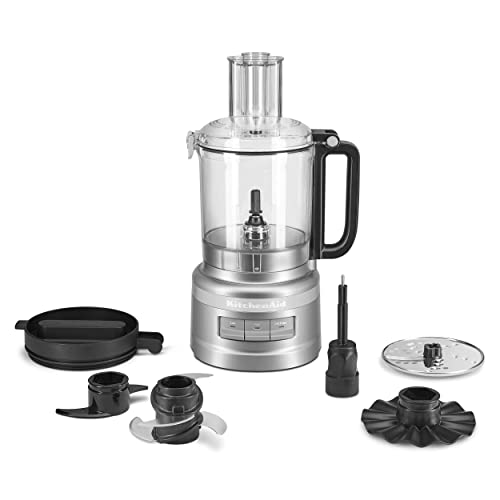
4. KitchenAid 9-Cup Food Processor KFP0921 — Best for Storage and Everyday Baking
Pick the KitchenAid if your processor lives in a cupboard and you bake in the one-to-two loaf range. The listing confirms it kneads dough, the 9-cup bowl suits a standard loaf or a family pizza batch, and the all-in-one storage means the dough blade is always where you left it — in the bowl. The whisk accessory extends it to whipped cream and dressings. Bakers who shop by wattage should note this listing does not headline a motor number; the power-focused should compare the Ninja and Cuisinart picks.
Strengths
- Kneading dough confirmed in the listing
- All parts store in the bowl — nothing gets lost
- 9-cup size fits standard home batches
Trade-offs
- Motor wattage not stated in the verified listing
- Not the largest capacity for batch bakers
- Whisk accessory is a bonus, not a dough feature
| Spec | Detail |
|---|---|
| Capacity | 9-cup work bowl |
| Confirmed job in listing | Knead dough |
| Storage | All-in-one in-bowl storage per listing |
| Accessories | Whisk accessory included |
The KFP0921’s dough case rests on design rather than headline numbers. KitchenAid built this generation around an easy-clean bowl and in-bowl storage, and for a home baker that translates into a machine that gets used more — which matters, because the best kneader is the one you are willing to pull out on a Tuesday. In use, standard-hydration doughs come together reliably; keep to sensible flour quantities for the bowl size and use the burst-and-rest rhythm from the technique section.
Where it concedes to the top two picks is brute force: very stiff, low-hydration dough in maximum quantities is Cuisinart and Ninja territory. For the broad middle of home baking — sandwich bread, rolls, pizza, flatbreads — the KitchenAid covers the work with the least storage friction of any pick here.
Best for: Everyday bakers who value tidy storage / Not suited for: Maximum-stiffness dough at maximum batch size
Check on Amazon — check the current price on Amazon before you buy.
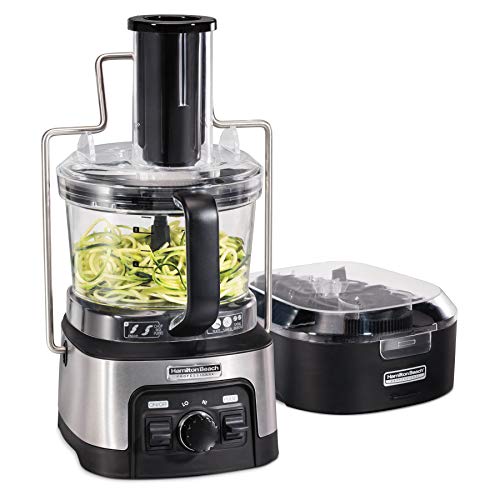
5. Hamilton Beach Professional Stack & Snap Food Processor 70815 — Best for Big Prep Plus Dough
Choose this Hamilton Beach if dough is one of several big jobs. The 12-cup bowl kneads a generous batch, the listing confirms kneading, and the rest of the machine is built for volume prep — whole vegetables through the 3-inch chute, plus a spiralizer. It suits bakers who also cook in quantity. If dough is your only serious job and you want the strongest dough-specific pedigree, the Cuisinart 14-cup remains the specialist’s choice.
Strengths
- 12-cup bowl kneads generous batches
- Kneading confirmed alongside slicing and shredding
- Stack & Snap assembly seals easily with floury hands
Trade-offs
- Generalist design — dough is one job among many
- Large footprint
- Spiralizer is a bonus most bakers will rarely use
| Spec | Detail |
|---|---|
| Capacity | 12-cup bowl |
| Feed chute | Extra-large 3-inch, fits whole vegetables |
| Confirmed jobs in listing | Slicing, shredding, kneading, spiralizing |
There is a practical dough advantage in the Stack & Snap design that rarely gets mentioned: the bowl stacks and seals without a twisting lock, which is noticeably easier to manage when your hands are dusted with flour and the lid needs to come off for a scrape-down. The 12-cup capacity also sits in a useful middle — bigger dough batches than the 9-cup machines, in a machine whose daily prep abilities justify its counter space even between bakes.
On kneading quality, it handles standard bread and pizza doughs competently when loaded sensibly. It is not the torquiest machine here, so very stiff doughs should be kept to moderate quantities. As a combined prep-and-dough station for a busy family kitchen, though, it offers the broadest usefulness per machine on this list.
Best for: Family kitchens combining dough with high-volume prep / Not suited for: Dough purists wanting the strongest specialist
Check on Amazon — check the current price on Amazon before you buy.

6. Ninja Mega Kitchen System BL770 — Best Blender-Processor Combo for Dough
Buy the BL770 if counter space forces one appliance to do everything. Its processor bowl is confirmed for dough in the listing, the system’s 1500 watts is ample, and the same base drives a full blender pitcher and single-serve cups. It suits smoothie households that also bake. Dedicated bakers should note the processor bowl is 8 cups — fine for standard batches, not for doubles — and a standalone processor remains the more focused tool.
Strengths
- One base covers blending, processing, and dough
- 1500W system power
- Dough explicitly named for the processor bowl
Trade-offs
- 8-cup processor bowl limits dough batch size
- System footprint with all attachments is substantial
- Blade system needs careful handling when washing
| Spec | Detail |
|---|---|
| System power | 1500 watts |
| Processor bowl | 8-cup |
| Also included | 72-oz pitcher and two 16-oz cups per listing |
| Confirmed job in listing | Processes salsa & dough |
Combo systems earn skepticism from bakers, usually fairly — but the BL770’s listing names dough for its processor bowl, and the system’s power is more than sufficient for the bowl’s size. Within that 8-cup envelope, pizza and bread doughs come together quickly, and the convenience of one base for the morning smoothie and the evening dough is real for space-limited kitchens.
The discipline is the same as the compact Cuisinart: respect the bowl’s ceiling. A standard loaf’s worth of dough kneads well; an ambitious double batch will not circulate and will strain the coupling. If your baking grows beyond the bowl, that is the moment to graduate to the 14-cup Cuisinart — and the Ninja will still have earned its keep as your blender.
Best for: Small kitchens wanting one system for blending and dough / Not suited for: Bakers who regularly double batches
Check on Amazon — check the current price on Amazon before you buy.
Comparison Table
For kneading, read capacity as batch size and the badge as working style: raw torque, preset automation, compact strength, or combo convenience. All six confirm dough work in their listings — the differences are scale and feel.
| Pick | Badge | Key spec | Best for |
|---|---|---|---|
| Cuisinart 14-Cup Food Processor DFP-14BCNY | Best Overall | 14-cup bowl, 720W, kneading named in listing | Weekly bread, pizza, and enriched dough at home scale |
| Ninja Professional Plus Food Processor BN601 | Best for Preset Dough Cycles | 9-cup, 1000W, Auto-iQ dough preset | Beginners and pizza-night regulars who want a dough program |
| Cuisinart Pro Classic 7-Cup Food Processor DLC-10SYP1 | Best Compact Kneader | 7-cup, 600W, kneading named in listing | One-loaf bakers and small kitchens |
| KitchenAid 9-Cup Food Processor KFP0921 | Best for Storage and Everyday Baking | 9-cup, knead dough in listing, in-bowl storage | Everyday bakers who value tidy storage |
| Hamilton Beach Professional Stack & Snap Food Processor 70815 | Best for Big Prep Plus Dough | 12-cup, kneading confirmed, 3-inch feed chute | Family kitchens combining dough with high-volume prep |
| Ninja Mega Kitchen System BL770 | Best Blender-Processor Combo for Dough | 1500W system, 8-cup processor bowl, dough named | Small kitchens wanting one system for blending and dough |
How to Choose the Best Food Processors for Kneading Dough
First, insist on confirmation. A processor whose listing names kneading or dough — as all six here do — has a dough blade or dough program and gearing chosen for the load. A processor without that wording may survive occasional dough, but you are experimenting with its motor warranty, not using a feature. This single check is the most reliable filter in the category.
Second, translate bowl size into flour reality. Stated capacity is a liquid measure; dough needs room for a ball to form and travel. As working guidance, a 7-cup bowl suits a single small loaf, 9 cups a standard loaf or family pizza batch, 12 to 14 cups a large or double batch. Overloading is the root cause of most processor dough failures — the ball cannot circulate, the motor strains, and the crumb turns gummy from friction heat. When in doubt, split the batch; two quick kneads beat one overloaded one.
Third, consider how you like to work. Preset dough programs, like the Ninja’s, remove timing guesswork. Traditional pulse control, like the Cuisinarts, rewards experience with adaptability across hydration levels. Neither is wrong; match the machine to your temperament as well as your batch size.
- Listing confirmation: kneading or dough must be a named job
- Realistic flour load: size the bowl to your biggest regular batch, not your biggest ever
- Motor stamina: stated wattage from 600W up is the comfort zone for dough
- Control style: preset program for beginners, manual pulse for experienced bakers
- Lid and bowl seal: dough thumps; a secure lock matters more than with any other job
Dough Blades, Metal Blades, and What Actually Kneads
Most dough-capable processors knead with a plastic dough blade — shorter and more curved than the metal chopping blade — which folds and stretches the dough mass rather than cutting it. Cutting is the enemy at the kneading stage: a metal blade can tear gluten strands and heat the dough faster. Some bakers do use the metal blade for the initial shaggy mix, then switch; others use it throughout for very wet doughs like focaccia, where tearing matters less. Know which blade your machine intends for dough and start there.
What actually develops gluten is repeated stretching and folding as the ball travels around the bowl. That is why bowl geometry and loading matter as much as the blade: a ball that circulates gets kneaded; a mass smeared against the wall gets stirred. If your dough is not forming a ball, the fix is almost always a flour adjustment — a spoonful at a time — not more running time.
Hydration and Temperature: The Two Variables That Decide Your Crumb
Processor kneading is fast — often under two minutes of total running — and friction is the price. Every second of running warms the dough, and warm dough ferments fast and can turn slack and sticky. Three habits keep temperature in your favor: use cool water, work in bursts of twenty to thirty seconds with brief rests, and stop as soon as the dough is smooth and elastic rather than running a timer. Experienced processor bakers often hold back a little flour and add it at the end if the dough feels warm and loose.
Hydration interacts with the machine too. Very wet doughs slap around the bowl and knead inefficiently until enough flour structure forms; very stiff doughs strain motors and locks. The comfortable processor zone is the broad middle most home recipes occupy. Bagel-stiff and brioche-rich doughs are both possible in the stronger picks here, but in moderate quantities and with the burst discipline above.
How to Knead Dough in a Food Processor Without Overheating It
This method suits every pick on the list and a standard bread or pizza dough. The principles are simple: dry first, liquid gradually, short bursts, and an early stop.
- Add the flour, salt, and yeast to the bowl with the dough blade fitted. Pulse a few times to combine and aerate the flour.
- With the machine running, pour most of the cool water through the feed tube in a steady stream. Stop when a shaggy mass forms, then rest two minutes — this rest lets the flour hydrate and cuts the kneading the motor must do.
- Run in bursts of twenty to thirty seconds, resting briefly between them, adding the remaining water or a spoonful of flour as needed until a single smooth ball forms and cleans the bowl walls.
- Check the dough: it should be smooth, elastic, and slightly tacky, and it should stretch thin without tearing immediately. Stop here — processor dough goes from perfect to overheated quickly.
- Turn the dough onto a lightly floured surface, give it a few hand folds to feel its condition, then cover and let it rise as your recipe directs. If the dough feels warm, give it its rise in a cooler spot.
If the ball will not form, add flour a spoonful at a time — a too-wet dough is the usual cause. If the motor strains and the dough climbs the center post in a tight lump, the batch is too big or too stiff: divide it and knead in two runs. Clean flour paste from the bowl promptly; dried dough is far harder to remove than fresh.
Matching the Machine to Your Dough Repertoire
Different doughs stress a processor differently, and your repertoire should steer the pick. Lean bread and pizza doughs — flour, water, salt, yeast — are the processor’s home ground: moderate hydration, a clean ball, and a fast knead in every machine here. Enriched doughs with butter, eggs, and sugar are stickier and warmer-running; they reward the stronger motors and benefit from chilled ingredients and shorter bursts, because the fat softens as friction warms it. Whole-grain doughs are thirstier and slightly more abrasive to develop; give them an extra rest after mixing so the bran hydrates before you judge the dough’s consistency.
Pastry is the special case that proves the rule about blades. Pie and tart doughs should be made with the metal blade in short pulses, keeping the butter in visible pieces — that is cutting-in, not kneading, and a dough blade would ruin it. The machines here all handle pastry well precisely because they are proper processors first. Flatbread doughs — roti, tortilla, pita — are the processor’s gift to weeknight cooking: small batches, thirty seconds of kneading, and a rest while you heat the pan.
Stiff, low-hydration doughs like bagel dough are the boundary. The strongest picks manage them in moderate quantities; every machine manages them better split into two runs. If bagels are your weekly ritual in quantity, that is the one repertoire that argues for graduating to a stand mixer — and this guide would rather tell you that than sell you a processor that strains at your favorite dough.
Processor Dough Troubleshooting: A Field Guide
Most processor dough problems announce themselves clearly once you know the vocabulary. Dough that smears around the bowl and never forms a ball is too wet or under-floured for its bowl — add flour a spoonful at a time until the mass gathers. Dough that forms a tight lump riding the center post, with the motor laboring, is too much dough or too stiff a dough — divide it and knead in two runs. Dough that feels warm and slack after kneading was run too long: shorten the bursts, use cooler water next time, and give this batch a cooler, slightly longer rise to compensate.
Dough that tears when stretched rather than extending was either under-kneaded — give it a few more short bursts after a rest — or made from flour that needs more hydration time. The two-minute rest after the initial mix is the cheapest fix in this entire guide: hydrated flour develops gluten with a fraction of the motor work, and doughs that seemed hopeless often come together smoothly after it. Dough that sticks stubbornly to the bowl after kneading usually needs only a light flour dusting on the counter and a confident scrape with a plastic spatula; a properly kneaded ball leaves the bowl nearly clean.
Finally, the sound of the machine is information. A processor kneading happily has a rhythmic, even note as the ball circulates. A rising strain note, a rocking base, or a burning smell is the machine asking you to stop — and with dough, stopping early costs nothing, because a rested dough can always be kneaded a little more, while an overheated motor or a burnt-out coupling cannot be un-done. Listen to the machine and it will knead for you for years.
From Processor Dough to the Oven: Resting, Shaping, and Proofing
The processor’s job ends at a smooth, elastic ball, but the loaf is decided afterward, and processor dough has two habits worth knowing. First, it tends to be slightly warmer than hand- or mixer-kneaded dough, because the kneading was fast and frictional. Warm dough proofs faster, so judge the rise by the dough — roughly doubled, with a springy poke test — rather than by the clock your recipe suggests, and choose a cooler spot for the rise if your kitchen is warm. Second, fast kneading can leave the dough’s surface less developed than a long mixer knead; a few gentle hand folds at shaping time, and a proper tightening of the loaf’s surface as you form it, close that gap completely.
Shaping rewards the same confidence as the kneading itself. Turn the rested dough onto a barely floured surface — excess flour at this stage toughens the crust’s underside — press it gently into a rectangle rather than punching it down, and roll or fold it into its final form with deliberate tension across the top surface. That surface tension is what lets a loaf expand upward in the oven instead of spreading, and it is built in thirty seconds of handling, not in any machine.
Proofing in a turned-off oven with the light on, or in any reliably warm, draft-free spot, suits processor dough well. When the loaf goes into a properly hot oven with steam in its first minutes — a covered Dutch oven is the home baker’s easiest steam — the quick-kneaded dough rewards you with the same open crumb and crisp crust as dough made by any slower method. The processor saved you twenty minutes; the craft was always in these last steps, and they were never the machine’s to do.
Care and Longevity for a Machine That Kneads
Kneading is the hardest work these machines do, and a few habits decide whether a processor kneads for three years or fifteen. Never force a locked bowl or lid that resists — flour dust in the locking track is the usual cause, and a brush-out is the fix. Wash dough from the bowl promptly: dried dough sets like plaster in the blade hub, and soaking the bowl for ten minutes in warm water before washing turns the worst cleanup in baking into an easy one. Keep the dough blade with the machine rather than in a general drawer, where its edges — designed for folding, not cutting — get knocked about.
Listen across the machine’s life. A kneading note that grows rougher, a base that walks more than it used to under the same load, or a coupling that smells warm on a normal batch are all early requests for mercy: smaller batches, stricter burst discipline, and eventually service or replacement. The bakers who keep processors for decades are not gentler people — they are people who never asked the machine to prove itself on an overloaded bowl. Respect the ceiling, and the ceiling quietly rises to meet years of ordinary, excellent dough.
Common Buying Mistakes
The classic buying mistake is purchasing a processor that never claimed to knead. Chopping power and kneading torque are different engineering, and a listing that omits dough is telling you something. Every pick here names the job; let that be your minimum standard.
The second mistake is buying by bowl size alone and then overloading it. A 14-cup bowl does not knead 14 cups of flour. Dough needs circulation room, and an overloaded bowl produces the exact gummy, overheated crumb that makes people conclude processors cannot knead — when the machine was never given a fair load.
- Overloading the bowl — split big batches into two kneads
- Running continuously — friction heat damages yeast and texture; use bursts
- Using the metal blade by default — the dough blade folds; the metal blade can tear
- Adding all the water at once — gradual addition lets you land the right hydration
- Skipping the rest after mixing — hydrated flour kneads in half the motor time
Finally, do not judge a kneading processor by its first dough. Hydration that suits a stand mixer often needs a small adjustment for a processor’s speed. Two or three batches in, with the burst method above, the same machine that disappointed you will be producing your best loaves.
Final Recommendation
The Cuisinart 14-Cup DFP-14BCNY is the default recommendation for kneading: confirmed dough design, the strongest combination of bowl size and sustained motor, and decades of home bakers proving the format. If you want the machine to manage timing, the Ninja BN601’s dough preset is the beginner-friendly alternative with the most stated power here.
Smaller households should look at the Pro Classic 7-cup or the tidy KitchenAid 9-cup, high-volume cooks at the Hamilton Beach 70815, and space-limited bakers at the Ninja BL770 system. Whichever you choose, work in bursts, respect the bowl’s real flour ceiling, and stop the moment the dough turns smooth — the machine does the hard work, but the judgment is still yours.
- Cuisinart 14-Cup Food Processor DFP-14BCNY — check price on Amazon
- Ninja Professional Plus Food Processor BN601 — check price on Amazon
- Cuisinart Pro Classic 7-Cup Food Processor DLC-10SYP1 — check price on Amazon
Keep exploring this category with related guides from the same program: Best Food Processors For Dough Best Food Processors For Baking Best Food Processors For Indian Cooking Best Food Processors For Hummus Best Food Processors For Home Use
A closing perspective on cost. A kneading-capable processor is not a cheap appliance, but dough economics are forgiving: a household that bakes two loaves and a pizza a week recovers the difference between bakery and home prices steadily, in ingredients that cost a fraction of the finished bread. The machine’s real return, though, is not the arithmetic — it is the Tuesday-night feasibility of fresh bread, the pizza that no longer waits for a weekend, and the enriched dough that takes ten minutes instead of an afternoon. Buy the machine that fits your batch and your temperament, and that return starts with the first loaf.
One more practical note belongs here: keep a small bench scraper and a light dusting of flour within reach whenever the processor kneads. The scraper turns a rested dough out of the bowl in one motion, portions it cleanly for rolls or pizza bases, and keeps your hands from tearing a surface you have worked to make smooth. It costs almost nothing, lives in the drawer with the dough blade, and — like the two-minute rest and the burst rhythm — it is one of the small, unglamorous habits that separate bakers who love their processor from bakers who merely own one. Dough rewards systems, and this is the last piece of this one.
Frequently Asked Questions
Is a food processor or a stand mixer better for kneading dough?
For one or two loaves, a processor is faster and easier to clean, and its dough quality is excellent with the burst method. A stand mixer wins for large batches, very stiff doughs in quantity, and bakers who knead many times a week in volume. Many home bakers happily use a processor for years without needing a mixer.
How much flour can I knead in a food processor?
As working guidance: a 7-cup bowl suits a small single loaf, 9 cups a standard loaf or family pizza batch, and 12–14 cups a large or double batch. When a batch feels like a squeeze, split it — two short kneads give better dough than one overloaded run.
Why did my processor dough come out gummy?
Almost always friction heat from running too long or an overloaded bowl. Use cool water, knead in twenty-to-thirty-second bursts with rests, and stop as soon as the dough is smooth and elastic. Gumminess is a technique result, not proof the machine cannot knead.
Should I use the plastic dough blade or the metal blade?
Start with the dough blade — it folds and stretches without tearing gluten. The metal blade suits the initial mix of very wet doughs and pastry work in pulses. If your machine’s listing confirms kneading, it intends a specific blade for it; follow that design.
Can a food processor knead pizza dough?
Yes — pizza dough is one of its best jobs. Moderate hydration, a quick ball formation, and a short burst knead give you smooth, extensible dough. Let it rise properly afterward; the processor replaces kneading time, not fermentation time.
How do I stop the processor walking across the counter with dough?
An overloaded or very stiff batch is the usual cause. Reduce the load, make sure the bowl is locked and the machine sits on a clean, dry surface, and stay nearby during kneading — dough is the one job where you should never leave a processor unattended.
Can I knead gluten-free dough in a food processor?
Yes, and in some ways it is an ideal job for one: gluten-free doughs are batter-like, need thorough, even mixing rather than gluten development, and come together quickly without the tearing concerns of wheat dough. Use the dough blade or metal blade per the manufacturer’s design, expect a wetter consistency than wheat dough, and handle it with oiled or wet hands and tools at shaping time.

