Finding the best food processors Canada shoppers can actually buy means looking past the American roundups and checking what is stocked, supported and serviced north of the border. A food processor is one of the hardest-working tools in a Canadian kitchen, handling everything from grating cheese for tourtière to shredding cabbage for coleslaw, kneading dough for butter tarts and chopping vegetables for a week of soups through a long winter. The six processors in this guide are all models with real Canadian availability, standard 120-volt plugs that suit Canadian outlets, and parts and service that a Canadian buyer can reach without shipping a heavy appliance across the border.
Below we compare the six picks side by side, explain what each one does well and where it compromises, and finish with a buying guide on bowl size, motor power and blades, so you can choose the processor that matches how you actually cook. Every pick below is a real, currently listed product with a clear identity: a brand, a model and a set of features you can check on its listing before you buy.
In this guide
Quick picks: best food processors canada
| # | Product | Where to buy |
|---|---|---|
| 1 | Cuisinart 14-Cup Food Processor | Check on Amazon |
| 2 | KitchenAid 13-Cup Food Processor KFP1318 | Check on Amazon |
| 3 | Ninja Professional Plus 9-Cup BN601 | Check on Amazon |
| 4 | Breville Sous Chef 16-Cup BFP810 | Check on Amazon |
| 5 | Hamilton Beach 10-Cup Food Processor | Check on Amazon |
| 6 | Braun Easy Prep 8-Cup FP3101BK | Check on Amazon |
How the Picks Were Chosen
The six picks below were chosen from the food processors available to Canadian buyers on Amazon, looking for models that cover the main bowl sizes, motor strengths and budgets rather than six versions of the same machine. Each one is a real, currently listed product with a clear identity: a brand, a model and a set of features you can check on its listing. We looked for processors with a wide feed tube that takes whole vegetables, a set of discs that covers slicing and shredding, a bowl that lifts off and cleans without a fight, and a motor that holds its speed under a full load of dense food. The comparison table that follows gives the headline detail for each pick, and the individual sections explain the strengths and the trade-offs honestly, so a model that is wrong for your household is easy to spot before you spend money on it. Canadian buyers should also check the listing for warranty terms that apply in Canada, since some brands handle service through Canadian distributors while others route everything through the United States.
Quick Comparison
The table below gives the headline detail for each of the six food processors, so you can shortlist by bowl size and motor before reading the full reviews.
| Product | Key Detail | Best For |
|---|---|---|
| Cuisinart 14-Cup Food Processor | 14-cup bowl, 720-watt motor | family batch cooking |
| KitchenAid 13-Cup Food Processor KFP1318 | 13-cup bowl, KFP1318, all-in-one storage | tidy family cooking |
| Ninja Professional Plus 9-Cup BN601 | 9-cup bowl, 1000 peak watts, Auto-iQ | everyday family use |
| Breville Sous Chef 16-Cup BFP810 | 16-cup bowl, BFP810, 24-setting slicer | serious batch cooking |
| Hamilton Beach 10-Cup Food Processor | 10-cup bowl, two speeds, Easy Clean bowl | best value |
| Braun Easy Prep 8-Cup FP3101BK | 8-cup bowl, FP3101BK, compact | small kitchens |

1. Cuisinart Food Processor, 14-Cup Vegetable Food Chopper, 720-Watt
When a Canadian household cooks in volume, the Cuisinart 14-cup processor is the kind of machine that earns its counter space. The 14-cup bowl takes a whole head of cabbage, a full batch of pie dough or a large pile of vegetables for soup without splitting the job, and the 720-watt motor holds its speed through dense food such as hard cheese and raw root vegetables. It minces, dices, shreds, purees and kneads, so one machine covers the chopping board, the grater and the dough hook for most weeknight cooking.
The wide feed tube is the detail that saves the most time: whole potatoes, carrots and blocks of cheese go in without pre-cutting, and the slicing and shredding discs turn a pile of prep into a few minutes of work. The bowl, lid and discs are dishwasher-safe, which matters when the processor is used several times a week, and the base is heavy enough to stay put on the counter under a full load. For a family that batch cooks or preserves, this is the workhorse of the six picks.
Key specs: 14-cup bowl, 720-watt motor, slicing and shredding discs, dishwasher-safe bowl and discs
Strengths:
- Large 14-cup bowl: handles family-size batches and preserving jobs without splitting them in two.
- Strong 720-watt motor: holds speed through hard cheese, dense dough and raw root vegetables.
- Wide feed tube: takes whole vegetables and blocks of cheese, so pre-cutting is minimal.
Trade-offs:
- Takes counter space: a 14-cup machine is tall and heavy, so it needs a permanent spot or a roomy cupboard.
- Overkill for small jobs: a small amount of herbs or garlic can sit below the blade in a bowl this large.
- More parts to wash: the discs and lid add up after a big session, even though they are dishwasher-safe.
Best for: a Canadian family that batch cooks, preserves or preps large volumes of vegetables and dough.
Not suited for: a single person or a small kitchen where a compact 3- or 4-cup chopper would do the job.
Check price on Amazon: Cuisinart 14-Cup Food Processor
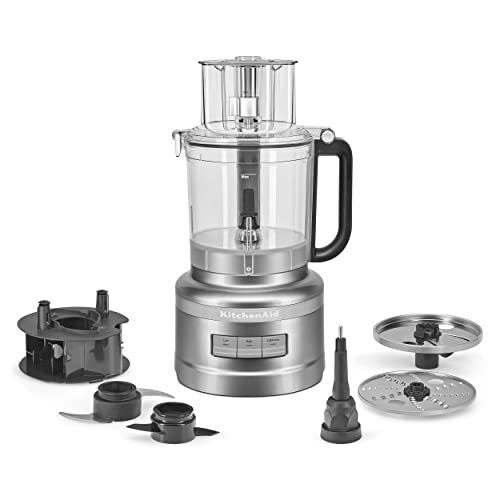
2. KitchenAid 13-Cup Food Processor, KFP1318, Contour Silver
The KitchenAid KFP1318 is the processor for a cook who wants everything in one place. Its 13-cup bowl suits family cooking, and the all-in-one storage keeps the blades and discs inside the bowl, so nothing gets lost in a drawer and the whole machine packs away as a single unit. The three-speed control and the two-in-one feed tube give real control: the small pusher handles thin items such as carrots and celery, while the wide tube takes larger pieces without pre-cutting.
KitchenAid built this machine around everyday use rather than showpiece features. It chops, shreds, kneads and mixes, and the adjustable slicing disc lets you choose the thickness of a slice instead of accepting whatever a fixed disc gives you. The Contour Silver finish suits a modern kitchen, and the bowl and accessories are dishwasher-safe. For a household that already owns KitchenAid tools and wants a processor that stores neatly and works predictably, the KFP1318 is an easy recommendation.
Key specs: 13-cup bowl, KFP1318, three-speed control, 2-in-1 feed tube, all-in-one blade and disc storage
Strengths:
- All-in-one storage: blades and discs store inside the bowl, so the machine packs away as one unit.
- Adjustable slicing disc: chooses slice thickness instead of forcing a single fixed cut.
- 2-in-1 feed tube: the small pusher handles thin items while the wide tube takes larger pieces.
Trade-offs:
- Large footprint: a 13-cup bowl and a wide base need real cupboard or counter space.
- Heavier than compact models: moving it in and out of a cupboard takes two hands and a clear spot.
- Premium styling, premium care: the finish shows fingerprints and needs a soft cloth rather than a scouring pad.
Best for: a family cook who wants a full-size processor with tidy built-in storage for every blade and disc.
Not suited for: a tiny kitchen or a cook who only chops small amounts and would be better served by a mini chopper.
Check price on Amazon: KitchenAid 13-Cup Food Processor KFP1318

3. Ninja Professional Plus Food Processor, 1000PW, 9-Cup, Grey, BN601
The Ninja Professional Plus BN601 sits in the sweet spot between a mini chopper and a full-size machine. Its 9-cup bowl is big enough for a family meal and small enough to store without a struggle, and the 1000-peak-watt motor powers through ice, frozen fruit and dense vegetables without bogging down. The Auto-iQ presets take the guesswork out of the four jobs most people use a processor for: chop, slice, puree and mix dough, each with a timed pattern of pulses that stops the food at the right texture.
What makes the BN601 practical is how fast it is to use and clean. The preset programs mean you press one button instead of pulsing and checking, and the bowl, lid and blades are dishwasher-safe. The grey finish is understated and the base is compact for a 9-cup machine. For a household that wants one processor for everything from salsa to pizza dough without paying for a premium brand, the BN601 covers the middle ground well.
Key specs: 9-cup bowl, 1000 peak watts, BN601, Auto-iQ presets for chop, slice, puree and dough
Strengths:
- Auto-iQ presets: timed pulse patterns stop food at the right texture without constant checking.
- Strong 1000-watt motor: powers through frozen fruit, ice and dense vegetables without stalling.
- Right-size 9-cup bowl: big enough for family meals, small enough to store easily.
Trade-offs:
- Presets suit common jobs: unusual textures still need manual pulsing and watching.
- Plastic bowl: lighter than glass but needs care to avoid clouding and scratches over time.
- No nested small bowl: tiny amounts of herbs or garlic can be awkward in a 9-cup bowl.
Best for: a household that wants one mid-size processor for chopping, slicing, pureeing and dough.
Not suited for: a batch cooker who needs 13 cups or more, or a cook who wants a glass bowl.
Check price on Amazon: Ninja Professional Plus 9-Cup BN601

4. Breville BFP810 Sous Chef 16 Cup Food Processor, Brushed Stainless Steel
The Breville Sous Chef BFP810 is the premium pick in this guide, built for a cook who processes large batches and wants the machine to feel as good as it performs. The 16-cup bowl is the largest here, and the brushed stainless steel base gives it a weight and stability that cheaper machines cannot match. It chops, slices and shreds large batches with a wide feed tube that takes whole vegetables, and the variable slicing disc adjusts through 24 settings, from paper-thin to thick, so a gratin and a slaw come out exactly as intended.
Breville pairs the big bowl with a smaller processing bowl for little jobs, which solves the classic large-processor problem of tiny amounts disappearing under the blade. The motor is quiet for its size, the lid seals well, and the whole machine feels designed by people who actually cook. It costs more than the other picks, but for a serious home cook who uses a processor several times a week, the capacity, the adjustable slicing and the build quality make it the long-term choice.
Key specs: 16-cup bowl plus mini processing bowl, BFP810, variable slicing disc with 24 settings, brushed stainless steel base
Strengths:
- Largest 16-cup bowl: handles the biggest batches in this guide without splitting the job.
- 24-setting slicing disc: adjusts from paper-thin to thick for precise, even slices.
- Mini bowl included: small jobs work properly instead of disappearing under a large blade.
Trade-offs:
- Premium build, premium size: it is heavy, tall and needs a permanent counter spot.
- More to clean: two bowls, a lid and several discs add up after a big session.
- Higher cost: the capacity and build come at a higher outlay than the mid-range picks.
Best for: a serious home cook who processes large batches often and wants precise slicing.
Not suited for: a small household, a tight budget or a kitchen with no free counter space.
Check price on Amazon: Breville Sous Chef 16-Cup BFP810

5. Hamilton Beach Food Processor and Vegetable Chopper, 10 Cups
The Hamilton Beach 10-cup processor is the value pick: a straightforward, full-size machine that covers the core jobs without a premium badge. The 10-cup bowl suits family cooking, and it slices, shreds, minces and purees with a simple two-speed control and a pulse button. The Easy Clean bowl design is the detail that matters most day to day: the bowl lifts off and rinses out without food trapping in awkward corners, and the parts are dishwasher-safe.
This is the processor to buy when the budget matters and the cooking is ordinary rather than ambitious. It will not slice as precisely as the Breville or store as neatly as the KitchenAid, but it chops onions, shreds cheese, makes dough and purees soup reliably, and it does so at a fraction of the cost of the premium models. For a first processor, a rental kitchen or a household that wants a capable machine without overthinking it, the Hamilton Beach is hard to beat on value.
Key specs: 10-cup bowl, two-speed control plus pulse, slicing and shredding, Easy Clean bowl
Strengths:
- Strong value: a full-size 10-cup machine at a fraction of the premium models.
- Easy Clean bowl: rinses out without food trapping in awkward corners.
- Simple controls: two speeds plus pulse cover everyday chopping, shredding and pureeing.
Trade-offs:
- Fixed slicing thickness: no adjustable disc, so slices come out at one thickness.
- Lighter build: the base is lighter than the premium machines and can shift under a heavy load.
- Basic storage: blades and discs need a drawer or a separate spot rather than storing in the bowl.
Best for: a first-time buyer or a budget-conscious household that wants a capable full-size processor.
Not suited for: a cook who needs adjustable slicing or a machine that stores all its parts inside itself.
Check price on Amazon: Hamilton Beach 10-Cup Food Processor

6. Braun FP3101BK Easy Prep 8-cup Food Processor, Black
The Braun Easy Prep FP3101BK is the compact pick for a smaller Canadian kitchen. Its 8-cup bowl is big enough for a family side dish or a batch of dough, yet the machine is light and small enough to live in a cupboard and come out only when needed. Braun keeps the design simple: a clear bowl, a stainless steel blade and a straightforward control, with no extra programs to learn and no parts that demand a manual to understand.
Eight cups is the right size for a couple or a small family, and it handles the daily jobs well: chopping onions and herbs, grating cheese, making crumbs and mixing a small batch of dough. The black finish is understated, the bowl is dishwasher-safe, and the whole machine is easy to lift with one hand. For an apartment, a condo or a household that cooks for two or three, the FP3101BK gives real food-processor capability without taking over the kitchen.
Key specs: 8-cup bowl, FP3101BK, stainless steel blade, dishwasher-safe bowl
Strengths:
- Compact and light: fits a cupboard easily and lifts out with one hand.
- Right-size 8-cup bowl: handles daily cooking for two or three without wasted capacity.
- Simple design: no programs to learn and no fiddly parts to assemble.
Trade-offs:
- Smaller capacity: a big batch of dough or a full cabbage needs two rounds.
- Fewer discs: slicing and shredding options are more limited than the full-size picks.
- Lighter motor: very dense dough and hard cheese need smaller loads and more patience.
Best for: a couple, a small family or an apartment kitchen that needs a capable compact processor.
Not suited for: a large household, a batch cooker or anyone who preserves in volume.
Check price on Amazon: Braun Easy Prep 8-Cup FP3101BK
Buying Guide: How to Choose a Food Processor in Canada
Bowl capacity
Bowl size is the first decision, and it should follow the size of your household and the size of your batches. A 3- or 4-cup bowl suits a single person or a couple who mostly chop herbs, make small batches of pesto and grate a little cheese. A 7- to 9-cup bowl is the sweet spot for a family, big enough for a batch of pie dough or a full head of cabbage without splitting the job in two. Bowls of 11 cups and up suit batch cooking, preserving and households that cook for a crowd, but they take more cupboard space and their minimum working volume is higher, so a tiny amount of garlic or herbs can disappear under the blade. If you regularly cook both small and large batches, a processor with a nested small bowl or a mini chopper attachment is worth looking for, since it covers both ends without buying a second machine.
Motor power
Motor power decides whether the processor powers through dense food or stalls and heats up. For light work such as chopping soft vegetables and making crumbs, a modest motor is enough. For kneading dough, grating hard cheese and shredding raw root vegetables, look for a stronger motor with a higher wattage and a heavy base that does not walk across the counter. A motor that slows under load is a warning sign: it means the machine is working at its limit, and repeated stalling shortens its life. Direct-drive motors tend to run quieter and last longer than belt-driven ones, and a processor with two or three speeds plus a pulse button gives more control than a single-speed machine. Pulse matters more than it sounds: short bursts keep chunky salsa chunky and stop hummus turning to glue.
Feed tube and blades
The feed tube and the blade set decide how much prep the processor actually saves you. A wide feed tube takes a whole potato, a block of cheese or a full carrot without pre-cutting, which is where the time saving really comes from. Check that the slicing disc adjusts for thickness if you care about even slices, and that a shredding disc is included rather than sold separately. A dough blade is useful if you bake, and a mini bowl insert handles small jobs. Stainless steel blades stay sharp longer than coated ones, and discs that store in the bowl or in a case are less likely to be lost in a drawer. Before buying, check that replacement blades and bowls are sold in Canada, because a processor is only as durable as its most fragile plastic part.
Ease of cleaning
A food processor that is hard to clean is a food processor that stays in the cupboard. Look for a bowl, lid and blades that are dishwasher-safe, and a base that wipes clean with a damp cloth. Sealed buttons are easier to keep clean than deep crevices, and a bowl with a smooth interior and no hidden corners rinses out in seconds. The blade is the awkward part: a blade that lifts out with a handle or a hub you can grip without touching the edge is safer and faster to wash. If you process sticky dough or oily nuts, a processor with a simple lid design and few small parts will save you real time every week.
Build, warranty and Canadian support
A food processor is a long-term purchase, so build quality and support matter as much as the spec sheet. A heavy base stays put, a well-fitting lid seals without leaking, and a bowl made from thick, clear plastic resists clouding and cracking. Check the warranty length and, just as importantly, whether warranty service is handled inside Canada: a warranty that requires shipping the unit to the United States is worth much less than one serviced by a Canadian centre. Brands with a long Canadian retail presence tend to have parts on the shelf here, which matters when a bowl or a blade needs replacing two years from now. Read the listing carefully for the exact model and the items included, since some listings bundle extra discs and some do not.
How to Use and Care for Food Processors
A food processor lasts longest when it is cleaned right after use and stored with its blade protected. Rinse the bowl, lid and blade as soon as you finish, before food dries on, and wash them in warm soapy water or on the top rack of the dishwasher if the maker allows it. Dry the blade fully before storing it, and keep it in its case or with a blade guard so the edge stays sharp and nobody gets cut reaching into a drawer. Never immerse the motor base in water; wipe it with a damp cloth and dry it straight away. Let the motor rest between heavy batches of dough, and never run it continuously for longer than the maker recommends, since overheating is the most common way a good processor dies young. Store the bowl with the lid off or ajar so it airs out and does not hold smells, and keep the cord wrapped loosely rather than wound tight around the base.
Common Mistakes to Avoid
The most common mistake is overfilling the bowl, which leaves food unprocessed at the top and mush at the bottom, and can force liquid past the lid seal. Fill to the line the maker marks, and work in batches for large jobs. The second mistake is running the motor non-stop instead of pulsing: continuous running turns chunky mixtures into paste and heats the food, while short pulses give an even texture. The third is putting hot food or liquid in a processor not rated for it, which can warp the bowl or push steam past the seal. A fourth is using the wrong disc, such as shredding with a slicing disc, and then blaming the machine for the result. Finally, many buyers pick a bowl that is too small for their real cooking and end up processing every recipe in two or three batches, which wipes out the time saving the machine was bought for. Measure your typical batch before you choose.
What to Check on a Canadian Listing
The first thing to check on any listing is the voltage and the plug. A food processor sold for the Canadian market runs on standard 120-volt, 60-hertz household power with a North American plug, the same as in the United States. That sounds obvious, but grey-market listings built for other regions can carry a different plug or a 220-volt motor, and running one of those needs a transformer and voids any Canadian warranty. The listing should state the voltage plainly; if it does not, ask the seller before you buy, and favour listings that name a Canadian distributor or a Canadian warranty centre.
The second check is the warranty and where it is honoured. Some brands handle warranty claims through Canadian service centres, while others route everything through the United States, which means shipping a heavy appliance across the border at your own expense. A warranty that is serviced inside Canada is worth real money on a machine this heavy, so read the warranty terms on the listing and check the brand website for a Canadian service address. The same applies to parts: bowls, lids and blades wear out eventually, and a model whose parts are stocked by Canadian retailers will serve you far longer than one whose parts must be ordered from abroad.
The third check is what is actually in the box. Listings for the same model can differ: one may include the slicing and shredding discs, another may sell them separately, and a third may bundle a dough blade or a mini bowl. Compare the included items line by line, because a cheaper listing that omits the discs is not cheaper once you buy them separately. Check the model number character by character as well, since a single letter can mean a different bowl size or a different motor, and the wrong variant is a common source of disappointment.
Finally, look at the packaging and the manual. Products sold in Canada usually carry bilingual English and French labelling, and the manual should include French instructions. That is a useful sign that the unit was built for the Canadian market rather than diverted from another region. Also check the shipping origin and any duties: a listing that ships from inside Canada arrives faster and without surprise brokerage fees, while a cross-border shipment can add days and extra charges that wipe out a small saving on the sticker.
Frequently Asked Questions
What size food processor is best for a family in Canada?
A 7- to 9-cup bowl suits most Canadian families, handling a batch of dough, a full cabbage or a pile of vegetables for soup without splitting the job. Smaller households can manage with 3 to 4 cups, while batch cookers and preservers should look at 11 cups and up.
Can I buy replacement bowls and blades in Canada?
For the major brands, yes: bowls, lids and blades are sold through Canadian retailers and online, but availability varies by model. Check that parts for the exact model you are buying are listed in Canada before you order, especially for older or imported models.
Is a food processor the same as a blender?
No. A food processor chops, slices, shreds and kneads with interchangeable blades and discs, and it handles solid food without added liquid. A blender liquefies with a fixed blade and needs liquid to move food around. They overlap on sauces and purees, but neither replaces the other.
Do food processors work on Canadian voltage?
Models sold for the Canadian market run on standard 120-volt, 60-hertz household power, the same as in the United States. Avoid grey-market models built for other voltages, since they need a transformer and may not be covered by a Canadian warranty.
How do I keep my food processor blade sharp?
Use the blade only for food, never for ice, bones or frozen blocks unless the maker says it is safe, and store it in its case or with a guard. Wash it by hand and dry it fully. A blade that is looked after this way stays sharp for years; once it dulls, order a genuine replacement rather than sharpening it yourself.
Do I need a voltage converter for a food processor bought in Canada?
No, as long as the model is sold for the Canadian market. It runs on standard 120-volt household power with a North American plug. Only a grey-market model built for another region would need a transformer, and that is a reason to avoid it.
Are replacement parts easy to find in Canada?
For the major brands, yes: bowls, lids and blades are stocked by Canadian retailers and online sellers. Check that parts for the exact model you are buying are listed in Canada before you order, especially for older models.
Related Reading
If this guide helped, these companion guides on the same site go deeper on neighbouring topics: the best 3-cup food processors the best 8-cup food processors the best affordable food processors food processors with 700 watts or more.
Final Recommendation
For most Canadian households, the pick to start with is a mid-size processor with a 7- to 9-cup bowl, a motor strong enough for dough and hard cheese, and a wide feed tube that keeps pre-cutting to a minimum. If you cook in small batches, a compact model with a nested bowl covers daily chopping without taking over the counter. If you batch cook or preserve, go bigger and check that replacement parts are sold in Canada before you commit. Whichever you choose, buy the exact model named in its section, confirm the included discs on the listing, and give the bowl size a hard look against your real cooking: the right processor is the one that matches your batches, not the one with the longest feature list.
Conclusion
The best food processors Canada buyers can rely on are the ones with real Canadian availability, a bowl that matches the household, a motor that holds speed under load, and blades and parts you can replace without a cross-border shipment. The six picks in this guide cover compact choppers, family-size workhorses and batch-cooking machines, and the buying guide above gives you the checks that matter before you order. Measure your batches, check the warranty and the parts supply, and choose the model that fits the way you cook week after week.

