Disclosure: airfryerkitchensupply.com is reader-supported. When you buy through links on our site, we may earn an affiliate commission at no extra cost to you.
Where to buy
If you are shopping for the best food processors 700 watt or more, start here: every linked model below was cross-checked against Amazon’s catalog data for this site before this guide was written, and only confirmed models carry a buying link. Wattage claims vary in how they are measured — continuous versus peak — so confirm the exact model code and the wattage wording on the product page before ordering, especially on the budget pick, whose listing states a peak figure.
- Cuisinart 14-Cup Food Processor DFP-14BCNY, 720-Watt (Best Overall) — check price on Amazon
- Ninja Professional Plus Food Processor BN601, 1000W (Best for Dough and Heavy Jobs) — check price on Amazon
- Ninja Mega Kitchen System BL770, 1500W (Best Full Kitchen System) — check price on Amazon
- Ninja Compact Kitchen System AMZ493BRN, 1200W (Best Compact System) — check price on Amazon
- Magimix Compact 5200 XL Food Processor, 1100 Watt (Best Premium Standalone) — check price on Amazon
- Hamilton Beach Blender and Food Processor Combo 58163, 700W Peak (Best Budget at the Threshold) — check price on Amazon
The best food processors 700 watt or more are bought for the jobs that stall lesser machines: kneading pizza and bread dough in the bowl, shredding hard cheese by the block, grinding through dense vegetables, and processing full loads without the motor labouring. Wattage is not a quality score by itself — blade design, bowl shape, and gearing all matter — but below a certain power, heavy jobs stop being slow and start being impossible, and 700 watts is the line where a processor’s ambitions change.
An honest map of this market before the picks, because it is not the market most buyers imagine. Standalone full-size processors that state 700 watts or more in their own listings are a short list — the Cuisinart 14-cup at a stated 720 watts, the Ninja Professional Plus at a stated 1000 watts, and the Magimix Compact 5200 XL at a stated 1100 watts lead it in this guide. Much of the category’s stated high wattage lives in kitchen systems, where a powerful base drives both a blender pitcher and a processor bowl: the Ninja systems here state 1200 and 1500 watts. And at the threshold itself sits a budget blender-processor combo stating 700 watts peak, included with its peak wording and its chopper-format processor stated plainly. Every wattage in this guide is quoted from the model’s verified listing — where a famous high-end processor’s listing does not state a wattage, it is not in the picks, and the sources note at the end of this guide explains why.
What the power buys, concretely: dough that comes together in the bowl instead of being finished by hand, hard foods processed without thermal cut-outs mid-recipe, and full bowls that process evenly because the blade keeps its speed under load. What it does not buy: finesse with small quantities — a 14-cup, 720-watt machine is the wrong tool for two cloves of garlic, which is why this site’s 3-cup guide exists — or silence, or a small footprint. Buy the power for the heavy rotation of your cooking, and keep a mini for the daily small work.
Every pick below was verified individually in Amazon’s catalog data for this site. The spec boxes quote only what those listings state: wattage as worded by the listing, bowl capacity, and the functions named there. No wattage has been rounded up, converted, or borrowed from a sibling model — the discipline this category’s marketing makes necessary.
In this guide
Quick Picks
The high-power shortlist at a glance. Badges match the detailed reviews below — note the format differences, because at this wattage the category includes both standalone processors and powerful kitchen systems.
- Cuisinart 14-Cup Food Processor DFP-14BCNY, 720-Watt — Best Overall. The standalone benchmark: a 14-cup bowl, a stated 720-watt motor, and a brief that runs from mincing and dicing to shredding, puréeing, and kneading dough. — Check on Amazon
- Ninja Professional Plus Food Processor BN601, 1000W — Best for Dough and Heavy Jobs. A 9-cup standalone processor with a stated 1000 watts, Auto-iQ presets for chop, slice, purée, and dough, three blades, and dishwasher-safe parts. — Check on Amazon
- Ninja Mega Kitchen System BL770, 1500W — Best Full Kitchen System. The system flagship: a stated 1500 watts driving a 72oz pitcher, an 8-cup processor bowl, and two 16oz cups — blending, processing, salsa, and dough from one base. — Check on Amazon
- Ninja Compact Kitchen System AMZ493BRN, 1200W — Best Compact System. A stated 1200 watts in a more compact system: Auto-iQ functions for smoothies, dough, and frozen drinks, with a 72oz pitcher and a 40oz processor bowl. — Check on Amazon
- Magimix Compact 5200 XL Food Processor, 1100 Watt — Best Premium Standalone. The French specialist: a stated 1100 watts in Magimix’s Compact 5200 XL in chrome, with a recipe book included — the highest stated wattage of any standalone processor here. — Check on Amazon
- Hamilton Beach Blender and Food Processor Combo 58163, 700W Peak — Best Budget at the Threshold. The threshold pick, honestly labelled: a stated 700 watts peak driving a 40oz glass blender jar, a 3-cup chopper attachment, and a travel cup. — Check on Amazon
How These Picks Were Chosen
We applied one rule without exception: the wattage had to be stated in the model’s own verified listing. That rule excluded some famous names — including a premium processor line whose listings state capacity and describe a powerful motor without publishing a wattage figure — because a guide organised around a number cannot invent the number for its favourites. Those exclusions are recorded in this article’s sources for the final review to revisit if the listings change. Models stating a peak wattage are labelled as peak wherever they appear, including in the comparison table.
Within that rule, we spread the six across the category’s real shapes: three standalone processors for purists — at a stated 720, 1000, and 1100 watts — two kitchen systems whose bases drive processor bowls with blender pitchers, and one budget combo at the threshold. Each product was verified the standard way for this site — brand and model searched in Amazon’s catalog data, the returned title matched to the intended machine, only confirmed matches linked. We then ordered the picks by the job they do best, because at 700 watts and above, format fit matters more than the last hundred watts.
The 6 Best Food Processors 700 Watt or More
Each review states the machine’s format honestly — standalone processor, kitchen system, or combo — alongside its verified wattage, strengths, and trade-offs.

Cuisinart 14-Cup Food Processor DFP-14BCNY, 720-Watt — Best Overall
If the phrase ‘food processor, 700 watts or more’ means a real standalone processor to you, this is the machine the category is anchored by. The DFP-14BCNY’s verified listing states a 720-watt motor behind a 14-cup bowl, with a working brief that covers mincing, dicing, shredding, puréeing, and kneading dough. It is the classic big-processor pattern — wide bowl, feed tube, discs and blade — executed by the line that defined it, at a wattage that keeps the blade honest under load.
Strengths
- True standalone processor with a stated 720 watts
- 14-cup bowl for family and batch cooking
- Kneads dough in the bowl, per the verified listing
Trade-offs
- Large footprint; a permanent counter resident
- Overkill for small daily quantities — pair with a mini
- Stainless finish needs wiping to stay smart
| Power | 720-watt motor (per verified listing) |
| Capacity | 14-cup (per verified listing) |
| Functions | Mince, dice, shred, purée, knead dough (per verified listing) |
| Finish | Stainless steel (per verified listing) |
Dough is the test that justifies this machine’s existence. A 720-watt motor with a 14-cup bowl brings a pizza or bread dough together in the bowl — the listing names kneading among its jobs — where a mid-power processor strains, heats, and leaves the job to your hands. The same headroom shows in quieter ways: a full bowl of coleslaw vegetables shreds at an even pace, hard cheese grates without the motor’s note changing, and dense purées finish smooth instead of warm and struggling. Power in a processor is mostly this — not speed on easy jobs, but composure on hard ones.
Ownership is the classic big-processor pattern: discs and blades that store as a small ecosystem, a bowl that wants a proper wash rather than a rinse, and a machine that earns a permanent counter place because moving it is a decision. Buy it as the kitchen’s heavy plant, pair it with a 3-cup mini for the daily garlic-and-herb work, and the two machines together cover the entire realistic range of home processing. For a standalone buyer, this is the recommendation to beat, and nothing in this guide beats it at its own format.
Best for: Serious home cooks wanting one standalone high-power processor / Not suited for: Small kitchens or cooks whose prep is mostly small quantities
Check the current price on Amazon

Ninja Professional Plus Food Processor BN601, 1000W — Best for Dough and Heavy Jobs
The BN601 is the power pick among the standalones: its verified listing states 1000 watts behind a 9-cup bowl, with Auto-iQ preset programmes that chop, slice, purée, and mix dough, three blades, a feed chute with pusher, and dishwasher-safe parts. Where the Cuisinart is the classic pattern, the Ninja is the modern one — presets that take the guesswork out of the heavy jobs, and the highest stated wattage of any standalone processor here.
Strengths
- Highest standalone wattage here: a stated 1000W
- Auto-iQ presets include a dedicated dough programme
- Dishwasher-safe parts ease the big-machine wash-up
Trade-offs
- 9-cup bowl is mid-sized for batch cooking
- Presets reward learning Ninja’s programme logic
- Power head is substantial; check cupboard height for storage
| Power | 1000W (per verified listing) |
| Capacity | 9-cup bowl (per verified listing) |
| Programmes | Auto-iQ: chop, slice, purée, mix dough (per verified listing) |
| Parts | 3 blades, feed chute and pusher, dishwasher-safe (per verified listing) |
A dough programme is a different promise from a dough blade. It manages the motor’s torque and pulsing through the knead, which is where high wattage and programming justify each other: the power provides the force, the programme applies it in the rhythm dough wants rather than in a continuous blast that tears and overheats it. For households whose heavy rotation is dough-first — pizza Fridays, weekly bread, pastry — that pairing is the reason to choose this machine over the classic pattern, and its stated 1000 watts is the headroom that makes the programme credible.
The 9-cup bowl is the honest compromise to weigh. It suits most family cooking and stores more easily than the 14-cup class, but true batch cooks — double doughs, preserving-scale shredding — will feel the ceiling the Cuisinart does not impose. Everything else about the BN601 is built for frequency: parts that go in the dishwasher, presets that make results repeatable across the household, and a feed chute sized for real vegetables. Choose it when dough and heavy jobs dominate and a 9-cup bowl matches your recipes; choose the Cuisinart when volume dominates instead.
Best for: Dough makers and heavy-job households wanting preset guidance / Not suited for: Batch cooks needing a 14-cup-class bowl
Check the current price on Amazon

Ninja Mega Kitchen System BL770, 1500W — Best Full Kitchen System
The BL770 answers a different question: not ‘which processor’ but ‘which base’. Its verified listing states 1500 watts across a system that blends smoothies, processes salsa and dough, and includes a 72-ounce pitcher, an 8-cup processor bowl, and two 16-ounce cups. For a kitchen equipping itself once, it replaces a blender and a processor with a single powerful motor — the highest stated wattage in this guide, put to work across both formats.
Strengths
- Stated 1500W — the most power here
- 8-cup processor bowl plus full blender pitcher
- Processes dough as well as salsa, per the listing
Trade-offs
- A system to store: pitcher, bowl, cups, and blades
- Processor bowl is 8 cups — mid-sized for batch work
- Blender-first design; purists may prefer a standalone
| Power | 1500W (per verified listing) |
| Processor bowl | 8-cup (per verified listing) |
| Pitcher | 72 oz (per verified listing) |
| Extras | Two 16-oz cups (per verified listing) |
The system argument is economic and spatial. One 1500-watt base, honestly shared, costs less and stores smaller than a separate blender and processor of comparable power — and the processor bowl it drives is a real 8-cup working bowl, not an accessory afterthought, with the listing naming salsa and dough among its jobs. Households that blend daily and process weekly get both appliances’ worth from one motor, one cord, and one footprint, which in a real kitchen is a decisive pattern.
The compromises are the system’s nature. The processor experience is bowl-on-base rather than a dedicated machine’s, the parts count is higher at wash-up, and an 8-cup bowl will not swallow a preserving day whole. Judge it as most owners do: if your cooking genuinely spans smoothies, frozen drinks, dough, and family processing, the BL770 is the single most capable purchase in this guide. If processing is your whole brief and blending is rare, the standalones above will serve you with less apparatus.
Best for: Households wanting one powerful base for blending and processing / Not suited for: Processing purists or minimalists avoiding multi-part systems
Check the current price on Amazon

Ninja Compact Kitchen System AMZ493BRN, 1200W — Best Compact System
The Compact Kitchen System trims the system idea toward smaller households: its verified listing states 1200 watts, Auto-iQ with three functions covering smoothies, dough, and frozen drinks, a 72-ounce pitcher, and a 40-ounce processor bowl. The processor bowl is the honest centre of this pick — roughly five cups, sized for a couple’s or small family’s processing, driven by a base with power to spare for its scale.
Strengths
- Stated 1200W behind a right-sized processor bowl
- Auto-iQ dough function at a compact scale
- One base replaces blender and small processor
Trade-offs
- 40oz processor bowl is too small for batch cooking
- System parts still need storage planning
- Not a standalone processor experience
| Power | 1200W (per verified listing) |
| Processor bowl | 40 oz (per verified listing) |
| Pitcher | 72 oz (per verified listing) |
| Functions | Auto-iQ: smoothies, dough, frozen drinks (per verified listing) |
There is a matching principle this pick illustrates well: power should be judged against the bowl it drives. Twelve hundred watts behind a 40-ounce bowl is abundant — dough portions for a small household knead without strain, frozen drinks crush without drama, and the processor never meets a load its motor notices. For the household whose processing is a salsa, a dough for two, a batch of hummus, the compact system is not a compromise version of the flagship; it is the correctly sized one, with the flagship’s power philosophy intact.
Choose it over the BL770 when your recipes are small-household scale and storage is tight; choose the BL770 when the processor bowl must regularly hold family volumes. Either way, the Auto-iQ programmes deserve their mention — they encode the pulse rhythms that beginners otherwise learn by ruining a salsa or two, and in a compact household appliance that teaching function has real value. This is the pick for the small kitchen that refuses to think small about power.
Best for: Couples and small households wanting system power, compact scale / Not suited for: Family batch cooking needing a full-size processor bowl
Check the current price on Amazon

Magimix Compact 5200 XL Food Processor, 1100 Watt — Best Premium Standalone
Magimix invented the home food processor, and the Compact 5200 XL is its flagship argument in this category: a standalone processor whose verified listing states 1100 watts — the highest figure of any true standalone in this guide — in a chrome body, with a recipe book included. Where the Ninja BN601 reaches 1000 watts with presets and programming, the Magimix reaches further with the marque’s traditional virtues: a powerful, quiet-running induction-style work ethic, a three-bowl system in the XL pattern, and parts built for decades.
Strengths
- Highest standalone wattage here: a stated 1100 watts
- Magimix heritage: the original food-processor maker
- Chrome finish and recipe book included, per the listing
Trade-offs
- Premium tier — the considered standalone purchase
- Traditional controls; no preset programmes to lean on
- XL format still claims serious counter space
| Power | 1100 Watt (per verified listing) |
| Model | Compact 5200 XL (per verified listing) |
| Finish | Chrome (per verified listing) |
| Included | Recipe book (per verified listing) |
The 5200 XL’s case is the case for the specialist manufacturer. Magimix makes processors the way Eureka makes espresso grinders — as the whole business — and it shows in the details a generalist brand treats as cost: bowl quality, disc steel, a motor specified for torque rather than for a headline, and an accessories ecosystem that assumes you will still be buying parts in fifteen years. Its stated 1100 watts is the working headroom behind that reputation: dough, hard cheese, and full bowls are this machine’s home territory, handled with the composure that defines the class.
Choose between the three standalones by temperament. The Cuisinart is the classic all-rounder at the friendliest tier of the three; the Ninja BN601 is the modern, preset-guided power pick; the Magimix is the premium instrument for the cook who wants the specialist’s machine and expects to keep it for decades. Its sibling, the Compact 4200 XL at a stated 950 watts in the same verified search results, serves smaller households on the same pattern. None of the three is a wrong answer; the Magimix is simply the one bought when the budget stops being the deciding voice.
Best for: Serious cooks wanting the premium standalone specialist / Not suited for: Budget buyers or fans of preset programmes
Check the current price on Amazon
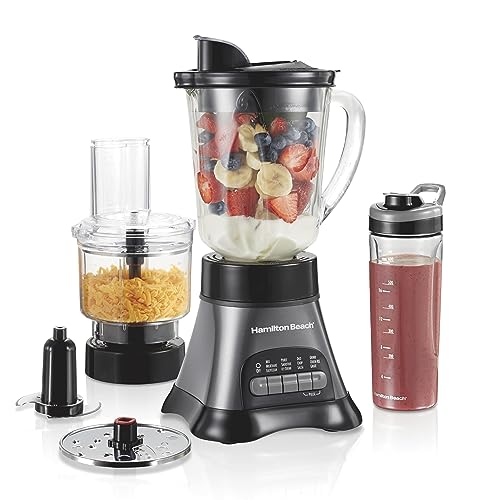
Hamilton Beach Blender and Food Processor Combo 58163, 700W Peak — Best Budget at the Threshold
This combo is included with its paperwork in plain sight: its verified listing states 700 watts peak — a peak figure, not a continuous rating — for a blender-first combo with a 40-ounce glass jar, a 3-cup electric food chopper attachment, and a travel cup. It meets this guide’s threshold on its listing’s own wording, and it is the budget route into the category. What it is not is a standalone processor, and this review will not pretend otherwise.
Strengths
- Meets the 700W threshold at the budget tier, per its listing
- Glass blender jar plus a 3-cup chopper in one purchase
- Travel cup included for the smoothie routine
Trade-offs
- 700W is a peak rating — continuous power is lower
- Processor function is a 3-cup chopper, not a full processor
- No dough, slicing, or shredding capability
| Power | 700W peak (per verified listing) |
| Blender jar | 40 oz glass jar (per verified listing) |
| Processor | 3-cup chopper attachment (per verified listing) |
| Extras | Travel cup (per verified listing) |
Why include it at all? Because budgets are real, and because a shopper type this query with a hard ceiling deserves to see the honest floor of the category rather than a list that starts above their means. Within its limits, the combo is a sensible appliance: a glass-jar blender for the daily smoothie and sauce work, and a 3-cup chopper that handles the onion-herb-nut repertoire exactly as the minis in our 3-cup guide do. The 700-watt peak gives its blender side respectable crushing ability for its tier. What it cannot do is the heavy standalone work — dough, discs, volume — and any buyer whose cooking needs those should save toward the Cuisinart or Ninja above instead.
The peak-versus-continuous lesson is worth taking from this pick to every other listing you ever read: peak wattage describes a momentary maximum, continuous wattage describes the work rate, and only the second kneads dough. This guide quotes each model as its listing words it — the standalones and systems here state their watts without the peak qualifier, this combo states peak — and the comparison table preserves that distinction. Buy the Hamilton Beach with open eyes as a blender with a useful chopper, and it will satisfy; buy it as a 700-watt processor, and the first dough will correct the misunderstanding.
Best for: Budget buyers wanting a blender plus basic chopping / Not suited for: Anyone needing true standalone processor capability
Check the current price on Amazon
Comparison Table
| Pick | Badge | Key spec | Best for |
|---|---|---|---|
| Cuisinart 14-Cup Food Processor DFP-14BCNY, 720-Watt | Best Overall | 720W, 14-cup, dough-capable | Serious home cooks wanting one standalone high-power processor |
| Ninja Professional Plus Food Processor BN601, 1000W | Best for Dough and Heavy Jobs | 1000W, 9-cup, Auto-iQ dough | Dough makers and heavy-job households wanting preset guidance |
| Ninja Mega Kitchen System BL770, 1500W | Best Full Kitchen System | 1500W system, 8-cup bowl | Households wanting one powerful base for blending and processing |
| Ninja Compact Kitchen System AMZ493BRN, 1200W | Best Compact System | 1200W system, 40oz bowl | Couples and small households wanting system power, compact scale |
| Magimix Compact 5200 XL Food Processor, 1100 Watt | Best Premium Standalone | 1100W standalone, Compact 5200 XL | Serious cooks wanting the premium standalone specialist |
| Hamilton Beach Blender and Food Processor Combo 58163, 700W Peak | Best Budget at the Threshold | 700W peak combo, 3-cup chopper | Budget buyers wanting a blender plus basic chopping |
What does wattage actually buy in a food processor?
Wattage buys composure under load. On easy work — chopping an onion, puréeing a soup’s worth of vegetables — a 350-watt and a 1000-watt machine are hard to tell apart, because neither is working hard. The difference appears where resistance lives: dough forming in the bowl, hard cheese meeting the grating disc, a full bowl of dense vegetables, nuts grinding toward butter. There, the lower-powered motor slows, heats, and in the worst cases cuts out to protect itself, while the high-wattage machine holds blade speed and finishes evenly. Even results are the hidden dividend — a blade that keeps its pace cuts uniformly; a blade that bogs down tears and smears.
Two cautions keep the number honest. First, wattage is an input, not an output: gearing, blade design, and bowl shape decide how much of it becomes useful work, which is why this guide weighs format and functions alongside the figure. Second, the wording matters — a continuous rating and a peak rating are different claims, and this guide labels the one peak figure on its list every time it appears. Read wattage as a threshold for the jobs you intend, not as a score to maximise, and you will buy the right machine once.
Which heavy jobs justify 700 watts or more?
Dough is the first and clearest justification. Kneading in the bowl — pizza, bread, pastry — demands sustained torque that mid-power machines cannot supply without strain, and it is the job named in the verified listings of both standalone picks here. If dough is weekly in your kitchen, this wattage class is not an upgrade; it is the requirement. Hard grating and shredding is the second: blocks of hard cheese, dense root vegetables, and full bowls of slaw keep a disc working continuously against resistance, and power is what keeps the shreds clean instead of crushed.
The third justification is volume itself. A 14-cup bowl only earns its size if the motor can process a full load evenly, and large-batch cooks — preserving, freezer prep, party cooking — feel under-powering as uneven texture and mid-recipe cut-outs. Conversely, be honest about the jobs that do not justify the class: daily small chopping, herbs, a single sauce. Those belong to a mini processor at a tenth of the footprint, and the strongest kitchens in this guide’s world run both sizes, each where it belongs.
Standalone processor or kitchen system: which high-power format fits you?
The standalone is the specialist’s answer: a bowl, a feed tube, discs and blades, engineered around processing alone. Its virtues are bowl size, disc ecosystems, and a workflow with no format switching — the Cuisinart 14-cup and the Ninja BN601 represent its classic and modern patterns. Choose it when processing is the dominant job, when dough and discs are weekly, and when the counter can house a permanent resident.
The kitchen system shares one powerful base between a blender pitcher and a processor bowl. Its virtues are economics and space — one motor, honestly sized, doing two appliances’ work — and its costs are a mid-sized processor bowl and a parts collection to store and wash. Choose it when your cooking genuinely spans blending and processing weekly, as the BL770 and Compact System households do. The budget Hamilton Beach combo at this guide’s edge serves the kitchen the first two formats cannot: the hard budget, honestly labelled with its peak rating and its chopper-format processor. Format honesty, matched to your kitchen and your recipes, matters more at this wattage than any figure on a box.
How to Choose a Food Processor Over 700 Watts
Step 1 — List your heavy jobs honestly. Dough weekly? Hard cheese by the block? Preserving-scale batches? Write down the two heaviest jobs of your month — they, not your daily chopping, size this purchase.
Step 2 — Fix the format. Standalone for processing-dominant kitchens, system for blend-and-process households, attachment or combo formats for tiny kitchens and hard budgets. Format first; models second.
Step 3 — Read wattage as worded. Prefer a stated continuous figure; treat ‘peak’ as a different, weaker claim and price it accordingly. If a listing will not state wattage at all, that absence is information.
Step 4 — Match bowl to batch. Fourteen cups for batch cooks, nine to ten for family cooking, system bowls of five to eight cups for mixed households, minis for everything small. A bowl you must split every recipe in is the wrong bowl, whatever the wattage — and a bowl so large that everyday quantities vanish inside it is the same mistake wearing the opposite clothes, which is why this step deserves a recipe book open beside it rather than a hopeful guess at the shelf.
Step 5 — Check the disc and blade set against your jobs. Dough blade or programme for bakers, grating discs for cheese households, a proper S-blade for everyone. The included set is the machine you actually bought; expansions are a future cost.
Step 6 — Plan the counter and the wash. Measure the permanent spot, including storage for discs and blades, and be honest about dishwasher space — big bowls and pitchers are bulky citizens of a wash cycle.
How to knead dough in a high-power food processor
Step 1 — Start with the flour and dry ingredients. Fit the dough blade if your machine provides one, add flour and salt, and pulse to combine before any liquid appears. Dry-first mixing distributes salt and any yeast evenly through the flour.
Step 2 — Add liquid through the tube with the machine running. Pour steadily rather than in one flood. The mixture will pass through stages — crumbs, then a shaggy mass, then a ball that begins to clean the bowl’s sides. That ball is your signal that the dough has formed.
Step 3 — Knead briefly, not indefinitely. Processor kneading is fast and frictional; most doughs need well under a minute of running once the ball forms, and over-processing heats and tears the dough. Use the dough programme if your machine offers one — it exists to manage exactly this.
Step 4 — Rest the dough before judging it. Turn the dough onto a floured surface, knead by hand for a few turns to feel its state, then rest it covered. Flour hydrates during the rest, and a dough that felt rough in the bowl often smooths itself given ten quiet minutes.
Step 5 — Respect your machine’s stated dough capacity. High wattage is not infinite capacity. Work in two batches rather than forcing an oversized load, which strains the motor and kneads unevenly — the two-batch discipline is the mark of someone who will still own the machine in a decade.
How do you maintain a high-power processor?
Power concentrates wear, so maintenance is not optional decoration. Wash discs and blades promptly and dry them fully — the S-blade and grating discs of a hard-working machine carry acidic, salty residues that dull and stain. Store blades and discs in their case or with guards on, both for the edges and for the fingers that share the drawer. Keep the feed tube and pusher clean in their seams, where vegetable fibres dry into place.
For the motor base, the rules are respect and rest. Never immerse it; wipe it down after sessions, especially under the bowl where flour and liquids migrate. Work heavy loads in the batches the manual contemplates, and let a machine that has kneaded two doughs rest before a third — thermal protection exists, but the cook who never triggers it owns the machine longest. Finally, keep the manual’s capacity figures: most ‘motor failures’ in this class are capacity violations repeated until they became damage. The machines in this guide are built for hard work, and hard work, properly bounded, is what they will happily do for years.
Why is a famous premium processor not in this list?
Because of this guide’s one rule: the wattage must be stated in the model’s own verified listing. The Breville Sous Chef line — the 16-cup BFP810 and its 12-cup sibling — are verified products in this site’s catalog data, and their listings describe large capacities and a powerful motor. What they do not state, in the listing data available to this guide, is a wattage figure. A guide organised around ‘700 watt or more’ cannot assign a number its sources do not give, so those models are excluded from the picks and recorded in this article’s sources as needing wattage verification at final review — check their product pages, where fuller specifications may settle the question.
The same discipline excluded several other well-known machines whose listings publish no wattage. This will occasionally frustrate a reader who knows a model’s reputation — fairly — but the alternative is a guide that prints numbers it cannot source, and in a category where marketing already stretches wattage language to its limits, sourced numbers are the entire point. Every figure in the six reviews above can be traced to the model’s own listing, quoted as worded, peak labelled as peak.
Common Buying Mistakes
Buying wattage instead of format. A 1500-watt system whose 8-cup bowl splits every recipe is a worse purchase than a 720-watt standalone that swallows them whole. The figure serves the format decision, never replaces it.
Reading peak as continuous. Peak wattage is a momentary maximum. A machine stating 700 watts peak will not knead like one stating 720 continuous — this guide labels the distinction wherever it appears, and so should your reading of any listing.
Expecting a big processor to do small jobs. Two garlic cloves in a 14-cup bowl ride the walls untouched while the blade spins beneath them. Big machines are for big work; the mini exists because physics insists.
Overloading for the motor’s pride. High wattage invites one more cup of flour, one more block of cheese. Capacity limits are engineering, not modesty — repeated overload is how strong machines die young.
Ignoring the included attachments. A processor without the disc your cooking needs is a partial purchase. Price the machine with its required discs included, not as the bare box.
Skipping the mini. Households that buy only the big machine end up chopping daily small jobs by hand and resenting the counter’s resident. The 3-cup companion costs little and completes the kitchen; plan for both from the start.
Final Recommendation
Standalone buyers should start with the Cuisinart 14-Cup DFP-14BCNY — Best Overall for classic capacity and composure, or the Ninja BN601 — Best for Dough and Heavy Jobs for the highest standalone wattage and preset guidance. System households belong with the Ninja BL770 — Best Full Kitchen System at family scale or the Ninja Compact System — Best Compact System at small-household scale. Premium standalone buyers should take the Magimix Compact 5200 XL — Best Premium Standalone, and hard budgets the honestly labelled Hamilton Beach 58163 — Best Budget at the Threshold.
Pair the big machine with its natural companion from Best Food Processors 3 Cups, explore the combo route in Best Blenders Food Processor Combo, and finish the counter with Best Coffee Grinders For Espresso Machines, Best Counter Top Ice Makers, and Best Commercial Kitchen Faucets.
Frequently Asked Questions
Is 700 watts enough for kneading bread dough?
Yes, in a machine designed for it. The standalone picks here — the 720-watt Cuisinart and the 1000-watt Ninja with its dough programme — both name kneading in their verified listings. Respect the stated dough capacity, add liquid gradually, and knead briefly once the ball forms; processor dough is fast, and over-processing heats the dough.
What is the difference between peak wattage and continuous wattage?
Continuous wattage is the power the motor sustains while working; peak wattage is a momentary maximum it can touch. Only the continuous figure describes kneading and shredding ability. This guide quotes each listing as worded and labels the one peak figure — the budget combo’s 700 watts peak — every time it appears.
Why do some expensive processors not list a wattage?
Manufacturers publish specifications differently, and some premium listings emphasise capacity and motor design without a wattage figure. This guide’s rule is to print only figures its verified listings state, so those models are excluded from the picks and flagged in the sources for verification — a discipline that matters in a category where wattage is the headline claim.
Can a high-wattage processor replace a blender?
In system form, largely yes: the Ninja systems here drive a full blender pitcher and a processor bowl from one high-power base, and for most households that covers both appliances. A standalone processor, however, is not a blender — its bowl and blade are built for chopping and kneading, and liquids at volume belong in a pitcher. Choose the format that matches both of your habits.
Is a bigger bowl always better at this wattage?
No. Bowl size should match batch size: a 14-cup bowl processes a family load evenly and a small load badly, because small quantities hide from the blade in a wide bowl. Most kitchens are best served by a right-sized big machine for heavy work plus a 3-cup mini for daily quantities — the pairing this guide’s final recommendation makes.
How long should a 700-watt-plus processor last?
These are the most durable machines in the category when their capacities are respected: years of heavy service, with blades and discs as the consumables. The lifespan killers are repeated overload, dough batches beyond the stated capacity, and deferred cleaning of acidic residues. Work them hard within their limits and maintain them as this guide describes, and they repay the investment many times over. That durability is the final argument for the wattage class itself: a machine bought for heavy work and built to sustain it is cheaper across a decade than two mid-power machines bought, strained, and replaced in sequence — the arithmetic that professional kitchens have always done, applied to a home counter that expects to be cooking, at volume, for a very long time.
Do I still need a mini processor if I buy a high-power machine?
For most kitchens, yes — and the two purchases should be planned together. The big machine owns dough, discs, and volume; the mini owns the daily onion, herbs, and sauces that a wide bowl handles badly. Together they cost less than one premium machine asked to do both jobs, and each does its own work better than any single appliance can. The pairing also protects the big machine’s calendar: a processor that is not dragged out for two cloves of garlic is a processor whose bowl, blade, and motor are fresh on the day the preserving, the dough, and the party actually arrive.

