Disclosure: airfryerkitchensupply.com is reader-supported. When you buy through links on our site, we may earn an affiliate commission at no extra cost to you.
Where to buy
If you are shopping for the best coffee grinders for espresso machines, start here: every linked model below was cross-checked against Amazon’s catalog data for this site before this guide was written, and only confirmed models carry a buying link. Grinder line-ups change quietly — a name like Encore covers both a brew grinder and an espresso-specific ESP version — so confirm the exact model suffix on the product page before ordering.
- Baratza Encore ESP Coffee Grinder ZCG495BLK (Best Overall) — check price on Amazon
- Breville Smart Grinder Pro BCG820 (Best for Beginners and Variety) — check price on Amazon
- Eureka Mignon Libra Espresso Grinder (Best Premium) — check price on Amazon
- Baratza Sette 270 Conical Burr Grinder (Best for Fast, Fluffy Espresso Grinds) — check price on Amazon
- Fellow Opus 2 Conical Burr Grinder (Best All-Range Stepless Design) — check price on Amazon
- Baratza Virtuoso+ Conical Burr Grinder (Best Dual-Purpose for Brew and Espresso) — check price on Amazon
The best coffee grinders for espresso machines are the ones that can grind fine enough, evenly enough, and adjustably enough for a pressurised basket to forgive nothing. Espresso is the least tolerant brew method in coffee: water under pressure finds every inconsistency in the grind, so a pile of mixed boulders and dust extracts sour and bitter in the same sip. A grinder that is excellent for French press can be genuinely incapable of espresso, which is why this guide is restricted to models whose verified listings speak directly to espresso grinding.
Three qualities decide everything here. The first is range at the fine end: the grinder must reach true espresso fineness with room to spare on both sides, because beans, roast levels, and baskets all shift the ideal setting. The second is adjustment resolution — stepped settings that jump in fine increments, or stepless adjustment that moves continuously — because dialling in a shot is a game of small corrections. The third is consistency: burr geometry and build that produce a narrow spread of particle sizes at those fine settings, so the puck resists water evenly.
The six picks below cover the realistic shape of the market, and every one was verified individually against Amazon’s catalog data for this site, with the listing’s own words quoted in the spec boxes. There is an espresso-specific all-rounder that most home baristas should buy first, a programmable 60-setting machine that forgives beginners, a stepless Italian specialist that grinds by weight, a direct-path speed specialist built purely for espresso, an all-range stepless design that runs from espresso to cold brew, and a dual-purpose burr grinder for households that brew every way there is. Prices in this category span a wide ladder, and this guide will be honest about where the money stops mattering.
One warning before the picks, because it is the most expensive misunderstanding in home espresso: a famous grinder name does not guarantee the espresso version. The standard Baratza Encore is a brew grinder; the Encore ESP is its espresso-tuned sibling, and they are different purchases wearing similar clothes. This guide lists the ESP, and the buying notes in every review repeat the discipline — check the suffix, check the listing, then enjoy the coffee.
In this guide
Quick Picks
The espresso-grinder shortlist at a glance. Badges match the detailed reviews below — start with the pick whose badge sounds like your counter.
- Baratza Encore ESP Coffee Grinder ZCG495BLK — Best Overall. The espresso-tuned Encore: 40mm conical steel burrs producing uniform grounds for espresso and more, in the friendliest format a first serious grinder can take. — Check on Amazon
- Breville Smart Grinder Pro BCG820 — Best for Beginners and Variety. A programmable conical burr grinder with 60 settings for any brew method, espresso included, in brushed stainless — the forgiving, do-everything household grinder. — Check on Amazon
- Eureka Mignon Libra Espresso Grinder — Best Premium. The Italian specialist: grind-by-weight dosing, 55mm burrs, stepless adjustment, and Eureka’s silent technology in chrome — precision without the café noise. — Check on Amazon
- Baratza Sette 270 Conical Burr Grinder — Best for Fast, Fluffy Espresso Grinds. Baratza’s espresso specialist with a straight-through grind path: precise, programmable espresso grinding with very low retention between doses. — Check on Amazon
- Fellow Opus 2 Conical Burr Grinder — Best All-Range Stepless Design. Fellow’s second-generation all-rounder: 48mm burrs, stepless adjustment across an espresso-to-cold-brew range, anti-static behaviour, and auto stop, in black. — Check on Amazon
- Baratza Virtuoso+ Conical Burr Grinder — Best Dual-Purpose for Brew and Espresso. The versatile veteran: 40 grind settings spanning brew methods including espresso, per its listing — the one-grinder household’s classic choice. — Check on Amazon
How These Picks Were Chosen
We filtered on espresso evidence, not reputation. A pick had to state its espresso capability in its verified listing — in the title itself, in its stated grind range, or in espresso-specific design facts like grind-by-weight dosing for espresso — because the surest way to buy the wrong grinder is to assume a respected brew grinder crosses over. General-purpose grinders whose listings speak only of drip and press were excluded, however well reviewed they are in their own category.
We then spread the six across the real decision axes: stepped versus stepless adjustment, dialled-in espresso specialists versus all-range machines, and the tiers a home barista actually climbs — first serious grinder, versatile household grinder, enthusiast specialist. Verification followed this site’s standard discipline, twice over for this category because the stakes are higher: products were checked in the site’s verified cache and, for the newest models, in fresh Amazon listing data searches run for this batch, with the listed titles matched word for word against the intended models. Only confirmed matches received links, and specifications below quote only what those listings state — burr size, setting counts, and adjustment type, never an invented uniformity figure.
The 6 Best Coffee Grinders for Espresso Machines
Each review covers the home barista the grinder suits, its strengths, its trade-offs, and the verified specifications its listing actually states.

Baratza Encore ESP Coffee Grinder ZCG495BLK — Best Overall
The Encore ESP is the grinder this category needed: Baratza took the most recommended beginner grinder in coffee and re-engineered its fine end for espresso. Its verified listing states the proposition plainly — 40mm conical steel burrs producing uniform grounds for espresso and more, with consistent performance and durability. For a home barista buying a first dedicated espresso grinder, this is the default answer, and the burden of proof is on everything else here to beat it for a specific reason.
Strengths
- Espresso-specific tuning of a proven, repairable platform
- 40mm conical steel burrs, per the verified listing
- Simple, learnable adjustment for first-time dial-in
Trade-offs
- Stepped adjustment; micro-tuning is by step, not continuous
- Single-purpose value peaks at espresso and filter range
- Plastic-forward body at this tier
| Burrs | 40mm conical steel burrs (per verified listing) |
| Design focus | Uniform grounds for espresso and more (per verified listing) |
| Model | ZCG495BLK Encore ESP (per verified listing) |
| Adjustment | Stepped, espresso-tuned range |
Why does the ESP matter when the standard Encore exists? Because espresso lives in a narrow band at the fine end, and a generalist grinder spreads its settings across the whole brew spectrum, leaving few usable steps where espresso actually happens — and sometimes not reaching fine enough at all with margin. The ESP re-allocates its resolution to that band, so dialling in becomes a series of small, repeatable corrections instead of a leap between too-fast and choked. That is the difference between a beginner who learns espresso in a weekend and one who concludes their machine is broken.
Baratza’s ownership virtues complete the case: a platform designed to be opened, cleaned, and repaired, with parts and knowledge widely available, at the accessible end of the serious tier. It will not be the last grinder an enthusiast owns — the Sette and the Mignon below exist for the next climb — but it is the one most home espresso drinkers should buy first, because it removes the grinder as the limiting factor and lets the learning be about coffee. Confirm the ESP suffix on the product page; the standard Encore is a fine brew grinder and a disappointing espresso one.
Best for: First serious espresso grinder for home baristas / Not suited for: Enthusiasts wanting stepless micro-adjustment or café volume
Check the current price on Amazon
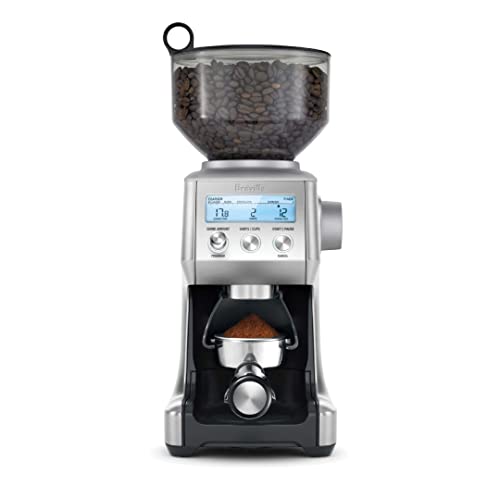
Breville Smart Grinder Pro BCG820 — Best for Beginners and Variety
The Smart Grinder Pro is the grinder for households that refuse to specialise: its verified listing promises programmable conical burr grinding with 60 settings for any brew method, espresso beans included by name. Sixty settings with a digital, programmable interface makes it the most approachable dial-in experience here — set a time, adjust by number, repeat tomorrow exactly — which is why it anchors so many first espresso corners.
Strengths
- 60 grind settings spanning espresso to press, per the listing
- Programmable dosing makes shots repeatable by number
- Brushed stainless build suits a permanent coffee corner
Trade-offs
- All-range design trades some fine-end resolution for breadth
- Electronic dosing is a convenience, not a scale
- Larger footprint than espresso-only specialists
| Settings | 60 grind settings (per verified listing) |
| Burrs | Conical burr (per verified listing) |
| Dosing | Programmable (per verified listing) |
| Model | BCG820BSS Smart Grinder Pro (per verified listing) |
Programmability is this grinder’s real argument. Espresso beginners drown in variables; a grinder that doses by a set time, at a numbered setting, removes two of them at once and makes yesterday’s good shot reproducible today. That repeatability teaches faster than any tutorial, because one variable at a time can actually change. The 60-setting spread also future-proofs the household: the same machine grinds for the espresso machine on Saturday and the French press on Sunday, which is how most homes genuinely drink.
The honest trade is resolution at the extreme fine end. A grinder that must also serve cold brew coarse cannot devote as many micro-steps to the espresso band as a stepless specialist, and very light roasts in demanding baskets can expose that. For the great majority of home espresso — medium roasts, standard baskets, learning palates — the Smart Grinder Pro is not a compromise at all; it is the sensible centre of the category. Choose it when variety and forgiveness outrank the last degree of tuning.
Best for: Households brewing espresso plus other methods, beginners first / Not suited for: Light-roast specialists chasing stepless micro-adjustment
Check the current price on Amazon

Eureka Mignon Libra Espresso Grinder — Best Premium
The Mignon Libra is where this list stops compromising. Its verified listing reads like an enthusiast’s specification sheet: grind by weight, 55mm burrs, stepless adjustment, and silent technology, in a chrome Eureka body. Grind-by-weight is the headline — the grinder doses by mass rather than by time, so the dose stays constant as beans, settings, and hopper level change — and it is the feature that most transforms daily espresso consistency.
Strengths
- Grind-by-weight dosing for true dose consistency
- 55mm burrs with stepless adjustment, per the listing
- Silent technology suits home kitchens and early mornings
Trade-offs
- Premium tier — the considered purchase of this list
- Espresso-focused; not the household all-rounder
- Weight-based dosing rewards a careful, level setup
| Burrs | 55mm (per verified listing) |
| Adjustment | Stepless (per verified listing) |
| Dosing | Grind by weight (per verified listing) |
| Noise | Silent technology (per verified listing) |
Dose consistency is the invisible variable in home espresso. Timed dosing drifts: a fuller hopper feeds faster, a finer setting feeds slower, and the same five seconds quietly becomes a gram or two different — enough to move a shot’s time and taste. Weighing every dose removes that drift entirely, which is why café workflow is built on scales. The Libra builds the scale into the grinder, and combined with stepless adjustment — where the dial moves continuously and the perfect setting is always reachable, never one step away — it gives the home barista the two controls that professionals refuse to work without.
The silence deserves its own sentence, because grinder noise is the tax every household member pays for one person’s hobby. Eureka’s sound-dampened design makes a 6 a.m. shot a private act instead of a household announcement, and in flats and family homes that is a feature with daily value, not a luxury. Buy the Libra when espresso is a settled, serious habit and consistency is the goal; it is wasted on a machine that comes out monthly, and perfect for one that never goes away.
Best for: Serious home baristas wanting café-grade dose consistency / Not suited for: Occasional espresso drinkers or multi-method households
Check the current price on Amazon
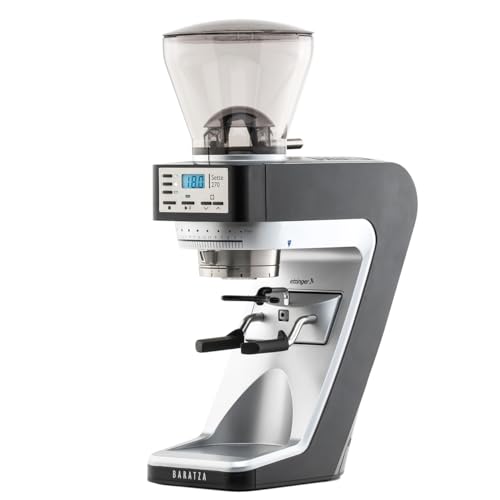
Baratza Sette 270 Conical Burr Grinder — Best for Fast, Fluffy Espresso Grinds
The Sette 270 was designed from a blank page for espresso, and it shows in the one specification that shapes daily use: the grind path runs straight through, so grounds fall directly into the portafilter with minimal retention. Its verified listing describes it as precise, programmable espresso grinding. Low retention means the first shot of the day is not seasoned with yesterday’s stale grounds, and setting changes take effect immediately instead of purging their way through.
Strengths
- Straight-through path: very low grind retention
- Purpose-built for espresso, per the verified listing
- Programmable dosing for repeatable shots
Trade-offs
- Espresso-first design; coarse range is not its party trick
- Gear-driven design has a distinctive working sound
- Enthusiast tier and enthusiast learning curve
| Design | Conical burr, espresso-focused (per verified listing) |
| Dosing | Programmable (per verified listing) |
| Grind path | Straight-through, low retention (design characteristic) |
| Model | Sette 270 (per verified listing) |
Retention is the specialist concept this grinder teaches. In a conventional grinder, several grams of ground coffee live in the chute and burr chamber, emerging into later doses — so a setting change is really a blend of the old setting and the new for the next shot or two, and morning coffee includes yesterday’s oxidised grounds. The Sette’s vertical path shrinks that to a whisper. Dialling in becomes honest: change the setting, taste the change. Single-dosing — weighing beans per shot and grinding them through — becomes practical for the same reason, which is why the Sette built such a following among methodical home baristas.
The trade-offs are focus and character. This is an espresso instrument; households wanting one grinder for every method should take the Breville or the Virtuoso+ instead. Its gear-driven mechanism also has a working voice that some find assertive next to the Mignon’s hush. Neither matters to the buyer it was built for: the espresso drinker who weighs, times, and tastes, and wants the grinder to stop being the noisy variable in the experiment. For that buyer, the Sette 270 remains a defining design.
Best for: Methodical espresso drinkers, single-dosing workflows / Not suited for: Households needing one grinder for every brew method
Check the current price on Amazon

Fellow Opus 2 Conical Burr Grinder — Best All-Range Stepless Design
The Opus 2 is the design-led answer to the all-range problem: a conical burr grinder whose verified listing states 48mm burrs, stepless grind adjustment, and a range running from espresso to cold brew, with anti-static behaviour and auto stop. Stepless adjustment in an all-range body is the notable engineering — it promises espresso-band resolution without surrendering the coarse end — and the anti-static design attacks the mess that makes home grinding feel like a chore.
Strengths
- Stepless adjustment across espresso to cold brew, per the listing
- 48mm burrs — a step up in burr size for the class
- Anti-static design and auto stop for a cleaner routine
Trade-offs
- All-range breadth still asks espresso drinkers to learn its fine band
- Design-led premium over purely functional rivals
- Newer generation; long-term record still being written
| Burrs | 48mm conical burrs (per verified listing) |
| Adjustment | Stepless (per verified listing) |
| Range | Espresso to cold brew (per verified listing) |
| Extras | Anti-static, auto stop (per verified listing) |
Static is the unglamorous enemy of home grinding: fine grounds cling to the burr chamber, dust the counter, and skew the dose that lands in the basket. An anti-static design that delivers grounds into the catch cup cleanly is a daily-quality feature, felt every single morning, and it pairs with auto stop to make the grinding routine a one-touch act rather than a supervised one. Fellow’s industrial design also matters in real kitchens — this is a grinder that earns its permanent counter place visually, which is where grinders must live to be used daily.
Judge the Opus 2 as the versatile stepless option. The Mignon Libra out-specialises it for pure espresso with grind-by-weight; the Smart Grinder Pro undercuts it for programmable simplicity. The Opus 2’s ground is the household that brews across the map — espresso on weekdays, pour-over and cold brew on weekends — and refuses to accept stepped jumps at the fine end as the price of that breadth. If your coffee life genuinely spans the range its listing claims, it is the most elegant one-grinder answer here.
Best for: Multi-method households wanting stepless adjustment / Not suited for: Pure espresso specialists wanting grind-by-weight
Check the current price on Amazon

Baratza Virtuoso+ Conical Burr Grinder — Best Dual-Purpose for Brew and Espresso
The Virtuoso+ is the pick for the household that brews everything and wants one proven grinder to do it with honest competence. Its verified listing states 40 grind settings giving access to an extensive range of brew methods, including espresso, French press and more. It does not pretend to be an espresso specialist — its badge here is dual-purpose — but for homes whose espresso machine shares the counter with a dripper and a press, it is the balanced, long-trusted answer.
Strengths
- 40 settings including espresso, per the verified listing
- Proven Baratza platform: repairable, parts widely available
- One grinder for the household’s whole brew range
Trade-offs
- Fine-end resolution below the espresso specialists here
- Best with standard baskets and medium roasts for espresso
- Stepped adjustment, shared across all methods
| Settings | 40 grind settings (per verified listing) |
| Range | Espresso, French press and more (per verified listing) |
| Burrs | Conical burr (per verified listing) |
| Model | ZCG587BLK Virtuoso+ (per verified listing) |
The Virtuoso+’s espresso honesty needs framing, because it is the pick most likely to be misjudged in both directions. It does grind for espresso — its listing says so — and with a standard or pressurised basket and a medium roast it produces satisfying shots. What it does not offer is the dense thicket of micro-settings at the fine end that the ESP, Sette, and Mignon provide for demanding baskets and light roasts. Households should buy it for the whole range and enjoy its espresso as a strong capability, not buy it as a specialist and resent its breadth.
Longevity is the closing argument. Baratza’s platform philosophy — user-serviceable burrs, available parts, a design that expects to be maintained rather than replaced — suits a grinder bought as a decade’s appliance, and the Virtuoso+ has the track record to prove the pattern. For the two-method or three-method household, it is the grinder that keeps the counter honest: one machine, every method, no apologies at the coarse end and a fair showing at the fine. Add a dedicated espresso specialist later if the hobby deepens; many owners never feel the need.
Best for: Households brewing espresso alongside drip, press, and pour-over / Not suited for: Espresso-only drinkers wanting maximum fine-end control
Check the current price on Amazon
Comparison Table
| Pick | Badge | Key spec | Best for |
|---|---|---|---|
| Baratza Encore ESP Coffee Grinder ZCG495BLK | Best Overall | 40mm conical burrs, espresso-tuned | First serious espresso grinder for home baristas |
| Breville Smart Grinder Pro BCG820 | Best for Beginners and Variety | 60 settings, programmable dosing | Households brewing espresso plus other methods, beginners first |
| Eureka Mignon Libra Espresso Grinder | Best Premium | 55mm burrs, stepless, grind-by-weight | Serious home baristas wanting café-grade dose consistency |
| Baratza Sette 270 Conical Burr Grinder | Best for Fast, Fluffy Espresso Grinds | Low retention, programmable, espresso-built | Methodical espresso drinkers, single-dosing workflows |
| Fellow Opus 2 Conical Burr Grinder | Best All-Range Stepless Design | 48mm burrs, stepless, espresso–cold brew | Multi-method households wanting stepless adjustment |
| Baratza Virtuoso+ Conical Burr Grinder | Best Dual-Purpose for Brew and Espresso | 40 settings incl. espresso, conical burrs | Households brewing espresso alongside drip, press, and pour-over |
Stepped vs stepless: which adjustment do you actually need?
Stepped grinders move between fixed, numbered settings. Their virtues are repeatability and communication: setting 12 today is setting 12 tomorrow, recipes can be shared as numbers, and returning to a bean’s setting after grinding for another method is instant. Their cost is granularity — the perfect setting for a particular bean sometimes lives between two steps, and the barista compensates with dose or tamp. The Encore ESP answers this by crowding more steps into the espresso band; the Smart Grinder Pro and Virtuoso+ spread their steps across all methods and accept wider spacing at the fine end.
Stepless grinders move continuously, so the perfect setting always exists — at the price of finding it by taste rather than by number, and of losing it when the dial is knocked or the grinder is cleaned. The Mignon Libra and Opus 2 in this guide are stepless. The honest rule: beginners and multi-method households are usually happier stepped, because repeatability teaches faster than resolution; experienced espresso drinkers dialling in demanding beans feel stepped limits within months and should buy stepless once, properly. Neither is a quality tier — they are different contracts with the same coffee.
How fine is fine enough? Burrs, baskets, and the truth about espresso range
An espresso grinder must reach the fine band with margin. ‘Margin’ is the operative word: the ideal setting shifts with bean age, roast level, humidity, and basket, so a grinder whose finest setting is merely adequate on the day you test it will be inadequate on the day the beans change. Every pick in this guide states its espresso capability in its own listing, and the specialists — ESP, Sette, Mignon — build their ranges around that band rather than visiting it at the end of a dial.
Basket type changes the demand. Pressurised (double-wall) baskets create resistance artificially and forgive a coarser, less even grind, which is why entry machines ship with them and why generalist grinders can serve them acceptably. Bottomless and precision baskets forgive nothing: they expose grind inconsistency as spraying, channeling shots, which is why enthusiasts graduate to the specialists on this list. Burr size, stated in several listings here — 40mm, 48mm, 55mm — correlates with speed and, loosely, with consistency headroom, but geometry and build matter as much as diameter; treat size as one verified fact among several, not a score.
Dosing: timed, programmable, and grind-by-weight explained
How the grinder measures a dose decides how repeatable your mornings are. Timed dosing runs the motor for set seconds; it is simple and drifts as the hopper empties and settings change, because flow rate is not constant. Programmable dosing — the Smart Grinder Pro and Sette pattern — refines the timer with saved settings per method, which is a real convenience and the same drift in a nicer coat. Many careful baristas bypass both by weighing the dose on a small scale, accepting a few seconds of ritual for exactness.
Grind-by-weight, the Mignon Libra’s stated design, builds that scale into the grinder: the dose is mass, every time, regardless of hopper or setting. It is the café standard for a reason, and its arrival in a home-format, quiet grinder is why the Libra holds this guide’s premium badge. The practical ladder is honest: any consistent routine beats an inconsistent one, timed dosing with an occasional scale check serves most homes well, and grind-by-weight is for the drinker who has felt dose drift cost them shots and decided to stop paying. Match the dosing to your patience, not to your aspirations.
How to Get Consistent Shots From Your Grinder Every Morning
Step 1 — Keep one bean dialled at a time. Finish a bag before opening the next where you can; every bean change is a re-dial, and overlapping bags double the variables in a small kitchen.
Step 2 — Weigh the dose, or verify the timer weekly. Timed and programmable doses drift. A ten-second scale check once a week keeps the routine honest; grind-by-weight owners may skip this step with a clear conscience.
Step 3 — Purge with intent. On grinders with retention, grind a small purge after setting changes or first thing in the morning, so the dose in the basket is the setting you chose, ground today.
Step 4 — Distribute before you tamp. Level the grounds in the basket — a gentle shake or a distribution tool — because a perfect grind tamped unevenly channels exactly like a poor one.
Step 5 — Taste with a notebook. Time the shot, taste it, write one line. Sour and fast, finer; bitter and slow, coarser. The notebook turns a month of mornings into a skill instead of a series of guesses.
Step 6 — Store beans against air, not in the hopper by default. Beans stale faster in a hopper’s warmth and light. Keep the bag sealed and fill the hopper for a few days at a time — less if your kitchen is hot — and the last shots of the bag will need less rescue.
How to dial in a new espresso grinder, step by step
Step 1 — Season and settle. Run a small amount of inexpensive beans through a new grinder and discard the grounds; fresh burrs and factory traces settle quickly, and your first dialled shots should not pay for them.
Step 2 — Fix every variable except grind. Choose one bean, one dose weighed on a scale, one basket, one machine routine. Dialling in is an experiment; experiments need constants.
Step 3 — Start at the maker’s espresso mark. Most of these grinders indicate an espresso zone. Begin there, pull a shot, and time and taste it rather than judging by looks alone.
Step 4 — Move in small steps toward the target. Sour, fast, and thin means grind finer; bitter, slow, and choking means grind coarser. Change one step — or a small stepless nudge — per shot, and purge a little after each change on grinders with retention.
Step 5 — Record the landing. Note the setting, dose, and shot time for this bean. Stepped owners get a number; stepless owners should mark the dial position. Future bags of the same bean will start within a step or two of home.
Step 6 — Re-dial as beans age. Coffee changes across the bag’s life, usually needing a touch finer as it stales. A setting is a relationship with a specific bag, not a permanent truth — expect to tend it, briefly, forever.
How do you clean and maintain an espresso grinder?
Espresso grinders live closer to their limits than brew grinders, so their maintenance matters more. Brush the burr chamber and chute weekly in home use; coffee fines compact there, go stale, and season fresh doses with old flavours. Run grinder-cleaning tablets or the maker’s recommended routine monthly if you grind oily, dark roasts — oils are the accelerant of every grinder problem, from clumping to rancid carry-over.
Deep-clean on a calendar: unplug, empty, and follow the maker’s path to the burrs, which on the Baratza platforms here is designed to be owner-serviceable. Vacuum out the chamber — never wash burrs with water — and reassemble carefully, then re-check your dial-in setting, because a deep clean can shift the burr alignment by a step. Note the date and the post-clean setting in the same notebook as your bean records. A maintained grinder tastes invisible, which is the goal: the coffee should be the only flavour in the cup that came from the equipment.
How much grinder do you need for your espresso machine?
Match the grinder to the machine and the basket, not to the internet’s enthusiasm. An entry machine with pressurised baskets is honestly served by the Encore ESP or the Smart Grinder Pro; a specialist grinder’s resolution would be spent on a basket that cannot express it. A prosumer machine with a bottomless portafilter inverts the logic: it will expose every weakness in a generalist grinder, and the Sette or Mignon class stops being indulgence and becomes the enabling purchase. The commonest misallocation in home espresso is an expensive machine paired with an inadequate grinder — the machine gets blamed, the grinder was the ceiling all along.
Budget guidance follows from that: in a combined purchase, the grinder deserves a far larger share than beginners instinctively give it. A mid machine with an excellent grinder produces better espresso than an excellent machine with a mid grinder, because extraction is grind before it is pressure. Buy the grinder as the foundation, keep it through machine upgrades — the picks here span exactly that climb — and the hobby’s economics finally make sense.
A final calibration for new buyers: your first month’s shots will vary, and that variance is you, not the equipment, provided the grinder came from this list’s evidence standard. Espresso is a skill built on a stable platform. The grinder’s job is to be the stable part — same dose, same fineness, same behaviour every morning — so that the only thing changing is the barista, in the right direction. Judge any of these six again after a month of mornings, not after a weekend, and you will be judging them fairly. By then the setting will be a habit, the dose a reflex, and the coffee — the point of the entire exercise — will finally be the most interesting variable on the counter, which is exactly where every home barista wants it to be.
Common Buying Mistakes
Buying the brew version of a famous name. The standard Encore and the Encore ESP are different grinders for different jobs. The suffix is the product. Check it on the listing and again on the box when it arrives.
Pairing a prosumer machine with a generalist grinder. A bottomless portafilter will expose a brew grinder’s fine-end limits in the first shot. Budget the grinder as the foundation of the setup, not as the accessory.
Changing three variables at once. New beans, new setting, new dose — and a bad shot that teaches nothing. Dialling in works one variable at a time, with the others held constant and a note taken.
Ignoring retention. Yesterday’s grounds in today’s dose, and old settings haunting new ones, are retention at work. Purge after changes, and favour low-retention designs if you single-dose.
Letting oily beans gum the burrs. Dark, oily roasts coat burrs and chutes, clumping doses and adding stale flavour. Brush weekly, deep-clean on schedule, and the problem stays a chore instead of becoming a taste.
Grinding for a crowd with a home grinder. Home espresso grinders are built for shots, not for a brunch queue of eight lattes in ten minutes. Motors heat, consistency drifts, and the barista frays. For gatherings, pull shots in a steady rhythm with rests, or accept the household division of labour: espresso drinks for a few, and a pot from the counter’s other brewer for the rest.
Chasing a number instead of the taste. Shot times and settings are guides for your palate, not commandments. A shot that tastes balanced at an unfashionable time is a good shot; adjust toward flavour, and let the notebook serve the tongue.
Final Recommendation
Most home baristas should buy the Baratza Encore ESP — Best Overall first: espresso-tuned, learnable, repairable, and honest value. Households that brew every way should take the Breville Smart Grinder Pro — Best for Beginners and Variety or the Baratza Virtuoso+ — Best Dual-Purpose, while the design-minded all-rounder is the Fellow Opus 2 — Best All-Range Stepless Design. Serious espresso drinkers graduate to the Baratza Sette 270 — Best for Fast, Fluffy Espresso Grinds for its low retention, or the Eureka Mignon Libra — Best Premium for grind-by-weight consistency in near-silence at home.
Complete the espresso corner with Best Coffee Espresso Combination Machines and Best Coffee Espresso Machines Home, then compare the machines themselves in Best Espresso Machines, with Best Coffee Pots For Making Hot And Iced Coffee and Best Coffee Makers for the household’s other coffee drinkers.
Frequently Asked Questions
Can a regular coffee grinder work for espresso?
Usually not well. Espresso needs a fine, even grind with small adjustments available at the fine end, and most general brew grinders either cannot reach that fineness with margin or jump over the ideal setting in one step. Pressurised baskets forgive some of this, which is why entry machines can pair with generalist grinders — but the models in this guide state their espresso capability in their own listings, and that evidence is what to buy on.
What is the difference between the Baratza Encore and the Encore ESP?
The standard Encore is a brew grinder for filter methods. The Encore ESP — the pick in this guide — is re-tuned for espresso, with its adjustment resolution concentrated in the fine band espresso uses and 40mm conical steel burrs specified for uniform espresso grounds, per its verified listing. The names differ by three letters and the products differ by purpose; check the suffix when ordering.
Is stepless adjustment better than stepped for espresso?
Stepless offers infinite resolution, so the ideal setting always exists; stepped offers repeatable, numbered settings you can return to and share. Beginners usually learn faster stepped, while experienced drinkers with demanding beans and baskets benefit from stepless. This guide includes both — the Mignon Libra and Opus 2 stepless, the Baratza and Breville picks stepped — because the right answer depends on the drinker, not the brochure.
Why does grind-by-weight matter?
Because dose is a primary variable in espresso, and timed dosing drifts as the hopper level and grind setting change the flow rate. Grind-by-weight — the Eureka Mignon Libra’s stated design — doses by mass every time, removing that drift. It is the café standard, and for a serious home barista it is the single largest consistency upgrade a grinder can offer.
How long do espresso grinder burrs last?
Home-use burrs last for years — typically hundreds of kilograms of coffee — before wear softens their consistency. The signs of wear are gradual: shots that need ever-finer settings and taste less distinct. Static and clumping that cleaning no longer fixes can be another late sign, as worn burrs produce more dust-like fines that cling and scatter. When those signs accumulate across several bean types — ruling out the coffee itself — the burrs, not your technique, have become the variable. The platforms in this guide are chosen partly for serviceability, so burr replacement, when the day eventually comes, is a maintenance task rather than a new grinder.
Can one grinder serve espresso and French press equally well?
One grinder can serve both, with an honest trade. All-range models like the Smart Grinder Pro, Opus 2, and Virtuoso+ cover the full span, but their fine-end steps are wider than a specialist’s, which demanding espresso setups can feel. Households that mostly brew filter and sometimes pull shots are well served by one machine; espresso-first households should buy the specialist and let it be excellent at its one job.
What does retention mean, and should I care?
Retention is ground coffee left inside the grinder after a dose, which emerges into later shots. A gram or two sounds trivial until you remember that an espresso dose is itself only a small double handful of grams, so retained coffee can be a meaningful fraction of what lands in the basket — stale, and ground at yesterday’s setting. It matters if you change settings often or single-dose, because retained grounds are stale and belong to the previous setting. Low-retention designs like the Sette 270 minimise it; on other grinders, a small purge after changes keeps doses honest.


