Disclosure: airfryerkitchensupply.com is reader-supported. When you buy through links on our site, we may earn an affiliate commission at no extra cost to you.
Where to buy
You can buy every pick in this best coffee espresso combination machines guide through Amazon, where stock, delivery options and returns are easiest to manage for kitchen gear of this size. Start with our top recommendations: De’Longhi COM530M All-In-One Combination Coffee and Espresso Machine, De’Longhi All-in-One Espresso & Coffee Maker with Dual Heating System, De’Longhi COM630BK All-In-One Combination Coffee and Espresso Machine, De’Longhi Combi BCO430 Coffee and Espresso Machine, Ninja DualBrew Prestige Espresso & Coffee System (CFN801), Cuisinart Coffee Center Barista Bar 4-in-1 Coffee Maker (SS-4N1NAS). Prices and availability change often, so check price on Amazon on the product page before you order, and confirm the exact size, colour and configuration on the listing matches what you measured your kitchen for.
The best coffee espresso combination machines exist for the most common split in real households: one person drinks filter coffee by the pot, the other wants a proper espresso or cappuccino, and the counter has room for exactly one machine. A combination machine puts a drip coffee maker and an espresso maker in a single body — one footprint, one water routine, two brewing systems — so the morning pot and the afternoon espresso stop competing for space. Done well, as the picks below are, a combo is not a compromise but a consolidation: fewer appliances, one learning curve, and drinks for every preference under one lid.
Done badly, a combo is two mediocre machines sharing a power cord, which is why this guide is selective. Every machine here was verified on this site’s Amazon integration — searched by brand and model, the returned listing title matched, and a buying link attached only after confirmation. That verification matters in this category, because manufacturers sell several near-identical variants (with and without grinders, with different milk systems) under confusingly similar names. We print no prices and no ratings, since both change constantly; check price on Amazon at the listing, and confirm the exact model code against the one named in each review.
What separates the six picks is how they balance the two halves. Some are drip-first machines with a capable espresso side for occasional cappuccinos; others are genuine dual systems where both halves can run at once. Read the badges by your household’s real ratio of pots to shots, and the right machine will be obvious by the final section. One more framing before we begin: a combination machine should be judged as a household system, not as two spec sheets glued together. The best combo is the one whose two halves match your two habits — and that matching, more than any single feature, is what the reviews below are organised to reveal.
In this guide
Quick Picks
If you only have a minute, these are the coffee espresso combination machines worth shortlisting. Each one is reviewed in full further down, with strengths, trade-offs and a clear verdict on who it suits.
- Best Overall — De’Longhi COM530M All-In-One Combination Coffee and Espresso Machine: The benchmark combo: a full drip brewer on one side, a pump espresso maker with milk frothing on the other, in one coherent De’Longhi design.
- Best for Simultaneous Brewing — De’Longhi All-in-One Espresso & Coffee Maker with Dual Heating System: Dual heating means the 10-cup pot and an espresso can brew at the same time — the combo for households that gather at once.
- Best Premium Combo — De’Longhi COM630BK All-In-One Combination Coffee and Espresso Machine: The flagship of the line in black, with De’Longhi’s Advanced Cappuccino System for easier milk drinks.
- Best Value Combo — De’Longhi Combi BCO430 Coffee and Espresso Machine: The long-running value entry in the De’Longhi combi family — both drinks, honest specification, friendliest tier in this guide.
- Best Modern Combo — Ninja DualBrew Prestige Espresso & Coffee System (CFN801): A different species of combo: grounds-based coffee plus capsule espresso in three brew styles — the modern, flexible interpretation.
- Best for Pod and Grounds Flexibility — Cuisinart Coffee Center Barista Bar 4-in-1 Coffee Maker (SS-4N1NAS): Four functions in one centre: carafe coffee, single-serve pods, espresso-style drinks and hot water — the maximalist’s combo.
How These Picks Were Chosen
Combination machines invite exaggerated claims, so verification came first. Every pick was searched by brand and full model code on this site’s Amazon integration, and the returned listing title was matched against the machine’s format — drip plus pump espresso, dual heating, capsule system or 4-in-1 centre — before a link was attached. Model codes matter here: De’Longhi alone sells several combination variants, and the difference between a manual wand and an advanced cappuccino system is the difference between two of our badges. If the API could not confirm the exact variant, it is not linked in this guide. That discipline cost us a few famous names — and it is why the six machines that remain can be recommended without a single asterisk or apology attached to them at all.
We judged the machines on the balance of their two halves, because a combo is only as good as its weaker side: drip quality and carafe size on one, genuine pump espresso (or an honestly-labelled capsule alternative) on the other. Milk systems, simultaneity, footprint and cleaning burden were weighed as daily-life factors, since a combo lives or dies on whether both halves stay in regular use. No prices or ratings are printed — check price on Amazon at the listing, where the exact model code can be confirmed one final time.
The 6 Best Coffee Espresso Combination Machines

De’Longhi COM530M All-In-One Combination Coffee and Espresso Machine — Best Overall
The COM530M is the machine this category is judged by, and it earns Best Overall by refusing to treat either half as an accessory. The verified listing confirms De’Longhi’s All-In-One combination format with a 47-ounce capacity on the coffee side. The drip half brews a proper carafe with programmable convenience for weekday mornings, while the espresso half is a real pump machine with a milk frother for lattes and cappuccinos — not a steam toy bolted to a coffee maker. For the classic two-drinker household, this is the single-box answer.
Strengths
- Both halves are genuine: programmable drip brewing and pump espresso with milk frothing
- One footprint and one brand’s logic to learn, instead of two appliances competing for the counter
- De’Longhi’s parts and service network stands behind a machine with two systems to maintain
Trade-offs
- No built-in grinder — budget for a separate burr grinder if you want fresh-ground espresso
- Two systems means two cleaning routines; the espresso side needs regular descaling and purging
- Counter depth is substantial; measure before ordering, as with all combos
| Format | All-in-one drip + pump espresso combination |
| Coffee capacity | 47 ounces (per Amazon title) |
| Milk | Frother for cappuccinos and lattes |
Daily life with the COM530M settles into a pleasant pattern: the drip side, set the night before, handles the household’s first hour, and the espresso side wakes up later for the drinks that feel like a treat. Because the two systems are independent in use, one person’s pot never blocks the other’s shot — the design flaw that sinks cheaper combos. Espresso quality from the pump side is honestly good for this class: proper extraction pressure behaviour, a frother that produces real steamed milk with a little practice, and drinks that satisfy anyone short of a home-barista hobbyist.
The ownership caveats are about diligence, not defects. Espresso systems scale in hard water, drip systems grow stale if carafes are not rinsed, and a combo asks you to stay on top of both. Owners who build the small routines — purge the wand after milk, descale on schedule, rinse the carafe daily — find the machine ages gracefully. Those who will not should buy the simplest drip machine and a pod espresso maker instead; this guide’s honesty extends to telling you when a category is not for you.
For the household it suits, though, the COM530M is the consolidation that works: one machine, both rituals, no daily negotiation over counter space. That is why it leads this guide.
Best for: mixed households drinking both drip pots and milk-based espresso drinks daily / Not suited for: espresso purists who need a grinder-integrated machine, or anyone who hates maintenance
Check the current price on Amazon
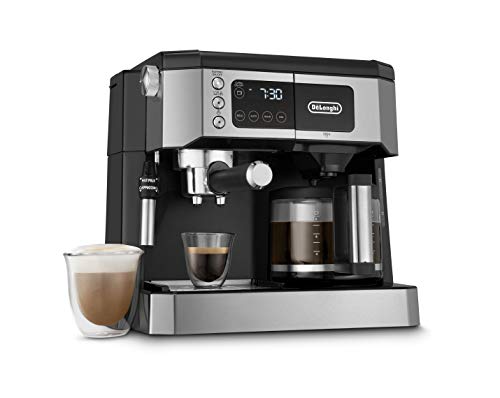
De’Longhi All-in-One Espresso & Coffee Maker with Dual Heating System — Best for Simultaneous Brewing
This De’Longhi variant’s verified listing names its party trick plainly: a dual heating system serving a 10-cup drip pot and an espresso side with milk frother. Most combination machines make you choose — coffee first or espresso first — because one heater serves both. Dual heating removes that queue, which matters most in households where breakfast is a group event: guests, family weekends, holiday mornings when four people want four different drinks in the same ten minutes.
Strengths
- Dual heating system brews drip coffee and espresso simultaneously — a rare, genuinely useful combo feature
- A full 10-cup pot suits family and guest service better than smaller carafes
- Milk frother included for the cappuccino drinkers in the group
Trade-offs
- Simultaneity is the premium here; solo drinkers will rarely use it and can save with simpler models
- A bigger, thirstier machine in every sense — counter space, water and descaling attention
- No integrated grinder, as with most of this category
| Format | All-in-one combination, dual heating (per Amazon title) |
| Coffee capacity | 10-cup pot (per Amazon title) |
| Milk | Milk frother (per Amazon title) |
Think of the use case concretely: Sunday, 9 a.m., six people. Two want a pot of filter coffee for the table, one wants a cappuccino, one wants a straight espresso, and the cook wants nobody waiting. A single-heater combo serialises those drinks into a queue and a cooling pot; this machine runs the pot and the shots in parallel, and the morning stays social instead of procedural. That is a small feature on paper and a large one in a real kitchen’s life.
The rest of the machine is the proven De’Longhi combo formula — competent drip brewing, a real pump espresso side, and a frother that handles milk drinks with a little technique. If your household’s pattern is one or two drinks at scattered times, this capability is surplus and the COM530M above is the leaner buy. If your pattern is gatherings, this is the combo that will not make you the bottleneck at your own breakfast table.
Best for: families and hosts whose coffee moments happen all at once / Not suited for: solo drinkers or couples on staggered schedules
Check the current price on Amazon

De’Longhi COM630BK All-In-One Combination Coffee and Espresso Machine — Best Premium Combo
The COM630BK is the premium step in De’Longhi’s combination range, and its verified listing names the upgrade that matters: an Advanced Cappuccino System, in a black finish that suits modern kitchens. Where the standard frother asks for technique, the advanced system is designed to make milk drinks more automatic and more consistent — the difference between a cappuccino that depends on your morning coordination and one that arrives reliably while you are still half awake.
Strengths
- Advanced Cappuccino System makes milk drinks easier and more consistent than a manual frother
- The flagship build and finish of the De’Longhi combo line, in a kitchen-friendly black
- Full combination format: carafe coffee for the household, espresso drinks on demand
Trade-offs
- Premium positioning within the combo category; the upgrade is mostly about milk convenience
- Milk systems need rinsing after every use — the easier the system, the more important the habit
- Still no built-in grinder; espresso purists will pair it with a separate burr grinder
| Format | All-in-one combination |
| Milk system | Advanced Cappuccino System (per Amazon title) |
| Finish | Black (BK model code) |
Milk is where home espresso dreams usually die: the shots are fine, but the frothing is fiddly, the wand is a chore, and the cappuccino habit quietly fades. The COM630BK’s reason to exist is removing that friction. An advanced cappuccino system that textures milk with less technique means the drinks actually get made on weekday mornings, not just on demonstration weekends — and a combination machine only justifies its counter space if both halves are in regular use.
Choose it over the COM530M when milk drinks are the espresso side’s main job in your house, and when the black flagship finish suits your kitchen. Choose the 530 when your espresso drinkers take their shots straight or with a dash of milk and the standard frother is enough. Either way you are inside the same proven platform; the 630 simply finishes it at the highest level the line offers.
Best for: cappuccino and latte households wanting the easiest milk routine in a combo / Not suited for: black-coffee households paying for a milk system they will not use
Check the current price on Amazon

De’Longhi Combi BCO430 Coffee and Espresso Machine — Best Value Combo
The BCO430 has been the value doorway into combination machines for years, and it stays in this guide because the fundamentals are right. It pairs De’Longhi’s drip brewing with a pump espresso side and steam wand in the combi format the brand essentially defined. For buyers who want one machine that does both jobs without paying for flagship milk systems or dual heaters, this is the sensible spend — the combination concept at its most accessible.
Strengths
- The friendliest entry point into genuine combination machines from the category’s defining brand
- Drip and espresso halves cover the full household range without flagship pricing
- A long production run means parts, carafes and community knowledge are easy to find
Trade-offs
- The milk wand is manual — cappuccinos take a little learned technique
- Fit, finish and features sit a step below the COM-series flagships
- No grinder and no simultaneous brewing; it is the honest basics, done properly
| Format | Combi drip + espresso |
| Brand line | De’Longhi BCO430 (per Amazon title) |
Value picks earn their place by what they refuse to cut, and the BCO430 refuses to cut the two things that matter: a real drip brewer and a real pump espresso maker. The savings live in the trimmings — simpler controls, a manual wand, less theatre in the finish. A household upgrading from a drip-only machine will feel the espresso side as pure addition; a household downsizing from two machines will feel the consolidation every morning on a clearer counter.
The manual wand deserves a fair word: with a week of practice — cold milk, wand tip just under the surface, stretch then swirl — it produces genuinely good textured milk, and many owners come to prefer the control. If that learning curve sounds like a burden rather than a pleasure, the COM630BK’s advanced system exists precisely for you. At its tier, though, the BCO430 is the combination machine we recommend to friends who ask what to buy first.
Best for: first-time combo buyers wanting both drinks at the most accessible tier / Not suited for: buyers wanting automated milk or simultaneous brewing
Check the current price on Amazon

Ninja DualBrew Prestige Espresso & Coffee System (CFN801) — Best Modern Combo
Ninja’s DualBrew Prestige rethinks what a combination machine is. The verified listing spells out the concept: a 2-in-1 system brewing coffee from grounds and espresso from Nespresso-compatible capsules, with three espresso brew styles and single-serve coffee sizing. Instead of a carafe-and-portafilter machine, this is a flexibility machine — a household can run a big brew of grounds coffee, a single cup, or a capsule espresso from the same body, matching the drink to the moment without a second appliance.
Strengths
- Grounds coffee and capsule espresso in one system covers the widest preference range in this guide
- Three espresso brew styles and single-serve sizing suit households where nobody drinks the same thing
- Capsule espresso means no grinding, dosing or tamping — the fastest route to a consistent shot
Trade-offs
- Capsule espresso is not portafilter espresso; hobbyists will miss the craft and the ceiling
- Capsule cost per drink exceeds ground coffee over time — the convenience is the product
- A different maintenance profile: no portafilter to clean, but capsule systems still need descaling
| Format | 2-in-1: grounds coffee + capsule espresso (per Amazon title) |
| Espresso | Nespresso compatible, 3 brew styles (per Amazon title) |
| Model | DualBrew Prestige CFN801 (per Amazon title) |
Judge this machine on its own philosophy and it is excellent. Most households do not actually want espresso craft; they want an espresso-strength drink, quickly, that tastes the same every time, next to a coffee maker that handles everything from a single mug to a travel flask. The DualBrew Prestige is engineered precisely for that household, and its brew-style options let capsule drinkers choose intensity in a way basic pod machines do not offer.
The honest boundary is the capsule ceiling: you are limited to the capsules available, the per-drink cost is the highest in this guide, and there is no path to the fresh-ground, dialled-in espresso the De’Longhi machines can grow into with a good grinder. If your household contains an aspiring home barista, buy the portafilter route. If it contains four people with four different morning drinks and no patience, the Ninja is the modern answer and earns its badge outright.
Best for: varied households wanting grounds coffee and instant capsule espresso from one machine / Not suited for: espresso hobbyists or buyers minimising per-drink cost
Check the current price on Amazon

Cuisinart Coffee Center Barista Bar 4-in-1 Coffee Maker (SS-4N1NAS) — Best for Pod and Grounds Flexibility
Cuisinart’s Barista Bar takes the combination idea to its logical extreme: the verified listing confirms a 4-in-1 coffee centre that is single-serve pod compatible, brews carafe coffee across three brewing sizes, and adds espresso-style and hot-water functions. It is built for the household — or the office kitchen, or the guest-heavy home — where the drink requests never repeat: a pot for the table, a pod for the person in a hurry, an espresso-style drink for the guest who asks, hot water for tea.
Strengths
- The broadest function set in this guide: carafe, pods, espresso-style drinks and hot water in one centre
- Three brewing sizes make single servings from grounds practical without a separate machine
- Cuisinart’s coffee-centre format keeps the footprint coherent despite the versatility
Trade-offs
- Espresso-style here means pod-based convenience, not portafilter extraction — set expectations accordingly
- Four systems is the most to clean and descale in this guide
- Jack-of-all-trades design: specialists in any single drink should buy the dedicated machine
| Format | 4-in-1 coffee centre (per Amazon title) |
| Single-serve | Pod compatible, three brewing sizes (per Amazon title) |
| Model | SS-4N1NAS (per Amazon title) |
The Barista Bar’s real competitor is not another machine — it is the cluttered counter of three machines it replaces. In homes where a drip maker, a pod brewer and a kettle currently share space with an espresso gadget gathering dust, consolidating into one centre with one water routine is a genuine quality-of-life upgrade, even if each individual function is a step below a dedicated specialist. Versatility is this machine’s specification, and it delivers it coherently.
Buy it when the household’s diversity is the dominant fact: different drinks, different schedules, guests with opinions. Skip it when one drink dominates — a drip household should buy a great drip machine, an espresso household a real espresso machine — because paying for four systems to use one is the mirror image of this machine’s value. Judged on its own terms, it is the most complete coffee centre in this guide.
Best for: diverse households, offices and guest-heavy homes wanting every drink from one centre / Not suited for: single-drink households or espresso purists
Check the current price on Amazon
Comparison Table
| Pick | Badge | Key spec | Best for |
|---|---|---|---|
| De’Longhi COM530M All-In-One Combination Coffee and Espresso Machine | Best Overall | Drip + pump espresso, 47 oz carafe side | mixed households drinking both drip pots and milk-based espresso drinks daily |
| De’Longhi All-in-One Espresso & Coffee Maker with Dual Heating System | Best for Simultaneous Brewing | Dual heating, 10-cup pot + espresso | families and hosts whose coffee moments happen all at once |
| De’Longhi COM630BK All-In-One Combination Coffee and Espresso Machine | Best Premium Combo | Combo + Advanced Cappuccino System | cappuccino and latte households wanting the easiest milk routine in a combo |
| De’Longhi Combi BCO430 Coffee and Espresso Machine | Best Value Combo | Combi drip + espresso, value tier | first-time combo buyers wanting both drinks at the most accessible tier |
| Ninja DualBrew Prestige Espresso & Coffee System (CFN801) | Best Modern Combo | Grounds + Nespresso capsules, 3 styles | varied households wanting grounds coffee and instant capsule espresso from one machine |
| Cuisinart Coffee Center Barista Bar 4-in-1 Coffee Maker (SS-4N1NAS) | Best for Pod and Grounds Flexibility | 4-in-1: carafe, pods, espresso-style, hot water | diverse households, offices and guest-heavy homes wanting every drink from one centre |
How to Choose the Best Coffee Espresso Combination Machine
Decide your household’s real ratio of pots to shots
Count a normal week. If drip coffee is the daily driver and espresso is a weekend pleasure, a drip-strong combo like the BCO430 or COM530M fits. If milk-based espresso drinks are daily and drip is for guests, weight the espresso side and its milk system — the COM630BK logic. If nobody drinks the same thing twice, the capsule and 4-in-1 systems exist for you. The ratio, honestly counted, chooses the machine more reliably than any feature list.
Portafilter, capsule or pod: three different espressos
Portafilter machines (the De’Longhi picks) brew true espresso from ground coffee: the best ceiling, the most involvement, and the need for a grinder. Capsule systems (the Ninja) trade the ceiling for perfect consistency and zero technique. Pod-based espresso-style drinks (the Cuisinart) prioritise convenience within a multi-function centre. None is the ‘real’ answer for everyone — but they are different drinks at different costs per cup, and conflating them is the category’s most common buying error.
One heater or two: the simultaneity question
Most combos share a heating system between halves, so drinks queue. Dual-heating models brew both at once. The premium is worth it only if your household’s coffee moments are genuinely simultaneous — family breakfasts, dinner-party endings, office peaks. Scattered solo drinks never meet the queue, and those buyers should spend the difference on a grinder instead.
Milk systems decide the espresso half’s fate
Manual wands reward a week of practice with real control. Advanced automatic systems trade a little control for weekday-proof consistency. Be honest about which drinker you are at 7 a.m., not which you are on a Sunday demonstration. A milk system you will not clean is worse than none: rinse and purge after every use, whichever type you choose, or the espresso half will quietly retire itself.
Programmability and the weekday morning
The drip half’s timer is the feature weekday households feel most: coffee brewed before the alarm, in a kitchen that smells like a cafe when you enter it. When comparing combos, check that the programming is simple enough to set nightly without a manual — a timer that needs a tutorial will not be used, and an unused timer is just a clock. Espresso sides rarely offer true scheduling, since fresh drinks are the point, but fast heat-up matters for the same reason: a machine ready in a minute joins the morning routine, while one that needs ten minutes gets skipped on busy days. Judge both halves by the 7 a.m. test, not the Sunday test.
Footprint, water and the two-routine reality
Measure the counter with the machine’s lid and carafe movements in mind, not just its base. Then accept the category’s truth: a combo is two appliances sharing a body, with two descaling and cleaning routines. The consolidation saves space and money, not maintenance. Buyers who embrace that get a machine that serves for years; buyers who expected a free lunch get a dusty espresso side by March.
Do Combination Machines Make Good Espresso?
The portafilter models in this guide make genuinely good espresso — proper pump extraction, real crema, and milk drinks that satisfy anyone whose reference point is a good cafe rather than a competition barista’s bench. Their ceiling is set by the grinder you pair with them and the freshness of the beans, not by the combination format: the espresso half of a COM530M is a real espresso machine that happens to share a body with a drip brewer. Capsule and pod systems make a different, consistent, espresso-style drink — enjoyable, repeatable, and honestly labelled as such in this guide.
What combos do not offer is the hobbyist’s upgrade path: no interchangeable baskets, no pressure profiling, no precision temperature play. If espresso is becoming your hobby, buy a dedicated machine and keep the drip maker. If espresso is a pleasure rather than a project, a combo’s ceiling is comfortably above your needs.
What Grinder Should You Pair With a Combination Machine?
For the portafilter combos, a burr grinder is not an accessory but half the espresso machine: espresso extraction is brutally sensitive to grind consistency, and pre-ground coffee stales within days of opening. A capable entry burr grinder, ground fresh per session, lifts a combo’s espresso from acceptable to genuinely good. Blade grinders and pre-ground bricks are the two false economies of this category — both cap the machine far below its design.
For drip-only use, the same grinder serves at a coarser setting, which makes the pairing doubly rational: one grinder, one combo, every drink in the house covered. Capsule and pod machine owners can skip the grinder entirely — that exemption is a real part of those systems’ appeal, and a fair reason to choose them.
How to Keep Both Halves of a Combo Alive for Years
Descale on the schedule your water hardness dictates — espresso systems scale fastest and complain loudest, usually as slow flow and sour shots. Purge and wipe the milk wand immediately after every use; dried milk is the number one killer of home espresso enthusiasm. Rinse the carafe and drip basket daily, and run the drip side’s cleaning cycle before old coffee oils turn the pot permanently stale-tasting.
Treat the two halves as two appliances on a shared calendar and neither will surprise you. Owners who do this routinely report combo machines serving five years and beyond; the format is not inherently short-lived, it is merely twice as dependent on its owner’s habits.
Combination Machine vs Two Separate Machines
Two dedicated machines win on ceiling and repairability: each can be upgraded or replaced independently, and a dedicated espresso machine out-features any combo’s espresso half. The combo wins on footprint, total cost, one-outlet convenience and the simple fact that most households’ second machine ends up unplugged in a cupboard. The honest deciding question is counter geography: if you have the space and the hobby, separate machines are the connoisseur’s answer. If space is the constraint — and in most kitchens it is — a good combo is not the compromise; it is the solution.
What Does a Combination Machine Cost to Run?
Beyond the purchase, three running costs deserve a place in the decision. Coffee itself: grounds for both halves are the cheapest route per drink, capsules the dearest — over a year of daily drinks, that gap can rival the machine’s price, which is the capsule systems’ real trade-off stated plainly. Consumables: water filters where fitted, descaler, and the occasional carafe or seal, all modest and all cheaper if you keep the machine clean enough to avoid repairs. Energy: two heating systems sound extravagant, but a combo idles as one appliance and brews each drink once; the true energy waste in home coffee is reheating forgotten pots, which a programmable drip side with a thermal routine largely eliminates.
None of this should scare a buyer off the category — it should simply be counted. A portafilter combo with a grinder is the cheapest serious coffee a household can make at home; a capsule combo is a subscription to convenience. Both are rational, at different prices, for different people.
Combination Machines for Offices and Guest Houses
Shared spaces are the combo’s natural second habitat. In a small office, the drip side carries the morning while the espresso side serves the afternoon and the clients, and a single machine is far easier to keep descaled and stocked than a counter of personal gadgets. In guest houses and holiday rentals, a combination machine is a quiet luxury signal: guests can make the drink they actually want, and the capsule and 4-in-1 variants shine here because a stranger can operate them without instructions or a learning curve.
If you are equipping a shared space, weight durability of routine over drink ceiling: choose the machine whose cleaning a rota of non-owners will actually perform, keep the manual in the drawer beneath it, and stock both halves generously. A combo that is always ready is hospitality; a combo waiting for descaler is furniture.
What Size Carafe and Tank Do You Need?
Size follows the gathering pattern, not the household size alone. A couple that hosts Sunday brunch needs the 10-cup class more than a family of five that drinks in shifts. Water capacity matters differently: espresso sides sip, drip sides drink deeply, and a shared tank that runs dry mid-pot is the combo-specific annoyance to avoid — another reason the dual-system De’Longhi designs, which manage the two halves thoughtfully, anchor this guide. When in doubt, size the carafe for your largest regular gathering and the tank for your least patient morning, and the machine will never feel small in the moments that count.
How to Set Up a Combination Machine for the First Week
A combo rewards a deliberate first week, because you are really commissioning two machines. Follow this order and both halves will be dialled in by the weekend.
- Flush both systems. Run plain water through the drip side and the espresso side before the first real drinks, per the manual’s first-use guidance.
- Dial in the drip side first. Brew your usual coffee at your usual ratio for two mornings and adjust strength before judging anything else.
- Learn the espresso side with fresh coffee. If yours is a portafilter model, use freshly ground coffee, a level tamp and timed shots; change one variable at a time.
- Practice milk on day one. Cold milk, a purged wand, and five minutes of attempts teach more than a month of reading. Wipe the wand immediately, every time.
- Set the calendar. Note the descaling interval for your water and the filter changes in your phone now, while the machine is new and the intention is strong.
- Assign the counter properly. Leave room to remove the carafe, swing the portafilter and access the water tank without moving the machine.
After that first week, the combo becomes what it promises to be: the household’s single coffee address, fluent in both of its languages. Keep a small notebook or a phone note for the first month — the drip ratio that pleased everyone, the grind setting that pulled the best shot, the milk routine that finally worked. Combination machines have more variables than single machines, and the households that record their answers stop experimenting and start enjoying, which is the entire point of the purchase.
Common Buying Mistakes
Buying a combo for one drink. If 95% of your drinks are drip, buy a great drip machine; if 95% are espresso, buy a real espresso machine. Combos pay off only when both halves work weekly.
Skipping the grinder on a portafilter combo. Pre-ground coffee caps the espresso half below its design. A burr grinder is part of the purchase, not an optional extra.
Neglecting the milk wand. Dried milk residue ruins flavour and eventually the machine. Thirty seconds of purging and wiping after each use is the whole secret.
Confusing capsule espresso with portafilter espresso. They are different drinks at different costs. Choose the system whose daily reality matches your household, not the one with the grander name.
Measuring the base, not the machine in use. Carafes slide, lids lift, portafilters swing. Measure the working envelope, or the perfect combo will not fit the real counter.
Forgetting the cost per cup. Capsule convenience is priced per drink, forever. Count your household’s weekly drinks before choosing a system, or the machine you saved on becomes the coffee you overpay for.
Letting one half die of neglect. The classic combo failure is not breakdown — it is one side slowly abandoned because its routine felt like a chore. Choose the milk system and the cleaning burden you will genuinely sustain.
Final Recommendation
For the classic mixed household, the De’Longhi COM530M is the best coffee espresso combination machine here: two genuine halves, one coherent machine. The dual-heating model serves gathering households, the COM630BK finishes the formula for milk-drink lovers, and the BCO430 opens the category at its friendliest tier. The Ninja DualBrew Prestige and the Cuisinart Barista Bar answer a different, more varied household — one that values flexibility and capsules over portafilter craft.
Decide by your week’s real drinks, confirm the model code on the listing, budget for a grinder if you choose the portafilter route, and keep both halves descaled and clean. Do that, and one machine will carry your household’s whole coffee life with room to spare.
A last word on expectations: a combination machine will not make you a barista, and it is not trying to. What it makes is peace — between the pot drinker and the espresso drinker, between the counter you have and the drinks you want, between weekday speed and weekend pleasure. Households that buy one with clear eyes about its two routines almost never go back to separate machines, because the daily experience of one coffee address is simply better than the sum of its parts. That is the quiet verdict behind every badge in this guide.
Keep exploring the rest of our coverage in this category: Best Coffee Espresso Combo Machines Best Coffee Espresso Machines Home Best Espresso Machines Best Coffee Makers Best Espresso Machines With Grinder
Frequently Asked Questions
What is a coffee espresso combination machine?
A single appliance that combines a drip coffee maker with an espresso maker — or, in modern variants, with capsule or pod espresso systems — so one footprint serves both drinks.
Can a combination machine brew coffee and espresso at the same time?
Most share one heating system and brew sequentially. Dual-heating models, like the De’Longhi pick in this guide, can run both halves simultaneously — valuable for family and guest service.
Do I need a grinder with a combination machine?
With a portafilter model, yes: fresh-ground coffee from a burr grinder is essential to its espresso quality. Capsule and pod models need no grinder at all.
Is capsule espresso as good as portafilter espresso?
It is consistent and convenient, with a lower ceiling: no fresh grinding, no technique control, and a higher cost per drink. Many households prefer it precisely because it asks nothing of them.
How much counter space does a combo need?
Roughly one large appliance’s footprint, but measure the working envelope — carafe removal, tank access and portafilter swing — rather than the base alone.
How often should I descale a combination machine?
Follow the machine’s indicator or manual, adjusted for your water hardness. Hard-water homes may descale every few months; the espresso half always needs it most.
Can I use a combination machine for tea or hot water?
The Cuisinart Barista Bar includes a hot-water function by design. On other combos, running the drip side without coffee produces hot water, but a kettle remains the better tool for tea drinkers.
Are combination machines reliable?
The proven platforms in this guide come from makers with long combo histories and real service networks. Reliability in practice tracks maintenance: two systems kept descaled and clean serve for years.


