Disclosure: airfryerkitchensupply.com is reader-supported. When you buy through links on our site, we may earn an affiliate commission at no extra cost to you.
Where to buy
This is the flagship guide: the best espresso machines across every style — manual-feel semi-automatics, dual boilers, lever machines and one-touch automatics — each confirmed through the site’s Amazon verification step. Most readers should start with the Breville Barista Express (BES870XL), the machine that teaches real espresso skills without a separate grinder purchase, while milk-drink households that want zero learning curve should look at the De’Longhi Magnifica Evo.
Check the current price on Amazon through the links in this guide. Espresso machines are the most returned category in home coffee because buyers pick a style that does not match their patience, so read the style breakdown in the buying guide before you commit — the right machine is the one whose daily ritual you will still enjoy in month six.
Introduction
Shopping for the best espresso machines means choosing between four genuinely different hobbies that happen to share a drink. A semi-automatic like the Barista Express makes you the barista: you grind, tamp and time the shot. A dual boiler hands that same control to someone chasing café repeatability. A fully automatic grinds, brews and froths at one touch. And a lever machine turns extraction into a manual craft. The best machine is the one matched to the ritual you want, which is why this guide ranks across styles instead of crowning one technology.
Every pick below was verified against its Amazon listing through a listing check, and the specs quoted — boiler type, drink counts, tank sizes — come only from those verified listings. Where a machine’s reputation runs on numbers the listing does not state, the review talks about behaviour instead of inventing figures.
The shortlist deliberately spans the category: a learner-friendly all-in-one, a prosumer dual boiler, two automatics at different tiers, a compact fast-heating machine and a tinkerer’s classic. Whatever your budget tier and patience level, one of these six is the honest answer.
A word about what this guide is not: it is not a ranking of the most expensive machines, nor of the most technically exotic. Two famous categories are deliberately absent — plumbed-in prosumer machines and manual lever flagships — because their verified listings through this site’s check could not be confirmed for the models concerned, and this programme links only what it can verify. What remains is the strongest honest field available to a home buyer today, and it is a strong field.
In this guide
Quick Picks
Six machines, four styles of espresso making — pick your ritual first, then your machine:
- Best Overall: Breville Barista Express Espresso Machine (BES870XL) — built-in grinder and full manual control — the machine that teaches espresso properly.
- Best for Enthusiasts: Breville Dual Boiler Espresso Machine (BES920XL) — separate brew and steam boilers for back-to-back drinks and precise control.
- Best Fully Automatic: De’Longhi Magnifica Evo Automatic Espresso Machine — seven one-touch recipes with built-in grinder and automatic milk frothing.
- Best Premium Automatic: Jura E8 Chrome (15646) — 17 customisable drinks at one touch, in Jura’s premium automatic format.
- Best Compact: Breville Bambino Plus Espresso Machine (BES500) — fast heat-up and automatic milk texturing in a narrow footprint.
- Best for Tinkerers: Gaggia Classic Pro E24 Espresso Machine — the moddable Italian classic — commercial-style portafilter, endless upgrades.
How These Picks Were Chosen
Picks were verified one by one on the airfry storefront: the listing title had to match the exact model, and only then did a machine earn a buying link and a spec box. Machines that could not be confirmed — including some famous lever and prosumer names that circulate through third-party sellers — were left out rather than linked on reputation.
The ranking criteria were shot quality potential, milk performance, heat-up and workflow speed, build and serviceability, and how forgiving each machine is while you learn. A machine that makes great espresso only after a month of frustration ranks below one that makes very good espresso on day two, because most home machines are abandoned at the frustration stage, not the quality stage.
Grinder quality was weighted heavily: three picks build the grinder in, because a separate capable grinder is the hidden second purchase that surprises new buyers. Where a pick has no grinder, the review says so and the buying guide explains what to pair with it.
One more criterion deserves naming, because it silently shaped the order: abandonment risk. Industry wisdom and owner forums agree that most home espresso machines are not worn out but given up on, usually within the first year, because the daily ritual mismatched the household. Every ranking decision in this guide — the Express over more exotic learners, the automatics’ high placement — was tested against the question ‘will this still be used on an ordinary Tuesday in month nine?’ Machines that failed that test in their category were ranked down, however impressive their best shot.
Rankings in a category this broad are arguments, not measurements, and this one is transparent about its values: daily usability over spec-sheet drama, verified listings over famous names, and the grinder question treated as part of every machine rather than as an afterthought. Readers who weight those values differently should still find the field here complete — the six machines span every style a home buyer can sensibly choose, and the reviews give the dissenting reader the evidence to re-rank them honestly.
The 6 Best Espresso Machines

Breville Barista Express Espresso Machine (BES870XL) — Best Overall
Breville Barista Express Espresso Machine (BES870XL) — check price on Amazon.
The Barista Express remains the default recommendation for a reason: it is the cheapest honest route to real espresso, because the grinder — the component that decides whether your shots taste like a café or like disappointment — is built in and good enough to learn on. You grind into the portafilter, tamp, lock in and pull the shot yourself, with a pressure gauge that teaches you what a good extraction looks like.
That learning curve is the point and the caveat. In week one your shots will be inconsistent; by week four, if you weigh your dose and watch the gauge, you will be making lattes that embarrass the local coffee chain. Few purchases in a kitchen repay skill-building this directly.
Budget the first month honestly: a bag or two of beans sacrificed to dialling in, a kitchen scale if you do not own one, and ten minutes of video tuition on tamping. That small tuition is the entire hidden cost of this machine, and owners who pay it stop thinking about the machine and start thinking about coffee — the transition every pick in this guide is ultimately for.
Strengths
- Built-in grinder removes the hidden second purchase
- Pressure gauge gives real-time extraction feedback for learning
- Steam wand makes genuine microfoam with practice
Trade-offs
- Single heating system means brewing and steaming are sequential
- Grinder is good, not great — upgrade path leads to a separate grinder
- Takes counter space and a few minutes per drink
| Specification | Detail |
|---|---|
| Style | Semi-automatic espresso machine |
| Grinder | Built-in (integrated conical burr) |
| Finish | Brushed stainless steel |
| Model | BES870XL |
Ownership is where the Express quietly wins: parts, baskets, cleaning tablets and advice are everywhere because so many households run this exact machine. When a seal wears or a descale light appears, the answer is a search away, which matters more in year three than any spec-sheet duel.
If you want one machine to start a real espresso habit — and to find out whether you enjoy the ritual before spending prosumer money — this is the machine the rest of the category is compared against, and it still wins the comparison for most people.
A realistic expectation to set: the Express rewards a small daily routine — purge the group, wipe the wand, knock out the puck while it is fresh — with years of service, and punishes neglect mainly through taste long before anything breaks. Owners who build that sixty-second habit describe the machine as the best purchase in their kitchen; owners who do not tend to blame the machine for what the routine would have fixed.
Best for: beginners who want to learn real espresso on one machine / Not suited for: anyone who wants a latte at one touch with no technique
Check on Amazon — check the current price on Amazon before you decide.

Breville Dual Boiler Espresso Machine (BES920XL) — Best for Enthusiasts
Breville Dual Boiler Espresso Machine (BES920XL) — check price on Amazon.
The Dual Boiler is what Barista Express owners upgrade to when the hobby sticks. Two boilers — one dedicated to brewing, one to steam — mean you can pull a shot and texture milk at the same time, at stable temperatures, back to back for a table of guests. That workflow, normal in cafés, is what separates prosumer machines from home appliances.
Control is the other half: temperature adjustment, pre-infusion control and shot timing let an enthusiast chase the variables that turn good espresso into dialled-in espresso. It assumes you own, or will buy, a serious grinder — budget for that pairing honestly.
For buyers torn between this and the Diletta-style E61 machines in the premium guide elsewhere in this programme: the Breville is the engineer’s answer — faster heat-up, more automation of temperature, easier repeatability — while the E61 is the traditionalist’s. Both are legitimate endpoints of the hobby; choose by temperament, because the drinks converge long before the ownership experiences do.
Strengths
- Brew and steam simultaneously with stable temperatures
- Deep control over temperature and pre-infusion
- Built for back-to-back drinks when entertaining
Trade-offs
- No built-in grinder — a capable separate grinder is required
- Premium tier and a large footprint
- More settings than a casual drinker will ever touch
| Specification | Detail |
|---|---|
| Style | Dual boiler semi-automatic |
| Finish | Brushed stainless steel |
| Model | BES920XL |
The honest question with this machine is whether your palate and patience justify it. If you buy single-origin beans and taste the difference between a 25- and 30-second shot, the Dual Boiler gives you the tools to act on that. If you mostly want a pleasant latte before work, it is magnificent overkill — and the Magnifica Evo below exists for you.
Longevity is a genuine strength: this class of machine is built to be serviced rather than replaced, and Breville’s parts ecosystem supports that. Bought once and maintained, it can anchor a home coffee bar for many years.
One capability deserves emphasis because it changes entertaining completely: temperature stability across consecutive drinks. On lesser machines the fourth shot of a dinner-party run tastes different from the first because the system is still recovering; the Dual Boiler’s dedicated boilers hold the line, so the last guest’s flat white matches the first. Hosts feel that difference more than any single-shot nuance.
Best for: enthusiasts who want café workflow and control at home / Not suited for: one-touch drinkers or buyers without a grinder budget
Check on Amazon — check the current price on Amazon before you decide.

De’Longhi Magnifica Evo Automatic Espresso Machine — Best Fully Automatic
De’Longhi Magnifica Evo Automatic Espresso Machine — check price on Amazon.
The Magnifica Evo is the machine for households that love espresso drinks and hate rituals. Beans go in the hopper, water in the tank, and seven one-touch recipes — from straight espresso to milk drinks handled by its automatic frother — come out with the consistency of a machine that doses and tamps for you. The MyLatte personalisation lets each drinker save how they actually take their coffee.
Shot quality from a good automatic does not match a dialled-in semi-automatic, and this guide will not pretend otherwise. But a very good latte in ninety seconds, made by a half-awake person, beats a theoretically perfect espresso machine that sits unused because mornings are busy.
A practical tip for Evo households: put each person’s MyLatte-style preference in writing on a card inside the cupboard door for the first month. Automatics reward the household that standardises early, and the small social contract of ‘these are our settings’ prevents the slow drift of a dozen hands adjusting the machine into nobody’s ideal cup.
Strengths
- True one-touch drinks including milk recipes
- Built-in grinder and automatic dosing — nothing to learn
- Personalised signature drink settings per user
Trade-offs
- Less control — you cannot chase extraction variables
- Brew group needs regular rinsing and care
- Espresso purists will outgrow its ceiling
| Specification | Detail |
|---|---|
| Style | Fully automatic bean-to-cup |
| Recipes | 7 one-touch recipes per listing |
| Grinder | Built-in grinder |
| Milk | Automatic milk frother (this variant) |
Choose the variant carefully: this listing is the automatic-frother version, which textures milk for you; a manual-frother sibling exists for people who prefer a steam wand. Households with several coffee drinkers, guests and teenagers making drinks will feel the benefit of the automatic route daily.
Running costs are mostly beans and descaler, and the machine reminds you about maintenance rather than failing silently. For busy homes, that managed routine is the difference between an automatic that lasts and one that clogs its way to the repair shop.
A household detail that sells this machine in practice: the learning curve for other people. A partner who will never read a manual, a teenager, a visiting parent — all of them can produce a good latte from the Evo within one demonstration. Machines that only their owner can operate create a household barista; the Evo abolishes the role, which many families count as its best feature.
Best for: households wanting café-style drinks at one touch / Not suited for: hobbyists who enjoy grinding, tamping and experimenting
Check on Amazon — check the current price on Amazon before you decide.

Jura E8 Chrome (15646) — Best Premium Automatic
Jura E8 Chrome (15646) — check price on Amazon.
The Jura E8 is the premium expression of the one-touch idea: seventeen drinks, each customisable, delivered with the polish and quiet refinement that define the Swiss brand. Where the Magnifica Evo is the sensible automatic, the E8 is the indulgent one — the machine for a household that drinks a lot of varied coffee and wants every cup to feel like an occasion rather than a process.
Jura’s brewing is tuned for a crowd-pleasing, aromatic cup, and the machine’s milk drinks are its party trick: consistent foam, drink after drink, with no wand technique to learn and no portafilter to knock out.
The E8 also suits a specific entertaining style: the long brunch or open-house day where drinks are wanted continuously, by many people, over hours. Its consistency across a long session — where semi-automatics heat-soak and home baristas tire — is the scenario its premium was designed for, and hosts who recognise their calendar in that sentence should weight this pick heavily.
Strengths
- 17 drinks with per-drink customisation
- Refined, quiet, premium ownership experience
- Consistently good milk drinks with zero technique
Trade-offs
- Premium tier — the most expensive automatic here
- Sealed brew system means dealer servicing for deep issues
- No manual mode for tinkerers
| Specification | Detail |
|---|---|
| Style | Fully automatic bean-to-cup |
| Drinks | 17 coffee drinks at one touch per listing |
| Finish | Chrome |
| Model | 15646 |
The E8 makes sense as a household appliance decision, not a hobby decision: cost per cup across years of daily family use, against café prices, is where its tier justifies itself. If four people drink two café drinks a day, the maths turns quickly.
Buyers who entertain will also appreciate its pace and consistency — drink twelve tastes like drink one. That repeatability, more than any single feature, is what the premium buys.
Worth stating plainly: the E8’s drinks lean crowd-pleasing rather than experimental, and that is a deliberate brand choice. Jura tunes for a balanced, aromatic cup that a whole household agrees on, not for the acidic brightness a specialty hobbyist chases. If your home contains both kinds of drinker, the hobbyist should take the semi-automatic route and let the E8 serve everyone else superbly.
Best for: high-volume households wanting premium one-touch variety / Not suited for: budget shoppers or hands-on espresso hobbyists
Check on Amazon — check the current price on Amazon before you decide.

Breville Bambino Plus Espresso Machine (BES500) — Best Compact
Breville Bambino Plus Espresso Machine (BES500) — check price on Amazon.
The Bambino Plus solves the two problems that kill home espresso in small kitchens: space and mornings. It is narrow enough for counters that cannot host a Barista Express, heats up almost immediately thanks to its fast-heating design, and — the Plus model’s signature — textures milk automatically, so a flat white does not require wand skills at 7 a.m.
You still grind (a separate grinder is needed) and tamp yourself, so the espresso side remains honest, hands-on espresso. Think of it as the Express’s workflow, compressed: less bench presence, faster starts, and milk handled for you.
Owners should know the Plus’s milk system likes fresh, cold milk and a jug filled to just below the spout — the automatic texturing is programmed around that fill level, and respecting it is the difference between café foam and frothy disappointment. It is the machine’s one real instruction, and it is printed here because it decides most owners’ first impression.
Strengths
- Slim footprint suits small kitchens and tight counters
- Very fast heat-up — espresso in moments, not minutes
- Automatic milk texturing makes lattes beginner-proof
Trade-offs
- No built-in grinder — budget for one separately
- Small water tank needs frequent refills in busy homes
- Less manual steam control than the Express wand
| Specification | Detail |
|---|---|
| Style | Compact semi-automatic |
| Finish | Brushed stainless steel |
| Model | BES500 (Bambino Plus) |
Apartment dwellers and first-time buyers consistently overbuy machine and underbuy grinder; the Bambino Plus flips that correctly. Paired with a good compact grinder it produces drinks that shame machines twice its size, because extraction fundamentals do not care how wide the chassis is.
If your counter is shared with a kettle, a toaster and actual cooking, this is the espresso machine that will still be on it — rather than in a cupboard — a year from now. Presence is a feature: machines that live out get used.
The automatic milk texturing deserves one more sentence, because it changes who can make drinks: a sleepy partner, a guest, a teenager can all produce a flat white that looks and tastes right, without the wand apprenticeship the standard Bambino requires. In shared homes, that accessibility is used daily and valued accordingly — it is the Plus premium’s entire justification, and it holds up.
Best for: small kitchens wanting real espresso with easy milk / Not suited for: households making many milk drinks back to back
Check on Amazon — check the current price on Amazon before you decide.
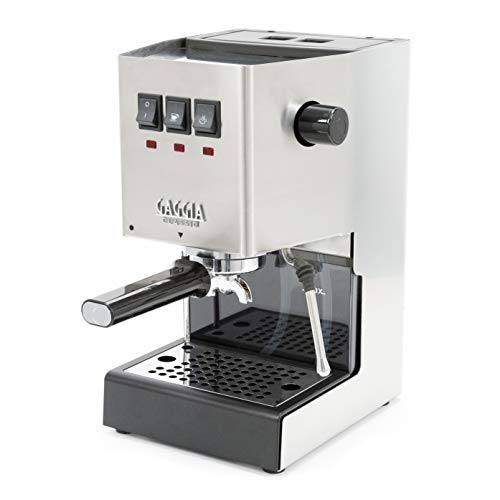
Gaggia Classic Pro E24 Espresso Machine — Best for Tinkerers
Gaggia Classic Pro E24 Espresso Machine — check price on Amazon.
The Gaggia Classic line has been the tinker’s espresso machine for decades: a simple, sturdy Italian semi-automatic with a commercial-style portafilter, a proper steam wand, and a community that has documented every modification imaginable — from pressure adjustments to full PID temperature control kits. The E24 in brushed stainless is the current expression of that idea.
Out of the box it makes honest espresso and demands honest technique: your grinder, your tamp, your timing. It will not texture milk automatically or forgive a bad grind. For the right owner, that directness is exactly the appeal — this is a machine you grow with and personalise.
One caution for Gaggia buyers that the community itself repeats: resist modifying the machine in the first month. Learn it stock, because every mod changes several variables and a beginner cannot tell which change helped. The Classic rewards patience in its owner as much as it rewards skill — stock first, mastery second, modifications third.
Strengths
- Huge owner community and modification ecosystem
- Simple, repairable construction built to be kept
- Commercial-style portafilter and real steam wand
Trade-offs
- No grinder, no automation, no hand-holding
- Single boiler means brew-then-steam sequencing
- Temperature stability is the owner’s project, not a feature
| Specification | Detail |
|---|---|
| Style | Semi-automatic espresso machine |
| Finish | Brushed stainless steel |
| Model | RI9380/46 (Classic Pro E24) |
Budget honestly around the Gaggia: the machine is the starting point, and a capable grinder plus, eventually, a mod or two is the real programme. Total spend can approach bigger machines — but you will understand espresso more deeply than any one-touch owner, and every upgrade is a choice rather than a replacement.
If the words ‘I might add a PID later’ excite rather than exhaust you, this is your machine. If they exhaust you, scroll back up to the automatics with a clear conscience.
Budget for the Gaggia the way its community does: machine first, grinder alongside, then small upgrades as skills grow — a precision basket here, a bottomless portafilter there for diagnosing your shots. Spread across a year, that path teaches more espresso than any single purchase can, and it is why the Classic’s owners tend to keep their machines through upgrades that would replace lesser gear entirely.
Best for: hands-on learners who enjoy modifying and mastering gear / Not suited for: anyone wanting convenience or built-in grinding
Check on Amazon — check the current price on Amazon before you decide.
Comparison Table
| Pick | Badge | Key spec | Best for |
|---|---|---|---|
| Breville Barista Express Espresso Machine (BES870XL) | Best Overall | Semi-automatic with built-in grinder | beginners who want to learn real espresso on one machine |
| Breville Dual Boiler Espresso Machine (BES920XL) | Best for Enthusiasts | Dual boiler semi-automatic | enthusiasts who want café workflow and control at home |
| De’Longhi Magnifica Evo Automatic Espresso Machine | Best Fully Automatic | Fully automatic, 7 one-touch recipes, built-in grinder | households wanting café-style drinks at one touch |
| Jura E8 Chrome (15646) | Best Premium Automatic | Fully automatic, 17 one-touch drinks | high-volume households wanting premium one-touch variety |
| Breville Bambino Plus Espresso Machine (BES500) | Best Compact | Compact semi-automatic, automatic milk texturing | small kitchens wanting real espresso with easy milk |
| Gaggia Classic Pro E24 Espresso Machine | Best for Tinkerers | Semi-automatic, brushed stainless steel | hands-on learners who enjoy modifying and mastering gear |
The table compresses the real decision: style first. Semi-automatics (Express, Dual Boiler, Bambino Plus, Gaggia) trade your effort for control; automatics (Magnifica Evo, Jura E8) trade control for effortlessness. Grinder inclusion is the second filter — three of these machines need a separate grinder in the budget.
How to Choose the Best Espresso Machines for Your Routine
Be honest about your morning, not your weekend fantasy. If weekdays allow ninety seconds, buy an automatic and enjoy it daily; if you genuinely look forward to a ten-minute ritual, buy a semi-automatic and enjoy that instead. The most common espresso mistake is purchasing the other person’s routine.
Then decide the grinder question, because it is half the budget and most of the flavour. Built-in grinders (Barista Express, both automatics) simplify everything and cap your ceiling. Separate grinders raise the ceiling and the spend. There is no wrong answer — only an unbudgeted one.
- One-touch automatic: Magnifica Evo or Jura E8
- Learn-the-craft semi-automatic: Barista Express
- Enthusiast control: Breville Dual Boiler
- Small counter: Bambino Plus plus a compact grinder
- Tinker and modify: Gaggia Classic Pro
Finally, count your milk drinks. Households where most drinks are lattes and cappuccinos should weight milk performance — automatic frothing or a good wand — as heavily as the espresso itself, because milk is most of what you will actually taste and clean.
Boilers, Thermoblocks and Why Heat-Up Time Matters
Single-boiler machines brew and steam at different temperatures from one boiler, so you wait between pulling a shot and steaming milk — fine for one drink, slow for four. Dual boilers dedicate one boiler to each job and remove the wait entirely, which is why they anchor the enthusiast tier. Fast-heating thermoblock and thermojet designs, like the compact Breville, trade a little thermal mass for near-instant readiness — the right trade for one or two morning drinks.
Temperature stability matters more than the headline system: a stable, repeatable temperature beats a powerful but wandering one. This is also why unverified pressure and temperature claims are ignored in this guide — behaviour you can repeat beats numbers you cannot check.
The Real Cost of Ownership: Beans, Descaling and Seals
The machine is the down payment. Beans are the subscription: a household drinking two milk drinks a day uses a meaningful amount of coffee monthly, and stale beans will make a premium machine taste ordinary. Buy smaller bags, store them sealed away from heat, and grind fresh — or, with an automatic, keep the hopper modestly filled rather than topped up for weeks.
Maintenance is the other cost people skip until it bills them. Descale when the machine asks, rinse milk systems the same day, replace group seals when shots start to channel, and an espresso machine repays you for years. Every pick in this guide has an established parts and support ecosystem for exactly that reason.
Espresso Machine Styles Compared: Semi-Automatic, Automatic and Lever
The category divides by who does the work. In a semi-automatic, you grind, dose, tamp and start the pump; the machine controls water temperature and pressure. In a fully automatic, the machine grinds, doses, tamps and brews internally at one touch, and you control only settings. In a lever machine, your arm provides the pressure, and you control — and feel — everything. None is objectively best; they are different distributions of effort between human and machine, which is why this guide’s ranking is by fit rather than by a single ladder.
Super-automatics and semi-automatics also fail differently. Semi-automatics mostly fail mechanically and visibly — a seal, a pump — and are often repairable at home or by any technician. Automatics fail in their brew groups and electronics and lean on brand service networks. Buyers planning a decade of ownership should weigh that difference alongside drink quality, because at year seven it may matter more.
Pressure, Temperature and the Specs That Actually Matter
Espresso marketing loves pump pressure numbers, but extraction happens in a narrow band of pressure at the puck regardless of a pump’s maximum rating, and machines regulate themselves there. What separates good machines is not the headline number but temperature stability (does the water arrive at the same heat on shot five as shot one?), pre-infusion (a gentle wetting of the puck before full pressure, which reduces channelling), and the grinder’s consistency. This guide’s spec boxes therefore quote only what verified listings state, and the reviews judge machines on those behaviours rather than on the biggest number on the box.
A practical consequence: if two machines both look plausible, choose the one with the better grinder story and the better service network over the one with the higher pressure claim. Your palate will notice the first two within a month; the third is a number you will never taste.
Setting Up a Home Espresso Station That Works Daily
The machines in this guide all perform better inside a small system: fresh beans stored sealed beside the machine, a knock box for pucks, a milk jug that lives with the machine, a towel dedicated to the wand, and — for semi-automatics — a scale for dosing. None of that is expensive, and together it converts a countertop appliance into a station where a drink takes three unhurried minutes instead of a scavenger hunt.
Placement matters too: near water for refills, with clearance to remove the tank and hopper, and enough frontage to work a portafilter without elbowing the wall. Espresso is a daily ritual performed in one spot; spending ten minutes arranging that spot pays back every single morning, on every machine in this guide.
Espresso at Home vs the Café: An Honest Quality Comparison
A well-run home setup from this guide does not beat a great café’s best barista on their best day — and does beat the average café’s average drink, which is the comparison that matters, because the average drink is the one you actually buy most weeks. Home advantages are real: beans chosen by you, milk fresh, no queue-driven shortcuts, and a machine dialled to your taste rather than to a menu’s. Café advantages are equally real: commercial grinders, plumbed water, and a human who pulls two hundred shots a day.
The economic comparison is less ambiguous. A household drinking two café drinks a day spends, across a year, a sum that buys a machine from the top of this guide outright — and the machine keeps serving in year two. Home espresso is therefore best understood as buying the café’s means of production at household scale: the quality argument gets you most of the way, and the arithmetic finishes it.
Second-Hand and Refurbished Machines: A Note for Budget Stretchers
Because the machines in this guide are popular and serviceable, a genuine second-hand market exists for them, and it deserves one honest paragraph. Semi-automatics like the Barista Express and Gaggia travel well between owners: budget for a descale, fresh group seals and a new water filter on arrival, and the machine’s history matters less than its maintenance from that day forward. Automatics are the riskier used buy, because their internal state — brew group wear, milk system hygiene, descale history — is invisible at purchase. If you stretch a budget second-hand, stretch it on the manual side of this guide, verify the machine heats, pumps and steams before money changes hands, and treat the saving as your servicing fund rather than as pure discount.
How to Pull Your First Good Espresso Shot
Whatever semi-automatic you choose, the first-week method is the same. Automatics owners can skip to the care steps — but even there, fresh beans and a clean milk system follow the same logic.
- Start with fresh, whole beans roasted for espresso, and grind only what you need for the shot — pre-ground coffee stales in minutes, not days.
- Dose consistently: fill the basket evenly, distribute the grounds level with a fingertip or tool, then tamp flat with firm, even pressure — level matters more than force.
- Lock the portafilter in immediately and start the shot; aim for the shot to run in a thin, steady stream rather than gushing or dripping.
- Taste and adjust one variable at a time: sour and fast usually means grind finer; bitter and slow usually means grind coarser.
- Texture milk after the shot on single-boiler machines: purge the wand, keep the tip just under the surface to add air early, then submerge to heat without boiling.
- Knock out the puck, rinse the portafilter and wipe the wand immediately — dried milk and old grounds are the two flavours that ruin tomorrow’s drink.
- Once a week, backflush or rinse the group as your manual directs, and descale on the machine’s schedule rather than your memory’s.
- Keep a simple shot log for the first month — bean, dose, grind setting, time, taste in three words. Patterns that are invisible drink-to-drink become obvious on paper, and dialling in speeds up dramatically.
- End each session by wiping the machine down and emptying the drip tray; a clean station in the morning is the strongest predictor that tomorrow’s espresso actually happens.
Expect the first bag of beans to be tuition. By the second bag, most owners of the machines above are pulling shots they would happily serve a guest — and that is the moment the purchase starts paying for itself.
Common Buying Mistakes
Buying the machine and forgetting the grinder. Three picks here need a separate grinder. An espresso machine fed by a blade grinder or stale pre-ground coffee cannot make espresso, whatever it cost.
Choosing by maximum pressure claims. Pump pressure headlines do not predict taste; grind quality, dose and temperature stability do. This guide deliberately ignores unverifiable pressure marketing.
Skipping descaling until the machine fails. Scale is the silent killer of home espresso. Follow the machine’s prompts and your water hardness, not a crisis.
Buying a manual machine for an automatic lifestyle. If the ritual will annoy you by week three, the machine becomes furniture. Match the style to your real mornings.
Using old beans in a new machine. Beans roasted months ago make every machine in this guide taste flat. Fresh beans are the cheapest upgrade there is.
Judging a machine by its first-week drinks. Every machine here improves as its owner learns it. A verdict formed on day three measures the operator, not the equipment — give any pick a month of honest use before concluding anything.
Final Recommendation
If you buy one machine from this guide, make it the Breville Barista Express: it is the best espresso machine for most people because it teaches the craft, includes the grinder, and produces drinks that justify the learning curve within a month. Graduate later to the Dual Boiler if the hobby takes hold, exactly as thousands of Express owners have.
Choose the De’Longhi Magnifica Evo when the household votes for convenience, the Jura E8 when it votes for convenience at a premium, the Bambino Plus when the counter votes, and the Gaggia Classic Pro when you want a machine to master and modify for years. There is no wrong pick here — only mismatched rituals, and this guide exists to prevent those.
A closing thought for the reader who has scrolled this far without deciding: the best espresso machine is ultimately the one that turns coffee from an errand into a ritual you own. Every pick here can do that for the right household. Choose the ritual you will enjoy on the tired mornings, not just the triumphant ones, and the machine will take care of the drinks.
And if you are buying for a household rather than for yourself alone, let the household vote before the order is placed: the machine that two or three people are all content to use will outperform, in real drinks made, the theoretically superior machine that only one person touches. Espresso at home is a shared pleasure or it is an expensive ornament — choose the shared version.
Keep researching with these related guides from the same program: Best Espresso Coffee Machines Best Espresso Coffee Machines For Home Best Espresso Coffee Machines For Home Use Best Espresso Drip Combo Machines Best Espresso Machines 1000 Best Coffee And Espresso Combo Machines
Frequently Asked Questions
What is the best espresso machine for a beginner?
The Breville Barista Express, because its built-in grinder and pressure gauge teach you what a good shot looks like while you learn. If you want no learning curve at all, the De’Longhi Magnifica Evo is the beginner pick instead.
Do I need a separate grinder for espresso?
For machines without one built in — the Dual Boiler, Bambino Plus and Gaggia Classic Pro here — yes. The grinder influences flavour more than any other single component, so budget for a burr grinder designed for espresso.
Is a dual boiler worth it over a single boiler?
If you make several milk drinks in a row, yes: you can brew and steam at once with stable temperatures. For one drink at a time, a good single-heater machine is slower but not worse in the cup.
How long do home espresso machines last?
With descaling, fresh seals and same-day milk cleanup, the machines in this guide are multi-year appliances, and the prosumer and tinkerer models are designed to be serviced rather than replaced.
Can an automatic machine make espresso as good as a café?
A good automatic makes a very good, consistent drink with zero skill, which for most households beats an unused manual machine. A dialled-in semi-automatic in practised hands still has the higher ceiling.
What beans should I use in an espresso machine?
Fresh whole beans, ideally roasted within the last few weeks and labelled for espresso or a medium roast you enjoy. Avoid very oily beans in automatics, as oils build up in built-in grinders and brew groups.
What is the best espresso machine for lattes at home?
For hands-on buyers, the Breville Barista Express or Bambino Plus, whose steam wands texture proper latte milk; for one-touch households, the De’Longhi Magnifica Evo or Jura E8, whose milk systems deliver consistent lattes without technique. The best choice depends on who is making the drinks, not on the drink itself.
How much should a first espresso machine cost?
Enough to include a real grinder in the equation — either built in, as in the Barista Express and the automatics here, or bought alongside. The most common first-purchase error is spending the whole budget on the machine and feeding it with inadequate grinding, which no machine can overcome.

