Disclosure: airfryerkitchensupply.com is reader-supported. When you buy through links on our site, we may earn an affiliate commission at no extra cost to you.
Where to buy
Start with this shortlist of the best food processors for dough. Every linked pick below was verified against Amazon’s own catalog data for this site before this guide was written, so the model names and capacities in this article match real, current listings. Use the links in this box, in Quick Picks, and under each review to check price on Amazon on the day you buy, because food processor bundles and included blades change between listings. If a pick is marked as unlinked anywhere in this guide, that means we could not confirm the exact configuration, and you should compare live listings carefully instead of trusting a headline capacity.
- Cuisinart 14-Cup Food Processor DFP-14BCNY (Best Overall) — check price on Amazon
- Ninja Professional Plus Food Processor BN601 (Best for Fast Dough Cycles) — check price on Amazon
- Cuisinart Pro Classic 7-Cup Food Processor DLC-10SYP1 (Best Compact for Dough) — check price on Amazon
- KitchenAid 9-Cup Food Processor KFP0921 (Best for Storage and Everyday Baking) — check price on Amazon
- Hamilton Beach Professional Stack & Snap Food Processor 70815 (Best for Big Prep Plus Dough) — check price on Amazon
- Ninja Mega Kitchen System BL770 (Best Blender-Processor Combo for Dough) — check price on Amazon
If you are shopping for the best food processors for dough, the honest starting point is that most food processors are mediocre dough machines, and only a handful are genuinely good at it. A processor kneads by driving a plastic or metal dough blade through a stiff mass at high speed, which develops gluten fast but also generates friction heat and puts real strain on the motor and the bowl lock. The models that handle dough well share three traits: a motor with enough torque to keep turning under load, a bowl sized so the dough forms one ball instead of smearing up the walls, and a feed tube and lid that stay sealed when the ball starts thumping around.
This guide separates the processors that can knead a full bread batch from the ones that should stick to pastry, pizza dough in small quantities, and soft enriched doughs. Capacity claims need care: a 14-cup bowl does not mean 14 cups of flour. Flour capacity for dough is much lower than liquid capacity, and overloading is the single most common reason home bakers burn out a processor motor or end up with a gummy, overheated crumb. Every pick below was chosen for dough work first and general chopping second, and each review states plainly how much dough the machine is realistically suited to, who should buy it, and who should buy a stand mixer instead.
You will also find a full buying guide on motor power, bowl geometry, and dough blades, a step-by-step section on kneading dough in a processor without overheating it, and the mistakes that kill both dough and machines. Prices are never printed in this guide because they move constantly; check price on Amazon for the current figure on any model you shortlist.
In this guide
Quick Picks
Short on time? These are the six dough-capable processors worth your money, from the heavy-duty 14-cup workhorse to the compact 7-cup machine that still kneads a respectable small loaf.
- Best Overall — Cuisinart 14-Cup Food Processor DFP-14BCNY: The classic heavy-duty answer for bread dough at home: a 14-cup bowl and a 720-watt motor whose own listing names kneading dough among its jobs. Check on Amazon
- Best for Fast Dough Cycles — Ninja Professional Plus Food Processor BN601: A 1000-watt, 9-cup processor with Auto-iQ presets that explicitly include mixing dough, for bakers who want a program rather than guesswork. Check on Amazon
- Best Compact for Dough — Cuisinart Pro Classic 7-Cup Food Processor DLC-10SYP1: A 600-watt, 7-cup classic whose listing names kneading dough, sized for one good loaf and small kitchens. Check on Amazon
- Best for Storage and Everyday Baking — KitchenAid 9-Cup Food Processor KFP0921: A 9-cup processor whose listing calls out kneading dough and a whisk accessory, with all-in-one in-bowl storage that keeps parts together. Check on Amazon
- Best for Big Prep Plus Dough — Hamilton Beach Professional Stack & Snap Food Processor 70815: A 12-cup Stack & Snap machine with an extra-large feed chute and kneading among its listed jobs, built for bakers who also prep in volume. Check on Amazon
- Best Blender-Processor Combo for Dough — Ninja Mega Kitchen System BL770: A 1500-watt system with an 8-cup processor bowl whose listing names dough among its jobs, plus a full blender pitcher for the same counter spot. Check on Amazon
How These Picks Were Chosen
Picks were chosen by matching verified catalog data for each model against the actual demands of dough: motor wattage where the manufacturer states it, bowl capacity, and whether the listing itself confirms kneading or dough functions. Models whose own listings mention dough or kneading were prioritized, because that wording means the maker designed the blade, gearing, and bowl lock for the load. General reputation was not enough on its own; a famous chopper with no dough provision did not make this list.
We also weighed batch realism. A dough processor lives or dies on the size of batch it can repeat weekly without straining, so each pick is framed around a realistic flour quantity rather than the biggest number on the box. Cleanup mattered too: dough is sticky, and bowls, blades, and feed tubes that rinse clean without flour paste setting in the seams scored higher. Finally, we kept a spread of sizes and price tiers, described in words rather than fixed prices, so a single-loaf household and a family that bakes every weekend can both find a fit.
The 6 Best Food Processors for Dough

1. Cuisinart 14-Cup Food Processor DFP-14BCNY — Best Overall
This is the processor to buy if dough is a weekly habit rather than an occasional experiment. The 14-cup bowl gives a full bread batch room to form a single ball and ride the blade instead of climbing the walls, and the 720-watt motor has the torque to keep that ball moving through the sticky early phase when weaker machines stall and whine. It suits home bakers making sandwich loaves, dinner rolls, and pizza dough for a family, and it still slices, shreds, minces, and purees like a proper full-size processor the rest of the week.
Strengths
- Listing confirms puree and kneading dough duties, so dough is a designed-for job, not an afterthought
- 14-cup bowl fits family-size batches with room for the dough ball to move
- 720-watt motor sustains torque through stiff, low-hydration doughs
Trade-offs
- Large footprint and a heavy base that is awkward to move in and out of a cupboard
- Bowl, lid, and feed tube assembly takes more sink space to wash than compact models
- Power is wasted on households that only ever make one small loaf
Key specs (verified):
- Capacity: 14-cup work bowl (verified from listing)
- Motor: 720 watts (verified from listing)
- Finish: stainless steel (verified from listing)
In dough terms, the value of this machine is headroom. A dough ball that fits comfortably leaves space for the blade to fold the mass over itself, which is what develops gluten in a processor. Crowd the bowl and the dough just spins in place, heating up without kneading. With the DFP-14BCNY you can work in the comfortable middle of the bowl’s range, pulse the flour and liquid together until a shaggy mass forms, then run the machine in short bursts so friction heat stays under control. That workflow produces smooth, elastic dough for loaves and rolls with noticeably less hand finishing than smaller machines manage.
The honest limitation is size and commitment. This is a countertop resident, not a store-away appliance, and its parts are big in the sink. Bakers with limited counter space who make dough twice a month will feel the bulk every day for a benefit they rarely use. But for anyone replacing hand kneading or an aging mixer with one machine that preps vegetables on Tuesday and kneads bread dough on Saturday, this is the most defensible single purchase in the category.
Best for: weekly bread bakers and families who want one full-size processor that genuinely kneads / Not suited for: tiny kitchens, occasional bakers, or anyone who only makes small pastry batches
Check on Amazon — check price on Amazon before you buy, since listings and included accessories change over time.

2. Ninja Professional Plus Food Processor BN601 — Best for Fast Dough Cycles
The BN601 suits bakers who like pressing a button and walking away. Its listing confirms Auto-iQ presets that chop, slice, puree, and mix dough, and the 1000-watt motor is the strongest in this roundup on paper, which shows up as confidence with stiff pizza dough and bagel-style low-hydration mixes. The 9-cup bowl lands in the practical middle: big enough for a standard loaf or a family pizza night, small enough to store without drama. Three blades and a feed chute with pusher keep it useful for everyday prep between baking days.
Strengths
- 1000-watt motor with a dedicated dough-mixing preset confirmed in the listing
- 9-cup bowl is a realistic single-loaf and pizza-night size
- Dishwasher-safe parts make sticky dough cleanup straightforward
Trade-offs
- Preset cycles need supervision the first few times so dough is not overworked
- Bowl is mid-size, so double batches mean two runs
- Plastic bowl and housing feel less heirloom-grade than heavy metal-base rivals
Key specs (verified):
- Capacity: 9-cup bowl (verified from listing)
- Motor: 1000 watts (verified from listing)
- Programs: Auto-iQ presets for chop, slice, puree, and dough (verified from listing)
- Blades: 3 blades with feed chute and pusher (verified from listing)
Processor dough lives on timing, and that is where a dough preset earns its keep. Gluten development in a fast-spinning bowl happens in a couple of minutes, not the ten minutes a stand mixer takes, and the line between smooth and overworked is thin. A preset tuned for dough pulses and runs in a pattern that rests the mass between bursts, which limits heat build-up. You still need to learn your flour: strong bread flour reaches elasticity faster than a soft all-purpose blend, and the first few batches teach you when to stop the cycle early and finish with a short rest and fold on the counter.
Where this Ninja gives ground to the big Cuisinart is batch ceiling and long-term feel. It is a modern, feature-led machine rather than a decades-long countertop fixture, and serious bakers producing multiple loaves for a weekend bake sale will outgrow the 9-cup bowl. For the far more common pattern of one loaf, one pizza base, or a tray of rolls at a time, it is arguably the easiest dough processor here to live with.
Best for: pizza nights, single-loaf bakers, and anyone who wants a dough preset instead of manual pulsing / Not suited for: high-volume bakers or buyers who want the largest possible bowl
Check on Amazon — check price on Amazon before you buy, since listings and included accessories change over time.

3. Cuisinart Pro Classic 7-Cup Food Processor DLC-10SYP1 — Best Compact for Dough
Not every dough kitchen has room for a 14-cup machine, and the Pro Classic is the compact answer that still takes dough seriously. Its listing confirms a 600-watt motor and kneading dough among its core jobs, alongside mincing, dicing, shredding, and pureeing. In practice the 7-cup bowl suits a single loaf, a batch of rolls, or pizza dough for two to three people. It is the pick for smaller households, apartment bakers, and anyone whose baking is frequent but modest in scale, and it stores far more easily than the big machines.
Strengths
- 600-watt motor in a compact body, with kneading dough confirmed in the listing
- 7-cup bowl is honestly sized for one loaf at a time
- Classic simple controls with nothing to learn
Trade-offs
- One loaf is the ceiling; family batches need splitting
- Smaller feed tube means more pre-cutting for general prep
- Design and feature set are traditional rather than modern
Key specs (verified):
- Capacity: 7-cup bowl (verified from listing)
- Motor: 600 watts (verified from listing)
- Finish: white (verified from listing)
Compact dough processors fail in a predictable way: the dough ball is nearly as big as the bowl, so it wedges and spins instead of folding. The Pro Classic avoids the worst of this because its bowl proportions and blade geometry were designed in an era when this size class was the standard home machine, and its motor gearing favors torque over showy speed. Keep batches at a sensible single-loaf scale, add liquid gradually through the feed tube, and it produces properly elastic dough for bread, enriched rolls, and flatbreads without the drama of an overloaded mini chopper.
The trade-off is throughput, full stop. If your household eats a loaf every two days, you will run this machine constantly and wish for the 14-cup bowl. If your pattern is a loaf on the weekend and dough for flatbreads midweek, the smaller footprint, easier washing, and lower tier pricing make it the rational buy. It is also a sensible second machine for bakers who own a stand mixer but want a faster small-batch option.
Best for: small households and apartment bakers making one loaf or small batches often / Not suited for: large families or anyone batch-baking several loaves at once
Check on Amazon — check price on Amazon before you buy, since listings and included accessories change over time.
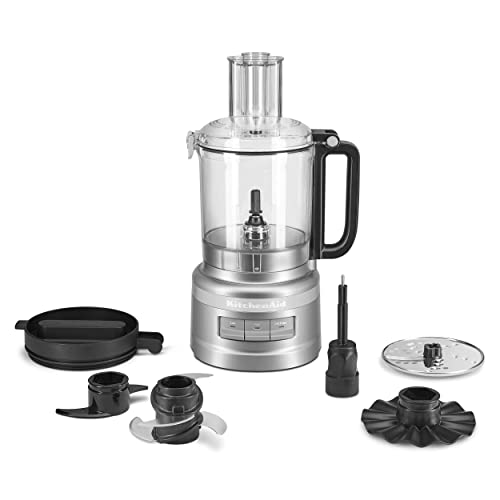
4. KitchenAid 9-Cup Food Processor KFP0921 — Best for Storage and Everyday Baking
The KFP0921 is the organized baker’s pick. KitchenAid’s listing confirms it can knead dough and includes a whisk accessory, and the design stores every blade and disc inside the bowl, which matters more than it sounds: dough blades get lost in drawers, and a processor you can assemble in ten seconds is a processor you actually use. The 9-cup bowl handles a standard loaf, pastry for a double-crust pie with room to spare, and weekly prep. The easy-clean work bowl design reduces the flour-paste-in-the-seams problem that makes bakers dread cleanup.
Strengths
- Kneading dough and whisk accessory both confirmed in the listing
- All-in-one storage keeps blades and discs inside the bowl
- Four-blade multipurpose design covers prep beyond baking
Trade-offs
- Mid-size bowl still means one loaf per run
- Storage system rewards keeping all parts together; stray parts defeat the point
- Sits in a mid-to-upper tier rather than the budget end
Key specs (verified):
- Capacity: 9-cup bowl (verified from listing)
- Storage: all-in-one in-bowl storage (verified from listing)
- Accessories: whisk accessory included (verified from listing)
Dough performance here is about control rather than brute force. The multipurpose blade handles the initial shaggy mix evenly, and for soft to medium doughs the machine brings the mass together cleanly without the violent thumping that makes lids creep on lesser models. Enriched doughs for brioche-style bakes and cinnamon rolls suit it particularly well, because those doughs are softer and benefit from the fast, cool kneading a processor gives before butter warms up. For very stiff, lean doughs, work in two smaller halves and combine them by hand for the final minute.
Owners should know the bowl rewards a rinse-immediately habit. The easy-clean design genuinely helps, but dried dough in any processor’s lid seal is stubborn. Rinse the bowl and blade in warm water straight after tipping the dough out, and this machine stays pleasant to own for years. As a combined prep-and-dough station for a family kitchen that bakes weekly, it is one of the most balanced choices in this guide.
Best for: organized family kitchens, pastry and enriched doughs, and bakers who hate hunting for blades / Not suited for: buyers chasing the lowest price or the absolute largest batches
Check on Amazon — check price on Amazon before you buy, since listings and included accessories change over time.
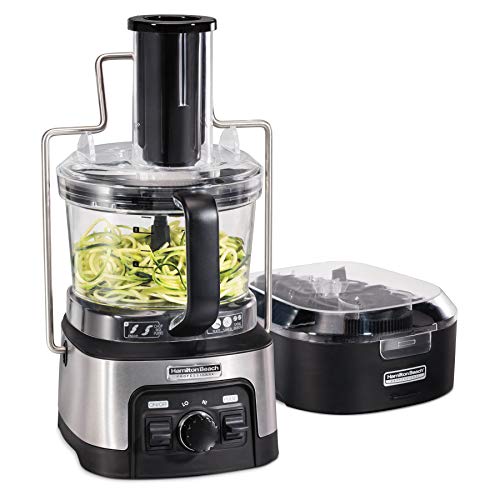
5. Hamilton Beach Professional Stack & Snap Food Processor 70815 — Best for Big Prep Plus Dough
Some kitchens buy a processor for dough and then use it for everything else daily, and the 70815 is built for that double life. Its listing confirms slicing, shredding, and kneading, a 12-cup bowl, and an extra-large 3-inch feed chute that fits whole vegetables, which cuts prep time dramatically on soup and slaw days. The Stack & Snap assembly avoids the twist-and-lock wrestling that puts people off using a processor at all. For dough, the 12-cup bowl gives a generous single batch or a small double loaf’s worth of room to move.
Strengths
- Kneading confirmed in the listing, with a roomy 12-cup bowl
- Extra-large 3-inch feed chute fits whole vegetables for fast prep
- Stack & Snap assembly is genuinely easier than twist-lock bowls
Trade-offs
- Also includes a spiralizer function some bakers will never use
- Large bowl and chute parts take real cupboard and sink space
- Assembly ease matters less if the machine lives assembled on the counter
Key specs (verified):
- Capacity: 12-cup bowl (verified from listing)
- Feed chute: extra-large 3-inch, fits whole vegetables (verified from listing)
- Functions: slicing, shredding, kneading, spiralizing (verified from listing)
The dough case for this machine is capacity with convenience. A 12-cup bowl lets a family-size dough form and fold properly, and the sealed, easy assembly means the lid stays put when the ball starts moving. It handles pizza dough for a crowd and enriched doughs confidently, and the same machine then shreds the cheese and slices the toppings, which is the kind of single-appliance efficiency that justifies counter space. Keep lean, stiff doughs at a moderate batch size and let the machine work in bursts, resting the dough a few minutes midway so the gluten relaxes.
The honest caveat is that this is a wide, full-featured machine aimed at enthusiastic prep cooks. Minimalists who only want dough should look at the simpler Cuisinart models. But households that cook from scratch most nights will find the chute size and assembly design save more time across a month than any single dough feature, and the kneading ability means it never has to sit out baking day.
Best for: scratch-cooking families who prep in volume and bake family-size dough batches / Not suited for: minimalists or very small kitchens with no storage for a wide machine
Check on Amazon — check price on Amazon before you buy, since listings and included accessories change over time.

6. Ninja Mega Kitchen System BL770 — Best Blender-Processor Combo for Dough
If counter space forces a choice between a blender and a processor, the BL770 refuses the choice. The listing confirms a 1500-watt base, a 72-ounce pitcher, an 8-cup processor bowl, and two 16-ounce cups, and states plainly that the system processes salsa and dough. In the processor bowl it brings together pizza and bread dough with the authority you would expect from that power figure, while the pitcher covers smoothies and frozen drinks. It suits households that genuinely use both appliances weekly and bakers whose dough needs sit at the one-to-two-loaf scale.
Strengths
- 1500-watt system; dough named in the listing for the processor bowl
- 8-cup processor bowl plus 72-ounce blender pitcher in one system
- Two 16-ounce cups add single-serve blending without washing the pitcher
Trade-offs
- Many parts to store: pitcher, bowl, cups, and blades
- Processor bowl is mid-size, so dough batches stay moderate
- System approach costs more counter and cupboard organization than a single machine
Key specs (verified):
- Power: 1500 watts (verified from listing)
- Processor bowl: 8-cup (verified from listing)
- Pitcher: 72-ounce, plus two 16-ounce cups (verified from listing)
Power changes dough behavior. With this much drive, the BL770 pulls flour and liquid together almost immediately, so the skill is in restraint: add liquid in stages, pulse to a shaggy mass, rest five minutes so the flour hydrates, then run short bursts until the dough turns smooth and pulls from the sides. Rushed, it will overwork a dough before you notice; paced properly, it produces elastic pizza dough faster than any other route in this guide. The bowl size keeps batches honest, which quietly protects both the dough and the machine.
Judge this pick as a system, not a dedicated dough tool. A baker who never blends should buy the Cuisinart 14-cup and enjoy the bigger bowl. A household blending smoothies daily and baking on weekends gets two appliances’ worth of use from one base, and the dough performance is real rather than a marketing footnote. That dual-use math is exactly what this pick is for.
Best for: households that blend and bake weekly and want one powerful base for both / Not suited for: dedicated bakers who never blend, or anyone wanting the biggest dough bowl
Check on Amazon — check price on Amazon before you buy, since listings and included accessories change over time.
Comparison Table
| Pick | Badge | Key spec | Best for |
|---|---|---|---|
| Cuisinart 14-Cup Food Processor DFP-14BCNY | Best Overall | 14-cup bowl, 720W motor | weekly bread bakers and families who want one full-size processor that genuinely kneads |
| Ninja Professional Plus Food Processor BN601 | Best for Fast Dough Cycles | 9-cup bowl, 1000W, Auto-iQ dough preset | pizza nights, single-loaf bakers, and anyone who wants a dough preset instead of manual pulsing |
| Cuisinart Pro Classic 7-Cup Food Processor DLC-10SYP1 | Best Compact for Dough | 7-cup bowl, 600W motor | small households and apartment bakers making one loaf or small batches often |
| KitchenAid 9-Cup Food Processor KFP0921 | Best for Storage and Everyday Baking | 9-cup bowl, whisk accessory, in-bowl storage | organized family kitchens, pastry and enriched doughs, and bakers who hate hunting for blades |
| Hamilton Beach Professional Stack & Snap Food Processor 70815 | Best for Big Prep Plus Dough | 12-cup bowl, 3-inch feed chute | scratch-cooking families who prep in volume and bake family-size dough batches |
| Ninja Mega Kitchen System BL770 | Best Blender-Processor Combo for Dough | 1500W, 8-cup processor bowl, 72oz pitcher | households that blend and bake weekly and want one powerful base for both |
How to Choose the Best Food Processors for Dough
Start with the batch you actually bake. Write down your most common dough: a 500-gram-flour loaf, a double pizza batch, a tray of enriched rolls. Then shop for the bowl that handles that batch in the middle of its range, not at its limit. Processor bowls are rated by total volume, but dough capacity is governed by how much room the ball needs to tumble and fold. As a working rule, a 7-cup bowl suits a single small loaf, a 9 to 12-cup bowl suits a standard family loaf or pizza batch, and a 14-cup bowl suits bigger or double batches run as one dough. Buying one size up from your usual batch is the cheapest insurance against straining the motor.
Motor power matters, but torque delivery matters more. Wattage figures in this guide come from the manufacturers’ own listings, and they are a useful shorthand: dough-capable machines here run from 600 watts upward, with the strongest systems far higher. What you feel in use is whether the motor slows and strains when the dough tightens. A machine that bogs down generates heat, and heat is the enemy twice over, warming the dough past the point yeast enjoys and stressing the motor’s windings. If you bake lean, stiff doughs like bagels, favor the higher-power picks; if your world is soft sandwich loaves, pastry, and enriched doughs, mid-power machines cope comfortably.
- Match bowl size to your usual flour weight, not the box’s biggest number
- Prefer models whose listings explicitly name dough or kneading
- Higher wattage helps most with stiff, low-hydration doughs
- Check that blades and discs store sensibly; lost dough blades end the hobby
- Plan for cleanup: bowls that rinse clean get used weekly
Dough Blades, Bowls, and What Actually Does the Work
A processor kneads with either a plastic dough blade or the standard metal blade, and each has a logic. The plastic blade pushes and folds the dough mass, mimicking kneading and reducing the cutting action that can tear developing gluten strands. The metal blade brings ingredients together faster and is often better for the first thirty seconds, especially with pastry and crumbly mixes. Many experienced processor bakers start with the metal blade to form the mass, then switch if the dough needs extended work. Neither is magic; the real work is done by the folding motion of a ball riding around a bowl, which is why bowl shape and batch size matter as much as the blade.
Bowl and lid sealing deserve more attention than they get. As dough comes together it thumps, and a lid that creeps or a bowl lock that flexes will leak flour dust and eventually liquid. Machines designed with dough in mind have positive locks and seals that tolerate that movement. The feed tube is your liquid inlet: adding water gradually through the tube while the machine runs is how you hit the right hydration without drowning the flour, and a pusher that fits the tube keeps flour dust from puffing back at you during the first pulses.
Flour Capacity and Hydration: The Numbers That Decide Success
Every processor dough failure story is really a hydration or quantity story. Too much flour for the bowl and the dough cannot move; too much liquid at once and the mass turns to batter that the blade cannot gather. Work by weight when you can. A practical approach for any machine in this guide is to start with the flour and salt, pulse to combine, then add roughly ninety percent of the liquid while running, stopping to judge the dough before adding the rest in small splashes. Dough should gather into a ball that rides the blade and cleans the bowl sides; if it smears, it is too wet or too much; if it stays in dry clumps, it needs liquid a spoonful at a time.
Temperature is the hidden variable. Processor kneading is fast and friction warms dough quickly, so use cool liquid, especially in summer, and consider chilling flour for enriched doughs where butter must stay firm. Short bursts with rests keep the dough in the zone where yeast thrives and gluten stays supple. If the dough feels warm to the touch, stop, rest it ten minutes in the bowl, and finish with a few pulses. That patience produces a better crumb than any single feature on any machine in this guide.
Dough Styles Compared: Lean, Enriched, and Pastry in a Processor
Lean doughs, the flour, water, salt, and yeast family that includes baguettes, pizza bases, and rustic loaves, are the processor’s sternest test because they are stiff and resist the blade. They reward the strongest motors and the largest bowls in this guide, and they punish overfilling more than any other style. Work them in the middle of the bowl’s range, expect the dough to thump and ride in a tight ball, and give them a mid-knead rest so the gluten can relax; a lean dough that looks shaggy and rough after the first bursts often turns smooth and elastic after ten minutes of rest and thirty seconds more work. Bagel and pretzel doughs sit at the extreme of this family, and even confident machines should take them in half batches.
Enriched doughs, brioche, challah, cinnamon rolls, and soft sandwich loaves enriched with egg, milk, and butter, behave almost oppositely. The base dough comes together quickly, and the skill is in adding the fat gradually once the gluten has begun to form, so the dough absorbs it into a glossy, supple mass instead of sliding around in grease. A processor’s speed is an advantage here because the work finishes before friction warms the butter into melting, which is the usual home failure with enriched doughs in slow mixers on warm days. Keep ingredients cool, add butter in pieces while the machine runs in bursts, and stop as soon as the dough turns smooth and shiny.
Pastry sits in its own category: the goal is the opposite of kneading. Pie and tart doughs want the fat cut into flour in pea-sized pieces with the liquid added only until the mixture barely holds, and every extra second of blade time toughens the result. Use short pulses exclusively, chill everything including the flour on hot days, and tip the crumbly mixture out to bring it together by hand. The same machine that kneads a loaf beautifully will ruin a pie crust if you let it run, which is why this guide keeps repeating the real rule of processor dough: the machine provides power, but the baker provides judgment about when to stop.
Troubleshooting Processor Dough: Seven Fixes
If the dough never forms a ball and stays in wet shreds, the batch is either too large for the bowl or too wet for the flour. Stop, remove a third of the mixture, and process the remainder; or work a spoonful of flour in with two pulses and reassess. If the dough forms a ball but smears grease-like around the bowl, it has over-warmed: scrape it out, rest it in the refrigerator for twenty minutes, and finish with a few pulses once cool. If the motor strains, slows audibly, or the bowl unlocks itself, stop immediately, divide the batch in half, and process each half separately; forcing a straining machine is how motors and bowl locks die.
If the finished dough tears instead of stretching, it is under-developed or too dry: rest it fifteen minutes and give it a few more short bursts, adding water by the teaspoon only if it feels genuinely stiff and crumbly. If it stretches but springs back aggressively and refuses to be shaped, the gluten is simply tight, not underworked; cover it and walk away for twenty minutes, and it will relax into obedience. If the baked loaf tastes bland and pale, the dough was probably under-salted or the flour was old, neither of which any machine can fix. And if every batch climbs the center post and escapes the blade, your batch is too small for your bowl, which is the one failure cured by making more dough, a problem most bakers learn to live with happily.
How to Knead Dough in a Food Processor Without Overheating It
Processor kneading rewards a calm sequence. The method below works for lean bread and pizza dough in any machine in this guide; enriched doughs follow the same steps with butter added after the dough first comes together.
- Add flour, salt, and yeast to the bowl, keeping salt and yeast from direct contact at first, and pulse three or four times to distribute them evenly.
- With the machine running, pour in most of the cool liquid steadily through the feed tube, then stop and check the texture before adding the remainder a little at a time.
- Run the machine in bursts of fifteen to twenty seconds, resting between bursts, until the dough forms a ball that rides the blade and largely cleans the sides of the bowl.
- Rest the dough in the bowl for five to ten minutes. This pause lets flour fully hydrate and gluten relax, and it keeps friction heat down.
- Run two or three final short bursts until the dough looks smooth and elastic, then tip it onto a lightly floured counter and finish with a few hand folds.
- Check elasticity with a small stretch test: gently pull a piece thin. If it stretches without tearing immediately, the dough is ready to rise; if it rips at once, give it another rest and a few more pulses.
- Move the dough to a lightly oiled bowl, cover, and let it rise as your recipe directs, noting that processor-kneaded dough often rises a touch faster because it starts slightly warm.
Rinse the bowl, blade, and lid in warm water immediately. Dried dough sets like cement in lid seals and around the blade hub, and a two-minute rinse now saves twenty minutes of soaking and picking later. Dry the blade carefully and store it with the machine so it is ready for the next bake.
Common Buying Mistakes
Overloading the bowl. Filling a processor to its headline capacity with flour guarantees a dough that spins in place, overheats, and strains the motor. Keep dough batches in the middle of the bowl’s range and split big bakes into two runs.
Adding all the liquid at once. Flour absorption varies by brand, season, and recipe. Dumping in every drop turns dough to soup or forces you to add flour blindly. Add most of the liquid, judge, then finish in small additions.
Running the machine continuously. Minutes of non-stop running build friction heat that can push dough too warm and stress the motor. Short bursts with rests develop gluten just as well and protect both dough and machine.
Judging dough by the clock. Processor dough is done when it is smooth, elastic, and cleans the bowl, which may take ninety seconds or four minutes depending on flour and hydration. Watch the dough, not a timer.
Buying a chopper and expecting a kneader. Small choppers and mini processors are wonderful for herbs and nuts but cannot knead bread dough. If dough is the goal, buy a machine whose listing names dough or kneading, like the picks in this guide.
Final Recommendation
For most home bakers, the Cuisinart 14-Cup DFP-14BCNY is the safest recommendation: real capacity, a motor built for the load, and dough named in its own listing. If you prefer a guided experience, the Ninja BN601’s dough preset and strong motor make it the easiest to learn on, while the Cuisinart Pro Classic 7-Cup serves small households honestly without wasting counter space. The KitchenAid KFP0921 wins on storage and everyday polish, the Hamilton Beach 70815 suits high-volume prep cooks, and the Ninja BL770 is the right answer when one base must blend and bake.
Whichever you choose, respect batch size, add liquid gradually, and knead in bursts. A food processor will never replicate the slow romance of hand kneading, but used properly it turns out elastic, well-developed dough in minutes, and that is what gets bread baked on a weeknight instead of just planned for the weekend.
If you want the shortest path to a decision, check these three first: Cuisinart 14-Cup Food Processor DFP-14BCNY, Ninja Professional Plus Food Processor BN601, Cuisinart Pro Classic 7-Cup Food Processor DLC-10SYP1. Each links to its live listing so you can check price on Amazon and confirm the current bundle before ordering.
Keep exploring this category with our related guides: Best Food Processors For Home Use Best Food Processors For Emulsifying Best Food Processors For House Use Best Food Processors For Baking Best Food Processors For Baby Food
Frequently Asked Questions
Can a food processor really knead bread dough?
Yes, within sensible batch limits. A processor develops gluten by folding a dough ball around the bowl at speed, which works well for lean and enriched doughs alike. The keys are a batch sized to the middle of the bowl’s range, gradual liquid addition, and short bursts with rests so friction heat stays controlled.
How much flour can I use in a food processor for dough?
Far less than the bowl’s headline cup capacity suggests. Judge by your usual loaf: small bowls suit a single small loaf, mid-size bowls suit a standard family loaf or pizza batch, and the largest bowls suit bigger batches. When in doubt, split the batch; two comfortable runs beat one strained run every time.
Is a plastic dough blade better than the metal blade?
Each has a role. The plastic blade folds and pushes the dough, which suits longer kneading, while the metal blade gathers ingredients faster at the start. Many bakers form the dough with the metal blade and finish either way. Technique, batch size, and resting matter more than the blade material alone.
Why did my processor dough come out tough or overworked?
Usually it ran too long or too hot. Processors knead fast, and continuous running builds friction heat and can overdevelop or damage the dough’s structure. Use short bursts, rest the dough midway, start with cool liquid, and stop as soon as the dough is smooth and elastic.
Food processor or stand mixer for dough?
A stand mixer wins for very large batches, very stiff doughs, and long, slow kneading. A food processor wins on speed, small-to-medium batches, counter space, and doubling as a prep machine. Many bakers own a processor first because it covers daily chopping as well as weekly dough.
How do I clean dough out of a food processor easily?
Rinse everything in warm water immediately after tipping the dough out, before residue dries. A brief soak in warm water loosens anything left around the blade hub and lid seal. Avoid letting dough dry in the bowl; dried dough is the one genuinely unpleasant part of processor baking.

