Disclosure: airfryerkitchensupply.com is reader-supported. When you buy through links on our site, we may earn an affiliate commission at no extra cost to you.
Where to buy
Start with this shortlist of the best food processors for emulsifying. Emulsifying lives and dies on blade speed, bowl geometry, and how the machine handles a thin stream of oil, so every linked model in this guide was verified against Amazon’s catalog data for this site before writing. Use the links here, in Quick Picks, and under each review to check price on Amazon when you are ready to buy, since bundles and included discs vary between listings. Any pick described as prose-led in its review still links only where the exact model was confirmed; compare live listings carefully for included whisk and emulsifying accessories.
- Sangcon 400W 4-Cup Mini Food Processor (Best Overall for Emulsifying) — check price on Amazon
- KitchenAid 5 Cup Food Chopper KFC0516 (Best for Whipping and Small Sauces) — check price on Amazon
- KitchenAid 9-Cup Food Processor KFP0921 (Best Full-Size for Emulsions and Whipping) — check price on Amazon
- Hamilton Beach 10-Cup Food Processor 70730 (Best Value for Sauces and Purees) — check price on Amazon
- Cuisinart Core Custom 10-Cup Food Processor FP-110 (Best Premium All-Rounder for Sauce Work) — check price on Amazon
- Cuisinart Mini-Prep Plus 4-Cup DLC-4CHB (Best Budget Mini for Dressings) — check price on Amazon
Searching for the best food processors for emulsifying means looking for a different talent than chopping. An emulsion, whether it is mayonnaise, a stable vinaigrette, aioli, or a glossy hollandaise-style sauce, forms when a fast blade shears oil into tiny droplets while you add it slowly enough for the mixture to absorb each addition. The processor has to spin fast, seal well, and give you a way to drizzle oil in a thin, controlled stream, ideally through a pusher or feed tube designed for exactly that. Machines with a whisk accessory or a dedicated emulsifying disc widen the repertoire further, into whipped cream, egg whites, and light batters.
The honest market picture is that only some processors are set up for this work. One pick in this guide has an emulsifying disc named in its own listing, several include whisk accessories confirmed in their listings, and the rest earn their place through blade speed, bowl design, and pureeing power that suits sauce work. Batch size cuts both ways: too little mixture in a big bowl never reaches the blade, while small choppers excel at a cup of dressing but cannot whip cream for a crowd. Each review below states the emulsion jobs the machine genuinely suits, and the buying guide explains the physics in plain terms so you can match a machine to the sauces you actually make.
As everywhere in this program, no fixed prices or ratings appear here; tiers are described in words and you check price on Amazon for the live figure. What you get instead is verified model data, straight talk about minimum batch sizes, and a workflow section that will improve your mayonnaise in any machine you already own.
In this guide
Quick Picks
Six processors that can build and hold an emulsion, from a mini machine with a dedicated emulsifying disc to full-size models with whisk accessories for cream and egg whites.
- Best Overall for Emulsifying — Sangcon 400W 4-Cup Mini Food Processor: The only pick whose listing names an emulsifying disc outright, in a 4-cup, 400-watt mini format that suits real sauce batch sizes. Check on Amazon
- Best for Whipping and Small Sauces — KitchenAid 5 Cup Food Chopper KFC0516: A 5-cup chopper whose listing confirms a whisk accessory for fast whipping, plus two speeds and pulse for controlled emulsions. Check on Amazon
- Best Full-Size for Emulsions and Whipping — KitchenAid 9-Cup Food Processor KFP0921: A 9-cup full processor with a whisk accessory confirmed in its listing, for cooks who emulsify at family scale and prep with the same machine. Check on Amazon
- Best Value for Sauces and Purees — Hamilton Beach 10-Cup Food Processor 70730: A 10-cup processor listed for slicing, shredding, mincing, and puree, with a bowl scraper that keeps sauces moving without stopping. Check on Amazon
- Best Premium All-Rounder for Sauce Work — Cuisinart Core Custom 10-Cup Food Processor FP-110: A 10-cup multifunctional Cuisinart platform for cooks who want refined controls and a full accessory ecosystem around their sauce-making. Check on Amazon
- Best Budget Mini for Dressings — Cuisinart Mini-Prep Plus 4-Cup DLC-4CHB: A 250-watt, 4-cup mini with an auto-reversing blade, sized exactly for the cup-or-two emulsions most homes actually make. Check on Amazon
How These Picks Were Chosen
Selection started from verified listing data: accessories and functions named by the manufacturers themselves. A dedicated emulsifying disc, a whisk accessory, high blade speed, and puree performance were the qualifying evidence, in that order. Models were then sorted by the emulsion work they suit best, because a machine that whips cream beautifully may be wrong for a small batch of vinaigrette, and the mini chopper that nails a cup of mayo cannot help with a quart of Caesar dressing.
We also considered control. Emulsifying rewards machines with pulse control and multiple speeds, since starting slow to establish the emulsion and then increasing speed as it thickens prevents the splashing and breaking that ruin sauces. Bowl and lid sealing mattered too, because oil added through a feed tube will find any gap. Finally, the set spans small to full-size bowls and budget to premium tiers so the right choice depends on your cooking, not on a single flagship.
The 6 Best Food Processors for Emulsifying

1. Sangcon 400W 4-Cup Mini Food Processor — Best Overall for Emulsifying
If emulsifying is the headline job, start here. The Sangcon’s listing confirms an emulsifying disc alongside a slice and shred disc, two speeds plus pulse, and a dual-level blade, in a 4-cup bowl driven by a 400-watt motor. That combination is exactly what home sauce-making needs: the bowl is small enough that a cup or two of mayonnaise base actually engages the blade, the disc is purpose-built for emulsions and whipped textures, and pulse control lets you start gently. It suits cooks who make dressings, mayo, aioli, and dips weekly in household quantities.
Strengths
- Emulsifying disc confirmed in the listing, a rarity in this category
- 4-cup bowl matches real sauce and dressing batch sizes
- Two speeds plus pulse and a dual-level blade give control from drizzle to whip
Trade-offs
- Mini format cannot handle family-scale prep or dough-style jobs
- Less established brand than the legacy makers in this guide
- Slice and shred capacity is limited by the small bowl and feed area
Key specs (verified):
- Capacity: 4-cup bowl (verified from listing)
- Motor: 400 watts (verified from listing)
- Discs: emulsifying disc and slice/shred disc (verified from listing)
- Controls: 2 speeds plus pulse, dual-level blade (verified from listing)
Most emulsions made at home are small: a cup of mayonnaise, a half cup of vinaigrette, a bowl of aioli for fries. In a 12-cup bowl those quantities sit under the blade’s working zone and never emulsify properly, which is why so many people conclude processors cannot make mayo. A 4-cup bowl fixes the geometry. The mixture pools where the blade and disc can work it, the emulsion establishes quickly, and the small volume means the oil stream you add is proportionally easy to control. The emulsifying disc then handles the whipping end of the spectrum, aerating creams and batters in a way a chopping blade cannot.
The limits are the flip side of the size. This is a specialist: it will chop, whip, slice, and shred in small quantities, but it will not replace a full-size processor for meal prep, and cooks feeding a crowd will outgrow it. Treat it as the sauce station it is designed to be, or as the second, small machine alongside a big prep processor, and it is the most directly qualified emulsifying pick in this guide.
Best for: mayo, aioli, vinaigrettes, dips, and whipped toppings in household quantities / Not suited for: large families or anyone needing one machine for all prep work
Check on Amazon — check price on Amazon before you buy, since listings and included accessories change over time.

2. KitchenAid 5 Cup Food Chopper KFC0516 — Best for Whipping and Small Sauces
The KFC0516 earns its place through its whisk. KitchenAid’s listing states that it precisely chops or purees and includes a whisk accessory for fast whipping, with two speeds plus pulse and a stainless multipurpose blade. That makes it a double threat for emulsion work: the blade builds mayonnaise and dressings, and the whisk whips cream and lightens batters and egg mixtures. The 5-cup bowl is a sweet spot for couples and small families, big enough for a proper batch of dressing, small enough that the mixture engages the blade from the first seconds.
Strengths
- Whisk accessory confirmed in the listing for whipping tasks
- Two speeds plus pulse support gentle starts and faster finishes
- 5-cup bowl suits both a cup of mayo and a family dressing batch
Trade-offs
- Chopper format, so slicing and shredding discs are not part of the package
- Not the tool for large-volume prep or heavy dough work
- Whisk tasks are light-duty; thick mixtures still belong to the blade
Key specs (verified):
- Capacity: 5-cup bowl (verified from listing)
- Accessories: whisk accessory included (verified from listing)
- Controls: two speeds plus pulse, stainless multipurpose blade (verified from listing)
Whipping is emulsifying’s close cousin: both are about incorporating one phase into another evenly, whether that is air into cream or oil into egg yolk. A whisk accessory changes what a small chopper can do, turning it into the machine you reach for when a sauce needs finishing with whipped cream or a dessert needs a quick chantilly. For oil-based emulsions, the workflow is classic: yolks and mustard in the bowl, a few pulses to combine, then oil in the thinnest stream you can manage while the blade runs, speeding up only once the mixture turns pale and thick.
Size discipline still applies. Five cups is generous for sauces but the machine is a chopper at heart, so cooks wanting sliced potatoes or shredded cheese from the same purchase should look at the full processors here. As a dedicated sauce and whipping station from a major maker, though, it covers the two jobs home cooks actually repeat, dressings and whipped toppings, in one compact footprint.
Best for: whipped cream, dressings, mayo, and small-batch sauces in smaller households / Not suited for: cooks who need slicing and shredding discs in the same machine
Check on Amazon — check price on Amazon before you buy, since listings and included accessories change over time.
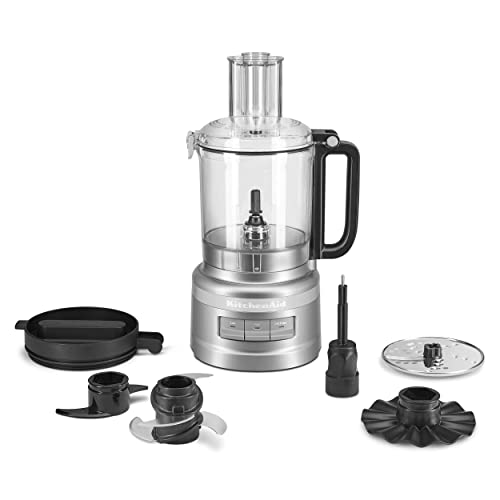
3. KitchenAid 9-Cup Food Processor KFP0921 — Best Full-Size for Emulsions and Whipping
When the batch is a quart of dressing for a dinner party or whipped cream for a crowd, mini choppers run out of room, and that is where the KFP0921 steps in. Its listing confirms a whisk accessory, a four-blade multipurpose design, an easy-clean work bowl, and all-in-one storage for blades and discs. The 9-cup bowl handles double and triple sauce batches, big purees that behave like emulsions, and full prep work. It suits family cooks and entertainers who want one machine whose accessories cover chopping, whipping, and sauce-making without a drawer full of loose parts.
Strengths
- Whisk accessory confirmed in the listing, at full-processor scale
- 9-cup bowl handles party-size dressings and whipped batches
- All-in-one storage keeps the whisk and blades with the machine
Trade-offs
- Minimum batch still applies: a half cup of vinaigrette will not engage in a 9-cup bowl
- Mid-to-upper tier pricing compared with basic choppers
- Bigger footprint than the compact picks
Key specs (verified):
- Capacity: 9-cup bowl (verified from listing)
- Accessories: whisk accessory included (verified from listing)
- Storage: all-in-one in-bowl storage (verified from listing)
Scale changes emulsion technique. In a big bowl you need enough base mixture to reach the blade, so the method is to start the emulsion with a concentrated base, yolks, mustard, a splash of liquid, get it thick and stable, and only then build volume with the remaining oil and liquid. Done that way, this machine produces stable, glossy mayonnaise and dressings in quantities a mini chopper cannot attempt, and the whisk then handles the aerated jobs: whipped cream for a trifle, foamed egg whites for a souffle-style bake, light cake batters that need air rather than force.
The discipline this pick demands is honesty about batch size. For a single cup of sauce it is the wrong tool, and owners who also make small dressings often keep a mini chopper beside it. As the single full-size answer for a household that entertains, preps, whips, and emulsifies at scale, it is the most complete package in this guide, with storage design that keeps its own accessories from going missing.
Best for: families and entertainers making larger sauce batches and whipped toppings / Not suited for: solo cooks whose emulsions are always a cup or less
Check on Amazon — check price on Amazon before you buy, since listings and included accessories change over time.

4. Hamilton Beach 10-Cup Food Processor 70730 — Best Value for Sauces and Purees
Emulsion-adjacent work, the thick purees, hummus-style spreads, romesco, pesto, and sauce bases that need to stay in motion, is where the 70730 quietly shines. Its listing confirms a 10-cup bowl for slicing, shredding, mincing, and pureeing, plus an easy-clean bowl scraper. That scraper matters for sauces: it sweeps the bowl walls while the machine runs, folding strays back into the blade path instead of leaving unmixed oil or paste smeared above the emulsion line. It suits value-focused cooks who make big, rustic sauce batches and want a full prep machine at a budget-friendly tier.
Strengths
- Bowl scraper keeps sauces and purees circulating without stopping
- 10-cup capacity for family-size dressing and sauce batches
- Full slicing and shredding ability at a value tier
Trade-offs
- No whisk or emulsifying disc in the listing, so whipping is out of scope
- Fine, glossy mayo needs the gradual-oil technique and patience
- Minimum batch rules apply in a 10-cup bowl
Key specs (verified):
- Capacity: 10-cup bowl (verified from listing)
- Feature: easy-clean bowl scraper included (verified from listing)
- Functions: slicing, shredding, mincing, puree (verified from listing)
Think of this pick as the emulsion workhorse rather than the emulsion artist. For blended sauces where oil must be fully incorporated, pesto, chimichurri, nut-based sauces, and thick dressings, blade time and circulation do the work, and the scraper keeps the mixture honest. It also purees soups and baby-food-style textures smoothly, which rely on the same fine-droplet, fully-mixed principle. For classic mayonnaise it can succeed with a proper base and a slow drizzle, but it lacks the dedicated accessories that make the top picks here foolproof.
Value is the argument. This is a full-size, full-function processor at the accessible end of the market, and for many kitchens the sauces it makes, hummus by the quart, dressing for the week, pesto in season, are ninety percent of real emulsion demand. Buy it for breadth and batch size, and use the technique section of this guide to close the gap on the remaining ten percent.
Best for: hummus, pesto, big dressing batches, and value-focused family prep / Not suited for: whipped cream or cooks wanting a dedicated emulsifying accessory
Check on Amazon — check price on Amazon before you buy, since listings and included accessories change over time.

5. Cuisinart Core Custom 10-Cup Food Processor FP-110 — Best Premium All-Rounder for Sauce Work
The FP-110 is the choice for cooks who treat the processor as the kitchen’s central prep station and want sauce work to feel precise rather than improvised. Its listing confirms a 10-cup multifunctional platform in the Core Custom line, a system built around interchangeable accessories and refined speed control. For emulsions, control is the story: the ability to run the blade at a measured pace while oil streams in, then lift speed as the sauce thickens, produces the glossy, stable results that separate restaurant-style mayo and vinaigrettes from broken, oily ones.
Strengths
- 10-cup multifunctional platform with refined control for gradual emulsifying
- Core Custom accessory ecosystem extends the machine over time
- Full-size prep ability for ingredients before and after sauce-making
Trade-offs
- Premium tier; over-specified for cooks who only make a weekly dressing
- Small single batches still sit low in a 10-cup bowl
- Accessory ecosystem rewards buying into one system
Key specs (verified):
- Capacity: 10-cup bowl (verified from listing)
- Line: Core Custom multifunctional platform (verified from listing)
- Finish: white and stainless (verified from listing)
Premium processors earn their keep in emulsion work through consistency. A blade that holds a steady speed under changing load keeps droplet size even as the sauce thickens, and even droplets are what make an emulsion stable rather than lucky. The FP-110’s platform approach also means the machine grows: cooks can add specialized tools over time instead of replacing the base. For dinner-party cooking, where a bearnaise-style sauce, a whipped topping, and a full prep list all land on the same evening, that depth is genuinely useful.
The counterpoint is proportionality. If your emulsion life is a jar of dressing on Sundays, the Sangcon or the KitchenAid chopper will make you happier for less money and less counter. This pick is for committed cooks who will use the control and the ecosystem weekly, and who understand that in sauce work, finesse is a feature, not a luxury.
Best for: committed home cooks who make sauces often and want precise control / Not suited for: occasional dressing-makers or strict budget buyers
Check on Amazon — check price on Amazon before you buy, since listings and included accessories change over time.

6. Cuisinart Mini-Prep Plus 4-Cup DLC-4CHB — Best Budget Mini for Dressings
The Mini-Prep Plus has been the small-sauce answer for years for a simple reason: geometry. Its listing confirms a 4-cup bowl, a 250-watt motor, and an auto-reversing stainless blade that chops in one direction and grinds in the other, with a dishwasher-safe bowl and lid. A cup of mayonnaise base sits right in the blade’s working zone, so emulsions establish fast and hold. It suits solo cooks, couples, and anyone whose dressing and dip production is frequent but small, and it earns counter space by also handling herbs, garlic, nuts, and hard cheese daily.
Strengths
- 4-cup bowl puts small emulsion batches in the blade’s working zone
- Auto-reversing blade handles both chopping and finer grinding textures
- Dishwasher-safe bowl and lid make oily sauce cleanup painless
Trade-offs
- 250-watt motor is for light duty; thick, large mixtures are out of scope
- No whisk or emulsifying disc, so no whipping
- Too small for family-scale prep of any kind
Key specs (verified):
- Capacity: 4-cup bowl (verified from listing)
- Motor: 250 watts (verified from listing)
- Blade: auto-reversing stainless steel SmartPower-style blade; dishwasher-safe bowl and lid (verified from listing)
Technique with this machine is direct: combine yolks, mustard, acid, and seasoning, pulse to a smooth base, then run the blade and add oil in the thinnest stream you can pour, ideally a few drops at a time at first. The small bowl means the emulsion thickens visibly within seconds, which teaches good habits, because you can see the moment it turns pale and glossy and know to keep the stream slow. Vinaigrettes benefit from the same control; a stable, creamy dressing that coats leaves instead of pooling is a thirty-second job.
Know its borders. It will not whip cream, it will not slice a cucumber, and it resents being asked to puree a pot of soup. Within its borders it is close to perfect, cheap to own, easy to wash, and honest about what it is. For the specific job of small emulsions on a budget, it remains the benchmark the newer minis have to beat.
Best for: solo cooks and couples making dressings, mayo, and dips in small batches / Not suited for: whipping, slicing, or any family-scale work
Check on Amazon — check price on Amazon before you buy, since listings and included accessories change over time.
Comparison Table
| Pick | Badge | Key spec | Best for |
|---|---|---|---|
| Sangcon 400W 4-Cup Mini Food Processor | Best Overall for Emulsifying | 4-cup, 400W, dedicated emulsifying disc | mayo, aioli, vinaigrettes, dips, and whipped toppings in household quantities |
| KitchenAid 5 Cup Food Chopper KFC0516 | Best for Whipping and Small Sauces | 5-cup, whisk accessory, 2 speeds plus pulse | whipped cream, dressings, mayo, and small-batch sauces in smaller households |
| KitchenAid 9-Cup Food Processor KFP0921 | Best Full-Size for Emulsions and Whipping | 9-cup bowl, whisk accessory | families and entertainers making larger sauce batches and whipped toppings |
| Hamilton Beach 10-Cup Food Processor 70730 | Best Value for Sauces and Purees | 10-cup bowl, built-in bowl scraper | hummus, pesto, big dressing batches, and value-focused family prep |
| Cuisinart Core Custom 10-Cup Food Processor FP-110 | Best Premium All-Rounder for Sauce Work | 10-cup Core Custom platform | committed home cooks who make sauces often and want precise control |
| Cuisinart Mini-Prep Plus 4-Cup DLC-4CHB | Best Budget Mini for Dressings | 4-cup, 250W, auto-reversing blade | solo cooks and couples making dressings, mayo, and dips in small batches |
How to Choose the Best Food Processors for Emulsifying
Choose by batch size first, because emulsion physics punish the wrong bowl. An emulsion needs the mixture to circulate through the blade zone continuously. In an oversized bowl, a small batch smears thinly across the bottom and the blade spins above the action; in a right-sized bowl, the mixture pools deep enough to fold over itself. If your typical job is a cup of mayonnaise or dressing, a 4 to 5-cup machine is not a compromise, it is the correct tool. If you regularly make a quart or more for gatherings, step up to a 9 or 10-cup model and build your emulsion from a concentrated base before adding volume.
Accessories decide the top end of what is possible. A dedicated emulsifying disc, like the one confirmed in the Sangcon’s listing, is purpose-built for emulsions and light whipping. A whisk accessory, confirmed in both KitchenAid listings here, covers whipped cream, foamed eggs, and light batters. A plain chopping blade can still make excellent mayonnaise and vinaigrettes with good technique, but it cannot whip. Decide whether whipping matters to your cooking before paying for full-size machines, and conversely, do not expect a blade-only mini to produce whipped toppings no matter how long it runs.
- Match bowl size to your usual sauce batch, not your biggest ever batch
- Emulsifying disc or whisk accessory required for whipped results
- Pulse and multiple speeds help you start slow and finish fast
- A pusher or feed tube you can drizzle through makes oil control easier
- Dishwasher-safe bowls matter; oily emulsions are miserable to hand-wash
The Physics of a Stable Emulsion, in Plain Terms
An emulsion is a suspension of tiny droplets of one liquid inside another that would rather separate: oil in water-based liquid, usually. Two things keep it stable. First, droplet size: the finer the blade shears the oil, the slower the droplets recombine, which is why blade speed and circulation matter. Second, emulsifiers: ingredients like egg yolk, mustard, and garlic contain compounds that coat droplets and stop them merging, which is why classic mayonnaise starts with yolk and mustard rather than oil alone. Temperature helps too; ingredients at cool room temperature emulsify more reliably than a fridge-cold yolk or oil warmed by a hot kitchen.
Failure follows predictable patterns. Add oil too fast at the start and the mixture floods before droplets can form, and the sauce breaks into greasy liquid. Start with too little base in too big a bowl and the blade never engages. Run a thin vinaigrette too briefly and it separates in the jar within the hour. Every one of these is a technique or sizing problem, not a mystery, and the workflow in the how-to section below is built to prevent each of them in any machine in this guide.
Blades, Discs, and Whisks: Which Tool for Which Sauce
Use the chopping blade for mayonnaise, aioli, vinaigrettes, and blended sauces like romesco and pesto, where shearing force does the work. Use an emulsifying disc, where fitted, for lighter, airier emulsions and whipped textures that need incorporation without cutting. Use a whisk accessory for cream, egg whites, and thin batters, where the goal is foam and volume. Thick purees such as hummus sit in the blade’s world too, but benefit from a bowl scraper or a mid-process scrape-down, because their thickness stops circulation sooner than a pourable sauce does.
One more practical distinction: continuous run versus pulse. Establish emulsions on continuous run so the oil stream meets a moving blade, and use pulse for chunky, broken-style dressings and salsas where texture should stay coarse. Matching the motion to the sauce is the difference between a processor that feels like a blunt instrument and one that behaves like a saucier’s third hand.
Sauce-by-Sauce: Matching the Machine to the Emulsion
Mayonnaise is the benchmark emulsion and the least forgiving: it demands a controlled oil stream, a right-sized bowl, and an emulsifier base, and it rewards the dedicated disc and whisk-equipped picks in this guide most clearly. Hollandaise and bearnaise are warm emulsions with a narrower margin, because heat plus agitation can scramble the yolks; a processor makes them by the blender-style method, with hot butter streamed into yolks, and the machine’s steady blade work replaces the whisk arm that tires over a bain-marie. Vinaigrettes are the easiest class and the most commonly made badly: processed briefly with mustard they turn creamy and stable, while a shaken jar separates before the salad is dressed.
Aioli and garlic-forward sauces sit between mayonnaise and vinaigrette in difficulty, and they benefit from making the base first, garlic, yolk, and acid processed smooth, before the oil stream begins, so no raw garlic chunk survives into the finished sauce. Caesar and other egg-and-cheese dressings need the anchovy and cheese fully incorporated before the oil, for the same reason. Nut and seed butters and their sauce relatives, romesco, satay-style blends, and tahini sauces, are emulsions of a thicker kind, where bowl circulation and a scraper matter more than drizzle control, which is why the Hamilton Beach pick with its bowl scraper appears in this guide despite lacking a whisk.
Whipped applications close the circle. Cream, foamed eggs, and light batters are air emulsions, and they belong exclusively to the whisk and disc accessories; no blade technique substitutes. A household that makes all of these across a month of cooking is exactly the household the full-size KitchenAid and Cuisinart picks were chosen for, while a household whose emulsion life is a Sunday dressing is honestly served by the smallest machine here.
Storage, Shelf Life, and Food Safety for Homemade Emulsions
Homemade emulsions lack the preservatives and industrial stabilizers of bottled products, so treat them as fresh food. Mayonnaise and aioli made with raw yolk should be refrigerated promptly in a clean, sealed jar and used within several days; when in doubt about freshness, make a smaller batch rather than stretching an old one. Use the freshest eggs you can, keep the sauce cold between uses, and never return a spoon that has touched other food to the jar, because contamination, not time alone, is what usually spoils a homemade emulsion.
Vinaigrettes keep longer and more forgivingly, often a week or more refrigerated, though their fresh herb and garlic notes fade first; let them sit at room temperature briefly before serving so the oil loosens, and give them a few seconds of processing or a vigorous shake to bring the emulsion back. Whipped cream is the most perishable of all and belongs to the day it is made. None of this should discourage the habit: the entire point of owning a good emulsifying processor is that a fresh, superior sauce is five minutes away whenever it is wanted, which makes small, frequent batches the natural rhythm.
Emulsifying for Special Diets and Everyday Variations
The processor’s emulsion skills adapt well beyond the classics. Egg-free mayonnaise built on aquafaba, the liquid from canned chickpeas, emulsifies by the same drizzle method and suits vegan households and egg-allergic guests; it is lighter than yolk mayo and benefits from a little mustard and a patient oil stream. Yogurt-based dressings are not true oil emulsions but behave like them at the table, and a processor blends them silk-smooth with herbs in seconds. Tahini sauces, thinned with water and lemon until they turn pale and pourable, demonstrate the same droplet logic with sesame solids doing the emulsifying work.
Everyday variations keep the habit alive. A basic mayonnaise becomes aioli with garlic processed into the base, a sandwich spread with herbs and lemon, a remoulade-style sauce with capers and mustard, or a spicy version with chili folded in after the emulsion sets. A basic vinaigrette becomes a green goddess-style dressing with herbs, a miso dressing with a spoon of paste whisked into the base, or a creamy Caesar-style dressing with cheese and anchovy. Owning the base technique, which the how-to section teaches once, is what turns one machine into a shelf of sauces you no longer buy in bottles.
How to Make Mayonnaise and Vinaigrette in a Food Processor
The sequence below works in every machine in this guide. Scale the batch to your bowl: small bowls want a single-yolk batch, large bowls want a double batch started as a concentrated base.
- Bring ingredients to cool room temperature. Cold yolks resist emulsifying, so give eggs twenty minutes out of the fridge.
- Add yolks, a spoon of mustard, the acid (lemon juice or vinegar), salt, and a splash of water to the bowl, and run the blade for fifteen seconds until smooth and pale.
- With the machine running, add the first oil drop by drop, then in the thinnest stream you can pour, through the feed tube or pusher. The mixture should turn pale and begin to thicken before you pour any faster.
- Once half the oil is in and the sauce looks glossy and thick, you can add the rest in a slightly faster stream, still steady rather than dumped.
- Stop, scrape down any oil clinging above the mixture line, and run five more seconds to bring it together.
- Taste and adjust: a spoon of warm water loosens an over-thick mayo and stabilizes it; extra acid brightens a flat vinaigrette. For vinaigrette, use the same method with a three-to-one oil-to-acid ratio and stop while it is just combined for a pourable, stable dressing.
- If a sauce breaks, do not throw it away: put a fresh yolk and a spoon of water in a clean bowl, run the blade, and drizzle the broken sauce in slowly. It will almost always re-emulsify.
Use emulsions promptly or refrigerate them in a clean jar. Homemade mayonnaise keeps for several days refrigerated; vinaigrettes keep longer and re-whisk in seconds. Wash oily bowls right away in hot water; a dishwasher-safe bowl, as several picks here offer, makes that a non-event.
Common Buying Mistakes
Adding oil too fast at the start. The first quarter of the oil decides the emulsion. Drops, then a thread-thin stream, until the sauce thickens; only then can you pour faster. Impatience in the first thirty seconds is the top cause of broken mayo.
Making a tiny batch in a huge bowl. A half cup of dressing in a 10-cup bowl never reaches the blade properly. Use a mini processor for small batches, or double the recipe and store the extra; emulsions keep well.
Skipping the emulsifier. Oil and vinegar alone separate quickly. Yolk, mustard, or a little garlic gives droplets their protective coating. Even a teaspoon of mustard transforms a vinaigrette’s stability.
Using fridge-cold ingredients. Cold yolks and cold oil resist combining and encourage breaking. Cool room temperature ingredients emulsify faster and hold longer, for almost no effort.
Expecting a chopping blade to whip cream. Blades cut; they do not whip. For whipped cream or foamed eggs you need a whisk accessory or an emulsifying disc, which is why those accessories headline the top picks in this guide.
Final Recommendation
If emulsifying is the job you are buying for, the Sangcon 4-Cup is the most direct answer: a dedicated emulsifying disc, the right bowl size for real sauce batches, and controlled speeds at a mini-machine tier. The KitchenAid 5 Cup Chopper is the better buy if whipping matters as much as mayo, and the KitchenAid 9-Cup extends the same whisk advantage to family scale. The Hamilton Beach 70730 covers big, rustic sauce work on a budget, the Cuisinart FP-110 rewards committed cooks with control, and the Cuisinart Mini-Prep Plus remains the budget benchmark for small dressings.
Whatever you buy, learn the drizzle. A slow first stream, room-temperature ingredients, and a bowl sized to the batch will make any of these machines produce stable, glossy emulsions, and will rescue the processor already sitting in your cupboard as well.
If you want the shortest path to a decision, check these three first: Sangcon 400W 4-Cup Mini Food Processor, KitchenAid 5 Cup Food Chopper KFC0516, KitchenAid 9-Cup Food Processor KFP0921. Each links to its live listing so you can check price on Amazon and confirm the current bundle before ordering.
Keep exploring this category with our related guides: Best Food Processors For Dough Best Food Processors For Home Use Best Food Processors For House Use Best Food Processors For Baking Best Food Processors For Baby Food
Frequently Asked Questions
What makes a food processor good at emulsifying?
Blade speed with control, a bowl sized so the batch circulates through the blade, and a way to add oil in a thin stream while running. Dedicated emulsifying discs and whisk accessories extend the range into whipped textures. The picks in this guide were chosen on exactly those verified features.
Can I make mayonnaise in a large food processor?
Yes, if you start with a concentrated base: yolks, mustard, acid, and a splash of water, emulsified thick before you build volume. A double batch also helps the mixture reach the blade. For a single small batch, a 4 or 5-cup machine is simply the right-sized tool.
Why does my vinaigrette keep separating?
Usually it was under-processed or made without an emulsifier. Add a teaspoon of mustard, process until the dressing looks creamy rather than oily, and store it in a jar you can shake. A properly processed vinaigrette holds together far longer than a whisked one.
What is an emulsifying disc used for?
It is a disc accessory designed to incorporate and whip rather than cut, used for emulsions, light batters, and whipped textures. In this guide only the Sangcon’s listing confirms one, which is why it headlines the emulsifying picks; whisk accessories, as on the KitchenAid models, cover similar ground.
Can a food processor whip cream?
Only with the right accessory. A whisk attachment or emulsifying disc can whip cream; a standard chopping blade cannot, because it cuts instead of folding air in. If whipped toppings matter to you, choose a pick whose listing confirms a whisk or disc.
How do I fix a broken mayonnaise?
Start a fresh base in a clean bowl with one yolk and a spoon of water, run the blade, and drizzle the broken sauce in slowly as if it were oil. The new base gives the droplets fresh emulsifier and the sauce almost always comes back together, glossy and stable.
Can I emulsify with a regular blender instead of a food processor?
Often, yes, and the two appliances overlap here. A blender’s vortex is excellent for vinaigrettes and smooth sauces and can make mayonnaise with the same slow-drizzle discipline. A food processor earns its place for thicker, smaller, and chunkier work: dips, pesto, romesco, and batches where a blender’s narrow jar struggles to circulate. The whisk and disc accessories in this guide also do jobs no blender attempts, like whipped cream. Households that make the full range of emulsions generally find the processor the more versatile sauce station, while a blender-only household can cover dressings and smooth sauces well. Choose by the sauces you actually repeat, not by appliance loyalty.


