Disclosure: airfryerkitchensupply.com is reader-supported. When you buy through links on our site, we may earn an affiliate commission at no extra cost to you.
Where to buy
Start with this shortlist of the best food processors for indian cooking. Every linked pick below was verified against Amazon’s own catalog data for this site before this guide was written, so the model names and capacities in this article match real, current listings. Use the links in this box, in Quick Picks, and under each review to check price on Amazon on the day you buy, because bundles and included accessories change between listings. If a pick is marked as unlinked anywhere in this guide, that means we could not confirm the exact configuration, and you should compare live listings carefully instead of trusting a headline claim.
- Cuisinart 14-Cup Food Processor DFP-14BCNY (Best Overall) — check price on Amazon
- Hamilton Beach Professional Stack & Snap Food Processor 70815 (Best for Big Vegetable Prep) — check price on Amazon
- Ninja Professional Plus Food Processor BN601 (Best for Pastes and Chutneys) — check price on Amazon
- Breville Sous Chef 12 Cup Food Processor BFP710 (Best Premium Mid-Size) — check price on Amazon
- Hamilton Beach Stack & Snap 14-Cup Food Processor 70585 (Best Two-Bowl Flexibility) — check price on Amazon
- KitchenAid 7-Cup Food Processor KFP0718 (Best Compact for Smaller Households) — check price on Amazon
If you are shopping for the best food processors for indian cooking, you are really shopping for three machines in one. Indian home cooking asks a processor to grind onion-tomato masala bases to a fine paste, knead small batches of roti and paratha dough several times a week, chop large volumes of vegetables evenly for sabzi and pakora, and shred everything from cabbage for thoran to carrots for halwa. A processor that only chops well will disappoint you at the masala stage; one that purees beautifully but cannot knead will sit idle on roti nights. The picks below were chosen because their verified listings confirm the spread of jobs Indian cooking actually demands — puree, kneading, slicing, and shredding — in bowls big enough for family quantities.
Two realities of the category deserve honesty up front. First, a food processor is not a wet grinder or a spice grinder: it will make excellent ginger-garlic paste and onion masala, but idli batter belongs in a wet grinder and dry garam masala in small quantities is better in a dedicated spice or coffee grinder. Second, chutneys sit in between — a processor handles a big batch of coriander chutney well, while a small single batch circulates poorly in a big bowl, which is why one pick below includes a mini bowl option. With those boundaries clear, a good processor becomes the hardest-working prep tool in an Indian kitchen.
Every linked pick was verified against this site’s catalog data before writing, and the spec boxes quote only what those listings confirm. Prices are never printed, because they change constantly; check price on Amazon on the day you buy.
In this guide
Quick Picks
Short on time? These six processors cover the full Indian prep list — masala pastes, roti dough, vegetable chopping, and shredding — at sizes from family-large to apartment-friendly.
- Best Overall — Cuisinart 14-Cup Food Processor DFP-14BCNY: The one listing here that names both puree and kneading dough, in a 14-cup bowl with a 720-watt motor — the complete Indian prep brief in a single machine. Check on Amazon
- Best for Big Vegetable Prep — Hamilton Beach Professional Stack & Snap Food Processor 70815: A 12-cup machine with a 3-inch feed chute that fits whole vegetables and a listing that confirms kneading — built for sabzi prep at family volume. Check on Amazon
- Best for Pastes and Chutneys — Ninja Professional Plus Food Processor BN601: The strongest motor here and Auto-iQ programs for both puree and dough — the fastest route to smooth masala bases and green chutney. Check on Amazon
- Best Premium Mid-Size — Breville Sous Chef 12 Cup Food Processor BFP710: Breville’s 12-cup Sous Chef in brushed stainless, with dicing among its confirmed jobs — the premium pick for precise vegetable work. Check on Amazon
- Best Two-Bowl Flexibility — Hamilton Beach Stack & Snap 14-Cup Food Processor 70585: A 14-cup main bowl plus an included 4-cup mini bowl — the only pick that handles both a family masala batch and a small chutney without compromise. Check on Amazon
- Best Compact for Smaller Households — KitchenAid 7-Cup Food Processor KFP0718: A 7-cup processor with three speeds and all-in-one storage — the apartment-size pick for couples cooking Indian food without the family-scale batches. Check on Amazon
How These Picks Were Chosen
Picks were chosen by matching verified catalog data to the four jobs Indian cooking repeats most: pureeing masala bases and pastes, kneading dough (listings that explicitly confirm kneading were prioritized), slicing and shredding vegetables at family volume, and chopping onions and herbs evenly. Bowl capacity mattered — Indian family cooking rarely preps two onions at a time — as did feed chute size, because whole vegetables and large onion halves save real minutes across a week of cooking.
We also valued machines that combine a full-size bowl with help for small jobs, since Indian kitchens swing between a Sunday batch of masala and a Tuesday handful of coriander for chutney. Every linked model was confirmed through this site’s own catalog verification; specs in the mini boxes come from the verified listing titles only. No prices, star ratings, or review counts appear anywhere in this guide.
The 6 Best Food Processors for Indian Cooking

1. Cuisinart 14-Cup Food Processor DFP-14BCNY — Best Overall
This is the pick for the household that cooks Indian food most days and wants one processor to anchor it. Onion-tomato masala for the week fits in one run, a family batch of roti dough kneads without splitting the batch, and the shredding disc handles cabbage, carrot, and beetroot at volume. It suits larger families and batch cooks. It is more machine than a single person cooking for one needs, and its footprint demands storage space.
Strengths
- Listing confirms both puree and dough kneading — the two hardest Indian jobs
- 720W motor sustains masala pastes and stiff dough
- 14-cup bowl suits family-size and batch cooking
Trade-offs
- Large and heavy for small kitchens
- Premium effort to wash after big masala batches — turmeric stains light plastics (this finish is steel, a plus)
- Overkill for cooking-for-one households
| Spec | Detail |
|---|---|
| Capacity | 14-cup work bowl |
| Motor | 720 watts |
| Confirmed jobs in listing | Mincing, dicing, shredding, puree, kneading dough |
| Finish | Stainless steel |
The DFP-14BCNY earns Best Overall here because its own listing reads like an Indian prep checklist: mincing for onion bases, puree for masalas and pastes, kneading for dough, shredding for sabzi vegetables. In practice the 720-watt motor is the difference between a masala that comes together in one continuous run and one that needs stopping, scraping, and coaxing. Ginger-garlic paste — fibrous and sticky — processes evenly, and the big bowl means a week’s worth happens in minutes.
For dough, treat the processor as a fast kneader for roti and paratha quantities: pulse the flour and salt, add water through the tube, and run until a ball forms, then rest the dough well — processor-kneaded dough needs its rest even more than hand-kneaded. The stainless finish also shrugs off turmeric better than white plastic bowls, a small mercy anyone who has scrubbed a stained bowl will appreciate.
Best for: Families cooking Indian food most days / Not suited for: Singles or very small kitchens
Check on Amazon — check the current price on Amazon before you buy.
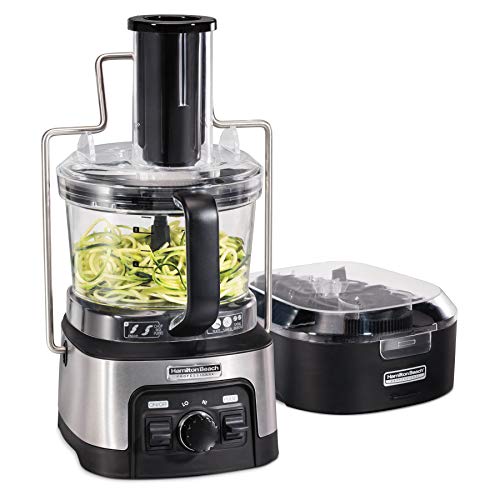
2. Hamilton Beach Professional Stack & Snap Food Processor 70815 — Best for Big Vegetable Prep
Choose this Hamilton Beach if your Indian cooking is vegetable-heavy and voluminous: cabbage for thoran, onions for biryani, carrots and beans for mixed sabzi. The extra-large feed chute takes whole vegetables, which removes the pre-cutting step that makes processor prep feel slower than a knife. The listing confirms kneading, so roti dough is covered too, and the spiralizer is a bonus for salads and garnishes. It is less focused on fine purees than the Cuisinart, so masala specialists may prefer that pick.
Strengths
- 3-inch feed chute fits whole vegetables — minimal pre-cutting
- 12-cup capacity for family vegetable prep
- Kneading confirmed in the listing, plus a spiralizer bonus
Trade-offs
- Puree performance is good, not the list’s best, for very fine masala
- Stack & Snap assembly differs from twist-lock bowls — a habit to learn
- Large footprint, like all 12-cup machines
| Spec | Detail |
|---|---|
| Capacity | 12-cup bowl |
| Feed chute | Extra-large 3-inch, fits whole vegetables |
| Confirmed jobs in listing | Slicing, shredding, kneading, spiralizing |
Vegetable volume is where Indian cooking quietly consumes its prep time, and this machine attacks exactly that. Slicing onions for a biryani, shredding cabbage, or cutting carrots for pulao happens in a fraction of knife time, and the wide chute means potatoes and onions go in whole or halved rather than trimmed to fit. The Stack & Snap bowl design also seals without the fiddly twisting that makes some processors annoying when your hands are wet or oily — a real consideration mid-recipe.
For masala work, it performs respectably: onion-tomato bases process fine with one scrape-down midway. Where it concedes ground to the Cuisinart is the very finest pastes, where the 720-watt machine’s sustained power shows. As an all-round family prep station with dough capability confirmed, though, it is one of the most practical buys on this list.
Best for: Vegetable-heavy family cooking and biryani prep / Not suited for: Buyers who prioritize the finest masala pastes above all
Check on Amazon — check the current price on Amazon before you buy.

3. Ninja Professional Plus Food Processor BN601 — Best for Pastes and Chutneys
Buy the Ninja if pastes and chutneys are your priority. Ginger-garlic paste, onion masala, and coriander-mint chutney all reward raw power and a programmed puree cycle, and the BN601’s 1000-watt motor with an Auto-iQ puree preset is the strongest combination on this list for them. Its dough preset also covers small roti batches. The 9-cup bowl suits couples and small families; households cooking for six will find themselves splitting batches and should look at the 12- and 14-cup picks instead.
Strengths
- 1000W motor — the most power here for fibrous pastes
- Auto-iQ puree and dough programs remove timing guesswork
- Dishwasher-safe parts ease turmeric-and-oil cleanup
Trade-offs
- 9-cup bowl splits batches for large families
- Presets give less manual control than a dial
- No extra-large feed chute for whole vegetables
| Spec | Detail |
|---|---|
| Capacity | 9-cup bowl |
| Motor | 1000 watts (listing states 1000PW) |
| Programs | Auto-iQ presets: chop, slice, puree, mix dough |
| Parts | Dishwasher-safe parts per listing |
Green chutney is a revealing test: coriander leaves, mint, green chillies, and ginger must become a smooth, vivid paste without so much added water that the chutney turns thin. The Ninja’s power and puree program handle that balance well, keeping the mixture moving so you can add water by the spoonful rather than the quarter cup. The same applies to ginger-garlic paste made in quantity for the freezer — a monthly job in many Indian kitchens that this machine turns into a ten-minute task.
The dough preset deserves honest framing: it mixes and kneads small batches effectively, which covers weekday rotis for two to four people. For a weekend poori session for guests, the bigger bowls above are the better tools. As a paste-and-chutney specialist with genuine all-round ability, the BN601 is an easy recommendation for smaller households.
Best for: Pastes, chutneys, and small-family dough / Not suited for: Cooking for six or more at once
Check on Amazon — check the current price on Amazon before you buy.

4. Breville Sous Chef 12 Cup Food Processor BFP710 — Best Premium Mid-Size
Pick the Breville if you value precise, even vegetable cuts and a machine that lives handsomely on the counter. Its listing confirms chopping, slicing, shredding, and dicing — and dicing is a genuinely useful word for Indian cooking, where evenly diced onions, potatoes, and carrots cook at the same rate in a sabzi or pulao. The 12-cup bowl handles family batches. It sits at a premium tier, and buyers whose priority is dough or the finest pastes should weigh the Cuisinart and Ninja first, since this listing does not headline those jobs.
Strengths
- Dicing confirmed — even cubes for sabzi and pulao
- 12-cup family capacity in a premium build
- Brushed stainless resists turmeric staining better than white plastic
Trade-offs
- Premium tier positioning
- Listing does not headline kneading or puree programs
- Size suits permanent counter storage best
| Spec | Detail |
|---|---|
| Capacity | 12-cup |
| Finish | Brushed stainless steel |
| Confirmed jobs in listing | Chop, slice, shred, dice |
Evenness is an underrated virtue in Indian vegetable cookery. A potato sabzi where half the cubes are twice the size of the rest cooks unevenly no matter how skilled the tadka. The BFP710’s dicing capability, confirmed in its listing, addresses that directly, and its slicing and shredding maintain the consistency home cooks usually only get with serious knife time. For a household that cooks a lot of mixed vegetable dishes, that consistency is worth real money.
On pastes and dough, approach it as a capable generalist: it chops masala ingredients finely and handles general processing confidently, but the listing’s emphasis is precision prep rather than puree programs or kneading. Pair it with the technique section below — process onion bases in two stages for the finest result — and it will cover an Indian kitchen’s week comfortably, with the best-looking counter presence on this list.
Best for: Precision vegetable prep and premium build / Not suited for: Dough-first or paste-first buyers on a budget
Check on Amazon — check the current price on Amazon before you buy.

5. Hamilton Beach Stack & Snap 14-Cup Food Processor 70585 — Best Two-Bowl Flexibility
This Hamilton Beach solves the Indian kitchen’s size problem in one box. The 14-cup bowl takes the Sunday masala batch and family dough; the included 4-cup mini bowl handles the small jobs — a cup of coriander chutney, a few chillies and garlic for a tadka paste, a small batch of ginger paste — that slosh uselessly around a big bowl. Three speeds and a 500-watt motor cover the work honestly. It suits families who cook across both scales every week. Power-focused buyers should note the Ninja and Cuisinart state stronger motors.
Strengths
- Two bowls in one purchase — big batch and small batch both covered
- 14-cup main capacity for family cooking
- Mini bowl makes small chutneys and pastes practical
Trade-offs
- 500W motor is mid-pack for the stiffest dough
- Two bowls mean more parts to store and wash
- Plastic construction at a workmanlike tier
| Spec | Detail |
|---|---|
| Capacity | 14-cup bowl plus included 4-cup mini bowl |
| Motor | 500 watts, 3 speeds |
| Blades | Dishwasher-safe stainless steel blades per listing |
The mini bowl is the feature that sounds minor and proves major. Indian cooking constantly generates small-volume wet jobs — grinding a handful of soaked chillies, a small coconut chutney for idli breakfast, a paste of garlic and cumin for dal tadka. In a 14-cup bowl those quantities smear across the base and never reach the blade properly. Dropping in the 4-cup bowl fixes the physics, and because it is included rather than an accessory hunt, you will actually use it.
The main bowl, meanwhile, is a proper family tool: Stack & Snap assembly, dishwasher-safe blades, and capacity for a week’s onion base. The 500-watt motor asks for sensible loading on dough — add water gradually and do not exceed comfortable flour quantities — but for the chopping, slicing, and paste work that dominates Indian prep, it is entirely adequate. For households torn between big and small batch needs, this is the smartest single purchase here.
Best for: Families who swing between big batches and small chutneys / Not suited for: Buyers chasing maximum motor power
Check on Amazon — check the current price on Amazon before you buy.
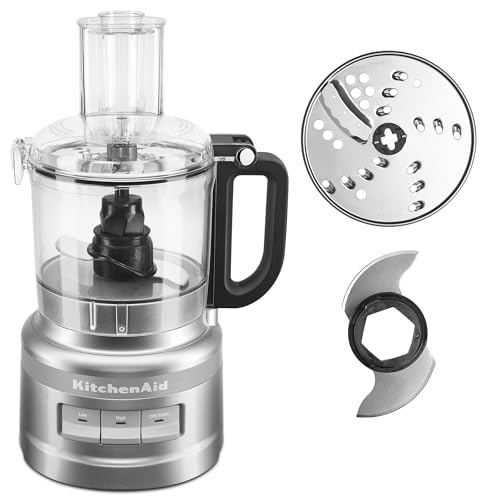
6. KitchenAid 7-Cup Food Processor KFP0718 — Best Compact for Smaller Households
Choose the KitchenAid 7-cup if you cook Indian food for one to three people and your kitchen is small. Seven cups handles a modest onion-tomato base, a small batch of roti dough, and everyday chopping without the storage burden of a 14-cup machine, and every blade and disc stores inside the bowl. Three speeds give more control than a basic two-speed for tasks like pulsing onions without liquefying them. It is the wrong pick for batch cooking or family quantities — that is what the larger machines above exist for.
Strengths
- Compact footprint with all parts stored in the bowl
- Three speeds for controlled onion chopping
- Easy-clean bowl suits frequent small jobs
Trade-offs
- 7-cup bowl means splitting family-size batches
- Not the tool for a week’s masala in one run
- Feed tube is narrower than the big Hamilton Beach chute
| Spec | Detail |
|---|---|
| Capacity | 7-cup work bowl |
| Controls | Three speed control |
| Feed tube | 2-in-1 feed tube |
| Storage | All-in-one storage for blades and discs |
For a couple, this machine hits the practical center of Indian home cooking. A two-onion masala base, a four-roti dough, chopped vegetables for a two-person sabzi — all sit comfortably in its working range, and the three-speed control matters for onions specifically: short low-speed pulses give you chopped onion, while full speed gives you onion water. That distinction decides whether your base fries properly or steams.
The all-in-one storage is not a cosmetic detail in a small kitchen; it is the difference between a processor that lives within reach and one exiled to a high cupboard. If your household grows or your batch cooking ambitions do, you will outgrow the 7-cup bowl — but as a first processor for Indian cooking at small scale, it is the most livable option on this list.
Best for: Couples and small apartments / Not suited for: Family batch cooking
Check on Amazon — check the current price on Amazon before you buy.
Comparison Table
Match the bowl to your household size first, then the specialty: pastes, dough, vegetable volume, or small-batch flexibility. Every pick covers the basics; the badge marks where each one pulls ahead.
| Pick | Badge | Key spec | Best for |
|---|---|---|---|
| Cuisinart 14-Cup Food Processor DFP-14BCNY | Best Overall | 14-cup bowl, 720W, puree + kneading confirmed | Families cooking Indian food most days |
| Hamilton Beach Professional Stack & Snap Food Processor 70815 | Best for Big Vegetable Prep | 12-cup, 3-inch feed chute, kneading + spiralizer | Vegetable-heavy family cooking and biryani prep |
| Ninja Professional Plus Food Processor BN601 | Best for Pastes and Chutneys | 9-cup, 1000W, Auto-iQ puree + dough presets | Pastes, chutneys, and small-family dough |
| Breville Sous Chef 12 Cup Food Processor BFP710 | Best Premium Mid-Size | 12-cup, brushed stainless, dicing confirmed | Precision vegetable prep and premium build |
| Hamilton Beach Stack & Snap 14-Cup Food Processor 70585 | Best Two-Bowl Flexibility | 14-cup + 4-cup mini bowl, 500W, 3 speeds | Families who swing between big batches and small chutneys |
| KitchenAid 7-Cup Food Processor KFP0718 | Best Compact for Smaller Households | 7-cup, 3 speeds, in-bowl storage | Couples and small apartments |
How to Choose the Best Food Processors for Indian Cooking
Begin with the four jobs and be honest about which you do weekly. Masala bases and pastes need sustained puree power and a bowl that circulates thick mixtures. Roti and paratha dough needs a listing that confirms kneading and a bowl sized to your batch — roughly, a family of four’s roti dough wants a 9-cup bowl or larger. Vegetable prep rewards capacity and a wide feed chute. Chutneys reward either raw power in a mid-size bowl or a dedicated mini bowl for small quantities. A machine that confirms all four, like the Cuisinart 14-cup, is the safe default; specialists make sense when one job dominates your cooking.
Capacity deserves a second thought because Indian prep is batch-oriented. Onion-tomato masala is often made for several days at once, ginger-garlic paste for the month, and vegetables for a family meal in one session. Bowls under 7 cups force split batches that erase the time the processor was bought to save. Conversely, if you cook for one or two, a 14-cup bowl wastes storage and makes small chutneys awkward — the two-bowl Hamilton Beach and the 7-cup KitchenAid exist on this list precisely for those patterns.
Materials and cleanup are not minor in this cuisine. Turmeric stains pale plastics permanently, mustard oil and ghee leave films that punish creviced bowls, and a processor used daily must rinse or dishwasher clean without drama. Stainless finishes and dishwasher-safe parts, both confirmed on several picks here, are worth weighting heavily.
- Puree power: for masala bases, ginger-garlic paste, and chutneys
- Kneading confirmed: check the listing names dough or kneading if roti is a weekly job
- Feed chute: wide chutes take whole vegetables and halve prep time
- Two size options: a mini bowl transforms small chutney and tadka paste work
- Stain sense: stainless and dark finishes forgive turmeric; white plastic does not
What a Processor Can and Cannot Do in an Indian Kitchen
Honesty about boundaries makes for a better purchase. A food processor excels at onion-tomato masala, ginger and garlic pastes, vegetable chopping and shredding, small dough batches, and family-size chutneys. It is the wrong tool for idli and dosa batter, which needs the stone grinding action of a wet grinder to ferment and aerate properly; processor batter comes out coarse and flat. It is also the wrong tool for dry spice grinding in small quantities — a spoonful of cumin disappears under the blade and never grinds fine. A small dedicated spice grinder handles that job for very little money.
Coconut is the middle case. A processor can grate coconut flesh with the shredding disc and can make coconut chutney in family quantities, but the finest, smoothest coconut chutney still comes from a blender jar or mixer-grinder of the kind common in Indian kitchens. If your household owns a mixer-grinder already, the processor complements it — taking over the big chopping, shredding, dough, and batch paste work the mixer-grinder does awkwardly — rather than replacing it. Buy the processor for the jobs it genuinely wins, and it will earn its counter space every day.
Matching Bowl Size to Household and Batch Habits
Households of one or two who cook Indian food a few times a week are best served by the 7- to 9-cup class, or by the two-bowl Hamilton Beach if small chutneys are frequent. Families of four to six should start at 12 cups: masala batches, biryani onion slicing, and dough for a full meal all sit comfortably there, and the 14-cup picks add headroom for batch cooking and guests. Joint families and weekend batch cooks should look at 14 cups as the baseline, not the ceiling.
Remember that stated capacity is the bowl’s liquid measure, not its comfortable working load for thick pastes and dough. A masala batch should fill no more than about two-thirds of the bowl to circulate properly, and dough flour quantities are lower still. Buying one size up from your estimate is rarely regretted in this cuisine; buying one size down is regretted weekly.
How to Make a Smooth Onion-Tomato Masala Base in a Food Processor
This base — the foundation of countless curries — is the best test of a processor in an Indian kitchen. The method below produces a fine, even base that fries properly, without the watery, uneven result that gives processor masalas a bad name.
- Roughly chop onions and pulse them in short bursts, scraping once, until evenly chopped but not liquid. If you want a smooth restaurant-style base, continue to a puree; for a home-style base with body, stop at a coarse chop. Process onions alone — adding tomatoes now makes everything soupy.
- Heat oil or ghee in your pan and fry the onion base on medium heat, stirring, until it turns golden and the oil begins to separate at the edges. This frying stage, not the processor, is where masala flavor is built — do not rush it.
- While the onion fries, process the tomatoes with ginger and garlic to a smooth puree in the same bowl — no need to wash it between stages. Add this puree to the golden onions.
- Fry the combined masala until it thickens, darkens slightly, and oil glistens at the edges again. Add ground spices — turmeric, chilli, coriander, cumin — in the last minute so they bloom without burning.
- Use the base immediately for your curry, or cool and refrigerate it for several days, or freeze it in portions. A double batch made this way turns weeknight curries into a fifteen-minute assembly job.
Two troubleshooting notes: if the onion base turns watery in the processor, you pulsed too long or the onions were very wet — fry patiently and the water will cook off before the base browns. If the fried masala tastes raw, it was under-fried, not under-processed; the processor’s job ends at an even chop or puree, and the pan does the rest.
A Week of Indian Cooking, Mapped to Your Processor
It helps to see the machine’s week whole. Monday’s dal needs a quick ginger-garlic paste and chopped onion — two minutes of processing. Tuesday’s sabzi is a shredding and slicing session: cabbage, carrots, and beans cut evenly enough to cook at the same rate. Wednesday is roti night, and the processor kneads while you roll. Thursday’s curry starts from the onion-tomato masala you batched on Sunday. Friday might be pakora — onions sliced thin and even so they fry at the same speed — and the weekend is biryani, where the wide-chute machines earn their keep on a mountain of sliced onions, or a batch of coriander chutney for the freezer.
Seen that way, the purchase logic sharpens. The processor is not bought for one hero dish; it is bought because five weeknight tasks each lose five to fifteen minutes of knife work, and the total is an hour a week returned to the cook. That is also why reliability and cleanup outrank exotic features in this category: a machine used ten times a week must be pleasant ten times a week, and the picks were weighted accordingly — dishwasher-safe parts, stain-tolerant finishes, and storage that keeps the right blade findable.
It is also why the two-bowl Hamilton Beach and the big Cuisinart anchor the list’s ends. Indian cooking’s defining rhythm is the swing between the month’s ginger-garlic paste and tonight’s two chillies, between the biryani mountain and the single chutney. Machines that respect both ends of that swing are the ones still in daily use a year later.
Knife Skills vs Processor: An Honest Division of Labor
A processor does not replace a knife in an Indian kitchen; it replaces the knife’s drudgery. Fine brunoise for a garnish, the julienne for a specific salad, the hand-cut texture of onions for a particular pakora — those stay knife work, and they are the minority of the week’s cutting by weight. The majority — onions for bases, cabbage for thoran, carrots for halwa, potatoes for sabzi — is volume work where evenness matters more than artistry, and evenness is exactly what a machine delivers and a tired human at 7 p.m. does not.
There is one texture to manage consciously: processor-chopped onions release more liquid than knife-chopped ones, because more cell walls are cut. For masala bases that is harmless — the water fries off. For dishes where onions must brown before they soften, like a dry sabzi or the crisp onions of a biryani, give processor onions a few minutes in a colander or a squeeze in a cloth first, or fry them a touch longer before adding anything else. Knowing that single adjustment removes the most common complaint about processor prep in this cuisine.
The same realism applies to herbs. Coriander and mint for garnish should be knife-cut at the last moment; a processor bruises them into a dark paste. But coriander for chutney is processor work by definition. The mature Indian kitchen uses both tools without ideology — the knife for the last five percent of finesse, the machine for the ninety-five percent of volume — and cooks faster and better for it.
Care, Staining, and Long-Term Ownership in a Turmeric Kitchen
Indian cooking is hard on processors in specific, predictable ways, and a little foresight keeps a machine looking and smelling new. Turmeric is the famous one: it will stain pale plastic permanently on contact, which is why this list favors stainless finishes and darker bowls where possible, and why an immediate rinse — before the masala dries — is the single most valuable habit you can build. A paste of baking soda left on a stained bowl for an hour lifts much of what does set, and sunlight genuinely helps fade turmeric on plastic parts left by a window.
Smell is the second tax: garlic, onion, and spice oils linger in gaskets and lid seals. Wash seals separately rather than leaving them seated, let everything air-dry fully before reassembly, and store the bowl unsealed. A machine stored closed with a damp, garlic-scented gasket will perfume the next batch of anything pale — including, memorably, whipped cream. The easy-clean and dishwasher-safe designs confirmed on several picks here are not marketing garnish in this cuisine; they are the difference between a machine that gets properly washed nightly and one that gets a hopeful rinse.
Blades and discs deserve a yearly audit: a dulled chopping blade tears onions instead of cutting them, which shows up as watery masalas, and a nicked shredding disc leaves ragged cuts that cook unevenly. Replacement blades for the established brands here are part of normal ownership, not an admission of failure. Treat the processor as the week’s hardest-working tool — because in an Indian kitchen it is — and maintain it like one.
Setting Up a Prep Station That Makes the Machine Faster
A processor saves the most time when the station around it is arranged for flow: ingredients washed and staged before the bowl is fitted, a large bowl or tray for processed output, and the compost or bin within reach for peels and trimmings. The common failure is a cook processing in stops — chopping onions, then hunting for a container, then washing ginger while the bowl sits full — until the machine’s speed advantage evaporates into logistics. Five minutes of staging before the first pulse is what converts a fast appliance into a fast cook.
Order matters too. Process dry and pale ingredients before wet and staining ones — breadcrumbs and nuts before onions, onions before tomatoes, anything before turmeric-heavy pastes — and a single rinse between stages replaces a full wash. Dough, which leaves the bowl needing a real clean, goes last in any combined session. Worked this way, one processor and one washing-up can carry an entire evening’s Indian prep, which is the quiet promise underneath every pick on this list.
Common Buying Mistakes
The most common buying mistake is expecting a processor to replace every Indian grinding appliance. It will not make idli batter or fine dry spice powders, and buying it for those jobs guarantees disappointment. Buy it for masala, dough, chopping, and shredding — the jobs it wins — and keep a small spice grinder alongside.
The second mistake is under-sizing the bowl. Indian cooking is batch cooking: masala for the week, vegetables for the family, dough for the meal. A cute compact processor that forces three split batches costs more time than a knife for many jobs. Size for your largest weekly job, not your average one.
- Expecting wet-grinder results — batter needs a wet grinder; buy the processor for prep, pastes, and dough
- Undersizing the bowl — split batches erase the time savings
- Ignoring turmeric staining — white bowls stain permanently; steel and dark finishes forgive
- Pulsing onions to soup — a technique issue at cooking time, but a 3-speed machine helps control it
- Skipping the kneading check — if roti dough matters, the listing should confirm kneading
A final mistake is judging by chopping alone in the shop. Chopping is the easiest job here. The discriminating tests are a thick paste that must circulate and a dough that must come together — which is why this guide weighted confirmed puree and kneading so heavily in its picks.
Final Recommendation
For most Indian home kitchens, the Cuisinart 14-Cup DFP-14BCNY is the recommendation: it is the one machine whose listing confirms the full brief — puree, kneading, shredding, mincing — with the motor and bowl to back it up at family scale. If pastes and chutneys dominate your cooking and your household is smaller, the Ninja BN601 is the sharper specialist.
The Hamilton Beach 70815 is the vegetable-volume pick, its two-bowl sibling the 70585 is the flexible family’s pick, the Breville BFP710 is the premium precision option, and the KitchenAid KFP0718 serves small households best. Whichever you choose, keep the boundaries in mind — processor for prep, pastes, and dough; wet grinder for batter; spice grinder for masala powders — and your kitchen system will have no weak link.
- Cuisinart 14-Cup Food Processor DFP-14BCNY — check price on Amazon
- Hamilton Beach Professional Stack & Snap Food Processor 70815 — check price on Amazon
- Ninja Professional Plus Food Processor BN601 — check price on Amazon
Keep exploring this category with related guides from the same program: Best Food Processors For Hummus Best Food Processors For Kneading Dough Best Food Processors For Making Baby Food Best Food Processors For Chopping Best Food Processors For Dough
One last word on value. Indian home cooking extracts more work from a food processor than almost any other cuisine — more sessions per week, more staining ingredients, more swings between tiny and family-size batches. That intensity cuts both ways in a purchase: it justifies spending up a tier for build and cleanup, because the machine will repay it in months rather than years, and it punishes a careless purchase faster, because a wrong-sized or hard-to-clean machine will be confronted daily. The cooks who get this purchase right are the ones who described their actual week honestly before they shopped — which is, in the end, all this guide has asked you to do.
Frequently Asked Questions
Can a food processor knead roti dough properly?
Yes, for home quantities. Pulse the flour and salt, add water gradually through the feed tube, and run until a soft ball forms — usually well under a minute. Rest the dough at least twenty minutes; processor kneading is fast and the gluten needs that rest to relax for rolling.
Will a food processor make ginger-garlic paste smooth enough?
Yes, especially the stronger picks here. Peel, roughly chop, and process with the smallest possible amount of water or a little oil, scraping once. Making a large batch and freezing it in ice-cube trays is the standard efficient approach.
Can I grind dry spices like garam masala in a food processor?
Not well. Small quantities of dry spice fall below the blade and stay coarse. Use a dedicated spice or coffee grinder for dry masalas, and keep the processor for wet pastes and prep.
Is a food processor a substitute for a mixer-grinder or wet grinder?
No — it complements them. A wet grinder remains essential for idli and dosa batter, and a mixer-grinder handles small chutney jars well. The processor takes over large chopping, shredding, dough, and batch paste work that those appliances do awkwardly.
How do I stop onions turning to liquid when I chop them?
Pulse in short bursts on a lower speed, process onions alone and dry-ish, and stop earlier than you think — the pieces continue to settle. A three-speed machine gives useful control here. If a batch does go watery, fry it patiently; the water cooks off before browning begins.
Which size food processor suits a family of five?
Start at 12 cups and consider 14. Masala batches, biryani onions, and meal-size dough all need the headroom, and thick mixtures should fill no more than about two-thirds of the bowl to circulate properly.
Can I make dosa or idli batter in a food processor?
Not successfully. Batter needs the sustained stone grinding of a wet grinder to become smooth, aerated, and fermentable; a processor leaves it coarse and flat. Use the processor for the chutneys and podis that accompany idli and dosa — coconut chutney in family quantities is squarely its job — and keep batter with the wet grinder.

