Disclosure: airfryerkitchensupply.com is reader-supported. When you buy through links on our site, we may earn an affiliate commission at no extra cost to you.
Where to Buy
All six chairs in this guide are sold through Amazon, where you can check price on Amazon for the exact configuration before ordering — and where the listing’s stated dimensions and adjustment ranges deserve a careful read, because for a smaller body the centimetres are the product. The verified line-up: the Herman Miller Classic Aeron as the premium, size-conscious pick, the Steelcase Leap for the most adaptive fit, the HON Ignition 2.0 as the mid-range adjustable, the SIHOO M18 as the full-featured budget ergonomic, the Sweetcrispy Ergonomic Desk Chair as the compact mid-back option, and the DUMOS Home Office Chair as the simple budget mesh chair.
One framing note before the picks, because this search deserves it: this guide is about seating comfort and fit. No chair treats, cures, or prevents sciatica or any other medical condition, and nothing here is medical advice. Persistent, worsening, or radiating pain is a conversation for a clinician or physiotherapist, who can also advise on your specific sitting needs. What a well-fitted chair can honestly do — and what this guide judges — is remove the avoidable discomforts of a badly sized seat: feet dangling, a seat pan pressing behind the knees, lumbar support landing in the wrong place, and the fidgeting marathon that follows. For smaller people, those avoidable discomforts are the default outcome of standard-sized chairs, which is why this search exists.
Introduction: Why Small Bodies Get Bad Chairs by Default
Finding the best chairs for small people with sciatica starts with an uncomfortable truth about office chairs: they are designed around a statistical middle body that smaller adults are not. A standard chair’s seat height range often starts where a petite person’s feet stop reaching the floor; its seat depth assumes a thigh length that leaves smaller sitters choosing between back support and circulation, perched forward without the backrest or slumped back with the seat edge pressing behind the knees; its lumbar curve is positioned for a longer torso, so the support lands at the wrong vertebrae or floats uselessly above them. None of this is malice — it is averaging — but the smaller sitter lives the average’s consequences for eight hours a day, and a back that is already sensitive registers every one of them.
So this guide judges chairs by petite-fit criteria first and brand prestige second: How low does the seat actually go, and can your feet rest flat with knees at a comfortable angle? How shallow is the seat, or does its depth adjust, so the backrest can be used without the front edge pressing? Does the lumbar support adjust in height, so it can meet a shorter torso where its curve actually is? Is the backrest a mid-back proportioned to a smaller frame, or a tall back whose headrest will meet the back of your skull? Every chair below was verified against Amazon’s catalogue data through this site’s verification system, and the features named — lumbar pads, glide systems, adjustable arms, mesh mid-backs — are the ones those verified listings state. Where a dimension matters and varies by configuration, the review tells you to confirm it on the listing, because in this category the dimension is the decision.
In this guide
Quick Picks
- Herman Miller Classic Aeron — Best Premium Fit. Verified listing specifies lumbar pad, tilt limiter with seat-angle adjustment, and fully adjustable arms; the Aeron line’s size options make it the premium pick for smaller frames — confirm the size variant on the listing. Check on Amazon
- Steelcase Leap — Best Adaptive Fit. LiveBack technology and a Natural Glide System in its verified listing — the chair that adjusts its back shape and seat position to the sitter. Check on Amazon
- HON Ignition 2.0 — Best Mid-Range Adjustable. Ergonomic design with lumbar support and adjustable arms per its listing — the office-standard route to a better fit. Check on Amazon
- SIHOO M18 — Best Budget Ergonomic. Adjustable lumbar support, headrest, 2D armrests, and a 330 lb capacity in its verified listing — the fullest feature set at a budget tier. Check on Amazon
- Sweetcrispy Ergonomic Desk Chair — Best Compact Mid-Back. Mesh mid-back with lumbar support and flip-up arms — proportions that suit smaller frames and smaller rooms. Check on Amazon
- DUMOS Home Office Chair — Best Simple Budget. Mid-back mesh, lumbar support, height adjustment, and a rocking mode — the uncomplicated, inexpensive route off a dining chair. Check on Amazon
How These Picks Were Chosen
Four filters, applied in the order a small body experiences a chair. First, verified identity: every chair confirmed in Amazon’s catalogue data for this site, with its adjustment features present in the verified listing rather than in brand mythology. Second, low-and-shallow potential: chairs were favoured if their design language — height-adjustable mid-backs, size variants, seat-glide systems, adjustable lumbar placement — gives a smaller sitter a realistic route to feet-flat, back-supported sitting; chairs whose verified descriptions offered no such route were not promoted regardless of fame. Third, lumbar honesty: adjustable or adaptive lumbar support outranked fixed curves, because a fixed curve positioned for a median torso is, for this readership, a curve positioned somewhere else. Fourth, tier spread: the list deliberately runs from premium (Aeron, Leap) through the office mid-range (HON) to genuine budget mesh chairs (SIHOO, Sweetcrispy, DUMOS), because fit problems do not check bank balances.
Two exclusions deserve stating. Gaming chairs as a class were not promoted: their styling typically brings deep, long seat pans and fixed bolster geometry that fight petite fit, whatever their comfort for larger bodies. And no chair here is credited with therapeutic effects — the guide’s claims are limited to fit, adjustability, and comfort features a buyer can verify, and readers managing a diagnosed condition should treat their clinician’s guidance as senior to anything on this page.
The 6 Best Chairs for Small People with Sciatica

1. Herman Miller Classic Aeron — Best Premium Fit
The Aeron earns the premium slot in a petite-fit guide for a structural reason: it is one of the few famous chairs conceived in sizes. The verified listing for this Classic Aeron specifies the fit-relevant hardware — a lumbar pad, tilt limiter with seat-angle adjustment, and fully adjustable vinyl arms — and the Aeron family’s size system means the first task on the listing is choosing the smallest size configuration, the one scaled to shorter, lighter bodies. That single choice changes seat dimensions, back height, and tilt tension together, which is more coherent than adjusting a one-size chair at its extremes. The mesh suspension seat also eliminates the foam seat-edge problem entirely: there is no thick cushion front to press behind shorter knees, and the seat’s waterfall character is kind to the backs of thighs.
Strengths
- Size-variant design: fit starts from a frame scaled to the body, not from adjustments at their limits.
- Lumbar pad plus tilt limiter and seat-angle adjustment let you set back support and recline resistance precisely.
- Mesh suspension removes the seat-edge pressure that foam pans impose on shorter legs.
Trade-offs
- Premium tier by a wide margin — the most expensive route in this guide by far.
- The size choice is unforgiving: order the wrong size and the chair’s whole premise collapses, so measure and use the maker’s size guidance on the listing.
- Mesh feels firmer and cooler than foam; sitters who love a plush cushion will not convert.
The Aeron buyer in this guide is the person for whom sitting is a profession and discomfort a daily tax — the smaller professional who has already tried the mid-range and wants the problem solved at the level of the frame itself. For that buyer, the premium buys the one thing adjustments cannot fake: proportions.
Best for: smaller professionals wanting a size-scaled premium chair. / Not suited for: budget buyers, or anyone who has not confirmed their size variant.
Check on Amazon — check the current price on Amazon and confirm the size variant before ordering.

2. Steelcase Leap — Best Adaptive Fit
The Leap’s verified listing names the two technologies that make it the adaptive pick: LiveBack, in which the backrest changes shape to follow the sitter’s spine, and the Natural Glide System, which lets the seat move as you recline so the geometry of the chair follows the geometry of the body instead of fighting it. For a smaller sitter, adaptivity is a direct answer to the averaging problem: rather than a fixed set of curves placed for a median torso, the Leap’s back meets the back it is given, and its well-known seat-depth adjustability in this model family addresses the thigh-length issue head-on — confirm the exact adjustment set on the listing, since configurations vary. Upholstered rather than mesh, it also suits sitters who find mesh cold or overly firm.
Strengths
- LiveBack adaptive backrest follows the individual spine rather than a template.
- Natural Glide seat movement keeps posture geometry coherent through recline.
- Deep adjustment culture in this model family — seat depth included — serves non-standard proportions.
Trade-offs
- Premium tier, in the Aeron’s neighbourhood rather than the mid-range’s.
- Upholstered foam seat has a front edge mesh lacks; petite sitters should set seat depth deliberately (see the fitting guide below).
- Its many adjustments reward ten minutes of setup and punish none-at-all — budget the setup time.
Where the Aeron solves fit by size, the Leap solves it by adaptation, and the choice between them is partly philosophical: a frame built to your scale, or a mechanism that follows your shape. Smaller sitters who shift posture often — upright for typing, reclined for calls — will feel the Leap’s glide working all day, which is why it holds the adaptive title here.
Best for: smaller sitters who change posture often and want an adaptive, upholstered chair. / Not suited for: buyers unwilling to spend setup time, or strict budgets.
Check on Amazon — check the current price on Amazon before ordering.
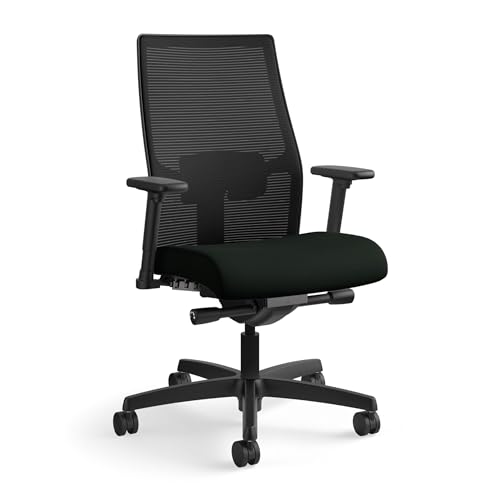
3. HON Ignition 2.0 — Best Mid-Range Adjustable
The Ignition 2.0 is the office-standard answer: HON’s ergonomic task chair whose verified listing specifies lumbar support and adjustable arms in a desk-chair format built for workplaces — which means built for adjustability across many bodies, the exact culture a smaller sitter needs. Its mid-range positioning is the story: the fit-relevant features that the premium pair pioneered — a lumbar system that can be positioned, arms that move out of a small frame’s way, a seat height range meant to serve a workforce rather than a showroom — at a tier an employer or a home worker can approve without a committee. For the petite buyer who wants a serious chair without the flagship invoice, this is the guide’s centre of gravity.
Strengths
- Lumbar support with the adjustable culture of an office line — position it where a shorter torso needs it.
- Adjustable arms matter disproportionately for small frames: arms that narrow and lower stop forcing shoulders upward.
- Workplace-grade build expectations at a mid-range tier.
Trade-offs
- Confirm the seat height minimum and seat depth on the listing against your measurements — office lines offer variants, and the variant is the fit.
- Less adaptive than the Leap, less size-scaled than the Aeron: it fits small bodies by adjustment range, not by design premise.
- Aesthetics are corporate; home users wanting furniture character should look at the room, not just the spec sheet.
The Ignition’s buyer is often a smaller person equipping a real job — theirs or an employee’s — where the chair must simply be right, durable, and defensible. In that brief it is the least dramatic and most sensible purchase in this guide.
Best for: home-office and workplace buyers wanting proven adjustability at a mid tier. / Not suited for: buyers wanting premium adaptation or furniture styling.
Check on Amazon — check the current price on Amazon and confirm dimensions on the listing.

4. SIHOO M18 — Best Budget Ergonomic
The M18 is the budget ergonomic overachiever: its verified listing specifies a mesh back with headrest, adjustable lumbar support, 2D armrests, a wide cushion, tilt lock, and a 330 lb capacity — a feature inventory that, read cold, belongs a tier up. For the smaller sitter, the headliners are the adjustable lumbar (placeable support rather than a fixed curve) and the 2D arms (height and width movement that lets narrow shoulders keep their arms supported without shrugging). The headrest deserves an honest note: on a high-back chair, a petite sitter should check where the headrest actually lands — for some shorter torsos it meets the head correctly only at its lowest setting, and for others it is best treated as an occasional lean-back feature rather than a working one.
Strengths
- Adjustable lumbar support at a budget tier — the single most valuable feature for this readership.
- 2D armrests adapt to narrow frames instead of dictating to them.
- Mesh back breathes through long sessions; tilt lock supports posture variety.
Trade-offs
- The ‘wide cushion’ in its listing cuts both ways: verify seat depth against your thigh length, because width is not depth but deep cushions often travel with wide ones.
- High-back-plus-headrest geometry is the least petite-native in the guide; the lumbar adjustment must do the fitting work.
- Budget-tier mechanisms loosen faster than premium ones over years of daily use.
None of that dethrones it as the budget ergonomic pick: it puts the two adjustments that matter most — lumbar placement and arm position — within reach of the tightest budget in this guide, and that is the correct priority order for a smaller sitter spending carefully.
Best for: budget buyers who refuse to give up lumbar and arm adjustability. / Not suited for: the very petite who need a genuinely small-scaled frame.
Check on Amazon — check the current price on Amazon and the seat dimensions on the listing.

5. Sweetcrispy Ergonomic Desk Chair — Best Compact Mid-Back
The Sweetcrispy’s verified listing describes a mesh office chair with lumbar support, a mid-back, rolling swivel base, and flip-up arms — and the mid-back is the petite-relevant headline. A mid-back’s top edge lands around a smaller torso’s shoulder blades rather than looming above the head, its proportions suit shorter backs, and its smaller footprint suits the smaller rooms smaller people often work in. Flip-up arms are the second quiet virtue: they let the chair roll fully under a desk (a small-room necessity) and let the sitter choose, posture by posture, whether arms are furniture or obstacles. As an ergonomic proposition it is simpler than the SIHOO — position this as the compact, honest mesh chair rather than the feature flagship.
Strengths
- Mid-back proportions match smaller torsos and smaller rooms.
- Flip-up arms solve the desk-clearance and posture-choice problems at once.
- Mesh back plus lumbar support covers the breathable-basics brief well.
Trade-offs
- Simpler adjustment set than the M18 — fewer levers to fine-tune fit with.
- Fixed armrest arms (when down) offer less positional tailoring for very narrow shoulders.
- Confirm seat height range and depth on the listing; compact chairs vary quietly in both.
This is the dorm-to-first-apartment, spare-room-desk pick: proportionate, breathable, inexpensive in tier, and honest about what it is. For a smaller person currently working from a kitchen chair, the upgrade in daily comfort is not subtle.
Best for: smaller rooms, smaller torsos, and first proper desk chairs. / Not suited for: buyers wanting maximum adjustability.
Check on Amazon — check the current price on Amazon before ordering.

6. DUMOS Home Office Chair — Best Simple Budget
The DUMOS closes the guide at the simplest tier: its verified listing describes a home office chair with lumbar support, an ergonomic mid-back mesh design, height adjustment, fixed armrests, and a rocking mode in a 360-degree swivel format. Read that list against this guide’s criteria and it covers the fundamentals — a back with lumbar intent, a seat that goes down as well as up, breathable mesh, mid-back proportions friendly to smaller torsos — without pretending to the adjustment depth of the chairs above it. The rocking mode is a genuine comfort feature for posture variety across a day, and the fixed arms are the honest budget trade: present, simple, and to be checked against your desk height and shoulder width on the listing’s dimensions.
Strengths
- Covers the fundamentals — lumbar support, height adjustment, mid-back mesh — at the guide’s lowest tier.
- Rocking mode encourages the posture changes that long sitting demands.
- Simple assembly and simple controls suit buyers who will never touch a lever twice.
Trade-offs
- Fixed armrests cannot adapt to narrow frames or low desks — the budget compromise, stated plainly.
- Lumbar support is a designed curve rather than a placeable system; its position is the maker’s choice, not yours.
- Long-term heavy daily use will find a budget chair’s limits sooner than a premium one’s.
The DUMOS buyer is upgrading from something worse — a dining chair, a stool, a sofa’s edge — on a budget that is real. Judged as that upgrade, it delivers the largest comfort delta per unit of money in this guide, and there is no shame in the guide’s sixth place when sixth place still means lumbar support, mesh, and a seat at the right height.
Best for: first upgrades and tight budgets needing the fundamentals. / Not suited for: buyers needing placeable lumbar support or adjustable arms.
Check on Amazon — check the current price on Amazon before ordering.
Comparison Table
| Pick | Badge | Key spec (verified) | Best for |
|---|---|---|---|
| Herman Miller Classic Aeron | Best Premium Fit | Lumbar pad, tilt limiter, seat-angle adjustment, fully adjustable arms | Size-scaled premium fit |
| Steelcase Leap | Best Adaptive Fit | LiveBack, Natural Glide System | Adaptive, upholstered comfort |
| HON Ignition 2.0 | Best Mid-Range Adjustable | Lumbar support, adjustable arms | Office-standard mid tier |
| SIHOO M18 | Best Budget Ergonomic | Adjustable lumbar, headrest, 2D arms, 330 lb capacity | Feature-rich budget buy |
| Sweetcrispy Ergonomic Chair | Best Compact Mid-Back | Mesh mid-back, lumbar support, flip-up arms | Small rooms and torsos |
| DUMOS Home Office Chair | Best Simple Budget | Mid-back mesh, lumbar support, height adjustable, rocking mode | First upgrades |
How to Choose the Best Chairs for Small People with Sciatica
Measure yourself before you measure chairs; three numbers decide almost everything in this category. First, your lower-leg length: sit on a firm surface with feet flat and measure from the floor to the crease behind your knee — your chair’s seat, at its lowest useful setting, should let you sit with feet flat and thighs roughly level, which for most smaller adults means a seat height at or below that measurement. Second, your thigh length, from the back of the buttock to behind the knee: the seat depth should be a little less than that, leaving a small gap between the seat edge and the back of your calves when your back is against the backrest — if a chair’s depth is fixed and longer than your thigh, you will perch, and perching deletes the backrest and its lumbar support from your day. Third, your torso’s lumbar position: note roughly where your lower back’s inward curve sits, and favour chairs whose lumbar support adjusts in height to meet it, or adaptive backs (the Leap) that find it themselves.
Then rank the adjustments by what they fix. Seat height range fixes feet and desk geometry — check its minimum, not its marketing. Seat depth adjustment (or a genuinely shallow seat) fixes the perch problem, the most common petite failure. Lumbar height adjustability fixes support placement. Arm adjustability — height and ideally width or flip-up designs — fixes the shoulder shrug that narrow frames suffer when arms are set for wider bodies. Back height is a proportion question: mid-backs suit smaller torsos; tall backs with headrests must be checked for where the headrest lands. Finally, the desk enters the equation: your chair height is partly dictated by your desk, and if the desk forces the chair up beyond your feet-flat height, the honest accessory is a footrest — a normal, inexpensive completion of a small person’s workstation, not an admission of defeat. And one standing instruction for this entire keyword: whatever chair you choose, no chair makes all-day stillness healthy — build movement breaks into the day, because posture variety is the one ergonomic intervention every tradition agrees on.
How to Set Up Your Chair: A Fitting Routine for Smaller Sitters
1. Start with the seat height. Sit, feet flat on the floor (or on a footrest if your desk demands a higher seat), knees at roughly a right angle or slightly open, thighs level. If your feet dangle at the chair’s lowest setting, the chair is too tall for you — no other adjustment compensates, and that verdict is worth reaching in the return window, not after it.
2. Set the seat depth if it adjusts: slide until you can fit roughly two to three fingers between the seat’s front edge and the back of your calves with your back fully against the backrest. Fixed-depth chairs: perform the same check as a pass/fail test of the chair itself.
3. Place the lumbar support. Adjust its height until its fullest point meets the inward curve of your lower back — for shorter torsos this is usually lower than the factory position, which is set for the median body this guide keeps mentioning. You should feel support, not pressure.
4. Set the arms to carry, not lift: elbows resting with shoulders relaxed and level. Narrow frames should bring arms inward where the design allows, flip them up where it does not, and treat arms that force a shrug as arms to remove or ignore.
5. Set recline tension to your weight — lighter sitters often find factory tension effectively locks the backrest; soften it until a lean produces a gentle recline you control. Posture variety across the day is the goal: upright for typing, eased back for reading and calls.
6. Revisit after a week. Bodies report fit problems slowly; the ache that arrives on day four is data. Adjust one variable at a time, and if discomfort persists or involves pain that radiates, worsens, or worries you, stop adjusting furniture and talk to a clinician — that conversation outranks this guide.
Common Buying Mistakes
The first mistake is buying by brand tier without checking the two numbers that decide petite fit — seat height minimum and seat depth — because a premium chair in the wrong dimensions is a premium-priced problem. The second is choosing a gaming or executive silhouette whose deep seat pan guarantees perching for a shorter thigh. The third is treating a headrest as a requirement: on many tall chairs a petite sitter’s head meets the headrest’s lower edge, which is worse than no headrest at all — mid-backs exist in this guide for a reason. The fourth is ignoring the desk: fitting the chair to your body but not to your workstation just relocates the compromise to your shoulders and wrists. The fifth is expecting any chair to resolve a medical condition — chairs address fit and comfort; pain with a pattern, a history, or red-flag features belongs to healthcare, and a guide that promised otherwise would be selling something it cannot deliver. And the sixth is sitting still in a perfectly fitted chair for ten hours: fit reduces the cost of sitting; it does not repeal it.
Final Recommendation
For the premium, size-first answer: the Herman Miller Classic Aeron in the correct size variant. For adaptive fit in an upholstered chair: the Steelcase Leap. For the sensible office mid-range: the HON Ignition 2.0. On a budget without surrendering adjustability: the SIHOO M18. For compact proportions: the Sweetcrispy. For the simplest honest upgrade: the DUMOS. Measure first, fit with the routine above, move often — and let clinicians, not chairs, handle anything that deserves the word treatment.
Related guides on this site: Best Chairs For Sitting At Desk · Best Chairs For Sketching Outside · Best Chairs For Soft Ground · Best Chairs For Watching Soccer
Desk, Monitor, and Footrest: Completing the Small Workstation
A chair is half a workstation, and smaller sitters lose more comfort to the other half than anyone else, because desks and monitors are also built to median dimensions. Desk height is the fixed point most home setups get wrong: a standard desk top sits at a height that suits a taller seated body, and when a smaller person raises their chair to meet it, their feet leave the floor — which is why this guide treats the footrest as standard equipment rather than an accessory. A good footrest is stable, angled slightly, and large enough for both feet to move on; movement on the rest is a feature, because a footrest that invites small shifts is a posture-variety device, not just a shelf. Monitor height follows from the seated position the chair and desk create: the screen’s top should sit around eye level with the display at arm’s length, and smaller sitters at raised chairs often discover their laptop-on-desk setup has been asking their neck to live at an angle all day — a stand or a stack of books is the unglamorous, effective fix, and it costs less than any chair in this guide. Keyboard and mouse belong at elbow height with shoulders down; if the desk cannot go there, a keyboard tray can. The order of operations matters: fit the chair to your body first (the routine above), then fit the desk environment to the chair’s resulting position, then the screen to your eyes. Households that reverse the order — screen first, chair last — end up adjusting the one component with the least range to compensate for all the others, and the smaller body pays the difference.
Testing a Chair Inside the Return Window: A Two-Week Protocol
Because fit is empirical, the purchase is not finished at delivery; it is finished when the chair survives a fortnight of your real work. Week one is for setup and suspicion: assemble carefully, run the full fitting routine, and then deliberately notice your body at three fixed moments daily — mid-morning, after lunch, end of day — because chair problems announce themselves as patterns at hours, not as impressions in minutes. Adjust one variable every couple of days rather than five at once, so improvements and regressions have causes you can name. Week two is for verdicts: by now the novelty has worn off, the foam and mesh have settled into their working character, and your notes answer the only questions that matter — are your feet flat without thought, does your back find the lumbar support without arranging yourself, do your shoulders stay down through a long afternoon, and do you leave the desk less aware of the chair than you arrived at it? A chair that passes is furniture for years. A chair that fails should go back inside the window without sentimentality, because the alternative — a decade of almost-right — is the most expensive outcome in this entire guide, and it is purchased by politeness toward a cardboard box. Smaller sitters, who have the narrowest margin for ‘almost’, should be the least sentimental returners of all.
Reading Chair Specifications Like a Fitter
Listings speak a dialect, and smaller buyers need the translation. ‘Seat height’ is a range, and only its bottom number matters to you — a chair advertised as height-adjustable whose range starts above your feet-flat measurement is, for you, not height-adjustable at all. ‘Seat depth’ may be given as the cushion’s physical depth or as a range when it slides; compare it against your thigh measurement with the two-to-three-finger rule from the fitting routine, remembering that waterfall-front cushions forgive a centimetre that a square foam edge does not. ‘Lumbar support’ spans everything from a moulded curve (present, fixed, the maker’s guess) to a height-adjustable pad to an adaptive system — the words are the same in listings and the products are not, so classify what you read: adjustable beats designed, and designed beats ‘ergonomic backrest’, which means nothing measurable at all. ‘Weight capacity’ — the M18’s stated 330 lb is an example — describes structural rating, not fit, and a generous capacity tells a smaller buyer nothing except that the chair will not fail; do not let it substitute for dimensions. ‘High back’ and ‘mid back’ are proportion claims to check against your torso, and headrests deserve the suspicion this guide has given them throughout: an accessory positioned for a longer spine. Finally, casters and bases matter quietly in small rooms — a five-star base’s footprint can exceed a compact desk’s knee space, and carpet casters (named in the Aeron’s listing) versus hard-floor casters change both movement and floor wear. Read every listing this way — bottom of ranges, class of lumbar, proportion of back — and the six picks above sort themselves against your three measurements with very little drama.
Posture Variety: The Habit That Outranks Every Chair
Every tradition of sitting advice converges on one point that no product can sell: the best posture is the next one. A perfectly fitted chair held in a single position for ten hours still loads the same tissues the same way all day, and smaller sitters — whose fit margins are thinnest — benefit most from breaking the pattern deliberately. The practical repertoire is small. Alternate the chair’s own configurations: upright with lumbar contact for focused work, eased recline for calls and reading, arms in play for typing and flipped or lowered for close desk work where the Sweetcrispy’s design cooperates. Stand for the tasks that allow it — calls, reading, thinking — because standing badly for five minutes still rests the sitting tissues completely. Walk for the ones that allow more; the water trip is an ergonomic intervention disguised as a habit. And set the day’s rhythm by timer rather than by discomfort, because discomfort is a lagging indicator that reports a debt already incurred. None of this diminishes the chair’s role — fit decides how much each sitting hour costs — but it places the purchase honestly inside a system whose other component is a calendar. Readers who take one sentence from this guide to their clinician conversation, let it be that one: the chair is fitted, the desk is set, and the breaks are scheduled; what else should this particular back be doing?
Shared Desks, Hot Desks, and Chairs That Must Fit Two Bodies
One common buying situation complicates everything above: the chair that serves two people of different sizes — partners sharing a home office in shifts, a household desk used by a parent and a teenager, the workplace hot desk. Fit is personal, but adjustment range is shareable, and the shared-chair brief reorders this guide’s priorities. What matters most becomes speed and memory of adjustment: the chair whose height, arms, and lumbar can be reset in twenty seconds without tools will actually be reset; the chair needing five minutes of lever archaeology will be sat in, wrongly, by whoever arrives second — and in a size-mismatched pair, the smaller body usually inherits the worse compromise, because the taller setting is the one that stays. Favour, for shared duty, the chairs with the most legible adjustments (the mid-range office culture of the HON, the SIHOO’s clear lumbar and arm controls), agree a household convention — each user resets at the end of their session, like a car seat returned — and mark personal settings with a discreet tape dot if memories differ. Where the size gap is extreme, honesty may require two chairs and a storage plan rather than one heroic compromise; a small person’s chair and a tall person’s chair, swapped at the desk, cost less than one premium chair that fits neither. The principle generalises beyond households: any chair bought for a named individual should be fitted to that individual, and any chair bought for a rotation should be bought for its adjustment manners first and its peak comfort second.
Children, Teenagers, and the Family Desk Chair
A neighbouring case deserves a short, careful word: smaller bodies at desks are not only adults. Teenagers doing homework and older children at family computers face the same median-dimension problem in miniature, and the household chair that serves them follows this guide’s logic — feet supported (a footrest or a box is fine and normal), seat depth that does not force perching, a back whose support lands where their back actually is. What children should not inherit is the search’s medical framing: growing bodies with back pain are a clinician’s conversation promptly, not a furniture problem, and this guide’s comfort criteria are offered for ordinary desk comfort only. Practically, the compact mid-back picks here — the Sweetcrispy’s proportions, the DUMOS’s simplicity — often serve a family desk better than a tall chair bought ‘to grow into’, because a chair, unlike a coat, does its work at today’s dimensions or not at all. Buy for the body at the desk this school year; the return-window protocol applies to family chairs exactly as it does to professional ones.
Frequently Asked Questions
What seat height do smaller people actually need?
One that lets you sit with feet flat and thighs roughly level — which depends on your lower-leg length, so measure from floor to the crease behind your knee while seated. Many smaller adults need a seat that adjusts lower than standard chairs go, which is why this guide insists on checking the minimum height on the listing, and why a footrest is the correct fix when a fixed-height desk forces the seat higher.
Can the right chair fix sciatica?
No. A chair can improve fit and sitting comfort; it cannot diagnose or treat sciatica or any medical condition. If you have persistent or radiating pain, numbness, or weakness, see a clinician or physiotherapist — and feel free to ask them what seating features suit your specific situation, then use this guide’s fit criteria to shop.
Why does seat depth matter so much for small people?
Because a seat deeper than your thigh forces a choice between using the backrest and keeping circulation behind your knees. You end up perched forward — losing lumbar support entirely — or slumped. Adjustable depth, a glide system, or a genuinely shallow seat removes the dilemma, which is why depth is a headline criterion throughout this guide.
Is a footrest a good idea with these chairs?
Yes, when the desk height sets the chair higher than your feet-flat position. A stable footrest restores the geometry the chair alone cannot, and it is a standard, inexpensive part of a smaller person’s workstation rather than a workaround to be embarrassed about.
Mid-back or high-back for a smaller torso?
Usually mid-back, whose proportions match a shorter back and whose top edge lands sensibly at the shoulder blades. High-backs can work when their lumbar support adjusts low enough and any headrest meets your head rather than its edge — check both against your measurements before assuming taller means better.
Is a second-hand premium chair a smart buy for a smaller sitter?
It can be — premium chairs like the Aeron and Leap are built for long service, and office liquidations put them within mid-range budgets. The petite-specific cautions: confirm the size variant on an Aeron (a bargain in the wrong size is not a bargain), check that every adjustment still moves and holds, and budget for the return impossibility by inspecting in person where you can. A verified-fit used premium chair beats a new chair in the wrong dimensions every time.
How long should I sit before taking a break?
Short, frequent changes beat long endurance: stand, walk, or change posture at regular intervals through the day — many people use a half-hour rhythm as a starting habit. A well-fitted chair lowers the cost of sitting; movement remains the part no product can do for you.
Fit is not a luxury specification. For the smaller body at a desk, it is the difference between equipment and obstacle — and it is achievable at every tier in this guide, provided the measurements lead and the marketing follows.


