Disclosure: airfryerkitchensupply.com is reader-supported. When you buy through links on our site, we may earn an affiliate commission at no extra cost to you.
Where to buy
Every chair below was cross-checked against Amazon’s catalog data before it earned a link:
- Coleman Big-N-Tall Camping Chair with Cup Holder & Side Pocket — Check on Amazon
- Tommy Bahama 5-Position Lay-Flat Backpack Beach Chair — Check on Amazon
- Rio Brands 4-Position Lace-Up Backpack Beach Chair — Check on Amazon
- Coleman Utopia Breeze Lightweight Beach Chair — Check on Amazon
- Neso Beach Chairs, Lightweight Portable Foldable Recliner — Check on Amazon
- SUNNYFEEL Oversized Camping Chair, Portable Director’s Chair with Side Table — Check on Amazon
Introduction: Soft Ground Defeats Ordinary Chairs in One Specific Way
The best chairs for soft ground are engineered around a single piece of physics: pressure is weight divided by contact area. A standard camp chair concentrates your whole weight onto four narrow leg tips, and on sand, soft soil, mud, or lush grass those tips act like tent stakes — the chair sinks, tilts, and eventually deposits you at an angle while your drink migrates into the grass. Chairs that work on soft ground defeat the stake effect in one of three ways: oversized feet that spread the load, low wide frames that put long rails or broad contact patches on the ground instead of points, or flat bar feet that behave like skis. Every pick in this guide uses at least one of those strategies, and most use two.
That is why this list looks different from a generic camping chair roundup. The anchor pick, Coleman’s Big-N-Tall, states “stable large feet” in its own listing — the exact feature this category exists for. Around it, we chose beach chairs, because the beach is soft ground in its purest form and beach chair design has spent decades solving exactly your problem: low centers of gravity, wide aluminum frames, and ground contact along rails rather than points. A director’s chair rounds out the list with the ski principle — flat horizontal feet that float on turf and soft soil where pointed legs punch through.
Honesty about limits belongs at the top. No portable chair makes deep mud or saturated ground pleasant, and a chair that excels on beach sand behaves differently on a soft, uneven lawn. The reviews grade each pick by the soft ground it suits — sand, grass, soft soil, festival fields — and the buying guide explains how to read any chair for soft-ground competence: look at its feet first, its frame geometry second, and its comfort features last, because on soft ground that is the order in which they will matter to you.
In this guide
Quick Picks
- Best Overall: Coleman Big-N-Tall — stable large feet stated in the listing, extra-roomy seat, supports up to 600 pounds. Check on Amazon
- Best for Sand: Tommy Bahama Backpack Beach Chair — 5-position lay-flat design, low beach frame, carries on your back. Check on Amazon
- Best Value Beach Chair: Rio Brands Backpack Beach Chair — 4-position lace-up design, aluminum frame, 11-inch seat height. Check on Amazon
- Best Lightweight: Coleman Utopia Breeze — 5.3 pounds, low design, mesh cup holder and seatback pocket. Check on Amazon
- Best Portable Recliner: Neso Beach Chairs — lightweight, portable, foldable recliner design for park, camping, and outdoors. Check on Amazon
- Best for Lawns and Events: SUNNYFEEL Director’s Chair — flat-bar feet, side table, 300-pound capacity, breathable mesh. Check on Amazon
How These Picks Were Chosen
The first filter was ground contact. We looked for chairs whose listings evidence a soft-ground strategy — large feet, beach-frame geometry, low wide stances, or flat bar feet — and set aside the standard quad camp chairs whose four pointed legs are precisely the failure mode this search exists to solve. Several excellent camping chairs were excluded on exactly that ground; they will serve their owners well on patios and hardpack, and badly on a wet festival field.
The second filter was verification: every product, capacity figure, and feature below comes from the manufacturer’s Amazon listing data, cross-checked before any link was assigned. Where a listing states a capacity (600 pounds for the Coleman, 300 for the SUNNYFEEL) or a weight (5.3 pounds for the Utopia Breeze), we quote it as the maker’s figure in the spec box. Where a listing does not state a number, the box stays shorter — that is what honest spec boxes look like. Finally, we balanced the list across soft-ground venues: deep sand, lawns and parks, soft campsite soil, and event fields, because the best chair for a beach week is not automatically the best chair for a backyard on soft turf.
The 6 Best Chairs for Soft Ground

Coleman Big-N-Tall Camping Chair — Best Overall
The Big-N-Tall is the rare camp chair whose listing names this guide’s core feature outright: stable large feet. Around them sits an extra-roomy steel-frame chair rated to support up to 600 pounds, water-resistant, with a cup holder and side pocket. It suits larger users first — the seat is genuinely generous — and anyone whose soft-ground problem is a standard chair sinking under them on lawns, campsites, and fields, because large feet plus a wide stance is the direct mechanical answer.
Strengths
- Stable large feet stated in the listing: the load-spreading contact this category is about.
- Supports up to 600 pounds per the listing — the highest capacity here, on a steel frame.
- Extra-roomy design with cup holder and side pocket: full camp-chair comfort, not a compromise stool.
Trade-offs
- Big and tall means big when folded — car camping and backyard duty, not long carries.
- Large feet help on soft soil and grass; on the softest dry sand, low beach frames still float better.
- Steel frame is sturdy and correspondingly weighty next to the aluminum beach picks.
| Spec | Detail |
|---|---|
| Feet | Stable large feet |
| Capacity | Supports up to 600 pounds (manufacturer’s figure) |
| Frame | Steel frame, water-resistant |
| Extras | Cup holder, side pocket |
Why this anchors the list is that it solves soft ground without changing what a camp chair is. You still sit at camp-chair height, with a back, arms, and a place for your drink — you simply stop sinking. On lawns after rain, on soft campsite soil, on the grassy edge of a festival, the large feet turn the slow tilt-and-sink routine into a non-event. For larger users the effect doubles, because the same physics that punishes weight rewards contact area, and this is the one mainstream chair that visibly engineered for both.
Best for: larger users and general soft ground — lawns, campsites, fields / Not suited for: long carries or the deepest dry sand.
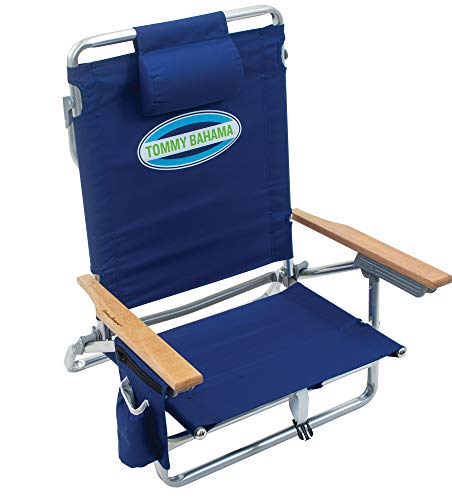
Tommy Bahama 5-Position Lay-Flat Backpack Beach Chair — Best for Sand
Beach chairs are soft-ground specialists by birth, and the Tommy Bahama is the category’s beloved standard: a 5-position chair that reclines to lay-flat, with an 8.5-inch seat height, a pillow, cup holder, storage pouch, and backpack straps that leave your hands free for the cooler. On sand, its low, wide frame spreads weight along its structure instead of driving legs into the beach — which is why generations of beachgoers converged on this architecture.
Strengths
- Low, wide beach frame: ground contact by design, the anti-sinking architecture.
- 5 positions to lay-flat — genuine reclining for reading, sunning, and napping.
- Backpack straps plus pillow, cup holder, and storage pouch: the complete beach kit in one carry.
Trade-offs
- An 8.5-inch seat height is low by design; anyone with knee trouble should test the rise before a beach week.
- Beach geometry is sand-first: on firm ground it is comfortable, on soft soil good, but its home is the shore.
- Lay-flat mechanisms and sand are eternal enemies — rinse and dry the frame after beach use.
| Spec | Detail |
|---|---|
| Positions | 5-position, lay-flat |
| Seat height | 8.5 inches |
| Carry | Backpack straps |
| Extras | Pillow, cup holder, storage pouch |
The soft-ground lesson this chair teaches is that sinking is a posture problem as much as a feet problem. By sitting you low and wide, it keeps your center of gravity inside a broad footprint, so the chair settles millimeters into sand and stops — stable, level, done. Compare the standard camp chair beside it on the same beach, legs drilling at four points, and the category makes sense at a glance. If your soft ground is primarily sand, start here and let the lawn picks argue for second place.
Best for: beaches and sandy ground of every kind / Not suited for: users who struggle to rise from low seats.

Rio Brands 4-Position Lace-Up Backpack Beach Chair — Best Value Beach Chair
Rio Brands builds the other classic of the beach-chair world: a 4-position recliner with a lace-up suspension seat, an aluminum frame, an 11-inch seat height — noticeably easier to rise from than the lowest beach chairs — plus pillow, cup holder, storage pouch, and backpack carry. The lace-up seat is the detail veterans swear by: the fabric suspends rather than stretches, so the chair keeps its comfort and shape season after season.
Strengths
- Aluminum frame: light, rust-resistant, and wide in the beach geometry that floats on sand.
- 11-inch seat height — the friendliest rise among the true beach chairs here.
- Lace-up suspension seat holds its tension and comfort longer than plain fabric seats.
Trade-offs
- Four positions rather than the Tommy Bahama’s five, and no full lay-flat claim in the listing.
- Lace-up seats eventually need re-tensioning — a small chore, honestly disclosed.
- Beach-first design, like its rival: happiest on sand and soft lawns.
| Spec | Detail |
|---|---|
| Positions | 4-position |
| Seat height | 11 inches |
| Frame | Aluminum frame |
| Seat | Lace-up suspension |
| Extras | Pillow, cup holder, storage pouch, backpack straps |
Choose the Rio over the Tommy Bahama on two grounds: the higher seat, if rising matters, and the lace-up seat, if you keep chairs for many seasons and maintain them. Its soft-ground credentials are the same beach physics — low, wide, rail-borne — proven across the same decades of shoreline use. As the value end of the classic beach pair, it gives up a reclining position and keeps everything that makes the format work where the ground gives way.
Best for: beachgoers wanting easier rising and a durable suspension seat / Not suited for: lay-flat sunbathers.

Coleman Utopia Breeze Lightweight Beach Chair — Best Lightweight
The Utopia Breeze weighs 5.3 pounds — Coleman’s figure in the listing — and builds its soft-ground case on the low beach profile: a low design for leg comfort, a relaxed back rest, a mesh cup holder, and a seatback pocket. At that weight it is the chair you actually bring: to the far end of the beach, the soft far corner of the park, the festival field a mile from parking, where heavier chairs get left in the car and their owners sit on the ground they were trying to escape.
Strengths
- 5.3 lb stated weight — carry it all day without thinking about it.
- Low beach design spreads load the way beach frames do, on sand and soft grass alike.
- Mesh cup holder and seatback pocket cover the small essentials without bulk.
Trade-offs
- Low seat, like all beach chairs: the rise is the price of the profile.
- Lightweight build means a simpler feature set than the backpack chairs — no multi-position recline story here.
- Best on sand and soft lawns; deep mud defeats it as it defeats everything portable.
| Spec | Detail |
|---|---|
| Weight | 5.3 pounds (manufacturer’s figure) |
| Design | Low beach design, relaxed back rest |
| Extras | Mesh cup holder, seatback pocket |
There is a soft-ground scenario the big chairs cannot serve: the long walk. Soft ground is rarely beside the parking lot — it is at the end of the trail, the far dune, the back field — and every pound of chair is a pound carried over the very terrain in question. The Utopia Breeze is the pick that respects that arithmetic, arriving light enough to be an afterthought and sitting, once there, with the same low wide stability as its heavier beach relatives.
Best for: long carries to sand and soft grass / Not suited for: users needing a high, easy-rise seat.

Neso Beach Chairs — Best Portable Recliner
Neso’s entry is a lightweight, portable, foldable recliner positioned by its listing for park, camping, and outdoor adventures — the generalist of the beach family. Where the Tommy Bahama and Rio are shore traditionalists, the Neso aims at the mixed soft-ground life: a park lawn on Saturday, a campsite on Sunday, a beach when the season allows, folding flat enough to live in a car trunk between all three.
Strengths
- Recliner function in a lightweight, foldable package — comfort that travels.
- Positioned across park, camping, and beach use: the mixed-venue brief most households actually have.
- Beach-family geometry — low and wide — with the portability to reach soft ground far from the car.
Trade-offs
- A generalist’s compromise: shore purists may prefer the classic backpack chairs’ features.
- Recliners sit low like their beach relatives; check the rise if that is a concern.
- The listing is spare on stated figures — fewer spec-box numbers to lean on than the Colemans provide.
| Spec | Detail |
|---|---|
| Type | Foldable recliner beach chair |
| Design | Lightweight, portable |
| Positioning | Park, camping, outdoor adventures |
The Neso’s argument is versatility across soft venues rather than mastery of one. Its recline gives it the lounging comfort the simple beach chairs lack, its fold keeps it trunk-friendly, and its ground manners follow the family pattern — a frame that meets soft ground across a wide footprint instead of at four points. For households whose soft ground changes by the weekend, that breadth is worth more than any single-venue refinement.
Best for: mixed soft-ground life — parks, campsites, beaches / Not suited for: buyers wanting maximum stated specifications or a high seat.
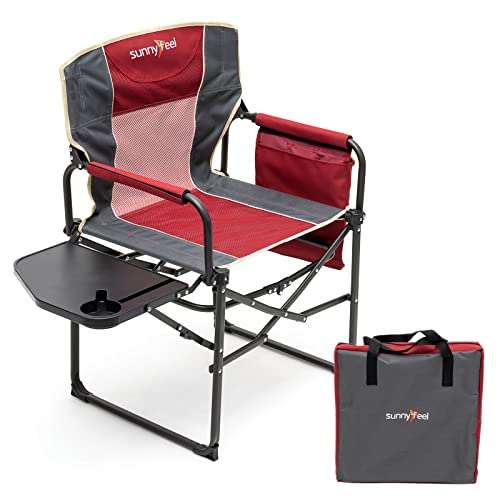
SUNNYFEEL Oversized Director’s Chair with Side Table — Best for Lawns and Events
The director’s chair is soft ground’s quiet answer for turf: its feet are flat horizontal bars, and a bar cannot punch into soil the way a leg tip does — it rests on the surface like a ski. SUNNYFEEL’s oversized version adds a side table, breathable mesh, a pocket and carry bag, and a 300-pound capacity per the listing, in a folding lawn chair format that sits at proper chair height. It suits backyard gatherings on soft lawns, outdoor events, sidelines, and anyone who wants to sit high and level while camp chairs around them slowly tilt.
Strengths
- Flat bar feet: the ski principle — ground contact along a bar, not at a point.
- Proper seat height with arms and a side table: the civilized end of portable seating.
- 300 lb capacity per the listing, with breathable mesh for warm-weather events.
Trade-offs
- Director’s chairs fold flat but long — trunk-friendly, backpack-hostile.
- Bar feet excel on turf and soil; on loose dry sand, low beach frames still win.
- The side table is a convenience with a limit — level ground helps it, as it helps everything.
| Spec | Detail |
|---|---|
| Feet | Flat bar feet (director’s chair frame) |
| Capacity | 300 pounds (manufacturer’s figure) |
| Extras | Side table, pocket, carry bag |
| Fabric | Breathable mesh |
Watch a garden party on a soft lawn and you can sort the chairs by physics: the pointed-leg chairs are at angles, their owners unconsciously re-leveling every few minutes, while the director’s chairs sit placidly at their original height. That is this pick’s whole case, and on turf it is decisive. Add the table — a civilized place for a glass that is not the grass — and the SUNNYFEEL becomes the event chair of the list, the one hosts buy in pairs and guests quietly compete for.
Best for: lawns, gardens, events, and sidelines on soft turf / Not suited for: beach sand or long carries.
Comparison Table
| Pick | Badge | Key spec | Best for |
|---|---|---|---|
| Coleman Big-N-Tall | Best Overall | Stable large feet, up to 600 lb, steel frame | Lawns, campsites, larger users |
| Tommy Bahama Backpack Beach Chair | Best for Sand | 5-position lay-flat, 8.5″ seat, backpack carry | Beaches |
| Rio Brands Backpack Beach Chair | Best Value Beach Chair | 4-position, aluminum, 11″ seat, lace-up | Beachgoers, easier rising |
| Coleman Utopia Breeze | Best Lightweight | 5.3 lb, low beach design | Long carries |
| Neso Beach Chairs | Best Portable Recliner | Foldable recliner, park/camping/beach | Mixed soft venues |
| SUNNYFEEL Director’s Chair | Best for Lawns and Events | Flat bar feet, side table, 300 lb | Soft turf, events, backyards |
How to Choose a Chair for Soft Ground
Read the feet first. Large flat feet, wide disc-like feet, long rails, or flat bars all spread load; narrow leg tips concentrate it. If a chair’s product photos hide its feet, that is information in itself. The Coleman Big-N-Tall puts its large feet in its listing title; the director’s chair’s bars are visible in its silhouette; beach chairs show their low wide frames from across the room. On soft ground, the feet are the product — everything above them is upholstery.
Second, match the frame to your ground. Sand rewards the lowest, widest frames — the beach picks — because dry sand behaves almost like a fluid and only broad contact floats on it. Lawns and soft soil reward contact area plus a little clearance: large feet or bar feet, at normal or near-normal seat heights, as the Coleman and SUNNYFEEL provide. Mud rewards honesty: everything portable struggles, and the best strategy is the widest contact you can carry plus a ground mat under the chair — a trick worth knowing for festival fields and fishing banks, where a simple mat under any of these chairs transforms its manners.
Third, respect the rise. Soft-ground chairs trend low, and low seats are genuinely harder to leave — knees and hips notice. The Rio’s 11-inch seat and the director’s chair’s full height exist for buyers who need the help, and needing it is no small thing: a chair you cannot rise from gracefully will be left at home regardless of its feet. Test with your actual body in mind, and if two chairs tie on ground manners, buy the one you can get out of at the end of a long, comfortable sit.
Finally, weigh the carry. Soft ground is usually some distance from hard parking, and a chair’s transport — backpack straps on the beach pair, a 5.3-pound lift in the Utopia Breeze, a carry bag on the SUNNYFEEL — decides whether the chair attends the soft ground at all. Match the chair to the whole journey: car, carry, ground, sit, rise, return. The best chair for soft ground is the one that completes that journey with you, every time.
How to Set Up and Use Chairs on Soft Ground
Setup on soft ground has a technique worth learning. Place the chair, then sit down slowly the first time and let it settle — every soft-ground chair finds its level in the first minute, and fighting that settle by perching is how chairs end up tilted. If one corner sinks further, do not shim with random objects under a leg; instead, shift the chair a few inches to firmer ground or stamp the soft spot flat with your foot before resetting. On sand, a small excavation for the frame’s low points levels a beach chair beautifully; on lawns, rotating the chair ninety degrees sometimes finds the turf’s firmer grain.
During use, keep the load honest: these are one-person chairs with stated capacities, and soft ground multiplies stress on frames and feet when a chair is shared, rocked hard, or used as a step. Getting up, push from the arms rather than twisting — twisting drives one foot deeper and teaches the chair a permanent lean. After use, knock sand and soil from feet and joints before folding; grit in a hinge is a slow grinder, and a rinse-and-dry after beach days, as the Tommy Bahama review notes, is the difference between a five-season chair and a two-season one. Store dry, and soft-ground chairs repay the small discipline for years.
The Physics of Sinking — and the Three Design Answers
Every soft surface has a bearing capacity: the load per unit area it can support before it deforms. Dry sand’s is low and treacherous, because grains shift rather than lock; a wet lawn’s is moderate until the topsoil saturates; soft campsite soil sits between. A seated adult loads a chair with well over a hundred pounds, and a standard camp chair delivers that load through four tips with a combined area smaller than a credit card. The arithmetic guarantees sinking. The three design answers in this guide are simply three ways of changing that arithmetic.
Answer one: bigger feet. The Coleman Big-N-Tall’s stable large feet multiply the contact area at each corner, dropping the pressure at every point below what grass and soil can bear. It is the minimal change to the classic camp chair — same height, same posture, different ending. Answer two: change the geometry. Beach chairs abandon the four-point stance altogether, meeting the ground along a low, wide frame whose contact is measured in square feet rather than square inches; on sand, whose grains flow around broad surfaces and then settle, this is the definitive solution, refined over decades of shoreline trial and error. Answer three: the ski. The director’s chair’s flat bars spread load along lines rather than points — less total area than a beach frame, far more than leg tips — which is exactly calibrated to turf, a surface that needs distribution but not flotation.
Understanding the three answers protects you from the category’s marketing noise. A chair advertised for soft ground should be able to say, in its geometry, which answer it embodies. If its feet are ordinary and its frame is a standard quad, no fabric upgrade or cup-holder count changes its physics. Conversely, modest chairs with honest geometry — the 5.3-pound Utopia Breeze is the example here — outperform premium chairs with pointed legs every time the ground gives. Feet first is not a slogan; it is the entire engineering of this category, and now you can read any chair the way its designer had to.
Soft Ground, Venue by Venue
Beaches. Dry sand is the softest common surface and the beach chairs’ home: Tommy Bahama for the full recline, Rio for the rise, Utopia Breeze for the walk, Neso for the mix. Wet sand near the waterline is firmer — almost any pick works — but chairs migrate toward the dry sand as the day warms, so buy for the soft end of the beach, not the hard.
Lawns and gardens. The everyday soft ground. After rain or watering, turf that felt firm at noon gives way by evening, and this is where large feet and bar feet earn their keep at civilized seat heights: the Coleman for gatherings that need real chairs, the SUNNYFEEL for hosts who want the table and the level sit. Garden parties, graduation lawns, and backyard cinemas all live here.
Campsites and festival fields. Variable ground — firm at the pitch, soft at the field’s heart — rewards the generalists: the Big-N-Tall’s feet across soil and grass, the Neso’s portability when the soft spot is a walk from the car. Festival veterans add the ground mat to the kit and stop thinking about the problem entirely.
Sports sidelines and docks. Sideline grass is lawn physics with an audience: director’s chairs rule it for height, visibility, and the side table. Docks and decks are hard ground wearing soft-ground clothes — any pick works, and the choice reverts to comfort and carry. Fishing banks and river edges close the survey: soft, sloped, and damp, they want the widest contact and the lowest center you can carry — beach geometry again, or the Coleman planted with its large feet leveled by a stamped-flat patch of bank.
Accessories That Extend a Soft-Ground Chair’s Range
Three accessories genuinely change what these chairs can do, and the rest are decoration. The ground mat leads: a simple outdoor mat or even a cut of old carpet under a chair spreads its load across the mat’s whole area, converting marginal ground — damp fields, soft banks, borderline mud — into serviceable seating for any pick here. It is the cheapest capability upgrade in this entire guide. The canopy or umbrella comes second for beach and sideline duty, with a soft-ground caveat: shade attachments raise a chair’s wind profile, and soft ground anchors nothing, so canopies belong to calm days and attended chairs.
The third is the carry solution matched to your walk: backpack straps (built into the Tommy Bahama and Rio) for hands-free beach approaches, a shoulder-strapped bag (the SUNNYFEEL includes one) for field walks, or simply a chair light enough — the Utopia Breeze’s 5.3 pounds — to need no solution at all. What did not make this list: clip-on fans, elaborate tray systems, and multi-chair connectors, all of which add weight and complexity to a category whose whole virtue is arriving simply and sitting level. Spend on the mat first; it is the accessory that changes physics rather than convenience.
Care and Longevity: Keeping Soft-Ground Chairs Alive
Soft-ground chairs live harder lives than patio chairs — they are folded sandy, stored damp, and leaned on at angles their designers only half intended — and their care is correspondingly specific. Sand and soil must leave the chair before storage: shake it, brush the feet and joints, and rinse salt and grit from frames after beach use, because grit in a folding joint is a file that works every time the chair opens. Fabrics should dry fully before the closet; a chair stored with damp fabric in a warm garage will announce it at the next outing.
Frames reward a seasonal inspection: check foot caps and bar ends for wear (they are the ground-contact sacrificial parts), tighten what loosens, and touch rust-prone steel — the Coleman’s frame class — with the respect of a dry storage spot. Lace-up seats, the Rio’s signature, want their tension checked and renewed as seasons pass; it is a ten-minute ritual that returns the chair to new. Do these ordinary things and a soft-ground chair serves for many seasons; skip them, and the failure will arrive, as it always does, at the far end of a beach with no replacement in the car.
Soft Ground and Larger Users: Why the Margin Matters More Here
Soft ground amplifies every load question, and larger users feel it first: the same four leg tips that annoy a lighter sitter can drill outright under a heavier one, and a frame’s stated capacity — tested on firm, level floors — meets a less forgiving reality when one corner bears extra load in soft soil. The buying response is margin. Choose capacity with headroom to spare, as the Coleman Big-N-Tall’s up-to-600-pound rating provides; choose the widest contact geometry available, because pressure is the enemy and area is the cure; and prefer steel-frame sturdiness where the carry allows it.
Technique helps too: set the chair on the firmest patch, settle into it gradually rather than dropping, rise using both arms evenly instead of twisting up from one side, and re-level without embarrassment whenever the ground shifts — soft ground moves under everyone, and the chair that is re-seated once sits level for the whole afternoon. Larger users are also the buyers best served by the director’s chair format at events: full height for an easy rise, bar feet for the turf, and a stated capacity with real headroom in the SUNNYFEEL. The principle generalizes beyond any single body type — on soft ground, buy margin, in capacity and in contact area alike, and the surface stops being a negotiation.
Common Buying Mistakes
Buying a standard camp chair for soft ground. Four narrow leg tips are tent stakes. If the feet are not visibly part of the design, the chair is not part of this category.
Ignoring seat height. The most comfortable soft-ground chair you cannot rise from is a trap with a cup holder. Check the height against your knees before the beach trip.
Overlooking capacity on soft ground. Soft surfaces stress frames unevenly. Respect stated capacities — and value the headroom of picks like the 600 lb Coleman if you are a larger user.
Assuming one chair serves every soft surface. Sand, turf, and mud are different problems. The list splits its picks by venue because the physics genuinely differ.
Skipping the ground mat trick. On the worst ground — saturated fields, deep mud — a mat under the chair helps more than any chair upgrade. Pack one and every pick here levels up.
Storing chairs wet and sandy. Grit and moisture eat frames and fabrics in the closet. Rinse, dry, then store.
Final Recommendation
For most soft ground — lawns, campsites, fields — buy the Coleman Big-N-Tall: its large feet solve the sinking problem in a full-size chair, and its capacity covers nearly every user. For sand, the classics rule: the Tommy Bahama for full lay-flat lounging, the Rio Brands for the easier rise and lace-up durability. Long walks to soft ground belong to the Coleman Utopia Breeze at 5.3 pounds; mixed park-and-camp life to the Neso recliner; and soft turf events to the SUNNYFEEL director’s chair, whose flat bar feet simply refuse to sink. Read the feet first, and soft ground stops being a seating hazard.
Related guides in this series: Best Car Camp Chairs · Best Camper Lounge Chairs · Best Chairs For A Dock · Best Chairs For An Outdoor Party · Best Chairs Affordable
A closing perspective for buyers torn between this list and a conventional premium camp chair: ask where the chair will spend its hours, not its photographs. If the honest answer is decks, patios, and hardpack, buy the conventional chair and enjoy it. If the answer includes beaches, lawns after rain, festival fields, riverbanks, or a backyard that never quite firms up, the geometry in this guide is not a niche preference — it is the difference between sitting on the ground and sitting in it. Soft ground is where outdoor life actually happens; chairs built for it are not special equipment, they are the correct equipment.
Children change the soft-ground calculation in one specific way worth naming: kids treat chairs as terrain — climbing, rocking, and launching from them — and soft ground forgives none of it, because a tipping chair on grass falls farther into its tilt than one on a deck. The stable picks here — the wide-based Coleman, the low beach frames, the bar-footed director’s chair — are also the family picks for exactly that reason, provided adults set the example of sitting rather than mountaineering. Seat children in the lowest, widest chair available, keep the acrobatics on the lawn itself, and soft ground becomes what it should be for a family: the forgiving surface, not the hazard.
Short version of the whole guide, if you read nothing else: look at the feet before the fabric, match the frame to your softest venue, respect the rise as much as the sit, and add a ground mat to the kit for the days the earth wins anyway. Soft ground is not an edge case in outdoor life — it is most of it — and a chair chosen by its contact with the earth will serve you on every surface, including the hard ones, for seasons longer than a chair chosen by its cup holders.
And a word for gift buyers, because outdoor chairs are a classic gift that goes wrong in a specific way: the giver buys for the deck they imagine, the recipient lives with the lawn they have. If you are choosing for someone else’s soft ground — a beach-house host, a sideline parent, a gardener — buy from the forgiving end of this list: the Coleman’s large feet and generous seat, or the director’s chair’s height and table, both of which suit bodies and backyards you have not measured. A chair that fits its ground and its person without adjustment is the rare gift that gets used the same weekend it arrives.
Frequently Asked Questions
Why do regular camping chairs sink into soft ground?
Because of pressure concentration: your weight exits the chair through four narrow leg tips, and soft surfaces cannot resist that focused load, so the tips drive in like stakes. Chairs for soft ground spread the same weight across large feet, wide frames, rails, or flat bars — the load per square inch drops, and the chair rests on the surface instead of drilling into it.
Are beach chairs really good on grass and soft soil, or only on sand?
The same physics applies on any yielding surface: low, wide frames with broad ground contact settle shallowly and stay level on soft lawns and campsite soil too. Where beach chairs concede is seat height — they sit low by design. For turf at normal sitting height, the director’s chair’s bar feet or the Coleman’s large feet are the better-shaped answers.
What can I do if my current chair sinks?
Three field fixes help: place a ground mat or even a flattened cardboard sheet under the chair to spread its load; choose the firmest patch available and stamp it flat before setting up; and sit down gently to let the chair settle evenly rather than dropping into it. For a permanent fix, replacement wide feet and chair foot accessories exist — but a chair designed for soft ground, like the picks here, solves it structurally rather than by accessory.
Which of these chairs is easiest to get out of?
The SUNNYFEEL director’s chair sits at full chair height with arms to push from — the easiest rise on the list. Among the beach chairs, the Rio’s 11-inch seat is noticeably friendlier than the Tommy Bahama’s 8.5-inch. The Coleman Big-N-Tall’s standard camp-chair height and sturdy arms also rise well. Low beach chairs are the trade-off picks: superb on sand, demanding on knees.
How much weight can these chairs hold?
Where the manufacturers state figures, we quote them: up to 600 pounds for the Coleman Big-N-Tall and 300 pounds for the SUNNYFEEL director’s chair. The beach picks’ listings do not state capacities in the data we verified, so consult their product pages for current figures — and always respect stated limits, since soft ground stresses frames unevenly and margins matter more, not less, when the ground gives.
What is the difference between large feet, disc feet, and bar feet?
They are three shapes of the same idea — more contact area. Large feet are widened pads at each leg’s end, as on the Coleman Big-N-Tall: the least departure from a normal camp chair and very effective on grass and soil. Disc feet are round, plate-like feet, sometimes fixed and sometimes swiveling to match slopes, found on some specialist camp chairs; they excel at not punching through turf. Bar feet, the director’s chair pattern, spread load along a horizontal line and are the turf specialists. All three beat leg tips decisively; choose by the chair style and seat height you prefer.
Can I use these chairs on hard ground too?
Yes — soft-ground design costs nothing on hard ground. Large feet and bar feet sit perfectly well on decks, patios, and hardpack; the beach chairs are less at home indoors only because of their low seats, not their frames. A soft-ground chair is a superset purchase: it handles the hard venues adequately and the soft ones properly, which is more than can be said in reverse for standard chairs.
Do I need a different chair for mud?
Mud is the limiting case for every portable chair. The widest-contact picks — the Coleman’s large feet, the director’s bar feet — handle firm mud and damp fields best, and a ground mat underneath improves any chair dramatically. In genuinely deep mud, no folding chair is the right tool; choose the firmest ground available, add the mat, and let the widest feet here do their honest best.


