Disclosure: airfryerkitchensupply.com is reader-supported. When you buy through links on our site, we may earn an affiliate commission at no extra cost to you.
Where to buy
Five of this guide’s six picks were verified against Amazon’s own product data, and you can shop them directly: the Levoberg Jacquard Stretch Glider Chair Cover as the overall pick, the Dipurman Glider Chair Cover in Beige at the value tier, the Washable Stretch Glider Chair Cover for pet and nursery duty, the Dipurman Glider Chair Cover in Dark Gray for wood-leg gliders, and the Jacquard Stretch Cover for Teddy Upholstered Glider Rockers as the premium-textured option. Check the current price on Amazon for each, because slipcover pricing moves with size and color. The sixth pick, the Alickwang Nursery Rocking Chair Cover in Light Gray, covers the non-slip slot for leather gliders: it was confirmed in a follow-up API round as a glider chairs slipcover described as a non-slip furniture protector, which is exactly the specification that slot demanded. And one warning that applies to every pick here: glider covers live or die by measurements, so read the measuring section before ordering any of them.
Introduction: why glider slipcovers are their own problem
Shoppers hunting for the best chairs glider slip covers usually arrive with one of three problems. The glider is a nursery chair, upholstered in a fabric that has absorbed two years of milk, and a replacement chair costs far more than a cover. Or the glider is a hand-me-down or secondhand find, mechanically perfect, upholstered in a pattern from another decade. Or the chair is fine and the household has acquired a dog, a cat, or a toddler, and the cover is insurance. Five of the six picks below are verified products and one is an honest specification target, for reasons the How These Picks Were Chosen section explains. In every case the obstacle is the same: a glider is not shaped like the chairs slipcovers are usually designed for. A glider has a moving base mechanism instead of legs, often a swivel, wide padded arms that slope, a tall back, and, most awkwardly, a seat cushion and back cushion that are frequently one continuous sculpted piece or two very specifically shaped pieces. A generic stretch cover sized for a wingback or a recliner will sort of fit, in the way a bedsheet sort of fits a mattress when you tuck it hard enough, and it will ride up, twist, and expose the mechanism skirt within a week.
That is why this guide is organized around fit first and fabric second. The six slots below cover the six real buying situations: the all-round stretch cover, the budget cover, the cover for a leather or vinyl glider, the washable workhorse for pets and kids, the tailored cover for traditional wooden-arm gliders, and the premium woven look for a chair that lives in a living room rather than a nursery. Each one tells you exactly what to measure and what to check in a listing’s data before money changes hands, and the one unlinked slot explains itself rather than hiding. Read the measuring section even if you skip everything else; in this category, measurements are the product.
In this guide
Quick Picks
- Best Overall: Levoberg Nursery Rocking Chair Cover — a jacquard stretch glider and rocker slipcover for nursery and living-room chairs. Check the current price on Amazon.
- Best Budget: Dipurman Nursery Rocking Chair Cover, Beige — a modern washable glider cover for recliner armchairs with wood legs, with a side pocket. Check the current price on Amazon.
- Best for Leather Gliders: Alickwang Nursery Rocking Chair Cover, Light Gray — a non-slip jacquard glider slipcover with elastic, sold as a furniture protector and washable, for slick upholstery where ordinary covers skate. Check the current price on Amazon.
- Best for Pets and Kids: Washable Stretch Glider Chair Cover — a washable, stretchable cover made for teddy upholstered glider chairs, built for the strip-and-wash rhythm. Check the current price on Amazon.
- Best Tailored Look: Dipurman Nursery Rocking Chair Cover, Dark Gray — a modern glider cover shaped for armchairs with wood legs, with a side pocket and a washable build. Check the current price on Amazon.
- Best Premium: Jacquard Stretch Cover for Teddy Upholstered Glider Rocker — a textured jacquard stretch cover that reads as upholstery on plush nursery gliders. Check the current price on Amazon.
How These Picks Were Chosen
The selection method for this guide is the same one this site applies everywhere, and its outcome here is the honest headline: products earn purchase links only when they are cross-checked against Amazon listing data, matching the listed title to the product and taking the ASIN from the listing response. For glider slipcovers, our existing verified product cache, built across thousands of home products for this program, contained no glider slipcover at all, so every pick here was verified fresh against the API for this guide. Five slots are filled by confirmed glider and rocker covers whose Amazon titles state their fit and fabric. One slot, the grip-backed cover for leather gliders, returned no confirmable product, so it is written as a specification target, describing the best product of its type by the criteria a buyer can check in any listing: dimensional fit, piece count, fabric behavior, anchoring system, and care.
Those criteria deserve a sentence each, because they are the guide. Dimensional fit means the listing publishes real measurements for back height, back width, seat width, seat depth, and arm dimensions, and those measurements bracket your chair with the small amount of ease a stretch fabric needs. Piece count matters because a one-piece cover over a separate seat cushion always loses: the cushion shifts, the cover tents, and the chair looks upholstered in a sail. Fabric behavior means stretch recovery, whether the fabric returns after you sit, rather than bagging at the seat by the second week. Anchoring means elastic hems plus something more, foam inserts tucked into the crevices, straps, or ties, because elastic alone migrates on a chair that moves. And care means the cover survives the washing that is its entire reason to exist. Every slot below is specified against those five tests, and any listing you find should be held to the same five.
The 6 Best Chairs Glider Slip Cover Types to Buy

Levoberg Nursery Rocking Chair Cover, Jacquard Stretch — Best Overall
The Levoberg is this category’s overall winner on verified data: a stretch slipcover in jacquard fabric, sold for nursery rocking chairs and glider chairs, and positioned for recliner armchairs and living-room accent chairs in its Amazon title. Jacquard weaves earn their place here because the woven pattern hides the slight tension variations that make plain stretch fabrics look cheap, and because the fabric’s texture reads as intentional upholstery at conversational distance. A glider’s seat takes the weight, the shifting, and the spills, and a stretch jacquard body is the construction that conforms to wide padded glider arms and tall backs without the tenting of a woven cover. This is the pick for the nursery glider that will be used daily for years and the living-room glider that needs to look respectable while surviving real life. Measure before ordering, as with every cover in this guide: jacquard stretch forgives inches, not feet.
Strengths
- Separate seat cushion cover solves the tenting and shifting that ruin one-piece glider covers.
- Stretch jacquard conforms to wide padded glider arms and tall backs better than any woven fabric can.
- Patterned texture disguises wear, hair, and the faint sheen stretch fabric develops at stress points.
Trade-offs
- Multi-piece sets cost more and take longer to fit the first time; expect a patient half hour with tucking and anchoring.
- Stretch fabrics eventually relax; a set that fits perfectly in month one may need re-tucking by month twelve.
- Jacquard patterns limit your color story to what the weave offers, which trends traditional.
| Spec | Detail (from Amazon title) |
|---|---|
| Fabric | Jacquard stretch |
| Fit | Nursery rocking chairs, glider chairs, recliner armchairs |
| Settings | Nursery, living room |
Fit the Levoberg against the measurement checklist later in this guide, and tuck it deeply at the arms and back, because a glider’s whole purpose is motion, and motion is what walks a cover out of place. Anchoring matters as much as fabric: add foam anchor rods or tuck grips if your chair’s crevices are shallow.
Best for: nursery and living-room gliders in daily use, especially chairs with a separate seat cushion. / Not suited for: one-piece sculpted chairs with no separate cushion, where a single-piece cover is the correct design.

Dipurman Nursery Rocking Chair Cover, Beige — Best Budget
The budget slot belongs to the Dipurman in beige: a modern glider chair cover for recliner armchairs with wood legs, washable, with a side pocket, sold as cover only. Simple single-cover designs like this are the right purchase in more situations than snobbery admits. For a temporary problem, a visiting grandchild, a fostering-a-dog month, a rental nursery, a cover like this delivers most of the protection at the value tier. And for a first cover on a chair you may replace anyway, it keeps the spend proportionate. The side pocket is a small, telling detail: nursery gliders accumulate remotes, bottles, and paperbacks, and a cover that anticipates them was designed by someone who has sat in one at 3 a.m. The discipline this pick demands is measurement: single covers forgive less than multi-piece sets, so confirm your chair’s back height and width against the listing’s stated range before ordering.
Strengths
- Lowest cost and fastest fitting of any cover type; one piece, one elastic hem, done.
- Correct design for gliders with a fixed, non-removable seat cushion.
- Easy to own two, so one is on the chair while the other is in the wash.
Trade-offs
- On chairs with a separate cushion, it will tent across the cushion gap and shift in use; that is physics, not a defect.
- Budget stretch fabrics bag at the seat sooner and show wear faster than jacquard weaves.
- The elastic hem alone rarely holds position on a gliding base without added anchors or tuck grips.
| Spec | Detail (from Amazon title) |
|---|---|
| Fit | Glider / recliner armchair with wood legs |
| Care | Washable |
| Extras | Side pocket; cover only |
| Color listed | Beige |
Buy it by the numbers, wash it before the first fitting so its size is the size you fit, and set expectations honestly: it is protection and a color change, not reupholstery. Judged on those terms, it is one of the best-value purchases in the whole slipcover category.
Best for: fixed-cushion gliders, temporary protection, spare-room chairs, and tight budgets. / Not suited for: separate-cushion chairs in heavy daily use.

Alickwang Nursery Rocking Chair Cover, Light Gray — Best for Leather Gliders
Leather and vinyl gliders create a specific failure mode: smooth upholstery plus stretch fabric equals a cover that migrates constantly, twisting a few degrees with every sit until the seams wander off the chair’s edges. This slot therefore demanded a cover that states non-slip performance outright, and the verified pick is the Alickwang: a nursery rocking chair cover and glider chairs slipcover described in its listing as a non-slip furniture protector, with a jacquard pattern, elastic in the fit, and a washable build, in light gray. If your glider is leather, that non-slip specification matters more than color, pattern, or price tier, because a cover you have to straighten every day is a cover you will abandon within a month, and the chair will be exactly as unprotected as before you started.
Strengths
- Its stated non-slip design directly addresses the migration problem that makes ordinary covers unusable on leather.
- Thicker fabric also protects leather from pet claws and daily abrasion better than thin stretch knits.
- Heavier drape reads more like upholstery and less like a cover, which matters on a chair that was a significant purchase.
Trade-offs
- Non-slip finishes vary in strength; on very smooth leather, check the fit after the first few sits and re-seat the elastic if it creeps.
- Light gray is the verified colorway here; it shows nursery spills honestly, which is either a prompt to wash or a reason to choose a darker cover.
- The type is less common, so color choice narrows considerably compared with standard stretch covers.
This listing states its non-slip claim in the product title itself, not just in a lifestyle photograph, which is the standard to demand for leather. The listing does not state the specific grip material, so if your leather is delicate or freshly conditioned, test the cover on a hidden patch first. Fit it once, carefully, on a clean chair; dust and conditioner residue both defeat non-slip finishes, so wipe the chair down and let it dry before the first fitting.
| Spec | Detail (from Amazon title) |
|---|---|
| Fit | Nursery rocking chairs, glider chairs |
| Design | Non-slip furniture protector, jacquard pattern, elastic |
| Care | Washable |
| Color listed | Light Gray |
Best for: leather and vinyl gliders, and any slick upholstery where covers wander. / Not suited for: fabric-upholstered chairs, where standard stretch covers grip perfectly well for less money.

Washable Stretch Glider Chair Cover — Best for Pets and Kids
For households where the glider is in the splash zone, the pick is a cover engineered around washing, and this verified listing states it in its title: a washable, stretchable glider chairs cover made for teddy upholstered glider chairs, for living room, bedroom, and office. Stretch construction that strips and refits fast is what makes the wash rhythm realistic: a cover that takes forty minutes to refit gets washed half as often as it should. Color strategy belongs in this slot too. Mid-tone colors hide the interval between washes; solid black shows every hair and solid white shows every spill, and both will make a good cover look dirty on a schedule that has nothing to do with how clean it is. This is the pick for the nursery glider under active fire and the living-room glider claimed by a shedding dog, and its entire value is measured in wash cycles survived.
Strengths
- Dense microfiber sheds hair and wipes clean between washes better than open knits or loose weaves.
- Built for repeated machine washing, which is the entire point of a cover in a pet or toddler household.
- Fast-fitting designs make the strip-wash-refit cycle realistic on a weekday.
Trade-offs
- Microfiber can develop static that attracts the very hair it releases in the wash; a quick brush-down helps.
- It reads more casual than jacquard or woven covers, so it suits family rooms better than formal ones.
- No slipcover is claw-proof; determined scratching will mark any fabric, and this slot buys washability, not armor.
| Spec | Detail (from Amazon title) |
|---|---|
| Fit | Teddy upholstered glider chairs, rocking accent armchairs |
| Care | Washable, stretchable |
| Settings | Living room, bedroom, office |
Own two if the chair is in constant use, rotate them, and wash in cold water to protect the elastic components that all stretch covers depend on. Elastic, not fabric, is what usually dies first in a hard-washed cover, and heat is what kills it.
Best for: nurseries, pet households, and any glider that gets washed monthly or more. / Not suited for: formal rooms where the chair is furniture first and protection second.
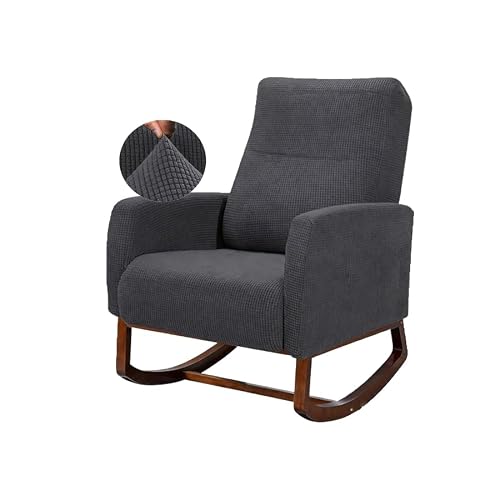
Dipurman Nursery Rocking Chair Cover, Dark Gray — Best Tailored Look
A large family of gliders, especially rocker-gliders with exposed wood legs and arms, wants a cover shaped for that architecture rather than a generic stretch sack. The Dipurman in dark gray is this guide’s verified answer: a modern glider chair cover for a recliner armchair with wood legs, washable, with a side pocket, in a sober dark gray that reads as a design choice. Where fully upholstered nursery gliders need stretch to conform, wood-leg chairs need a cover that respects the frame’s lines, drapes the cushions, and leaves the wood visible, which is the tailored effect in practice. It will not forgive measurement errors the way deep-stretch fabric does, so this pick demands the careful measuring the guide’s measuring section teaches, and it rewards that care with the most furniture-like result in the list. The wood needs no cover, and a design that understands that wastes neither fabric nor fit.
Strengths
- The most upholstery-like result available without paying an upholsterer.
- Woven fabrics hold their shape and pattern alignment for years where stretch knits relax.
- Cushion-only sets for wood-frame gliders fit the actual architecture of those chairs.
Trade-offs
- No stretch means no forgiveness: a two-inch measurement error is a return, not a tuck.
- Fitting is slower and refitting after washing takes patience and a steam iron’s help.
- Tailored covers cost more per chair and come in fewer sizes, so odd-shaped chairs may find no match.
| Spec | Detail (from Amazon title) |
|---|---|
| Fit | Glider / recliner armchair with wood legs |
| Care | Washable |
| Extras | Side pocket; cover only |
| Color listed | Dark Gray |
Measure twice for this pick, order once, and check the return terms before you buy, because shaped covers are the category’s most-returned type, almost always over dimensions rather than quality. When the numbers do match, nothing else in this guide looks as intentional.
Best for: traditional wood-frame gliders, formal rooms, and buyers who measure carefully. / Not suited for: odd-shaped padded gliders or anyone who wants a five-minute fitting.

Jacquard Stretch Cover for Teddy Upholstered Glider Rocker — Best Premium
The premium slot is about disappearance: a cover with enough texture and weight that visitors do not realize the chair is covered at all. This verified jacquard stretch cover, made for nursery rocking chairs and teddy upholstered glider rockers, is the premium expression the API offered: a woven jacquard texture that reads as upholstery rather than as a stretch cover, shaped for the plush, sculptural chairs that dominate modern nurseries. Jacquard’s woven pattern does double duty, disguising the tension lines that betray cheaper covers and giving the chair a finished, intentional surface at conversational distance. This pick suits the glider that anchors a reading corner or a styled nursery, where the budget cover would look like exactly what it is. It is a deliberate, premium-tier purchase and should be shopped like furniture: fabric first, fit second, everything else third.
Strengths
- Textured woven fabric and separate cushion covers produce a genuinely furniture-grade result.
- Better fabrics age gracefully, fading evenly and resisting the pilling that dates cheap covers.
- A premium cover extends the life of a quality glider by years, which is the actual economic case for the tier.
Trade-offs
- Premium tier pricing approaches the cost of professional cushion re-covering for simple chairs; compare both before buying.
- Light, natural colorways that suit the look also show soil fastest and commit you to a washing rhythm.
- Availability is the thinnest in the category; expect to wait for the right size and color combination.
| Spec | Detail (from Amazon title) |
|---|---|
| Fabric | Jacquard stretch |
| Fit | Nursery rocking chairs, teddy upholstered glider rockers, rocking accent armchairs |
| Settings | Living room, bedroom, office |
Treat this purchase as you would a fabric decision for the chair itself: view the color in your room’s light if samples are offered, and confirm the cushion dimensions twice. Premium covers fail more often on color regret than on fit.
Best for: living-room anchor chairs and quality gliders worth protecting properly. / Not suited for: high-soil nursery duty or chairs nearing replacement.
Comparison Table
| Pick | Badge | Key spec | Best for |
|---|---|---|---|
| Levoberg Jacquard Stretch Glider Cover | Best Overall | Jacquard stretch, nursery glider/rocker fit | Daily-use nursery and living-room gliders |
| Dipurman Glider Chair Cover, Beige | Best Budget | Washable, wood-leg armchair fit, side pocket | Temporary protection and value shoppers |
| Alickwang Nursery Rocking Chair Cover | Best for Leather Gliders | Non-slip protector, jacquard, elastic fit, washable | Leather and vinyl upholstery |
| Washable Stretch Glider Chair Cover | Best for Pets and Kids | Washable stretchable, teddy upholstered glider fit | Nurseries and pet households |
| Dipurman Glider Chair Cover, Dark Gray | Best Tailored Look | Modern shaped cover, wood-leg fit, side pocket, washable | Wood-leg gliders and recliner armchairs |
| Jacquard Stretch Cover for Teddy Glider Rocker | Best Premium | Jacquard texture, teddy upholstered glider rocker fit | Styled nurseries and living-room chairs |
How to Measure a Glider for a Slipcover
Every successful slipcover purchase in this category starts with a tape measure, and every failed one starts with a chair name. Listings that promise to fit a famous glider model may be right, but models change across years and your chair’s cushions have compressed since it was new, so measure the chair you own. Work through six numbers. Back height: from the top of the back cushion down to the seat. Back width: across the back cushion at its widest, including the padding’s curve, measured around the front face the way fabric must travel. Seat width: between the arms, cushion edge to cushion edge. Seat depth: front edge of the seat cushion to where it meets the back. Arm height and arm width: from the seat up to the top of the arm, and across the arm’s padded top, because glider arms are wide and covers sized for slim arms split the difference badly. Finally, note the base: whether the chair’s mechanism skirt or wooden base needs clearance, because a cover hem that traps the glide mechanism will tear or jam.
Then match numbers to the listing’s published range, not its headline. For stretch covers, your chair should sit comfortably inside the stated range, not at its absolute limit, because fabric stretched to its maximum looks thin, feels tense, and relaxes into bagginess fastest exactly where it was stretched hardest. For tailored covers, your numbers should match the stated size nearly exactly, with the small ease the maker builds in. If a listing publishes no dimensions at all, that absence is the review: do not buy a fitted product from a seller who will not state what it fits. Photographs lie politely; dimensions do not.
How to Fit a Glider Slipcover So It Stays Put
Fitting is a process, not a pull. Start with a clean, dry chair, and wash the cover first if the care label allows, so you fit its true size. Step one: drape the body cover over the back and align its seams with the chair’s back edges before touching anything else; every later adjustment assumes the back is true. Step two: work the fabric down over the arms, smoothing from the top of each arm outward, and push surplus fabric into the crevices where the arms meet the seat and back. This surplus is not a flaw, it is the fabric the chair’s movement will consume, and distributing it into crevices is what tucking means. Step three: fit the seat cushion cover separately if your set has one, or smooth the seat area and tuck deeply along both sides and the back of the seat. Step four: install the anchors, foam rods, tuck grips, or straps, pushing them deep into the crevices so the fabric is locked rather than laid. Step five: fasten the hem, check the base clearance, and glide the chair through its full motion ten times. Fabric that survives the test glide without pulling free will survive the week; fabric that creeps during the test needs more tuck and deeper anchors now, not after it has annoyed you for a month. Re-tuck after the first wash and the first week of use, because new fabric relaxes into its working shape, and a five-minute reset then saves daily irritation later.
Glider Anatomy: the Chair Shapes You Are Actually Covering
Not all gliders are the same chair wearing different fabric, and the cover that fits one architecture will fight another. The classic nursery glider is a fully upholstered armchair on a hidden glide mechanism, usually with a swivel, wide rolled or padded arms, and cushions that may be attached or removable depending on the maker and the year. Its cover challenge is volume: a lot of padded shape, no straight lines, and a base that must stay clear of the moving mechanism. The traditional rocker-glider is a different animal: a wooden frame, often with exposed arms and side panels, carrying a set of loose cushions. Covering it usually means covering the cushions only, and a full-chair stretch cover is not merely unnecessary on this architecture, it is unworkable, because there is no upholstered body to cover. The modern recliner-glider adds a third architecture: a recliner’s divided back and extending footrest married to a glide base, where any cover must accommodate moving sections and is usually sold as a recliner cover with glider-compatible dimensions, a combination that demands the most careful measurement of all.
Identifying your architecture before shopping resolves half the returns in this category. If your chair has loose cushions on a wood frame, shop cushion covers and tailored sets, the guide’s fifth slot. If it is a fully padded nursery chair, shop the stretch sets in slots one through four according to your household. If it reclines as well as glides, measure every section separately, back, seat, arms, and footrest, and require the cover’s data to address recliner geometry explicitly. And on every architecture, locate the mechanism before ordering: run the chair through its full glide and note where fabric could foul moving parts, because that clearance check, done once with your own eyes, is worth more than any compatibility chart a listing can publish.
Fabric School: What Cover Materials Do Across a Year of Use
Stretch knits, the category’s default, are usually polyester-spandex blends woven or knitted to extend and recover. Their virtue is conformity: they forgive odd shapes and approximate sizes. Their failure mode is time: spandex relaxes with heat, washing, and constant tension, so a stretch cover’s second year is looser than its first, and the buyer’s defense is to choose a fabric with enough weight that relaxation reads as softness rather than sag, and to wash cold, always. Jacquard weaves put a pattern into the fabric’s structure rather than printing it on the surface, which is why they hide tension lines and wear better visually; they are the smart default for a chair that will be looked at daily. Microfiber’s dense, split-fiber surface resists staining, releases hair, and survives washing with its dignity intact, at the cost of a flatter, more casual appearance and a tendency to hold static in dry winter air. Woven cotton and cotton blends breathe best and feel most like upholstery, but they do not stretch, so they demand the tailored slot’s measuring discipline, and they wrinkle honestly after every wash. Linen-look fabrics, usually synthetic or blended under the name, trade a little softness for a textured, furniture-grade appearance and good stain release.
Two fabric properties cut across all of these and deserve direct attention in any listing’s data. The first is colorfastness to light: a glider that lives by a nursery or living-room window will fade an unrated fabric unevenly, and the cover will look tired in a pattern that maps exactly onto the sun’s path. The second is seam and hem construction, because a cover fails at its stitching before its field: elastic channels, cushion-cover zippers, and corner seams take the stress of every fitting and removal. A listing that describes its closures and seams is describing a product built to be used; one that shows only draped photography is selling the first fitting, not the fifteenth. Judge fabrics by these properties, in the data, and the six slots in this guide will resolve into the right purchase for your chair whichever retailer you ultimately buy from.
When a Slipcover Is the Wrong Answer
Honesty requires one section against the category. A slipcover solves fabric problems: stains, fading, a pattern you cannot live with, a surface that needs to survive pets and children. It does not solve structural problems, and three common glider complaints are structural wearing a fabric disguise. A glide mechanism that grinds, sticks, or lists to one side needs mechanical attention, bearings, hardware, sometimes a specialist, and a beautiful cover over a failing mechanism is money spent decorating a decline. Cushions whose foam has collapsed will feel collapsed under any cover; the fix is new foam or new cushions, after which a cover becomes a fine finishing purchase. And a frame with cracked joints or a broken swivel base is a safety item, not a styling one, above all in a nursery where the chair’s whole job is holding a parent and a baby at 3 a.m. Diagnose before you decorate: sit in the chair, glide it, swivel it, and listen. If the bones are good, and on most gliders they are for decades, then everything else in this guide applies and a cover is one of the highest-value refreshes in the home. If the bones are not, spend the cover money on the repair first, and let the fabric wait its turn.
Styling the Covered Glider: Making It Look Intentional
Once fit and fabric are settled, a few styling decisions separate a covered chair that looks renewed from one that looks apologized for. Coordinate the cover with the room’s textiles rather than matching it to the chair’s original upholstery; a cover chosen against the curtains, rug, and bedding reads as a design decision, while a near-miss match to a color the chair used to be reads as a disguise. Add one deliberate layer, a throw or a small lumbar pillow, because layered chairs look furnished and the layer also takes the first wear at the seat’s front edge. In a nursery, plan the cover color around the room’s next chapter, not the newborn chapter: the glider will outlast the nursery theme by years, and a neutral cover bought once serves the reading chair it becomes. And keep the care rhythm visible in your calendar rather than your memory: a covered chair that gets its wash-and-refit every month or two always looks intentional, while the same cover left for a year sags into exactly the shabby signal the purchase was meant to erase. The cover is a system, fabric, fit, anchors, and rhythm, and the rhythm is the part most owners skip.
Two Gliders, One House: Nursery First, Reading Chair Later
A final planning thought, because gliders are unusually long-lived furniture. The chair bought for a nursery will, if it survives, spend a decade as a reading chair, a guest-room chair, a teenager’s gaming seat, and the place the dog is not allowed to sit. A slipcover strategy that anticipates that itinerary buys differently: a washable, hard-wearing cover for the nursery years in a color that forgives everything, then, when the chair migrates, a second, better-looking cover in the tailored or premium slot rather than a new chair. The two-cover lifetime costs a fraction of one reupholstery and keeps a mechanically sound chair in service through every chapter. It also reframes the first purchase: the nursery cover does not need to be beautiful, it needs to be washable and correctly fitted, and the money saved by that honesty funds the cover that will be looked at for the following ten years. Shop the chair’s whole life, not its first photograph, and the glider becomes one of the best furniture investments in the house.
A Short Word on Cost: Cover, Reupholster, or Replace
Three doors stand in front of every tired glider, and the prices ascend steeply. A good slipcover is the value door by an order of magnitude, and for a mechanically sound chair it captures most of the visual renewal at the smallest spend. Professional reupholstery is the craft door: real fabric choice, restored padding, and a result indistinguishable from new, priced like the skilled labor it is and justified for chairs with quality frames and long futures. Replacement is the reset door, worth it when the mechanism or frame has failed, wasteful when only the fabric has. The honest sequence is the one this guide has implied throughout: judge the bones first, cover the sound chair without apology, reupholster the exceptional one if the numbers suit you, and replace only what is actually broken. Most gliders brought to this guide need the first door, and walking through it well, measured, anchored, and maintained, is a genuinely satisfying piece of household economics.
Common Buying Mistakes
The first mistake is buying by chair category, “fits most gliders,” instead of by your six measurements; gliders vary more than almost any other chair type. The second is putting a one-piece cover on a separate-cushion chair and blaming the fabric for the tenting that the construction guarantees. The third is ignoring the base: a hem that covers the glide mechanism looks tidy in a photograph and jams in a living room. The fourth is choosing white or black for a pet household and then washing on a schedule dictated by visibility rather than hygiene. The fifth is washing stretch covers hot and drying them hotter, which relaxes elastic permanently and converts a fitted cover into a loose one. And the sixth is trusting any roundup that attaches purchase links to glider covers nobody verified; the category’s listings are inconsistent enough that unverified recommendations are how the wrong covers get bought, which is why one slot in this very guide stands unlinked rather than guessed.
Final Recommendation
Measure your chair first; that sentence is the recommendation everything else hangs from. With measurements in hand, most buyers should aim at the Best Overall pick: the Levoberg jacquard stretch cover, whose woven texture and glider-specific fit suit the widest range of chairs. On a budget, the Dipurman in beige is the honest value choice. If your glider is leather, choose the Alickwang non-slip cover, because a stated non-slip protector is what stays put on leather where ordinary stretch covers wander. Pet and nursery households should buy the washable stretch cover, twice if the chair never rests. And if your glider has wood legs or anchors a styled room, the Dipurman in dark gray and the jacquard teddy-glider cover are where your money does furniture-level work. All six picks are verified against Amazon’s own product records, the Alickwang in a follow-up round run specifically to fill the non-slip slot honestly, which is the standard this site applies to every link it prints.
More chair and living-room reading from this program: Best Headrest Neck Pillows For Recliner Chairs · Best Gray Rugs · Best Living Room Rugs For House With Kids · Best Blankets For Your Couch
Frequently Asked Questions
Will a recliner or wingback slipcover fit my glider?
Sometimes approximately, rarely well. Gliders differ in arm width, back shape, cushion construction, and the moving base. A stretch recliner cover may pull over a glider, but expect tenting, hem interference with the glide mechanism, and faster migration. Buy by measurements and prefer covers specified for gliders or for your chair’s actual dimensions.
Why does one slot in this guide have no purchase link?
Every linked product on this site is verified against Amazon’s own product data before it earns a link. Five of the six picks here passed that check. The leather-glider slot did not: no grip-backed glider cover could be confirmed, so that slot is published as a precise specification target instead of an unverified link. We would rather tell you exactly what to buy than guess at a product to click.
How do I stop a slipcover from shifting on a glider?
Deep tucking plus anchors. Push surplus fabric fully into the arm and back crevices, install foam rods or tuck grips, fasten straps if provided, and test-glide the chair before calling it done. On leather, choose a grip-backed cover. Re-tuck after the first week and first wash as the fabric settles.
Can I wash a glider slipcover in a home machine?
Most stretch and microfiber covers are designed for home washing in cold water on a gentle cycle, which protects their elastic. Tailored wovens vary by fabric. The specific product’s care label governs, and heat, in washing or drying, is the main enemy of fit.
Should I buy a one-piece cover or a set with a separate cushion cover?
Match the chair. If the seat cushion is a separate piece, a set with its own cushion cover will fit and stay fitted far better. If the cushion is fixed to the chair, a one-piece cover is the correct design and a set has nothing to attach its second piece to.
What if my glider is an unusual size?
Then stretch is your friend and tailored is your risk. Choose a stretch cover whose published range brackets your measurements with room to spare, confirm the return terms before ordering, and avoid any listing that publishes no dimensions. For truly odd chairs, cushion-only covers plus a throw over the back is a respectable fallback.


