Disclosure: airfryerkitchensupply.com is reader-supported. When you buy through links on our site, we may earn an affiliate commission at no extra cost to you.
Where to buy
Every chair in this guide to the best chairs for a dock is a current listing we verified through Amazon’s own catalogue data. Dock chairs ship in many colours and pack sizes within the same listing, so buy by the full product name, confirm the colour and quantity on the listing page, and check price on Amazon before you order. For the boat-seat picks, confirm the mounting pattern your dock bench or pedestal needs before ordering.
- POLYWOOD AD4030GY Classic Outdoor Adirondack Chair, Slate Grey – check price on Amazon; choose the listing sold or shipped by Amazon or the brand store where available.
- Lifetime Faux-Wood Adirondack Chair – check price on Amazon; choose the listing sold or shipped by Amazon or the brand store where available.
- Keter Alpine Adirondack Resin Patio Chair with Cup Holder, Grey – check price on Amazon; choose the listing sold or shipped by Amazon or the brand store where available.
- Wise Premium High Back Fold Down Fishing Boat Seat – check price on Amazon; choose the listing sold or shipped by Amazon or the brand store where available.
- Tempress ProBax Orthopedic Folding High Back Boat Seat – check price on Amazon; choose the listing sold or shipped by Amazon or the brand store where available.
- PORTAL Extra Large Quick Folding Tripod Stool with Backrest – check price on Amazon; choose the listing sold or shipped by Amazon or the brand store where available.
The best chairs for a dock live a harder life than any patio chair, and buying for the dock means buying for the environment first and the silhouette second. A dock chair sits over water in full sun, takes spray and rain from every direction, endures freeze-thaw winters if it stays out, and must stay put when the wind comes off the lake — while its feet stand on deck boards with gaps that swallow narrow legs and its hardware bathes in the most corrosive air most furniture ever meets. That is why this guide is dominated by HDPE lumber Adirondacks and marine seating rather than pretty garden chairs: recycled-plastic lumber does not rot, splinter, peel or feed mildew, it is heavy enough to ignore ordinary wind, and its stainless fasteners are chosen for wet service. The Adirondack shape itself is dock furniture by birth — low, reclined, wide-armed for a drink or a fishing rod, stable on uneven boards.
The six picks split by dock lifestyle. Three classic Adirondacks anchor the lounging end, at premium, value and budget tiers. Two marine fishing seats — the kind designed for boats — serve anglers who fish from the dock and want a proper high-back, fold-down seat mounted on a bench or pedestal, with the back support that hours of fishing demand. And one folding tripod chair covers the portable case: the chair that lives in the dock box or the car and comes out when guests or a fishing session need it. Match the pick to how your dock is actually used — sunset sitting, serious fishing, or flexible hosting — and the buying guide will keep you out of the mistakes that send dock chairs to the landfill in two seasons.
In this guide
Quick Picks
- Best Overall – POLYWOOD Classic Adirondack Chair: genuine HDPE lumber construction in the classic silhouette, built to live outdoors over water for decades with essentially no maintenance.
- Best Value – Lifetime Faux-Wood Adirondack Chair: UV-protected polystyrene with a wood look, a 300 lb capacity and the lowest upkeep-to-cost ratio in the guide.
- Best Budget with Cup Holder – Keter Alpine Adirondack Chair: weather-resistant resin with a built-in cup holder, light enough to rearrange daily and priced for buying in pairs.
- Best for Dock Fishing – Wise Premium High Back Fold Down Boat Seat: a marine-grade high-back folding seat for mounting on a dock bench or pedestal, made for long fishing sessions.
- Best for Back Support – Tempress ProBax Orthopedic Boat Seat: an orthopaedic folding high-back designed around lumbar support, for anglers whose backs set the session length.
- Best Portable – PORTAL Folding Tripod Stool with Backrest: an extra-large quick-folding tripod chair with carry strap that stores in the dock box and travels anywhere.
How These Picks Were Chosen
Material was the first and hardest filter. Over water, the hierarchy is unforgiving: HDPE lumber and marine vinyl over stainless or aluminium hardware survive; painted wood, ordinary steel and indoor fabrics fail publicly within a few seasons. Every pick here is built from weather-rated synthetics or marine-grade components for exactly that reason. Weight was judged as a dock virtue — a chair heavy enough to stay where it is put in a lakeside gust is a feature, not a flaw — balanced against the portable pick, where lightness is the entire point and storage out of the wind is the plan. Stability on deck boards mattered too: wide feet and sled-style bases spread load across boards instead of dropping a leg into a gap.
Use-case honesty shaped the list’s back half. A large share of dock chairs are bought for fishing, and an Adirondack — however comfortable for sunset — is the wrong tool for six hours of casting and waiting; marine seats exist for that job and two are included, with their mounting requirements stated plainly. Every product was cross-checked against Amazon’s catalogue data for this site, and only confirmed listings carry purchase links. Prices are never printed because they move constantly; check price on Amazon when you buy.
The 6 Best Chairs for a Dock

POLYWOOD AD4030GY Classic Adirondack Chair – Best Overall
POLYWOOD is the name that defined HDPE lumber furniture, and its Classic Adirondack is the dock chair against which the rest of this guide is measured. The slats are solid recycled-plastic lumber — colour throughout the material rather than a surface finish — so sun, spray, spilled drinks and winter storage outdoors do not fade, rot or splinter it, and the classic wide-arm, deep-recline geometry is the original dock posture: low, settled, with an arm wide enough for a mug, a book or a rod butt. In slate grey it reads as weathered timber from ten feet and as indestructible from one. It suits dock owners furnishing for the long term — the buy-once answer. It does not suit buyers furnishing a whole dock cheaply this weekend, or anyone who needs to move chairs frequently; HDPE lumber has real heft.
Strengths
- Solid HDPE lumber shrugs off water, sun and winter without sealing, painting or covering.
- Weight that laughs at lakeside wind; the chair stays where the evening left it.
- Classic ergonomics refined over decades of the design’s production.
Trade-offs
- Premium pricing, multiplied across a full dock set.
- Heavy to reposition; arrange it once, thoughtfully.
- Assembly is required and the lumber does not forgive sloppy bolt work — follow the torque guidance.
The economics deserve one plain paragraph. A cheap dock chair replaced every third season costs more per decade than this chair bought once, before counting the landfill trips and the mid-season failures. POLYWOOD’s proposition is that the dock gets furnished a single time, correctly, in a material the water cannot argue with. For a primary residence dock that hosts a generation of evenings, that arithmetic is decisive, and it is why this chair leads the guide despite its price.
Best for: permanent docks and buy-once furnishing. / Not suited for: tight budgets or frequently rearranged seating.
Check the current price on Amazon
Lifetime Faux-Wood Adirondack Chair – Best Value
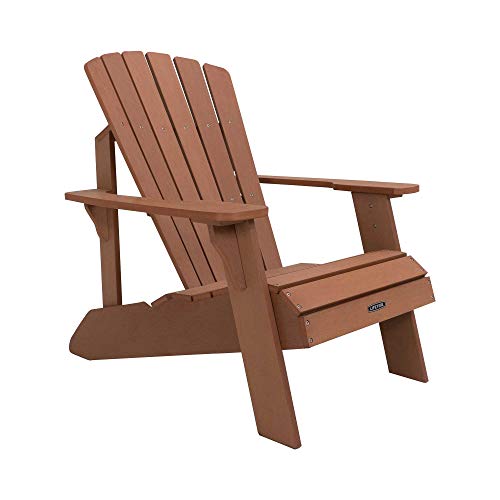
Lifetime’s faux-wood Adirondack delivers the dock formula at a friendlier tier: UV-protected polystyrene moulded with a wood-grain look, weather-resistant, rated to a 300 lb capacity in its listing, and maintenance-free in the way dock furniture must be. It gives renters, cottage owners and multi-chair buyers the essential experience — the recline, the wide arms, the leave-it-outside freedom — without the HDPE flagship’s investment. It suits seasonal properties, first docks and anyone furnishing several seats at once. It does not suit buyers expecting solid-lumber heft and decades-long horizons; polystyrene is lighter, and lightness over water is a compromise to manage, as the trade-offs note.
Strengths
- The dock essentials — weatherproof, UV-protected, maintenance-free — at a value tier.
- Stated 300 lb capacity covers the household and its guests.
- Lighter than HDPE, so seasonal put-out and take-in is genuinely easy.
Trade-offs
- Lighter weight means storm gusts can move it; store or secure it ahead of big weather.
- Moulded polystyrene feels less substantial than solid lumber under hand.
- Long-term horizon is seasons shorter than the POLYWOOD’s.
Value at the dock is not the cheapest chair; it is the cheapest chair that survives the environment, and the Lifetime clears that bar with room to spare. Its lightness, framed honestly, cuts both ways — the same quality that makes spring setup a pleasure makes a storm plan necessary. Cottage owners who already bring docks and boats in for winter will find that rhythm natural, and for them this is the smart money pick of the guide.
Best for: cottages, seasonal docks and multi-chair budgets. / Not suited for: unattended storm exposure or buy-once expectations.
Check the current price on Amazon

Keter Alpine Adirondack Resin Chair – Best Budget with Cup Holder
Keter’s Alpine brings the Adirondack to the true budget tier in weather-resistant resin, with the small feature dock users disproportionately love: a built-in cup holder in the arm, sized for the drink that otherwise balances on a deck board waiting to be kicked into the lake. The listing positions it across beach, pool and fire-pit duty, and that versatility is the point — this is the chair that gets bought in pairs and fours, moved between dock and fire ring, stacked or lined up as the gathering demands. It suits casual docks, guest seating and households furnishing widely rather than deeply. It does not suit buyers seeking heirloom materials or the deep, low lounge of the classic geometry; resin Adirondacks sit a touch more upright and feel lighter in every sense.
Strengths
- Built-in cup holder solves the dock’s most persistent small problem.
- Resin construction is weatherproof, hose-cleanable and light to rearrange.
- Budget pricing makes matched sets and guest extras painless.
Trade-offs
- Lightest of the Adirondacks here; secure or store it in serious wind.
- Resin flex and finish are a class below HDPE lumber.
- Sitting posture is slightly less reclined than the classic pattern.
There is a social logic to the Keter: docks host groups, groups need chairs in numbers, and a chair everyone can afford four of beats a masterpiece someone owns one of. Add the cup holder’s quiet genius and the Alpine becomes the gathering chair of the guide — not the best seat on the dock, but the one that makes the dock work for everybody who shows up.
Best for: guest seating, pairs and sets, and casual multi-spot use. / Not suited for: storm-exposed permanent placement.
Check the current price on Amazon
Wise Premium High Back Fold Down Fishing Boat Seat – Best for Dock Fishing
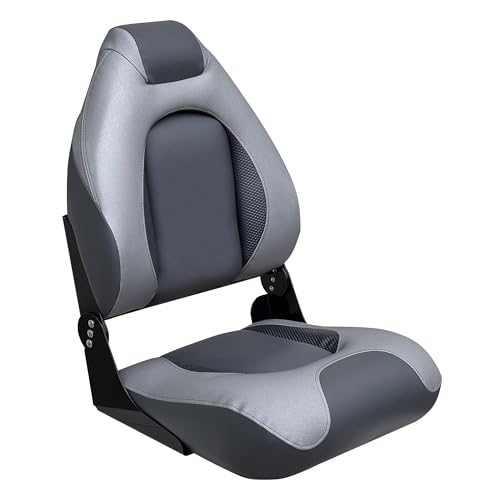
Half the chairs on real docks are there for fishing, and fishing from a low Adirondack is a compromise nobody chose on purpose. The Wise Premium is a marine fishing seat — high back, fold-down design, built for boat duty — that mounts to a dock bench, a purpose-built seat box or a pedestal, and turns the dock’s edge into a proper fishing station. Marine construction means the vinyl, foam and hardware are specified for wet, sunny service, and the fold-down back keeps the profile low and the walkway clear when the session ends. It suits dedicated dock anglers and multi-use docks where the seat must appear and disappear. It does not suit buyers without a mounting plan — this is a seat that bolts to something, not a freestanding chair — or sunset loungers, for whom the Adirondacks remain the answer.
Strengths
- High-back support shaped for hours of fishing rather than minutes of sitting.
- Marine-grade materials specified for exactly the dock’s wet, high-UV environment.
- Folds down flat, keeping the dock walkway and sightlines clear between sessions.
Trade-offs
- Requires a bench, box or pedestal mount — plan and possibly build the base first.
- A task chair, not a lounge chair; nobody naps in it.
- Mounting hardware choices matter; use stainless fasteners for dock service.
The dock-fishing setup this enables is worth describing: seat mounted at the dock’s edge on a sturdy bench, rod holders beside it, everything at working height, the back supported through the slow hours and the fight alike. Anglers who fish their own dock weekly will wonder why they spent years in a lawn chair. Buyers should measure twice — seat height above the dock boards determines leg comfort, and the mount is the one part of this purchase that cannot be improvised safely.
Best for: dedicated dock anglers with a bench or pedestal to mount to. / Not suited for: lounging or mount-free setups.
Check the current price on Amazon

Tempress ProBax Orthopedic Folding Boat Seat – Best for Back Support
The ProBax is the fishing seat for anglers whose backs end sessions before the fish stop biting. Tempress built this folding high-back around orthopaedic support — the ProBax name refers to its back-support design heritage — in marine materials, in a black, charcoal and carbon colourway. Mounted on a dock bench or pedestal like the Wise, it trades a little plushness for posture: the support that keeps a long sit comfortable rather than merely soft. It suits older anglers, anyone with a temperamental back, and all-day dock fishing. It does not suit buyers wanting a soft lounge cushion or a freestanding chair.
Strengths
- Orthopaedic back support designed for long seated sessions.
- Folding high-back format keeps the dock tidy between uses.
- Marine construction throughout, from a specialist boat-seat maker.
Trade-offs
- Mount required, as with all boat seats; budget the pedestal or bench.
- Firmer, posture-led comfort divides opinion versus plush seats.
- Premium pricing within the marine-seat class.
Comfort over six hours is a different discipline from comfort over six minutes, and it is won by support geometry rather than padding depth — the same lesson office chairs teach. The ProBax applies it at the dock’s edge. Anglers who currently stand up every twenty minutes to unkink will feel the difference in the first long morning, and for them this is not a luxury pick but the enabling one.
Best for: long fishing sessions and back-conscious anglers. / Not suited for: casual short sits or lounge use.
Check the current price on Amazon

PORTAL Extra Large Folding Tripod Stool with Backrest – Best Portable
Every dock needs one chair that is not really a dock chair: the extra seat that lives folded in the dock box, travels to the beach and the campsite, and appears when a guest or a fishing buddy materialises. The PORTAL tripod stool with backrest fills that role in an extra-large format — a quick-folding tripod chair with a carry strap, sized beyond the flimsy stools that give the type a bad name. It suits occasional seating, bank-and-dock fishing away from home, and small docks where permanent chairs would crowd the boards. It does not suit daily all-evening lounging; a tripod stool is a perch with a backrest, not an Adirondack.
Strengths
- Folds in seconds and stores in a dock box, closet or car boot.
- Extra-large sizing and a real backrest lift it above basic tripod stools.
- Carry strap makes it the take-anywhere seat for fishing spots beyond the dock.
Trade-offs
- Tripod feet need care on widely gapped deck boards — position across boards.
- Session comfort is good for its class, not comparable to fixed chairs.
- Fabric and frame want storage out of the weather between uses.
Portability is a genuine dock strategy, not a compromise, for properties where the dock is small, the season is short or the seating need is occasional. The PORTAL’s virtue is readiness: it is the chair that exists when needed and vanishes when not, and its backrest — the feature cheap stools omit — is what makes an hour’s fishing from it pleasant rather than endured.
Best for: occasional seating, small docks and travelling anglers. / Not suited for: permanent all-evening lounging.
Check the current price on Amazon
Comparison Table
| Pick | Badge | Key spec | Best for |
|---|---|---|---|
| POLYWOOD Classic Adirondack | Best Overall | Solid HDPE lumber, slate grey | Permanent, buy-once dock furnishing |
| Lifetime Faux-Wood Adirondack | Best Value | UV-protected polystyrene, 300 lb capacity | Cottages and seasonal docks |
| Keter Alpine Adirondack | Best Budget with Cup Holder | Resin, built-in cup holder | Guest sets and casual gatherings |
| Wise Premium High Back Boat Seat | Best for Dock Fishing | Marine fold-down seat, mount required | Dedicated dock anglers |
| Tempress ProBax Boat Seat | Best for Back Support | Orthopaedic folding high-back, mount required | Long sessions, sensitive backs |
| PORTAL Tripod Stool with Backrest | Best Portable | Quick-fold tripod, carry strap | Occasional and travelling seating |
How to Choose Chairs for a Dock
Let the water choose the material. Anything that lives over water should be HDPE lumber, quality resin, polystyrene or marine-grade components with corrosion-resistant hardware; wood that is not diligently maintained, ordinary painted steel and indoor fabrics are on borrowed time at a dock, and the borrowing is short. Within the synthetics, the tiers in this guide map to horizon: HDPE for the forever dock, polystyrene and resin for seasonal and budget furnishing, marine seats for working fishing stations, folding fabric for portability with storage between uses.
Then match the chair to the dock’s real programme. Sunset-and-coffee docks want Adirondacks, in numbers matched to the household plus guests — the Keter’s economics shine here. Fishing docks want a mounted marine seat at the edge, and should be planned as a station: seat height, mount solidity, rod holders, and a walkway left clear behind. Mixed docks do both and add the folding chair for overflow. Consider the boards themselves: wide feet and continuous bases sit kindly on decking, narrow legs find gaps, and on floating docks — which move — lower, heavier chairs feel more secure than tall, light ones.
Finally, plan for weather as a system. Decide now where each chair goes in a storm: HDPE can ride out almost anything in place; light resin and polystyrene should be stacked against the boathouse or stored; folding chairs live indoors by definition. A five-minute storm routine decided in spring saves the autumn discovery of a chair in the lake. And buy the count honestly — dock seating is social, and one perfect chair plus three absent ones is a worse dock than four good ones.
How to Set Up and Care for Dock Chairs
Placement is the first act of care. Set lounging chairs back from the dock’s edge far enough that rising from the deep Adirondack recline never means stepping backward toward water, and angle them for the view and the evening sun rather than in a rigid row. Fishing seats mount at the edge, on a bench or pedestal anchored into the dock’s framing — not just the deck boards — with stainless fasteners throughout, and with the seat height set so feet rest flat and knees sit comfortably below the rail of the rod’s arc. Keep a clear walking lane behind all seating; docks are workplaces as well as lounges, and chairs that block the lane get moved, dragged and damaged.
Routine care for synthetic dock furniture is mercifully short: hose or bucket-wash with mild soap as grime and pollen build, a soft brush for texture, and an end-of-season wash before storage or winter. Inspect fasteners annually — dock vibration and freeze cycles loosen hardware, and HDPE chairs reward a bolt check with another decade of silence. Marine vinyl seats want their own rhythm: rinse after use in brackish or salt water, clean with marine vinyl cleaner rather than household chemicals, and keep them folded or covered out of the worst UV when the dock is idle for weeks. In freezing climates, even leave-out-forever HDPE appreciates being stood where meltwater drains rather than pools and freezes around its feet. Do those few things and dock furniture becomes the lowest-maintenance seating you own, which is exactly what a place built for relaxing requires.
Saltwater Docks, Freshwater Docks and What Changes
Not all water is equally kind, and the dock’s water type should steer the details of a purchase. Salt and brackish water are aggressively corrosive: hardware is the battleground, and even good furniture suffers if its fasteners are merely plated rather than stainless or polymer. On a saltwater dock, the HDPE and resin picks in this guide remain sound — the materials themselves are indifferent to salt — but the ownership rhythm changes: rinse chairs with fresh water when you rinse the boat, inspect fasteners each season for the first blush of corrosion, and treat marine vinyl seats to their rinse-and-clean routine religiously, because salt crystals left in vinyl seams abrade and degrade the surface. Folding fabric chairs should live ashore between uses in salt country, full stop.
Freshwater is gentler on metal but brings its own pressures: algae and mildew colonise shaded, damp surfaces, pollen and lake sediment film everything, and freeze-thaw winters in northern lakes are the sternest test any dock chair faces. The synthetics here handle all of it with washing and drainage, but cushions and fabric — the portable chair, any pads you add — want storage dry and indoors through the wet and frozen months. In both environments, sun is the common enemy working year-round: UV is why the guide’s materials are rated for it, and why a chair that begins life as a patio bargain without UV stabilisation chalks, embrittles and cracks at the dock while its indoor-outdoor cousins survive on the porch. Buy for your water, rinse for your water, and the furniture stops being a recurring expense.
Dock Chair Safety and Stability, Taken Seriously
A dock is a wonderful place built over an unforgiving one, and chair safety deserves a plain paragraph rather than fine print. Stability begins with the base: wide feet and low centres of gravity are why Adirondacks dominate docks — the deep recline that makes them comfortable also makes them hard to tip — while tall, narrow chairs and lightweight stools deserve placement away from the edge and out of the traffic lane. Teach the household’s rhythm early: chairs are for sitting, not for standing on to reach a cleat or a light, and a chair used as a step stool over water is an accident rehearsing. Children change the calculation further; seat them in the stable chairs, keep the portable stools for adults, and let the dock’s edge be a place children occupy with a seated adult’s attention rather than as a climbing frame.
The second half of safety is housekeeping. Chairs left scattered become obstacles on a structure where people walk barefoot, carry coolers and move in the dark; the setup section’s clear-lane rule is a safety rule wearing a tidiness costume. In storm country the safety duty extends to neighbours and boats: an unsecured light chair in a gale is a projectile with a return address, which is why the storm routine — stack, secure or store — belongs to seamanship, not fussiness. None of this dims the dock’s pleasure. It is what allows the pleasure to run, season after season, without the one bad evening that rewrites how a family feels about its favourite place.
Common Buying Mistakes
The expensive classic is buying beautiful wooden or steel garden chairs for a dock and watching the environment dismantle them — rust streaks on the boards by midsummer, splinters by the second year. Second is ignoring wind: lightweight chairs bought for a breezy lake spend the season being retrieved, and one storm can donate them to the water. Third is buying fishing seating without a mounting plan, leaving a boat seat in its box while the angler returns to the lawn chair. Fourth is under-buying count for a social dock, or over-furnishing a small dock until the walkway disappears. Fifth is narrow-legged chairs on gapped decking, a small daily annoyance that never improves. Sixth is forgetting the storm and storage plan until the first gale makes the decision for you. The dock rewards buyers who think like harbourmasters: environment first, programme second, looks third — though as the POLYWOOD shows, the order need not cost you the looks.
Arranging a Dock Seating Plan That Hosts Well
A furnished dock is a room, and it hosts like one when its seating is planned in zones rather than lined up by habit. The sunset zone is the social heart: two to four Adirondacks angled toward the evening view and toward each other at conversation distance, close enough that talk stays low and nobody performs across a gap. Angle beats alignment — chairs in a firing-squad row along the rail force every conversation to happen sideways, while a shallow arc turns the group inward and the view into a shared backdrop. Leave the small table question answered: wide Adirondack arms carry a drink each, but a shared surface for food turns a sit into a stay, and on a dock that surface should be as weatherproof and heavy as the chairs.
The working zone belongs to the fishing station and the dock’s practical life: the mounted seat, rod storage, and clear boards for landing, cleaning and moving, kept deliberately apart from the lounge so hooks and hospitality never share an elbow. The flexible zone is wherever the folding chairs land — the end of the dock for extra guests, the shady side at noon — and its virtue is that it empties completely when the gathering ends. Finally, respect the dock’s circulation as a floor plan: a walking lane from shore to end, unobstructed, wide enough for a person carrying a cooler in the dark. Docks arranged this way feel generous at every occupancy — serene for one reader at dawn, capable for twelve at a birthday — and the chairs in this guide were chosen to fill exactly these zones, from the POLYWOOD’s permanence in the sunset arc to the PORTAL waiting folded for its cue.
Dock Chairs for Every Generation: Kids, Elders and Everyone Between
A dock hosts the whole span of a family, and chair choice quietly decides who is comfortable there. Children need stability above all: the low, wide, hard-to-tip Adirondack geometry suits them far better than tall folding chairs, and the resin Keter’s lightness lets them carry their own seat into the circle — a small sovereignty children value out of proportion to its cost. What children should not get is the tripod stool as a perch near the edge, or any chair as a step to see over the rail; the dock’s rules are set in the furniture before they are set in words. For elders, the calculus inverts in an interesting way: the deep Adirondack recline that young backs love can be genuinely hard to rise from, because the seat is low and the arms bear the lift. Households with older regulars do well to include one higher, firmer seat — the mounted marine chairs at bench height serve beautifully, and a firm upright chair near the lounge arc keeps grandparents in the conversation rather than stranded in the geometry.
The middle generations, who imagine the dock is furnished for them, mostly need count and cup holders. But designing the dock for its youngest and oldest users is what makes it a family place rather than a couple’s deck with visitors. It also future-proofs the purchase: the household that buys the POLYWOOD set plus one supportive seat has furnished the dock for the family it will be in fifteen years, not only the one posing for this summer’s photograph. That long view is the dock’s own lesson, taught by every grey, silvered board on it.
Final Recommendation
Furnish a permanent dock once, properly, with the POLYWOOD Classic Adirondack; furnish a seasonal or budget dock happily with the Lifetime or a set of Keter Alpine chairs. If the dock is a fishing platform, mount the Wise Premium — or the Tempress ProBax when your back votes — and keep a PORTAL tripod chair in the dock box for everyone else. Choose materials the water cannot beat, plan the storm routine, and the dock will seat a decade of evenings. Related guides: Best Adirondack Chairs, Best Outdoor Chairs For Patios, Best Fishing Chairs, Best Polywood Chairs and Best Folding Outdoor Chairs.
Dock Chairs in Winter: Storage Decisions by Material
Winter is when dock furniture purchases reveal their fine print, and each material in this guide asks a different kindness. HDPE lumber, the POLYWOOD class, is the leave-it-out champion: it does not absorb water, does not crack in freeze-thaw and does not care about snow load in any ordinary winter, asking only to be stood where meltwater drains and, in the harshest lakeside climates, to be moved out of the direct path of ice and storm surge. Owners in extreme exposures still bring it under cover, not because the material needs it but because the lake in February is stronger than any furniture. Resin and polystyrene — the Keter and Lifetime classes — tolerate cold well but grow more brittle at deep temperatures, so winter asks them to be stored under cover or at least stacked in shelter, handled gently on the coldest days rather than dragged frozen across the boards.
Marine seats and folding chairs have the clearest instructions: indoors. Vinyl grows stiff and vulnerable in hard cold, mechanisms and fabrics age fastest in damp freezing storage, and a boat seat or tripod chair kept in the boathouse or garage emerges in spring as it went in. The spring commissioning is the mirror ritual for everything: wash off the winter, check every fastener the freeze cycles have worked on, test folding mechanisms before a guest trusts one, and rinse salt-country hardware with fresh water. Fifteen minutes of this in April is the whole maintenance contract for furniture designed, as everything in this guide is, to spend its life outdoors without complaint. Buyers in year-round warm climates may skip the ritual — and should know that their neighbours in the snow belt regard that as the finest feature of their address.
What Dock Owners Actually Report After a Season
Guides deal in specifications, but docks are lived on, and the patterns that emerge after a season of use are worth recording for the next buyer. The first is that chairs migrate: the seat bought for the sunset corner ends up at the fishing end, the guest chair becomes somebody’s favourite, and the dock sorts its furniture by use rather than by plan — which is why matched, versatile chairs age better in a set than one hero piece among strangers. The second is that the cup holder, the wide arm and the low stable base are mentioned constantly, while the design details that filled the shopping cart are mentioned never; dock comfort is a short list of physical kindnesses repeated nightly. The third is that the mounted fishing seat, bought with some hesitation, becomes the dock’s most defended territory, claimed by whoever reaches it first on a still morning.
The fourth report is the one that justifies this guide’s material sermon: by the second season, every dock tells the same story about its one wrong purchase — the chair that rusted, splintered or blew into the lake — and tells it as comedy only because it was replaced by something in this guide’s classes. Buy the materials first, arrange the zones second, and let the seasons do the reviewing.
One more season-tested observation deserves recording: docks accumulate chairs the way kitchens accumulate mugs, one reasonable purchase at a time, until the boards hold a museum of every era’s intentions. The discipline that prevents it is a simple inventory each spring — what do we sit in, what do we lend, what has quietly become a plant stand — and the willingness to retire the failures to the fire pit’s circle or the charity run before buying anything new. The six picks in this guide were chosen to be the chairs that survive that inventory year after year: the permanent pair, the value set, the mounted seat, the folding spare. Buy within that discipline and the dock stays what it was built to be — a place to sit by the water — rather than a storage problem with a view.
Budget honesty closes the loop. A dock’s seating can be phased the way the dock itself often is: the permanent pair this year, the guest set next, the fishing station when the angler’s season demands it, the folding spare whenever a gathering exposes the gap. Phasing is not settling — it is how waterfronts have always been built, one sound piece at a time, each chosen to still be earning its place when the next arrives. What phasing forbids is the placeholder purchase, the chair bought cheap to fill space for one summer and landfill the next; the water charges interest on those, in rust, splinters and retrieval swims. Buy in phases if the budget asks, but buy each phase properly, and the dock will thank you in the only currency it deals in: evenings.
There is a photograph every dock family owns: the chairs in their arc, the water behind, somebody mid-laugh with a drink resting on a wide arm. Nobody in that photograph is thinking about UV stabilisation, fastener grades or freeze-thaw cycles, and that is precisely the point of thinking about them now, at the buying stage, with this guide open. The right chairs disappear into the evenings they make possible. Choose the ones built for your water and your weather, and then go be in the photograph — the furniture has already done its worrying for you.
Frequently Asked Questions
What is the best material for chairs that stay on a dock?
HDPE lumber is the benchmark: it does not rot, splinter, peel or need sealing, its colour runs through the material, and its weight resists wind. Quality resin and UV-protected polystyrene serve well at lower cost and weight, and marine-grade vinyl and hardware are the standard for fishing seats.
Will Adirondack chairs blow off a dock?
Heavy HDPE Adirondacks stay put in all ordinary weather and most serious weather. Light resin and polystyrene chairs can move in storm gusts; the routine is to stack, secure or store them ahead of big weather, and never leave the lightest chairs loose on an exposed dock in a gale.
Can I mount a boat seat on my dock?
Yes — it is a common and excellent dock-fishing setup. The seat needs a solid base: a bench, seat box or pedestal anchored into the dock’s framing with stainless fasteners. Set the height so your feet rest flat, and leave the walkway behind the seat clear.
How many chairs does a dock need?
Match the household plus your typical guests, minus what the dock’s size can hold while keeping a clear walking lane. For most family docks that is two to four lounging chairs; fishing stations and a folding spare cover the rest of the programme.
How do I clean dock chairs?
Synthetic lumber and resin wash with mild soap, water and a soft brush, then rinse. Marine vinyl prefers marine vinyl cleaner and a rinse after salt or brackish exposure. Check and snug all fasteners once a year, ideally at the start of the season.
Are folding chairs practical on a dock?
Very, as the flexible layer: guest seating, travelling fishing and small docks all suit them. Position tripod feet across deck boards rather than over gaps, and store folding chairs out of the weather so fabric and frame arrive at each season ready.


