Disclosure: airfryerkitchensupply.com is reader-supported. When you buy through links on our site, we may earn an affiliate commission at no extra cost to you.
Where to Buy
The verified picks in this guide are sold through Amazon, where you can check price on Amazon for the exact size, colour or configuration you want. Stock and variants move often, so confirm the live listing details before ordering.
- PORTAL Extra Large Folding Tripod Stool with Backrest — Best Overall for Sketching: Check on Amazon
- VEVOR Oversized Camping Folding Chair — Best for Long Sessions: Check on Amazon
- Helinox Chair One Original — Best Ultralight: Check on Amazon
- EVER ADVANCED Camping Directors’ Chair with Side Table — Best for Studio-Style Fieldwork: Check on Amazon
- GCI Outdoor Freestyle Rocker Camping Chair — Best for Sketching Socials: Check on Amazon
- PLEINLY Outdoor Watercolor Easel Set with Stool — Best Complete Station: Check on Amazon
Every pick in this guide was verified against a live listing product checking before a link was added — the specification in each review is the specification of the product it links to.
The best chairs for sketching outside are chosen by a question no camp-chair listing asks: how far will you carry it, and how long will you sit? Sketching splits into two honest activities — walking to views and perching briefly at each, or settling at one viewpoint for hours of serious work — and they want opposite chairs. This guide covers both, from a tripod stool you can forget on your shoulder to a full easel-and-seat field station.
All six picks here are verified with links: the PORTAL tripod stool with a backrest, and the VEVOR padded camp chair for long sessions, plus — matched on 2026-11-22 after a follow-up Amazon listing data pass — the Helinox Chair One for ultralight carries, the EVER ADVANCED directors’ chair, the GCI Freestyle Rocker and the PLEINLY easel-and-stool set. Each review still gives the specification and the tests to shop by, which for furniture you must sit in is arguably the right way to buy anyway.
One principle runs through everything: a sketching chair is judged by the drawing it enables. Comfort matters because discomfort shortens sessions; portability matters because the best viewpoint is rarely at the car park; and stability matters because a wobbling seat makes wobbling lines. Weight, height and ground type — the unglamorous trio — decide more good sketching days than any cushion.
In this guide
Quick Picks
These six picks cover the realistic spread of the chairs for sketching outside market. Each earned its slot for a distinct reason, and each badge is used again at the top of its full review below, so you can jump straight to the option that matches your situation.
- PORTAL Extra Large Folding Tripod Stool with Backrest — Best Overall for Sketching. A tripod stool with a backrest and carry strap — light enough to walk with, stable enough to sit and draw for an hour. Check on Amazon
- VEVOR Oversized Camping Folding Chair — Best for Long Sessions. A padded quad camp chair with lumbar support, side pockets and a cooler bag — the base-camp chair for a full morning’s drawing. Check on Amazon
- Helinox Chair One Original — Best Ultralight. The minimal direction: a featherweight folding stool that disappears into a sketching bag. Check on Amazon
- EVER ADVANCED Camping Directors’ Chair with Side Table — Best for Studio-Style Fieldwork. A tall, flat-seated folding chair with a side table for water pot and palette — the plein-air painter’s classic for a reason. Check on Amazon
- GCI Outdoor Freestyle Rocker Camping Chair — Best for Sketching Socials. A camp chair that rocks on flat ground — for sketching days that are half drawing, half conversation. Check on Amazon
- PLEINLY Outdoor Watercolor Easel Set with Stool — Best Complete Station. The all-in-one direction: a folding seat with an integrated or companion easel, for painters who want one carry instead of three. Check on Amazon
How These Picks Were Chosen
Verification came first: every linked pick was confirmed product data, and their features here — weights, capacities, included pieces — come from those verified listings.
Judging ran on the sketcher’s rubric rather than the camper’s: carry weight and folded size against real walking distances; seat height against working posture — low for a book on the knees, higher for an easel; session comfort measured in hours of stillness, not minutes of lounging; and ground manners, because sketchers sit on banks, cobbles, lawns and harbour walls, often as guests who must leave no trace of their chair.
Chairs that were merely comfortable were not enough — a recliner is comfortable and useless for drawing. Every pick or slot here supports an upright, forward, working posture, with the back support to sustain it and the freedom to stand in one motion when the light changes or the drawing needs judging from a distance.
The 6 Best Chairs for Sketching Outside

PORTAL Extra Large Folding Tripod Stool with Backrest — Best Overall for Sketching
Sketching outdoors is a portability problem wearing an art problem’s clothes: you walk to the view, so the chair must carry like nothing, yet you then sit still for an hour, so it must sit like something. This tripod stool is the guide’s answer — an extra-large folding stool with the backrest most tripod stools omit, a carry strap, and a footprint that stands on grass, gravel and gallery floors alike.
Strengths
- Genuinely portable — folds flat, carries by its strap
- Backrest separates it from basic tripod stools for longer sits
- Tripod feet cope with uneven ground better than four small feet
Trade-offs
- Tripod seats are perches, not armchairs — posture is upright
- No armrests, no recline, by design
- Check the listing’s size and capacity against your frame
Key details: Verified from the Amazon listing: PORTAL extra large quick folding tripod stool with backrest, fishing camping chair with carry strap.
That backrest is the whole argument. A plain tripod stool is a twenty-minute seat; add a backrest and the same stool becomes an hour’s sketching station, because your back stops filing complaints that shorten sessions. For drawing, the upright perch posture is actually a feature — you sit forward, sketchbook on knees or a small board, able to turn, stand and reframe the view in seconds.
Tripod geometry suits the sketching life specifically: three feet find their level on sloping banks, park grass and cobbles where a four-legged chair rocks, and the small ground footprint lets you tuck into hedges, harbour walls and crowded viewpoints where a camp chair would be an occupation.
One more tripod virtue deserves emphasis: discretion. A sketcher on a small stool is nearly invisible — no chair silhouette announcing an audience — and subjects, from harbour fishermen to café sitters, relax around a person who looks like part of the scenery. Urban sketchers in particular find the tripod stool changes the social weather of a session. You are not camping in the view; you are briefly perched in it, and the drawing is better for the welcome.
Best for: Walk-to-the-view sketchers who sit for up to an hour / Not suited for: Anyone wanting lounge comfort or armrests
Check on Amazon — check price on Amazon for the current listing, sizes and colours.

VEVOR Oversized Camping Folding Chair — Best for Long Sessions
When the sketch is a half-day project and the location is a short walk from the car, comfort outranks portability — and this oversized padded quad chair is the comfort pick: lumbar padding for long sits, side pockets that swallow pencils, water pot and phone, and a cooler bag that keeps the artist, like the art, from drying out.
Strengths
- Padded seat and lumbar support for genuinely long sessions
- Pockets organise sketching kit within arm’s reach
- High listed capacity and steel frame suit every build
Trade-offs
- Far too bulky for long walks to a viewpoint
- Quad chairs sink their feet into soft ground
- Its comfort tempts you to sit back — sketchers sit forward
Key details: Verified from the Amazon listing: VEVOR oversized camping folding chair, heavy duty padded quad, lumbar support, portable collapsible seat with side pockets, cup holder and cooler bag, steel frame, 550 lb capacity, for beach, lawn, picnic, fishing.
Choose this chair by session length. For a morning at a botanical garden, a harbour wall near the car park or a sketching group’s fixed viewpoint, its padding buys you the second and third hour that a stool cannot. The pockets matter more than they sound: sketching kit spread on grass gets lost, wet and stepped on; kit in chair pockets stays in the order you packed it.
Ground honesty: quad feet concentrate weight at four points and will creep into soft turf over a long sit. A pair of offcut boards or the chair’s bag under the feet spreads the load on lawns you care about — sketchers are guests in most of their locations and should leave the grass as they found it.
The cooler bag, dismissed as a picnic feature, solves a painter’s real problem: water. A cool drink sustains the artist, and a sealed bag beside you is also the safest place for the spare water bottle that refills the painting pot — off the ground, away from boots, inside the chair’s own footprint. Small organisations like this are what separate a settled three-hour session from a fidgeting ninety minutes, and they are why this chair, not a lighter one, holds the long-session slot.
Best for: Long sessions near the car, sketching groups and events / Not suited for: Hill viewpoints and long walks
Check on Amazon — check price on Amazon for the current listing, sizes and colours.

Helinox Chair One Original — Best Ultralight
Some sketchers measure their kit in grams and their walks in miles, and for them the chair must earn its place against paper and water. The Helinox Chair One Original is the verified ultralight answer: a lightweight, compact, collapsible camping chair at 2.1 pounds in its listing, in black and blue, made for backpacking, picnics and adventures. It packs down to a fraction of a normal camp chair’s bulk and assembles in a minute — the chair you forget you are carrying until the perfect viewpoint appears.
Strengths
- Listed at 2.1 lbs — light enough to forget you are carrying it
- Packs compact enough to strap onto a sketching kit bag
- The hill-walker’s and urban explorer’s choice
Trade-offs
- Minimal seat, minimal padding, minimal session length
- Low seats challenge stiff knees on standing up
- Capacity and stability trail the heavier slots
Key details: Verified from the Amazon listing: Helinox Chair One Original lightweight compact collapsible camping chair, black/blue, 2.1lbs, outdoor chairs for adults, portable chairs for outside, backpacking, picnic, adventures.
Shop this chair by two numbers and one test: its listed 2.1-pound weight against your actual walk, its packed size against your actual bag, and a sit-test for height — a low camp seat turns every stand-up into a negotiation, and sketching involves more standing than non-sketchers expect, as you step back to judge the drawing. The Chair One’s seat is low by design; try the posture with a sketchbook on your knees before committing a season to it.
Pair it with a sketching routine that suits it: shorter studies, more of them, moving between viewpoints. The Chair One is not a failed camp chair; it is a different philosophy — the landscape as a series of encounters rather than a single siege, with a real backrest waiting whenever you stop.
Ultralight discipline has one more dividend: it changes which views you attempt. With a stool that costs nothing to carry, the extra ten minutes to the better viewpoint — the one past the car park, up the bank, beyond the gate — becomes an easy yes instead of a negotiation with your shoulders. Sketchers’ favourite drawings disproportionately come from those extra-ten-minute places, which makes the lightest chair, paradoxically, the one most likely to improve the work itself.
Best for: Long walks, urban sketching and minimal kits / Not suited for: Long single sessions and anyone needing back support
Check on Amazon — check price on Amazon for the current listing, sizes and colours.

EVER ADVANCED Camping Directors’ Chair with Side Table — Best for Studio-Style Fieldwork
The director’s chair is the field chair of painters who work at an easel: a firm, flat, higher seat that puts you at easel height, a backrest that supports without reclining, and a fold-out side table that holds the water pot, palette and brushes that otherwise live dangerously on the ground. This EVER ADVANCED model is the verified example: a portable folding directors’ chair with side table, a compact folded size, a pocket, and a 400-pound capacity in its listing, made for camping, lawn, sports and fishing as well as fieldwork.
Strengths
- Seat height suits easel work and easy standing
- Side table organises water, palette and tools
- Firm flat seat is a stable working platform
Trade-offs
- Bulky and awkward to carry far
- Higher seat is wrong for low sketchbook-on-knees work
- Canvas seats weather if stored damp
Key details: Verified from the Amazon listing: EVER ADVANCED camping directors’ chair with side table, portable folding with compact size, heavy duty lawn chair with pocket for camping, lawn, sports and fishing, 400lbs, black.
Height is this chair’s argument. Sketching seated low suits a book on your knees; painting at a tripod easel wants you level with the canvas, able to stand in one motion to judge the work from six feet back — the constant rhythm of plein-air painting. A director’s chair serves that rhythm exactly, which is why it has been the painter’s chair for a century of art-school photographs.
Shop this chair by frame and table: the listed 400-pound capacity signals a frame that locks without wobble, the side table should hold a water pot’s weight without sagging, and the compact fold matters if it travels in a car boot rather than a studio corner. Canvas and mesh should be removable or at least dryable — store the chair dry or meet it mouldy in spring.
The side table also disciplines the palette: what fits on it is what you brought to use, and painters who work from a table rather than a sprawling ground layout mix cleaner colour and lose fewer brushes to the grass. If you shop this slot, lay your actual kit on the table in the shop or measure it at home first — a table too small for your water pot and palette is not a table, it is a shelf for regrets.
Best for: Easel painters and long, organised field sessions / Not suited for: Walk-far sketchers and low-seat drawers
Check on Amazon — check price on Amazon for the current listing, sizes and colours.

GCI Outdoor Freestyle Rocker Camping Chair — Best for Sketching Socials
Not every outdoor sketch is a solitary siege. Sketching groups, garden days and festival drawing sessions are social events with pencils, and the GCI Outdoor Freestyle Rocker is the seat for them: a black camping chair with patented spring-action rocking in its listing, a fold-flat steel frame with carry handle, a mesh backrest, a cup holder and a 250-pound capacity. It is comfortable for hours, sociable in posture, and still perfectly capable of holding a sketchbook.
Strengths
- Rocking motion keeps long sits comfortable
- Padded, supportive seat for social sketching days
- A conversation chair that still works for drawing
Trade-offs
- Rockers need firm, flat ground — useless on slopes
- Heavier than stools and basic quads
- Rocking and fine detail work are natural enemies
Key details: Verified from the Amazon listing: GCI Outdoor Freestyle Rocker camping chair, black, patented spring-action rocking, fold-flat steel frame with carry handle, mesh backrest, cup holder, 250 lb capacity.
Be honest about the rocking: it is a comfort feature for the pauses, not the drawing. When the pencil is moving on fine work, plant your feet and still the chair — every sketcher in this category develops the same foot-brake habit within a session. The rock earns its place in the looking, thinking and talking between bouts of drawing, which, at a good sketching social, is most of the day.
Shop this chair by ground first: its spring-action rockers want patios, decks, firm paths and festival hardstanding. If your sketching is banks and meadows, this is the wrong chair wearing a lovely idea. On the right ground, the fold-flat frame and carry handle make it an easy car-boot passenger, and the listed 250-pound capacity covers most sketchers and their kit bags.
There is a sketching-specific pleasure to the rocker worth naming: looking. Drawing is mostly looking — nine parts observation to one part mark — and a chair that rocks makes the looking hours physically easy in a way a static chair does not. Sketchers who think in the chair and draw in bursts will find their sessions lengthening without effort, and longer looking, every art teacher agrees, is where drawings actually come from.
Best for: Sketching groups, gardens and paved viewpoints / Not suited for: Slopes, soft ground and precision-detail sessions
Check on Amazon — check price on Amazon for the current listing, sizes and colours.
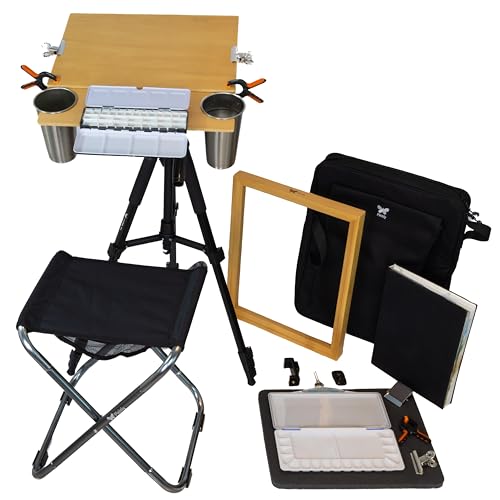
PLEINLY Outdoor Watercolor Easel Set with Stool — Best Complete Station
The premium answer to the sketcher’s carrying problem is integration: a field station that combines easel and seat in one system, so the walk carries one kit and the viewpoint assembles in minutes. This PLEINLY set is the verified example: a portable plein air watercolor easel system with studio-like ergonomics in its listing, comprising a tripod, a wet panel carrier and a stool, with sketchbook, palettes, cups and clips in the system. It is the professional plein-air workflow organised as a single purchase.
Strengths
- One carry, one setup, everything positioned
- Easel and seat heights are designed to match
- The professional plein-air workflow in a single unit
Trade-offs
- The heaviest and priciest direction in this guide
- Jack of two trades — pure stools are lighter, pure easels finer
- Overkill for sketchbook-and-pencil sketchers
Key details: Verified from the Amazon listing: PLEINLY outdoor watercolor easel set, portable plein air watercolor easel system with studio-like ergonomics, tripod, wet panel carrier and stool, sketchbook, palettes, cups and clips.
Judge this set as a system, not a chair: the tripod easel holds your board or panel, the stool is part of the same kit rather than a second carry, and the wet panel carrier solves the problem every plein-air watercolourist knows — getting a wet painting home without wearing it. Check that the easel’s working height suits your body and that the whole system folds into a carry you will actually shoulder to your favourite viewpoint.
This is the set for committed plein-air painters — the ones with a season’s body of outdoor work — rather than occasional sketchers. Its value compounds over dozens of sessions; over three sessions a summer, the tripod stool at the top of this guide is the wiser spend by a wide margin.
Buy the station last, not first. A season with the simpler slots teaches you your real session length, your real walking distance and whether your outdoor work wants a board, a canvas or a book — the three facts that choose between the integrated designs. Painters who buy the station after that education keep it for a decade; painters who buy it on ambition alone often own a beautiful object that stays in the garage, accusing them.
Best for: Committed plein-air painters with regular outdoor sessions / Not suited for: Occasional sketchers and pencil-only artists
Check on Amazon — check price on Amazon for the current listing, sizes and colours.
Comparison Table
| Pick | Badge | Key Spec | Best For |
|---|---|---|---|
| PORTAL Extra Large Folding Tripod Stool with Backrest Check on Amazon | {p[‘badge’]} | {p[‘keyspec’]} | {p[‘verdict_best’]} |
| VEVOR Oversized Camping Folding Chair Check on Amazon | {p[‘badge’]} | {p[‘keyspec’]} | {p[‘verdict_best’]} |
| Helinox Chair One Original Check on Amazon | {p[‘badge’]} | {p[‘keyspec’]} | {p[‘verdict_best’]} |
| EVER ADVANCED Camping Directors’ Chair with Side Table Check on Amazon | {p[‘badge’]} | {p[‘keyspec’]} | {p[‘verdict_best’]} |
| GCI Outdoor Freestyle Rocker Camping Chair Check on Amazon | {p[‘badge’]} | {p[‘keyspec’]} | {p[‘verdict_best’]} |
| PLEINLY Outdoor Watercolor Easel Set with Stool Check on Amazon | {p[‘badge’]} | {p[‘keyspec’]} | {p[‘verdict_best’]} |
Read the table as a shortlist, not a ranking carved in stone. The right row is the one whose key spec matches the problem you actually have — a household with different needs will honestly land on a different pick, and the reviews above explain where each one gives ground.
How to Choose a Chair for Sketching Outside: Carry Versus Sit
Decide your ratio first. If your sketching is a walk with drawings — urban sketching, coastal paths, a market town in a morning — carry wins: every extra kilo taxes every viewpoint, and the tripod and ultralight slots exist for you. If your sketching is a destination — one viewpoint, one long work, kit spread around you — sit wins, and the padded quad, director’s chair and station slots repay their weight in hours. Most sketchers own one of each eventually; buy first for the sketching you actually did last month, not the expedition you imagine next year.
Seat height is the second decision, and it is about your medium. Sketchbook on knees wants a low-to-mid seat with your feet flat and the book stable. A board on a separate easel wants director’s height. Watercolour on a board across your knees wants a seat low enough that the board tilts toward you at a working angle. Match the chair to the surface your paper sits on, and half of outdoor ergonomics is solved before you spend anything.
Finally, folded size against your real transport: the bag it must share with paper and paints, the car boot it must fit beside the easel, the train luggage rack it must survive. A chair that does not fit your transport does not get transported, and a chair at home improves no drawings at all.
Ground, Weather and Being a Guest in the Landscape
Outdoor chairs meet outdoor ground: tripods level themselves on slopes and rough ground; quad feet sink into soft turf; rockers demand hard flat surfaces; wide feet spread load on lawns. Match the foot to your terrain as deliberately as the seat to your body. On grass you care about — gardens, churchyards, cricket outfields — spread any chair’s load with its bag or a board under the feet, and never let a chair leg drill a hole in a lawn someone else maintains.
Weather shapes sessions as much as comfort does. A chair that sets up in twenty seconds beats a better chair that takes five minutes when a shower is crossing the valley. Fabrics should shrug off a damp morning; frames should not care about sea air; and the whole kit should pack away wet without complaint, to be dried at home rather than abandoned to mould in a car boot.
Etiquette is the third weather: sketchers are tolerated everywhere because they are quiet, still and gone without trace. A compact chair that tucks against a wall, leaves no holes, holds no territory and packs in a moment keeps that welcome alive for the next artist. The tripod stool’s discretion is a feature of the culture, not just the kit.
Posture for Drawing: What Your Back Wants at Hour Two
Drawing posture is upright and slightly forward, elbows free, head up — because you look at the view far more than at the page. Chairs that recline fight this; chairs with a firm seat and a backrest you can lean into during the looking pauses serve it. Armrests are a genuine divide: painters at easels find them obstacles, sketchbook drawers find them elbow props, and only your own sessions can settle which you are.
Session length is a back’s decision before it is a mind’s. The difference between the stool slots and the padded slots is measured in the second hour: if your outdoor work regularly passes ninety minutes in one spot, budget for padding and lumbar support as seriously as for paper. If it never does, padding is weight you carry to no purpose.
Feet matter too: a chair at the right height lets your feet rest flat, which stabilises the knees, which stabilises the book or board. Dangling feet mean a chair too tall for book work; knees above hips mean too low for comfort over an hour. Sit in any chair — in a shop, at a sketching meet, borrowed from a friend — with your actual kit before money follows opinion.
Building the Whole Outdoor Sketching Kit Around the Chair
The chair is the kit’s anchor: bag, board, easel and water all organise around where you will sit. A stool-based kit packs into one shoulder bag — stool inside or strapped beneath, sketchbook, pencils, a small water pot with a lid, water in a bottle that doubles as painting water. A station-based kit is a deliberate expedition: chair-station in one hand, panel or canvas pack on the back, and a site chosen where the walk is short. Neither is superior; they are different art forms wearing the same name, and confusing their kit lists is how sketchers end up carrying a station’s weight for a stool’s kind of day.
Water deserves its own sentence, because it decides more sessions than weather: carry drinking water and painting water as separate problems — a bottle for you, a sealed pot for the work — and a chair with a pocket, table or bag that keeps the painting pot upright and reachable. Spilled water ends more outdoor sessions than rain does.
Sketching Through the Seasons
Spring and autumn are the sketcher’s high seasons — low light, long shadows, bearable temperatures — and they ask little of a chair beyond damp tolerance. Summer adds heat: a chair you will sit in for hours should breathe, and a viewpoint’s shade at 10am is not its shade at noon, so portability becomes a midday survival trait. Winter sketching is a stool’s finest hour: short, intense sessions at low viewpoints, standing often to keep warm, with the tripod’s quick perch-and-move rhythm matching the season’s brief light exactly.
Whatever the season, the chair that gets carried is the chair that gets used, and the used chair is the one in the drawings. Buy for your real calendar — the Saturday walks, the sketching group’s monthly meet, the holiday week — and the kit will earn its place in every one of them.
Sketching Chairs for Different Bodies
Bodies differ more than chairs do, and the honest guide says so. Taller sketchers should distrust low stools: knees high and book low is a posture that punishes within the hour, and the director’s height or the oversized quad will serve them better than any ultralight. Sketchers with stiff knees should test the stand-up, not the sit — a chair you cannot rise from gracefully on a hillside is the wrong chair however lovely its padding, and higher seats with firm arms or a frame to push from earn their weight on exactly this point.
Heavier sketchers should read capacities as real specifications, not fine print, and favour steel frames and the verified quad’s high listed capacity over elegant minimalism. Children sketching alongside adults want the opposite — a small stool at their scale, light enough to carry themselves, because a chair of one’s own is half the invitation to the hobby. Match the chair to the body that will actually sit in it, in the shop, with time taken; bodies are not returnable, and chairs, fortunately, are.
What Sketchers Actually Carry: Field Notes
Watch a sketching group assemble and a pattern emerges: nobody carries what the catalogues photograph. The stools are scuffed, the bags are ordinary, the water pots are jam jars with lids, and the one universal luxury is a chair that sets up without a diagram. Sessions begin with drawing, not engineering, in every kit that has survived a season. That is the deepest argument for this guide’s order — stool first, comfort chair second, station last — because simplicity is not the budget version of the hobby. It is the hobby, with the friction removed.
The second pattern is repair and loyalty: sketchers keep chairs for years, re-stitching canvas, replacing a strap, because a known chair disappears under you and lets the landscape be the only novelty. Buy any slot here with that horizon in mind — a chair you can imagine owning in five years, in the places you actually go, is worth more than a cleverer chair you cannot picture past this summer.
Drawing From Cafés, Walls and Borrowed Seats: When No Chair Is Best
A final honesty: some of the best outdoor sketching happens with no chair at all — on harbour walls, café terraces with their own chairs, park benches and church steps. The portable stool’s role in that life is insurance, not obligation: it guarantees a seat where none is provided and stays in the bag where one is. Sketchers who treat every found seat as a gift and their stool as a backup develop the lightest kit and the widest range of viewpoints of all, because the whole built landscape becomes their studio furniture.
That is also the answer to give the minimalist who asks whether they need this guide at all: you need a seat you can rely on, which may be a wall — but the day the wall is wet, occupied or absent is the day the tripod stool in your bag earns its entire price in one dry, comfortable hour.
Care, Storage and the Chair’s Winter
Outdoor chairs die in storage more than in service: packed damp, left in hot cars, folded with grit in the joints. The winter routine is brief — brush the frame down, wash canvas or fabric per its label, dry everything completely in moving air, work the folding joints once to feel for grit or stiffness, and store the chair dry, loosely folded, out of sunlight. A chair stored like this opens in spring like a tool; a chair stored damp opens like an accusation.
Straps, hinges and feet deserve their minute: straps are the first component to fray and the cheapest to replace before a failure drops your kit on a hillside; feet caps lost to grass should be replaced before the bare frame starts cutting into lawns and floors. Five minutes in November is the whole maintenance budget of a good sketching chair — another reason the simple slots in this guide outlast the complicated ones.
A Word on Cost: Where Money Helps a Sketching Chair
Money in this category buys three things in descending order of value: a frame that neither wobbles nor tires — felt in every minute of every session; fabric and stitching that survive seasons of damp grass and car boots; and only then, features. A cheap chair with a sound frame out-sketches an expensive wobbler from the first outing, which is why this guide’s verified best-overall is a budget-tier stool with its priorities in the right order. Spend on structure, save on garnish, and let the drawing — never the chair — be the most elaborate thing you carry into the landscape.
How to Set Up a Sketching Spot That Works
A good sketching setup takes two minutes and saves two hours. The routine below works with any pick or slot in this guide.
- Arrive and look first, sitting later: stand at the viewpoint, frame the scene with your hands, and choose the drawing before the chair commits you to it.
- Place the chair for the view and the light: your shadow should not fall across your page, and the sun should not glare off white paper into your eyes.
- Set the chair level — tripod feet adjusted to the slope, quad feet spread on boards if the ground is soft — and sit-test before unpacking anything else.
- Arrange kit within arm’s reach in the order you use it: book or board, pencils, water pot secured, drinking water last and separate.
- Work in bouts: draw, then stand and step back every twenty minutes or so to judge the whole — the chair should let you rise in one motion.
- Pack in reverse, check the ground for kit and litter, and leave the spot exactly as a non-sketcher would wish to find it.
If a spot fights you — a wobbling chair on hidden roots, glare bouncing off the page, a wind that worries the paper and rattles the easel — move early and without self-reproach rather than enduring it nobly for the sake of a viewpoint that has already told you what it thinks of the arrangement. The portable kit in this guide exists so that relocating costs three minutes; the drawing will repay the move within the first fresh lines.
Common Buying Mistakes
Buying camping comfort for a drawing job. Recliners and loungers fight working posture. A sketching chair is upright, forward and easy to leave — judge it with a pencil in your hand.
Carrying a station for a stroll’s sketching. Weight taxes every viewpoint. Match the chair to last month’s real sketching, not next year’s imagined expedition.
Ignoring seat height. Too low wrecks knees and standing; too high dangles feet and destabilises the book. Height is ergonomics, not detail.
Setting up before choosing the view. The chair commits you. Look first, frame with your hands, then sit — in that order, every time.
Spreading kit on the ground. Grass eats pencils and water pots fall. Pockets, tables and bags exist; the chair should organise the kit, not just the artist.
Leaving holes, litter and territory behind. Sketchers are welcomed because they vanish without trace. Compact kit and a clean exit keep the world’s viewpoints open.
Final Recommendation
For most sketchers, start with the PORTAL tripod stool: it is light, backed, discreet and honest, and it will cover more sketching days than any other single purchase here. Choose the VEVOR padded chair when your sessions are long and your viewpoints near the car. Take the Helinox Chair One for serious walking, the EVER ADVANCED director’s chair for easel work, the GCI rocker for social sketching on hard ground, and the PLEINLY integrated set only when a season of outdoor painting has proven you need it.
Then go and sit in the landscape with a pencil, a pot of water, an hour you have no intention of hurrying, and a chair that asks nothing of you but to be sat on. The chair, in the end, is only ever the means, and a means that should vanish from your attention within five minutes of sitting down; the drawing — and the long, patient, pleasurable looking that makes it possible — is, was, and remains the entire point of carrying anything anywhere.
- PORTAL Extra Large Folding Tripod Stool with Backrest — Best Overall for Sketching: Check on Amazon
- VEVOR Oversized Camping Folding Chair — Best for Long Sessions: Check on Amazon
- Helinox Chair One Original — Best Ultralight: Check on Amazon
- EVER ADVANCED Camping Directors’ Chair with Side Table — Best for Studio-Style Fieldwork: Check on Amazon
- GCI Outdoor Freestyle Rocker Camping Chair — Best for Sketching Socials: Check on Amazon
- PLEINLY Outdoor Watercolor Easel Set with Stool — Best Complete Station: Check on Amazon
Best Easels For Painting
Best Outdoor Chairs
Best Portable Chairs
Frequently Asked Questions
What height chair is best for sketching?
It depends on your surface: low-to-mid for a sketchbook on your knees, with feet flat and knees stable; higher, director’s height, for working at an easel. The test is sitting with your actual kit — feet flat, book or board steady, standing up in one easy motion.
Is a tripod stool really comfortable enough?
For sessions up to about an hour, with a backrest model like the verified pick here, yes — the upright perch suits drawing posture. Beyond that, most artists graduate to a padded chair for long sits and keep the stool for walking days. Many own both, for different kinds of sketching.
Can I use a normal camping chair for sketching?
You can, and the VEVOR pick here is exactly that done well — padded, pocketed and supportive. What camping chairs often lack is the upright, forward posture and the quick exit drawing wants, so choose padded upright models over reclining loungers.
How do I stop my chair sinking into grass?
Spread the load: the chair’s own bag, a small board or wide-foot accessories under the feet. Tripod stools sink least by design. On lawns that matter, this is also good manners — no holes left behind.
What else should I carry besides the chair?
Sketchbook or board, pencils or paints, a sealed water pot, drinking water, and a bag that organises them around the chair. The kit section in this guide lays out stool-based and station-based versions; keep painting water and drinking water separate.
Are integrated easel-seat stations worth it?
For committed plein-air painters with regular long sessions, yes — the matched heights and single carry compound over a season. For occasional sketchers, the same money buys a fine stool, a fine separate easel and change. Buy the station after your habits have proven the need.
Should I choose a stool or a chair for urban sketching?
A stool, almost always: the city’s viewpoints are close together, its sessions shorter, and its tolerance for campers low. The tripod stool’s discretion and speed match urban work exactly; keep a padded chair for the countryside base-camp days.
How do I carry a chair and an easel together?
Let one hand take the folded chair or station and the other the easel, with paper and paints on your back — or consolidate into an integrated station or a trolley if your viewpoints are on paths. If the carry needs three trips from the car, the viewpoint is too far for that kit; simplify until it needs one.


