Disclosure: airfryerkitchensupply.com is reader-supported. When you buy through links on our site, we may earn an affiliate commission at no extra cost to you.
Where to buy
Every pick in this guide to the best camper toilets was cross-checked against Amazon’s own catalog data before it earned a link, so the model names and capacities below match the listings you will land on. Prices move constantly on portable sanitation gear, so instead of printing numbers that go stale, each pick links straight to its live listing — check the current price on Amazon before you decide. If a model ever shows as unavailable, the closest substitute is usually the next pick down in the same size class.
- Thetford Porta Potti 365 Portable Toilet (92820) — Best Overall for Campers
- Kohree Portable RV Toilet, 5.8 Gallon — Best Capacity
- Camco Portable RV Toilet with Detachable Tank, 5.3 Gallon (41541) — Best Simple Mechanism
- Dometic 976 Portable Toilet, 5.0 Gallon — Best Established Alternative
- Thetford Porta Potti 135 Portable Toilet (92860) — Best Compact for Small Campers
- Reliance Products Luggable Loo Portable Toilet, 5 Gallon Bucket Style — Best Indestructible Backup
Best camper toilets: What Actually Matters Before You Buy
The best camper toilets share one job: give you a private, sealed, genuinely usable toilet anywhere the camper stops, then get out of the way when you are driving. Whether your camper is a converted van, a small travel trailer without a black tank, or a truck camper, the realistic choices are sealed cassette toilets in a few sizes, plus one dead-simple bucket system for owners who value indestructibility over flushing.
This guide is honest about the trade every camper toilet makes. Bigger waste tanks mean fewer trips to the dump point but a heavier cassette to carry when full. Smaller units store anywhere but cycle faster. Flush mechanisms range from bellows pumps to piston pumps, and none of them feels like a home toilet — the good ones simply rinse the bowl cleanly and seal odor away between uses, which is the actual job.
Every pick below was verified against Amazon’s catalog before it received a link, and the capacities and features in the spec boxes come from those verified listings. Read the trade-offs as carefully as the strengths: in a camper, the wrong toilet is not a minor annoyance, it is a smell in a small box you sleep in.
It also helps to name what a camper toilet is not. It is not a plumbed RV toilet with a black tank, and it will never flush like one; it is not a backpacking solution, and its weight says so; and it is not a household fixture, however domestic some models look. It is a sealed, portable system for vehicles without plumbing — and within that honest definition, the best of them are genuinely excellent at a job that has no glamorous alternative.
In this guide
Quick Picks
If you only read one section, read this one. These six picks cover the realistic spread of the best camper toilets market — different sizes, different waste systems and different budgets — and each one earned its badge for a specific job rather than a generic ranking.
Best Overall for Campers — Thetford Porta Potti 365 Portable Toilet (92820). The balanced benchmark: a proven sealed cassette from the best-known portable line, sized for real trips and listed for everything from RVs to healthcare use.
Best Capacity — Kohree Portable RV Toilet, 5.8 Gallon. A 5.8-gallon detachable waste tank with a level indicator and leak-proof build, for campers who measure trips in days between dump points.
Best Simple Mechanism — Camco Portable RV Toilet with Detachable Tank, 5.3 Gallon (41541). A 5.3-gallon cassette with a sealing slide valve and bellows flush — moving parts you can understand, rinse and trust, with a built-in carry handle.
Best Established Alternative — Dometic 976 Portable Toilet, 5.0 Gallon. Dometic’s 5.0-gallon portable from the 970-series family — a middle size from a maker whose sanitation gear fills marinas and campgrounds.
Best Compact for Small Campers — Thetford Porta Potti 135 Portable Toilet (92860). The small Porta Potti: the sealed cassette format shrunk for teardrops, micro campers and vans where the toilet lives in a cupboard, not a bathroom.
Best Indestructible Backup — Reliance Products Luggable Loo Portable Toilet, 5 Gallon Bucket Style. A 5-gallon bucket, a snap-on seat and lid, and a metal handle. No flush, no seals to fail, nothing to break — the backup that always works.
How These Picks Were Chosen
We built this list for campers without plumbed black-water systems — van conversions, teardrops, truck campers and small trailers — and verified every model on this site before linking it. Candidates had to be genuinely portable, fully sealed between uses, and sized for vehicle storage. We spread the badges across the real decision points: overall balance, capacity, compact storage, simple mechanisms and the budget end of the market, and we included one bucket-style system because for some campers it is honestly the right answer. Capacities and features are quoted only from verified Amazon titles; no prices or fixed ratings are printed, since both change constantly.
Two filters did quiet work in this selection. First, every pick had to be serviceable at a dump point by one person wearing gloves, without tools, in the rain — because that is the real servicing environment, not a showroom. Second, we favored designs whose seals and valves can be rinsed and inspected by the owner, since seal condition is what the next three years of ownership actually depend on. Models that hid their working parts behind sealed novelty lost marks regardless of their feature lists.
The 6 Best camper toilets — Reviewed in Detail

Thetford Porta Potti 365 Portable Toilet (92820) — Best Overall for Campers
The Porta Potti 365 is the camper toilet against which others are measured, and it earns Best Overall by being unremarkable in the best way: it seals properly, flushes adequately, empties without drama and fits the storage bays and bathroom corners of most campers. Its listing spans RV, marine, camping, vans, trucks and healthcare, which reflects how many roles this one format quietly fills. For a first camper toilet purchase, it is the lowest-risk choice in this guide.
Strengths
- Proven sealed cassette format with a long track record
- Versatile sizing that suits most camper layouts
- Familiar routine any travel partner can operate
Trade-offs
- Flush is functional rather than luxurious
- Full cassette is a two-handed carry to the dump point
- Uses cassette additive, an ongoing consumable
| Specification | Detail |
|---|---|
| Model | 92820 (per Amazon title) |
| System | Sealed portable cassette toilet |
| Stated uses | RV, marine, camping, vans, trucks, healthcare (per Amazon title) |
What the 365 gets right is the unglamorous middle: big enough that a couple is not emptying it daily, small enough to lift and store, and sealed well enough that a closed camper in the sun does not announce its presence. Empty it before it is completely full — the last inch is where spills and resentment live — rinse the cassette at the dump point, and recharge with fresh water and additive before storing it back in the camper so it is always ready to go.
A second cassette is the 365 upgrade its owners mention most: it converts emptying from a deadline into a swap, which matters on the morning you are leaving a site with a queue at the dump point. Store the spare sealed and charged, rotate the pair, and the toilet’s logistics flatten into the background of the trip. It is not an exciting purchase. It is the kind that separates campers who have a system from campers who have a chore.
Best for: most campers wanting one proven, balanced cassette / Not suited for: owners who want a composting system or hate carrying cassettes
Check on Amazon — check the current price on Amazon and confirm the tank size on the listing matches what is described here before ordering.
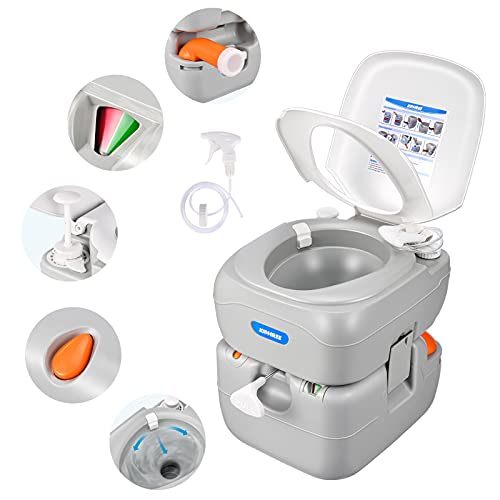
Kohree Portable RV Toilet, 5.8 Gallon — Best Capacity
The Kohree 5.8-gallon model is built around one idea: go longer between emptying stops. The detachable waste tank is the largest class in this guide, the level indicator removes the guesswork about when that stop is due, and the leak-proof design brief covers the tank, seals and transport. It suits couples and families on longer camper trips, festival weekends and remote stops where the nearest dump point is a planned excursion rather than a casual errand.
Strengths
- 5.8 Gal waste capacity stretches time between dump points
- Level indicator makes the emptying decision obvious
- Detachable tank and leak-proof design suit transport
Trade-offs
- A full 5.8-gallon cassette is genuinely heavy to carry
- Larger unit needs a larger storage spot in the camper
- Capacity tempts owners to delay emptying past the comfortable point
| Specification | Detail |
|---|---|
| Waste tank | 5.8 Gallon, detachable (per Amazon title) |
| Indicator | Waste level indicator (per Amazon title) |
| Design | Leak-proof (per Amazon title) |
Capacity is a blessing with one discipline attached: the indicator is there so you empty at three-quarters, not at overflow. Carried at a sensible level, the big Kohree turns toilet logistics into a twice-a-trip non-event. It also works well as a home backup — its listing includes home use — which gives it a second life during power cuts or bathroom renovations, a small but real value point for gear that otherwise sits in storage between trips.
The big Kohree has a second talent worth planning around: it is the pick most likely to be borrowed by your own household for non-camping duty — the renovation week, the power cut, the extra guest room. A toilet that earns its storage space across the year, rather than only on trips, changes the value arithmetic considerably. If your camper gear must justify its shelf, the capacity pick is the one that keeps finding work.
Best for: longer trips and campers with storage room for a larger unit / Not suited for: small campers where every litre of storage is contested
Check on Amazon — check the current price on Amazon and confirm the tank size on the listing matches what is described here before ordering.

Camco Portable RV Toilet with Detachable Tank, 5.3 Gallon (41541) — Best Simple Mechanism
Camco’s 5.3-gallon portable takes the mechanically simple path: a bellows-type flush you pump by hand and a sealing slide valve between bowl and tank. There is nothing pressurized and nothing electric, which suits campers who fix their own gear and distrust complexity on the road. The detachable tank, compact lightweight design and built-in carry handle round out a package aimed squarely at RV and camper duty.
Strengths
- Sealing slide valve gives a positive shut-off between uses
- Bellows flush is simple, manual and easy to rinse clean
- Built-in carry handle and detachable tank simplify dump runs
Trade-offs
- Bellows flush rinses less forcefully than pressurized systems
- Manual pumping is a deliberate action, not a button press
- Slide valve seal needs rinsing to stay odor-tight over time
| Specification | Detail |
|---|---|
| Waste tank | 5.3 Gallon, detachable (per Amazon title) |
| Flush | Bellows-type (per Amazon title) |
| Seal | Sealing slide valve (per Amazon title) |
| Model | 41541 (per Amazon title) |
The slide valve deserves its reputation: a positive mechanical seal is why this class of toilet can live in a camper without perfuming it. Treat the seal kindly — rinse the cassette thoroughly at emptying, work the valve a few times under clean water, and let it dry before storage — and it will keep doing its job for years. For campers who boondock far from services, that fix-it-yourself simplicity is worth more than any convenience feature.
Camco ownership has a folk ritual worth adopting: the end-of-season seal ceremony. Cassette out, long rinse, valve worked open and closed under clean water until it feels exactly as it did when new, everything dried in the sun before storage. Owners who do this measure their toilets’ lives in decades and talk about seals the way gardeners talk about soil. It takes twenty minutes, once a year, and it is the entire secret.
Best for: self-reliant campers who prefer simple, serviceable mechanisms / Not suited for: buyers wanting the strongest possible flush rinse
Check on Amazon — check the current price on Amazon and confirm the tank size on the listing matches what is described here before ordering.
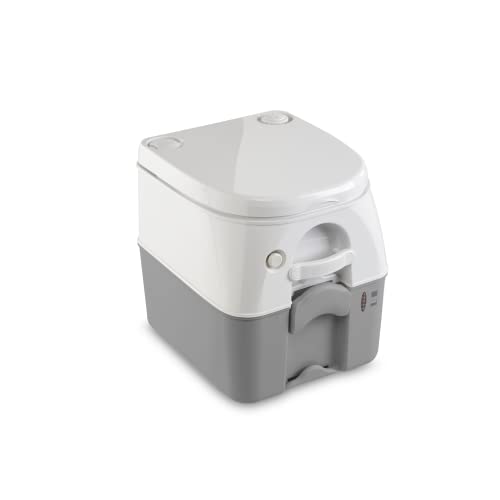
Dometic 976 Portable Toilet, 5.0 Gallon — Best Established Alternative
The Dometic 976 splits the difference in this guide: a 5.0-gallon capacity that suits couples on standard weekends, from a brand whose portable sanitation line is a fixture in both RV and marine worlds. It is the pick for buyers who want the cassette format from a long-established maker and whose trips do not demand the Kohree’s maximum tank or the Thetford’s exact footprint. In mixed camper-and-boat households it also shares a family resemblance with its smaller 2.6-gallon siblings.
Strengths
- 5.0 Gal capacity suits standard couple-length trips
- Established maker with a broad portable sanitation line
- Middle size stores more easily than the largest cassettes
Trade-offs
- Fewer headline features than newer rivals — no indicator listed
- Mid-size still cycles faster than 5.8-gallon models on long trips
- Gray finish shows travel scuffs honestly
| Specification | Detail |
|---|---|
| Capacity | 5.0 Gallon (per Amazon title) |
| Model | 301097606 (per Amazon title) |
| System | Portable cassette toilet |
Judge the 976 on rhythm: for the classic Friday-to-Sunday camper pattern it lands exactly right, with an emptying stop on the way home rather than mid-trip. Its value is competence without novelty — the format is proven, the size is sensible, and nothing about it will surprise you in either direction after a season of use. Buyers stretching trips toward a week should step up in capacity instead.
The 976’s gray finish, mentioned as a scuff-shower in its trade-offs, cuts the other way for working campers: it does not show the road. White portables look pristine in photographs and honest after one season of gravel pitches and storage bays; the Dometic simply starts honest. Pair that with its middle sizing — the cassette most likely to fit the bay you actually have — and its ownership proposition is quiet competence, which many campers will recognize as exactly what they wanted.
Best for: couples on weekend-pattern camper trips / Not suited for: long-stay campers who need maximum days between dump points
Check on Amazon — check the current price on Amazon and confirm the tank size on the listing matches what is described here before ordering.

Thetford Porta Potti 135 Portable Toilet (92860) — Best Compact for Small Campers
The Porta Potti 135 answers the storage question first. In a teardrop, a micro camper or a minimalist van build, the toilet must disappear — under a bench, in a cupboard, behind a seat — and the 135’s compact format is designed for exactly that life while keeping the sealed cassette system that makes portable toilets civilized. It suits solo campers and couples whose trips are short and whose space discipline is strict.
Strengths
- Compact format stores in cupboards and under benches
- Keeps the sealed cassette system despite the small size
- Ideal for teardrops, micro campers and minimal van builds
Trade-offs
- Small tank means frequent emptying on longer trips
- Lower seat height will not suit every adult
- Not a family-size solution for group camping
| Specification | Detail |
|---|---|
| Model | 92860 (per Amazon title) |
| System | Compact sealed cassette toilet |
| Format | Porta Potti compact class |
A small cassette changes trip habits in a good way: emptying is quick and light, so owners actually do it often, which keeps everything fresher than a big tank left too long. The 135 also makes an excellent second toilet — the overnight option inside the camper while the main facilities are a walk away. Just buy it with open eyes about seat height and capacity, and it will be the most-used small box in the camper.
The little 135 has an underappreciated talent: it makes an excellent toilet for the camper’s annex or awning, even in rigs that have a main solution. Kept there for night use, it saves the whole crew the walk to the block without asking the small tank to serve as the trip’s primary system. Sized honestly as a secondary, its capacity stops being a limitation and becomes the reason it is always fresh — small tanks, emptied often, are the freshest toilets in any campground.
Best for: solo campers and couples in very small campers / Not suited for: families or long trips needing maximum capacity
Check on Amazon — check the current price on Amazon and confirm the tank size on the listing matches what is described here before ordering.

Reliance Products Luggable Loo Portable Toilet, 5 Gallon Bucket Style — Best Indestructible Backup
The Luggable Loo is the honest end of the camper toilet spectrum: a 5-gallon bucket with a snap-on lid, seat and cover, carried by a metal handle, used with bag liners. There is no flush because there is nothing to flush — waste goes into a liner, the liner gets sealed and disposed of properly, and the bucket rinses clean in seconds. For remote camping, hunting camps, emergency kits and as the spare that lives in the camper permanently, its simplicity is the feature.
Strengths
- Nothing mechanical to fail, clog or leak under pressure
- Snap-on seat and lid keep it civilized and contained
- Metal handle and bucket format carry and clean easily
Trade-offs
- No flush and no odor-sealing valve — liners and prompt disposal matter
- Bucket height and format are basic by design
- Liner supply is a consumable to keep stocked
| Specification | Detail |
|---|---|
| Capacity | 5 Gallon bucket (per Amazon title) |
| Format | Bucket style with snap-on lid, seat and cover (per Amazon title) |
| Carry | Metal handle (per Amazon title) |
Used properly — good liners, a little absorbent or gelling material where appropriate, lid snapped shut, bags disposed of in proper waste — the Luggable Loo is far more pleasant than its price-class reputation suggests, and it never once needs a dump point, a rinse hose or a spare part. Many experienced campers run a cassette as the main toilet and keep this as the zero-maintenance backup. That pairing is not cheaping out; it is good systems thinking.
Bucket ownership improves sharply with two cheap habits: line it before every trip segment rather than when needed, and keep a small sealed container of absorbent or gelling agent in the same bag as the liners. The first habit means the toilet is always ready at a rest stop epiphany; the second turns each bag into a tidy, sealed, genuinely unremarkable package. With those two habits, the Luggable Loo’s simplicity stops being a compromise anyone notices.
Best for: remote trips, hunting camps, emergency kits and as a permanent backup / Not suited for: campers wanting a flushing toilet as their only system
Check on Amazon — check the current price on Amazon and confirm the tank size on the listing matches what is described here before ordering.
Comparison Table
The table below compresses the six picks into the four facts that decide most purchases in this category: what the product is, the badge it earned, the one specification that defines it, and the buyer it fits. Use it to shortlist two candidates, then read their full reviews above before spending money.
| Pick | Badge | Key spec | Best for |
|---|---|---|---|
| Thetford Porta Potti 365 Portable Toilet (92820) | Best Overall for Campers | Model 92820, sealed cassette design for RV, marine and camping use | most campers wanting one proven, balanced cassette |
| Kohree Portable RV Toilet, 5.8 Gallon | Best Capacity | 5.8 Gal detachable waste tank, level indicator, leak-proof | longer trips and campers with storage room for a larger unit |
| Camco Portable RV Toilet with Detachable Tank, 5.3 Gallon (41541) | Best Simple Mechanism | 5.3 Gal detachable tank, sealing slide valve, bellows flush | self-reliant campers who prefer simple, serviceable mechanisms |
| Dometic 976 Portable Toilet, 5.0 Gallon | Best Established Alternative | 5.0 Gal portable toilet, gray | couples on weekend-pattern camper trips |
| Thetford Porta Potti 135 Portable Toilet (92860) | Best Compact for Small Campers | Model 92860, compact Porta Potti format | solo campers and couples in very small campers |
| Reliance Products Luggable Loo Portable Toilet, 5 Gallon Bucket Style | Best Indestructible Backup | 5 Gal bucket style, snap-on lid, seat and cover, metal handle | remote trips, hunting camps, emergency kits and as a permanent backup |
How to Choose the Best Camper Toilets
Measure your storage before you fall in love with a tank size. The best camper toilets are the ones that fit the cupboard, bay or bench void you actually have, with the seat height you can live with, and a full-cassette weight you can carry at arm’s length across a campground. Weigh that last point honestly: waste weighs roughly what water weighs, so a big tank at full capacity is a serious lift.
Then match capacity to your trip pattern. Weekend couples can run mid-size cassettes happily; week-long boondockers should buy capacity or plan dump stops; solo travelers in small rigs should prioritize compact storage and light, frequent emptying. Finally, decide your mechanism philosophy — simple manual systems you can service anywhere, or more elaborate flush systems that rinse better and ask more of you.
- Measure the storage void and door openings before choosing a size class
- Estimate full-cassette weight and test your willingness to carry it
- Match tank size to days between realistic dump opportunities
- Decide simple-manual versus convenience features before comparing brands
- Budget for the consumables your system needs: additive, liners or medium
Flush Types, Seals and Why Odor Control Is Really Seal Control
Portable toilet flushes exist to rinse the bowl and move waste through the valve — bellows pumps, piston pumps and pressurized systems differ in effort and rinse strength, but all of them are modest compared with a home flush, and that is fine. What actually determines whether a camper smells is the seal: the slide valve or cassette closure that isolates the tank between uses. A positive, well-rinsed seal beats a powerful flush with a tired seal every single time.
That is why the maintenance advice in this guide repeats one theme: rinse the cassette and work the seal at every emptying, let things dry before long storage, and never let waste dry onto sealing surfaces. Do that, and any of the cassette picks here will live in a small camper without announcing itself. Skip it, and no feature list will save you.
Dump Points, Additives and Legal Emptying on the Road
A cassette is only as convenient as your emptying plan. Campground dump stations, RV parks, marinas and some rest areas accept cassette waste; a household toilet works too, which makes home the easiest dump point of all. What never works — legally or ethically — is emptying a chemically treated cassette into the environment, a pit toilet that forbids it, or a septic system the additive is not approved for. Check additive compatibility before you travel, not at the dump point.
Carry the kit that makes emptying a two-minute, no-drama stop: gloves, a short rinse hose or bottle, paper towel, and a small bottle of additive measured for the recharge. Empty at three-quarters full, rinse until the water runs clear, recharge with fresh water and additive immediately, and the cassette goes back into the camper ready rather than festering in a storage bay.
How to Use and Empty a Camper Cassette Toilet Cleanly
The cassette routine is simple, and doing it the same way every time is what keeps camper toilets pleasant. These steps cover the cassette picks in this guide; bucket systems follow the liner guidance in their review.
- Before the trip: fill the flush tank with clean water, add cassette additive to the empty waste tank as directed, and check the seal closes fully.
- In use: open the valve or flush mechanism as the model directs, keep the lid closed between uses, and never put wipes, sanitary products or kitchen waste into the cassette.
- Watch the level where an indicator is fitted; plan to empty at about three-quarters full rather than at the brim.
- At the dump point: gloves on, cassette out by its handle, cap and vent handled as the manual describes, and empty slowly to avoid splashing.
- Rinse the cassette with clean water, work the valve or seal under the rinse, and repeat until the rinse water runs clear.
- Recharge immediately with fresh water and the correct dose of additive, close everything, and wipe the cassette exterior before it goes back in the camper.
- Wash hands thoroughly and stow the emptying kit separately from food and fresh-water gear.
Once a season, give the cassette a deeper clean at home: a long rinse, attention to the seal and valve area, and a full dry before storage. Seals that are cleaned and stored dry stay supple and odor-tight far longer than seals stored wet and dirty.
Storing a Camper Toilet Between Trips (and in Winter)
More camper toilets are ruined in storage than in use. The rules are short: empty and rinse before storing, always; leave the cassette valve or closure in the position the maker recommends so seals are not compressed under load for months; dry everything fully to deny mildew its start; and store the unit out of hard freeze if it holds any residual water, because ice finds every trapped pocket. A toilet stored clean comes back in spring as a non-event. A toilet stored dirty becomes the story of the first trip.
Winter adds one decision: if the camper itself is winterized, the toilet is part of that job — flush tank drained, cassette emptied and rinsed, seals checked while you can still do something about them. Owners in freeze country often bring the cassette indoors for winter, which also makes the spring commissioning a kitchen-sink job instead of a campground discovery.
Keep the consumables with the toilet, not scattered through the camper: additive, liners for the bucket backup, gloves and a small towel in one bag that lives beside the unit. Systems fail socially when the chore is annoying; a complete, ready kit is how the chore stays at two minutes and nobody starts avoiding it.
The Two-Cassette System and Other Habits of Happy Camper Toilet Owners
Spend time around experienced camper owners and a pattern emerges: they talk about systems, not toilets. The two-cassette rotation — one in service, one clean and charged — is the emblematic example, turning the format’s one chore into a swap measured in seconds. But the pattern generalizes: the rinse kit that lives in its own bag, the additive measured rather than guessed, the dump stop planned into the route rather than discovered by desperation, the seal checked while clean instead of when complaining.
None of this is product. All of it is purchasable cheaply and learnable in one trip, and it explains why two owners of the identical toilet can report opposite experiences. When you read reviews of any pick in this guide — ours included — weight the ones describing a routine over the ones describing a first impression. A camper toilet is a five-year routine wearing a product’s clothes, and the routine is the part you control completely.
The practical takeaway for a new buyer is to budget the system, not just the unit: the toilet, its consumables for a season, gloves and rinse kit, and the spare cassette if your pick supports one. Bought together, the whole apparatus costs its owner a single decision. Bought piecemeal, it costs a small annoyance on every trip until it is complete.
Camper Toilet Buying Checklist
Before you order, walk through these six checks with your actual camper in mind:
- Storage measured: the void, the door or hatch it passes through, and the surface it will sit on in use.
- Full weight imagined honestly: the cassette at capacity, carried across a wet campground, by the person who will actually carry it.
- Trip pattern named: nights between dump opportunities on your longest typical trip, not your shortest.
- Mechanism philosophy chosen: simple and serviceable, or convenience-led — before brand comparisons begin.
- Consumables planned: additive type confirmed compatible with your usual dump points and any septic at home.
- Backup considered: a bucket system as the permanent spare is cheap insurance every experienced owner understands.
The Dump Stop, Choreographed: Making the Chore Disappear
Ask owners what separates a camper toilet they love from one they tolerate and the answer is rarely the toilet — it is the dump stop. Choreographed well, it takes four minutes and leaves no trace in memory. Choreographed badly, it involves a brim-full cassette, a missing glove, a queue of strangers and a smell that follows the camper for an hour. The choreography is learnable in one trip and worth more than any single feature in this guide.
The sequence that works: choose the stop before it is urgent, ideally where you are already pausing for fuel or water. Gloves live in an outside pocket of the cassette’s own kit bag, reachable before the cassette moves. The cassette travels from camper to point by its shortest path, empties slowly, rinses until clear, gets its valve worked under the rinse, and is recharged on the spot — never ‘later,’ because later is how cassettes end up stored dirty. Hands washed, kit stowed, and the whole event is over before the kettle boils.
Two refinements separate the veterans. First, they empty on their schedule, not the tank’s: the three-quarter habit means the stop happens at a good facility on a good day, not at the only facility on a bad one. Second, they debrief silently — seal felt right, rinse ran clear, additive stock noted — in the ten seconds of the walk back. That micro-inspection is the entire maintenance program of a healthy cassette, performed so casually it does not feel like one. Build the choreography once, and the toilet’s chore stops being the price of the trip and becomes part of its rhythm.
What to Pack Around the Toilet: The Support Kit That Makes the System
A camper toilet never travels alone, and the owners who love theirs have usually curated the small crowd of objects that travel with it. The complete kit is short enough to list: the correct additive for a full season, measured rather than guessed; disposable gloves in a quantity that removes hesitation; a short rinse aid — hose, bottle or the model’s own sprayer; a cloth that belongs to the toilet and nothing else; a headlamp that lives in the kit bag; and, for bucket owners, liners counted before every trip rather than discovered missing at one. Everything fits in one bag, and the bag lives with the toilet, in the camper, permanently.
Two items on that list deserve emphasis because they are the ones new owners skip. The dedicated cloth matters because general-purpose towels pressed into toilet service create a laundry diplomacy problem in a small camper; a labelled, separate cloth ends it. The headlamp matters because dump points and night use share one trait — they happen in the dark, at the hour when a flashlight in the mouth stops being funny. Small kit, assembled once, is the difference between a toilet system and a toilet object, and it costs less than any accessory the makers sell.
Common Buying Mistakes
Buying the biggest tank for a small camper
Capacity you cannot store or carry is not capacity. Measure the void, then imagine the full cassette at arm’s length, before choosing the largest class.
Emptying at completely full, every time
Brim-full cassettes spill, strain seals and make the chore miserable. The three-quarter habit is the difference between a two-minute stop and a story.
Using the wrong additive — or none
Cassette additives break down waste and control odor, but the wrong type can clash with septic systems and dump rules. Use the correct product, dosed as directed.
Putting wipes and trash in the cassette
Cassettes are not bins. Wipes and foreign objects jam valves and turn emptying into excavation. Everything except waste and toilet paper stays out.
Storing the toilet dirty between trips
A sealed cassette stored dirty will punish you at the next opening. Rinse, recharge or dry-store — but never just close the lid on a used tank and leave.
Final Recommendation
Most campers should start with the Porta Potti 365: it is the balanced, proven middle of this market. Step up to the Kohree 5.8-gallon if your trips run long between dump points, choose the Camco if you value a simple valve-and-bellows mechanism you can service yourself, and look at the Dometic 976 for a mid-size from an established sanitation maker. Small rigs belong with the Porta Potti 135, and every camper is better with a Luggable Loo as the backup that cannot break.
Buy for your storage, your trip length and your willingness to carry — in that order — and the toilet will disappear into the background of your trips, which is the highest praise camping sanitation can earn.
If you want the short version of this entire guide, it is this: start with Thetford Porta Potti 365 Portable Toilet (92820), Kohree Portable RV Toilet, 5.8 Gallon, Camco Portable RV Toilet with Detachable Tank, 5.3 Gallon (41541). One of those three fits the large majority of buyers in this category, and the full reviews above explain exactly which buyer each one fits.
Keep exploring the rest of this cluster once you have a shortlist: Best Cabin Toilets Best Campervan Toilets Best Camping Toilets Portable 2.8 Gal Best Camping Toilets Under $200 Best Cassette Toilets
Related guides
Frequently Asked Questions
How long does a camper cassette toilet last between emptying stops?
It depends on tank size and headcount, but as a planning rhythm: a mid-size cassette serves a couple for a long weekend, the largest class here stretches toward a week of careful use, and compact models suit a couple of days. Indicators and the three-quarter rule make the timing predictable.
Does a camper toilet smell inside a small camper?
A sealed cassette with a healthy, rinsed seal should not. Odor complaints trace back to seals fouled by dried waste, cassettes stored dirty, or vents and valves left open. The maintenance routine in this guide is specifically what prevents it.
Where can I legally empty a cassette toilet?
At campground and RV dump stations, marinas, approved rest-area facilities, or a household toilet. Never into the environment, and check additive compatibility before using any septic system. Rules vary by place, so check local guidance on longer trips.
Do I need chemicals in a camper cassette toilet?
Cassette systems are designed around an additive that breaks down waste and controls odor, dosed into the waste tank at each recharge. Bucket systems use liners instead. Composting alternatives avoid chemicals but are covered in the cabin and campervan guides in this cluster.
Can I use a camper toilet in winter?
Yes, with the same freeze discipline as the rest of the camper: protect flush water from freezing, empty before hard freezes if the rig sits, and store the cassette clean and dry. Many owners bring the cassette indoors for deep-winter storage.
Bucket toilet or cassette toilet for a camper?
A cassette gives you flushing and a sealed valve — the civilized default. A bucket gives you indestructibility, zero mechanisms and liner-based disposal. Many experienced campers carry the cassette as the main toilet and the bucket as the permanent backup.
What should I do if my camper toilet’s seal starts to smell?
Treat it as a maintenance message, not a product failure. At the next emptying, rinse the cassette longer than usual, work the valve or closure repeatedly under clean water, and inspect the sealing surfaces while they are clean — residue, grit and dried waste are the usual culprits, and all of them rinse away. Recharge with fresh water and the correct additive dose, then judge the result over the next few uses. If a thoroughly cleaned seal still leaks odor, the seal itself is aging and should be replaced; on the mainstream models in this guide that is a small, documented job. What never helps is masking scent with sprays while the seal stays dirty — the odor is information, and the information is almost always ‘rinse me properly.’ Owners who build that response into their routine find that seal smells are rare, brief and self-limiting.


