Disclosure: airfryerkitchensupply.com is reader-supported. When you buy through links on our site, we may earn an affiliate commission at no extra cost to you.
Where to buy
For best and worst camper van toilets, start here. Start with the two formats that dominate real van builds: a quality cassette or portable flush toilet for short trips, and a urine-diverting composting toilet for long ones. Every linked pick below was verified against Amazon; the composting and cassette models named here are the ones van converters actually bolt down, and the check-price links go to the exact verified listings.
Start here: Thetford Porta Potti 365 · Dometic 976 Portable Toilet 5.0 Gallon · Camco Portable RV Toilet 5.3 Gallon — check price on Amazon on each listing.
Best and Worst Camper Van Toilets: What Actually Works on the Road
Shopping for the best and worst camper van toilets in the same search is smart, because the gap between the best and the worst in this category is not a matter of taste — it is the difference between a toilet you forget about for a week and one that leaks, smells, or cracks in the first month. A camper van is the harshest home a toilet will ever have: no plumbing vent stack, no unlimited water, constant vibration, freezing nights and hot afternoons, and a waste tank you carry by hand through a campground. Products designed for a house, a boat showroom, or a festival weekend fail here in predictable ways, and this guide names both ends of the market honestly.
The honest shape of the market is this. At the top sit two mature technologies: sealed cassette and portable flush toilets from Thetford, Dometic and Camco, which work like a tiny chemical toilet and empty at a dump point, and urine-diverting composting toilets from Nature’s Head, Separett, OGO and Compo Closet, which separate liquids from solids and can go weeks between solids emptying. At the bottom sit unbranded folding stools with bag liners, wafer-thin portable pots with toy flush pumps, and “camping toilets” that are really a seat on a bucket. Those worst options are covered in prose in this guide — what to avoid and why — rather than recommended with links.
Your first decision is not brand but rhythm. If your van trips run two to four days and you pass dump points, a cassette toilet is simpler, cheaper to run, and familiar to anyone who joins you. If you boondock for a week or more, hate dump stations, or travel in winter when dump points close, composting earns its larger footprint and higher purchase tier by removing the dump-point dependency almost entirely. Everything below is organized around that rhythm, with six verified best picks and a clear account of the worst designs to leave on the shelf.
In this guide
Quick Picks
Six verified picks cover every sane van setup, from a weekend cassette to a full-time composting install. After the reviews, a dedicated section covers the worst designs in this category and the failure modes that put them there.
- Thetford Porta Potti 365 — Best Overall: the default van toilet: a real sealing valve, a sensible tank, and parts support everywhere. — Check the current price on Amazon
- Dometic 976 Portable Toilet 5.0 Gallon — Best Large-Capacity Portable: the big-tank Dometic for longer stretches between dump points. — Check the current price on Amazon
- Camco Portable RV Toilet 5.3 Gallon — Best Budget: a big tank and a sealing valve at the budget tier — the sensible cheap cassette. — Check the current price on Amazon
- Nature’s Head Self Contained Composting Toilet with Close Quarters Spider Handle Design — Best Composting: the full-time standard: weeks between solids emptying, no dump point, no chemicals. — Check the current price on Amazon
- Separett Tiny — Best for Small Vans: composting discipline in the smallest serious footprint, made for vans. — Check the current price on Amazon
- Kohree 5.8 Gallon Cassette Portable Toilet — Best Cassette Style: the cassette-format challenger: big tank, level gauge, elongated seat. — Check the current price on Amazon
How These Picks Were Chosen
Each pick had to pass four tests. First, identity: the product was searched by brand and model and the ASIN below is taken from the listing response whose title matches the product, so the link lands on the toilet described. Second, containment: the design must seal waste away from the living space — a sealing slide valve, a cassette with a vent and cap, or a diverting composting chamber — because odor in a van is a containment failure, not a fact of life. Third, serviceability: tanks, seals, fan parts or medium must be replaceable and the emptying job must be doable by one person wearing gloves at a dump point or a bin, without tools. Fourth, van fit: footprint, height and weight had to suit a garage drawer, a shower-pan wet bath, or a bench cabinet in a real conversion.
Composting picks were judged on diversion quality, fan reliability and how the solids chamber is emptied; cassette picks on valve sealing, tank capacity matched to realistic trip length, and whether the pour spout and vent make emptying clean rather than theatrical. Products that failed containment or serviceability — including several popular bag-and-bucket designs — were moved to the worst section rather than quietly dropped, because knowing what to avoid is half the value of this search.
The 6 Best Camper Van Toilets
The six picks run from the default cassette choice to the best compact composting unit for tight vans. Read the verdict line on each: in a van, the wrong excellent toilet is still wrong if it does not fit your cabinet, your trip length, or your tolerance for dump points.

Thetford Porta Potti 365 — Best Overall
The Porta Potti 365 is the toilet more van conversions start with than any other, and it earns that position by doing the unglamorous things correctly. The bowl sits at a usable height, the piston flush actually rinses the bowl instead of dribbling, and the holding tank detaches with a sealing slide valve that keeps the living space and the waste genuinely separate. For couples doing long weekends and solo travelers doing a week of mixed campground and stealth stops, it is the balanced default.
Strengths
- Sealing slide valve and tank vent make carrying a full tank through a campground a non-event
- Piston flush is simple, repairable and works without power or water pressure
- Tank size is honestly matched to several days of use for two people
Trade-offs
- Chemical fluid is an ongoing consumable and a matter of taste on scent
- Seat height suits most adults but very tall users will want a riser platform
- Like every cassette, it still depends on finding dump points on long trips
| Specification | Detail |
|---|---|
| Type | Portable flush toilet with detachable holding tank |
| Flush | Piston pump |
| Use case | Vans, RVs, marine, camping (per Amazon title) |
What separates the 365 from the lookalikes is the emptying experience. The tank carries by a proper handle, the pour spout rotates so you are not wrestling the tank over a dump hole, and the vent button prevents the glugging splash that makes cheap portables notorious. In a van, where the person emptying the toilet also sleeps two meters from it, those details are the product. The flush tank and waste tank separate without tools, so a deep clean at home between trips takes minutes, and replacement seals and valves are stocked by RV dealers everywhere — a genuine advantage when something wears out mid-season, far from home.
Its limits are the format’s limits. You will plan around dump points on trips past a few days, you will buy holding-tank fluid, and in freezing weather the flush water needs the same winter thinking as the rest of the van. Within the cassette format, though, nothing here is a compromise: this is the reference design the copies imitate, and buying the original is the cheapest way to own the category.
Ownership rhythm: expect the seal inspection to become a seasonal habit — a glance at the valve blade and a rinse of the tank at each home return — and the 365 will reward it with years of unremarkable service, which is the highest state a toilet can achieve.
In the hand, the 365 also teaches the category’s grip-and-pour ergonomics better than any rival: full, it balances; empty, it rinses without gymnastics. New owners should practice the first empty at home with clean water, because the dump point is a poor classroom and the skill is entirely learnable in advance.
Best for: most van owners wanting a simple, proven toilet for trips up to a week / Not suited for: full-timers who refuse dump-point planning — look at the composting picks below
Check on Amazon — check price on Amazon before you order, and confirm the exact variant and tank size on the listing.
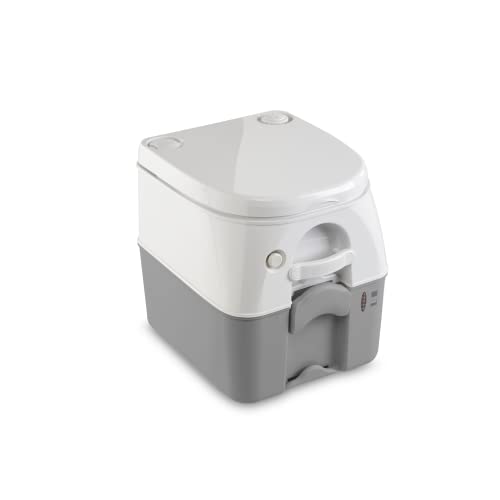
Dometic 976 Portable Toilet 5.0 Gallon — Best Large-Capacity Portable
The Dometic 976 answers the cassette format’s main complaint — how often you empty it — with capacity. Its 5.0-gallon holding tank stretches the interval for a couple on a long weekend or a solo traveler on a full week, and the push-button flush feels a step more civilized than a bellows pump. It suits vans with a dedicated toilet garage or a wet bath where the larger footprint is planned in from the start.
Strengths
- Largest tank in this portable class means fewer dump-point detours
- Push-button flush is easy for guests and children to use correctly
- Dometic’s RV dealer network makes seals and spares easy to source
Trade-offs
- Full, it is a heavy carry — plan the dump-point walk honestly
- Larger footprint will not fit the smallest toilet drawers
- Shares the cassette format’s chemical-fluid running cost
| Specification | Detail |
|---|---|
| Type | Portable toilet |
| Capacity | 5.0 gallon (per Amazon title) |
| Flush | Push-button |
Capacity is a trade, not a gift: every extra day between emptying is weight you eventually carry, and a full five-gallon tank is a serious one-handed load. The 976 makes sense where the math favors it — a fixed toilet cabinet near the van door, short walks to the dump point, and trips that would otherwise force a mid-trip empty of a smaller tank. The flush system also matters on longer trips: a pressurized push-button rinse keeps the bowl cleaner with less water discipline required from every user, which is exactly the kind of small mercy that adds up over a week.
Choose the 976 over the Porta Potti 365 when your cabinet fits it and your trips run long; choose the 365 when you carry the tank any distance or your space is tight. Both are honest versions of the same idea at different points on the capacity-versus-carry curve.
Ownership rhythm: because the tank’s interval is long, set your emptying trigger by the calendar as well as by fullness; waste left standing for weeks in a warm van tests any seal, and the 976 is happiest on a rhythm of use, empty, rinse, repeat.
The 976’s push-button flush also makes it the kindest cassette for households where hand strength varies — children and older travelers operate it without the bellows’ technique — a small accessibility fact that decides real purchases in real families.
Best for: couples and families whose toilet cabinet fits it and whose trips run four days or more / Not suited for: small vans with a shallow toilet drawer or anyone who dreads a heavy tank carry
Check on Amazon — check price on Amazon before you order, and confirm the exact variant and tank size on the listing.

Camco Portable RV Toilet 5.3 Gallon — Best Budget
Camco’s portable is the pick that proves budget does not have to mean the worst section of this guide. It has the two features that actually matter at this tier — a sealing slide valve and a detachable tank with a carry handle — and a 5.3-gallon capacity that embarrasses pricier small tanks. The bellows flush is basic, and the plastics feel like the budget tier they are, but the containment is real.
Strengths
- Sealing slide valve at a budget tier — the feature that must never be cut
- Generous 5.3-gallon tank for the price class
- Lightweight and compact enough for occasional-use vans and loaner builds
Trade-offs
- Bellows flush rinses less convincingly than piston or push-button systems
- Finish and latches feel budget-grade under daily full-time use
- Seat is compact; larger users should sit on one before committing
| Specification | Detail |
|---|---|
| Type | Portable RV toilet with detachable tank |
| Capacity | 5.3 gallon (per Amazon title) |
| Valve | Sealing slide valve (per Amazon title) |
The right way to judge a budget portable is to ask what the maker refused to cut. Camco kept the seal, the tank size and the carry handle, and saved money on flush refinement and surface finish — the correct priorities for a toilet that lives in a garage box and works on trips. For a second van, a rental build, a festival-and-weekend camper, or a first conversion whose owners are still learning their trip rhythm, that is exactly the right allocation of a small budget.
Treat it as an honest tool with a service life rather than a lifetime fixture: keep the valve seal clean, rinse the tank properly after each trip, and it will do seasons of weekend work. If you graduate to full-time travel, the composting picks below are the upgrade path — not a fancier version of the same bellows.
Ownership rhythm: the bellows flush rewards a full, confident pump rather than tentative half-strokes, and a drop of care on the valve seal at each rinse keeps the budget build sealing like its betters. Teach every user the full stroke and the Camco behaves above its tier.
For loaner and rental vans the Camco has a further quiet virtue: its simplicity survives strangers. There is nothing to configure, nothing electronic to explain, and its whole user manual fits in one sentence at handover — which is how a budget toilet earns fleet work.
Best for: weekend and occasional-use vans that need real containment on a budget / Not suited for: full-time daily use, where the basic flush and finish will wear thin
Check on Amazon — check price on Amazon before you order, and confirm the exact variant and tank size on the listing.
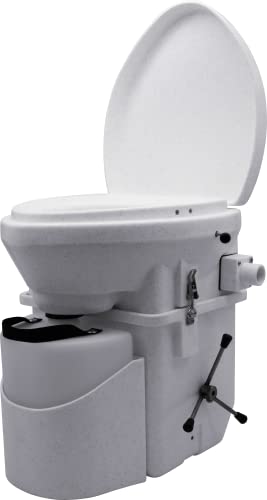
Nature’s Head Self Contained Composting Toilet with Close Quarters Spider Handle Design — Best Composting
The Nature’s Head is the composting toilet the van-life world standardized on, and the close-quarters spider-handle version is the one to buy for a van, because the handle clears tight cabinet walls when you crank the agitator. It diverts urine to a front bottle and drops solids into a medium-filled chamber you turn after use; the small fan vents the housing, and the result — used correctly — is a toilet with no black-water smell and no dump point in its life.
Strengths
- Weeks between solids emptying for a couple; urine bottle empties anywhere discreet
- No chemicals, no dump points, and freezing weather does not burst anything
- Close-quarters handle is purpose-shaped for van cabinets and wet baths
Trade-offs
- Needs a vent run and a small constant fan draw — a real install, not a drop-in
- Compost medium is an ongoing consumable to carry and store
- Guests need a thirty-second briefing on diversion and cranking
| Specification | Detail |
|---|---|
| Type | Self-contained composting toilet (per Amazon title) |
| Handle | Close quarters spider handle (per Amazon title) |
| System | Urine-diverting, fan-vented |
The learning curve is real but short. Diversion must be taught — sit fully, every time — and the medium must start at the right moisture: too dry and nothing breaks down, too wet and the fan cannot keep the chamber sweet. Owners who give it a week of attention at the start typically report the same surprise: the van simply stops having a toilet problem. There is no tank to gauge, no dump point to route toward, no chemical scent fighting the smell it masks — just a bottle to empty on a morning walk and a chamber that asks for attention every few weeks.
For full-timers and long-trip boondockers, that freedom is worth more than any single specification. The install deserves care — a straight, short vent, a fused fan circuit, and a mounting you trust on rough roads — and this guide’s how-to section walks through the discipline that keeps any composting toilet odor-free.
Ownership rhythm: keep a small stock of medium in the van, mark the urine bottle’s rhythm on your travel days, and treat the fan’s hum as a dashboard light — its silence is the one sound that should make you investigate the same day.
The Nature’s Head also anchors a community effect worth knowing: because so many owners run one, every van-life forum, marina dock and converter’s bench holds working knowledge of its habits — troubleshooting a composter at distance is easiest with the model everyone else has already troubleshot.
Best for: full-timers and long boondock trips where dump points are scarce or closed / Not suited for: weekend vans, where a cassette is simpler and the install effort never pays back
Check on Amazon — check price on Amazon before you order, and confirm the exact variant and tank size on the listing.

Separett Tiny — Best for Small Vans
The Separett Tiny takes a different composting path from the Nature’s Head: instead of mixing solids into medium, it separates urine into a built-in container and collects solids in a bag-lined chamber that you empty as a bag, with a view screen that closes after each use. For small vans, the appeal is the footprint and the simplicity — no cranking, no medium moisture to manage — and the emptying sensor removes the guesswork from the urine container.
Strengths
- Smallest serious composting footprint here — fits vans the Nature’s Head cannot
- No medium and no cranking: solids leave in a bag, which many owners find simpler
- Built-in urine container with an emptying sensor suits hidden installs
Trade-offs
- Bag-based solids handling is a consumable and a personal preference — try before you commit
- Solids emptying comes sooner than a mixing chamber on long trips
- Vent fan install is still required for odor-free running
| Specification | Detail |
|---|---|
| Type | Self-contained urine-separating compost toilet (per Amazon title) |
| Urine | Built-in container with emptying sensor (per Amazon title) |
| Medium | None — no additives or mixing (per Amazon title) |
Separett’s Swedish design assumes the toilet disappears into a small space and behaves like furniture: quiet fan, closed screen, clean lines. In a compact campervan where the toilet slides out from under a bench or lives in a slim shower stall, that integration is the difference between a toilet that fits the build and one that dictates it. The honest cost is rhythm: bag changes are quick but more frequent than a mixing chamber’s monthly empty, and you are committing to a supply of the right bags.
Pick the Tiny when space is the binding constraint and your trips are measured in days-to-a-couple-of-weeks; pick the Nature’s Head when you want the longest possible intervals and the medium system’s independence from bags. Both beat every cassette on freedom from dump points; they simply schedule their chores differently.
Ownership rhythm: stock the correct bags before a long trip rather than improvising with substitutes whose fit the screen depends on, and the Tiny’s whole service routine stays inside two minutes at a bin, gloves on, dignity intact.
The Tiny’s screen deserves a word of design credit: by closing the chamber from view after every use, it removes the one moment that makes guests hesitate, and a toilet guests use correctly without thinking is a toilet whose system stays intact.
Best for: compact campervans and tight wet baths that still want dump-point freedom / Not suited for: longest-interval full-timers who prefer medium composting over bags
Check on Amazon — check price on Amazon before you order, and confirm the exact variant and tank size on the listing.

Kohree 5.8 Gallon Cassette Portable Toilet — Best Cassette Style
Kohree’s cassette portable is the credible challenger format in this guide: a 5.8-gallon waste tank with a level indicator, a diagonal elongated bowl seat that feels less like a camping compromise, and leak-proof sealing aimed squarely at van and RV travel. The level indicator is the detail owners end up praising — knowing the tank state without guessing removes the main anxiety of cassette life.
Strengths
- Level indicator ends the guesswork that causes overfill accidents
- Largest tank here stretches dump intervals for families
- Elongated seat shape is noticeably more comfortable on longer trips
Trade-offs
- Brand support and spares are thinner than Thetford, Dometic or Camco
- Big tank means the heaviest full carry in this guide
- Confirm seal spares availability before a long season
| Specification | Detail |
|---|---|
| Type | Portable cassette toilet (per Amazon title) |
| Capacity | 5.8 gallon (per Amazon title) |
| Seat | Diagonal elongated bowl seat (per Amazon title) |
Judged purely as hardware, the Kohree makes a strong case: capacity, gauge and seat are the three things cassette owners ask for, and it answers all three. The caution is ecosystem, not engineering. A Thetford seal can be found in any RV town; a Kohree seal is an online order, so the smart owner buys the spare seal kit with the toilet and keeps it in the van. With that one precaution taken, the challenger’s advantages are real and daily.
It fits best in vans with a fixed toilet position near a door, where the big tank’s carry is a few steps, and in family vans where the gauge prevents the classic day-four surprise. Solo travelers in small vans will find the Camco or the Porta Potti 365 easier to live around.
Ownership rhythm: buy the spare seal kit at purchase, log the tank’s true days-per-fill for your household in the first season, and the challenger’s one ecosystem caveat disappears into a drawer where the spare already lives.
The level indicator, praised in the review, changes behavior beyond its information: owners who can see the tank’s state empty earlier and calmer, which means the Kohree’s seals live an easier life than the same seals would in a gaugeless twin.
Best for: family vans and fixed toilet cabinets that value capacity and a level gauge / Not suited for: owners who want dealer-network spares available in every town
Check on Amazon — check price on Amazon before you order, and confirm the exact variant and tank size on the listing.
Comparison Table
Badges summarize the job each toilet does best. Key specs are drawn from the verified Amazon titles; capacities are tank sizes as listed, and the right column restates the verdict so you can shortlist by trip rhythm first and brand second.
| Pick | Badge | Key spec | Best for |
|---|---|---|---|
| Thetford Porta Potti 365 | Best Overall | Sealed portable flush toilet; piston pump; detachable holding tank | most van owners wanting a simple, proven toilet for trips up to a week |
| Dometic 976 Portable Toilet 5.0 Gallon | Best Large-Capacity Portable | 5.0 gallon portable toilet; push-button flush | couples and families whose toilet cabinet fits it and whose trips run four days or more |
| Camco Portable RV Toilet 5.3 Gallon | Best Budget | 5.3 gallon detachable tank; sealing slide valve; bellows flush | weekend and occasional-use vans that need real containment on a budget |
| Nature’s Head Self Contained Composting Toilet with Close Quarters Spider Handle Design | Best Composting | Urine-diverting composting toilet; close-quarters spider handle | full-timers and long boondock trips where dump points are scarce or closed |
| Separett Tiny | Best for Small Vans | Urine-separating compost toilet; built-in container with emptying sensor | compact campervans and tight wet baths that still want dump-point freedom |
| Kohree 5.8 Gallon Cassette Portable Toilet | Best Cassette Style | 5.8 gal cassette; diagonal elongated seat; level indicator | family vans and fixed toilet cabinets that value capacity and a level gauge |
How to Choose the Best Camper Van Toilet for Your Trip Rhythm
Choose by rhythm before hardware. Count your longest stretch between reliable dump points, honestly, including winter closures and the forest roads where the dump station is a rumor. Two to four days points to a cassette; a week or more points to composting. Then measure the space the toilet must live in — drawer, cabinet or wet bath — including the clearance to remove a tank or a solids chamber, because a toilet you cannot service in place will be serviced resentfully and then not at all.
Next, decide who else must use it without instruction. Cassettes are intuitive for guests, children and anyone borrowing the van; composting toilets ask for a short briefing and reward it with freedom. Finally, weigh the chores you mind least: carrying a sealed tank to a dump point every few days, or managing medium, bags and a urine bottle on a slower cycle. There is no chore-free toilet; there is only the chore schedule that fits your travel.
The Worst Camper Van Toilets: Designs to Avoid
The worst end of this market fails on containment, and it fails in three repeatable designs. First, the bag-liner folding stool: a seat over a plastic bag, sold with camping imagery. It has no seal, no diversion and no dignity past the first night, and it turns every use into a waste-handling event. Second, the wafer-thin portable with a toy bellows and a latching lid instead of a sealing valve: it looks like the Camco pick’s cousin and behaves like a bucket with ambitions, leaking odor on every warm afternoon and flexing under adult weight. Third, the unbranded “flush” portable whose tank, seals and pump have no spare parts anywhere: the first cracked latch or perished seal ends its life, usually mid-trip.
A fourth failure is subtler: the quality toilet in the wrong job. A 2.6-gallon mini portable as the only toilet for a family of four, a composting toilet installed without its vent because the cabinet looked cleaner unvented, a plumbed RV toilet fitted to a van with no black tank plan — each is a good product made worst by mismatch. The avoidance rule is simple: if the listing cannot name its seal, its spares and its emptying method in plain language, it belongs to the worst list whatever its photographs promise.
Cassette vs Composting: Running Costs and Daily Reality
Running costs differ in kind. Cassettes spend money steadily — holding-tank fluid, dump fees where they exist, and water for rinsing — and spend your route-planning on dump points. Composting toilets spend money in lumps — medium or bags, a fan replacement every few years — and spend a little daily attention on diversion discipline and bottle emptying. Neither is expensive in absolute terms next to fuel; the real cost is the one measured in trip friction, and it is personal.
Daily reality also differs in failure modes. A cassette fails loudly and rarely: a perished seal announces itself and is a cheap part. A composting toilet fails quietly and gradually: medium too wet, fan stalled, diversion sloppy — each fixable in minutes once noticed, which is why the how-to routine below matters more for composting owners. Buy the failure mode you are better at noticing.
Living With the Choice: The First Season Teaches the Rhythm
No specification sheet survives contact with your actual travel unchanged, which is why this guide recommends treating the first season as field research. Note, trip by trip, how many days the tank or the bottle actually lasted, where you emptied, and which chore you complained about — aloud or silently — most often. That notebook, not any review, is the document that should govern a second purchase, because van toilets are matched to rhythms and rhythms are only visible in retrospect.
The pattern owners report is remarkably consistent. Weekend travelers discover the cassette was never the constraint they feared, and their upgrade money goes to a better seat or a second tank rather than a new system. Long-trip travelers discover the inverse: the dump point, not the tank size, was the tax on every route, and the composting conversion they postponed becomes the purchase they wish they had made first. Both discoveries are cheap at one season’s tuition and expensive at three — so travel first, record honestly, and let the second purchase be the informed one.
Weight, Water and Waste: The Van-Wide Accounting
A van toilet is also a weight and water decision. A cassette carries its flush water and accumulates its waste weight low and central if you place it well; a composter carries medium or bags and returns its flush water to your tank’s budget, which on long dry camps is a genuine range extender. In small vans near their payload limit, the difference between systems across a long trip is measured in tens of kilograms and a day or two of water — numbers worth an honest line in the build spreadsheet.
Waste disposal is the third ledger, and it is an ethical as much as a practical one. Cassette contents belong at dump points and nowhere else; urine from a diverter can go to any discreet, appropriate facility or drain where local practice allows; bagged solids follow local waste rules. The owners who keep van life welcome in the places it visits are the ones whose toilet leaves no trace beyond the official ones, and every system on the best list is designed to make that easy.
Seasons, Storage and the Toilet Between Trips
A van toilet’s hardest season is often the one it spends parked. Between trips, a cassette should be rinsed, dried and stored with its cap off and its valve open a fraction, so seals rest uncompressed and no residual moisture perfumes the cabinet it returns to. Holding-tank fluid is a working chemical, not a storage one; the tank that sits clean and dry in October is the tank that behaves in April. Wheels-up storage also means the toilet’s own weight is secured — a stored portable that slides around a garage arrives at the season pre-damaged.
Composting units store by the opposite instinct: they are left assembled, vented and dry-ish, with the chamber’s medium settled and the urine container emptied and rinsed. The fan need not run in storage, but the vent should not be sealed airtight against the unit, and a stored composter should be inspected once mid-winter in damp climates, because the same moisture discipline that governs its working life governs its rest. Owners who give storage the same ten minutes of method they give a trip are rewarded with a first trip that starts at the packing list, not at the parts store.
Finally, the between-trips season is when the upgrade decision ripens. The notebook from the first season — days per tank, dump points cursed, mornings the bottle run happened in the rain — reads differently in the quiet of winter, and the second purchase made from it, whether that is a second cassette for rotation, a composting conversion, or simply a better storage box for the unit you keep, is the purchase this entire category rewards: the one made from evidence instead of hope.
How to Set Up and Maintain a Camper Van Toilet
Whether you chose cassette or composting, the setup discipline below is what separates the best camper van toilets from the worst experiences — most odor stories are setup stories.
- Mount it against movement. Secure a cassette with a hold-down kit or a fitted cabinet; bolt a composting toilet through its base. A toilet that shifts on rough roads stresses its seals and its vent joint.
- Vent a composting toilet properly. Run the shortest, straightest vent you can, seal the joint, and confirm the fan runs before the first trip. An unvented composting toilet is a worst-list toilet regardless of brand.
- Prime a cassette correctly. Add holding-tank fluid and a little water to the waste tank before first use, and charge the flush tank with clean water. Dry seals and dry tanks are where smells begin.
- Prime composting medium honestly. For a mixing chamber, hydrate the medium to the maker’s wrung-sponge description before first use; for a bag system, fit the bag smoothly so the screen closes cleanly.
- Empty earlier than full. Cassette at the gauge or by day count, urine bottle daily on travel days, solids on schedule rather than by smell. Every toilet in this guide is pleasant at eighty percent and unpleasant at a hundred and ten.
- Rinse and dry at home. Between trips, rinse tanks, leave caps off to dry, and check seals while the job is easy and the parts shelf is near.
Keep a small kit with the toilet: gloves, a spare seal for your model, fluid or medium for one full service, and the Allen key or driver your mount needs. Five minutes of kit turns every roadside chore into routine — and routine, not hardware, is what keeps a van toilet in the “best” column for years.
Common Buying Mistakes
Buying capacity you cannot carry. A full large tank is heavy. If the dump-point walk is long, a smaller tank emptied cheerfully beats a big one emptied resentfully — and resentment is how seals get neglected.
Skipping the vent on a composting install. The fan and vent are the odor system. Owners who omit them to save an hour of fitting create the exact smell stories that give composting a bad name.
Using household chemicals in a cassette. Bleach and harsh cleaners attack seals and make tank odors worse. Use fluids made for holding tanks and rinse with water.
Judging by the product photo’s van, not yours. Measure your drawer or cabinet, including tank-removal clearance, before ordering. Returns of a used-test toilet are nobody’s favorite transaction.
Forgetting winter. Cassette flush water freezes like any water; composting chambers simply slow down. Plan the cold-season version of your toilet before the first frost, not during it.
Final Recommendation
For most vans, start with the Thetford Porta Potti 365 and travel: it is the balanced default, and a season with it will teach you your real rhythm. If the season teaches you that dump points rule your route, the Nature’s Head is the full-time answer and the Separett Tiny is its compact alternative; if it teaches you only that the tank fills too fast, the Dometic 976 or the Kohree cassette stretches the interval. On a budget, the Camco proves containment does not require a premium tier. And whatever you choose, leave the worst designs — bag stools, unsealed toy portables, no-spares unbranded flush pots — on the shelf where they belong.
Thetford Porta Potti 365 — check price on Amazon. Dometic 976 Portable Toilet 5.0 Gallon — check price on Amazon. Camco Portable RV Toilet 5.3 Gallon — check price on Amazon. Nature’s Head Self Contained Composting Toilet with Close Quarters Spider Handle Design — check price on Amazon. Separett Tiny — check price on Amazon. Kohree 5.8 Gallon Cassette Portable Toilet — check price on Amazon.
Keep reading in this series: Best Camper Van Toilets Best Composting Toilets For Camper Vans Best Portable Toilets For Camping Best Rv Toilets Best Toilets For Vans
Related guides
Frequently Asked Questions
What is the best toilet for a camper van with no bathroom?
A sealed cassette portable such as the Porta Potti 365 or the Camco 5.3-gallon, stored in a cabinet or garage drawer and used with a privacy tent or curtain setup. It needs no plumbing, no vent and no power, and the sealing valve keeps odor contained between uses.
Do composting toilets smell in a van?
A correctly installed and vented composting toilet — Nature’s Head or Separett Tiny, fan running, diversion used properly — has no black-water smell; owners typically notice only the medium’s earthy scent when the lid is open. Odor stories almost always trace to a missing vent, stalled fan or over-wet medium.
How often does a camper van cassette toilet need emptying?
By rhythm rather than a fixed number: a couple typically gets a long weekend from a mid-size tank, and the Kohree’s level indicator or your own day count should trigger emptying at about eighty percent, before the carry gets heavy and the seal gets stressed.
What makes a camper van toilet one of the worst?
Failed containment: no sealing valve, bag-only waste handling, no spare parts, or a quality product installed wrongly — most notoriously a composting toilet fitted without its vent. If a listing cannot explain its seal, spares and emptying method, treat it as worst-list.
Can I use a normal RV toilet in a camper van?
Only with a black-tank plan: a plumbed RV toilet like the Dometic 320 needs a mounted black tank and dump plumbing beneath it. In a self-contained van without that system, a cassette or composting toilet is the workable format.
Which is better for winter van travel, cassette or composting?
Composting, for most owners: there is no flush water to freeze and no dump point to find in the off-season. Cassette users winterize the flush tank and plan around closures, which is workable but adds chores exactly when daylight is shortest.


