Disclosure: airfryerkitchensupply.com is reader-supported. When you buy through links on our site, we may earn an affiliate commission at no extra cost to you.
Where to buy
For best and worst campervan toilets, start here. Campervan toilets divide into self-contained units you can lift out and fixed units plumbed to a black tank. The verified picks below cover both, from the compact Thetford Curve to a porcelain Dometic 320 for big coachbuilt vans. Check the current price on Amazon on the linked listings, and measure your washroom before falling for any of them.
Start here: Thetford Porta Potti Curve 565E · Dometic 972 Portable Toilet 2.6 Gallon · OGO Origin Compact Composting Toilet — check price on Amazon on each listing.
Best and Worst Campervan Toilets, Judged as One Word and One Room
The best and worst campervan toilets are separated by the same line as their two-word cousins, but the campervan — one word, one room, everything within arm’s reach — raises the stakes. In a coachbuilt or a panel-van conversion with a real washroom cubicle, the toilet shares air with the shower, the towels and often the kitchen’s far wall. A toilet that merely contains waste is not enough here; it has to behave like bathroom furniture: steady underfoot, civilized to sit on, sealed when the van moves, and serviceable through its own access hatch without dismantling the room.
This guide therefore judges the category the way a converter does. The best list rewards seat height and shape, flush quality, cassette access from outside the van where the build allows it, and — for the growing number of campervans with fixed washrooms — proper plumbed ceramics that connect to a black tank. The worst list, covered in prose after the reviews, names the designs that betray a washroom: flimsy all-plastic pots that flex, cassettes with no external access so the tank travels through the living space, and bargain “marine” toilets whose pumps were never meant for road vibration.
If your campervan is a micro-camper or a day van, read the compact picks first and skip the plumbed finale. If yours is a full conversion with a washroom, the order reverses: the fixed Dometic at the end may be your best, and the portables become the guest-and-overflow options. Either way, the six verified picks below are the ones worth your washroom’s limited square footage.
In this guide
Quick Picks
From the smallest serious portable to a fixed porcelain RV toilet, these six verified picks scale with the size of the campervan itself. The worst-designs section after the buying guide explains what to refuse at any size.
- Thetford Porta Potti Curve 565E — Best Overall: the portable that feels like a bathroom fixture: tall, curved, electric flush. — Check the current price on Amazon
- Dometic 972 Portable Toilet 2.6 Gallon — Best Compact: the small Dometic for micro-campers and day vans: real seal, tiny footprint. — Check the current price on Amazon
- OGO Origin Compact Composting Toilet — Best Compact Composting: a 15-inch footprint composting unit made for van installs. — Check the current price on Amazon
- Compo Closet Cuddy — Best for Van Conversions: a converter-friendly composter: 12V fan, carbon filter, self-contained. — Check the current price on Amazon
- Thetford Porta Potti 135 — Best Budget: Thetford’s sealing discipline at the budget end of its own range. — Check the current price on Amazon
- Dometic 320 Series RV Toilet — Best Fixed / Plumbed: the proper plumbed answer for big campervans with a black tank. — Check the current price on Amazon
How These Picks Were Chosen
Verification came first: every ASIN here was returned by Amazon listing data for the brand and model named, and the title match was checked before any link was written. Then came campervan-specific tests. Seating: height and bowl shape were judged against a normal household toilet, because a washroom fixture gets used daily, not endured occasionally. Sealing: the unit must travel full without weeping at the valve or cap. Access: on cassette models, preference went to designs whose tank removes cleanly and pours without splash; on the fixed model, to standard RV mounting and parts availability.
Products were moved to the worst list, rather than the picks, when their failure mode was structural: no sealing valve, no spares channel, a pump designed for still water on a boat rather than a moving van, or dimensions that fit no real washroom. Two near-identical keyword variants exist for this topic; this guide is deliberately the washroom-and-fixed-install angle, while its sibling covers the drawer-and-garage angle, so the picks overlap only where a product genuinely serves both.
The 6 Best Campervan Toilets
Ordered from the most portable to the most permanent. Your washroom size — not your budget — should decide where on this list you land.
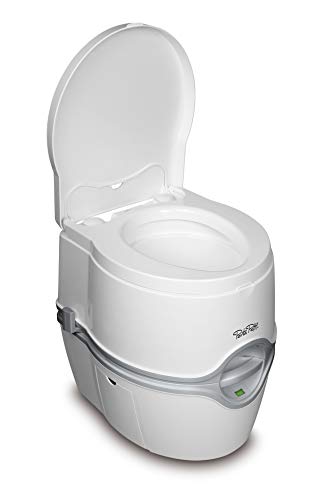
Thetford Porta Potti Curve 565E — Best Overall
The Curve is Thetford’s answer to the portable toilet’s oldest complaint — that it feels like camping equipment in a room that is supposed to feel like a bathroom. The seat height and curved profile mimic a household toilet, the flush is battery-powered and genuinely rinses, and the holding tank is sized for real trips. In a campervan washroom without plumbing, it is the portable that owners stop apologizing for.
Strengths
- Household-like seat height and shape suit daily washroom use
- Battery flush rinses evenly and is simple for every user
- Tank and seals share Thetford’s wide spares availability
Trade-offs
- Batteries are one more consumable to monitor and carry spares for
- Tall profile will not slide into low drawers — it is a washroom resident
- Premium tier among portables; budget builds should look at the 135 below
| Specification | Detail |
|---|---|
| Type | Portable flush toilet (Curve) |
| Capacity | 4/5.5 gallon class (per Amazon title) |
| Flush | Battery-powered |
The Curve rewards the campervan use case specifically. Because it lives in the washroom rather than a drawer, its height is an asset every single day, and its flush behavior — a proper rinse rather than a dribble — keeps the bowl presentable in a room where the shower shares the air. The tank removes and pours with the same sealing discipline as the Porta Potti line generally, so the service chore stays a two-minute, gloves-on routine at the dump point.
Its honest limits are size and power. Measure the washroom floor and door swing before ordering, and keep spare batteries with the toilet kit; a Curve with flat batteries still works, but the flush that justifies it does not. For a fixed washroom in a mid-size or large campervan without black-tank plumbing, this is the strongest portable recommendation in the category.
Ownership rhythm: keep spare batteries in the washroom kit and swap them at the season’s start rather than at the roadside’s need; the Curve’s flush is its party piece, and a two-minute seasonal habit keeps the party going.
The Curve also photographs a washroom well, which is not vanity in a campervan that may one day be sold: a resident toilet that looks like bathroom furniture signals a cared-for conversion, and cared-for conversions are the ones that hold their value.
Best for: campervans with a washroom cubicle but no black-tank plumbing / Not suited for: micro-campers needing a low drawer-stored toilet
Check on Amazon — check price on Amazon before you order, and confirm the exact variant and tank size on the listing.

Dometic 972 Portable Toilet 2.6 Gallon — Best Compact
The Dometic 972 is the compact end of the serious market: a 2.6-gallon portable with a real sealing system in a footprint that fits the smallest campervan cabinets, under-bed boxes and shower trays. It is the toilet for the van that camps at sites with facilities and needs its own only for nights, early mornings and the stretches between — a support toilet, honestly sized for that job.
Strengths
- Smallest footprint here from a major maker with real seals and spares
- Light to carry even when full — the emptying chore stays trivial
- Dometic build quality at the compact end of the range
Trade-offs
- 2.6 gallons is a night-and-weekend capacity, not a family week
- Low seat height is a compromise taller users will feel
- Frequent emptying on longer trips is the price of the size
| Specification | Detail |
|---|---|
| Type | Portable toilet |
| Capacity | 2.6 gallon (per Amazon title) |
| Maker | Dometic Sanitation (per Amazon title) |
Small toilets fail in two ways: pretending to be big ones, and being built like toys. The 972 does neither. It accepts its rhythm — empty often, carry easily — and it is built with the same valve discipline as Dometic’s larger units, which is what keeps a small tank from becoming a smell problem in a small van. In a micro-camper, where every liter of cabinet is contested, that honesty is exactly right.
Pair it with realistic expectations and it is a delight: nights sorted, children sorted, no midnight walk across a dark site. Ask it to serve four people for five off-grid days and you have not bought the wrong toilet so much as assigned it the wrong job — the larger picks above and below exist for that job.
Ownership rhythm: because emptying is frequent, make it frictionless — gloves stored with the unit, a rinse point identified at home, and the little Dometic returns to its tray clean enough that nobody thinks of it as the van’s compromise.
In a day van the 972’s other role is emergency infrastructure: the traffic jam, the closed site facilities, the child who cannot wait — the small toilet’s value concentrates in moments that never appear in its specification, which is why owners keep it long after bigger vans arrive.
Best for: micro-campers, day vans and solo travelers needing a night toilet / Not suited for: families or long off-grid trips as the only toilet
Check on Amazon — check price on Amazon before you order, and confirm the exact variant and tank size on the listing.
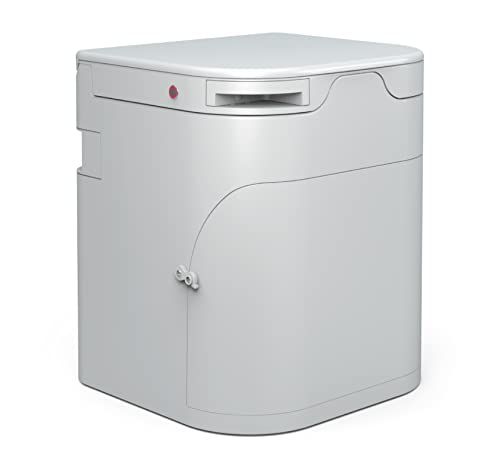
OGO Origin Compact Composting Toilet — Best Compact Composting
The OGO Origin brings the composting format down to a 15-inch footprint, which is the dimension that decides whether a campervan washroom can go dump-point-free. It diverts urine, agitates solids in medium at the push of a button, and vents through a small fan — the full composting discipline in a box shaped for van cabinetry rather than adapted from a cabin product.
Strengths
- Footprint designed for vans, RVs and boats from the start
- Push-button agitation is the easiest mixing routine in the class
- Full diversion and venting: no dump point in its working life
Trade-offs
- Electric agitation and fan mean a real 12V install and a small constant draw
- Medium management still applies — moisture discipline is the owner’s job
- Newer brand than Nature’s Head; check spares before a long season
| Specification | Detail |
|---|---|
| Type | Compact composting toilet (per Amazon title) |
| Footprint | 15 inch (per Amazon title) |
| Use case | Van, RV and boat (per Amazon title) |
What the Origin understands is that in a campervan, composting competes on cabinetry. A toilet that needs a wide crank swing or a deep chamber door loses to the cassette that simply slides out — so OGO shrank the mechanism, electrified the chore people forget, and kept the venting non-negotiable. The result suits the fixed-washroom campervan beautifully: bolt it down, wire it properly, and the washroom stops depending on site infrastructure at all.
The discipline is the same as any mixing composter: start the medium right, divert properly, empty the urine container on rhythm. Owners coming from cassettes should give it the same first week of attention they once gave learning dump points — after which the Origin’s owners tend to become the people at the site who cannot understand why everyone else plans their route around a dump station.
Ownership rhythm: the push-button agitator only works if it is pressed, so tie it to the visit itself — button as part of the routine, like the seat and the lid — and the chamber stays at the consistency the design assumes.
The Origin’s footprint claim should be verified against your own cabinet with a cardboard template before ordering — fifteen inches is the headline, but the vent’s exit direction and the chamber door’s swing are the dimensions that decide real fits, and cardboard is cheaper than returns.
Best for: fixed-washroom campervans wanting composting without the big footprint / Not suited for: unpowered or occasionally used vans, where a cassette is simpler
Check on Amazon — check price on Amazon before you order, and confirm the exact variant and tank size on the listing.

Compo Closet Cuddy — Best for Van Conversions
The Cuddy is the composting toilet that van converters recommend to each other, because its details read like a conversion checklist: self-contained, waterless, a 12V fan with a carbon filter, and a 3.9-gallon solids capacity in a unit shaped to disappear into a bench or a washroom corner. It separates urine, needs no chemicals, and cleans easily — the practical middle path between the bag systems and the big mixing chambers.
Strengths
- 12V fan and carbon filter are specified for vehicle installs, not adapted
- Waterless and chemical-free: nothing to freeze, nothing to dose
- Self-contained shape suits bench and washroom-corner conversions
Trade-offs
- Solids capacity means a steadier emptying rhythm than the largest chambers
- Fan wiring and vent routing still need a careful hour at install
- Availability of some spares is online rather than dealer-shelf
| Specification | Detail |
|---|---|
| Type | Self-contained composting toilet (per Amazon title) |
| Capacity | 3.9 gallon (per Amazon title) |
| Vent | 12V fan with carbon filter (per Amazon title) |
The Cuddy’s appeal is how little drama surrounds it. There is no medium moisture ritual as demanding as the big mixers, no bag subscription as constant as the separators, and no dump point at all. For a couple converting a van for long tours — the classic campervan use case — that middle path matches the way people actually travel: empty the urine on rhythm, service the solids every couple of weeks, and otherwise forget the toilet exists.
Install it with the same care as any composter: fused 12V feed, vent run kept short, mounting that trusts the unit on corrugated roads. Do that and the Cuddy returns the favor by being the least-discussed appliance in the van, which is the highest praise a toilet can earn.
Ownership rhythm: the carbon filter is a consumable with a memory problem — nobody remembers it — so write its change date on the unit itself in pencil, and the exhaust stays as sweet in year two as in week two.
Converters favor the Cuddy for one more reason: its self-contained shape tolerates creative mounting — bench, corner, slide-adjacent — without demanding the toilet dictate the furniture plan, and a component that respects the rest of the build is a component that gets installed well.
Best for: self-build conversions and long-tour campervans wanting a set-and-forget composter / Not suited for: owners who want the longest possible solids interval above all else
Check on Amazon — check price on Amazon before you order, and confirm the exact variant and tank size on the listing.

Thetford Porta Potti 135 — Best Budget
The Porta Potti 135 is what a budget campervan toilet should be: the smallest, simplest model from the maker whose seals define the category. It gives up tank size, seat height and flush refinement — visibly — and keeps the one thing that must never be given up, a proper sealing valve and a detachable tank that pours cleanly. For occasional-use campervans, that trade is exactly right.
Strengths
- Real Thetford sealing and spares at the lowest tier in this guide
- Compact and light: stores almost anywhere in a small campervan
- Simple piston-era mechanics with nothing electronic to fail
Trade-offs
- Small tank means frequent emptying on multi-day trips
- Low, compact seat is nobody’s idea of bathroom luxury
- Basic flush needs a little more water discipline from users
| Specification | Detail |
|---|---|
| Type | Portable toilet |
| Maker | Thetford (Porta Potti line) |
| Role | Budget / occasional use |
Budget is where the worst list breeds, so the 135 matters out of proportion to its size: it is the proof that a cheap toilet can still be an honest one. Everything it lacks is a comfort; everything it keeps is containment. A family day-van, a festival camper, a first conversion testing whether van life suits — all are better served by this small genuine article than by a larger unbranded pot with a toy valve and no spare seal in existence.
Its service rhythm is frequent and light: empty early, rinse at home, store dry with the cap off. Treated that way, the 135 does seasons of honest work and leaves the upgrade conversation — cassette size or composting — for the day the owners know their rhythm well enough to spend on it.
Ownership rhythm: store it dry, cap off, valve open a crack, and the smallest Thetford will greet each season sealing like it means it; stored wet and sealed is how budget toilets acquire the smell their owners then blame on the format.
The 135 is also the natural spare: households with a larger resident toilet keep one for the overflow weekend, the borrowed-van trip, the building work at home — a second genuine seal in the building is worth more than a first fancy one.
Best for: occasional-use and budget campervans that still demand real sealing / Not suited for: daily full-time use or long trips as the only toilet
Check on Amazon — check price on Amazon before you order, and confirm the exact variant and tank size on the listing.

Dometic 320 Series RV Toilet — Best Fixed / Plumbed
Some campervans are not portable-toilet vehicles at all: coachbuilt and large conversions with a fixed washroom and a black tank underneath deserve a real plumbed toilet, and the Dometic 320 is the standard-height gravity-flush fixture that fills that role. It mounts like an RV toilet, flushes with a foot pedal into the tank, and feels — because it is — like the household fixture its portable cousins imitate.
Strengths
- Real ceramic-feel bowl and household seat height for fixed washrooms
- Gravity flush into a black tank: the familiar, serviceable RV system
- Dometic parts — seals, valves, pedals — are stocked across the RV world
Trade-offs
- Requires a black tank and dump plumbing: a build decision, not an accessory
- Heaviest and least flexible option here; the washroom is designed around it
- Tank monitoring and dump routine become part of van life
| Specification | Detail |
|---|---|
| Type | RV toilet, standard height (per Amazon title) |
| Flush | Gravity flush, foot pedal (series standard) |
| Install | Fixed, black-tank plumbed |
The 320 is included to correct a common campervan mistake: forcing a portable into a van that was built for plumbing, or — worse — fitting a cheap plumbed fixture whose valve and seals have no support. In a proper black-tank build, the toilet should be the most boring component in the van, and Dometic’s ubiquity is precisely the point: any RV technician anywhere knows this fixture, and its wear parts are shelf items.
Choose it when the build already has, or genuinely will have, the tank and dump plumbing beneath the washroom floor. In that build it is not merely the best pick on this list; it is the only honest one, and the portables become what they should be in such a van — a backup for winterization weekends, not the main event.
Ownership rhythm: the bowl seal is the wear item that decides whether the tank’s water stays in the bowl; keep it clean, keep it conditioned per the maker’s guidance, and the plumbed fixture stays as boring as it was designed to be.
A plumbed 320 in a used coachbuilt is also a diagnostic gift: its standard fittings and known behavior make the whole black-water system legible to any technician, so the inherited van’s least-known system becomes its most serviceable one.
Best for: coachbuilt and large campervans with a black tank and fixed washroom / Not suited for: any van without black-tank plumbing — choose a self-contained pick instead
Check on Amazon — check price on Amazon before you order, and confirm the exact variant and tank size on the listing.
Comparison Table
The list scales with the van: compact portables at the top, a fixed plumbed fixture at the bottom. Match the format to your washroom and plumbing first; the badge then tells you which model does that job best.
| Pick | Badge | Key spec | Best for |
|---|---|---|---|
| Thetford Porta Potti Curve 565E | Best Overall | Curved high-profile portable; battery-powered flush | campervans with a washroom cubicle but no black-tank plumbing |
| Dometic 972 Portable Toilet 2.6 Gallon | Best Compact | 2.6 gallon portable; compact footprint | micro-campers, day vans and solo travelers needing a night toilet |
| OGO Origin Compact Composting Toilet | Best Compact Composting | 15-inch footprint composting toilet for van, RV and boat | fixed-washroom campervans wanting composting without the big footprint |
| Compo Closet Cuddy | Best for Van Conversions | 3.9 gal composting; 12V fan; carbon filter; waterless | self-build conversions and long-tour campervans wanting a set-and-forget composter |
| Thetford Porta Potti 135 | Best Budget | Compact budget portable from Thetford | occasional-use and budget campervans that still demand real sealing |
| Dometic 320 Series RV Toilet | Best Fixed / Plumbed | Standard-height gravity-flush RV toilet for black-tank installs | coachbuilt and large campervans with a black tank and fixed washroom |
How to Choose a Campervan Toilet for a Fixed Washroom
Start under the floor, not at the seat. If the van has or will have a black tank, you are shopping for a plumbed fixture and the Dometic 320 ends the search. If not, you are choosing between self-contained formats, and the washroom’s dimensions decide: floor space and door swing for a resident portable like the Curve, a slide-out drawer for a compact like the 972 or 135, or a bolted corner for a composter like the OGO or Cuddy.
Then be honest about service access. A cassette that must be carried through the living space, past the bed, on a rainy morning will eventually be carried resentfully; if your build allows an external hatch, favor models whose tanks present cleanly to it. Composting units need their vent path planned at the same time as the furniture, not drilled as an afterthought. The best campervan toilet is the one whose worst chore fits your van’s layout without a workaround.
The Worst Campervan Toilets: Washroom Betrayals
The worst designs in the campervan category share a theme: they treat the washroom like a cupboard. All-plastic pots with thin walls flex under an adult and crack at the mounting feet within a season of road vibration. Cassettes with lids instead of sealing valves perfume the whole van on warm days, because a washroom shares air with everything. Bargain plumbed fixtures copy the shape of an RV toilet while using valves and seals with no spares channel, so the first leak means a whole new toilet and a washroom floor to dry out.
The other worst pattern is the borrowed boat toilet: manual marine pumps designed for a hull’s still water and a through-hull discharge have no business in a van, where they demand plumbing that does not exist and maintenance no converter planned for. If a listing for a campervan toilet cannot state its seal, its spares and its discharge path in one sentence each, it is a worst-list product wearing a washroom’s clothes.
Portable, Composting or Plumbed: The Campervan Decision
Portable cassette is the flexible default: no install, familiar for guests, and a route planned around dump points. Composting is the independence play: an afternoon of install buys freedom from dump infrastructure, at the price of diversion discipline and a fan’s small draw. Plumbed is the permanence play: the best daily experience and the least flexible, sensible only when the build’s tank and washroom were designed together.
Running costs follow the same triangle. Cassettes spend steadily on fluid and fees; composters spend on medium or filters in lumps; plumbed systems spend on tank treatments and the occasional valve seal. None dominates; the right answer is the one whose chores your household will still be doing cheerfully in year three.
The Washroom as a System: Ventilation, Heat and the Toilet
A campervan washroom is a small climate, and the toilet lives in all of it. Shower steam tests every seal weekly; a heater duct aimed carelessly can warm a cassette into odor; a composting unit’s fan competes with the room’s own extraction. When you plan or retrofit the room, plan the toilet’s air as deliberately as its footprint: cassettes want cool, still storage, composters want their vent path privileged over the room’s, and every format wants a floor that drains a spill to somewhere survivable.
Heat deserves its own sentence because it is the invisible accelerant of every worst-list story. A washroom that bakes in afternoon sun will make a marginal toilet unbearable and a good one merely noticeable; shade, insulation and a vent that actually opens are toilet accessories in a campervan, whatever the catalog calls them. Owners who solve the room’s climate find their toilet — whichever pick they chose — performing a class above its reputation.
Guests, Children and Borrowed Vans: The Usability Audit
Sooner or later someone else uses your campervan’s toilet: a guest, a grandchild, a friend who borrowed the van for a festival. Audit your choice through their eyes. A cassette or the Curve asks nothing of them; a composter asks for the thirty-second briefing, which thoughtful owners write on a card inside the washroom door — diversion, crank or screen, nothing in the bowl but paper. That card has saved more composting installs than any fan upgrade, because most “the toilet smelled” stories begin with a guest nobody briefed.
Children shift the audit again: seat height and stability matter, a step may be part of the install, and the flush must be operable by small hands without flooding anything. The compact picks — the 972 and the 135 — serve small users kindly, while the Curve’s household manners suit family washrooms. Choose for the household you actually carry, including its smallest and its least mechanical members, and the washroom stays a room nobody negotiates with.
Secondhand Campervans: Auditing the Toilet You Inherit
Most campervan toilets are not bought; they are inherited with a used van, and the audit of an inherited toilet decides whether it joins the best list or the worst in its second life. Start with the seals, because everything else is commentary: a cassette’s valve blade and cap seals, a plumbed fixture’s bowl seal, a composter’s lid and vent joints. Perished seals are cheap on a documented model and fatal on an orphaned one, so the audit’s second step is the parts search — if the inherited unit’s wear parts cannot be found in ten minutes online, its remaining life is borrowed regardless of how clean it looks.
Then run the systems, not the brochure. Fill and flush a plumbed toilet and watch the bowl hold its water over an hour; a bowl that empties itself has a seal confessing. Run a composter’s fan and feel for airflow at the outlet; silence or stillness is a repair priced into the van’s negotiation. Work a cassette’s valve through its travel and fill its tank to the brim in a driveway test — the leak you find at home is a story, while the one you find at a site is a saga.
Price the audit into the purchase without drama: a documented toilet needing seals is a small deduction and a weekend’s pleasant work, while an undocumented one needing anything is a replacement line item. Sellers respect the buyer who checks the toilet as carefully as the engine, because that buyer has understood what a campervan actually is — a small house whose smallest room decides more mornings than the motor ever will.
Cold Mornings and Hot Afternoons: The Campervan Toilet Across Seasons
A campervan toilet lives through a wider temperature range than any house fixture, and each season interrogates it differently. Winter asks about water: a cassette’s flush tank is a small, freezable reservoir that must be drained, dosed per its maker’s winter guidance, or kept in a heated envelope; a plumbed system joins the vehicle’s whole winterizing regime, antifreeze in the traps as this program’s antifreeze guide sets out; a composter simply slows its biology and asks only that its fan and vent not be sealed away in the lay-up. The owners who winterize the washroom as a system, rather than discovering its parts one frost at a time, are the ones whose spring commissioning is a flush and a checklist.
Summer interrogates seals and air. Heat expands, softens and perfumes: a cassette valve that sealed in April can weep scent in August if its blade carries grit, and a washroom’s solar gain turns marginal ventilation into a daily complaint. The summer disciplines are cheap — valve blades wiped at each empty, the washroom vent cracked whenever the van stands in sun, composting fans confirmed running before a hot trip rather than during it — and they are the difference between a toilet that is “fine except in summer” and one that is simply fine.
Shoulder seasons test the owner instead: the impromptu October weekend in an unwinterized van, the first warm trip taken before the spring service. Build the habit of the five-minute washroom check — seals, fan, tank state, kit stocked — into the van’s departure routine in every month, and the seasons stop being the toilet’s enemies. In a campervan, consistency is not a personality trait; it is a maintenance schedule.
A Last Word on Fit: The Cardboard Template Test
Before any campervan toilet is ordered, spend twenty minutes with cardboard, tape and the washroom floor. Cut the footprint of the candidate — including its service swing: the cassette’s extraction path, the composter’s chamber door, the plumbed bowl’s knee room — and live with the template for a day of ordinary van use. Step over it, shower beside it, open every door against it. Templates fail cheaply and honestly; toilets fail expensively and wetly, and the template is the only review unit that knows your exact van.
Run the same honesty over the service route: carry a weighted box of the full tank’s mass from the template’s position to the van’s door and imagine the rest of the walk, in rain, at a site you have never visited. If the route argues against the choice, believe the route. The best campervan toilet is not the best toilet — it is the best toilet in your van, and cardboard is how your van gets its vote.
How to Install and Care for a Campervan Toilet
Washroom toilets live harder than house ones: they vibrate, freeze, bake and get serviced in lay-bys. This routine keeps any of the formats above in the best column.
- Fix the unit to the structure. Bolt composters and plumbed fixtures to their mounts; restrain portables with a hold-down or a fitted recess. Movement is the enemy of every seal in the room.
- Prove the vent before the first trip. On composting installs, run the fan, check airflow at the outlet, and seal the joints. Discover vent problems at home, not on night three.
- Commission plumbed systems with water only. Fill, flush and inspect every joint and the tank connection before the system is used in earnest; a dry-run leak is a puddle, a real one is a remediation.
- Service on rhythm, not on symptoms. Cassette by gauge or day count, urine containers daily on travel days, black tanks before they are brimful, solids chambers on schedule.
- Protect seals as a habit. Keep valve seals clean, never use bleach-based cleaners in cassettes or tanks, and store portables dry with caps off between trips.
- Winterize the washroom as a system. Drain plumbed lines and traps or protect them with RV antifreeze as this program’s antifreeze guide describes; cassettes travel empty and dry; composters simply slow down.
Keep the washroom kit together: gloves, spare seal for your model, fuses for the fan, and the small tools your mounts need. A campervan toilet that can be serviced with what is already in the van stays serviced — and a serviced toilet is, in the end, the whole difference between the best and worst lists.
Common Buying Mistakes
Carrying a cassette through the living space by design. If the build is still on paper, give the toilet external access or a washroom-side path. Morning-you, in the rain, will bless the decision every trip.
Fitting a plumbed toilet without a tank plan. A gravity RV toilet with nowhere to flush to is furniture, not sanitation. The black tank decision comes first, the fixture second.
Letting a composter’s fan share an always-off circuit. The fan is the odor system. Wire it to a circuit that stays live whenever the toilet is in service, and fuse it properly.
Using the washroom shower to “rinse” a cassette tank. Rinse tanks at a proper dump point or at home with an outside tap — not over the shower tray that drains to your grey tank.
Ignoring seat height until the first trip. Sit-height is a daily comfort, especially for older travelers. Check the number against your household toilet before you buy, not after.
Final Recommendation
For most campervans with a washroom and no black tank, the Porta Potti Curve is the resident toilet to beat, with the OGO Origin and Compo Closet Cuddy as the composting route to dump-point freedom in the same footprint class. Micro-campers should take the Dometic 972 or the budget-honest Porta Potti 135 and enjoy how little space a real seal can occupy. And if your campervan was built with a tank beneath the washroom, respect the build: fit the Dometic 320 and stop asking portables to do a plumbed job. The worst list, as ever, is reserved for what flexes, leaks, or cannot be repaired — refuse those at any price.
Thetford Porta Potti Curve 565E — check price on Amazon. Dometic 972 Portable Toilet 2.6 Gallon — check price on Amazon. OGO Origin Compact Composting Toilet — check price on Amazon. Compo Closet Cuddy — check price on Amazon. Thetford Porta Potti 135 — check price on Amazon. Dometic 320 Series RV Toilet — check price on Amazon.
Keep reading in this series: Best Camper Van Toilets Best Rv Toilets Best Composting Toilets For Vans Best Portable Toilets For Vans Best Toilets For Camper Vans
Frequently Asked Questions
What size toilet fits a campervan washroom?
Measure floor space, door swing and service access, then choose the format: resident portables like the Curve need a household-like footprint, compact units like the Dometic 972 fit drawers and trays, and composters like the OGO Origin need their 15-inch footprint plus vent clearance. The washroom decides; the catalog does not.
Is a plumbed toilet better than a portable in a campervan?
In a van built with a black tank, yes — a fixture like the Dometic 320 gives the best daily experience and empties in one dump routine. Without a tank, a plumbed toilet cannot work at all, and a sealed portable or composter is the better system by default.
Why do some campervan toilets end up on worst lists?
Because their containment or serviceability fails in a shared-air room: unsealed lids, flexing plastic, no spare seals or valves. In a campervan the whole vehicle notices a bad toilet, which is why this guide weights seals and spares so heavily.
Can a composting toilet work in a small campervan washroom?
Yes — compact units such as the OGO Origin and Compo Closet Cuddy are designed for van footprints and 12V fans. They need a vent run and diversion discipline, and in return they remove dump points from your route entirely.
How do I stop a campervan cassette toilet smelling?
Keep the sealing valve clean, dose the tank with proper holding-tank fluid and a little water before use, empty at about eighty percent, and rinse and dry the tank between trips. Smell in a cassette system is a seal or rhythm problem, not an inevitability.
What should I check before buying a secondhand campervan toilet?
The seals, above all: valve blade, cap and tank seals, plus cracks around mounting feet and the availability of those spares new. A cheap used toilet with perished, unobtainable seals is a worst-list purchase at any discount.


