Disclosure: airfryerkitchensupply.com is reader-supported. When you buy through links on our site, we may earn an affiliate commission at no extra cost to you.
Where to buy
Every pick in this guide to the best cassette toilets was cross-checked against Amazon’s own catalog data before it earned a link, so the model names and capacities below match the listings you will land on. Prices move constantly on portable sanitation gear, so instead of printing numbers that go stale, each pick links straight to its live listing — check the current price on Amazon before you decide. If a model ever shows as unavailable, the closest substitute is usually the next pick down in the same size class.
- Kohree 5.8 Gallon Camping Cassette Toilet with Diagonal Elongated Bowl Seat — Best Overall Cassette Toilet
- Thetford Porta Potti 365 Portable Toilet (92820) — Best Proven Benchmark
- VEVOR Portable RV Toilet, 5.3 Gallon Waste and 3.2 Gallon Flush Tank, Push-Button Pressurized Flush — Best Pressurized Flush Cassette
- Camco Portable RV Toilet with Detachable Tank, 5.3 Gallon (41541) — Best Simple and Serviceable Cassette
- Dometic 976 Portable Toilet, 5.0 Gallon — Best Established Mid-Size Cassette
- Kohree Portable Toilet 5.3 Gallon with Bellows Flush Pump — Best Bellows Cassette With a Comfort Seat
Best cassette toilets: What Actually Matters Before You Buy
The best cassette toilets solve the oldest problem in portable sanitation with a simple, durable idea: a sealed, removable cassette that collects waste under a flushing bowl, carries to a dump point like a suitcase, and returns rinsed and recharged for the next round. It is the format behind most RV, camper, boat and campsite toilets that are not plumbed in, and after decades of refinement it remains the default choice for anyone who wants a real flush without real plumbing.
This guide is the generalist entry in this cluster — the six cassettes we would shortlist for any buyer before the specialists take over. The specialists matter too: guides here cover the compact 2.6-gallon class, the under-budget mainstream, the strongest flushes and the van and car formats. But if you are starting from zero, start here: these are the reference points the rest of the category is measured against.
Every pick was verified against Amazon’s catalog before receiving a link, and capacities, mechanisms and features are quoted from those verified listings only. No prices or fixed ratings are printed — check the current price on Amazon — because the durable facts about a cassette are its size, its seal, its mechanism and its maker, and those are what the reviews judge.
One expectation to set before the reviews: a cassette toilet’s quality reveals itself slowly. The first weekend tells you about the seat and the flush; the first season tells you about the seal, the carry and the choreography of emptying; the third year tells you whether you bought well. This guide is written from the third year’s perspective — which is why seals, routines and ecosystems get as much ink as capacities and mechanisms.
In this guide
Quick Picks
If you only read one section, read this one. These six picks cover the realistic spread of the best cassette toilets market — different sizes, different waste systems and different budgets — and each one earned its badge for a specific job rather than a generic ranking.
Best Overall Cassette Toilet — Kohree 5.8 Gallon Camping Cassette Toilet with Diagonal Elongated Bowl Seat. A 5.8-gallon cassette with a diagonal elongated bowl seat, level indicator and leak-proof build: the most complete all-round specification we verified.
Best Proven Benchmark — Thetford Porta Potti 365 Portable Toilet (92820). The Porta Potti 365: the reference cassette against which the category is judged, with the deepest track record and the most familiar routine.
Best Pressurized Flush Cassette — VEVOR Portable RV Toilet, 5.3 Gallon Waste and 3.2 Gallon Flush Tank, Push-Button Pressurized Flush. A push-button pressurized flush with separate 5.3-gallon waste and 3.2-gallon flush tanks: the strongest rinse architecture in the mainstream field.
Best Simple and Serviceable Cassette — Camco Portable RV Toilet with Detachable Tank, 5.3 Gallon (41541). Camco’s 5.3-gallon cassette with sealing slide valve and bellows flush: the transparent mechanism that owners can rinse, inspect and keep for a decade.
Best Established Mid-Size Cassette — Dometic 976 Portable Toilet, 5.0 Gallon. Dometic’s 5.0-gallon portable: the middle size from a sanitation maker whose gear is standard equipment in the RV and marine worlds.
Best Bellows Cassette With a Comfort Seat — Kohree Portable Toilet 5.3 Gallon with Bellows Flush Pump. A 5.3-gallon, 20-litre cassette pairing a bellows flush pump with the diagonal elongated seat: simple mechanism, serious comfort.
How These Picks Were Chosen
We built this generalist shortlist by verifying the mainstream cassette field on this site, then spreading six badges across the decisions that define the category: the largest sensible capacity, the proven benchmark, the strongest flush architecture, the simple serviceable mechanism, the established mid-size, and the value bellows format with a comfort seat. Only models with catalog-verified capacities and mechanisms were linked, and specifications are quoted strictly from those verified titles. The result is deliberately not six versions of the same toilet — it is the category’s real range, so a buyer can locate their own priorities on it.
Selection for a generalist list carries one extra duty: no pick should require an asterisk. Each of these six can be recommended to a stranger without knowing their vehicle, crew or destination, because each is sound at the fundamentals the category runs on. The specialists elsewhere in this cluster — compact, premium-flush, budget-tier, dry alternatives — exist for buyers whose constraints are sharper. Here, soundness was the filter, and the badges merely distribute the soundness by emphasis.
The 6 Best cassette toilets — Reviewed in Detail

Kohree 5.8 Gallon Camping Cassette Toilet with Diagonal Elongated Bowl Seat — Best Overall Cassette Toilet
The Kohree 5.8-gallon cassette takes Best Overall by assembling the complete modern specification in one unit: the largest mainstream waste class, a diagonal elongated bowl seat that treats adults like adults, a level indicator that schedules emptying, and a leak-proof cassette brief, positioned by its listing across RV travel, boats and home use. It is the cassette for buyers who want the current state of the format rather than its history — everything the category has learned, in the size class that serves the longest trips.
Strengths
- Largest mainstream capacity stretches intervals between dump points
- Diagonal elongated seat leads the category on comfort
- Level indicator plus leak-proof design cover the ownership details
Trade-offs
- Full cassette is the heaviest carry in this guide
- Large format needs storage space planned in smaller rigs
- Newer name than the establishment it out-specifies
| Specification | Detail |
|---|---|
| Capacity | 5.8 Gallon waste tank (per Amazon title) |
| Seat | Diagonal elongated bowl seat (per Amazon title) |
| Indicator | Level indicator (per Amazon title) |
| Format | Portable cassette toilet (per Amazon title) |
Overall picks should be the ones you would hand a friend without caveats, and the Kohree qualifies: its capacity suits real trips, its seat suits real bodies, and its indicator suits real households where the emptying chore is shared. The one discipline it demands is the three-quarter rule — use the indicator, empty before the brim, and the big cassette stays a convenience instead of becoming a carry you dread. On the full evidence of the verified field, this is the cassette to beat.
The big Kohree’s ownership arc has a predictable shape worth planning for: month one is admiration, month two is the first genuinely full carry and a resolution about the three-quarter rule, and month three onward is the quiet satisfaction of a system whose interval matches long trips. Owners who pre-commit to the three-quarter rule skip the month-two lesson entirely. Consider this paragraph the pre-commitment, delivered free with the review.
Best for: most buyers wanting the complete modern cassette specification / Not suited for: small rigs where a large format cannot be stored
Check on Amazon — check the current price on Amazon and confirm the tank size on the listing matches what is described here before ordering.

Thetford Porta Potti 365 Portable Toilet (92820) — Best Proven Benchmark
Every category has a benchmark, and in cassettes it is the Porta Potti line, with the 365 as its balanced mainstream expression. Its verified listing spans RV, marine, camping, vans, trucks and healthcare — a breadth that reflects how thoroughly this design has been absorbed into portable life. It will not out-spec a challenger like the Kohree on paper, and it does not need to: its case is a decade-deep accumulation of seals that sealed, cassettes that emptied cleanly, and owners who replaced like with like.
Strengths
- The category’s reference design and deepest track record
- Balanced size suits the widest range of vehicles and users
- Parts, knowledge and routine familiarity are unmatched
Trade-offs
- Specification is conservative next to newer challengers
- Flush is workmanlike rather than class-leading
- Premium of the established name within its class
| Specification | Detail |
|---|---|
| Model | 92820 (per Amazon title) |
| System | Sealed portable cassette toilet |
| Stated uses | RV, marine, camping, vans, trucks, healthcare (per Amazon title) |
Benchmarks earn their status by being right about the fundamentals for a very long time. The 365’s seal, cassette handling and sizing are the format’s grammar — the thing other products are described as alternatives to. For risk-averse buyers, first-time cassette owners and anyone equipping a vehicle for unknown future users, that grammar is worth more than any single feature. Buy the benchmark when you want the decision to be over.
Benchmark ownership has a social dividend: every experienced camper, marina hand and campsite neighbor knows this toilet. When you need a tip, a spare or a second pair of hands at a dump point, you are holding the format the whole world learned on. Products are rarely bought for their community, but communities are often why products get kept — and the 365’s community is the largest in portable sanitation.
Best for: first-time cassette buyers and risk-averse owners / Not suited for: specification-maximizers who want every modern extra
Check on Amazon — check the current price on Amazon and confirm the tank size on the listing matches what is described here before ordering.

VEVOR Portable RV Toilet, 5.3 Gallon Waste and 3.2 Gallon Flush Tank, Push-Button Pressurized Flush — Best Pressurized Flush Cassette
The VEVOR represents the mainstream’s move toward better flushing: a push-button pressurized system, a dedicated 3.2-gallon flush tank to sustain it, a 5.3-gallon waste tank and a leak-proof design brief. In a generalist list it earns the flush badge because it changes the daily experience most — one press, a complete rinse, no pumping ritual — while staying in the size class most buyers actually choose.
Strengths
- Pressurized push-button flush leads the mainstream on rinse
- Dedicated flush tank sustains performance across the trip
- Mainstream 5.3 Gal waste class suits most trip patterns
Trade-offs
- Pressurized system needs more care than simple pumps
- Two tanks to manage instead of one rhythm
- Newer brand beside the category’s establishment
| Specification | Detail |
|---|---|
| Waste tank | 5.3 Gallon (per Amazon title) |
| Flush tank | 3.2 Gallon (per Amazon title) |
| Flush | Push-button pressurized flush (per Amazon title) |
Flush quality is the complaint that ages worst in cassette ownership — the thing you notice at every use, forever — which is why a generalist guide should carry a genuine flush leader rather than six adequate rinses. The VEVOR is that leader in the verified mainstream field. Keep its tanks managed and its seals rinsed, and it delivers the experience buyers imagine when they first shop for a cassette with a powerful flush.
The VEVOR’s two-tank layout teaches a management habit that improves any cassette ownership: think of the toilet as two systems sharing a body. Waste rhythm and water rhythm are planned separately — the dump stop services both, but a mid-trip fresh top-up from your water carrier is a legitimate, easy intervention that owners of single-rhythm thinking never consider. Two-system thinking is the VEVOR’s hidden curriculum, and graduates flush better on every toilet afterward.
Best for: buyers whose top priority is the best rinse in the mainstream / Not suited for: owners who prefer the simplest possible mechanism
Check on Amazon — check the current price on Amazon and confirm the tank size on the listing matches what is described here before ordering.

Camco Portable RV Toilet with Detachable Tank, 5.3 Gallon (41541) — Best Simple and Serviceable Cassette
The Camco is this guide’s argument for simplicity: a sealing slide valve that shuts positively, a bellows flush with nothing pressurized or electric in it, a detachable 5.3-gallon tank and a built-in carry handle. In a category drifting toward features, it is the cassette a self-reliant owner can understand completely in one look — and therefore the one most likely to still be working, unremarkably, in ten years.
Strengths
- Sealing slide valve is a positive, inspectable odor shut-off
- Bellows flush has the fewest possible failure modes
- Detachable tank and handle keep the dump run simple
Trade-offs
- Gentlest rinse in this guide — simplicity is the trade
- Seal needs rinsing discipline to stay odor-tight
- Utilitarian presentation next to comfort-led rivals
| Specification | Detail |
|---|---|
| Waste tank | 5.3 Gallon, detachable (per Amazon title) |
| Flush | Bellows-type (per Amazon title) |
| Seal | Sealing slide valve (per Amazon title) |
| Model | 41541 (per Amazon title) |
Serviceability is a feature that only appears on a spec sheet of the imagination, yet it decides real ownership more than most listed features. The Camco’s every working part can be rinsed, worked and judged by its owner at a dump point with no tools and no manual. For remote travelers and long-term keepers, that transparency is not a budget compromise; it is the premium they are actually shopping for.
Camco’s slide valve invites one piece of owner craftsmanship: learn its feel the way you would learn a good knife’s edge. Worked under rinse water at each emptying, its action stays clean and positive; the day it feels different, you have been given notice while the fix is still a thorough clean. Owners who develop that tactile attention own the most reliable cassettes on any site — regardless of brand — because they maintain by feedback instead of by failure.
Best for: self-reliant and remote travelers, and long-term keepers / Not suited for: buyers prioritizing rinse strength or seat luxury
Check on Amazon — check the current price on Amazon and confirm the tank size on the listing matches what is described here before ordering.
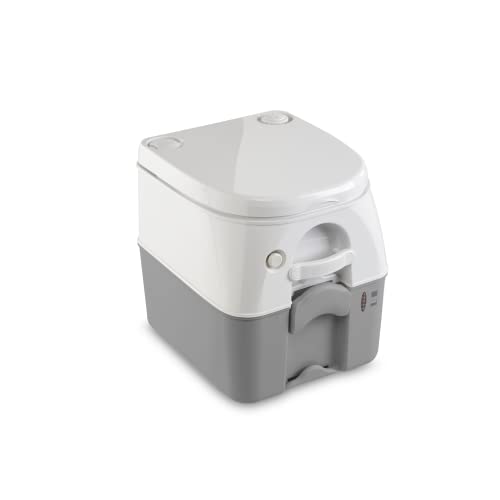
Dometic 976 Portable Toilet, 5.0 Gallon — Best Established Mid-Size Cassette
The Dometic 976 holds the established mid-size ground: 5.0 gallons — enough for the classic couple’s long weekend — from a maker whose portable sanitation line is a fixture wherever vehicles and boats need toilets. It lacks the headline extras of the newer challengers and offers instead the confidence of a broad, long-running product family, shared DNA with its compact siblings, and sizing that stores more easily than the largest class.
Strengths
- 5.0 Gal size threads between compact and largest classes
- Established maker’s sanitation line and support footprint
- Honest, proven format without novelty risk
Trade-offs
- Fewer modern extras — no indicator in its verified listing
- Out-specified on comfort by the elongated-seat picks
- Mid-size cycles faster than 5.8-gallon models on long trips
| Specification | Detail |
|---|---|
| Capacity | 5.0 Gallon (per Amazon title) |
| Model | 301097606 (per Amazon title) |
| System | Portable cassette toilet |
Mid-size is where most real usage lives, and the 976 serves it with the least drama in this guide. It is the cassette for the buyer who looked at the largest class, imagined the full carry, and chose sanity — and for households splitting use between a camper and a boat, where Dometic’s marine presence is a practical bonus. Judge it as the establishment’s sensible answer, because that is precisely what it is.
The 976 is the pick most likely to be bought twice — once for the camper, once for the boat, the cabin or the parents — because its sizing and manners transfer across households without re-education. That transferability is a real ownership quality in gear that families share, lend and inherit. A toilet everyone already understands is a toilet that gets used correctly in every house it visits, and correct use, as this guide repeats, is most of the product.
Best for: couples and mixed camper/boat households wanting the sensible middle / Not suited for: long-stay users needing maximum interval between dump points
Check on Amazon — check the current price on Amazon and confirm the tank size on the listing matches what is described here before ordering.

Kohree Portable Toilet 5.3 Gallon with Bellows Flush Pump — Best Bellows Cassette With a Comfort Seat
The second Kohree in this guide earns its own badge by combining the two virtues rivals separate: a bellows flush pump — the simple, durable end of mechanisms — with the diagonal elongated bowl seat that leads this category on comfort, in a 5.3-gallon leak-proof cassette. It is the pick for buyers who think like the Camco’s audience about mechanisms but refuse to accept the basic seat that usually accompanies simple flushing.
Strengths
- Bellows pump simplicity with a genuinely comfortable seat
- 5.3 Gal / 20L mainstream capacity for real trips
- Leak-proof cassette brief across RV, trailer and camp use
Trade-offs
- Bellows rinse is gentle — technique matters
- Two Kohree models in one guide demand careful variant checking
- Elongated format needs its storage measurement
| Specification | Detail |
|---|---|
| Capacity | 5.3 Gallon / 20L (per Amazon title) |
| Seat | Diagonal elongated bowl seat (per Amazon title) |
| Flush | Bellows flush pump (per Amazon title) |
Product ranges are usually ladders; this one is a fork, and the fork is informative. Kohree’s handle-pump model chases flush consistency, this bellows model chases longevity, and both keep the seat. If your instinct is that mechanisms should be simple and seats should not be, this is your cassette — the value-engineered expression of the modern format, with its compromises chosen in the places owners feel them least.
Having two Kohree variants in one guide is a small lesson in modern product ranges: the same maker sells the same seat and size with different flush philosophies, because the market’s real divide is not brand but mechanism temperament. Read the fork as permission to choose your temperament honestly — the decisive stroke or the indestructible squeeze — rather than as a hierarchy with a wrong answer at the bottom.
Best for: buyers wanting simple flushing without giving up seat comfort / Not suited for: buyers who want the strongest available rinse
Check on Amazon — check the current price on Amazon and confirm the tank size on the listing matches what is described here before ordering.
Comparison Table
The table below compresses the six picks into the four facts that decide most purchases in this category: what the product is, the badge it earned, the one specification that defines it, and the buyer it fits. Use it to shortlist two candidates, then read their full reviews above before spending money.
| Pick | Badge | Key spec | Best for |
|---|---|---|---|
| Kohree 5.8 Gallon Camping Cassette Toilet with Diagonal Elongated Bowl Seat | Best Overall Cassette Toilet | 5.8 Gal cassette, diagonal elongated bowl seat, level indicator | most buyers wanting the complete modern cassette specification |
| Thetford Porta Potti 365 Portable Toilet (92820) | Best Proven Benchmark | Model 92820, sealed cassette design for RV, marine and camping use | first-time cassette buyers and risk-averse owners |
| VEVOR Portable RV Toilet, 5.3 Gallon Waste and 3.2 Gallon Flush Tank, Push-Button Pressurized Flush | Best Pressurized Flush Cassette | 5.3 Gal waste, 3.2 Gal flush tank, push-button pressurized flush | buyers whose top priority is the best rinse in the mainstream |
| Camco Portable RV Toilet with Detachable Tank, 5.3 Gallon (41541) | Best Simple and Serviceable Cassette | 5.3 Gal detachable tank, sealing slide valve, bellows flush | self-reliant and remote travelers, and long-term keepers |
| Dometic 976 Portable Toilet, 5.0 Gallon | Best Established Mid-Size Cassette | 5.0 Gal portable toilet, gray | couples and mixed camper/boat households wanting the sensible middle |
| Kohree Portable Toilet 5.3 Gallon with Bellows Flush Pump | Best Bellows Cassette With a Comfort Seat | 5.3 Gal / 20L cassette, diagonal elongated seat, bellows flush pump | buyers wanting simple flushing without giving up seat comfort |
How to Choose the Best Cassette Toilets
Work through four decisions in order. Capacity: compact classes near 2.6 gallons for tight storage and short trips, the 5-gallon mainstream for most buyers, and the largest class near 5.8 gallons for long intervals — remembering that full weight, not empty size, is the real constraint. Seal: the closure is your odor control, so favor designs whose seals you can rinse and inspect. Mechanism: pressurized for rinse, piston and handle for positive manual flushing, bellows for longevity. Seat: the comfort variable owners feel daily and spec sheets bury.
Then place yourself in the ecosystem question. Benchmark brands bring parts, knowledge and resale familiarity; challengers bring specification per money. Neither answer is wrong — but choose consciously, because a cassette is a multi-year relationship with a chore, and the right relationship is the one whose chore you will still be doing properly in year three.
- Size by full-cassette carry weight, not by empty dimensions
- Prioritize a rinsable, inspectable seal above feature lists
- Pick the flush mechanism your usage intensity justifies
- Check seat shape and height against your household’s real users
- Decide benchmark ecosystem versus challenger specification consciously
Cassette Toilets Versus the Alternatives
Against bucket systems, cassettes win on flushing, sealing and dignity, and lose on simplicity, packed size and price class. Against composting and separating toilets, cassettes win on familiarity and guest-proofing, and lose on dump-point independence and consumable chemistry. Against plumbed RV toilets, cassettes win on installation — there is none — and lose on the walk-away convenience of a black tank. Most buyers cross-shop exactly these four families, and the honest answer is that each is the best tool for a distinct pattern of travel.
The cassette’s home pattern is mixed, facilities-reachable travel: campsites, marinas, festivals with emptying points, guest overflow at home, and vehicles too small or too simple for plumbing. If your pattern lives there — and most people’s does — the cassette is not the compromise choice. It is the correct one, and the six picks above are its current shortlist.
The Ownership Routine That Makes Any Cassette a Good One
Every cassette in this guide converges on the same ownership rhythm, and the rhythm matters more than the badge. Charge with water and additive before use. Flush economically but completely. Empty at three-quarters, at proper facilities, with a rinse that leaves the tank and seal genuinely clean. Recharge immediately or store fully dry. Inspect the seal while it is clean, once in a while, the way you would check a bicycle chain — briefly, and before it complains.
Owners who keep that rhythm report the same experience across brands: the toilet disappears. Owners who skip it report the same complaints across brands too, usually attributed to the product. Buy whichever pick matches your size, mechanism and seat priorities — then let the routine, which costs two minutes at a time, deliver the ownership you were actually shopping for.
How to Use, Empty and Care for a Cassette Toilet
This is the complete cassette routine, from first commissioning to seasonal storage, applicable to every pick in this guide.
- Commission: fill the flush tank with clean water; add clean water and the correct additive dose to the waste cassette; check the seal or valve closes fully.
- Use: flush with one complete action, keep the lid closed between uses, and put nothing in but waste and toilet paper — never wipes or trash.
- Monitor: use the level indicator where fitted, and plan the emptying stop at roughly three-quarters full.
- Empty: at a dump station, campsite facility or household toilet — gloves on, cassette carried by its handle, emptied slowly and under control.
- Rinse: flush the cassette with clean water repeatedly until it runs clear, working the valve or seal under the rinse.
- Recharge or store: refill with water and additive for immediate reuse, or dry fully for storage with the seal in its resting position.
- Seasonally: deep-rinse at home, inspect seals and pump action, and store clean, dry and out of hard freeze if any moisture remains.
Keep the emptying kit — gloves, additive, cloth, and a short rinse aid — stored with the toilet as one package. The routine above is two minutes when the kit is present and a production when it is not, and cassette satisfaction tracks that difference almost exactly.
Cassette Sizes, Seats and Seals: The Specification Deep-Dive
Size in this category is a rhythm, not a number. A cassette’s gallon figure translates, through your household’s headcount and flushing habits, into days between services — and that rhythm must harmonize with your trips. The verified classes in this cluster run from 2.6 gallons through the 5-gallon mainstream to the largest near 5.8, and the correct one is the largest whose full weight you will carry willingly, because willingness, not strength, is what keeps the three-quarter rule alive.
Seats are the category’s quiet revolution. The diagonal elongated layouts in this guide exist because makers finally treated portable seats as furniture rather than lids, and adult users — especially older users and anyone with an unhurried morning — feel the difference at every use. When two cassettes tie on capacity and mechanism, buy the seat. It is the specification you will appreciate most often and the one least visible in a headline.
Seals close the triangle. Everything a cassette promises — odor containment in a sleeping space, leak-free carries through campsites, a fresh start after every rinse — is delivered or betrayed by a few centimetres of closure. Favor seals you can see, rinse and work by hand; treat them gently; replace the routine of neglect with the routine in this guide. Do that, and any of these six cassettes will serve the way the format’s long history says it should.
The Cassette Ecosystem: Spares, Knowledge and Resale Reality
A cassette toilet is a long-lived object in a way few consumer products still are, and its ecosystem determines much of that life. Seals age, valves wear, handles take knocks — on a benchmark product, each of those is a known part with a known source and a crowd of owners who have replaced it before you. On an obscure product, each is a small research project. This is not an argument that everyone must buy the benchmark; it is an argument that ecosystem depth is a real specification, worth weighing alongside gallons and mechanisms, especially for buyers far from dealers or planning a decade of service.
Knowledge is the ecosystem’s other half. The cassette routine is simple, but its refinements — dosing in hard water, winter storage in your climate, the seal check that catches wear early — live in owner communities, marina lore and campground conversations. Buying into a widely owned format buys into that lore. Several picks in this guide benefit from it directly; the challengers are building it, season by season, owner by owner.
Resale and hand-me-down value close the argument. Vehicles change, crews change, and a sound cassette from a known line finds its next owner easily — cleaned, demonstrated and understood in minutes. An obscure one becomes garage stock. None of this should override the fundamentals of size, seal and seat for your own use; but as a tiebreaker between near-equal picks, the ecosystem is the most rational one available.
Cassette Toilet Buying Checklist
The generalist checklist — six confirmations that cover the category’s fundamentals before any badge is considered:
- Capacity translated into rhythm: headcount and habits converted into days between services, matched to your trips.
- Full carry accepted: the shortlisted size, at capacity, lifted and walked in imagination by its actual carrier.
- Seal identified and rinsable: you know what closes your cassette and how you will clean it at a dump point.
- Mechanism temperament chosen: decisive, balanced or indestructible — matched to your usage intensity and maintenance appetite.
- Seat checked against real users: shape, height and size verified for the household, not assumed from photographs.
- Ecosystem weighed: parts, knowledge and familiarity counted as part of the specification, especially for long-term ownership.
First Season, Fifth Season: How Cassette Ownership Ages
The first season with a cassette toilet is about learning: the rhythm of your household’s usage, the location of good dump points on your routes, the feel of a healthy seal. Everything is slightly deliberate, and the toilet is still, in a small way, a project. Owners should expect this and not mistake it for the product’s character — the same season happens with every format in this cluster, including the dry systems, because what is being learned is not the toilet but the household’s own sanitation rhythm.
By the fifth season, a well-chosen cassette has undergone a quiet transformation: it has become invisible. The routine is muscle memory, the kit restocks itself through habit, the seal gets its rinse without a decision being made, and the toilet is simply part of how the vehicle works — noticed only in its absence, on the rare trip it is borrowed or left behind. That invisibility is the true endpoint every pick in this guide is aiming at, and it is achievable with any of them.
What separates the cassettes that reach year five invisible from those replaced in year two is almost never the purchase. It is the accumulation of small fidelities: emptied on rhythm, rinsed while clean, stored with respect, seals noticed early. The category’s veterans all tell the same story with different brand names in it, which is the strongest evidence available that the routine, faithfully kept, is the real best cassette toilet — and the six above are its best current instruments.
Teaching the Next Owner: Why Cassette Habits Transfer So Well
One underappreciated strength of the cassette format is how completely its skills transfer. The routine learned on any pick in this guide — charge, flush completely, empty at three-quarters, rinse the seal, recharge or dry-store — operates every other cassette ever made with only detail changes. Owners who change vehicles, upgrade sizes or inherit a boat’s toilet carry their competence with them intact. Compare that with bespoke systems whose knowledge dies with the product, and the mainstream format’s conservatism reveals itself as a feature: it is a standard, and standards compound.
That transferability shapes this guide’s final advice. If you are equipping a vehicle, a household or a small fleet — a rental, a scout group, a family’s several cabins and campers — standardizing on the cassette format, and ideally on one size class within it, multiplies every owner’s competence across every unit. The six picks above differ in emphasis, but they speak the same operational language. Learn it once, on any of them, and you are fluent in the most widely spoken dialect in portable sanitation.
Common Buying Mistakes
Buying capacity you cannot carry
A full large cassette is heavy. If the carry defeats you, you will delay emptying, and every other quality of the toilet will be judged through that failure.
Judging by feature lists instead of seal and seat
Indicators and extras are garnish. The seal decides odor, the seat decides comfort, and both decide satisfaction long after the unboxing.
Putting wipes and trash into the cassette
Valves jam and emptying becomes excavation. A cassette accepts waste and toilet paper, and nothing else, ever.
Emptying anywhere convenient
Cassette waste belongs at dump points, facilities or a household toilet — never in the environment, and only into septic systems the additive is approved for.
Storing the cassette dirty or wet
Seals foul, odors set, and the next trip opens with a punishment. Rinse, recharge or dry-store — those are the only three endings a trip should have.
Final Recommendation
Start the shortlist with the Kohree 5.8-gallon for the complete modern specification, or the Porta Potti 365 if the proven benchmark matters more than the longest feature list. Choose the VEVOR when the rinse is your priority, the Camco when serviceable simplicity is, the Dometic 976 for the established mid-size, and the bellows Kohree when you want simple flushing without surrendering the good seat. That spread is the cassette category as it honestly stands — every pick defensible, each for a stated reason.
Then run whichever you buy the way this guide’s routine describes, and the cassette will do what it has done for decades of travelers: provide a real toilet, anywhere, with no plumbing and no drama. That is the whole promise of the format, and these six are its best current keepers.
If you want the short version of this entire guide, it is this: start with Kohree 5.8 Gallon Camping Cassette Toilet with Diagonal Elongated Bowl Seat, Thetford Porta Potti 365 Portable Toilet (92820), VEVOR Portable RV Toilet, 5.3 Gallon Waste and 3.2 Gallon Flush Tank, Push-Button Pressurized Flush. One of those three fits the large majority of buyers in this category, and the full reviews above explain exactly which buyer each one fits.
Keep exploring the rest of this cluster once you have a shortlist: Best Cassette Portable Toilets With Powerful Flush Best Camper Toilets Best Camping Toilets Under $200 Best Camping Toilets Portable 2.8 Gal Best Campervan Toilets
Frequently Asked Questions
What is a cassette toilet?
A portable toilet with a sealed, removable waste cassette beneath a flushing bowl. You use it like a normal toilet, then detach the cassette, carry it to a dump point or household toilet, empty, rinse and recharge it. It is the standard portable format for RVs, campers, boats and campsites without plumbing.
How long does a cassette last between emptying stops?
By class: compact cassettes serve a couple for a short trip, the 5-gallon mainstream for a long weekend and beyond, and the largest class stretches longest. Headcount and flushing habits move every estimate, and the three-quarter rule matters more than the theoretical maximum.
Do cassette toilets smell?
A sealed cassette with a clean, healthy seal should not smell in normal use. Odor traces to fouled seals, cassettes stored dirty, or missed additive dosing — maintenance states that this guide’s routine is designed to prevent.
What chemicals does a cassette toilet need?
A cassette additive, dosed into the waste tank at each recharge, which breaks down waste and controls odor. Use products made for cassette systems, and check septic compatibility before emptying into any septic tank.
Can I empty a cassette toilet at home?
Yes — a household toilet is one of the easiest dump points. Empty slowly, rinse the cassette, and clean up as you go. Campground and RV dump stations and designated campsite facilities are the on-trip equivalents.
Cassette toilet or composting toilet — which is better?
For facilities-reachable, mixed travel with varied users, the cassette’s familiarity usually wins. For long off-grid patterns, composting and separating systems remove the dump point entirely. This cluster has dedicated guides to both, linked from the final recommendation above.
How do I winterize a cassette toilet?
Winterizing a cassette is a fifteen-minute job with three rules. First, empty everything: waste cassette emptied and rinsed thoroughly, flush tank drained as the model directs, so no water remains to freeze in tanks, pumps or valves. Second, clean and dry: rinse the cassette until clear, work the seal under the rinse, and let the whole unit dry fully before storage, because trapped moisture is both a freeze risk and a mildew invitation. Third, store kindly: seals in their resting position, the unit out of hard freeze where possible, and its kit — additive, gloves, cloth — stored with it so spring commissioning is a single trip to the shelf. Do those three things in autumn and the cassette wakes in spring exactly as it slept, which is all winterizing ever promises. Owners in the coldest regions often bring the cassette indoors for the deep winter months, which makes the spring check a kitchen-sink job and removes the freeze question from the vehicle entirely.


