Disclosure: airfryerkitchensupply.com is reader-supported. When you buy through links on our site, we may earn an affiliate commission at no extra cost to you.
Where to buy
All six teapots in this guide are sold on Amazon, and every one was verified against Amazon’s catalogue before publication, so the listing you land on is the pot we describe. If you want one safe first purchase, make it the HIWARE 1000ml Glass Teapot for loose leaf and blooming teas, or the Sweese 27 oz Porcelain Teapot if you prefer a classic ceramic feel. Check the current price on Amazon for each pick as you compare, and check price on Amazon again before checkout if you are choosing between colourways or sizes in the same range.
Introduction
If you are searching for the best buy teapots — the ones actually worth your money this year — the honest answer is that there is no single best teapot, but there is a best teapot for the way you drink. A glass pot that shows off a blooming tea is a poor tool for a four-person round of builder’s tea; a cast iron tetsubin that keeps a pot hot through a long afternoon is overkill for a single cup of green tea at your desk. This guide is organised around that reality. We verified a shortlist of six teapots across the main materials — glass, porcelain, ceramic and cast iron — checked each one against Amazon’s catalogue so the names, capacities and features in this article match real listings, and then assigned each pot the job it genuinely does best.
What “best buy” means here is value in the full sense: a pot that brews well, pours cleanly, is honestly sized, and will still be on your shelf in five years. Some of our picks sit in the budget tier and earn their place by doing the basics properly; others sit in the mid-range and justify themselves with better infusers, better balance or better heat retention. None of them is here because of a decorative gimmick. A teapot has one job — turn hot water and leaves into good tea, repeatedly, without dribbling, cracking or stewing — and every pick below was judged against that job first and everything else second.
The range covers the main buying situations we see. The HIWARE glass pot is the all-round loose-leaf answer. The Sweese porcelain pot is the classic ceramic-style buy for everyday brewing. The Hario ChaCha Kyusu is the specialist for green tea and smaller, more delicate brews. The suyika cast iron tetsubin is the heat-keeping traditional pot. The London Pottery Farmhouse 4 Cup is the family-sized loose-leaf workhorse from a heritage British maker. And the Tea Forte Fiore is the design-led gift buy that still brews properly. Read the quick picks, then the full reviews, then the buying guide — by the end you will know not just which pot to buy, but why it is the right one for your kitchen.
In this guide
Quick Picks
- Best Overall: HIWARE 1000ml Glass Teapot with Removable Infuser — stovetop-safe borosilicate glass, a removable infuser, and a full litre of capacity for loose leaf and blooming teas. Check on Amazon
- Best Porcelain: Sweese Teapot, 27 oz Porcelain with Removable Stainless Steel Infuser — the classic everyday pot in a clean white finish that suits bags and loose leaf alike. Check on Amazon
- Best for Green Tea: Hario ChaCha Kyusu “Maru” Tea Pot, 700ml — a Japanese glass kyusu with a fine strainer, shaped for controlled, smaller brews. Check on Amazon
- Best Cast Iron: suyika Japanese Tetsubin Cast Iron Teapot, 22 oz — enamel-lined cast iron with a stainless infuser, stovetop safe and built to hold heat. Check on Amazon
- Best for Families: London Pottery Farmhouse 4 Cup Ceramic Teapot with Infuser — 1,200 ml of heritage British farmhouse pot with a fine mesh strainer for loose leaf at table scale. Check on Amazon
- Best Gift: Tea Forte Fiore Ceramic Teapot with Infuser, Stone Blue, 24 oz — a design-led ceramic pot with a stainless infuser and ceramic lid, presented the way a gift should be. Check on Amazon
How These Picks Were Chosen
We began with the materials, because material decides more about a teapot than any other single choice. Glass shows you the brew and suits blooming and loose-leaf teas but sheds heat fastest. Porcelain and ceramic are the versatile middle: decent heat retention, neutral flavour, easy care. Cast iron is the heat keeper and the traditionalist’s choice, at the cost of weight. Any honest “best buy” list has to cover that spread rather than crown six versions of the same pot, so we shortlisted across all four material families and across the capacity range from a 650 ml personal pot to a 1.2-litre family pot.
Every candidate then went through a verification step: we checked the product against Amazon’s own catalogue data and matched the listing title, brand, capacity and stated features to the pot we intended to describe. All six picks in this guide passed that check, which is why all six carry links — if a well-known pot had failed verification, it would appear here as unlinked with an explanation, the way we handle unverifiable products in our other guides. We do not attach links to products we cannot confirm, and we do not print prices or ratings, because both change; the article tells you how each pot is positioned by tier instead.
Finally, we judged brewing behaviour: infuser depth and mesh quality for loose leaf, spout behaviour, lid fit, handle clearance, and whether the stated capacity is a usable capacity or a brim-full fiction. The six survivors each lead a real category. If your situation matches one of the badges, you can buy that pot with confidence and skip the rest of the article — though the buying guide below will make you a better teapot shopper for the next decade, because the criteria transfer to any pot you ever consider.
The 6 Best Teapots to Buy
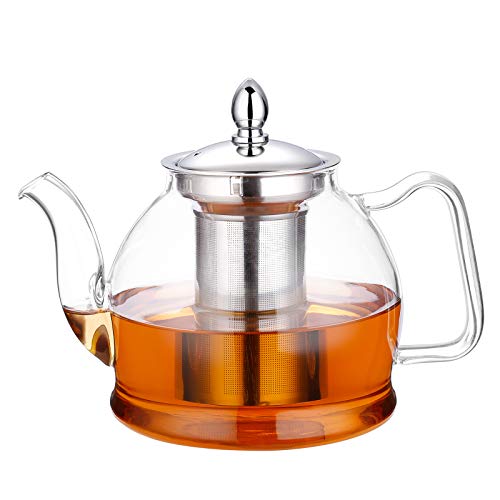
HIWARE 1000ml Glass Teapot with Removable Infuser — Best Overall
The HIWARE is the teapot we recommend when someone asks for one pot that does almost everything. It is a full litre of borosilicate glass with a removable stainless infuser, and — unusually for a glass teapot — it is stovetop safe, so you can heat water in the pot itself on a suitable hob as well as brew in it. Glass is the honest material for loose leaf: you can watch the leaves unfurl, judge the colour of the liquor at a glance, and show off a blooming tea the way it deserves to be shown. The litre capacity pours four mugs or a small table round, which makes this a genuine household pot rather than a desk accessory. It suits loose-leaf drinkers, blooming-tea fans and anyone who brews by eye. It is not the pot for someone who wants tea to stay hot for an hour untouched — no glass pot is.
Strengths
- Stovetop-safe borosilicate glass — heat and brew in one vessel, and watch the infusion develop so you stop the steep by colour, not by guesswork.
- Removable infuser lifts out cleanly at the end of the steep, so the pot becomes a clear serving pot that will not over-brew on the table.
- Full 1,000 ml capacity with a shape that pours steadily even when full.
Trade-offs
- Glass loses heat faster than ceramic or cast iron; for long sessions, pour promptly or use a warmer.
- It is glass — a knock against a stone worktop or a crowded sink is a real risk in a busy kitchen.
- The infuser mesh is a standard fineness; very fine rooibos will still shed some particles into the cup.
| Specifications (verified) | |
|---|---|
| Capacity | 1,000 ml |
| Material | Borosilicate glass, stovetop safe |
| Infuser | Removable, included |
| Best uses | Blooming and loose leaf teas |
The detail that lifts the HIWARE above the crowd of similar glass pots is the combination of size and stovetop rating. Most glass teapots are 600–800 ml brewing vessels that must never see a hob; this one is a litre and can. That makes it the natural centre of a home tea routine: heat the water, add the leaves to the infuser, watch the colour, lift, serve. For blooming teas — the hand-tied balls that open into flowers — there is no substitute for glass, and a litre gives the bloom room to open fully instead of pressing against the walls. Treat it with the respect glass deserves, keep it off the edge of counters, and it will repay you every day. Check the current price on Amazon; it sits in the budget-to-mid tier, which is remarkable for what it does.
Best for: loose-leaf and blooming tea drinkers who brew by eye for one to four people. / Not suited for: clumsy kitchens or anyone who needs a pot to hold heat for an hour. Check on Amazon
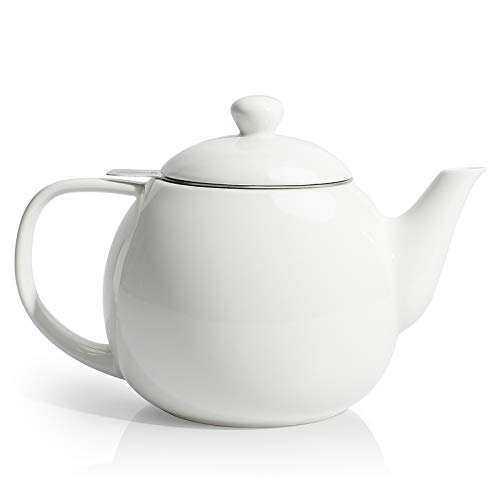
Sweese Teapot, 27 oz Porcelain with Removable Stainless Steel Infuser — Best Porcelain
The Sweese is the classic answer to “I just want a proper teapot.” It is 27 ounces of white porcelain with a removable stainless steel infuser, a clean silhouette that fits any kitchen, and a size that pours two generous mugs or three cups. Porcelain is the neutral material: it adds nothing to the flavour, rinses clean without holding the memory of yesterday’s lapsang, and holds heat noticeably better than glass. The infuser makes it a true loose-leaf pot, and because it lifts out, bag drinkers can simply leave it in the cupboard. It suits everyday drinkers who want one pot for everything from breakfast Assam to evening chamomile. It does not suit households of four or more tea drinkers, who will find themselves rebrewing — for them, the London Pottery below is the step up.
Strengths
- Porcelain body holds heat better than glass and never flavours the next brew.
- Removable stainless infuser covers loose leaf properly, and the pot works just as well without it for bags.
- The 27 oz size is the sweet spot for one or two drinkers — brewed fresh, finished fresh.
Trade-offs
- Two-mug capacity is a hard ceiling; this is not a family pot.
- White porcelain shows tannin staining over time and needs the occasional proper wash to stay bright.
- The classic look is deliberately plain — buyers wanting a statement piece should look at the Tea Forte.
| Specifications (verified) | |
|---|---|
| Capacity | 27 oz |
| Material | Porcelain |
| Infuser | Removable stainless steel |
| Colour | White (other colourways exist in the range) |
What you are buying with the Sweese is correctness. The proportions are the proportions teapots settled into over a century because they work: a body wide enough for leaves to move, a spout that pours without drama, a handle with knuckle clearance, a lid that stays put. It will not be the most beautiful object in your kitchen and it will not be the most traditional, but it may well be the most used. For a first teapot, a replacement for a chipped one, or a wedding-registry staple, this is the sensible money in the porcelain category. Check price on Amazon — it sits comfortably in the budget tier.
Best for: everyday brewing for one or two people, bags or loose leaf. / Not suited for: family rounds or design-led kitchens wanting a centrepiece. Check on Amazon

Hario ChaCha Kyusu “Maru” Tea Pot, 700ml — Best for Green Tea
Hario is Japan’s great glassware house, and the ChaCha Kyusu Maru is its everyday teapot: a round 700 ml glass pot in the kyusu tradition, built for the smaller, more attentive brews that green tea rewards. Where a British pot is designed to brew big and strong, a kyusu is designed to brew precisely — a moderate volume, a fine strainer, and a pour you can control to the last drop, which matters when a sencha or a jasmine green will turn bitter if it sits thirty seconds too long on the leaves. The glass body lets you watch pale liquors develop, and the whole pot is light and balanced in the hand. It suits green and white tea drinkers, solo brewers and anyone whose tea ritual is a pause rather than a round. It does not suit black-tea households who brew by the litre.
Strengths
- Hario glass quality — clear, well-finished borosilicate from a maker that specialises in it.
- The kyusu format gives a controlled, complete pour, so delicate teas leave the leaves on time.
- 700 ml is an honest two-cup size for the teas it is designed for.
Trade-offs
- Glass sheds heat quickly, and this is a brew-and-serve pot, not a keeper.
- Not the tool for boiling-water black tea rounds — the size and style are wrong for that job.
- Like all glass, it needs a less crowded shelf than a ceramic pot would.
| Specifications (verified) | |
|---|---|
| Capacity | 700 ml |
| Material | Glass |
| Style | Japanese kyusu |
| Brand | Hario |
Buy the ChaCha if your tea shelf leans green, white or lightly oxidised, and if you brew in the attentive style those teas ask for: water off the boil, a short steep, a full pour. In that role it is close to perfect — light, precise, and honest about what it is. It also makes a quietly excellent pot for herbal tisanes for one or two, where watching the colour develop is half the pleasure. Check the current price on Amazon; Hario’s everyday glassware sits in the budget-to-mid tier and tends to stay available when trendier pots come and go.
Best for: green, white and delicate teas brewed attentively for one or two. / Not suited for: black tea households or anyone needing heat retention. Check on Amazon

suyika Japanese Tetsubin Cast Iron Teapot, 22 oz — Best Cast Iron
The tetsubin is the heavyweight of the teapot world — literally. This suyika pot is cast iron with an enamelled interior, a stainless steel infuser, and a 22 oz (650 ml) capacity, and it is rated stovetop safe so it can serve as a small kettle as well as a brewer. Cast iron’s virtue is thermal mass: once hot, it holds its temperature through a long, slow drinking session better than anything else in this guide, and it pours with a steadiness that comes from its own weight. The enamel interior is the important modern detail — it protects the iron from rust and keeps the water tasting like tea rather than metal. It suits traditionalists, slow solo drinkers and anyone whose tea sits beside them for an hour. It does not suit anyone who finds a full cast iron pot heavy, because it is.
Strengths
- Best heat retention in this guide — cast iron’s thermal mass keeps a brew at drinking temperature through a long session.
- Enamelled interior prevents rust and metallic flavours, solving the classic cast iron maintenance problem.
- Stovetop safe and fitted with a stainless infuser, so it heats, brews and serves in one vessel.
Trade-offs
- Heavy even empty, and notably heavier full — a genuine consideration for wrists and for glass tabletops.
- 22 oz is a personal or two-cup size; it cannot serve a table.
- Cast iron should be dried after use and never left sitting in water, even with the enamel lining.
| Specifications (verified) | |
|---|---|
| Capacity | 22 oz / 650 ml |
| Material | Cast iron, enamelled interior |
| Infuser | Stainless steel, included |
| Stovetop | Stovetop safe |
A tetsubin changes the tempo of tea drinking. You heat it, brew in it, and then it simply stays warm beside you while you read or work, pouring cup after small cup at the same temperature. That is a specific pleasure and this pot delivers it at a budget-tier position that makes it an easy recommendation for the curious. Keep two care rules and it will last for decades: dry it after use, and lift it with both hands when full. Check price on Amazon before ordering as a gift — recipients with wrist issues are the one audience to avoid.
Best for: slow solo tea sessions and traditional Japanese-style brewing. / Not suited for: serving groups, or anyone who struggles with heavy cookware. Check on Amazon

London Pottery Farmhouse 4 Cup Ceramic Teapot with Infuser — Best for Families
Most large teapots force a choice: capacity or a proper infuser. The Farmhouse 4 Cup refuses it. London Pottery’s heritage farmhouse body holds 1,200 ml — four mugs, six cups — and inside sits a removable stainless steel fine-mesh strainer deep enough for a full loose-leaf brew at table scale. The fine mesh is the detail to notice: it handles broken-leaf breakfast blends and fine herbals without filling the cup with particles, while still giving leaves room to move. The ceramic body is thick, traditionally shaped, and made to be warmed, filled and carried to the table as the centre of a family breakfast. It suits loose-leaf households, weekend hosts and anyone outgrowing a two-cup pot. It is more pot than a solo drinker needs, and a full one wants two steady hands.
Strengths
- Family capacity with a real infuser — the combination most large pots leave out.
- Fine mesh strainer keeps the cup clear even with fine-cut teas.
- Heritage British farmhouse design with a century of refinement in its pour and balance.
Trade-offs
- Heavy when full; pour the first cups at the counter if your wrists prefer it.
- The big ceramic body needs a proper warm-up before brewing to hold temperature.
- Fine mesh must be rinsed straight after use or residue dries into it.
| Specifications (verified) | |
|---|---|
| Capacity | 4 cup / 40.6 oz / 1,200 ml |
| Material | Ceramic |
| Infuser | Removable stainless steel fine mesh strainer |
| Use | Loose tea or bags |
The Farmhouse earns the family badge because it fixes the two failures of family tea: the second brew that never matches the first, and the pot of loose leaf that stews while it waits. Brew once, lift the strainer, and the whole table drinks the same tea at the same strength, with the ceramic holding temperature through the meal — longer still under a cosy. If your household drinks tea together, this is the pot the routine should be built around. Check the current price on Amazon in whichever farmhouse colourway is in stock.
Best for: families and hosts brewing loose leaf for three to six people. / Not suited for: solo drinkers or small kitchens short on storage. Check on Amazon

Tea Forte Fiore Ceramic Teapot with Infuser, Stone Blue, 24 oz — Best Gift
Tea Forte built its name on presentation, and the Fiore shows it: a softly curved ceramic pot in a stone blue finish, a stainless steel loose-leaf infuser, and a ceramic lid that completes the silhouette instead of the metal lid most pots settle for. At 24 oz it is a two-person pot — two mugs or a small tray for two — and it is dishwasher and microwave safe, which removes the usual “beautiful but precious” objection to a design-led pot. It suits gift buyers, hosts of small teas, and anyone whose kitchen objects are chosen as much by eye as by hand. It does not suit family volume, and the design premium means you are paying partly for the look — fairly, in our judgement, because the brewing hardware underneath the look is proper.
Strengths
- Genuinely giftable presentation — the Fiore looks like an occasion, not an appliance.
- Complete brewing kit: stainless infuser and a ceramic lid that matches the body.
- Dishwasher and microwave safe, so the pretty pot survives real household routines.
Trade-offs
- 24 oz serves two; it will not stretch to a family round.
- You pay a design premium over a plain pot of the same capacity.
- The curved silhouette takes a little more shelf presence than its capacity suggests.
| Specifications (verified) | |
|---|---|
| Capacity | 24 oz |
| Material | Ceramic with ceramic lid |
| Infuser | Stainless steel loose leaf infuser |
| Care | Dishwasher & microwave safe |
The test of a gift teapot is whether the recipient uses it after the first week, and the Fiore passes because its infuser is a real one — deep enough for leaves to open, fine enough for most blends — and because it can go in the dishwasher on an ordinary Tuesday. Pair it with a couple of good loose-leaf teas and it becomes the rare present that is both beautiful and weekly-useful. It sits in the mid-range tier. Check price on Amazon, especially around gift seasons when the colourways rotate.
Best for: gifts, small hosted teas and design-conscious kitchens. / Not suited for: families or buyers who want maximum capacity per dollar. Check on Amazon
Comparison Table
| Pick | Badge | Key spec | Best for |
|---|---|---|---|
| HIWARE Glass Teapot | Best Overall | 1,000 ml borosilicate, stovetop safe, removable infuser | Loose leaf & blooming tea |
| Sweese Porcelain Teapot | Best Porcelain | 27 oz porcelain, removable steel infuser | Everyday brewing for two |
| Hario ChaCha Kyusu Maru | Best for Green Tea | 700 ml glass kyusu | Green & delicate teas |
| suyika Tetsubin | Best Cast Iron | 22 oz cast iron, enamel interior, stovetop safe | Slow solo sessions |
| London Pottery Farmhouse 4 Cup | Best for Families | 1,200 ml ceramic, fine mesh strainer | Loose leaf for the table |
| Tea Forte Fiore | Best Gift | 24 oz ceramic, steel infuser, ceramic lid | Gifts & small teas |
How to Choose the Best Teapot to Buy
Choose the material first, because it decides the experience more than brand or shape. Glass is for watching — blooming teas, pale liquors, judging strength by colour — and it is the weakest at holding heat. Porcelain and ceramic are the all-rounders: flavour-neutral, reasonably heat-retentive, easy to live with. Cast iron is the heat keeper and the traditionalist’s pot, bought at the price of weight. Stainless steel, the one material not represented in our six, is the durability champion for clumsy households but can carry a faint metallic note with delicate teas. If you drink one style of tea, let that style choose the material; if you drink everything, porcelain or ceramic is the safe centre of the map.
Size second — and size it in millilitres against your own mugs, not in the manufacturer’s “cups,” which may mean teacups, mugs or something in between. A solo drinker is best served by 500–700 ml. Two people want 750 ml to 1 litre. A family round needs 1.1 litres or more. An oversized pot is not a harmless luxury: tea brewed in a half-empty large pot cools faster, and a pot bought for guests but used daily for one will quietly make every solo brew worse.
Third, the infuser. If you drink loose leaf, the infuser is not an accessory; it is the mechanism that lets you stop the brew. Look for a basket deep enough that leaves sit submerged with room to expand, and a mesh fine enough for the finest tea you drink. If you drink only bags, an infuser is optional — but a removable one costs you nothing and keeps the option open. Fourth, the pour: a spout that rises from low on the body with its tip above the fill line, a lid that stays seated when you tip, and a handle that keeps knuckles off the hot wall. Every pick in this guide passes those tests, which is more than can be said for most novelty pots.
Finally, think in tiers rather than prices. Budget-tier pots like the HIWARE and the Sweese do the fundamentals properly and are the right buy for most people. The mid-range buys you design, heritage or thermal mass — the Fiore’s presentation, the Farmhouse’s tradition, the tetsubin’s heat. Premium tiers beyond that buy collectibility and fine china, which are legitimate pleasures but do not brew better tea. Spend where your actual pleasure is.
Teapot Materials Compared: Heat, Flavour and Care
Heat retention ranks the materials cleanly: cast iron first, thick ceramic and stoneware next, porcelain after that, glass last. But heat is only one axis. Flavour neutrality runs almost in reverse order of character: glass and porcelain are perfectly neutral, glazed ceramic nearly so, enamelled cast iron neutral while the enamel lasts, and unglazed clay — the one material we have not recommended here — deliberately interactive with the tea. Care runs from glass and porcelain, which ask only for ordinary washing, through ceramic, which wants protection from thermal shock, to cast iron, which wants drying after use and no long soaks. The right question is never “which material is best” but “which trade-off set matches my teas and my habits” — a question the table of your own drinking will answer in about ten seconds of honest thought.
One more material note matters for buyers of glass: borosilicate is the only glass you should consider for a teapot. It is formulated for thermal shock resistance, which is why the HIWARE can be stovetop safe and the Hario can take boiling water daily. Soda-lime glass — the cheap decorative kind — cracks under exactly the temperature swings a teapot lives on. If a glass teapot does not say borosilicate, do not buy it.
How to Brew Loose Leaf Tea in a Teapot
- Warm the pot. A swirl of hot water, discarded, brings the walls to temperature so the brew does not lose its first heat to cold ceramic or glass.
- Measure the leaf. Start with one teaspoon per cup plus one for the pot, and adjust over successive brews — leaf size varies too much for any rule to be final.
- Mind the water temperature. Black and herbal teas take freshly boiled water. Green and white teas want water cooled a few minutes off the boil; boiling water on green leaf is the most common cause of bitterness at home.
- Steep with the infuser in, then lift it out. Two to three minutes for green, three to five for black. Removing the infuser is what separates a teapot from a stew-pot.
- Pour in one round. Serve everyone at the same strength rather than topping the pot up, which dilutes and resteeps unevenly. Brew a second pot for seconds — most quality leaves resteeps well in a fresh fill.
Common Buying Mistakes
- Buying by “cups” without checking millilitres. Cup definitions vary wildly between brands and countries. The ml figure is the only honest number on the listing.
- Choosing a novelty shape for daily brewing. Pots shaped as animals, houses or vehicles pour badly, clean worse and hold heat unevenly. Buy them as ornaments if you love them; brew in a real pot.
- Ignoring the infuser until the first loose-leaf brew. Retrofitting a strainer habit is possible, but a pot with a proper basket is simply better from day one.
- Putting a non-stovetop pot on the hob. Only pots explicitly rated stovetop safe belong on a burner. Everything else is a brewer: boil in a kettle, pour into the pot.
- Buying glass that is not borosilicate. Decorative glass cracks under brewing temperatures. Check the material line before the colour.
- Oversizing for guests you rarely host. Buy for your Tuesday, not your Christmas. A right-sized pot used daily beats a banquet pot used twice a year.
Final Recommendation
If you buy one teapot from this guide, buy the HIWARE 1000ml Glass Teapot — check the current price on Amazon — because it brews everything, shows you the brew, and costs budget-tier money. If you prefer the classic feel, the Sweese Porcelain is the everyday answer for two. Green tea drinkers should go straight to the Hario ChaCha Kyusu, slow solo drinkers to the suyika Tetsubin, families to the London Pottery Farmhouse 4 Cup, and gift buyers to the Tea Forte Fiore. Every one of them was verified before it was recommended, and every one will still be earning its shelf space years from now.
Related guides in this series: Best British Teapots · Best Ceramic Teapots · Best Teapots · Best Cast Iron Teapots · Best Glass Teapots
What Your Budget Actually Buys in a Teapot
Teapot pricing confuses buyers because the object looks simple — a pot, a lid, a spout — while the price spread between a budget pot and a premium one can be tenfold. It helps to know what each tier is really selling. In the budget tier, where the HIWARE, the Sweese and the suyika in this guide sit, you are buying correct fundamentals: sound material, a working infuser, honest capacity and a clean pour. The compromises at this level are in finish and finesse — a lid that is merely good rather than perfect, mesh that is standard rather than extra-fine, glazes that are attractive rather than artisanal. For daily brewing, these compromises barely register in the cup, which is why our overall pick lives in this tier.
The mid-range tier — the London Pottery Farmhouse and the Tea Forte Fiore here — buys refinement and identity: heritage design with a century of iteration behind its pour, finer mesh, better balance in the hand, presentation good enough to give as a gift without apology. You are paying for the last ten percent of function and the first ninety percent of character. The premium tier above that buys materials and craft as ends in themselves: fine bone china, hand-applied patterns, collectible provenance. Tea from a premium pot does not taste better than tea from a good mid-range pot; the pleasure is in the object and the occasion. None of these tiers is the “right” one — but knowing which pleasure you are paying for stops the two classic errors: overspending on a first pot before you know your habits, and underspending on a decorative pot that brews badly and quietly ends your tea habit.
One budget note specific to this category: factor in the whole setup, not just the pot. A loose-leaf pot implies a small ongoing spend on leaves, which cost more per cup than bags but repay it in quality and in resteeping — most good leaves give two or three infusions, which changes the per-cup maths considerably. A cosy, if your sessions run long, is a small one-off cost that improves every brew. And if your water is hard, any pot will scale; a simple filter jug improves both the tea and the pot’s lifespan for less than the price difference between tiers. Spend on the system, not just the centrepiece.
Teapot vs Kettle: Two Tools, Two Jobs
New tea drinkers routinely confuse the two vessels, and some marketing encourages the confusion, so it is worth stating plainly: a kettle heats water, a teapot brews tea. The kettle’s job is speed and temperature — it brings water to the boil and nothing more is asked of it. The teapot’s job is everything after: giving leaves room and time, holding the brew at temperature, and pouring it gracefully. A few vessels genuinely do both — the stovetop-safe HIWARE and the cast iron tetsubin in this guide can heat water and then brew in it — but they are exceptions that prove the design rule, and even they brew better when the water is heated fast and the steep is managed separately in time if not in vessel.
Why does the distinction matter for a buyer? Because money spent in the wrong category buys disappointment in both. A beautiful teapot put on a hob it was never rated for will crack, craze or shed its glaze — the single most destructive mistake in this category, and one we flag in the mistakes section because it keeps happening. Conversely, brewing in a kettle leaves you pouring leaf-flecked tea from a spout designed for water, with no way to lift the leaves out. Budget for both tools, buy each for its own job, and the pair will outlast a decade of combination gadgets. If you can only upgrade one this year, upgrade the teapot: water from any sound kettle tastes the same, but the pot shapes every cup.
Caring for Your Teapot So It Lasts for Years
Teapot care is mostly a short list of habits. Rinse the pot with hot water after each use and let it dry with the lid ajar; a sealed, damp pot grows stale smells that no amount of later washing fully removes from the next brew. Wash properly — warm water, a soft sponge, a mild detergent — whenever tannin film builds up on the walls, and use a bicarbonate-of-soda soak for stubborn staining on ceramic and porcelain instead of abrasives that scratch glazes into permanent dullness. Glass needs the least ceremony: it shows every mark, which is its own reminder, and it releases stains easily. Cast iron asks the one extra discipline: dry it after washing, inside and out, and never leave it standing in water, because the enamel lining protects the iron only while it is intact and dry storage keeps it that way.
Two parts deserve specific attention. The spout is where mineral scale collects in hard-water homes, and a crusted spout tip is the hidden cause of many dribbling pots — a periodic soak of the whole pot in a warm descaling solution, followed by a thorough rinse, restores the clean stream. The infuser is the second: rinse it immediately after brewing, because leaf residue that dries into fine mesh takes soaking and brushing to remove, while a ten-second rinse under the tap keeps it clear indefinitely. Store the pot with its spout turned safely inward on the shelf, keep the lid with the pot rather than loose in a drawer, and your teapot’s realistic lifespan is measured in decades — which is the final argument for buying a good one in the first place.
Related guides
Frequently Asked Questions
What is the best material for a teapot?
It depends on your tea. Glass for blooming and visual brewing, porcelain or ceramic for all-round use, cast iron for maximum heat retention. There is no universal winner — the reviews above assign each material the job it does best.
What size teapot should I buy?
Work in millilitres: roughly 500–700 ml for one person, 750 ml–1 litre for two, and 1.1 litres or more for a family round. Check the ml capacity on the listing rather than trusting the “cup” count, which varies by brand.
Can I put a teapot on the stove?
Only if it is explicitly rated stovetop safe, as the HIWARE glass pot and the suyika cast iron pot in this guide are. Ceramic, porcelain and ordinary glass teapots are brewers — heat water in a kettle instead.
Do I need an infuser if I use tea bags?
No, but a removable infuser costs nothing when unused and makes the pot loose-leaf capable later. If you already know you will never brew loose leaf, a plain pot is fine; if there is any chance you will, buy the infuser version now.
Why does my tea go bitter in the pot?
Almost always over-steeping: the leaves stay in the water and extraction continues past the pleasant point. Use an infuser and lift it out at the end of the steep, use cooler water for green teas, and do not leave brewed tea sitting on leaves while you drink the first cup.
Are expensive teapots worth it?
Sometimes — but know what you are paying for. Above the mid-range, money buys craft, materials and presentation rather than better-tasting tea. A well-made budget or mid-range pot with a proper infuser brews as well as a premium one; the premium pot earns its price at the table and in the hand, not in the cup. Buy the tier that matches the pleasure you actually want, and revisit the decision once your tea habits have settled — most drinkers find their second teapot is a far better-judged purchase than their first, precisely because they finally know which sessions they are buying for.
How long should a teapot last?
Years to decades. Porcelain, ceramic and cast iron pots routinely last a generation with basic care; glass lasts as long as it is not knocked. The usual causes of death are chips and drops, not wear — which is another argument for buying a pot whose handling matches your kitchen.

