Disclosure: airfryerkitchensupply.com is reader-supported. When you buy through links on our site, we may earn an affiliate commission at no extra cost to you.
Where to buy
Every linked pick in this guide to the best non heavy metal teapots was verified against Amazon’s catalogue on 2026-11-22: the product name and ASIN below come from that check, not from memory. Prices move constantly, so this guide never prints them — use a link to see today’s figure.
- HIWARE 1000ml Glass Teapot with Removable Infuser — check price on Amazon
- Teabloom Stovetop & Microwave Safe Glass Teapot, 40 oz — check price on Amazon
- Hario ChaCha Kyusu Maru Tea Pot, 700ml — check price on Amazon
- Sweese Porcelain Teapot, 27 oz, White — check price on Amazon
- London Pottery Farmhouse 4 Cup Ceramic Teapot, 40.6 oz — check price on Amazon
- YXHUPOT Yixing Qingshuini Clay Teapot, 10 oz — check price on Amazon
If you are shopping for the best non heavy metal teapots, the honest starting point is what the pot itself is made of. Traditional cast iron tetsubin and bare aluminium pots put metal in direct, prolonged contact with near-boiling water, and plenty of tea drinkers would rather not think about that at all. The good news is that the strongest alternatives are not compromises: borosilicate glass, porcelain, stoneware ceramic and unglazed clay all brew excellent tea, hold heat respectably, and keep the water path free of heavy-metal cookware materials entirely.
One nuance matters before you buy. Several pots below use a removable stainless steel mesh infuser. Stainless infusers are not heavy-metal cookware in the sense this search usually means — nobody is worried about a fine mesh basket the way they worry about lead glazes or bare cast iron — but if you want a fully metal-free brew path, every pick here either has a glass or ceramic filter or lets you remove the basket and brew with a separate strainer. We flag the infuser material on every pick so you can decide with open eyes.
We also excluded the obvious traps: unbranded clay pots with no material information, decorative pots with metallic glazes of unknown composition sold as everyday brewers, and cast iron — however beautiful — because it defeats the purpose of the search. What remains is six pots we would happily brew in daily, each verified on Amazon, covering gongfu sessions, family pots, blooming teas and plain everyday loose leaf.
In this guide
Quick Picks
Best Overall — HIWARE 1000ml Glass Teapot with Removable Infuser. The HIWARE is the pot we would hand to someone who asked for a non-metal teapot without any further questions. Check the current price on Amazon.
Best for Blooming Tea — Teabloom Stovetop & Microwave Safe Glass Teapot, 40 oz. The Teabloom answers the strictest version of this search: not just a non-metal body, but a removable glass infuser as well, so from kettle to cup the water touches nothing but glass. Check the current price on Amazon.
Best for Green Tea — Hario ChaCha Kyusu Maru Tea Pot, 700ml. Japanese green tea punishes the wrong pot: water too hot, leaf stewed too long, a clumsy pour that keeps extracting while you serve. Check the current price on Amazon.
Best Porcelain Pick — Sweese Porcelain Teapot, 27 oz, White. Porcelain is the oldest answer to the non-metal question, and the Sweese shows why it never went away. Check the current price on Amazon.
Best for Sharing — London Pottery Farmhouse 4 Cup Ceramic Teapot, 40.6 oz. When the brief is a real pot of tea for real people — four cups, kept warm through toast and conversation — thick-walled ceramic is the material that does the job, and London Pottery has made this farmhouse shape for decades. Check the current price on Amazon.
Best for Gongfu Brewing — YXHUPOT Yixing Qingshuini Clay Teapot, 10 oz. Yixing clay is the connoisseur’s answer to this entire search: an unglazed zisha pot contains no metal, no glaze chemistry to wonder about, and a mineral body that famously softens and rounds oolong and pu-erh across months of use. Check the current price on Amazon.
How These Picks Were Chosen
Every pick had to pass a materials test first and a brewing test second. On materials: the body and the water-contact surfaces had to be glass, porcelain, stoneware or clay, confirmed from the manufacturer’s own listing details pulled — not from marketing adjectives. Pots whose listings were vague about body material were dropped, however pretty they looked.
On brewing: we weighted infuser design (fine enough mesh or holes for broken leaf, room for leaves to expand), pour quality, lid fit, capacity honesty and how the pot handles being used twice a day rather than twice a year. Heat retention was judged by material logic — thick ceramic and clay hold heat longer than thin glass — and we say so plainly in each review instead of pretending a glass pot insulates like stoneware.
Finally, each ASIN below was matched against the listed product title before any link was placed. Where a well-known pot in this category could not be confirmed, it was left out rather than linked on memory. Prices are never printed in this guide because they move; use the check-price links to see today’s figure.
The 6 Best Non Heavy Metal Teapots
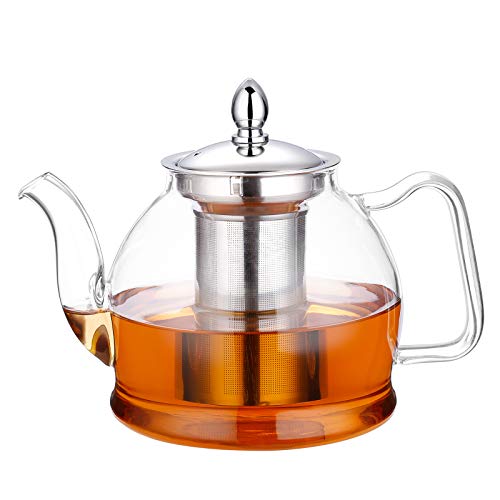
HIWARE 1000ml Glass Teapot with Removable Infuser — Best Overall
The HIWARE is the pot we would hand to someone who asked for a non-metal teapot without any further questions. The body is borosilicate glass rated for stovetop use, which removes the kettle from the equation entirely: fill it, heat it gently, add leaf, and pour. Watching the leaves unfurl is not a gimmick — it is genuinely useful feedback on whether your leaf has room to expand and whether a second steep is worth pouring.
Strengths
- Glass body keeps the brew path completely metal-free
- Stovetop safe, so it doubles as its own kettle
- Generous 1000 ml size serves three to four cups
Trade-offs
- Glass loses heat faster than ceramic or clay
- Removable infuser is metal mesh — remove it for a fully metal-free path
- Glass demands a little more care in the sink
| Capacity: 1000 ml (about 34 oz) |
| Body: borosilicate glass, stovetop safe |
| Infuser: removable (see review for material note) |
| Use: blooming and loose leaf tea |
Heat retention is the honest trade-off. A glass wall this thin gives up heat noticeably faster than stoneware, so for long, lazy sessions, brew slightly hotter or accept a cooler final cup. The removable infuser is stainless mesh; it lifts out in one motion, and the pot brews perfectly well with the leaf loose and a handheld strainer over the cup, which is how strict metal-avoiders will use it. As an everyday, transparent, nothing-to-hide brewer, it earns the top spot.
Ownership is undemanding: rinse after use, soak occasionally if tea film builds on the glass, and avoid thermal shock by not setting a boiling pot on a cold stone counter. The glass shows stains honestly, which owners come to appreciate — you can see when it needs a bicarbonate soak rather than guessing. Lids and infuser lift out for washing, and the wide mouth admits a bottle brush, a small mercy many narrower glass pots deny.
Best for: daily loose-leaf drinkers who want one pot for everything / Not suited for: collectors who want a display piece first and a brewer second.
Check on Amazon — check price on Amazon for the current figure.

Teabloom Stovetop & Microwave Safe Glass Teapot, 40 oz — Best for Blooming Tea
The Teabloom answers the strictest version of this search: not just a non-metal body, but a removable glass infuser as well, so from kettle to cup the water touches nothing but glass. It is also the natural home for blooming teas, where the whole point is the visual unfurling, and the 40 oz capacity means the performance comes with enough tea for the table, not just a single mug.
Strengths
- Glass infuser means the entire brew path is glass
- 40 oz capacity suits serving guests
- Microwave safe for easy reheating
Trade-offs
- Glass infuser holes suit whole leaf better than fine broken leaf
- Large glass body is the most fragile pick here
- Needs a trivet habit on hard stone counters
| Capacity: 40 oz |
| Body: glass, stovetop and microwave safe |
| Infuser: removable glass infuser |
| Use: blooming tea and loose leaf |
The glass infuser’s holes are cut for whole leaf and flowering teas; very fine rooibos or broken CTC leaf will shed particles into the cup, so pair it with full-leaf tea or accept a strainer at the cup. It is stovetop and microwave safe per the listing, which makes reheating a forgotten pot painless. Treat it like the glassware it is — no thermal shocks, no banging it into the faucet — and it is the purest brew path on this list.
Day to day, the Teabloom lives on the counter because it is genuinely pleasant to look at with a flowering tea inside, and that visibility drives use. The glass infuser rinses clean under the tap; stubborn leaf in the filter holes clears with a soft brush. Handle it like good glassware — two hands when full, a trivet on stone — and its fragility stops being a daily thought within the first month.
Best for: blooming-tea fans and anyone who wants zero metal anywhere in the pot / Not suited for: drinkers of fine-cut teas that slip through coarse glass filters.
Check on Amazon — check price on Amazon for the current figure.

Hario ChaCha Kyusu Maru Tea Pot, 700ml — Best for Green Tea
Japanese green tea punishes the wrong pot: water too hot, leaf stewed too long, a clumsy pour that keeps extracting while you serve. The ChaCha Kyusu Maru is shaped around those problems. The side handle gives a wrist-flick pour that empties fast and clean, the 700 ml size matches how green tea is actually drunk — small pots, frequent re-steeps — and Hario’s heatproof glass lets you watch the leaf colour tell you when to pour.
Strengths
- Purpose-built for green tea temperatures and leaf sizes
- Side-handle kyusu pour is controlled and drip-resistant
- Hario’s glass quality is a known quantity
Trade-offs
- 700 ml is a two-person pot at most
- Fine mesh basket is metal — lift it out if you want glass only
- Delicate spout rewards a careful hand
| Capacity: 700 ml |
| Body: Hario glass (Japanese heatproof glass) |
| Style: kyusu with side handle |
| Use: Japanese green tea and delicate loose leaf |
The internal basket is fine metal mesh, chosen because sencha needles escape coarser filters; it removes in seconds if you prefer to brew leaf loose in the pot and strain at the cup, which many kyusu traditionalists do anyway. This is a specialist, and it knows it: households wanting one big pot for everything should look at the HIWARE or the London Pottery below. For green tea brewed properly in a metal-free body, nothing else here comes close.
The Hario rewards a small ritual: warm it, add sencha, pour at the right temperature, and enjoy how the side handle makes the pour feel like a practised gesture rather than a task. Cleaning is a rinse and an air-dry; the fine mesh basket benefits from a weekly soak if you brew daily. It is the pick most likely to turn a casual green-tea drinker into a deliberate one, simply because the pot makes the process pleasurable.
Best for: sencha and gyokuro drinkers who brew small and often / Not suited for: tea drinkers who want a four-cup family pot.
Check on Amazon — check price on Amazon for the current figure.
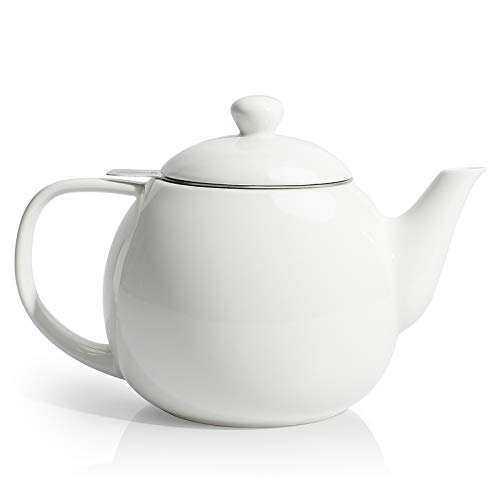
Sweese Porcelain Teapot, 27 oz, White — Best Porcelain Pick
Porcelain is the oldest answer to the non-metal question, and the Sweese shows why it never went away. A glazed porcelain body is chemically inert, rinses clean without holding yesterday’s Assam in its pores, and keeps heat noticeably better than glass across a slow breakfast. At 27 oz it is sized for real life: two generous mugs, or one mug plus a warm top-up waiting in the pot.
Strengths
- Porcelain is fully inert and adds no flavour of its own
- 27 oz is the sweet spot for one to two drinkers
- Clean white glaze shows tea colour honestly
Trade-offs
- Stainless infuser is metal, though removable
- Porcelain chips if it meets a cast-iron sink wrong
- No stovetop use — kettle required
| Capacity: 27 oz |
| Body: porcelain |
| Infuser: removable stainless steel |
| Colour: white |
The infuser is removable stainless steel — fine mesh, well made, and out of the pot in one lift if your preference is a metal-free path, in which case brew loose and strain. The white glaze is a feature, not a lack of imagination: you can judge a brew’s strength by colour at a glance. It needs a separate kettle and a minimum of respect around hard sinks, but as a flavour-neutral daily brewer it is hard to fault.
The Sweese settles into a kitchen the way a good mug does — used constantly, washed without ceremony, never worried about. Porcelain tolerates dishwashers, shrugs off staining with an occasional soak, and the white interior makes judging brew strength a glance rather than a guess. Owners should know the infuser’s mesh is fine enough for most broken leaf, so this is the pot that handles supermarket loose tea as gracefully as premium whole leaf.
Best for: drinkers who want a neutral, flavour-pure everyday pot / Not suited for: anyone wanting to heat water directly in the pot.
Check on Amazon — check price on Amazon for the current figure.

London Pottery Farmhouse 4 Cup Ceramic Teapot, 40.6 oz — Best for Sharing
When the brief is a real pot of tea for real people — four cups, kept warm through toast and conversation — thick-walled ceramic is the material that does the job, and London Pottery has made this farmhouse shape for decades. The 1200 ml body holds heat the way glass simply cannot, the spout is shaped by a maker that understands dribble, and the fine mesh strainer copes with the broken leaf in everyday blends that escapes coarser filters.
Strengths
- Proper four-cup capacity for families and guests
- Thick ceramic walls hold heat through a long table session
- Fine mesh strainer handles broken leaf well
Trade-offs
- The heaviest empty pot here — check wrist comfort
- Stainless strainer is removable but is the default brew path
- Farmhouse styling will not suit minimal kitchens
| Capacity: 40.6 oz / 1200 ml, 4 cup |
| Body: ceramic (stoneware-style farmhouse shape) |
| Infuser: removable stainless steel fine mesh strainer |
| Use: loose tea or bags |
It is the weightiest pot here even empty, which arthritic wrists should note, and the default strainer is stainless steel — removable, and the pot’s wide mouth makes loose brewing with a cup strainer perfectly practical. The cheerful farmhouse look will charm cottage kitchens and clash with stark modern ones. Judge it as what it is: the sharing pot, in a body with no heavy metal anywhere near your tea.
Living with the London Pottery means accepting its pleasant heft as part of the ritual: two hands to pour when full, a warm rinse before brewing on cold mornings, and a cosy if the pot must wait through a long breakfast. The ceramic shrugs off years of daily use, the glaze resists staining better than most, and replacement is rarely a thought — this is a maker whose pots routinely serve for a decade.
Best for: households brewing a full pot for the table / Not suited for: solo drinkers — the smaller picks above fit better.
Check on Amazon — check price on Amazon for the current figure.
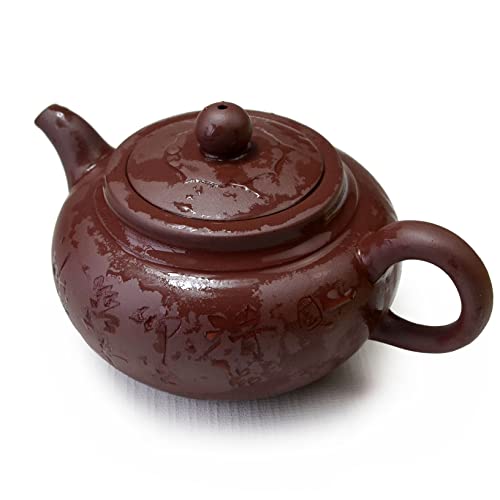
YXHUPOT Yixing Qingshuini Clay Teapot, 10 oz — Best for Gongfu Brewing
Yixing clay is the connoisseur’s answer to this entire search: an unglazed zisha pot contains no metal, no glaze chemistry to wonder about, and a mineral body that famously softens and rounds oolong and pu-erh across months of use. This Qingshuini pot uses built-in clay filter holes rather than any infuser basket, so the brew path is clay and water and leaf, nothing else. At 10 oz it is honestly sized for gongfu — many short steeps, not one long one.
Strengths
- Unglazed clay is as metal-free as a teapot gets
- Clay seasons over time and rounds harsh edges in oolong
- Built-in clay filter — no infuser of any material needed
Trade-offs
- 10 oz is a gongfu pot, not a family pot
- Unglazed clay absorbs flavours — dedicate it to one tea type
- Needs seasoning and gentle handling to perform its best
| Capacity: 10 oz / 320 ml |
| Body: Yixing Qingshuini clay (zisha), unglazed |
| Style: hand-carved, built-in clay filter holes |
| Use: gongfu brewing of oolong and pu-erh |
Clay ownership comes with rules. The porous body absorbs tea oils, which is the point, but it means dedicating the pot to one family of tea and never washing it with detergent. It will not make your morning English breakfast for two. What it will do is improve a specific tea, session after session, in a way no glazed or glass pot can imitate — the deepest expression of what a non-metal teapot can be.
The Yixing asks for commitment and repays it visibly. Season it with your chosen tea before first use, rinse only with hot water, dry it open, and within a few dozen sessions the same oolong starts tasting rounder from this pot than from any other vessel you own. Keep a small notebook if you like — which tea, how many steeps — because this pot turns brewing into a practice, and practices reward attention.
Best for: gongfu brewers who dedicate a pot to one tea / Not suited for: beginners wanting a big, forgiving everyday pot.
Check on Amazon — check price on Amazon for the current figure.
Comparison Table
| Pick | Badge | Key spec | Best for |
|---|---|---|---|
| HIWARE 1000ml Glass Teapot with Removable Infuser | Best Overall | 1000 ml (about 34 oz) | daily loose-leaf drinkers who want one pot for everything |
| Teabloom Stovetop & Microwave Safe Glass Teapot, 40 oz | Best for Blooming Tea | 40 oz | blooming-tea fans and anyone who wants zero metal anywhere in the pot |
| Hario ChaCha Kyusu Maru Tea Pot, 700ml | Best for Green Tea | 700 ml | sencha and gyokuro drinkers who brew small and often |
| Sweese Porcelain Teapot, 27 oz, White | Best Porcelain Pick | 27 oz | drinkers who want a neutral, flavour-pure everyday pot |
| London Pottery Farmhouse 4 Cup Ceramic Teapot, 40.6 oz | Best for Sharing | 40.6 oz / 1200 ml, 4 cup | households brewing a full pot for the table |
| YXHUPOT Yixing Qingshuini Clay Teapot, 10 oz | Best for Gongfu Brewing | 10 oz / 320 ml | gongfu brewers who dedicate a pot to one tea |
How to Choose a Non Heavy Metal Teapot
Start with the body material, not the marketing
Listings love the words natural and pure; ignore them and find the body material. Borosilicate glass is the most transparent choice in every sense — inert, flavour-neutral, and you can see the brew. Porcelain is equally inert with better heat retention and a more forgiving relationship with hard sinks. Stoneware ceramic sits between the two. Unglazed clay is the specialist option that trades neutrality for character. What you are avoiding is straightforward: bare cast iron, bare aluminium and any pot whose body material the seller will not state plainly.
Decide how strict your metal-free line is
Most pots in this category pair a non-metal body with a removable stainless steel mesh infuser. For most buyers that is a non-issue — the mesh is not a heavy metal and contact is brief. If your line is stricter, choose a glass infuser like the Teabloom’s, a clay pot with built-in filter holes like the Yixing, or simply brew loose and strain at the cup; every pot here supports that. Decide before ordering, because infuser style also decides which leaf sizes brew cleanly.
Match capacity to how you actually drink
Teapot capacities are quoted brim-full; working capacity is roughly three quarters of the headline figure. A 27 oz pot serves two mugs comfortably. A 40 oz pot serves a table. Small clay and kyusu pots around 10 to 24 oz are built for repeated short steeps, and judging them by family-pot standards misses their purpose entirely. Buy for your Tuesday, not for the dinner party you host twice a year.
Heat retention follows wall thickness
Thin glass cools fastest, porcelain and stoneware hold a session-length warmth, and unglazed clay sits in between while adding its own seasoning effect. If you brew one cup at a time and drink it promptly, glass’s weakness never appears. If a pot sits through a long breakfast, preheat a ceramic pot with hot water before brewing and the difference narrows further. A tea cosy helps every material and costs less than upgrading the pot.
How to Brew Loose Leaf Tea in a Glass or Clay Pot
- Warm the pot first. Swirl hot water inside for thirty seconds and discard it; a warmed pot keeps the brew temperature honest, especially with glass.
- Add leaf according to the tea, not habit: roughly one teaspoon of rolled leaf per cup for most teas, more for fluffy white teas, less for dense CTC. Give leaves physical room — an overfilled infuser brews like a teabag.
- Pour water at the right temperature: just off the boil for black tea and pu-erh, noticeably cooler — around 80°C — for green tea, which scorches and turns bitter in boiling water.
- Steep with a timer the first few times you brew a new tea. Most loose leaf peaks between two and four minutes; learn your tea’s number instead of guessing by colour alone.
- Decant fully. Pour every cup out once the steep is done rather than leaving tea sitting on the leaves, which keeps extracting and turns the second cup harsh. For gongfu pots, pour into a fairness pitcher first.
- Rinse, never scrub. Glass and porcelain need only a rinse and the occasional soak for stains; unglazed clay should never meet detergent at all — hot water only, then air-dry with the lid off.
Common Buying Mistakes
Buying cast iron for the look and calling it traditional
Tetsubin are beautiful and traditional — and they are exactly the heavy-metal body this search exists to avoid. If you love the look, use one as a kettle rest or decor, not as your daily brewer.
Assuming stainless infuser means the pot fails the brief
The body is what holds your tea for the whole steep. A removable mesh basket you can lift out in one second is a different question from a metal pot; decide your own line, but decide it on facts.
Putting a non-stovetop glass pot on a burner
Only pots explicitly listed as stovetop safe — like the HIWARE and Teabloom here — belong on heat. Other glass and all porcelain and clay pots will crack, sometimes dramatically.
Washing an unglazed clay pot with soap
Detergent soaks into porous clay and flavours the next dozen brews. Hot water, a soft cloth, and patience are the entire cleaning regime.
Judging capacity by the headline number
A brim-full measurement means a real serving is smaller. Households repeatedly buy a pot one size too small and then overfill it, which wrecks both the pour and the brew.
What ‘Heavy Metal’ Worry Is Actually About
Most concern behind this search is not about stainless steel or iron kettles in general — it is about specific materials in prolonged contact with hot, slightly acidic water: lead in some decorative glazes, cadmium in bright pigments, and bare reactive metals that can flavour water and corrode. Glass, porcelain and stoneware with food-safe glazes sidestep the whole conversation, which is why this guide insists on a stated body material from the manufacturer rather than reassuring adjectives from a reseller.
It is also worth keeping proportion. A certified pot from an established maker — London Pottery, Hario, Teabloom — operates inside food-contact regulations in its home market. The riskiest purchases in this category are unbranded decorative pots sold as functional, with metallic-look glazes and no material disclosure at all. Every pick here was chosen partly because its maker states what the pot is.
Glass vs Porcelain vs Clay: An Honest Taste Test Logic
Brew the same tea in all three and the differences are real but modest. Glass is the most neutral and the coolest-running; it shows you everything and forgives nothing, which is why tasters use it. Porcelain matches glass for neutrality and wins on warmth, making it the better breakfast pot. Clay is the only material that changes the tea on purpose, softening roast edges in oolong — a feature for one tea drunk often, a flaw for a pot expected to brew everything.
Our practical advice: households get the most from one glass or porcelain pot in the right size. Enthusiasts add a small clay pot for a favourite tea. Nobody needs five pots, and the money saved buys noticeably better leaf, which improves the cup more than any vessel upgrade.
Glass, Porcelain and Clay Care, Compared
Each material in this guide asks for a different kind of care, and choosing the care routine you will actually keep is a legitimate way to choose the pot. Glass wants gentleness with temperatures and knocks but forgives any washing method. Porcelain wants almost nothing — it is the lowest-maintenance serious teapot material ever made. Stoneware ceramic wants a warm-up on cold days and rewards it with the best heat keeping of the three. Unglazed clay wants a rule — hot water only, one tea family — and gives back flavour development no other material offers.
None of these routines is burdensome, but they are different, and households that ignore the difference end up with a cracked glass pot or a soap-flavoured clay pot and a wrong conclusion about the material. Read the care column before the beauty column and the pot you choose will still be pleasing you in five years.
Choosing Your Tier in This Category
At the accessible end, glass pots like the HIWARE deliver the full non-metal brief with the least ceremony and the easiest replacement if an accident happens. The middle of the category — porcelain and farmhouse ceramic — buys heat retention, durability and the feeling of a permanent kitchen object. The specialist end, exemplified by Yixing clay, is not really about price at all: it buys a relationship with one tea, and it is only worth it for drinkers who already know which tea that is.
A sensible household path is one good everyday pot first — glass or porcelain in your true serving size — and a specialist pot later, if a favourite tea starts asking for one. That sequence spends money in the order the benefits actually arrive.
A Note on Glazes and Decorative Pots
Glazed ceramic deserves one clarification: a food-safe glaze from an established maker is a glass-like surface engineered for food contact, and it is not comparable to the unknown metallic-effect glazes on unbranded decorative pots. The risk profile in this category lives almost entirely in no-name ornamental ware sold cheaply as functional. Every ceramic and porcelain pick here comes from a maker that states its materials and sells through mainstream channels — which is precisely the screening that removes the worry.
If you already own a decorative pot of unknown origin, the cautious path is simple: enjoy it as an ornament, and brew daily in a pot whose maker you can name.
How Water and Leaf Matter More Than the Pot
Honesty requires this section: once the pot is inert and sensibly shaped, the leaf quality and water temperature move the cup more than the vessel does. Fresh loose leaf, water at the right temperature for the tea, and a full decant at the right minute will make a modest glass pot outperform a superb clay pot used carelessly. Buy the pot to remove obstacles and worries — the non-metal brief is exactly that — then spend your ongoing budget on better tea.
That is also why this guide resists declaring exotic winners. The best non heavy metal teapot is the one whose material you trust, whose size matches your household, and whose care routine fits your life. The six above are the strongest current answers to that formula in their respective shapes.
Brewing Temperatures, by Tea and by Material
Material and temperature interact in ways worth understanding. Glass and porcelain are thermally neutral messengers: the water you pour is the water the leaf meets, minus a few degrees lost to a cold pot — which is why preheating matters most with these materials. Clay holds and smooths heat, forgiving small temperature errors across a long gongfu session, one reason oolong traditions settled on it centuries before thermometers existed to explain why.
Practically: green teas want water well off the boil and punish kettles poured straight onto leaf in any material; black teas and pu-erh want full heat and a preheated pot; oolongs sit between and reward the clay pot’s steadiness. A simple kettle thermometer or a temperature-controlled kettle removes the guesswork entirely, and costs less than any pot in this guide — the highest-value accessory a new loose-leaf drinker can buy.
If you take one habit from this section, take preheating. Thirty seconds with hot water before the brew lifts every material’s performance and erases most of the practical difference between glass and ceramic for a single steep.
Loose Leaf vs Bags in These Pots
Every pick here was chosen for loose leaf, but most households live in both worlds, and these pots handle bags gracefully — the wide mouths and removable infusers mean a bag can steep freely and be lifted out cleanly. The honest difference is expansion: loose leaf needs room to unfurl, and an infuser basket crammed tight negates the advantage you bought the pot for. Fill baskets no more than half, or brew loose and strain.
For broken-leaf blends and rooibos, filter fineness decides cup quality. The London Pottery’s fine mesh and the Sweese’s removable infuser handle small particles best; glass infusers and clay filter holes suit whole leaf. Matching leaf grade to filter is a small literacy that pays in every cup.
And a word for the teabag loyalist reading this far: a good non-metal pot improves bagged tea too, through proper water volume, full steeping space and a clean decant. The vessel is not a loyalty test.
Teapot Shapes and Why They Pour Differently
A teapot’s pour is engineering, not luck. The spout’s base should sit low and wide so the pot empties fully; its tip should reach near the pot’s rim height so tea does not dribble out during filling; and the lid needs a small air hole, without which the pour glugs and pulses. The makers in this guide — Hario, London Pottery, Teabloom — have solved these geometries over decades, which is why their pots pour cleanly while novelty shapes decorate shelves instead of tables.
Handle geometry matters as much as spout geometry. Side handles, as on the kyusu, pour with a wrist rotation that suits small, frequent servings. Rear handles suit two-handed, full-pot service. Neither is better; they are answers to different drinking patterns, and choosing between them is really choosing how your household drinks.
When a listing shows a beautiful pot with a tiny, high spout and no lid vent, you are looking at an ornament. Brew in the six above; admire the ornament on someone else’s shelf.
Building a Small, Complete Tea Setup
A non-metal pot is the centre of a tea setup, not the whole of it. The complete modest kit is short: a kettle you can pour controllably, a simple strainer for loose brewing days, a scale or a consistent spoon for repeatable leaf quantities, and cups whose size matches your pot’s working capacity so the last pour is as good as the first.
Storage deserves one sentence of respect: loose leaf dies by air, light and neighbouring spices, in that order — a sealed tin in a dark cupboard is the entire technology required. The pot, by contrast, should live where it is seen; beautiful tools get used, and used tools justify themselves.
Resist completing the kit in a weekend. Buy the pot, brew for a month, and let your actual habits name the next purchase. Tea culture accumulated its equipment over centuries of daily practice; your cupboard can take its time too.
A Short History of Brewing Without Metal
Tea was brewed for centuries before metal teapots were common, in clay and porcelain vessels across China and later Japan, and the traditions that produced gongfu and the tea ceremony built their entire flavour language around those materials. The European porcelain industry itself began as an attempt to replicate Chinese porcelain precisely because metal pots of the era — pewter and silver aside — were understood to be working vessels, not tasting vessels.
That history matters to a modern buyer for one practical reason: the techniques still taught for these teas assume an inert pot. Water temperatures, steep counts and leaf quantities in traditional guidance were all calibrated in clay and porcelain. Brewing the same tea in a reactive vessel is not wrong, but it is a translation, and some nuance is always lost in translation.
The contemporary non-metal movement adds a second motive — material transparency — to the original flavour motive. The reassuring conclusion of this guide is that the two motives point at the same shortlist. The pots your grandparents’ generation trusted for taste are the pots this generation trusts for composition, and they are the six reviewed above.
How to Test a Teapot in Its First Week
A new pot earns trust through three simple tests. The water test: fill it with plain hot water, wait five minutes, and taste — the water should taste like water, with no flavour donated by the vessel. Any pot in this guide passes; a decorative pot of unknown glaze often does not, which is the entire screening argument in a single sip.
The pour test: fill to working capacity and pour at serving speed into a cup at table height. Watch for dribble at the spout’s end, glugging from a missing lid vent, and a handle that forces your knuckles toward hot ceramic. Small faults here are daily faults, and the first week is when returning a pot is painless.
The second-steep test: brew the same leaves twice and compare. A good pot keeps the second steep generous; a pot that stews leaf in a trapped puddle — poor drainage, an ill-fitting infuser — punishes it. Run these three tests and you will know your pot’s character more honestly than any review, including this one, can tell you.
Teapots as Gifts: Matching Pot to Person
A non-metal teapot is an unusually safe gift in this category because the material story is easy to explain and the object is beautiful in use. Match by drinking pattern rather than by aesthetics alone: the daily loose-leaf drinker gets the HIWARE’s practical glass; the breakfast traditionalist gets the London Pottery’s warmth; the green-tea devotee gets the Hario; the friend who hosts gets the Teabloom, because a flowering tea in glass is a small event at any table.
The Yixing is the expert’s gift and should be given only to someone whose favourite tea you can name — given blind, it risks becoming an ornament, which is the one fate a working pot should avoid. The Sweese is the universal fallback: neutral, elegant, sized for real life, and incapable of clashing with any kitchen it enters.
Add leaf, not accessories. A gift pot accompanied by a small quantity of excellent tea matched to its strengths will be used the same evening; a pot accompanied by gadgets will be admired and shelved. The object lesson of this whole guide applies to gifting too — the vessel serves the tea, never the reverse.
What to Do With the Metal Pot You Already Own
Many readers arrive at this search owning a cast iron or steel pot they like, and the honest advice is not theatrical disposal. A tetsubin makes a superb water kettle rest, a decorative object, or a dedicated vessel for the one robust tea whose character you prefer with a mineral edge — some drinkers genuinely do, particularly with certain dark teas.
What changes is the default. The daily pot — the one holding near-boiling water against leaf for thousands of steeps across years — becomes the inert vessel, and the metal pot retires to the roles where prolonged contact is not the point. That is a proportionate reading of the concern behind this search: material contact multiplied by time is the variable, and the daily pot is where the multiplication happens.
If the metal pot was cheap, unbranded and is beginning to rust or flake inside, the answer is simpler: retire it entirely. Cookware with a deteriorating interior has no remaining role in a careful kitchen, whatever it is made of.
Final Recommendation
For most households, the HIWARE glass pot is the answer: a fully non-metal body, stovetop convenience, and a size that covers daily drinking. Porcelain loyalists should take the Sweese for its warmth and neutrality, green-tea drinkers the Hario kyusu, and anyone ready to go deeper the Yixing clay pot, dedicated to one beloved tea.
Whichever you choose, you are buying a brew path you never have to think about again — which is the entire point of this category.
Related guides on this site: Best Glass Teapots Best Ceramic Teapots Best Teapots With Infusers Best Japanese Teapots Best Cast Iron Teapots
Revisit the top picks: HIWARE 1000ml Glass Teapot with Removable Infuser.
Revisit the top picks: Teabloom Stovetop & Microwave Safe Glass Teapot, 40 oz.
Revisit the top picks: Hario ChaCha Kyusu Maru Tea Pot, 700ml.
Frequently Asked Questions
Are glass teapots completely metal-free?
The body is, yes. Some glass pots include a stainless steel infuser or lid parts; the Teabloom in this guide uses a glass infuser for an all-glass path, and on other models the infuser lifts out so you can brew loose and strain at the cup.
Is a stainless steel infuser a heavy metal concern?
Stainless steel is not classed among the heavy metals people usually mean by this search, and contact is brief. If you prefer zero metal, choose glass-infusion or clay filter designs — both are represented in the picks above.
Can I put a glass teapot on the stove?
Only if the listing explicitly says stovetop safe, as the HIWARE and Teabloom here do. Ordinary glass, porcelain and clay pots must be filled from a kettle instead.
Why dedicate a clay teapot to one type of tea?
Unglazed clay absorbs tea oils and gradually seasons, which improves a similar tea over time but muddles delicate teas brewed after strong ones. One pot per tea family is the traditional and practical rule.
How do I remove tea stains from porcelain or glass?
A soak in warm water with a spoon of bicarbonate of soda lifts most staining without scrubbing. Avoid abrasive pads on glazes, and never use detergent inside an unglazed clay pot.
What size teapot should a two-person household buy?
Around 27 to 34 oz of headline capacity gives two full mugs with a little left for a top-up. Go to 40 oz if you regularly serve three or four people.


