Disclosure: airfryerkitchensupply.com is reader-supported. When you buy through links on our site, we may earn an affiliate commission at no extra cost to you.
Where to buy
Every ceramic teapot in this guide is sold on Amazon and was verified against Amazon’s catalogue before publication, so the capacity, material and infuser details in each review match the listing you will land on. If you want one safe first purchase, start with the Sweese 27 oz Porcelain Teapot for everyday two-person brewing, or the Steinzeit Design 44 oz Ceramic Teapot if you brew for a table. Check the current price on Amazon as you compare the picks, and check price on Amazon again at checkout if you are choosing between colourways, because glazed finishes rotate in and out of stock.
Introduction
The best ceramic teapots occupy the sensible centre of the teapot world, and that is a compliment. Ceramic — in its porcelain and stoneware forms — holds heat far better than glass, weighs far less than cast iron, flavours nothing, and asks for nothing more exotic than ordinary washing. It is the material most teapots in most kitchens are made of, and the material most buyers should start with. But “ceramic” covers a wide range: thin porcelain that pours like a whisper, chunky stoneware that keeps a family pot hot through breakfast, reactive glazes where no two pots fire alike, and everything in between. This guide sorts that range into six verified picks, each assigned the job it genuinely does best.
We verified every pick against Amazon’s own catalogue data before writing, matching brand, capacity, material and infuser details to real listings. All six passed, so all six carry links. We do not print prices or star ratings anywhere in this guide — both change constantly — so each pick is positioned by tier instead: budget, mid-range or design-led. What we judged instead is what actually decides whether a ceramic teapot earns its shelf space: how the glaze and body handle daily heat, whether the infuser is deep and fine enough for real loose leaf, how the spout pours, how the lid seats, and whether the stated capacity is a usable brewing volume or a brim-full fiction.
The shortlist covers the main ceramic buying situations. The Sweese is the everyday porcelain answer for one or two people. The Tea Forte Fiore is the design-led pot that still brews properly. The London Pottery Farmhouse is the traditional British ceramic pot with a fitted infuser. The Steinzeit is the big 44 oz table pot. The KOOV brings a reactive-glaze party piece with a proper strainer. And the HVH is the rustic, wabi-sabi striped porcelain pot that serves six cups at a budget-tier position. Whether you drink bagged breakfast tea or single-origin loose leaf, one of these six is shaped for your routine — and the buying guide below explains the ceramic-specific details, from glaze safety to thermal shock, that decide between them.
In this guide
Quick Picks
- Best Overall: Sweese Teapot, 27 oz Porcelain with Removable Stainless Steel Infuser — the classic everyday ceramic pot: neutral flavour, honest size, a real infuser. Check on Amazon
- Best Design: Tea Forte Fiore Ceramic Teapot with Infuser, Stone Blue, 24 oz — a curved, giftable ceramic pot with a stainless infuser and a ceramic lid. Check on Amazon
- Best Traditional: London Pottery Farmhouse Teapot with Infuser, 2 Cup — the heritage British farmhouse shape in ceramic, with a fitted infuser basket. Check on Amazon
- Best Large: Steinzeit Design Ceramic Teapot, 44 oz, Black — a premium-feel large ceramic pot with a removable strainer for loose leaf at table scale. Check on Amazon
- Best for Tea Parties: KOOV Ceramic Teapot with Infuser, 34 oz, Nebula Blue Reactive Glaze — six cups of reactive-glazed ceramic that looks different on every firing. Check on Amazon
- Best Rustic Value: HVH Porcelain Teapot with Stainless Steel Infuser, 40 oz, Wabi Sabi Striped — a big, characterful porcelain pot for six cups at a budget-tier position. Check on Amazon
How These Picks Were Chosen
We restricted this guide to true ceramic bodies — porcelain and stoneware-family pots — and excluded glass, cast iron and steel, which have their own guides in this series. Within the ceramic field, we shortlisted across the real axes of difference: body type (fine porcelain versus heavier ceramic), capacity (24 oz personal pots up to 44 oz table pots), glaze character (plain white, solid colour, reactive and hand-finished stripe), and brewing hardware (every pick here includes an infuser or strainer, because a modern ceramic teapot guide that ignores loose leaf would be ignoring how a large share of buyers actually brew).
Each candidate was then verified against Amazon’s catalogue through the retailer’s product data: listing title, brand, capacity, material and infuser had to match the pot we intended to describe. Six pots passed cleanly. That verification step is also why the spec boxes in this article contain only what the listings themselves state — capacity, material, infuser, care instructions — and nothing we could not confirm. Where a well-known ceramic name could not be verified, we left it out rather than guess; an honest six is worth more than a padded ten.
Judgement criteria after verification were ceramic-specific. Glaze quality and coverage, because a crazed or thin glaze is where ceramic pots age badly. Wall thickness appropriate to the job — fine porcelain should be fine, a family stoneware pot should be substantial. Thermal behaviour: ceramic’s one real vulnerability is sudden temperature change, so we favoured designs and makers that treat warm-up as part of normal use. And the usual teapot tests that apply to every material: spout behaviour, lid fit, handle clearance, and honest capacity. The six picks each lead a category a real buyer shops for, which is the only kind of “best” list worth reading.
The 6 Best Ceramic Teapots
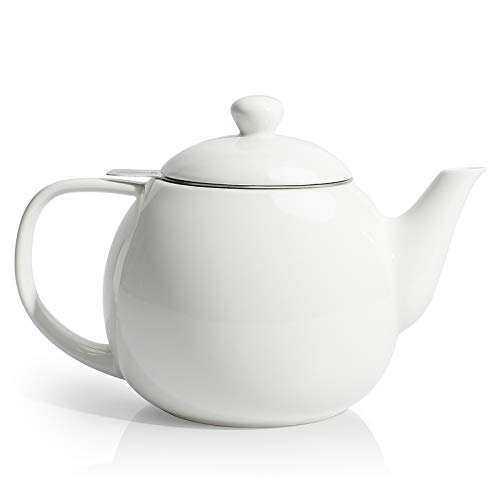
Sweese Teapot, 27 oz Porcelain with Removable Stainless Steel Infuser — Best Overall
The Sweese is what most people picture when they picture a ceramic teapot, executed correctly: a clean white porcelain body, a removable stainless steel infuser, and a 27 oz capacity that pours two generous mugs or three cups. Porcelain is the refined end of the ceramic family — fired at high temperature, non-porous, and completely neutral in flavour, so Monday’s smoky lapsang leaves no ghost in Tuesday’s delicate white tea. The body holds heat noticeably better than glass while staying light enough for an easy one-handed pour, and the plain white finish coordinates with every cup you own. It suits the everyday drinker who brews for one or two and wants one pot that handles bags and loose leaf without fuss. It does not suit the family round — for that, the Steinzeit and HVH below exist.
Strengths
- High-fired porcelain is non-porous and flavour-neutral — no carry-over between strongly different teas.
- Removable stainless infuser makes it a genuine loose-leaf pot, and lifts out for bag drinkers.
- The 27 oz size brews fresh and finishes fresh for one or two people, the way tea tastes best.
Trade-offs
- Two-mug capacity is a firm ceiling; households of three or more tea drinkers will rebrew often.
- White porcelain shows tannin film over time and rewards an occasional proper soak.
- The look is deliberately classic and plain — design-led buyers should start with the Fiore.
| Specifications (verified) | |
|---|---|
| Capacity | 27 oz |
| Material | Porcelain |
| Infuser | Removable stainless steel |
| Colour | White (other colourways exist in the range) |
What earns the Sweese the overall badge is the absence of weaknesses. The proportions are the settled proportions of the classic teapot — wide body for leaf movement, a spout that pours without drama, a handle with real knuckle clearance, a lid that stays seated through the last tilt. Porcelain’s smoothness also makes it the easiest ceramic to keep clean: tannin rinses off a glazed porcelain wall more readily than off a matte stoneware one. As a first ceramic teapot, a replacement for a chipped one, or the pot you hand to a student leaving home, it is the safest money in this guide. It sits in the budget tier; check the current price on Amazon.
Best for: everyday brewing for one or two people, any tea style. / Not suited for: family rounds or buyers wanting a statement piece. Check on Amazon

Tea Forte Fiore Ceramic Teapot with Infuser, Stone Blue, 24 oz — Best Design
The Fiore is the ceramic pot for people who choose kitchen objects by eye first — and it survives that choice because the brewing hardware underneath the design is proper. The body curves softly in a stone blue finish, the lid is ceramic rather than the metal afterthought most pots wear, and inside sits a stainless steel loose-leaf infuser deep enough to brew in earnest. At 24 oz it is a two-person pot: two mugs, or a small tray service for two with cups. Tea Forte also rates it dishwasher and microwave safe, which matters more than it might seem — a beautiful pot that demands hand-washing is a pot that quietly stops being used in a busy household, and this one asks for no such exemption. It suits gift buyers, small households and hosts of intimate teas. It does not suit anyone brewing for a table of six.
Strengths
- Design that earns its premium — the curved silhouette and matching ceramic lid make it a genuine table piece.
- A real stainless infuser, so the pretty pot brews loose leaf as well as it presents it.
- Dishwasher and microwave safe, removing the usual fragility tax on a design-led pot.
Trade-offs
- 24 oz is a two-person ceiling.
- Part of the price is the design itself; capacity-per-dollar buyers get more pot from the HVH.
- The curved body takes slightly more shelf and cupboard presence than a straight-sided pot of the same volume.
| Specifications (verified) | |
|---|---|
| Capacity | 24 oz |
| Material | Ceramic with ceramic lid |
| Infuser | Stainless steel loose leaf infuser |
| Care | Dishwasher & microwave safe |
Judge the Fiore as what it is: the gift and occasion end of the ceramic category, done honestly. It brews a correct two-person pot — the infuser is not a token — and then it does the thing plain pots cannot, which is make the serving of tea feel like a small event. Paired with a good loose-leaf tea, it is the present that gets used weekly rather than admired annually. It sits in the mid-range tier. Check price on Amazon, particularly if you are buying for a date, since the stone blue finish is the popular colourway and rotates accordingly.
Best for: gifts, design-conscious kitchens and teas for two. / Not suited for: family volume or strict value-per-ounce shopping. Check on Amazon

London Pottery Farmhouse Teapot with Infuser, 2 Cup, France Blue — Best Traditional
Some ceramic teapots are designed; this one was settled. The Farmhouse is London Pottery’s signature shape — a rounded, squat ceramic body, a short well-angled spout, and a fitted infuser basket under the lid — refined over decades of British kitchen use. At 600 ml (“2 cup” in the British teacup sense) it is sized for one or two drinkers, and the France Blue glaze gives it the farmhouse-kitchen character the name promises. The fitted basket deserves emphasis: it reaches deep into the pot, so leaves expand and circulate instead of sitting in a compressed puck, and when the steep is done you lift it out and the pot becomes a serving pot that will not stew. It suits traditionalists and loose-leaf drinkers who brew small. Mug drinkers who both want a large mug each should look at the bigger pots in this guide instead.
Strengths
- The heritage farmhouse body shape swirls leaves as water pours in, aiding an even extraction.
- Deep fitted infuser basket — the best small-pot loose-leaf hardware in this guide.
- Traditional spout geometry pours a clean stream and cuts off without running down the body.
Trade-offs
- 600 ml is two teacups, not two big mugs — check your mug size before ordering.
- Ceramic holds heat well but not indefinitely; a cosy remains the answer for a long session.
- The basket is one more part to rinse, and fine teas leave residue in any mesh.
| Specifications (verified) | |
|---|---|
| Capacity | 2 cup / 600 ml |
| Material | Ceramic |
| Infuser | Yes, fitted infuser included |
| Colour | France Blue (other farmhouse colourways exist) |
The Farmhouse is the pick for anyone who believes — correctly — that teapot design was essentially solved a long time ago and that the modern task is to execute the solution well. Thick enough walls to hold a brew’s temperature, a lid that seats, a handle placed for a full pot’s balance: it is all here, in a pot that also happens to look like it belongs next to a range cooker and a bread bin. For a British-style tea routine in a small household, nothing else in this guide is as completely itself. Check the current price on Amazon; colourways rotate, and the pot is the same in any of them.
Best for: traditional brewing for one or two, especially loose leaf. / Not suited for: big-mug households or groups. Check on Amazon
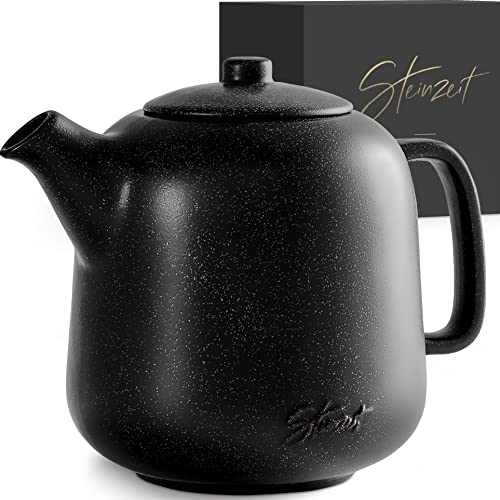
Steinzeit Design Ceramic Teapot, 44 oz, Black — Best Large
When the brief is a table-sized ceramic pot that still brews loose leaf properly, the Steinzeit is the answer in this guide. Forty-four ounces — roughly 1.3 litres — pours five to six cups, and the removable strainer means that volume can be a real loose-leaf brew rather than a bag-only compromise. The black finish and clean, modern lines put it at the contemporary end of ceramic design, a deliberate contrast to the farmhouse and floral traditions elsewhere in this list, and the body has the substantial feel its “premium ceramic” positioning promises. It suits households of tea drinkers, hosts, and offices that brew a shared pot. It is more pot than a solo drinker will ever fill, and a full one is a confident two-hand carry.
Strengths
- True table capacity — 44 oz serves a group from a single brew at a single strength.
- Removable strainer keeps it a genuine loose-leaf pot at family scale.
- Modern black ceramic finish suits contemporary kitchens that farmhouse styles do not.
Trade-offs
- Heavy when full; brew and pour at the counter if wrists are a concern.
- A large ceramic body needs a thorough warm-up to hold temperature through the session.
- Oversized for one or two drinkers — tea in a half-filled big pot cools and stews faster.
| Specifications (verified) | |
|---|---|
| Capacity | 44 oz |
| Material | Ceramic |
| Infuser | Removable strainer, included |
| Colour | Black |
The Steinzeit’s real achievement is refusing the usual large-pot trade-offs. Big pots often pour clumsily; this one’s proportions keep the pour controlled. Big pots often skip the infuser; this one includes a proper strainer. And big ceramic pots often look like scaled-up compromises; the black finish instead looks intentional. If your tea drinking is social — a household that gathers, a table that lingers — this is the ceramic pot to build the routine around, ideally with a cosy for the long sessions. It sits in the mid-range tier. Check price on Amazon before ordering for a gathering, as large pots ship in smaller batches.
Best for: households and hosts brewing loose leaf for four to six. / Not suited for: solo drinkers or small kitchens. Check on Amazon

KOOV Ceramic Teapot with Infuser, 34 oz, Nebula Blue Reactive Glaze — Best for Tea Parties
Reactive glaze is ceramic’s party trick: minerals in the glaze move and blend in the kiln, so the finish — here a deep, swirling Nebula Blue — varies from pot to pot and no two are exactly alike. The KOOV builds that finish onto a practical brewer: 34 oz of ceramic, enough for six cups, with an infuser and strainer arrangement for loose leaf. It is the pot you bring out when friends come for tea and the pot itself is part of the conversation, while still being a working everyday brewer the rest of the week. It suits hosts, gift buyers who want something less expected than white porcelain, and anyone whose table style leans colourful. It does not suit minimalists, or buyers who need a replacement lid or a second pot to match the first exactly — with reactive glaze, exact matching is not how the material works.
Strengths
- Reactive glaze finish is genuinely individual — your pot’s pattern is its own.
- Six-cup capacity with an infuser, so the showpiece is also a proper loose-leaf brewer.
- Ceramic body holds heat through a social session better than a glass party pot would.
Trade-offs
- The finish varies from the photos by the nature of the process — buy it for the family of colours, not an exact image.
- Dark, complex glazes show water marks and fingerprints more than plain white porcelain.
- Mid-size: too big for a solo drinker’s daily pot, too small for a large gathering.
| Specifications (verified) | |
|---|---|
| Capacity | 34 oz (six cups) |
| Material | Ceramic |
| Infuser | Yes, with tea strainer |
| Finish | Reactive glaze, Nebula Blue |
The KOOV earns its badge by solving the tea-party problem honestly: the pot must brew well for several people and look like it belongs at an occasion. Most party pots manage one or the other. The infuser keeps the brewing correct, the ceramic keeps the tea warm while the conversation runs, and the glaze does the dressing up. If you host a book club, a craft afternoon or a family Sunday tea, this is the pot that makes the table feel set rather than merely served. It sits in the budget-to-mid tier. Check the current price on Amazon.
Best for: hosts and tea parties of up to six cups, and colourful tables. / Not suited for: minimalists or anyone needing exact-match multiples. Check on Amazon
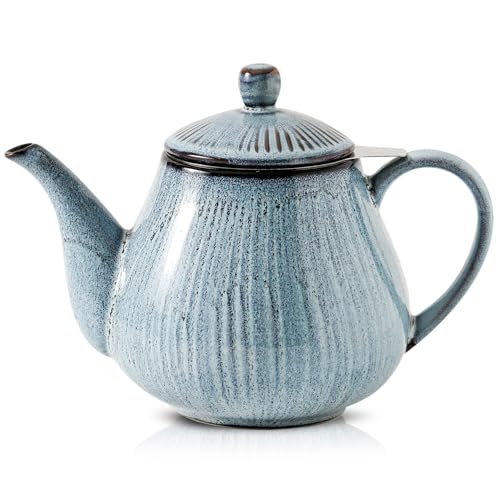
HVH Porcelain Teapot with Stainless Steel Infuser, 40 oz, Wabi Sabi Striped — Best Rustic Value
The HVH is the big-hearted budget pick: 40 oz of porcelain — six cups’ worth — with a stainless steel infuser, finished in a hand-character striped design in the wabi-sabi spirit, where slight irregularity is the aesthetic rather than a flaw. That combination is rarer than it should be. Large porcelain pots usually cost mid-range money; large cheap pots usually skip the infuser. The HVH gives a family or a small office a proper loose-leaf brewer at a budget-tier position, with a look that suits rustic, natural and eclectic kitchens far better than glossy white would. It suits value hunters, families and anyone furnishing a first kitchen properly. It does not suit perfectionists — the wabi-sabi finish is deliberately imperfect, and if a slightly organic stripe would bother you every morning, buy the Sweese’s discipline instead.
Strengths
- Six-cup porcelain capacity with a stainless infuser at a budget-tier position — the value equation of this guide.
- The wabi-sabi striped finish hides the small marks of daily use gracefully.
- Porcelain’s non-porous body keeps flavours clean across different teas.
Trade-offs
- The hand-character finish is intentionally irregular; it will not satisfy buyers who want machine-perfect uniformity.
- A 40 oz porcelain pot is still porcelain — it wants more careful handling than a stoneware pot of the same size.
- Full, it is a substantial pour; smaller households will rarely fill it.
| Specifications (verified) | |
|---|---|
| Capacity | 40 oz (six cups) |
| Material | Porcelain |
| Infuser | Stainless steel, included |
| Finish | Striped series, Wabi Sabi |
Value picks earn their place by what they refuse to compromise, and the HVH refuses to compromise the two things that matter: capacity and the infuser. Everything else — the rustic finish, the straightforward construction — is in service of getting a real family loose-leaf pot to a price tier where a first-kitchen buyer can say yes. Treat it with porcelain-appropriate care, warm it before brewing, and it will do family duty for years. Check price on Amazon; at its tier, it is frequently the easiest recommendation in this entire guide to act on.
Best for: families and value buyers wanting a big loose-leaf porcelain pot. / Not suited for: perfectionists or anyone who wants a small daily pot. Check on Amazon
Comparison Table
| Pick | Badge | Key spec | Best for |
|---|---|---|---|
| Sweese Porcelain Teapot | Best Overall | 27 oz porcelain, removable steel infuser | Everyday brewing for two |
| Tea Forte Fiore | Best Design | 24 oz ceramic, ceramic lid, dishwasher safe | Gifts & teas for two |
| London Pottery Farmhouse | Best Traditional | 600 ml ceramic, fitted infuser basket | British-style small brews |
| Steinzeit Design Teapot | Best Large | 44 oz black ceramic, removable strainer | Loose leaf for a table |
| KOOV Ceramic Teapot | Best for Tea Parties | 34 oz ceramic, reactive glaze | Hosting up to six cups |
| HVH Porcelain Teapot | Best Rustic Value | 40 oz porcelain, steel infuser, striped | Families on a budget |
How to Choose a Ceramic Teapot
Start by knowing which ceramic you are buying, because the word covers two personalities. Porcelain is fired hotter, vitrifies fully, and comes out thin, strong, translucent at the edges and completely non-porous — the Sweese and the HVH in this guide. Stoneware-family ceramics are thicker, heavier and more rustic in feel, with a warmer, more casual character — the Farmhouse and the Steinzeit end of the list. Porcelain suits lighter teas, smaller pots and easy cleaning; heavier ceramic suits family volumes, long sessions and traditional styles. Neither is better; they are tools tuned to different tables.
Glaze is the second decision, and it is more than cosmetic. A good glaze is a glass skin: it seals the body, keeps flavours out of the clay, and determines how the pot ages. Glossy glazes clean easiest and show tannin least deceptively — you can see the film and wash it. Matte and reactive glazes look richer and hide daily marks, but can show water spots and fingerprints. Whatever the finish, run a fingernail over the interior before first use: it should be smooth and fully glazed inside, because an unglazed interior absorbs flavours and stains permanently. All six picks here are glazed serving vessels, which is the correct default for a household pot.
Third, capacity — in millilitres or ounces, never in the manufacturer’s “cups,” which in this category can mean anything from a 100 ml tasting cup to a mug. Work out your real pour: your mug’s volume, times the number of drinkers, plus a small headroom. Then match: 24–27 oz for two, 34–40 oz for a small group, 44 oz for a table. Fourth, the infuser: for loose leaf, depth and mesh fineness decide whether the pot brews or merely contains. Every pick in this guide includes one, but if you shop beyond it, treat a missing or token infuser as a missing feature, not a detail.
Finally, handle the thermal rule that governs all ceramic: it dislikes sudden temperature change. A pot designed and used with a warm-up step will serve for decades; the same pot shocked daily with boiling water into a cold body will craze its glaze and eventually crack. The picks here are all built for normal brewing use — warm them, brew in them, never put them on a hob — and they will repay the small discipline handsomely.
One last check belongs to the lid and the pour, and it takes ten seconds in person or a careful read of the listing’s photos when buying online. The lid should have a small steam hole and a flange or lip that keeps it seated when the pot tilts to pour the last cup; a lid that slides is a lid that eventually falls. The spout’s tip should sit at or above the pot’s fill line, or the pot will dribble from the spout when filled and carried. And the handle should attach at two points with enough body clearance that a full pot can be lifted without your knuckles learning the wall temperature. These are unglamorous details, invisible in a beauty shot, and they are precisely the details that separate the pots in this guide from the decorative crowd — a teapot is a tool you will use half-asleep at seven in the morning, and it should behave like one.
Porcelain vs Stoneware: Which Ceramic Is Which?
Buyers often use “ceramic” and “porcelain” interchangeably, and listings encourage the blur, so here is the working distinction. Porcelain is a specific, high-fired ceramic made from refined clays: dense, non-porous, often thin enough to glow faintly against a light. It is the strongest ceramic per millimetre of thickness, which is why fine pots can be light without being fragile. Stoneware is fired slightly lower, is fully vitrified but opaque and thicker, and reads as sturdy and rustic. Earthenware, the third family member, is fired lowest, stays porous unless glazed, and is the most chip-prone — it appears in traditional patterned ware rather than in this guide’s picks.
In the cup, the difference is subtle: both porcelain and stoneware are flavour-neutral when glazed, so the tea tastes the same. In the hand and over the years, the difference is real. Porcelain pours with more delicacy and cleans to a brighter finish; stoneware holds heat a touch longer in a big pot and shrugs off the knocks of a family kitchen with more grace. Choose by your household’s tempo: careful and light, porcelain; busy and communal, stoneware-weight ceramic. The guide’s picks are labelled by their actual body in each spec box, so you can shop the distinction rather than guess at it.
How to Use and Care for a Ceramic Teapot
- Warm the pot before every brew. Swirl hot water inside and discard it. This is the single most important ceramic habit: it protects the glaze from thermal shock and keeps the brew at temperature.
- Brew with the infuser, serve without it. Add leaf to the basket, pour water at the right temperature for your tea, steep, then lift the basket out so the pot becomes a pure serving pot.
- Never put a ceramic teapot on a hob. Ceramic teapots are brewers, not kettles. Boil water separately, always.
- Wash gently and promptly. Warm water and a soft sponge after use; a bicarbonate-of-soda soak lifts tannin film without abrasion. Avoid scouring pads on any glaze, and be careful washing around the spout tip, the most-chipped part of any teapot.
- Dry and store with the lid ajar. A sealed damp pot grows stale odours. Store it with the spout turned safely inward on the shelf, away from heavier items that could swing into it.
Common Buying Mistakes
- Trusting “cups” instead of ounces. Ceramic teapot listings use cup counts that vary wildly. Buy by the oz or ml figure against your own mugs.
- Boiling water into a cold pot, daily. Thermal shock crazes glazes and eventually cracks bodies. The thirty-second warm-up is not optional ceremony; it is the care instruction.
- Putting the teapot on the stove. Unless a pot is explicitly rated for it — none of the ceramic picks here are — direct heat will damage or destroy it.
- Buying reactive glaze expecting an exact match. The finish varies by firing by design. If you need two identical pots, buy plain-glazed porcelain.
- Skipping the infuser to save a little. A ceramic pot without a basket limits you to bags or a strainer ritual. Every pick in this guide includes one for a reason.
- Scouring tannin off with abrasives. Scratched glaze stains faster forever after. Soak with bicarbonate of soda instead.
Final Recommendation
For most buyers, the Sweese 27 oz Porcelain Teapot is the ceramic teapot to buy first — check the current price on Amazon — because it does everything correctly for one or two drinkers at a budget-tier position. If design leads your kitchen, choose the Tea Forte Fiore; if tradition leads it, the London Pottery Farmhouse. Tables and families should go to the Steinzeit 44 oz or the HVH 40 oz depending on budget, and hosts who want the pot to be part of the occasion should pick the KOOV Nebula Blue. Warm the pot, mind the water, lift the infuser on time — ceramic will handle the rest for years.
Related guides in this series: Best British Teapots · Best Buy Teapots · Best Teapots · Best Porcelain Teapots · Best Teapots With Infuser
Ceramic Teapots and Heat: Getting the Most From the Material
Ceramic’s heat behaviour is its quiet superpower, and it is worth understanding precisely because it decides how you should use the pot. A glazed ceramic wall absorbs heat from the brew and then returns it slowly, which is why a warmed ceramic pot keeps tea at a steadier temperature than a glass pot of the same size, whose walls conduct heat away and radiate it off a thin surface. The effect is strongest in thicker stoneware-weight bodies and in larger pots, where the volume-to-surface ratio works in your favour — one more reason the 40 oz-class picks in this guide hold a family session so well. Porcelain, being thinner, sits between glass and stoneware: noticeably better than glass, slightly less of a heat bank than a chunky ceramic body.
Two practices multiply the material’s natural advantage. The first is the warm-up, which does double duty: a cold ceramic pot can steal enough heat in the first minute to drop a brew below its ideal extraction range, so warming is a flavour step as much as a care step. The second is the cosy for sessions longer than about twenty minutes. Ceramic slows heat loss; it does not stop it, and the lid and spout remain open chimneys for warmth. A cosy over a warmed ceramic pot is the traditional complete system, and it is why British tea culture — built on ceramic pots — treats the cosy as standard equipment rather than a decorative extra. If your complaint about a previous pot was that the second half went cold, the pot was probably fine; the system around it was incomplete.
Matching a Ceramic Teapot to Your Tea
Different teas ask slightly different things of a ceramic pot, and the picks in this guide divide along those lines more neatly than their badges suggest. Black teas and breakfast blends, brewed at a full boil and often in quantity, reward the bigger, thicker pots — the Steinzeit and the HVH — where thermal mass keeps a strong brew hot and the infuser handles broken-leaf grades without flooding the cup. Delicate green and white teas reward the opposite virtues: smaller volumes brewed fresh, thinner porcelain that does not hold yesterday’s heat or flavour, and precise pouring — the Sweese’s territory, used at two-thirds fill for a small session. Flavoured and herbal teas sit happily anywhere in the ceramic family because glazed ceramic is non-porous; a pot that brewed peppermint on Monday brews chamomile on Tuesday with no ghost between them, which is a freedom unglazed clay and seasoned iron deliberately do not offer.
Oolong drinkers, who resteep the same leaves repeatedly, should think in terms of small, frequent brews: a 24–27 oz porcelain pot filled halfway, resteeped through the afternoon, behaves almost like a large gaiwan with a handle, and the Fiore or the Sweese serves that style gracefully. Matcha drinkers need no teapot at all — a useful reminder that the best teapot purchase sometimes follows recognising which of your teas actually involve one. The honest summary is that ceramic’s neutrality makes it the most forgiving material across a mixed tea shelf, and the choice within the family is about session size and tempo far more than about the leaf itself.
A Short History of the Ceramic Teapot
The ceramic teapot is where tea culture became domestic. Teapots began in China, where the small unglazed clay pots of Yixing were developed for the gongfu style of brewing — concentrated, repeated infusions of a single tea. When tea reached Europe in the seventeenth century, it arrived as a luxury, and the pots followed the money: first imported Chinese porcelain, then European attempts to match it, from Delft’s tin-glazed earthenware to the Staffordshire potteries that industrialised the form in England. The red stoneware of the Staffordshire makers, and later their salt-glazed and creamware pots, put a durable ceramic teapot within reach of ordinary households for the first time — and the shapes they settled, round-bodied and short-spouted, are recognisably the shapes on sale in this guide today.
The nineteenth century completed the democratisation. Porcelain production spread, transfer printing let patterns be applied at industrial speed, and the teapot became standard equipment in the British home at exactly the moment afternoon tea became a national ritual. The twentieth century added the infuser basket as standard hardware and the twentieth-first added the design-led and reactive-glaze finishes represented in this list. What has not changed is the underlying brief, because the physics has not changed: leaves need room and hot water, the brew needs its temperature held, and the pour needs control. Every era’s ceramic teapot is an answer to those three requirements in that era’s materials and tastes — which is why a farmhouse pot and a reactive-glaze pot, centuries of fashion apart, are recognisably the same tool.
Related guides
Frequently Asked Questions
Is ceramic a good material for a teapot?
Yes — it is the best all-round material for most households. Glazed ceramic and porcelain are flavour-neutral, hold heat well, pour cleanly and need only ordinary care. Their one discipline is avoiding thermal shock: warm the pot before brewing and never put it on a hob.
What is the difference between porcelain and ceramic teapots?
Porcelain is a high-fired, fully vitrified ceramic: thinner, lighter, non-porous and slightly translucent. Other ceramics, such as stoneware, are thicker and more rustic. Both brew identically in flavour terms; the choice is about weight, delicacy and style.
Can a ceramic teapot go on the stove or in the microwave?
Not on the stove — ceramic teapots are brewers, and direct heat can crack them. Microwave use depends on the individual product; the Tea Forte Fiore in this guide is rated microwave safe, but treat that as a per-product specification, never a category assumption, and never microwave a pot with metallic decoration.
How do I remove tea stains from a ceramic teapot?
Soak the pot in warm water with a spoonful of bicarbonate of soda for an hour, then wash with a soft sponge. This lifts tannin film without scratching the glaze. Avoid scouring pads — scratches make future staining faster and permanent.
Why did my ceramic teapot crack?
The usual cause is thermal shock: boiling water into a cold pot, or a hot pot set on a cold stone surface or rinsed cold. Warm-up rinses and gradual temperature changes prevent it. Hairline glaze crazing from the same cause is cosmetic at first but shortens the pot’s life.
What size ceramic teapot is best for a family?
Work in ounces: 34–44 oz covers four to six cups. The Steinzeit at 44 oz and the HVH at 40 oz in this guide are the family-sized picks; both include infusers, so the family brew can be loose leaf rather than bags by default.
Are ceramic teapot glazes food-safe?
From established brands sold through mainstream retailers, yes — modern food-contact glazes are formulated and regulated for exactly this use, and every pick in this guide comes from a named maker selling through Amazon’s regular catalogue. The caution belongs to unbranded decorative and antique pots: vintage pieces can carry lead glazes that were never meant for daily acidic liquids like tea, and handmade imports with no maker information give you nothing to verify. Brew daily in a pot from a known maker, and keep the mysterious antique for the shelf — that division costs you nothing and removes the one real safety question in this category.
Can I brew coffee or other drinks in a ceramic teapot?
You can, and glazed ceramic will not hold the flavour afterwards the way porous materials would — a thorough wash resets it completely. In practice most households keep the teapot for tea out of habit rather than necessity. The one exception is strongly spiced drinks: a masala chai or a mulled infusion will leave the infuser mesh carrying spice oils, so rinse the basket immediately and give it a bicarbonate soak before brewing a delicate tea, or keep a second inexpensive basket for spice work.


