Disclosure: airfryerkitchensupply.com is reader-supported. When you buy through links on our site, we may earn an affiliate commission at no extra cost to you.
Where to buy
Below are the best new teapots verified for this guide. Amazon’s ‘new’ labels are applied liberally, so every linked pick below was verified against its maker’s own listing for this site and then screened for genuine newness — a new format, size, edition or newly available tradition — before a link was added. Capacities, clays and set contents in the reviews come from those verified listings. Use the links to check price on Amazon, and check the exact model name on the listing you open: in a category this fond of the word ‘new’, precision is the buyer’s protection.
- London Pottery Farmhouse 4 Cup Ceramic Teapot with Infuser, 40.6 oz, Yellow — Best New Heritage Format: Check the current price on Amazon
- Teabloom Celebration Glass Teapot & Kettle 27 oz with Infuser — Best New Blooming Tea Edition: Check the current price on Amazon
- London Pottery Bone China Teapot Set, Tea for One (Fox) — Best New Tea for One: Check the current price on Amazon
- HOHCNA Yixing Zisha Teapot, 10 oz Handmade Purple Clay Kung Fu Tea Pot — Best First Yixing Clay Pot: Check the current price on Amazon
- XUANTGY Yixing Clay Teapot, 14 oz, Zini Clay, Black — Best Larger Yixing for Sharing: Check the current price on Amazon
- Handmade Yixing Zisha Teapot, Wrinkled Zhu Clay Xi Pot, 150cc — Best Collector’s Small Clay Pot: Check the current price on Amazon
The best new teapots are not simply the oldest designs wearing a fresh listing — they are the models where something has genuinely changed. If you have shopped teaware lately you will know the problem: half the ‘new’ pots on sale are last decade’s shapes with this year’s adjective. So this guide applies a stricter test. Each pick below is a current-generation model from this site’s verified catalog — a new format from a heritage maker, a new edition from a specialist, or a traditional craft pot newly and properly available — and the review names what is actually new about it.
Three currents run through the current teaware moment, and the six picks are organized around them. First, heritage makers are resizing for real life: London Pottery’s farmhouse line grows into a 4-cup format in a fresh color, and its bone china tea-for-one set treats the solo drinker as a customer rather than an afterthought. Second, presentation tea keeps evolving: Teabloom’s Celebration edition refines the blooming-tea pot into a smaller, gift-ready form. Third — the most interesting — Yixing zisha clay, the connoisseur’s material, is arriving in verified listings with clay types and capacities stated plainly, and three picks here cover it at three levels of commitment.
Every pick was verified against its maker’s own listing for this site, with capacities and materials taken from those verified listings. A note on honesty that applies to the whole category: ‘new’ describes the model, not a promise that it brews better than a classic. The classics earned their status, and the sibling guides in this series cover them; this guide exists for the drinker who wants the current state of the art — and wants to know precisely what that state is.
If you are new to loose leaf entirely, read this alongside the loose leaf guide: start with the glazed, flexible pots here, and let the clay pots be the delicious second step they are designed to be.
In this guide
Quick Picks
Six current-generation models across three currents in teaware: heritage formats resized, presentation tea refined, and Yixing clay properly arrived. What is new about each is named in its review.
- London Pottery Farmhouse 4 Cup Ceramic Teapot with Infuser, 40.6 oz, Yellow — Best New Heritage Format. The heritage farmhouse line, newly upsized: 4 cups and 40.6 oz of ceramic with a fine stainless mesh infuser, in yellow. Check on Amazon
- Teabloom Celebration Glass Teapot & Kettle 27 oz with Infuser — Best New Blooming Tea Edition. The blooming specialist’s newer 27 oz edition — all-glass, with two blooming teas in the box and stovetop and microwave ratings. Check on Amazon
- London Pottery Bone China Teapot Set, Tea for One (Fox) — Best New Tea for One. A bone china pot, cup and saucer that brew one perfect serving — the solo ritual, kept whole, in a fox pattern. Check on Amazon
- HOHCNA Yixing Zisha Teapot, 10 oz Handmade Purple Clay Kung Fu Tea Pot — Best First Yixing Clay Pot. A 10 oz handmade unglazed purple clay gongfu pot with engraved calligraphy — the entry point into the Yixing tradition. Check on Amazon
- XUANTGY Yixing Clay Teapot, 14 oz, Zini Clay, Black — Best Larger Yixing for Sharing. Yixing clay at a social scale: 14 oz of handmade black zini with a tea towel included — gongfu for two or three. Check on Amazon
- Handmade Yixing Zisha Teapot, Wrinkled Zhu Clay Xi Pot, 150cc — Best Collector’s Small Clay Pot. A 150cc handmade wrinkled Zhu clay pot with a 9-hole outlet — the expressive, collector-grade end of the gongfu tradition. Check on Amazon
How These Picks Were Chosen
For a ‘new’ roundup, verification had two layers. First, the standard one for this series: each teapot was matched by brand and model against this site’s own Amazon catalog checks, and only a product whose returned listing confirmed the exact pot received a link. Second, a recency screen: priority went to listings carrying the newest model identifiers in this site’s verified catalog — current-generation releases from established teaware makers — rather than old listings merely re-photographed for a new season.
Within that recent set, the shortlist was balanced across what is actually new in teaware right now: larger farmhouse formats from a heritage pottery, a celebration edition from the blooming-tea specialist, small-batch Yixing clay work reaching Western shelves, and a bone china tea-for-one set that treats solo drinking as an occasion. A ‘new’ list of six interchangeable glass pots would have failed the assignment even if every one of them launched last month.
Finally, each pick had to brew to the standard of the other guides in this series — a real infuser or a genuine clay filtration tradition, a stated capacity, and a maker whose listing deals in specifics. Novelty for its own sake was excluded; newness was the entry ticket, not the whole qualification.
The 6 Best New Teapots

London Pottery Farmhouse 4 Cup Ceramic Teapot with Infuser, 40.6 oz, Yellow — Best New Heritage Format
What is new here is the format: London Pottery’s farmhouse line — the traditional British ceramic pot in this series’ loose leaf guide at two cups — arrives in a 4-cup, 40.6 oz version with a removable infuser and lid, in a yellow finish, per its verified listing. Heritage makers resize a beloved line only when drinkers ask with their wallets, and this is the answer to every two-cup owner who started hosting.
The specification shows a maker listening carefully. The infuser is a stainless steel fine mesh strainer — finer than the strainers in many traditional pots — which brings the farmhouse format up to date for modern tea shelves full of broken and flavored leaf. The ceramic body keeps the line’s heat manners and table warmth, now at a scale that serves a family’s breakfast or a table of friends.
Strengths
- A proven heritage design in the larger format drinkers asked for
- Fine mesh stainless infuser suits modern broken and flavored teas
- Ceramic heat retention at a genuine family-and-guests size
Trade-offs
- Too much pot for a solo drinker — the two-cup sibling exists for a reason
- Ceramic is opaque; no view of the brew
- A bigger ceramic pot is a heavier, two-hand pour when full
Key specs (from the verified listing)
- Capacity: 4 cup / 40.6 oz, per the verified listing
- Material: ceramic
- Infuser: removable, stainless steel fine mesh strainer
- Listing finish: yellow
Judge the size honestly: 40.6 oz brewed for one person is a pot wasted, but for two mug drinkers or a small table it is the sweet spot the two-cup could not reach. The yellow finish is the cheerful choice in the line — a pot that looks like morning — and the format’s arrival means farmhouse loyalists no longer have to leave the brand to brew bigger.
Choose this as the new pick if your kitchen already loves the farmhouse idea and your household has grown into its tea. It is tradition, updated in the two places tradition needed it: size and mesh.
Best for: Farmhouse fans who outgrew the two-cup size / Not suited for: Solo drinkers, who should take the two-cup farmhouse instead
Check on Amazon — check price on Amazon before ordering, and confirm the exact model name on the listing matches the name above.
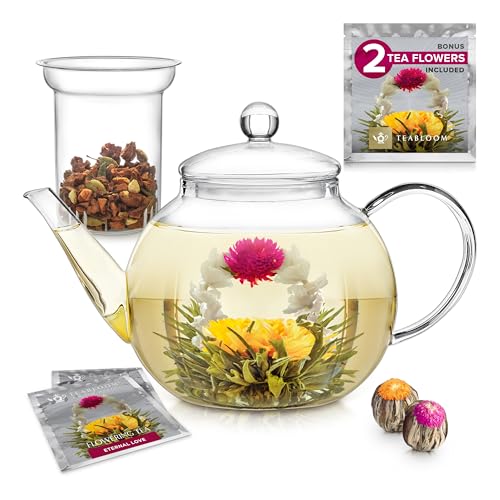
Teabloom Celebration Glass Teapot & Kettle 27 oz with Infuser — Best New Blooming Tea Edition
Teabloom’s Celebration is the blooming-tea specialist’s newer, more intimate edition: a 27 oz glass teapot and kettle with a removable glass infuser and two blooming teas included, stovetop and microwave safe per its verified listing. Where the brand’s 40 oz classic is a table centerpiece, the Celebration sizes the performance for two — a dinner’s end, an anniversary breakfast, a gift that becomes a ritual for a couple rather than a crowd.
The all-glass construction remains the point: pot, infuser and bloom in one uninterrupted view, with heat-resistant glass doing the quiet work. Including the first two blooming teas in the box is a small decision with an outsized effect — the pot performs on the day it is given, which is exactly when a gift needs to perform.
Strengths
- The blooming-tea ritual at a two-person, gift-ready scale
- All-glass view with the first performances included in the box
- Stovetop and microwave ratings add reheating flexibility
Trade-offs
- Glass infuser passes fines from broken teas
- 27 oz is a couples’ pot, not a party pot
- Glass remains the fragile material in any roundup
Key specs (from the verified listing)
- Capacity: 27 oz, per the verified listing
- Material: heat-resistant glass; stovetop and microwave safe per the listing
- Infuser: removable glass infuser
- Included: 2 blooming teas
The glass infuser’s known limit applies here as it does to its larger sibling: it suits whole leaves and blooming teas and will pass fines from broken teas, so this is a specialist’s pot rather than a household’s only pot. At 27 oz it is also honestly sized — measure your occasions in couples and small tables, and it fits; measure them in dinner parties, and the larger Teabloom remains the right tool.
Choose the Celebration if blooming tea is your love language or your gift problem. It is the most presentable object in this guide, engineered to be given.
Best for: Gift-givers and blooming tea hosts who brew smaller / Not suited for: Households needing one pot for every tea including fine-cut blends
Check on Amazon — check price on Amazon before ordering, and confirm the exact model name on the listing matches the name above.

London Pottery Bone China Teapot Set, Tea for One (Fox) — Best New Tea for One
The newest idea in this guide is also one of the oldest courtesies: a proper tea for one. London Pottery’s bone china set — a teapot, cup and saucer in an animal pattern, the fox in this listing, per its verified description — brews a single serving as a complete ceremony rather than a mug of compromise. The pot serves its own cup; the saucer catches the moment; the solo drinker is treated as a guest in their own kitchen.
Bone china is the connoisseur’s ceramic for reasons beyond delicacy: it is the strongest of the fine ceramics, translucent at the rim, and it pours a cup that feels like an occasion. A heritage pottery offering it in a playful animal pattern is a very current design decision — formality and whimsy in the same object, aimed at the desk, the reading chair and the gift table simultaneously.
Strengths
- A complete solo ceremony in one matched, stackable set
- Bone china is fine, strong and translucent — the premium ceramic
- Brews one serving at full quality instead of a big pot at quarter volume
Trade-offs
- One serving is the entire capacity — guests are not an option
- Bone china wants gentle handling and hand-washing manners
- A patterned set is a taste commitment a plain pot is not
Key specs (from the verified listing)
- Set: teapot, cup and saucer, per the verified listing
- Material: bone china
- Format: afternoon tea for one
- Listing pattern: fox (animal pattern series)
Practicality hides inside the charm. A tea-for-one set is one system to warm, wash and store; it brews a single serving at full quality instead of a family pot at quarter volume; and it makes the solo ritual self-limiting in the pleasantest way — one pot, brewed properly, finished while it is perfect. What it will not do is serve a second person, and it makes no apology for that.
Choose the tea for one if your tea life is a daily solo ceremony and you are done apologizing for it with a mug. It is the pick in this guide most likely to be given as a gift and most likely to be kept.
Best for: Solo drinkers who want the ritual kept whole / Not suited for: Anyone brewing for two or more
Check on Amazon — check price on Amazon before ordering, and confirm the exact model name on the listing matches the name above.

HOHCNA Yixing Zisha Teapot, 10 oz Handmade Purple Clay Kung Fu Tea Pot — Best First Yixing Clay Pot
The HOHCNA is the accessible door into the Yixing movement: a 10 oz handmade purple clay kung fu teapot, authentic unglazed zisha with engraved calligraphy, per its verified listing. Ten ounces is the classic gongfu scale — a pot for one devoted drinker or two sharing small cups across many infusions — and purple clay is the tradition’s most storied material, the zisha against which other clays are described.
Handmade and engraved are claims this category makes often, and the honest way to hold them is as the maker’s stated description, which is how this guide reports them. What can be said without reservation is the format’s fitness for its purpose: an unglazed clay pot at gongfu size, intended for the high-leaf, many-infusion brewing that develops both the tea and, over months, the pot itself.
Strengths
- Genuine unglazed zisha at the classic gongfu scale
- The pot seasons with use, deepening one tea family’s flavor over time
- Engraved calligraphy gives the object a meditative presence
Trade-offs
- One pot, one tea family — the clay keeps score permanently
- Small capacity is a method, and baffles big-pot drinkers
- Unglazed clay: water-only cleaning, full drying, no exceptions
Key specs (from the verified listing)
- Capacity: 10 oz, per the verified listing
- Material: Yixing zisha purple clay, unglazed
- Style: handmade kung fu teapot with engraved calligraphy
Buying it means accepting the tradition’s one rule — this pot belongs to one family of tea from its first steeping, because the clay absorbs and returns flavor. For the drinker whose shelf has a house oolong or a daily black, that rule is not a restriction but a relationship: the pot improves at its one job the way a seasoned pan does. Rotators should take a glazed pick from this guide instead, without regret.
Choose the HOHCNA if you have a signature tea and a curiosity about why clay drinkers speak about their pots the way musicians speak about instruments. It is the beginner’s Yixing, priced and sized for a first commitment.
Best for: Single-tea drinkers ready to start the clay tradition / Not suited for: Drinkers who rotate many different teas in one pot
Check on Amazon — check price on Amazon before ordering, and confirm the exact model name on the listing matches the name above.

XUANTGY Yixing Clay Teapot, 14 oz, Zini Clay, Black — Best Larger Yixing for Sharing
Most Yixing pots are solo instruments; this XUANTGY listing is the clay tradition at a shareable scale: a 14 oz handmade zini clay teapot — described by its maker as large capacity for the style — in black, with a tea towel included, per its verified listing. Fourteen ounces of gongfu brewing serves two or three drinkers across the rounds, which is how the method is often actually enjoyed: socially, in small cups, over an unhurried sequence.
Zini is the purple-brown clay family at the tradition’s heart, and the black finish here gives the pot a contemporary gravity the earthier clays do not attempt. The included tea towel is a knowing touch — clay pots are wiped, polished and dried as part of their care, and the maker’s inclusion of the tool signals an audience that understands the ritual it is buying into.
Strengths
- A shareable gongfu size — rare in a solo-scaled tradition
- Zini clay seasons beautifully with a dedicated tea
- Tea towel included: the maker understands the care ritual
Trade-offs
- Still one-tea dedication, at a size that tempts sharing different teas — resist
- 14 oz is large for gongfu and small for Western pots; know which you want
- Clay care rules are absolute: no soap, full drying
Key specs (from the verified listing)
- Capacity: 14 oz, per the verified listing
- Material: Yixing zini clay, handmade
- Listing finish: black
- Included: tea towel
The same clay rules apply at this size: dedicate the pot to one tea family, clean with water only, dry it fully and openly between sessions. The larger capacity softens none of that — if anything, a shared pot accumulates its seasoning faster, because it brews more tea for more people, and its character develops in company.
Choose the XUANTGY if the gongfu method appeals but the solo scale does not. It is the social version of the clay idea, and the pick most likely to convert a household rather than a single drinker.
Best for: Gongfu drinkers who brew for two or three / Not suited for: Tea rotators or anyone wanting a litre-class pot
Check on Amazon — check price on Amazon before ordering, and confirm the exact model name on the listing matches the name above.

Handmade Yixing Zisha Teapot, Wrinkled Zhu Clay Xi Pot, 150cc — Best Collector’s Small Clay Pot
The smallest pot in this guide is the most specialized: a handmade Yixing zisha pot in wrinkled Zhu clay, 150cc — about 5 oz — with a 9-hole outlet and an inner push spout, per its verified listing, which describes it as the work of a nationally graded craftsman. Zhu clay, the red side of the zisha family, is prized for the way it polishes with handling, and the wrinkled surface makes this pot as much an object for the hand as for the tea tray.
The 9-hole outlet is the detail that separates craft from souvenir at this scale: a multi-hole clay filter wall pours fast and clean for gongfu’s quick infusions, where a single hole clogs and a slow pour over-steeps the round. At 150cc the pot is a precision instrument for one drinker’s finest leaves — the teas you weigh, time and talk about.
Strengths
- Zhu clay polishes with handling — the pot improves in the hand as well as the cup
- 9-hole outlet pours at gongfu speed without clogging
- A true collector’s format from the tradition’s expressive end
Trade-offs
- 150cc is one devoted drinker’s ritual, nothing more
- Demands gongfu technique and one-tea dedication from day one
- Craft claims are the maker’s own; buy it for the verifiable clay, size and construction
Key specs (from the verified listing)
- Capacity: 150cc, per the verified listing
- Material: Yixing zisha, wrinkled Zhu clay
- Outlet: 9-hole filter with inner push spout
- Maker description: handmade, nationally graded craftsman (maker’s statement)
Hold its claims the way this guide holds all of them: the craftsmanship description is the maker’s, reported as stated, and the pot’s verifiable facts — clay, size, outlet, construction — are the ones in its listing. What experience adds is context: pots of this size and clay are bought by drinkers who already brew gongfu and want the ritual’s expressive end, not by beginners, who will be better served learning on the HOHCNA.
Choose the wrinkled Zhu clay pot if your tea shelf has a top shelf. It is the collector’s pick of this roundup — small, serious, and made to be handled as much as used.
Best for: Experienced gongfu drinkers who collect the craft / Not suited for: Beginners, big-pot drinkers, or anyone’s only teapot
Check on Amazon — check price on Amazon before ordering, and confirm the exact model name on the listing matches the name above.
Comparison Table
| Pick | Badge | Key spec | Best for |
|---|---|---|---|
| London Pottery Farmhouse 4 Cup Ceramic Teapot with Infuser, 40.6 oz, Yellow | Best New Heritage Format | 4 cup / 40.6 oz ceramic, removable stainless fine mesh infuser | Farmhouse fans who outgrew the two-cup size |
| Teabloom Celebration Glass Teapot & Kettle 27 oz with Infuser | Best New Blooming Tea Edition | 27 oz glass, glass infuser, 2 blooming teas included, stovetop and microwave safe per listing | Gift-givers and blooming tea hosts who brew smaller |
| London Pottery Bone China Teapot Set, Tea for One (Fox) | Best New Tea for One | Bone china teapot, cup and saucer set for one; fox pattern | Solo drinkers who want the ritual kept whole |
| HOHCNA Yixing Zisha Teapot, 10 oz Handmade Purple Clay Kung Fu Tea Pot | Best First Yixing Clay Pot | 10 oz handmade purple zisha clay, unglazed, gongfu format | Single-tea drinkers ready to start the clay tradition |
| XUANTGY Yixing Clay Teapot, 14 oz, Zini Clay, Black | Best Larger Yixing for Sharing | 14 oz handmade zini clay, black, tea towel included | Gongfu drinkers who brew for two or three |
| Handmade Yixing Zisha Teapot, Wrinkled Zhu Clay Xi Pot, 150cc | Best Collector’s Small Clay Pot | 150cc wrinkled Zhu clay, 9-hole outlet, inner push spout | Experienced gongfu drinkers who collect the craft |
How to Choose a New Teapot: What ‘New’ Should Actually Mean
Treat ‘new’ as a claim that needs evidence, because in teaware it is printed on listings for designs older than their buyers. A genuinely new model changes something checkable: a capacity the maker did not offer before, a format like the tea-for-one stack, a finish produced by a current technique, or a traditional product — Yixing clay is the clearest case here — reaching this market in a form that was not previously available with this clarity. The picks in this guide were screened for exactly those kinds of differences, and the reviews name the difference for each pot rather than asking you to trust an adjective.
The useful question is not ‘is it new?’ but ‘what does its newness do for my brewing?’ The current answers in teaware are consistent. Sizes are migrating from teacup arithmetic toward real servings — the 4-cup farmhouse and the 14 oz clay pot both acknowledge how people actually drink. Infusers are getting finer, because modern tea shelves hold more broken and flavored leaf than the whole-leaf world older strainers were drilled for. And small-pot traditions are having a genuine moment, as solo drinkers discover that a 10 oz pot brewed three times beats a litre brewed once.
Use novelty as a tiebreaker, never as the foundation. The foundation remains the one every guide in this series uses: a real infuser or a real clay tradition, an honestly stated capacity, a maker whose listing deals in specifics, and a size matched to your actual servings. A new pot that clears those bars is worth its freshness; a new pot that does not is a press release with a spout.
- Judge ‘new’ by changed specifics — capacity, format, finish — not by a date in the title
- Yixing clay means one pot per tea family; glazed and glass pots stay flexible
- Gongfu sizes are small on purpose: many short infusions, high leaf ratio
- Tea-for-one sets are real solo systems, not only gifts
- New models earn their place by fitting current habits — mug sizes, finer infusers
The Yixing Question: Why Three of the Newest Pots Are Clay
The most interesting movement in new teaware is not a gadget but an arrival: Yixing zisha clay pots, long traded through specialist channels, now appear in mainstream listings with their clay types, capacities and construction named. Three picks in this guide come from that movement, at three scales of commitment — a 10 oz handmade purple clay pot, a 14 oz larger-capacity zini pot, and a small 150cc wrinkled Zhu clay pot with a 9-hole outlet — because the movement is not one product but a category learning to introduce itself.
The clay’s appeal is physical. Unglazed zisha is porous at a microscopic level: it absorbs a trace of every infusion and returns it as depth in later ones, softening a tea’s edges across a season of use. That is why the tradition insists on one pot for one family of tea — the pot literally becomes a record of what it has brewed. It is also why these pots are small and brewed gongfu-style, with generous leaf and repeated short infusions: the method and the material evolved together.
Enter at the level that matches your habits. A single-tea daily drinker can start with the HOHCNA and be happy for years. A household that wants to share gongfu sessions should take the larger XUANTGY. The handmade wrinkled pot is for the drinker who already knows the ritual and wants the object at its most expressive. What none of them suits is the six-tea rotator — for that drinker, the glazed and glass picks in this same guide are the honest recommendation.
How to Brew in a New Teapot: First Pots and Gongfu Basics
A new pot deserves a deliberate first day. Glazed ceramic, porcelain and glass need only a thorough rinse and a warm-up brew you discard — call it a rinse steep — to clear any dust of manufacture and travel. Unglazed Yixing clay gets the traditional preparation described in the FAQ: rinse well, steep it in the tea it will be dedicated to, and let it dry fully before its first working session.
For gongfu brewing in the clay pots, the rhythm is: warm the pot, add a generous measure of leaf — more than a Western steeping, often filling a third of the small pot — rinse the leaves with a flash of hot water and pour it away, then steep in short rounds, lengthening each infusion slightly as the leaves open. Pour every round completely out, into cups or a fairness pitcher, so the leaves rest between rounds instead of stewing.
- Rinse any new pot thoroughly; brew and discard one warm-up steep before the first real pot
- For Yixing clay, steep the pot in its dedicated tea first and let it dry completely
- Gongfu method: warm the pot, add generous leaf, flash-rinse the leaves and discard
- Steep in short rounds, pouring out completely each time, lengthening later rounds slightly
- Western method in glazed pots: dose, pour at temperature, time it, lift the infuser
- Let clay pots air dry fully between sessions; never use soap on unglazed clay
Keeping New Teapots New: Care by Material
The care rules split cleanly by material, and following the right set is what keeps a new pot looking and brewing new. Glazed ceramic, porcelain and bone china wash like the tableware they are — warm water, a soft sponge, soap when needed — and ask only for protection from knocks and thermal shock. Glass adds descaling to its routine in hard-water homes, a citric soak whenever a film dulls the view.
Unglazed clay lives by opposite rules: water only, never soap, never detergent, and a full air dry with the lid off between sessions so the clay stays fresh. Wipe the outside with a tea cloth if you enjoy the slow polish the tradition calls raising the pot — over months, a well-kept zisha pot develops a soft luster that no glaze imitates. Store clay pots individually rather than stacked; their rims and spouts are the thinnest clay in the house and deserve the courtesy.
New Teapots and Sustainability: Buying the Current Model Well
There is an unfashionable truth inside any ‘new models’ guide: the most sustainable teapot is usually the one already in your kitchen, and a new pot should have to argue its way past it. The arguments that succeed are functional, not cosmetic — a size that finally matches your household, an infuser fine enough for the teas you now drink, a clay pot that begins a practice you have genuinely committed to, or a tea-for-one set that replaces a wasteful habit of brewing big and drinking small. If the current model in your cupboard fails none of those tests, the newest listing in this guide is a pleasure to read about and a purchase to postpone.
When a new pot does earn its place, buy it as a decade object. The makers in this roundup — a heritage pottery, a presentation-tea specialist, and clay workshops working in a centuries-old material — build for keeping, and the care sections of this guide are written to that horizon. A pot bought for ten years of mornings justifies its tier in a way no seasonal novelty can, and it will end its first year already looking less like a purchase and more like a habit.
What to Brew First in Each New Pot
First brews should flatter the pot and teach the drinker, so match them deliberately. The big farmhouse wants a robust breakfast blend brewed full — its moment is a table, a morning and a second round. The Celebration wants its included blooming tea and an audience of exactly the right size: two people and nowhere to be. The tea-for-one wants your favorite daily leaf, because its whole purpose is to dignify the ordinary day rather than wait for an occasion.
The clay pots want patience and their chosen tea. Give the HOHCNA and the XUANTGY their dedicated family from the first steeping and keep the rounds short and numerous, tasting how the same leaves change across an afternoon. Give the little Zhu clay pot the best leaves you own — it was built for them, and a first session with a great oolong in a 150cc pot is the fastest way to understand why this tradition has survived every fashion that was supposed to replace it. First impressions in teaware are not superficial; they are how a pot earns its place in the week’s rhythm.
When to Skip the New Model and Buy the Classic Instead
Honesty about newness includes its limits, and there are buyers this guide happily sends elsewhere in the series. If you want the widest infuser education and the most forgiving all-rounders, the loose leaf guide’s glass and porcelain standards remain the sensible first pots. If your taste is settled and traditional — a brown betty silhouette, a family porcelain service — a current model will not improve your mornings, and novelty is a tax on a ritual that was already working. New is a lens, not a ranking, and the classic guides exist because classics keep winning most kitchens most of the time.
Buy new when the change is real for you: the size that finally fits, the clay tradition you are ready to commit to, the solo set that dignifies a daily ceremony, the edition that turns a favorite ritual into an occasion. Bought for those reasons, a new teapot is not a fashion purchase at all — it is the current best answer to an old and permanent question, which is the only kind of new worth paying for.
One Last Check Before You Order a New Model
Before any order, run the listing itself through the same screen this guide used: the maker’s name spelled consistently, the capacity stated in numbers rather than adjectives, the material named precisely — zisha, bone china, borosilicate — and the infuser or filtration described rather than implied. A listing that passes those four checks is a product; one that fails them is a photograph with a price. The minute that check takes is the difference between buying the current state of the teaware art and buying its marketing.
Common Buying Mistakes
New-pot enthusiasm has predictable pitfalls:
- Believing a ‘new model’ headline with no changed detail behind it
- Buying an unglazed Yixing pot to rotate six different teas through — clay keeps score
- Washing unglazed clay with soap or detergent, ever
- Judging gongfu pots as ‘too small’ without understanding the many-infusion method
- Letting a clay pot dry sealed with its lid on, so it musts between sessions
- Paying a novelty premium for a shape whose infuser cannot handle your actual tea
Final Recommendation
Choose by the kind of newness you want. For a heritage maker in a new, bigger format, take the London Pottery Farmhouse 4 Cup. For the newest blooming-tea presentation, take the Teabloom Celebration, and for solo drinkers ready to make a ritual of it, the London Pottery Tea for One. The three Yixing picks split by ambition: the HOHCNA for a first clay pot, the XUANTGY for clay at a shareable size, and the handmade Wrinkled Zhu Clay pot for the collector’s shelf.
Whichever arrives, brew it the day it comes and judge it by the cup, not the unboxing. New earns its place in a kitchen by being used until it is not new anymore. Check price on Amazon for the pick that fits your ritual, verify the exact model and capacity on the listing, and start the first of many infusions.
Keep reading in this series: Best Teapots Best Loose Leaf Teapots Best Modern Teapots Best Japanese Teapots Best Ceramic Teapots.
Frequently Asked Questions
How can I tell if a ‘new’ teapot is genuinely new or just relisted?
Look for specifics that change between generations: a new capacity in a maker’s range, a new finish or format, a model name or identifier that did not exist in the maker’s older line. Vague listings that call a long-running design ‘new 2026 model’ without any changed detail are marketing, not news — the picks in this guide were screened for concrete, checkable differences.
Are Yixing clay teapots hard for beginners?
They ask for one commitment: dedicate the pot to a single family of tea, because the unglazed clay absorbs flavor and gives it back. Within that rule they are forgiving and rewarding, brewing small, concentrated infusions. A beginner who drinks one tea style daily is actually the ideal Yixing owner; a beginner who rotates six teas should start with glazed or glass.
What size are gongfu teapots, and why so small?
The Yixing picks here run from about 6 to 14 oz — deliberately small. Gongfu brewing uses a high leaf-to-water ratio and many short infusions, so a small pot produces a sequence of intense cups rather than one large mild one. It is a different drinking rhythm, closer to espresso culture than to the family pot, and the small size is the method, not a limitation.
Is a tea-for-one set practical or just a gift item?
Both, honestly. A teapot that stacks and brews directly into its own cup is a genuinely efficient solo system — one vessel to warm, wash and store — and the presentation makes it the most giftable format in teaware. The London Pottery set in this guide works as a daily desk ritual that happens to arrive in a gift-ready form.
Should I season a new Yixing teapot before using it?
A simple preparation is traditional: rinse thoroughly, then simmer or steep the pot in the tea you intend to dedicate it to, and let it dry completely. Elaborate rituals exist, but the essential acts are cleanliness and dedication to one tea family. Never use soap on unglazed clay, before or after seasoning.
Do newer teapots brew better than classic designs?
Not automatically — the physics of steeping has not changed. What newer models offer is better fit for current habits: sizes matched to mugs rather than teacups, infusers fine enough for modern broken-leaf teas, and traditions like Yixing becoming available with verified provenance. New is a reason to look, not a guarantee of better tea.


