Disclosure: airfryerkitchensupply.com is reader-supported. When you buy through links on our site, we may earn an affiliate commission at no extra cost to you.
Where to buy
The best brushes for cleaning grills are consumables with short model cycles, so each pick below links to its current Amazon listing — check the current price on Amazon there, and confirm the brush type matches your grate material before ordering, because the wrong brush on the wrong grate is how coatings get ruined. If your current brush is a wire-bristle model with any loose or missing bristles, replace it today rather than after this guide; that advice outranks every pick on the page.
- Grill Rescue Bristle Free Grill Brush with Scraper (Best Overall) — Check the current price on Amazon
- Scrub Daddy BBQ Daddy Grill Brush (Best Steam Scrubber Hybrid) — Check the current price on Amazon
- Grillaholics Brass Grill Brush (Best for Porcelain and Ceramic Grates) — Check the current price on Amazon
- Kona Safe/Clean Bristle-Free Grill Brush (Best Bristle-Free Scrubber) — Check the current price on Amazon
- OXO Outdoor Nylon Grill Brush for Cold Cleaning (Best for Cold Cleaning) — Check the current price on Amazon
- Char-Broil Safer Replaceable Head Nylon Bristle Grill Brush (Cool Clean) (Best Replaceable-Head System) — Check the current price on Amazon
Choosing the best brushes for cleaning grills matters more than the price of the tool suggests, because the grill brush is the one accessory that touches every meal you cook. A good brush keeps grates seasoned and food releasing cleanly; a bad one either fails to clean, damages the grate’s surface, or — in the case of worn wire-bristle brushes — sheds bristles that can end up in food, a hazard serious enough that it has reshaped the entire category. Four of the six picks in this guide are bristle-free or alternative-bristle designs, and that proportion reflects where the market’s centre of gravity now sits.
The category divides by method. Steam cleaners soften residue with water and heat and scrub it away without bristles. Coil and woven designs scrub mechanically with a continuous wire form that cannot shed a bristle. Nylon brushes clean cold grates safely, including coated ones. And traditional bristle brushes survive in one defensible form — soft brass, used gently on porcelain and ceramic grates, inspected often, and retired early. This guide covers the best current example of each method, all verified against their manufacturers’ Amazon listings.
It also covers the part of grill cleaning that is not about the brush at all: when to clean, how heat does most of the work, and the inspection habits that keep any brush — of any design — from becoming a problem. The best brush is the one matched to your grate and used on a rhythm; this guide sorts both halves of that sentence.
In this guide
Quick Picks
Six brushes across the four cleaning methods that matter, led by the steam and bristle-free designs most buyers should now default to.
Grill Rescue Bristle Free Grill Brush with Scraper — Best Overall. The steam method in its best-known form: a bristle-free head you soak in water and run over hot grates, letting steam lift the residue, with a scraper for the stubborn corners — safe on cast iron, stainless, and porcelain alike. Check price on Amazon
Scrub Daddy BBQ Daddy Grill Brush — Best Steam Scrubber Hybrid. A bristle-free hybrid: a temperature-responsive scrub head that firms up in cold water and softens as it works, backed by a steel scraper for the heavy deposits — scrub and scrape in one handle. Check price on Amazon
Grillaholics Brass Grill Brush — Best for Porcelain and Ceramic Grates. The traditional brush, in its safest specification: soft brass bristles that clean porcelain and ceramic grates without scratching them — for owners who prefer bristles and will inspect and retire the brush properly. Check price on Amazon
Kona Safe/Clean Bristle-Free Grill Brush — Best Bristle-Free Scrubber. The mechanical alternative: a bristle-free stainless design that scrubs with a continuous woven form rather than individual bristles — the cleaning action of a wire brush with nothing to shed. Check price on Amazon
OXO Outdoor Nylon Grill Brush for Cold Cleaning — Best for Cold Cleaning. The cold-cleaning specialist: nylon bristles designed to be used on cold grates, so the clean-up can happen before the cook, the morning after, or whenever the grill is stone cold — the schedule steam tools cannot serve. It is the pick that rescues the most real-world dinners in this roundup, because the forgotten clean-up is a more common event than any cooking emergency. Check price on Amazon
Char-Broil Safer Replaceable Head Nylon Bristle Grill Brush (Cool Clean) — Best Replaceable-Head System. A system rather than a brush: nylon bristles in a head designed to be replaced when it wears, with Cool Clean technology for cold-grate cleaning — the handle is the purchase, the heads are the consumable. Check price on Amazon
If you read nothing else: owners of porcelain or coated grates should choose from the steam, nylon, and brass picks; owners of bare cast iron or stainless can use any pick here, with the bristle-free designs still the prudent default. Everyone should retire worn wire brushes on sight.
How These Picks Were Chosen
Picks were chosen by method first, because method determines both safety and grate compatibility. The roundup had to include the leading steam design, a steam-scrub hybrid, the leading bristle-free coil design, a cold-cleaning nylon brush, a replaceable-head nylon system, and one traditional bristle brush in its safest form — soft brass — for the porcelain-grate owners who still prefer bristles and will maintain them properly.
Safety screening came before performance. No steel-bristle brush was included, because the category’s known hazard — a shed bristle adhering to a grate and then to food — is worst with stiff steel bristles on worn brushes, and because every cooking job a steel brush does is now done as well by one of the other methods here. The brass pick survived screening on conditions the review states plainly: soft bristles, gentle use, frequent inspection, early retirement.
There is also a deliberate omission to record: no wooden-handled novelty brushes, no drill-attachment scrubbers, and no cleaning stones were included, not because none can work, but because the six methods covered here answer every grate and every schedule with verified products, and a guide that tries to include everything ends up vouching for things it did not examine. The stone and the drill brush have their devotees; they did not have verified listings in this programme’s research, so they do not have this guide’s recommendation.
Finally, every pick had to be a current, verifiable product with a live manufacturer listing, which this programme confirmed cache for the Grills group. Brush models churn quickly, and a guide recommending a discontinued brush helps no one; specifications quoted are from the verified listing titles.
The 6 Best Brushes for Cleaning Grills

Grill Rescue Bristle Free Grill Brush with Scraper — Best Overall
Grill Rescue built its name on a simple substitution: water and heat instead of bristles. The cleaning head is soaked, then drawn across hot grates, where the water flashes to steam inside the residue and loosens it, and the pad scrubs it away; a scraper edge handles the carbonised corners the pad cannot shift. Because there are no bristles, there is nothing to shed, and because the working surface is a pad rather than wire, the listing rates it for cast iron, stainless steel, and porcelain — the full range of grate materials in one tool.
Strengths
- Steam cleaning lifts residue that dry scrubbing smears around
- Bristle-free by design — nothing to shed into food
- Rated for cast iron, stainless, and porcelain grates
Trade-offs
- Works on hot grates — it is a cook-time tool, not a cold-storage cleaner
- The head is a consumable that needs replacing as it wears and hardens
- Very heavy carbon build-up still wants a pre-burn before the pad can finish
| Method | Steam cleaning, bristle-free |
| Extras | Built-in scraper |
| Grate compatibility | Cast iron, stainless steel, porcelain |
| Design | Soakable cleaning head |
The technique matters and is quickly learned: burn off the worst residue at high heat for a few minutes, soak the head, then work the grates in sections with the steam doing the persuading. What surprises new users is how clean the result is — steam reaches the underside edges and the corners between bars that bristles skate over — and how the method preserves grate seasoning, because you are lifting residue rather than scouring the surface back to bare metal. Porcelain owners in particular gain: the coating that bristle brushes endanger is entirely safe here.
Keep a replacement head in the drawer. The design’s one honest cost is that its working surface wears, and a worn head steams weakly and tempts its owner to press harder, which helps nothing. Treated as the consumable it is, the system is the most complete answer this category currently offers.
Best for: most grill owners — the default recommendation across grate types / Not suited for: cooks who clean only cold, days later, and never at cook time
Check the current price on Amazon
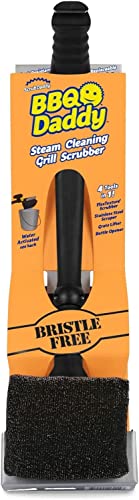
Scrub Daddy BBQ Daddy Grill Brush — Best Steam Scrubber Hybrid
The BBQ Daddy takes the steam-scrub idea and adds materials science. Its scrub material changes stiffness with temperature — firm when cold for aggressive work, more pliable as it heats — which the maker calls temperature-controlled scrubbing, and it pairs the head with a steel scraper for the deposits that no pad will shift. The result is the most versatile single tool in this roundup for grills that see heavy, saucy cooking: ribs, glazed chicken, and the caramelised residue they leave behind.
Strengths
- Temperature-responsive head adapts from firm scrub to gentler work
- Integrated steel scraper handles carbon the pad cannot
- Bristle-free design, safe across grate materials
Trade-offs
- The clever head is again a consumable with a service life
- Scraper demands care on coated grates — use it on bars, not across delicate finishes
- Larger head can be awkward between widely spaced bars on some grates
| Method | Steam scrub, bristle-free |
| Head | Temperature-controlled scrub material |
| Extras | Steel grill scraper |
| Design | Scrub brush + scraper combination |
Where the BBQ Daddy earns its badge is the mixed workload. Most grill cleaning is two jobs — the broad residue field and the few welded spots — and most tools do one of them. The scrub head handles the field with steam; the scraper, used deliberately and flat, lifts the welded spots without the frantic sawing that damages grates. Owners of hard-working grills, the ones that cook four nights a week, feel that completeness every session.
As with all pad systems, head replacement is the running cost, and the honest comparison is against the price of the bristle brushes it replaces — which also wore out, less safely. Budget the head as a per-season consumable and the economics are unremarkable; the safety and the clean are the story.
Best for: heavy-use grills and saucy cooking that leaves serious residue / Not suited for: minimalists who want one simple tool with no consumable parts
Check the current price on Amazon

Grillaholics Brass Grill Brush — Best for Porcelain and Ceramic Grates
This is the one bristle brush in the guide, included deliberately and with its conditions stated. Brass bristles are softer than the porcelain and ceramic coatings they are made for, so they scrub residue without scoring the surface the way steel does — the listing specifies the brush for porcelain and ceramic grates — and brass’s softness also means a stray bristle is a lesser hazard than a steel one, though the correct standard remains zero tolerance: inspect before use, and retire the brush at the first sign of loose, bent-flat, or missing bristles.
Strengths
- Soft brass bristles clean coated grates without scratching them
- Familiar brush action for owners who prefer the traditional tool
- Heavy-duty build for a bristle brush
Trade-offs
- It is still a bristle brush — inspection discipline is part of the price
- Brass wears faster than steel; expect a shorter service life
- Not the choice for aggressive carbon removal on bare grates
| Bristles | Soft brass bristles |
| Intended grates | Porcelain and ceramic grates |
| Method | Traditional bristle scrub |
| Build | Heavy-duty |
Used as intended — on warm grates, with moderate pressure, in the direction of the bars — the Grillaholics brush does the classic job well: it sweeps the grate crowns clean, knocks residue into the firebox, and leaves coated surfaces unmarked, ready for the light oil wipe that keeps food releasing. Its constituency is real: many experienced cooks simply work better with a brush’s feedback than with a pad, and for porcelain owners this is the bristle specification that respects the coating.
The discipline is non-negotiable and worth repeating as the pick’s verdict: store it where its bristles cannot be crushed, run a hand or a cloth over the grates after brushing to catch anything shed, and replace it early and without sentimentality. A brass brush is inexpensive; the inspection habit is the actual product, and owners unwilling to keep it should choose the bristle-free picks above.
Best for: porcelain and ceramic grate owners who prefer bristles and will inspect them / Not suited for: anyone who will not inspect a brush before every use — choose bristle-free
Check the current price on Amazon

Kona Safe/Clean Bristle-Free Grill Brush — Best Bristle-Free Scrubber
Kona’s answer to the bristle problem keeps the scrubbing feel of a wire brush and removes the wire brush’s failure mode. Instead of hundreds of individual bristles crimped into a head — each one a potential shed — the cleaning surface is a continuous stainless form, so there is no bristle to lose. For cooks who found pads unsatisfying and want metal-on-metal scrubbing with a safety story they can explain to their family, this is the design that resolves the argument.
Strengths
- Continuous stainless cleaning surface — no bristles to shed
- Mechanical scrubbing action closest to a traditional wire brush
- Durable construction with no consumable head
Trade-offs
- Metal scrubbing wants a lighter hand on coated grates
- Less effective on cold, hardened residue than steam methods
- Technique matters: work with the bars, not across them
| Design | Bristle-free stainless steel |
| Method | Mechanical scrub |
| Intended use | Outdoor grill grates |
| Consumables | None — fixed cleaning head |
In use, the Kona rewards the same rhythm as a classic brush — clean hot, immediately after cooking or during the next preheat, with strokes along the bars — and it cleans to a standard that satisfies cooks who distrust pads on principle. Its durability is the economic argument: with no head to replace and no bristles to flatten, the tool’s service life is measured in years, and its performance in year three resembles its performance in week three more closely than any bristle brush can claim.
Match it to the grate honestly. On bare stainless and cast iron it is close to ideal. On porcelain, it is usable with a gentle hand, but the steam and nylon picks respect the coating more completely, and this guide’s comparison table says so rather than pretending one tool wins everywhere.
Best for: cast iron and stainless grate owners who want wire-brush action without bristles / Not suited for: delicate coated grates that deserve steam or nylon instead
Check the current price on Amazon

OXO Outdoor Nylon Grill Brush for Cold Cleaning — Best for Cold Cleaning
Every other method in this guide assumes a hot grill, and real life includes the other case: the grill that was not cleaned last night, discovered at the moment guests arrive or the moment you want breakfast. OXO’s nylon brush is built for that case — nylon bristles stiff enough to scrub, specified for cold cleaning so the bristles are never melted against a hot grate. From OXO’s kitchen-tool design stable, it brings the brand’s ergonomic habits to a category that rarely thinks about handles.
Strengths
- Designed for cold grates — cleans on any schedule
- Nylon is safe for coated and porcelain surfaces
- OXO ergonomics: a handle designed to be used with pressure
Trade-offs
- Cold residue is harder work than hot — expect more strokes
- Never use it on a hot grill; nylon and heat do not mix
- Not a carbon remover; heavy build-up still needs a hot burn-off first
| Bristles | Nylon |
| Method | Cold cleaning |
| Intended use | Cold grill grates |
| Brand line | OXO Outdoor |
The cold brush earns its place as the second tool rather than the only one. Its best work is maintenance between cooks — the morning-after sweep that keeps residue from becoming carbon — and pre-cook preparation, where a cold scrub followed by the preheat’s burn-off leaves grates genuinely clean. Households that entertain will recognise the scenario it solves weekly: yesterday’s grill, today’s guests, no desire to light a cleaning fire before the cooking one.
Respect its one hard rule absolutely: cold means cold. Nylon against a hot grate melts, ruins the brush, and deposits material where food goes. Owners who build the habit — cold brush for cold work, steam or scrub for hot — will find the pair covers the calendar between them without either tool being asked to do the other’s job.
Best for: households that clean on their own schedule, and coated-grate owners / Not suited for: anyone tempted to use it on a hot grill — that is the steam picks’ job
Check the current price on Amazon

Char-Broil Safer Replaceable Head Nylon Bristle Grill Brush (Cool Clean) — Best Replaceable-Head System
Char-Broil’s Safer brush attacks the category’s core problem from the lifecycle end. Brushes become hazardous and ineffective as they wear; a replaceable head makes renewal cheap and obvious, so owners actually do it. The nylon head uses the maker’s Cool Clean approach — cleaning on cold grates, where nylon belongs — and when the bristles tire, the head swaps rather than the whole tool going to landfill or, worse, staying in service past its safe life.
Strengths
- Replaceable head makes renewal cheap enough to actually happen
- Nylon bristles are coating-safe and shed-risk is minimal by design
- Cold-cleaning method fits real household schedules
Trade-offs
- You are buying into a head ecosystem — keep a spare head on hand
- Cold cleaning only; hot-grate work belongs to other picks
- System value shows over years, not on the first clean
| System | Replaceable head, nylon bristles |
| Technology | Cool Clean (cold-grate cleaning) |
| Model | CB1250038P6 |
| Method | Cold scrub |
The design insight deserves credit: every safety campaign about grill brushes ultimately asks owners to replace brushes more often, and this is the product that prices that behaviour honestly. A fresh head restores the scrub, the nylon respects coated grates, and the handle — the part with the ergonomics — persists. For Char-Broil grill owners especially, whose grates and accessories come from the same catalogue, the fit is natural.
Pair it the way this guide pairs the OXO: cold system for cold work, and let heat do the heavy cleaning at cook time with a burn-off and one of the hot methods. Households that adopt that two-tool rhythm stop thinking about grill cleaning as a chore with a season; it becomes a minute attached to cooking, which is where it belongs. New owners should run the full sequence slowly the first two or three times, narrating the steps if it helps; by the fourth cook it compresses into habit, and the grill’s condition stops depending on memory at all.
Best for: owners who value a renewable system and clean cold on a schedule / Not suited for: single-tool minimalists or hot-cleaning traditionalists
Check the current price on Amazon
Comparison Table
Method and grate compatibility decide this category — find your grate in the table, then choose within its row.
| Pick | Badge | Key spec | Best for |
|---|---|---|---|
| Grill Rescue Bristle Free Grill Brush with Scraper | Best Overall | Steam, bristle-free, with scraper; all grate types | most grill owners — the default recommendation across grate types |
| Scrub Daddy BBQ Daddy Grill Brush | Best Steam Scrubber Hybrid | Temperature-controlled scrub head + steel scraper, bristle-free | heavy-use grills and saucy cooking that leaves serious residue |
| Grillaholics Brass Grill Brush | Best for Porcelain and Ceramic Grates | Soft brass bristles, for porcelain & ceramic grates | porcelain and ceramic grate owners who prefer bristles and will inspect them |
| Kona Safe/Clean Bristle-Free Grill Brush | Best Bristle-Free Scrubber | Bristle-free stainless continuous-form scrubber | cast iron and stainless grate owners who want wire-brush action without bristles |
| OXO Outdoor Nylon Grill Brush for Cold Cleaning | Best for Cold Cleaning | Nylon bristles, cold-cleaning design | households that clean on their own schedule, and coated-grate owners |
| Char-Broil Safer Replaceable Head Nylon Bristle Grill Brush (Cool Clean) | Best Replaceable-Head System | Replaceable nylon head, Cool Clean cold-cleaning system | owners who value a renewable system and clean cold on a schedule |
How to Choose a Brush for Cleaning Your Grill
Start with your grate material, because it eliminates half the shelf. Porcelain-enamelled and coated grates need gentle tools: steam pads, nylon, or soft brass used lightly. Bare cast iron and stainless grates tolerate everything here, including the mechanical scrub of the Kona. Next, choose by when you clean. Hot cleaners — the steam picks and the Kona — work at cook time and clean best; cold cleaners — the nylon picks — work whenever you remember, and clean adequately with more effort. Most households end up happiest with one of each, which is why this guide’s picks pair naturally into hot and cold couples.
Finally, decide your relationship with consumables honestly. Pad and replaceable-head systems cost a little every season and deliver consistent, safe performance in exchange. Fixed tools like the Kona cost nothing after purchase and ask for technique instead. Bristle brushes cost the least per unit and demand the most vigilance. None of these is the wrong answer; the wrong answer is buying a system whose upkeep you will not perform.
- Porcelain/coated grates: steam, nylon, or soft brass only
- Cast iron/stainless grates: any method, bristle-free preferred
- Hot cleaning is easier; cold cleaning is more convenient — many owners keep both
- Replaceable heads and pads are per-season consumables; budget them
- Any brush with loose, bent, or missing bristles is retired today, whatever its type
One more selection factor hides in plain sight: handle length and grip. You clean a hot grill at arm’s length, often one-handed while the other hand holds a tray or a lid. A brush that balances well and keeps your knuckles off the grate will be used properly; an awkward one will be used rarely and badly. The same logic applies to where the brush lives: hung beside the grill it joins the cooking routine, while buried in a garage drawer it joins the list of good intentions. If you can handle the tool before buying, do — and if you cannot, favour the designs in this guide whose ergonomics are their makers’ reputations — this category is unusually tactile.
The Wire Bristle Problem, Stated Plainly
Traditional grill brushes carry hundreds of thin wire bristles crimped into a block. With wear, bristles loosen; a detached bristle can cling to a grate, transfer to food, and be swallowed, where a stiff wire fragment can injure the throat or digestive tract — a rare but well-documented harm that has drawn warnings from medical and consumer-safety bodies. The risk concentrates in old, worn, cheap steel-bristle brushes used without inspection, which describes a large share of the brushes hanging beside the world’s grills.
The proportionate response is the one this guide is built on. Default to bristle-free or alternative designs — steam, coil-form, nylon — which now clean as well as bristles ever did. If you keep a bristle brush, let it be soft brass on the grates it suits, inspect it before every use, wipe the grates with a cloth or foil after brushing to catch anything shed, and retire it at the first sign of wear rather than the last. And whatever you use, the post-brush wipe is a habit worth adopting universally: it takes ten seconds and closes the risk almost entirely.
Beyond the Brush: The Rest of the Cleaning Kit
A brush is the headline tool, not the whole kit. The supporting cast is short and cheap: a dedicated scraper for the firebox and grease tray, long tongs that double as the holder for wipes and foil, a grill glove that makes hot work unhurried, and a spray bottle of water for managing flare-ups and testing grate heat. Add a stiff hand brush for ash and firebox debris on charcoal grills, and the kit is complete for under the cost of one premium brush — which is the correct proportion, because technique and heat do the heavy lifting and the tools mostly need to not get in the way.
Storage completes the system. Brushes stored loose in a drawer arrive at the grill with bent bristles and dulled pads; brushes hung by the grill, heads protected, stay ready. Steam heads should dry fully between uses to stay fresh, nylon heads should live away from the grill’s heat, and every tool should be visible enough that its wear gets noticed — a brush you see weekly is a brush whose condition you know, and condition is the safety story of this entire category.
Finally, keep the spare before you need it: a replacement head or a second brush in the drawer converts a worn tool from a temptation (‘one more cook’) into a thirty-second swap. Every safety recommendation in this guide becomes easier to follow when the replacement is already in the house.
Grate Materials and What Each One Forgives
Cast iron forgives heat and punishes neglect: it tolerates every hot method here, seasons beautifully, and rusts if left wet or stripped bare without oil. Stainless steel forgives almost everything except neglect of a different kind — it will not rust through, but baked-on residue dulls its release, and it rewards the steam methods that clean without scoring. Porcelain-enamelled grates forgive nothing mechanical: the coating that makes them release food so well chips under steel, scrapers, and drops, and once chipped, the exposed iron beneath rusts in the chip’s crater.
Match your cleaning ambition to that table and the picks sort themselves. The steam designs are the universal donors — safe everywhere, effective everywhere hot. The Kona is the bare-metal specialist. The nylon pair are the coating and cold specialists. The brass brush is the traditionalist’s bridge, safe on coatings precisely because it is softer than they are. A household with two grills of different grate types is not being extravagant with two brushes; it is being correct.
When in doubt about a grate’s material — common with inherited and second-hand grills — treat it as porcelain. The gentle methods clean bare metal adequately, while the aggressive methods damage coatings permanently; caution costs a few extra strokes, and the reverse error costs a grate.
Cleaning Rhythm: Heat Does Most of the Work
The best brush technique starts before the brush: heat. A grill run at high heat for ten to fifteen minutes after cooking — or during the next preheat — carbonises residue into the brittle ash that any tool removes easily. Brushes struggle because owners ask them to remove cold grease and sauce that heat would have converted first. Build the burn-off into the cook’s ending ritual and every pick in this guide performs a class better than its price suggests.
After brushing, finish with the grate care that keeps food releasing: while the grates are warm and clean, a light wipe of high-heat oil on a folded cloth — held in tongs, never fingers — seasons the surface. Then empty the grease tray on its own schedule, because a clean grate over a full tray is a fire postponed, not prevented. That three-part rhythm — burn, brush, oil — is the whole of professional grill hygiene, and it takes less time than reading this section did.
How to Clean Grill Grates Properly, Step by Step
The full sequence, written for the hot-cleaning methods and adaptable to cold tools by skipping the burn-off timing. It assumes a gas or charcoal grill of any grate material, with the brush matched to that material from the picks above.
- Burn off first: with the cooking done and food removed, run the grill at its highest setting with the lid closed for 10–15 minutes, until residue has carbonised to grey ash.
- Prepare the tool: soak a steam head thoroughly, or ready the scrubber or brush for your method — and put on a grill glove, because the next steps happen over a hot grate.
- Work in sections along the bars: draw the brush or pad along the direction of the grate bars with firm, even strokes, re-soaking the steam head as it dries, until each section runs clean.
- Address the welded spots: use the scraper edge flat and deliberate on carbon deposits, keeping scraper work off delicate coatings — scrape the bars of cast iron and stainless, persuade porcelain with steam alone.
- Turn attention to the underside edges: residue hides where bars meet the frame; a few angled strokes per section keep build-up from becoming next month’s smoke and flare-ups.
- Wipe down: with the grill still warm, pass a folded, damp cloth or a ball of foil held in tongs across the grates — this is the safety step that catches anything any tool may have left behind.
- Season lightly: follow with the oil wipe described in the guide — high-heat oil on a cloth, held in tongs, across the warm grates — to protect the surface and aid release next cook.
- Finish the system: once cool, empty the grease tray, check the brush or head for wear while you are looking at it, and note a replacement if bristles are tired or a pad has hardened.
Run this sequence at cook time and grill cleaning stops being a project. The whole routine adds minutes to a cook and subtracts the two experiences every grill owner dreads: food welded to dirty grates, and the deep-clean weekend that a season of small efforts would have prevented.
Common Buying Mistakes
Keeping a worn wire brush ‘for one more season’. A brush with loose or missing bristles is the category’s one genuine hazard, and its replacement cost is trivial. Retire it the day you notice wear — and inspect before use so that you do notice.
Scrubbing porcelain with steel or force. Coated grates chip and score under aggressive metal, and the damage then rusts and sticks forever. Steam, nylon, or soft brass, with patience, keeps the coating — and the coating is the grate’s non-stick system.
Using a nylon brush on a hot grill. Nylon brushes are cold-cleaning tools. On hot grates the bristles melt, the brush is ruined, and melted material ends up where food cooks. Match the tool to the temperature as strictly as to the grate.
Skipping the burn-off and blaming the brush. Cold sauce and grease defeat every tool in this guide. Fifteen minutes of high heat converts residue to ash that any method removes; without it, you are sanding, not cleaning.
Forgetting the post-brush wipe. Whatever you clean with, a damp cloth or foil ball in tongs across the finished grates catches anything left behind. It is the cheapest safety step in all of grilling and the most commonly skipped.
Cleaning the grates and ignoring the grease tray. The tray below is where the fire risk lives. Empty it on a rhythm — monthly for regular cooks — and the clean grates above it stop being a decoration over a hazard.
Final Recommendation
Buy the Grill Rescue if you buy one tool: steam cleaning is the method that suits the most grates, the most cooks, and the safety evidence, and its scraper covers the stubborn remainder. The BBQ Daddy is the upgrade for heavy, saucy workloads, and the Kona is the fixed-tool alternative for owners who want metal scrubbing with no consumables and no bristles.
Match the rest to your situation without overthinking: the OXO or the Char-Broil system if your cleaning happens cold and on your own schedule, and the Grillaholics brass if your grates are porcelain, your preference is bristles, and your inspection habit is real. Whichever you choose, adopt the rhythm — burn, brush, wipe, oil — and retire any brush in your drawer that wear has already retired in fact. A clean grate is not a cosmetic preference; it is the difference between food that releases and food that tears, between a grill that tastes of tonight’s dinner and one that tastes of last month’s — and it costs one small tool and four minutes a cook to have it, every time.
The linked picks, for a final side-by-side check of current pricing: Grill Rescue Bristle Free Grill Brush with Scraper, Scrub Daddy BBQ Daddy Grill Brush, Grillaholics Brass Grill Brush, Kona Safe/Clean Bristle-Free Grill Brush, OXO Outdoor Nylon Grill Brush for Cold Cleaning, Char-Broil Safer Replaceable Head Nylon Bristle Grill Brush (Cool Clean).
Related guides in this series: Best Bbq Grills Cleaner Best Built Bbq Grills Best Boat Grills Best Bbq Grills Guide Best Briquette Grills
Frequently Asked Questions
Are wire grill brushes dangerous?
Worn ones can be. Bristles loosen with age and use, and a shed bristle can transfer from grate to food and be swallowed, which has caused documented injuries. The risk is managed by preferring bristle-free designs — most of this guide — or by using soft brass, inspecting before every use, wiping grates after brushing, and retiring brushes at the first sign of wear.
What is the safest type of grill brush?
Bristle-free designs: steam pads, continuous-form stainless scrubbers, and nylon brushes have nothing to shed. Among them, steam cleaning is the most versatile across grate materials, and nylon is the choice for cold cleaning and delicate coatings.
Can I use a brass brush on cast iron?
You can, though it is specified for porcelain and ceramic grates, where its softness protects the coating. On cast iron it will clean gently but wear faster and remove less carbon than the steam or coil methods. Match the tool to the job: brass for coated grates, steam or Kona for bare iron’s heavy work.
How often should I replace a grill brush?
On condition, not calendar: bristles bent flat, loose, or missing; a steam pad hardened or thinning; a nylon head splayed. In practice, active grillers replace or renew heads about once a season. The replaceable-head systems in this guide exist to make that rhythm cheap enough to keep.
Should I clean the grill hot or cold?
Hot cleaning is easier and more thorough, because heat carbonises residue first — that is the steam and scrub methods’ home ground. Cold cleaning with nylon suits schedules and coated grates. Many households do both: a hot clean at cook time, a cold sweep before the next cook. The one combination to avoid is a nylon brush on a hot grill, which damages the brush and can deposit melted material on the grates.
How do I clean porcelain grates without damaging them?
Gently and without steel: burn off residue, steam-clean or use nylon or soft brass with light pressure along the bars, and never scrape the coating with metal tools. The coating is the grate’s working surface; treat it like the finish on a good pan, because that is what it is.
What should I do with an old wire brush I already own?
If it is steel-bristled and shows any wear — loose, bent, or missing bristles — retire it rather than donating or storing it, and replace it with a bristle-free design from this guide. If it is genuinely sound, the inspection and post-brush wipe habits in this guide reduce its risk, but the honest recommendation of this roundup is to move to a design whose failure mode does not involve your food.


