Disclosure: airfryerkitchensupply.com is reader-supported. When you buy through links on our site, we may earn an affiliate commission at no extra cost to you.
Where to buy
Start here if you are shopping for the best bbq grills cleaner. Grill cleaners are cheap compared with grills, but the wrong brush can cost you a grate — or worse, leave wire bristles where food cooks. Every cleaner below was verified in Amazon’s catalog before it earned a link, and the picks deliberately favor bristle-free and brass designs alongside one traditional option. Check the current price on Amazon when you buy, and replace any brush the moment its head loosens, whatever the calendar says.
- Grill Rescue Bristle Free Grill Brush with Scraper — Check the current price on Amazon
- Scrub Daddy BBQ Daddy Grill Brush — Check the current price on Amazon
- Kona Safe/Clean Bristle-Free Grill Brush — Check the current price on Amazon
- Grillaholics Brass Grill Brush — Check the current price on Amazon
- OXO Outdoor Nylon Grill Brush for Cold Cleaning — Check the current price on Amazon
- Charbroil Safer Replaceable Head Nylon Bristle Grill Brush (Cool Clean) — Check the current price on Amazon
The best bbq grills cleaner for your grill depends on two things most roundups ignore: what your grates are made of, and when you clean. Porcelain-coated grates chip under aggressive steel bristles. Cast iron rusts if soaked carelessly. Stainless tolerates more abuse but shows scratches. And a cleaner designed for a hot grill behaves nothing like one designed for a cold grill — using either at the wrong temperature ruins the tool and can endanger the cook. The six verified picks below cover the real combinations: steam cleaning on heat, bristle-free scraping, brass bristles, and nylon for cold grates.
Safety frames this whole category, so it goes first. Loose wire bristles from worn steel brushes can stick to grates and end up in food, and swallowed bristles are a genuine medical emergency — this is documented widely enough that many grill makers now advise against wire bristle brushes entirely. That is why five of the six picks here are bristle-free or use brass, which is softer and far less prone to shedding dangerous fragments. The one brass bristle entry comes with the inspection habit that makes bristle tools acceptable: check the head before every use and retire it at the first sign of looseness.
The second frame is honesty about chemistry. None of these picks is a chemical cleaner, because for routine grate care you do not need one: heat, steam, and the right mechanical tool handle carbon and grease. Save sprays for the once-a-season deep clean of the firebox, and never spray anything on a hot grate or near food-contact surfaces without following the label exactly.
In this guide
Quick Picks
Six cleaners matched to grate types and habits — steam for hot grates, nylon for cold porcelain, brass and coil designs in between. The reviews state plainly which grates each tool can damage.
- Grill Rescue Bristle Free Grill Brush with Scraper — Best Overall: a bristle-free steam-cleaning head with a scraper — dip in water, run it over the hot grate, and let steam do the work. — check price on Amazon
- Scrub Daddy BBQ Daddy Grill Brush — Best Steam Scrubber: Scrub Daddy’s temperature-responsive cleaning head on a long grill handle — firms up in cold water, scrubs with steam on the hot grate. — check price on Amazon
- Kona Safe/Clean Bristle-Free Grill Brush — Best Bristle-Free Coil: a continuous stainless coil instead of bristles — no shedding possible, built for hot grates and heavy use. — check price on Amazon
- Grillaholics Brass Grill Brush — Best Brass Bristle: brass bristles — softer than steel, safe for porcelain-coated grates, and far less hazardous if one ever strays. — check price on Amazon
- OXO Outdoor Nylon Grill Brush for Cold Cleaning — Best for Cold Cleaning: nylon bristles rated for cold grates — the safe choice for the clean-it-tomorrow crowd and for delicate porcelain. — check price on Amazon
- Charbroil Safer Replaceable Head Nylon Bristle Grill Brush (Cool Clean) — Best Replaceable-Head System: a cool-clean nylon brush whose head unclips and replaces — a fresh, safe cleaning surface whenever the old one tires. — check price on Amazon
How These Picks Were Chosen
We selected from the specialist grill-cleaning brands — Grill Rescue, Scrub Daddy, Kona, Grillaholics, OXO and Charbroil — and verified each product against Amazon’s catalog on 2026-11-21. Only listing-confirmed products carry links. Generic wire brushes with no brand accountability were excluded as a class.
The criteria: safety of the cleaning surface (bristle-free and brass ranked above steel wire), grate compatibility stated honestly, heat rating and cleaning method (hot vs. cold), head replaceability — a replaceable head turns a brush into a system instead of a consumable — and handle design, because leverage and hand distance from a hot grate decide whether a cleaner gets used or left in the drawer. Every pick below was also checked for the failure mode that matters most: parts that can detach into the cooking area.
The 6 Best BBQ Grills Cleaner Options for Every Grate Type

Grill Rescue Bristle Free Grill Brush with Scraper — Best Overall
Grill Rescue built its name on removing the bristle from the equation. Its Amazon listing confirms the design: a bristle-free brush with a scraper, used as a steam cleaner — the head is dipped in water and drawn across the hot grate, where the water flashes to steam and lifts carbon and grease without any wire near your food. For households that grill weekly, it converts cleanup from a chore into a thirty-second ritual.
It suits owners of any grate type who clean while the grill is hot — which is when cleaning works best. It does not suit cold-grill cleaners (the method needs heat to make steam) or anyone unwilling to keep a small water container near the grill during cleanup.
Strengths
- Zero bristles — the wire-in-food risk is designed out entirely
- Steam lifts baked-on residue that dry scraping smears around
- Integrated scraper handles the stubborn corners and edges
Trade-offs
- Requires a hot grill and a water dip — a small routine to adopt
- Cleaning head is a wear item that needs periodic replacement
- Steam bursts demand respect: keep hands back and work slowly
| Method | Steam cleaning on a hot grate (per Amazon listing) |
| Design | Bristle-free head with scraper (per Amazon listing) |
| Grate compatibility | All grate types, including porcelain-coated |
The steam method is the real innovation, and it works because of physics, not marketing. Water hitting a hot cleaning head produces a burst of steam exactly at the grate surface, softening carbon that a dry brush would polish rather than remove. In practice, a grate that took five minutes of aggressive scrubbing comes clean in a few calm passes — with no bristle inspection ritual afterward.
Ownership is a consumable rhythm: the head eventually compresses and loses its bite, and replacements are the ongoing cost of the system. Weigh that against a thrown-away wire brush every season and the math is competitive — with the safety question simply absent. For most households, this is the cleaner to buy first.
Best for: weekly grillers of any grate type who clean while the grill is hot / Not suited for: cold-grill cleaners or buyers avoiding replaceable-head systems
Check on Amazon — check the current price on Amazon before you decide, because grill pricing moves with the season.
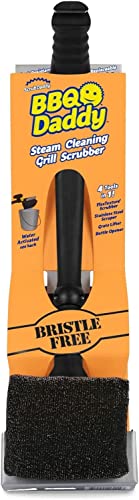
Scrub Daddy BBQ Daddy Grill Brush — Best Steam Scrubber
The BBQ Daddy brings Scrub Daddy’s temperature-responsive material to the grill: the Amazon listing confirms it as the brand’s dedicated grill brush. The head firms in cold water for scrubbing power and is used with water on the hot grate for steam-assisted cleaning, in a bristle-free format that keeps wire out of the food equation entirely.
It suits grillers who like a scrubbing action with real feedback, and households already fond of the Scrub Daddy sponge system. It does not suit anyone who cleans a cold grill exclusively, and the head — like all polymer scrubbers — is a replaceable wear part rather than a lifetime tool.
Strengths
- Bristle-free scrubbing with genuine cutting power on carbon
- Temperature-responsive head adapts firmness to the job
- Long handle keeps hands well back from grate heat
Trade-offs
- Works best with the water-and-heat steam routine
- Head wears with heavy use and needs replacement
- Polymer head must not rest on a hot grate — keep it moving
| Method | Steam-assisted scrubbing, bristle-free |
| Brand line | Scrub Daddy BBQ Daddy (per Amazon listing) |
Where Grill Rescue glides, the BBQ Daddy scrubs — and some grates need the scrub. Sugary sauces and marinades bake into a glaze that steam alone softens slowly; an abrasive-flex head breaks that glaze mechanically while the steam loosens it. Owners of stainless grates with heavy sauce habits will feel the difference within one session.
The discipline is heat management: the head is a tool in motion, dipped, scrubbed and lifted — never parked on hot metal. Follow that rhythm and it is one of the most effective bristle-free cleaners made. Treat it like a wire brush you can lean on and leave sitting, and you will shorten its life considerably.
Best for: sauce-heavy grillers wanting bristle-free scrubbing power / Not suited for: cold cleaning or park-it-on-the-grate habits
Check on Amazon — check the current price on Amazon before you decide, because grill pricing moves with the season.

Kona Safe/Clean Bristle-Free Grill Brush — Best Bristle-Free Coil
Kona’s answer to the bristle problem is geometry: the Amazon listing confirms the Safe/Clean bristle-free design, which replaces individual wires with continuous stainless steel coils. A coil cannot shed a bristle because there are no cut wire ends — the failure mode of conventional brushes is engineered away while keeping metal-on-grate cleaning power.
It suits owners of stainless and cast iron grates who clean hot and scrub hard. It does not suit delicate porcelain-coated grates at full aggression — the coil is still metal, and enamel deserves the steam or nylon picks instead — and it works best hot, like most metal tools.
Strengths
- Continuous coil design cannot shed wire bristles
- Metal cleaning power for stubborn carbon on iron and stainless
- Simple, durable construction with nothing to delaminate
Trade-offs
- Too aggressive for porcelain enamel if used with force
- Coils can bend out of shape under extreme pressure
- Less effective on a cold grate than the steam tools
| Method | Bristle-free coil scraping, best on a hot grate (per Amazon listing) |
| Design | Continuous stainless coil, Safe/Clean line |
The Kona is the traditionalist’s safe brush: it feels like the wire brush generations grew up with — metal, leverage, immediate results — while removing the one property that made those brushes risky. On cast iron and stainless, where the grate can take it, a coil brush after a fatty cook is deeply satisfying and fast.
Match it to the right grate and it may be the last brush design you buy. Keep it off porcelain enamel, or use it there with a deliberately light hand, and store it dry so the coil keeps its spring. It is the pick we hand to cast-iron owners who distrust ‘soft’ cleaners — and they convert quickly.
Best for: cast iron and stainless grate owners who clean hot / Not suited for: porcelain-coated grates under heavy pressure
Check on Amazon — check the current price on Amazon before you decide, because grill pricing moves with the season.

Grillaholics Brass Grill Brush — Best Brass Bristle
Brass is the bristle material porcelain owners were waiting for. The Grillaholics brush, confirmed in the Amazon listing, uses brass bristles that flex against enamel instead of gouging it, cleaning coated grates that steel wire would slowly strip. Brass is also softer in every sense that matters for safety, though the inspection habit below still applies to any bristled tool.
It suits porcelain-coated and cast iron grate owners who prefer a classic brush motion. It does not suit the heaviest carbon on stainless — brass gives up some bite — and no bristle brush of any metal is a set-and-forget tool: check the head before each use and retire it when bristles loosen or flatten.
Strengths
- Brass bristles are gentle enough for porcelain-coated grates
- Classic brush action — no new routine to learn
- Budget-tier cost makes scheduled replacement painless
Trade-offs
- Less bite than steel or coil on heavy carbon
- Bristles wear and flatten faster than a coil design
- Requires the inspect-before-use habit of all bristle tools
| Method | Brass bristle brushing (per Amazon listing) |
| Grate compatibility | Porcelain-coated, cast iron, stainless |
The honest case for brass is grate preservation. A porcelain coating is a glass-like shell; steel bristles micro-chip it cook by cook until rust blooms through the chips, and the grate — often the priciest wear part on a mid-tier grill — is done. Brass cleans the same food residue without the slow vandalism, which makes this brush the cheapest grate insurance in the guide.
Treat it as a consumable with a schedule: inspect the head each session, and replace the brush when bristles splay or loosen rather than when it stops cleaning. At its tier, that rhythm costs little and keeps both the grates and the safety equation sound.
Best for: porcelain-coated grate owners wanting a classic brush / Not suited for: heavy carbon on stainless, or owners who never inspect tools
Check on Amazon — check the current price on Amazon before you decide, because grill pricing moves with the season.

OXO Outdoor Nylon Grill Brush for Cold Cleaning — Best for Cold Cleaning
Some people clean the grill the next morning. The OXO Outdoor brush exists for them: its Amazon listing confirms nylon bristles designed for cold cleaning — nylon would melt on a hot grate, so this tool is honest about its moment. Used cold, nylon scrubs porcelain and coated grates with zero risk of chipping, scratching or shedding anything dangerous.
It suits cold cleaners, porcelain owners, and apartment grillers whose balcony rules make hot cleaning awkward. It does not suit hot cleaning under any circumstances — this is the one pick in the guide that heat genuinely destroys — and cold residue is harder work than hot, so expect a few more passes.
Strengths
- Completely safe for porcelain and coated grates
- No metal anywhere near the food surface
- OXO handle ergonomics suit longer scrubbing sessions
Trade-offs
- Cold use only — nylon melts on a hot grate
- Cold carbon takes more effort than hot cleaning
- Not the tool for cast iron’s heaviest buildup
| Method | Nylon bristle brushing, cold grates only (per Amazon listing) |
| Brand line | OXO Outdoor |
Cold cleaning has real advantages nobody advertises: no steam, no heat stress, no rush while guests wait, and the chance to see the grate’s actual condition in daylight. For porcelain owners it is arguably the kindest routine of all — the coating never meets metal, and yesterday’s residue, softened by a damp soak of the brush, lifts more easily than folklore suggests.
The rule that makes or breaks this pick is printed in its name: cold. Build the habit of brushing before the next cook rather than after the last one, and the OXO becomes the anchor of a gentle, grate-preserving routine. Use it hot once and you own a melted souvenir instead.
Best for: next-day cleaners and porcelain grate preservation / Not suited for: hot cleaning — ever
Check on Amazon — check the current price on Amazon before you decide, because grill pricing moves with the season.

Charbroil Safer Replaceable Head Nylon Bristle Grill Brush (Cool Clean) — Best Replaceable-Head System
Charbroil’s Cool Clean design solves the oldest brush problem — the tired head — by making the head the consumable. The Amazon listing confirms a replaceable-head nylon bristle brush in the Safer line, intended for cool grates: when the bristles flatten or clog, unclip and fit a fresh head instead of throwing away a whole brush or, worse, keeping a failing one in service.
It suits budget-minded owners of coated grates who clean cold and like systems over disposables. It does not suit hot cleaning — nylon’s limit again — and the system’s value depends on keeping a spare head in the drawer, which is a habit, not a purchase.
Strengths
- Replaceable head keeps the cleaning surface perpetually fresh
- Nylon is safe for coated and porcelain grates
- Cool-clean routine fits clean-before-cooking households
Trade-offs
- Cold use only, like all nylon designs
- Requires stocking spare heads to realize the system
- Nylon bite is gentler than coil or brass on heavy carbon
| Method | Nylon bristle, cool grates (per Amazon listing) |
| Design | Replaceable head, Safer Cool Clean line (per Amazon listing) |
Most brushes die slowly and get used long past their prime, which is precisely when bristle tools become risky and all tools become ineffective. A replaceable head interrupts that decay curve: the handle, leverage and grip stay familiar while the working surface is always near new. It is the same logic as changing a razor blade, applied to the grill drawer.
Within its cold-cleaning lane, performance is honest nylon performance — fine for routine residue, patient work for baked glaze. Pair it with the occasional hot steam session from the Grill Rescue if your grill sees heavy sauce use, and the two-tool system covers every cleaning situation in this guide for a modest total spend.
Best for: budget-minded cold cleaners who like replaceable systems / Not suited for: hot cleaning or heavy-carbon cast iron duty
Check on Amazon — check the current price on Amazon before you decide, because grill pricing moves with the season.
Comparison Table
| Pick | Badge | Key spec | Best for |
|---|---|---|---|
| Grill Rescue Bristle Free Grill Brush with Scraper | Best Overall | Bristle-free steam head + scraper | weekly grillers of any grate type who clean while the grill is hot |
| Scrub Daddy BBQ Daddy Grill Brush | Best Steam Scrubber | Bristle-free temperature-responsive scrub head | sauce-heavy grillers wanting bristle-free scrubbing power |
| Kona Safe/Clean Bristle-Free Grill Brush | Best Bristle-Free Coil | Continuous stainless coil, bristle-free | cast iron and stainless grate owners who clean hot |
| Grillaholics Brass Grill Brush | Best Brass Bristle | Brass bristles, porcelain-safe | porcelain-coated grate owners wanting a classic brush |
| OXO Outdoor Nylon Grill Brush for Cold Cleaning | Best for Cold Cleaning | Nylon bristles, cold cleaning only | next-day cleaners and porcelain grate preservation |
| Charbroil Safer Replaceable Head Nylon Bristle Grill Brush (Cool Clean) | Best Replaceable-Head System | Replaceable nylon head, cool-clean | budget-minded cold cleaners who like replaceable systems |
Match the tool to two facts: your grate material and your cleaning moment. Porcelain plus hot cleaning points to Grill Rescue or the BBQ Daddy; porcelain plus cold cleaning points to OXO or the Charbroil. Cast iron and stainless can take the Kona coil or the brass brush. The only true incompatibilities in the table are nylon on a hot grate and aggressive metal on porcelain — everything else is preference.
How to Choose a BBQ Grill Cleaner
Start with your grate, because it eliminates half the shelf. Porcelain-coated grates: steam heads, nylon, or brass — never aggressive steel. Cast iron: everything here works, with the coil and brass best for heavy carbon, and a light oil wipe after cleaning. Stainless: the full range works; choose by cleaning moment. Chrome-plated grates, found on small portables, deserve the gentlest tools — nylon or steam — because the plating is thin.
Next, your moment. Hot cleaning, done in the minutes after cooking, is easier and keeps buildup from ever curing — steam tools and the coil are built for it. Cold cleaning suits next-morning routines and delicate grates, with nylon as the safe instrument. The worst choice is the mismatch: nylon on heat, or a porcelain owner scrubbing cold carbon with steel because it is the brush they own.
The bristle question, settled plainly
Loose steel wire bristles in food are a documented injury risk, and the fix is not fear — it is selection and inspection. Bristle-free designs (steam heads, coils) remove the risk structurally. Brass reduces both grate damage and hazard severity. Any bristled brush you keep gets a two-second inspection before use: tug the bristles, look for looseness, and retire the brush at the first doubt. That habit, plus wiping the grate with a damp cloth after brushing, closes the issue responsibly.
Finally, think in systems. A cleaner whose head replaces (Charbroil) or whose design cannot shed (Kona, Grill Rescue) costs less over three seasons than a sequence of disposable brushes — and a cleaner you enjoy using gets used, which is the entire game.
How Each Cleaner Type Actually Works
Steam cleaners weaponize phase change. Water in the head hits the hot grate and expands into steam at the surface, lifting carbon from beneath while the pad or head wipes it away. They are the gentlest effective method and the safest for coatings, at the price of needing heat and a water source at the grill.
Coil and scraper designs are pure mechanics: a continuous metal edge shears residue off the grate bars. They are fast, durable and heat-proof, and their only vice is enthusiasm — on porcelain, force chips coatings. Brass bristles split the difference, flexing against enamel while still scrubbing, and nylon trades bite for absolute surface safety at cold temperatures.
No mechanical cleaner replaces the seasonal deep clean. Once or twice a year, grates should come off for a soak and scrub, the firebox should be scraped of grease scale, and the grease path cleared. The tools in this guide are for the weekly rhythm that makes the seasonal job a half-hour instead of an excavation.
Grate Care Routines by Material
Porcelain-coated grates live longest on a gentle rhythm: brush warm with steam, nylon or brass; never bang them, chip them, or shock them with cold water while hot. A chip is a rust seed — touch the grate’s care to the coating and these grates serve for many seasons.
Cast iron wants the opposite personality: scrub it properly with coil or brass, dry it with heat after any washing, and wipe the thinnest film of oil over it while warm. Iron that is cleaned and oiled is nearly immortal; iron left wet and dirty rusts theatrically. The cleaner is only half the routine — the oil wipe is the other half.
Stainless grates forgive almost everything except neglect of the underside, where grease carbonizes into flakes that fall onto burners. Flip them during the seasonal clean, scrape both faces, and the set will outlast the grill. Across all materials, one rule is universal: a clean grate releases food better, marks better, and makes the next cook easier — cleaning is a cooking technique, not housekeeping.
The Seasonal Deep Clean: Beyond the Weekly Brush
Twice a year — at season’s start and before winter storage — a grill deserves the deep clean that weekly brushing makes quick. Start cold and disconnected: propane off and tank removed or valve closed, charcoal fully ash-free. Remove the grates and heat tents and soak the grates in hot water with a degreasing dish soap; the tools in this guide handle the scrub afterward, with nylon or brass for coated grates and the coil reserved for iron and stainless. While they soak, scrape the firebox’s interior walls with a plastic putty knife — grease scale comes off in sheets when it is cold, and every sheet removed is fuel a future flare-up will not find.
Burners get their own inspection. Lift them out if the design allows, brush the port rows clear, and check the tubes for the spider webs and insect nests that famously cause weak, yellow flames after storage. Run a bottle brush or the manufacturer’s recommended tool through venturi tubes, then reseat everything and test-fire before the grates go back — it is far easier to reseat a burner with the grill empty than after reassembly.
The grease path is the deep clean’s real purpose. Pull the tray, scrape it bare, wash or line it, and trace the channel from firebox to cup, clearing the carbon dams that redirect grease toward burners. More grill fires start in a neglected grease path than at any burner, and the entire inspection takes ten unglamorous minutes.
Finish with the exterior and the plan. Wash painted and stainless surfaces with mild soap, touch up paint chips on steel bodies before rust starts in them, oil cast iron grates lightly, and make a note of any wear part that will not see another season — a burner, a heat tent, an igniter — and order it while the model numbers are in front of you. The grill that gets this treatment twice a year is the grill that never needs the emergency Saturday-morning replacement, and its weekly cleaning stays the five-minute routine the rest of this guide describes.
Matching the Cleaner to the Cook: A Working Decision Guide
Most households do not need a drawer of cleaners; they need one primary tool matched to their grill and one supporting habit. Work the decision in order. First question: what are your grates made of? Porcelain-coated owners start at the steam picks — Grill Rescue for hot cleaning, OXO or the Charbroil Cool Clean for cold — because their constraint is the coating. Cast iron owners start at the Kona coil or the Grillaholics brass, because their constraint is carbon and their grates can take honest metal. Stainless owners may choose freely, and usually land on the BBQ Daddy for its scrubbing bite or the Grill Rescue for its speed.
Second question: when do you actually clean? Answer with your behavior, not your intentions. If the grill gets brushed in the after-dinner glow, you are a hot cleaner and steam or coil tools will serve you for years. If the grate meets its brush in daylight before the next cook, you are a cold cleaner and nylon is your material. Buying against your own habit is how good tools end up unused — the most expensive cleaner is the one in the drawer.
Third: how saucy is your cooking? Sugar-heavy sauces and marinades bake into glazes that punish gentle tools; households that live on them should weight the BBQ Daddy’s abrasion or the coil’s shear more heavily, and shorten the interval — a glazed grate cleaned tonight is a two-minute job, and next week it is a project. Lean, dry-rub cooking is kinder to every tool and can run on the gentlest options in this guide.
Finally, set the replacement rhythm when you buy, not when the tool fails. Put a note in the calendar for the season’s start: inspect the head, tug the bristles if it has them, and replace without debating it. Every pick here costs less than the grate it protects and far less than the dinner it safeguards. The cleaner is a consumable by design; treating it as one is the entire safety and performance strategy in a single sentence.
How to Clean Grill Grates Properly, Step by Step
This is the routine the picks in this guide are built around. It takes five minutes after a cook and prevents the deep-clean marathons most owners dread.
- While the grill is still hot from cooking, close the lid for five minutes to let residual heat carbonize what’s left on the grates — brittle residue cleans; gummy residue smears.
- For steam tools: fill a container with water, dip the head, and draw it slowly across the grate bars, re-dipping as the steam fades. Work in sections and let the steam do the lifting.
- For coil, brass or scraper tools: brush along the bars, not across them, with firm strokes; flip attention to the grate edges and corners where buildup anchors.
- For cold routines (nylon): brush before the next cook, using a damp brush on stubborn spots, and never be tempted to ‘warm the grate a little first’ — nylon and heat do not mix.
- Wipe the cleaned grate with a folded damp cloth held in tongs. This final pass picks up any loosened debris — and, with bristled tools, is your safety check made physical.
- Empty the grease tray or cup once the grill is cool, and confirm ash (on charcoal grills) is fully cold before disposal.
- Finish by eye: hold the grate at an angle to the light. Shiny bars with matte corners mean one more pass at the corners; uniform bars mean you are done.
Once a season, extend the routine: grates off and soaked, firebox scraped, burners brushed out, and the whole grill inspected. The weekly five minutes is what makes the seasonal job small.
Cleaning porcelain-coated grates without chipping them
Porcelain’s enemies are impact and aggression, in that order. Never strike a coated grate to dislodge food, never scrape it with a steel tool’s edge, and never shock it with cold water while it is hot. The kind routine: steam head or brass brush while warm, a soak in hot soapy water for the seasonal clean with a nylon brush or pad, and a thorough dry before the grill’s heat touches it again. If a chip does appear, treat the exposed spot like cast iron — keep it oiled — so the damage stays a blemish instead of becoming a rust front.
Reviving a neglected grate
Inherited a grill whose grates look archaeological? Work in stages rather than with force. Heat the grill and let the lid-down bake carbonize the buildup until it is brittle, then take the coil or brass to it in passes, reheating between rounds. For removable grates, an overnight soak in hot water with degreasing soap loosens what heat cannot. Cast iron can then be re-seasoned like a skillet; porcelain should be inspected for chips once clean, because heavy buildup often hides them. Some grates are genuinely past saving — deep rust pitting on iron, widespread chipping on porcelain — and replacement grates for major brands are inexpensive enough that heroics have a price ceiling.
Common Buying Mistakes
- Using a worn wire brush ‘one more season’. Loose bristles are the category’s real hazard. Inspect before use; retire at the first looseness, whatever the brush cost.
- Scrubbing porcelain with aggressive steel. Chipped enamel rusts from the chip outward. Steam, nylon or brass only on coated grates.
- Melting a nylon brush on a hot grate. Nylon tools are cold tools. The OXO and Charbroil picks are explicit about it — believe them.
- Resting a polymer steam head on hot metal. Steam heads work in motion: dip, scrub, lift. Parked on the grate, the head cooks itself.
- Skipping the damp-cloth wipe. It takes ten seconds, removes loosened debris, and is the physical safety net after any brushing.
- Letting the grease tray fill until it smokes. Cleaner grates over a full grease tray still flare. The tray is part of the cleaning routine, not an afterthought.
Every cleaner in this guide fails in a predictable way when misused — the mistakes list is simply the instruction manuals, condensed.
Final Recommendation
For most households the answer is the Grill Rescue: bristle-free steam cleaning that works on every grate, takes under a minute, and removes the wire question from your kitchen permanently. Sauce-heavy cooks who want scrubbing bite should take the Scrub Daddy BBQ Daddy, and cast iron owners who love a metal tool should take the Kona coil with a clear conscience.
Porcelain owners on a classic-brush budget belong with the Grillaholics brass; cold cleaners belong with the OXO nylon or the Charbroil Cool Clean replaceable-head system. Whichever you choose, adopt the two habits that matter more than the tool: clean while the routine is easy, and inspect or replace the head before it fails. Your grates — and everyone eating off them — will notice the difference. The grill guides below will help when the cooker itself is due for replacement.
Our top recommendations again, for convenience: Grill Rescue Bristle Free Grill Brush with Scraper, Scrub Daddy BBQ Daddy Grill Brush, Kona Safe/Clean Bristle-Free Grill Brush. Check the current price on Amazon for each before ordering, and add the cover that fits your pick to the same order.
Best Bbq Gas Grills Under $400 Best Basic Grills Best Bbq Combo Grills Best Bbq Grills Dyna Glo Best Bbq Grills For A Condo
Frequently Asked Questions
Are wire grill brushes actually dangerous?
Worn wire brushes can shed bristles that stick to grates and transfer to food, and ingested bristles have caused documented medical emergencies. The risk is managed by choosing bristle-free or brass designs, inspecting any bristled brush before use, retiring it at the first sign of looseness, and wiping the grate with a damp cloth after brushing — the approach this guide is built on.
Can I use the same cleaner on porcelain and cast iron grates?
Steam cleaners and brass brushes serve both safely. The Kona coil is excellent on cast iron but should be used gently, if at all, on porcelain. Nylon serves porcelain beautifully and cast iron adequately for light residue. If you own both grate types, a steam head is the single-tool answer.
Should I clean the grill hot or cold?
Hot cleaning is easier — residue is brittle and steam tools work — and suits coil, brass and steam designs. Cold cleaning is gentler and suits nylon tools and porcelain preservation. The dangerous option is mixing them up: nylon must never touch a hot grate.
How often should I replace a grill brush or head?
Replace bristled brushes when bristles loosen, splay or flatten — often a season of regular use. Replace steam and scrub heads when they compress and stop biting. Coil brushes last longest and are replaced when the coil deforms. When in doubt, replace early: every tool here costs less than the grate it protects.
Do I need chemical grill cleaner?
Not for routine grate care — heat, steam and the right tool handle it. Chemicals have a place in the once-a-season firebox deep clean, used exactly per label, on cold surfaces, well away from food-contact areas. If a product promises to replace brushing entirely, read its instructions twice before believing it once.
What is the fastest cleaning routine that actually works?
Five minutes, hot: lid closed to carbonize, steam head or coil along the bars, damp-cloth wipe, done. Done after every cook, buildup never cures into the kind of carbon that needs soaking and scraping — the routine is fast precisely because it is frequent.
Can I put grill grates in the dishwasher or oven self-clean cycle?
We advise against both. Dishwasher detergents and cycles are hard on coatings and seasoning, and oven self-clean temperatures can damage porcelain, warp thin grates and bake grease smoke into your kitchen. The soak-and-scrub method in this guide is slower and entirely sufficient — and it keeps the mess where it belongs, outside the oven.
How do I clean the inside of the grill lid?
The flaky black buildup inside a lid is carbonized grease, not peeling paint, in almost every case. Scrape it cold with a plastic putty knife or ball of foil, brush the residue out, and wipe with a damp cloth. Removing it matters: flakes fall on food, and thick deposits feed flare-ups. A thin, smooth layer that survives scraping is harmless and can stay.
Is it safe to cook on a rusty grate?
Surface rust on cast iron should be scrubbed off and the grate re-seasoned before cooking — rust is not a seasoning anyone ordered. Light discoloration on stainless wipes away. Deeply pitted iron or chipped, rusting porcelain is a replacement decision, not a cleaning one: the grate’s cooking surface is compromised either way.
Can I use an oven cleaner or degreaser spray on my grates?
Only with real caution: many oven cleaners are caustic, are not intended for surfaces that contact food at grilling temperatures, and can damage porcelain coatings. If you use any chemical degreaser, use it on removed, cold grates, follow the label exactly, rinse exhaustively, and heat the grates before the next cook. For routine care, the mechanical and steam methods in this guide make chemicals unnecessary — which is precisely why we recommend them.


