Disclosure: airfryerkitchensupply.com is reader-supported. When you buy through links on our site, we may earn an affiliate commission at no extra cost to you.
Where to buy
The best built BBQ grills cannot be judged from a photograph, so every pick below was verified as a current manufacturer listing, and the construction details quoted — grate materials, burner systems, body construction — come from those listings. Use the links to check the current price on Amazon, and if a dealer near you stocks any of these, go and lift the lid before you buy: the picks in this guide were chosen to win that test.
- Weber Genesis E-415 Gas Grill (Propane) (Best Overall Build) — Check the current price on Amazon
- Napoleon Prestige 500 RSIB Propane Gas Grill (Best Premium Build) — Check the current price on Amazon
- Kamado Joe Classic Joe Series II 18-Inch Ceramic Charcoal Grill (Best Charcoal Build) — Check the current price on Amazon
- Broil King Baron 590 Pro Shadow 5-Burner Propane Gas Grill (Best Build for the Money in Gas) — Check the current price on Amazon
- Char-Griller AKORN 20-Inch Kamado Charcoal Grill and Smoker (Best Budget Build) — Check the current price on Amazon
- Weber Spirit E-310 Gas Grill (Best Compact Build) — Check the current price on Amazon
The best built BBQ grills are not the ones with the longest feature lists; they are the ones still cooking evenly in year eight, with lids that still sit true, burners that still light first time, and grates that have not become a rust farm. Build quality is a compound of materials — porcelain-enamelled cast iron, stainless steel in the right grades, ceramic, heavy-gauge steel — and of engineering judgement about where thickness matters and where it is theatre. This guide is a roundup of the grills that get that compound right, across gas, charcoal, and kamado formats.
The honest context is that most grills are built to a price and a warranty period, and the difference shows by the third season: thin fireboxes oil-can and rust at the seams, plated grates shed their coating, and burners perforate from the inside. The six picks here come from the makers who build against that timeline — Weber, Napoleon, Kamado Joe, Broil King, and the one value brand, Char-Griller, whose insulated steel kamado punches far above its tier. Each was verified against its live Amazon listing before inclusion, and each pick’s review names both its construction strengths and the places its makers chose to save money, because every grill has both.
If you are replacing a grill that disappointed you, this is the guide written for your exact frustration. Read the build-quality framework in the buying guide even if you skim the picks: it will let you judge any grill, including the ones not listed here, in about ninety seconds of hands-on inspection.
In this guide
Quick Picks
Six grills whose construction justifies their prices, from the premium flagships to one budget kamado that embarrasses grills twice its price.
Weber Genesis E-415 Gas Grill (Propane) — Best Overall Build. The benchmark for gas grill construction: four PureBlu burners under porcelain-enamelled cast-iron grates, in the firebox and cart engineering that have made Genesis the grill other makers’ build quality is measured against. Check price on Amazon
Napoleon Prestige 500 RSIB Propane Gas Grill — Best Premium Build. The stainless flagship statement: a Prestige 500 with infrared side and rear burners, built in stainless steel to a standard that justifies its position at the top of this roundup’s price range. Check price on Amazon
Kamado Joe Classic Joe Series II 18-Inch Ceramic Charcoal Grill — Best Charcoal Build. Ceramic permanence: an 18-inch ceramic kamado with stainless steel grates on a cart with side shelves — a grill whose body is effectively a lifetime component and whose cooking range runs from cold-smoke gentle to furnace hot. Check price on Amazon
Broil King Baron 590 Pro Shadow 5-Burner Propane Gas Grill — Best Build for the Money in Gas. Five burners, a side burner, and a rear rotisserie burner in Broil King’s deep-hooded, heavy-grated flagship construction — the most build per dollar in the gas half of this roundup. Check price on Amazon
Char-Griller AKORN 20-Inch Kamado Charcoal Grill and Smoker — Best Budget Build. The budget build that is genuinely built: triple-wall insulated steel and cast iron grates delivering kamado efficiency and decade-plausible durability at a fraction of ceramic money. Check price on Amazon
Weber Spirit E-310 Gas Grill — Best Compact Build. The smaller Weber, built like a Weber: three burners, porcelain-enamelled cast-iron grates, and Snap-Jet ignition in a compact body — proof that the maker’s construction standards survive the shrink. Check price on Amazon
The shortlist logic is simple, and it generalises beyond this page: Weber Genesis for the best all-round gas build, Napoleon Prestige for the premium statement, Kamado Joe for charcoal permanence, Broil King Baron for build-per-dollar in gas, the AKORN for the budget build that is not a compromise, and the Spirit where space is the constraint. If none of the six matches your fuel or your format exactly, take the framework rather than the list — the inspection in the buying guide grades any grill you meet.
How These Picks Were Chosen
Picks were chosen on construction evidence rather than feature counts: grate material and weight, firebox and lid construction, burner design, insulation where relevant, and the manufacturer’s parts ecosystem — because a well-built grill is also a repairable one, and a grill whose burners and grates are catalogue items in year ten is built in a different sense from one that is merely thick.
The price spread of the final six is wide, and deliberately so. Build quality is not a luxury good; it is an engineering allocation, and it can be bought at several budgets if the buyer knows which components carry it. The roundup therefore includes a budget kamado and a compact gas grill alongside the flagships, and it judges each against its own tier’s alternatives rather than against the most expensive object on the page.
Formats were deliberately mixed. ‘Best built’ means something different in a kamado — ceramic mass and gasket integrity — than in a gas grill, where burner metallurgy and firebox seams decide lifespan, or in a steel kamado, where insulation and coating carry the argument. The roundup holds one or two champions per format rather than crowning a single material, because the reader’s fuel is already chosen even when their grill is not.
Every candidate was verified for this programme: current manufacturer listing, configuration matching its title, specifications quoted only from that title. Several famous heavy-duty grills did not appear as verifiable current listings and were excluded on that ground alone — a discipline that matters in a category where discontinued legends linger in search results for years.
The 6 Best Built BBQ Grills

Weber Genesis E-415 Gas Grill (Propane) — Best Overall Build
The Genesis line is where Weber puts its serious construction, and the E-415 shows the recipe: a deep, well-seamed firebox, four of the maker’s PureBlu burners — designed for consistent flame along their length — and porcelain-enamelled cast-iron cooking grates, the grate specification that combines cast iron’s searing mass with an enamel coat that resists the rust bare iron invites. Nothing on this grill is the thickest or heaviest in isolation; the build quality is in the integration, the tolerances, and the way every wear part is a catalogue item.
Strengths
- Porcelain-enamelled cast-iron grates: searing mass with corrosion protection
- PureBlu burner system engineered for even flame distribution
- Deep parts and support ecosystem — the grill is repairable for years
Trade-offs
- Premium pricing that the feature list alone does not explain — you are paying for construction
- Cast-iron grates are heavy; grate handling is a two-hand job
- Black finish shows dust; plan on the cover habit
| Model | Genesis E-415 |
| Burners | 4 PureBlu burners |
| Grates | Porcelain-enamelled cast iron |
| Fuel | Propane |
What owners notice across years is the absence of the usual decay sequence. The lid keeps its fit, so heat stays predictable; the burners light evenly because their ports were drilled in quality metal; the grates season rather than shed. Genesis grills also hold the used market’s respect, which is the build-quality verdict rendered in cash: a five-year-old Genesis is a purchase, where a five-year-old budget grill is a favour you do the seller.
For the buyer cross-shopping on specifications, the E-415 can look plain beside feature-loaded rivals at similar money. That is the category’s central illusion, and this guide exists to correct it: the Genesis spends its budget inside the firebox, where it decides how the grill cooks in year five, rather than on the control panel, where it decides how the grill photographs in week one.
Best for: buyers who want the gas grill most likely to be cooking perfectly in a decade / Not suited for: feature hunters who value stations and electronics over construction
Check the current price on Amazon

Napoleon Prestige 500 RSIB Propane Gas Grill — Best Premium Build
Napoleon’s Prestige line is the Canadian maker’s flagship, and the 500 RSIB is its fullest common configuration: a stainless steel grill with infrared burners at both the side station and the rear for rotisserie work. The build story is material and finish — stainless construction that resists the patio’s weather and wipes back to bright — paired with the infrared hardware that gives this grill the widest cooking range in the roundup, from low roasting to a side-station sear that main burners cannot match.
Strengths
- Stainless steel construction with flagship fit and finish
- Infrared side and rear burners: searing and rotisserie specialisation
- Premium build throughout, including the small hardware
Trade-offs
- The highest investment in this roundup
- Stainless demands regular wiping to keep its showroom look
- Infrared stations are capability you must use to justify
| Model | Prestige 500 RSIB (P500RSIBPSS-3) |
| Burners | Main burners + infrared side burner + infrared rear burner |
| Construction | Stainless steel |
| Fuel | Propane |
The Prestige makes its case the moment a hand lands on it: lid weight, hinge action, and the way the doors and drawers meet their frames all report the same message. In cooking terms, the infrared rear burner transforms rotisserie work — radiant heat bastes evenly without flare — and the infrared side burner is a genuine sear station, not a sauce warmer with ambitions. This is the grill for the cook who uses every station and notices every tolerance.
It is also the pick that most rewards a dealer’s showroom visit. Premium stainless grills are bought partly as patio furniture, and the Prestige’s finish standard is its argument made visible. Buyers who will cover it, cook hard, and never wipe a fingerprint should save the premium and take the Genesis; buyers who will enjoy the object as well as the cooking should not hesitate.
Best for: premium buyers who want stainless construction and infrared versatility in one flagship / Not suited for: value calculators — the build is real, and so is the price
Check the current price on Amazon

Kamado Joe Classic Joe Series II 18-Inch Ceramic Charcoal Grill — Best Charcoal Build
In charcoal, ‘best built’ culminates in ceramic, and the Classic Joe Series II is the format’s reference: a thick ceramic body that stores heat like a masonry oven, stainless steel cooking grates, and a cart with side shelves that makes the heavy egg a practical workstation. The 250 square inches of cooking area in the listing understates the kamado’s real capacity story, because its two-tier cooking system stacks levels inside the dome — but the build story needs no such qualification: ceramic does not rust, does not warp, and does not wear out on any schedule a household will live to see.
Strengths
- Ceramic body: a lifetime material that holds heat superbly
- Stainless steel grates and quality hardware throughout
- Enormous temperature range, from low smoking to extreme searing
Trade-offs
- Heavy and fragile in transit — ceramic’s one weakness is impact
- Premium pricing, and the learning curve is real
- Temperature overshoots are slow to correct in a heat-soaked ceramic body
| Model | Classic Joe Series II (KJ-23RHC) |
| Size | 18-inch ceramic, 250 sq in cooking area |
| Grates | Stainless steel |
| Included | Cart and side shelves |
Cooking on a well-built kamado recalibrates expectations of charcoal. Once the ceramic is heat-soaked, the fire needs only a whisper of air to hold a smoking temperature for hours, and the same mass that stabilises the low end delivers a searing environment at the high end that gas grills cannot reach. The Series II generation refined the format’s ergonomics — the details owners touch daily — while keeping the ceramic core that is the entire point.
Ownership is correspondingly simple and long: gaskets are the scheduled wear item, the grates are stainless, and the body asks only to be protected from impact and thermal shock. For a buyer who wants to purchase a charcoal grill once, in the most literal sense the market offers, this is the pick — with the AKORN below as the honourable, affordable interpretation of the same idea in steel.
Best for: charcoal devotees buying a grill for the long term, across smoking and searing / Not suited for: movers, the impact-prone, or anyone who needs to drop temperature quickly
Check the current price on Amazon
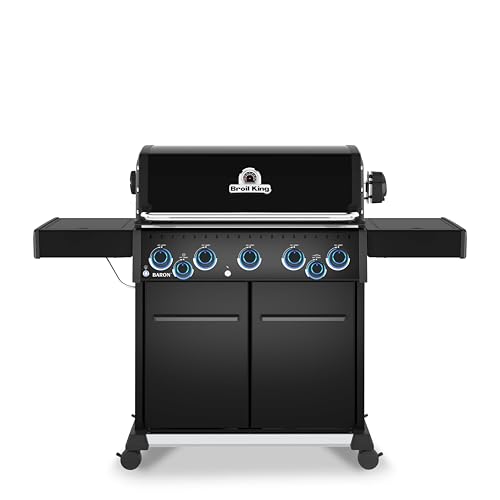
Broil King Baron 590 Pro Shadow 5-Burner Propane Gas Grill — Best Build for the Money in Gas
Broil King’s claim in a build-quality roundup rests on the same evidence as in its own brand guide: heavy cooking grates, a deep oven-style hood, and a North American parts ecosystem that treats the grill as a decade-long appliance. The Baron 590 Pro is the flagship expression — five main burners, side and rear rotisserie burners, the current Pro generation in Shadow black — and it undercuts the premium stainless flagships while matching or beating them on the construction points that decide cooking: grate substance and hood depth.
Strengths
- Heavy grates and a deep hood: the construction that cooks
- Five burners plus side and rotisserie stations included
- Parts ecosystem built for decade-scale ownership
Trade-offs
- Black Shadow finish rather than full stainless construction
- Large and heavy — a permanent patio resident
- Pellet-ready designation only matters within that accessory ecosystem
| Model | Baron 590 Pro Shadow (675144) |
| Burners | 5 main + side burner + rear rotisserie burner |
| Fuel | Propane |
| Finish | Black (Shadow) |
The Baron’s build argument is functional rather than cosmetic. Put a roast under that deep hood and the grill behaves like an oven with better flavour; work the five burners as zones and the grate’s mass smooths the transitions. Owners stepping up from mid-market grills consistently report the same first impression — everything feels a class heavier — and the tenth-year impression matters more: burners, grates, and heat plates for this brand are orderable parts, not archaeology.
Against the Genesis, the Baron trades some refinement for stations and size; against the Prestige, it trades stainless theatre for value. In a build-quality ranking it earns its place by spending on the firebox and the catalogue — the two places this guide argues money should go.
Best for: hosts who want flagship cooking construction and full stations without the stainless premium / Not suited for: small patios or buyers prioritising finish over firebox
Check the current price on Amazon

Char-Griller AKORN 20-Inch Kamado Charcoal Grill and Smoker — Best Budget Build
Every build-quality roundup needs its control case — the inexpensive grill that proves money is not the whole story — and the AKORN is it. Its triple-wall insulated steel body does the kamado’s essential trick, holding heat with minimal fuel, while cast iron grates provide the searing mass that budget grills almost never include. Steel brings practical virtues ceramic cannot: it survives knocks, it is lighter to move, and if the worst happens it has not shattered. The construction is honest at every point a hand or an eye can test.
Strengths
- Triple-wall insulation: kamado efficiency without ceramic fragility
- Cast iron grates — a premium material at a budget tier
- Steel body tolerates the knocks that end ceramic grills
Trade-offs
- Steel will eventually rust where ceramic would not — keep it covered and dry
- Fit and finish are a class below the premium picks
- Insulated bodies overshoot temperature if the vents are chased
| Size | 20-inch kamado |
| Construction | Triple-wall insulated steel |
| Grates | Cast iron |
| Fuel | Charcoal |
The AKORN’s build quality shows in the cooking before it shows anywhere else: a small charcoal load holding smoking temperature for hours is insulation doing measurable work, and a steak hitting those cast iron grates marks like a steakhouse’s. Owners who maintain the exterior — cover on, ash out, a touch-up where the finish eventually chips — report service lives that embarrass the disposable end of the gas market, at a purchase price within that market’s reach.
It is the pick this guide gives to the buyer whose budget is real and whose standards are too. The compromises are known and manageable — steel’s eventual cosmetic rust, a learning curve at high heat — and in exchange the buyer gets the only kind of budget grill worth recommending: one whose construction was the point of the design, not the casualty of its price.
Best for: budget buyers who refuse disposable grills, and kamado-curious cooks / Not suited for: buyers wanting ceramic permanence or gas convenience
Check the current price on Amazon

Weber Spirit E-310 Gas Grill — Best Compact Build
Compact grills are where build quality usually goes to die — thinner everything, justified by the footprint. The Spirit E-310 is the exception that tests the rule: its listing specifies the same porcelain-enamelled cast-iron grates as the Genesis line, a three-burner layout, and Snap-Jet ignition, in the smaller body the Spirit name denotes. For balconies, small patios, and households of two to four, it delivers the maker’s construction philosophy without the flagship’s size or price.
Strengths
- Porcelain-enamelled cast-iron grates — the flagship grate spec, compact edition
- Snap-Jet ignition and Weber burner engineering at a smaller scale
- Full parts support behind a compact grill, a rare combination
Trade-offs
- Three burners cap capacity and zoning ambition
- Compact firebox preheats fast and cools fast in wind
- Buyers who entertain will outgrow it — buy the Genesis instead
| Model | Spirit E-310 |
| Burners | 3 burners |
| Grates | Porcelain-enamelled cast iron |
| Ignition | Snap-Jet ignition |
The Spirit’s build story matters because small-grill buyers are usually told to accept disposability as the price of the footprint. Weber’s answer is that the footprint changes the dimensions, not the standards: the grates are the real material, the burners are the maker’s own system, and the parts catalogue covers the grill the way it covers the flagship. A Spirit kept covered and cleaned ages like a small Genesis, which is to say slowly and gracefully.
Choose it when the space is genuinely small and the household genuinely compact; it will serve that brief for years. Choose the Genesis the moment the brief grows, because the one build-quality mistake this guide cannot fix is buying the right construction in the wrong size.
Best for: small households and patios that refuse disposable build quality / Not suited for: hosts or growing families — size up to the Genesis
Check the current price on Amazon
Comparison Table
Build quality crosses formats in this table: read the key spec as the construction claim each maker stakes its price on.
| Pick | Badge | Key spec | Best for |
|---|---|---|---|
| Weber Genesis E-415 Gas Grill (Propane) | Best Overall Build | 4 PureBlu burners, porcelain-enamelled cast-iron grates | buyers who want the gas grill most likely to be cooking perfectly in a decade |
| Napoleon Prestige 500 RSIB Propane Gas Grill | Best Premium Build | Stainless, infrared side + rear burners, flagship construction | premium buyers who want stainless construction and infrared versatility in one flagship |
| Kamado Joe Classic Joe Series II 18-Inch Ceramic Charcoal Grill | Best Charcoal Build | 18 in ceramic body, stainless grates, cart + shelves | charcoal devotees buying a grill for the long term, across smoking and searing |
| Broil King Baron 590 Pro Shadow 5-Burner Propane Gas Grill | Best Build for the Money in Gas | 5 burners + side + rotisserie, deep hood, heavy grates | hosts who want flagship cooking construction and full stations without the stainless premium |
| Char-Griller AKORN 20-Inch Kamado Charcoal Grill and Smoker | Best Budget Build | Triple-wall insulated steel, cast iron grates, 20 in | budget buyers who refuse disposable grills, and kamado-curious cooks |
| Weber Spirit E-310 Gas Grill | Best Compact Build | 3 burners, porcelain-enamelled cast-iron grates, Snap-Jet | small households and patios that refuse disposable build quality |
How to Choose a Well-Built BBQ Grill
Judge construction in the order it fails. Grates fail first on cheap grills — plating sheds, thin steel warps — so start there: cast iron (ideally porcelain-enamelled) or heavy stainless are the durable answers, and grate weight in the hand is the fastest honest test in the category. Fireboxes and lids fail second, at seams and hinges, so lift the lid, feel its weight and its lateral play, and look at how the box is joined. Burners fail third, from the inside, which is why burner material and the availability of replacements matter more than burner count.
Then judge the ecosystem, because build quality includes the future. A grill whose burners, grates, heat plates, and igniters are catalogue items — true of every pick in this guide — can be kept at full performance indefinitely. A grill with no parts story is disposable at the first failed burner, whatever its steel thickness. The cheapest grill to own for fifteen years is frequently the one that looked expensive in year one.
- Lift the lid: weight, fit, and hinge play report the whole build
- Grate material is the first spec to check — cast iron or heavy stainless
- Burner replacements must exist; ask before buying, not after failing
- Thickness matters at the firebox; elsewhere it can be theatre
- A fitted cover and dry storage multiply any build quality
Finally, match the build to the life it will actually live. A grill under a covered porch in a mild climate can thrive in painted steel; the same grill on an exposed coastal deck needs stainless or ceramic and a cover discipline to match. Build quality is a property of the grill; durability is a property of the grill in its place, and the buyer’s honesty about that place is part of the purchase.
Materials, Honestly: Stainless, Cast Iron, Ceramic, and Steel
Stainless steel is not one material but a family of grades, and grill marketing exploits the ambiguity. Good stainless in hoods, doors, and burners resists corrosion for decades; thin, low-grade stainless tea-stains, and magnetic stainless — a rough field test for the lower grades — deserves a price that reflects it. Cast iron is the grate material of record for searing, superb when porcelain-enamelled against rust, demanding when bare. Ceramic is the kamado material: thermally unmatched, effectively immortal, and vulnerable only to impact and thermal shock.
Painted and enamelled steel, the AKORN’s and the kettles’ territory, is the honest middle: porcelain enamel over steel is a genuinely durable system with a century of evidence, while thin powder-coat over thin steel is a countdown. The picks in this guide were chosen so that every material present is the good version of itself — which is a more useful standard than any league table of materials in the abstract.
Burners, Igniters, and the Parts That Actually Wear Out
A well-built grill is honest about its consumables. Burners live in the firebox’s worst neighbourhood — heat, grease, moisture — and even excellent ones are wear parts on a long fuse; igniters fail from heat and weather; heat plates and flavour bars corrode by design, sacrificing themselves to protect the burners. Build quality therefore includes how gracefully these parts can be replaced: burners that lift out without dismantling the grill, igniters accessible without a service call, and every one of them orderable by model number years later. All six picks pass that test, which is not a coincidence but a selection criterion.
The practical habit that follows: when you buy any grill in this guide, spend two minutes in its parts catalogue and note the numbers for its burner, grates, and igniter. That small act converts a future failure from a research project into an order, and it is the moment a buyer starts thinking like the owners whose decade-old grills fill the testimonials — because those owners all did the unglamorous things early.
It also reframes the showroom comparison. Two grills can tie on materials and diverge completely on this axis: the one whose maker lists every wear part by model is built for a life; the one whose support page offers a cover and a brush is built for a cycle. In a category where the products look alike, the catalogue is the tell.
Warranty Length vs Build Quality: Reading the Signal Correctly
Buyers often use warranty length as a proxy for build quality, and the signal is real but noisy. A long warranty on burners and firebox does indicate a maker’s confidence in those components — and it is worth reading warranties at the component level, because the headline number usually belongs to the longest-covered part while grates, igniters, and finishes carry shorter terms. The picks in this guide come from makers whose component warranties and parts availability point the same way, which is the pattern to trust.
The proxy fails in both directions often enough to matter. Some aggressively marketed grills pair long paper warranties with thin construction and slow parts supply, betting that few owners claim; some excellent grills carry modest warranties because their makers price honestly and support generously in practice. Treat the warranty as one exhibit among several — behind grate material, firebox construction, and the live parts catalogue, ahead of the feature list — and it will serve you as it should: as corroboration, never as the verdict.
Whatever you buy, register it and keep the receipt with the grill’s records. Warranty value exists only for owners who can prove purchase, and the two minutes of filing is the cheapest insurance in the entire transaction.
The Ninety-Second Showroom Inspection
Rehearse this sequence and you can grade any grill on a showroom floor. One: lift and lower the lid three times — it should track straight, seat evenly, and feel like it will do so in year ten. Two: lift a cooking grate — its weight is its quality, within reason. Three: crouch and look at the firebox seams, the burner tubes, and the grease path; neat, substantial, and accessible beats sculpted and sealed. Four: work every control — knobs, dampers, igniter — for smoothness and range. Five: ask the parts question out loud: ‘Show me the replacement burner and grates for this model.’ The answer, and how quickly it comes, is the brand’s build philosophy in one sentence.
Apply the same inspection to the picks in this guide and they will pass it in the order presented — which is, in the end, the only claim a build-quality roundup is really making. Take a photograph of the rating label while you are on the showroom floor, too; the model and serial details in that photograph are the keys to the parts catalogue, the warranty registration, and every future question you will ever ask about the grill.
How to Make a Well-Built Grill Last: The Maintenance Routine
Construction sets the ceiling; maintenance decides how close you live to it. This routine is written for the gas and charcoal grills in this guide and takes minutes per month.
- After cooks, burn off residue at high heat for ten minutes, brush the grates with the tool matched to their material, and wipe lightly with high-heat oil while warm — the habit that keeps good grates good.
- Empty the grease tray monthly for regular cooks, and clear the grease path; more built grills are lost to grease fires and corrosion from standing grease than to any defect.
- Once a season, lift the grates and heat management parts, clear the firebox of ash and debris, and inspect burners for blocked or corroded ports — clearing them gently rather than enlarging them.
- Check the igniter, gas connections, and hose each spring: leak-test connections with soapy water, and replace a cracked hose before the season rather than during it.
- For kamados, inspect the gasket for compression and leaks, and check bands and hinge hardware for tightness — the ceramic body’s only real maintenance is the ring of parts around it.
- Touch up exterior chips on enamelled and painted steel promptly with the maker’s high-heat paint where offered; small breaches are where rust campaigns begin.
- Store covered and dry, with the cover fitted rather than draped, and the grill clean underneath it — a cover over a dirty, wet grill preserves the dirt and the wet, not the grill.
- Keep a one-line log of parts replaced and dates; when a burner or grate eventually tires, the log turns a guessing game into a five-minute order from the catalogue.
Followed consistently, this routine is why the grills in this guide acquire their reputations: the construction makes longevity possible, and the owner’s half-hour a season makes it actual. The grills that die young in driveways are rarely the badly built ones — they are the well-built ones nobody maintained, which is the one failure mode no manufacturer can engineer away. Start the routine with the grill’s first cook rather than its first problem; habits formed on a new grill protect it for its whole life, while habits formed at the first rust spot merely negotiate with decline.
Common Buying Mistakes
Judging build by weight alone. Mass in the grates and firebox is quality; mass in decorative panels is marketing. Lift the lid and a grate, not the brochure — and remember the heaviest grill in this guide, the ceramic, is also the one that cannot be dropped.
Paying for features instead of construction. Lighted knobs and apps do not cook in year eight. At any given price, the grill that spent its budget on grates, burners, and firebox will out-cook and out-last the one that spent it on the control panel.
Ignoring the parts question until something fails. A grill without available burners and grates is disposable on a delay. Every pick here has a parts story; make any grill you consider prove the same before it earns your patio.
Assuming stainless means maintenance-free. Stainless resists corrosion; it still needs wiping, covering, and grease management, and low-grade stainless in coastal air will tea-stain regardless. Buy the grade, keep the routine.
Buying flagship construction in the wrong size. A beautifully built grill that cannot hold your typical cook — or that dwarfs it — fails the only test that matters daily. Size to the household first, then maximise build within that size, as the Spirit and Genesis pairing in this guide demonstrates.
Skipping the cover because the grill is ‘built to be outside’. Built to cook outside is not built to store outside uncovered. Water in the firebox, ash turned to paste, and freeze-thaw in seams are storage failures, and a fitted cover prevents all three for the price of a pizza night.
Final Recommendation
Buy the Weber Genesis E-415 if you want the safest pair of hands in gas grilling: it is the construction benchmark, and its parts story is the deepest in the business. Buy the Napoleon Prestige 500 if the budget and the patio both say flagship — its stainless build and infrared range are the premium article, honestly priced. Buy the Kamado Joe Classic II if charcoal is your fuel and permanence is your value; nothing else in the roundup will outlive it.
The Baron 590 Pro is the build-per-dollar champion in gas, the AKORN is the proof that a budget grill can be a built grill, and the Spirit E-310 carries flagship grate construction into compact spaces. Every one of the six was verified for this guide and chosen on evidence you can repeat with your own hands in ninety seconds — which is the right way to buy the grill you intend to keep. If your current grill failed you, let its autopsy guide the choice: rusted firebox, buy the firebox; dead burner with no replacement, buy the catalogue; warped lid, buy the tolerances. The right pick in this guide is the one whose strengths answer your last grill’s failure, and that is a more reliable route to satisfaction than any ranking, including this one.
The linked picks, for a final side-by-side check of current pricing: Weber Genesis E-415 Gas Grill (Propane), Napoleon Prestige 500 RSIB Propane Gas Grill, Kamado Joe Classic Joe Series II 18-Inch Ceramic Charcoal Grill, Broil King Baron 590 Pro Shadow 5-Burner Propane Gas Grill, Char-Griller AKORN 20-Inch Kamado Charcoal Grill and Smoker, Weber Spirit E-310 Gas Grill.
Related guides in this series: Best Built Gas Grills Best Built Charcoal Grills Best Broil King Grills Best Bbq Grills Under $1000 Best Box Smoker Grills
Frequently Asked Questions
What makes a BBQ grill ‘well built’?
Materials and tolerances in the places that decide lifespan: heavy grates in cast iron or stainless, a firebox and lid that fit and stay fitted, burners made to be replaced rather than mourned, and a manufacturer whose parts catalogue supports the grill for years. Feature lists are not build quality; the ninety-second inspection in this guide is how you detect the real thing.
Is stainless steel always the best material?
No — it is a family of grades, and execution matters more than the label. Porcelain-enamelled cast iron out-sears it, ceramic out-lasts it thermally, and good enamelled steel out-values it. The Prestige earns its stainless premium with grade and finish; a thin, low-grade stainless grill is a worse buy than a well-made enamelled one.
How long should a well-built grill last?
With the maintenance routine in this guide — burn-off, grease management, seasonal inspection, covered storage — the gas picks here should serve for many years with occasional wear-part replacements, and the ceramic kamado’s body has no practical lifespan limit short of impact. Neglect compresses any of those timelines dramatically.
Are expensive grills worth it?
When the money buys construction and parts support, yes — the decade arithmetic favours one good grill over two or three disposable ones, and the cooking is better in every one of those years. When the money buys features and finish alone, the case weakens; this guide’s picks were chosen to sit on the right side of that line.
Weber Genesis or Napoleon Prestige?
The Genesis is the value-refined benchmark: superb construction, the deepest support, a plainer presentation. The Prestige answers with stainless construction and infrared stations the Genesis configuration here does not carry, at a flagship price. The Prestige is the flagship statement: stainless build, infrared side and rear burners, a premium presence. Cooks who prioritise the firebox buy the Weber; cooks who want the complete premium object buy the Napoleon, and neither is making a mistake.
How can I tell if stainless steel on a grill is good quality?
Start with the maker and the component: reputable brands specify stainless where it matters — burners, grates, hardware — and support it with parts. On the floor, a magnet offers a rough clue, since the lower, more corrosion-prone stainless grades are magnetic while the higher grades are weakly magnetic or not; treat it as a hint rather than a verdict, and weight the brand’s track record and warranty on those components more heavily than any single test.
Can a budget grill really be well built?
Yes — the AKORN in this roundup is the standing proof. Its insulated steel body and cast iron grates are genuine construction, chosen where they matter, at a budget tier. What budget cannot buy is every virtue at once: the AKORN trades ceramic permanence and flagship finish for value, openly, and that honesty is itself a build-quality signal.


