Disclosure: airfryerkitchensupply.com is reader-supported. When you buy through links on our site, we may earn an affiliate commission at no extra cost to you.
Where to buy
Every grill in this guide to the best boat grills is a purpose-built marine model sold through Amazon, and each linked model below was confirmed against the manufacturer’s own Amazon listing before it earned a place here. Boat grills are a niche category, so stock rotates and mounts are almost always sold separately from the grill itself. Use the links to check the current price on Amazon and to confirm which mount your boat needs before you order, because a grill without the right rail or pedestal hardware is just deck cargo.
- Magma Catalina Infrared Gas Boat Grill (A10-1218-2GS) (Best Overall) — Check the current price on Amazon
- Magma Marine Kettle Gas Boat Grill, Original Size 15 in (A10-205) (Best Classic Kettle) — Check the current price on Amazon
- Magma Cabo Portable Gas Grill (A10-703) (Best for Small Boats) — Check the current price on Amazon
- Camco Kuuma Stow N’ Go 216 Elite Propane Grill (58155) (Best Value Rail-Mount Pick) — Check the current price on Amazon
- Magma Marine Kettle Gas Boat Grill, Party Size 17 in (A10-215) (Best for Bigger Crews) — Check the current price on Amazon
- Magma Marine Kettle3 Combo Stove & Gas Grill, Party Size 17 in (A10-217-3) (Best Stove-and-Grill Combo) — Check the current price on Amazon
If you are shopping for the best boat grills, the first thing to understand is that a boat grill is not a small backyard grill. It is a piece of marine equipment that has to survive salt spray, constant motion, tight storage, and wind that never stops trying to blow the flame sideways. The six grills in this guide are all built for that job: marine-grade stainless steel bodies, lids that latch shut underway, and mounting systems designed for rails, pedestals, and rod holders rather than patio legs.
The second thing to understand is that the market splits cleanly in two. Magma dominates the premium end with its kettle and rectangular gourmet lines, and Kuuma covers the value end with its Stow N’ Go family. Both brands build real marine grills, but they make different trade-offs: Magma grills tend to run hotter, seal better in wind, and offer the widest mount catalogue, while Kuuma grills cost noticeably less, fold flatter for storage, and ask you to accept thinner steel and simpler burners. Neither approach is wrong. The right choice depends on how often you grill on the water, how big your crew is, and whether the grill lives on the rail all season or comes out of a locker only on weekends.
This guide walks through the six models worth buying, explains the mounting and fuel decisions that matter more than raw cooking area, and covers the safety habits that separate a pleasant anchorage cookout from a scorched swim platform. Every pick below was verified against Amazon listing for the airfryerkitchensupply.com programme, and the specs quoted are the ones the manufacturer itself publishes.
In this guide
Quick Picks
Short on time? These are the six boat grills that earned a place in this roundup, in the order most buyers should consider them.
Magma Catalina Infrared Gas Boat Grill (A10-1218-2GS) — Best Overall. The infrared burner is the difference-maker: it sears hard, shrugs off wind better than open-flame burners, and the 12 x 18 inch rectangular grate feeds four people without the juggling a round kettle demands. Check price on Amazon
Magma Marine Kettle Gas Boat Grill, Original Size 15 in (A10-205) — Best Classic Kettle. The original marine kettle and still the default recommendation for smaller boats: a wind-shedding round body, a lid that doubles as a windscreen, and decades of mount and spare-part support behind it. Check price on Amazon
Magma Cabo Portable Gas Grill (A10-703) — Best for Small Boats. A slim 9 x 18 inch footprint, folding tabletop legs, and proper marine stainless at the friendliest price in Magma’s line — the right first boat grill for compact decks and tight lockers. Check price on Amazon
Camco Kuuma Stow N’ Go 216 Elite Propane Grill (58155) — Best Value Rail-Mount Pick. The most cooking features per dollar in the marine category: built-in thermometer, push-button ignition, a warming rack, and fold-away legs, in a grill that undercuts the premium brands by a wide margin. Check price on Amazon
Magma Marine Kettle Gas Boat Grill, Party Size 17 in (A10-215) — Best for Bigger Crews. The 17-inch party-size kettle takes everything that works about the original and stretches it for six-person anchorages, raft-ups, and pontoon parties without changing the wind manners that made the design famous. Check price on Amazon
Magma Marine Kettle3 Combo Stove & Gas Grill, Party Size 17 in (A10-217-3) — Best Stove-and-Grill Combo. One appliance that converts between a 17-inch grill and an open stove burner, so the same mount point that sears dinner can boil the kettle, heat the beans, or run a skillet for breakfast. Check price on Amazon
If your boat has no rail space and no room for a pedestal, skip to the mounting section of the buying guide before ordering anything — on a boat, the mount decision comes before the grill decision, and it eliminates half the catalogue immediately.
How These Picks Were Chosen
These picks were chosen by working through the marine grill category the way an outfitter would: start with corrosion resistance, because a grill that rusts at the hinge in its second season is expensive no matter what it cost. Every pick here uses marine-grade stainless steel for the body and lid, the class of steel specified for saltwater environments, rather than the painted steel or plated finishes that pass on a patio and fail at a marina.
The second filter was the mounting ecosystem. A boat grill is only as good as its mount, so each pick had to offer at least two secure mounting options — rail, pedestal, rod holder, or a stable tabletop mode — with hardware from the same manufacturer, so parts actually fit. The third filter was wind performance and lid design: lids that lock, burners shielded from crosswinds, and grease management that keeps drippings inside the grill instead of on the deck.
One more filter deserves stating plainly, because it shaped the list: every grill here had to be a grill first and a boat accessory second. The marine aisle attracts novelty items — grills shaped like buoys, cookers that hang off a single clamp with no secondary support, stainless boxes with no real burner engineering behind them. None of that is here. Each pick is a cooker with a track record in the marine channel, from a maker that also sells the mounts, regulators, and spares the grill will need over its life.
Finally, each model had to be a current, verifiable product with a live manufacturer listing, which is why this roundup contains no discontinued kettles and no generic stainless boxes with a boat picture photoshopped behind them. Where a well-known model could not be verified, it was left out rather than recommended on reputation alone.
The 6 Best Boat Grills

Magma Catalina Infrared Gas Boat Grill (A10-1218-2GS) — Best Overall
The Catalina Infrared is the grill most serious boat cooks end up with, and it earns that position on burner physics rather than brand loyalty. Infrared burners heat a ceramic or emitter surface until it glows, and that radiant surface keeps cooking when a crosswind would be stripping heat from a conventional tube burner. On open water, where a breeze is the default condition rather than the exception, that translates directly into steaks that actually sear and chicken that finishes on schedule. The rectangular format helps too: a 12 x 18 inch grate lays out burgers, fillets, and a row of skewers in zones, instead of forcing everything into a circle with one hot centre.
Strengths
- Infrared burner holds searing heat in wind that defeats open-flame boat grills
- Rectangular 12 x 18 inch grate suits real meals, not just burgers
- Marine-grade stainless construction throughout, built for saltwater exposure
Trade-offs
- Premium tier pricing, and the mount is a separate purchase
- Infrared surface wants a proper preheat before food goes on
- Heavier than the kettle models, so locker storage is less casual
| Model | A10-1218-2GS Catalina Infrared |
| Grate size | 12 in x 18 in |
| Burner type | Infrared propane |
| Construction | Marine-grade stainless steel |
What you notice over a season with the Catalina is consistency. The emitter plate evens out the hot spots that plague small gas grills, so the corner pieces cook at close to the pace of the centre pieces — a small mercy that matters when you are cooking for a crew on a moving platform with limited counter space. The lid seals well, the latch keeps it shut underway, and the whole unit wipes down without the crevice corrosion that appears on lesser stainless once salt gets into folded seams.
Pair it with a pedestal mount on a swim platform or a rail mount on the stern rail and it becomes a permanent galley extension. If your boating is mostly fair-weather day trips, it is arguably more grill than you need; if you anchor out and cook real dinners, it is the benchmark the rest of this list is measured against.
Best for: liveaboard and weekend cruisers who cook full meals at anchor and want the most wind-proof sear in the category / Not suited for: occasional picnickers who grill twice a summer and store the grill in a dock box
Check the current price on Amazon

Magma Marine Kettle Gas Boat Grill, Original Size 15 in (A10-205) — Best Classic Kettle
The 15-inch Marine Kettle is the design that defined the category, and its longevity is itself a recommendation — mounts, regulators, grates, and latches for this grill have been continuously available for years, which matters for equipment you expect to keep for a decade. The round kettle shape is not nostalgia; the deep bowl and domed lid shed wind from every direction, and the lid can be positioned to shield the cooking surface from the prevailing breeze while you work. For two to four people on a centre console, a small sailboat, or a pontoon, it remains the most forgiving grill on this list.
Strengths
- Kettle shape and windscreen lid handle gusty anchorages gracefully
- Enormous mount and spare-parts ecosystem from the same manufacturer
- Compact footprint suits boats where rail and deck space are contested
Trade-offs
- Round grate limits how much food cooks at once
- Single burner means one heat zone, no indirect side
- Sits in the mid tier — cheaper than the Catalina, not a budget grill
| Model | A10-205 Marine Kettle |
| Size | 15 in (Original Size) |
| Fuel | Propane |
| Construction | Marine-grade stainless steel |
The kettle’s party trick is temperature stability in bad conditions. The burner sits low in the bowl, protected by the body of the grill itself, and the domed lid traps a cushion of hot air that open rectangular grills lose every time a gust crosses the deck. Burgers and dogs are easy; the surprise is how well it handles thicker cuts once you learn to use the lid as a tool, closing it to finish a chop the way you would close an oven door.
Choose the 15-inch original if your typical crew is two to four. It is also the easiest grill here to move between mounts — rail at the stern for cooking, pedestal on the dock for a shore-side lunch — because its size and weight stay manageable with one hand on the mount and one on the grill.
Best for: smaller boats and pontoons cooking for two to four people in real wind / Not suited for: hosts feeding six or more, who will find the round grate a bottleneck
Check the current price on Amazon

Magma Cabo Portable Gas Grill (A10-703) — Best for Small Boats
The Cabo is Magma’s answer for boats that cannot give a grill a permanent home. Its long, narrow 9 x 18 inch grate was shaped for the places boat grills actually go: across a stern bench, on a bait-station table, or on the swim platform, and the folding legs let it work as a tabletop grill without any mount at all. It still uses marine-grade stainless steel rather than the painted steel of land-based portables, which is the entire point — a cheap camping grill on a boat is a rust farm by August.
Strengths
- Slim rectangular footprint fits benches, platforms, and narrow decks
- Folding tabletop legs mean it works with zero mounting hardware
- Marine-grade stainless at the most accessible tier in the Magma range
Trade-offs
- Narrow grate suits strips and fillets better than big burgers for a crowd
- No infrared burner, so wind discipline matters more
- Small grease capacity — clean it after every few cooks
| Model | A10-703 Cabo |
| Grate size | 9 in x 18 in |
| Legs | Folding tabletop legs |
| Construction | Marine-grade stainless steel |
Think of the Cabo as a grilling surface rather than a grilling station. It excels at the foods boats actually produce: the catch of the day in fillets, sausages, skewers, vegetables in a grill basket, and sandwiches pressed under the lid. Its burner output is honest for its size, and because the grate is narrow, nearly all of it is usable cooking area rather than a cool perimeter you avoid.
Storage is where it quietly beats the kettles. Folded flat-ish with legs tucked, it slides into lockers that would never accept a round grill, and it travels home in a car boot without drama. For trailer boats and dry-stack boats that cannot leave gear aboard, that portability is worth more than extra grate area.
Best for: trailer boats, fishing boats, and small cruisers that store the grill in a locker between trips / Not suited for: raft-up hosts cooking for a crowd straight off the rail
Check the current price on Amazon

Camco Kuuma Stow N’ Go 216 Elite Propane Grill (58155) — Best Value Rail-Mount Pick
Kuuma’s Stow N’ Go line exists for boaters who did the maths on a premium kettle and decided the money was better spent on fuel and bait. The 216 Elite is the feature flagship of that line: it adds a built-in thermometer and push-button igniter — two things the base models make you live without — plus a removable warming rack that keeps finished food hot while the next batch cooks. The fold-away legs and latching lid keep the storage story intact, and Kuuma’s rail and pedestal mounts are widely available.
Strengths
- Built-in thermometer and push-button igniter at a value-tier price
- Removable warming rack genuinely helps when cooking in batches
- Fold-away legs and latch make locker storage simple
Trade-offs
- Steel and fittings are a step below the premium marine brands
- Burner output is modest — plan longer preheats in wind
- Value tier positioning means finishes need more diligent rinsing in salt use
| Model | Stow N’ Go 216 Elite (58155) |
| Ignition | Push-button igniter |
| Extras | Built-in thermometer, removable warming rack |
| Legs | Fold-away legs |
The honest way to judge the 216 Elite is against its price tier, not against the Catalina. Within that tier it is the complete package: ignition that works with wet hands, a thermometer that saves you from lifting the lid every two minutes, and enough grate to handle a family dinner. Owners who rinse it after saltwater trips and keep it covered get years out of one; owners who leave it on the rail uncovered all winter get the lifespan they paid for.
It is also the most flexible pick here for mixed use. The same grill that rail-mounts on the boat rides to a beach picnic or a campsite, because the legs and latch were designed for transport first. If your grill budget is shared between the boat and everything else, that dual citizenship is a real argument.
Best for: budget-conscious boaters who still want ignition, a thermometer, and a warming rack / Not suited for: buyers expecting premium-brand steel thickness and decade-long cosmetic life
Check the current price on Amazon
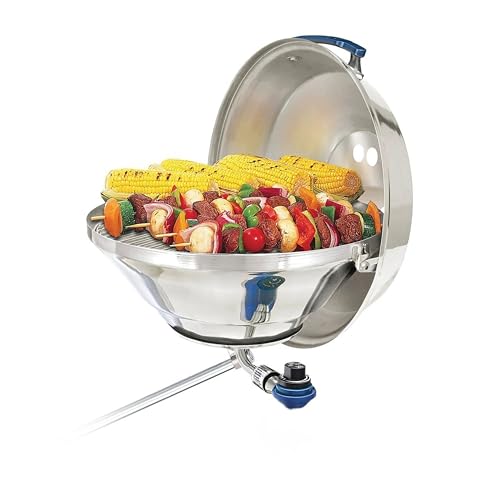
Magma Marine Kettle Gas Boat Grill, Party Size 17 in (A10-215) — Best for Bigger Crews
Two extra inches of diameter does not sound like much until you are cooking on it: the Party Size kettle fits the extra row of burgers, the second fish, the foil packet of potatoes that the 15-inch makes you choose against. Everything else about the formula is unchanged — the deep wind-shedding bowl, the domed lid that works as a windscreen, the same mount ecosystem — which is precisely the appeal. If the original kettle is the right grill in the wrong size for your crew, this is the correction.
Strengths
- Extra grate area feeds five to six without a second grill
- Same wind behaviour and mount compatibility as the 15-inch original
- Domed lid gives headroom for whole fish and beer-can-style birds
Trade-offs
- Bigger bowl needs a bigger locker or a permanent mount
- Single heat zone, like all kettles — batch cooking is the technique
- Mid-premium tier pricing once the mount is added
| Model | A10-215 Marine Kettle |
| Size | 17 in (Party Size) |
| Fuel | Propane |
| Construction | Marine-grade stainless steel |
The Party Size shines at the raft-up, where one boat becomes the kitchen for three. The kettle format handles the stop-start rhythm of social cooking well: lid down to hold heat between batches, lid up to serve, and a shape that does not care which direction the evening breeze picks. It also pairs naturally with a pedestal mount on a pontoon, where the round footprint wastes none of the corner space a rectangular grill would claim.
The trade-off to accept is storage. On boats under about 24 feet, this grill wants to live on its mount; if your plan was locker storage, measure the locker before ordering, because the 17-inch bowl with lid is a genuinely bulky object. Boats with the space will never think about it again.
Best for: pontoon owners and raft-up hosts regularly cooking for five or six people / Not suited for: small boats planning to stow the grill in a locker after every trip
Check the current price on Amazon

Magma Marine Kettle3 Combo Stove & Gas Grill, Party Size 17 in (A10-217-3) — Best Stove-and-Grill Combo
Small boats ration their appliances ruthlessly, and the Kettle3 Combo exists for the boat that has room for exactly one cooker. Swap the grate for the stove configuration and the unit becomes a single-burner stove that takes a kettle, a saucepan, or a skillet; swap back and it is the party-size kettle grill. For overnighters on boats without a galley — cuddy cabins, larger centre consoles, small sailboats — that conversion turns a grill into a genuine cooking system: coffee at dawn, grilled fish at dusk, from one mount and one fuel canister.
Strengths
- Converts between grill and stove, replacing two appliances with one
- Party-size 17 in format keeps real cooking capacity in both roles
- Marine-grade stainless construction, same mount ecosystem as the kettles
Trade-offs
- Conversion parts are one more thing to store and keep track of
- As a stove it is a single burner — no two-pot meals
- Premium tier pricing for the flexibility
| Model | A10-217-3 Marine Kettle3 Combo |
| Size | 17 in (Party Size) |
| Function | Dual-purpose stove and grill |
| Construction | Marine-grade stainless steel |
The combo’s value shows up on the second day of a trip. Grills alone strand you at breakfast; a stove alone strands you at dinner. The Kettle3 covers both with equipment that stores as one unit, and because it shares the kettle family’s bowl and lid, its wind behaviour in grill mode is the proven one rather than an experiment. In stove mode the burner sits sensibly low, and a kettle comes to the boil at a pace that respects a morning departure time.
Buy it as a system, not a novelty: keep the conversion parts in a dedicated pouch in the same locker, and the swap becomes a one-minute habit. Boats with a proper galley gain less — the stove function duplicates what is already below deck — but for galley-free boats this is the most capable single cooker in the marine aisle.
Best for: galley-free overnight boats that need one appliance to grill dinner and boil breakfast / Not suited for: boats with a full galley, where the stove function is redundant
Check the current price on Amazon
Comparison Table
All six are propane marine grills in stainless steel; the differences that matter are format, burner type, and how each one mounts and stores.
| Pick | Badge | Key spec | Best for |
|---|---|---|---|
| Magma Catalina Infrared Gas Boat Grill (A10-1218-2GS) | Best Overall | 12 x 18 in infrared grate, marine-grade stainless | liveaboard and weekend cruisers who cook full meals at anchor and want the most wind-proof sear in the category |
| Magma Marine Kettle Gas Boat Grill, Original Size 15 in (A10-205) | Best Classic Kettle | 15 in kettle, marine-grade stainless, propane | smaller boats and pontoons cooking for two to four people in real wind |
| Magma Cabo Portable Gas Grill (A10-703) | Best for Small Boats | 9 x 18 in grate, folding legs, marine-grade stainless | trailer boats, fishing boats, and small cruisers that store the grill in a locker between trips |
| Camco Kuuma Stow N’ Go 216 Elite Propane Grill (58155) | Best Value Rail-Mount Pick | Thermometer, push-button igniter, warming rack, fold-away legs | budget-conscious boaters who still want ignition, a thermometer, and a warming rack |
| Magma Marine Kettle Gas Boat Grill, Party Size 17 in (A10-215) | Best for Bigger Crews | 17 in kettle, marine-grade stainless, propane | pontoon owners and raft-up hosts regularly cooking for five or six people |
| Magma Marine Kettle3 Combo Stove & Gas Grill, Party Size 17 in (A10-217-3) | Best Stove-and-Grill Combo | 17 in dual-purpose stove + grill, marine-grade stainless | galley-free overnight boats that need one appliance to grill dinner and boil breakfast |
How to Choose a Boat Grill
Start with where the grill will live, because that decision quietly chooses the grill for you. A grill that stays rail-mounted all season can be larger and heavier; a grill that comes out of a locker must fold, latch, and fit a space you should measure before shopping. Boaters who skip the measuring step own the world’s nicest dock-box ornament. Write down the locker dimensions or the rail position first, then read the rest of this guide with those numbers in hand.
Next, choose the format. Kettles (the two Magma Marine Kettles and the Kettle3 Combo) are the forgiving all-rounders: wind-resistant, simple, and happy with almost any food, but limited to one heat zone and a round grate. Rectangular grills (the Catalina and the Cabo) lay food out in rows and zones, which suits mixed grills and larger pieces, and the Stow N’ Go splits the difference with a rectangular body and a folding, storage-first design. There is no universal winner — there is only the format that matches how you actually cook.
- Measure the storage locker or choose the mount position before choosing the grill
- Kettle format for wind forgiveness; rectangular format for layout and batch cooking
- Marine-grade stainless steel is non-negotiable for saltwater use
- Budget for the mount and a cover at the same time as the grill
- One heat zone is fine for most boat cooking; two zones is a luxury few marine grills offer
Finally, think about fuel logistics. Nearly every boat grill runs on small disposable propane canisters, which are easy to store and swap but create waste and a per-hour cost that adds up over a season. Some setups can be adapted to a boat’s larger propane system with the correct marine-rated hardware; if that idea appeals, treat it as a job for proper marine fittings and follow the grill manufacturer’s guidance exactly, because improvised fuel plumbing on a boat is how accidents happen.
Mounting Options Explained: Rail, Pedestal, Rod Holder, Tabletop
The rail mount is the classic boat grill installation: a clamp grips the stern or side rail and holds the grill outboard, over the water, where drips and smoke stay off the deck. It is the safest place to cook on most boats and the position that keeps the cockpit usable while dinner happens. Check your rail diameter before ordering, because mounts are sized to specific rail tubing, and confirm the rail itself is through-bolted and strong enough to carry a loaded grill in a seaway.
Pedestal mounts bolt to a swim platform, cockpit sole, or dock and hold the grill at working height like a tiny patio setup. They suit pontoons and larger cruisers, and they are the best choice when several boats raft up and one platform becomes the shared kitchen. Rod-holder mounts drop into a fishing rod holder and are the fastest install of all — ideal for fishing boats that already have holders to spare — while tabletop mode, offered by the Cabo and the Stow N’ Go with their folding legs, needs no hardware at all and works on any stable surface, on or off the boat.
Whichever system you choose, apply the underway rule: a mounted grill should either be rated by its maker to stay mounted while running, with the lid latched, or it comes off and goes in the locker before you leave the anchorage. A grill torn off a rail at speed is a hazard to everyone behind you, and insurers take a dim view of it.
Wind, Heat, and Cooking Technique on the Water
Wind is the defining cooking condition on a boat, and technique matters as much as hardware. Position the boat work in your favour where you can: a grill on the lee rail cooks calmer than one on the windward side. Preheat longer than you would at home — small burners and thin lids lose heat fast — and then keep the lid closed as much as the food allows, opening it in short, purposeful intervals rather than cooking with it up out of habit.
Expect the upwind edge of any boat grill to run cooler, and rotate food rather than fighting the burner. Infrared models like the Catalina narrow the gap between edge and centre; kettle models reward you for using the lid as an oven. A simple instant-read thermometer removes the guesswork that wind introduces, and on a boat it earns its drawer space every single cook.
Plan the menu around the machine, too. Thin, quick foods — fish fillets, shrimp, sausages, sliced vegetables, flatbreads — play to a boat grill’s strengths and forgive its fluctuations. Thick steaks and whole chickens are achievable, especially in the kettles, but they demand the lid-down, thermometer-checked patience that a rolling anchorage makes harder to sustain. Many experienced boat cooks sear on the grill and finish gently with the lid closed, treating the grill as a combined sear station and small oven rather than an open fire that must do everything at full blast.
Reading the Spec Sheet: What the Numbers on a Boat Grill Actually Mean
Boat grill listings are short on numbers compared with patio grills, and that is partly honest: burner output figures measured in still air tell you little about performance in a 12-knot breeze. The specifications worth weighing are the ones in the listings themselves — grate dimensions, construction material, ignition type, and the mount options the manufacturer supports. Grate dimensions deserve a second look, because shape matters as much as area: a 9 x 18 inch grate and an 18-inch round grate may post similar areas, but the rectangle takes a row of skewers or two long fillets that the circle handles awkwardly.
Construction language is the other spec to read literally. ‘Marine-grade stainless steel’ is a materials claim the brands in this guide stake their reputations on; vague phrases like ‘stainless finish’ or ‘rust-resistant coating’ describe something else, and on a boat the difference shows within a season. Likewise, treat ‘portable’ in a title as a description of size, not of purpose — several land-based portables are portable too, and they are not built for rails, salt, or motion.
Finally, check what the box does not include. Mounts, covers, and sometimes regulators are separate purchases across this whole category, so compare the complete cost of a working installation — grill plus the mount your boat needs — rather than the headline price of the grill alone. Two grills that look a tier apart often land within a few dollars of each other once both are actually mounted and ready to cook.
Corrosion Care: Keeping Stainless Marine-Grade in Practice
Marine-grade stainless resists salt; it does not ignore it. The care routine that keeps a boat grill bright for years is short: rinse or wipe the exterior with fresh water after saltwater trips, dry it before covering, and never leave a wet cover sealed over a salty grill for weeks, which creates exactly the oxygen-starved crevice conditions stainless dislikes. Tea-staining — the light brown surface blush that appears on even good stainless in marine air — is cosmetic and lifts with a stainless cleaner and a soft cloth.
Burners and regulators deserve the same attention. Clear burner ports of debris, check the regulator connection for the snug fit the maker specifies, and store canisters upright in a ventilated locker, never in the cabin or an enclosed bilge space. Ten minutes of care per trip is the difference between a grill that lasts two seasons and one that lasts ten.
How to Mount and Set Up a Boat Grill Safely
This sequence covers a first-time rail-mount installation and the checks to repeat every trip. It assumes the mount and grill are from the same manufacturer, which is the combination the hardware was designed for.
- Choose the cooking position: outboard over the water where possible, clear of fuel vents, filler caps, canvas, and lines, with room to work without leaning over the rail.
- Test-fit the mount to the rail and confirm the clamp matches your rail diameter; the mount should close fully with no rocking when you push on it firmly.
- Secure the mount exactly as its instructions specify, then attach the grill and latch or lock it in place before connecting any fuel.
- Connect the regulator and a propane canister by hand, following the grill maker’s sequence; check the connection with the soapy-water test the manual describes if anything feels loose.
- Open the lid, ignite the burner using the grill’s ignition or a long lighter as directed, and confirm an even flame pattern across the burner before the first preheat.
- Preheat with the lid closed, then do a short trial cook of something forgiving — sausages or vegetables — to learn your grill’s hot and cool spots in real wind.
- After cooking, let the grill cool fully, close and latch the lid, disconnect the canister if the grill will be stored, and fit the cover once the metal is dry.
Repeat the mount-tightness and connection checks at the start of every trip, not just the first one: vibration works on every boat fitting eventually, and the thirty seconds it takes to wiggle the mount and glance at the regulator is the cheapest safety equipment you own. The same discipline applies to the cooking itself: never leave a lit grill unattended on a boat, keep a fire extinguisher rated for grease fires within reach of the cooking position rather than below deck, and brief anyone else who will use the grill on where the fuel shutoff is. Boats concentrate people, fuel, and fabric in a small space, and the grill is the one open flame most of them carry — respecting that fact costs nothing and prevents the only kind of boat-grill story nobody wants to tell.
Common Buying Mistakes
Buying a patio portable instead of a marine grill. Land-based portables use painted or plated steel that rusts quickly in salt air, lack latching lids, and have no proper boat mounts. The savings disappear the first time you replace one, which will be soon.
Forgetting the mount is a separate purchase. Most marine grills ship without mounting hardware because the right mount depends on your boat. Price the grill, mount, and cover together or the ‘deal’ grill becomes the expensive one.
Mounting over the deck instead of over the water. Grease drips, flare-ups, and dropped food all argue for cooking outboard. A grill positioned over fibreglass or teak will eventually mark it, and a flare-up near canvas or a fuel vent is a genuine hazard.
Storing propane canisters in the cabin. Disposable canisters belong upright in a ventilated locker that drains overboard, never in enclosed living or bilge spaces. This is a hard safety rule, not a tidiness preference.
Judging size by grate area alone. A big grate on a small burner cooks slowly and unevenly, especially in wind. Match the grill to your typical crew size and let burner design — infrared, shielded, kettle-enclosed — carry the performance.
Leaving the grill uncovered on the rail all winter. Even marine stainless suffers under a season of neglect. Rinse, dry, cover, or better, store the grill ashore; spring-you will be grateful.
Final Recommendation
If you buy one grill from this list and stop reading, make it the Magma Catalina Infrared: it cooks the most like a real grill, in the conditions boats actually provide, and its rectangular format suits the way crews eat. The Marine Kettle in 15-inch form remains the default for smaller boats, and the 17-inch Party Size is the same idea scaled for sociable anchorages.
On a budget, the Kuuma Stow N’ Go 216 Elite delivers the features that matter — ignition, thermometer, warming rack — at a value-tier price, and the Cabo is the locker-friendly pick for trailer boats. The Kettle3 Combo stands alone for galley-free boats that need breakfast as well as dinner. Whichever you choose, buy the correct mount at the same time and treat the soapy-water connection check as part of lighting the grill, every time.
The linked picks, for a final side-by-side check of current pricing: Magma Catalina Infrared Gas Boat Grill (A10-1218-2GS), Magma Marine Kettle Gas Boat Grill, Original Size 15 in (A10-205), Magma Cabo Portable Gas Grill (A10-703), Camco Kuuma Stow N’ Go 216 Elite Propane Grill (58155), Magma Marine Kettle Gas Boat Grill, Party Size 17 in (A10-215), Magma Marine Kettle3 Combo Stove & Gas Grill, Party Size 17 in (A10-217-3).
Related guides in this series: Best Boat Bbq Grills Best Boat Gas Grills Best Bbq Grills For Rvs Best Beach Grills Best Bbq Camp Grills
Frequently Asked Questions
What size boat grill do I need?
Match the grill to your typical crew, not your biggest party. A 15-inch kettle or a slim rectangular grill handles two to four people comfortably; five or six regular diners justify a 17-inch kettle or the Catalina’s rectangular grate. For the occasional big raft-up, batch cooking on a mid-size grill beats storing a huge grill all season.
Can I use a regular portable grill on a boat?
You can physically, but it is a poor idea. Patio portables lack marine-grade stainless, latching lids, and boat mounts, and they corrode quickly in salt air. A purpose-built marine grill costs more because the materials and mounting systems are genuinely different.
Which mount is best: rail, pedestal, or rod holder?
Rail mounts suit most boats because they cook outboard over the water. Pedestals fit pontoons and swim platforms where a fixed working-height station makes sense. Rod-holder mounts are the fastest option on fishing boats. All three are secure when matched to the grill and installed as directed; the best one is the one that fits your boat’s layout.
How do boat grills handle wind?
By design and by technique. Kettles enclose the burner in a deep bowl and use the lid as a windscreen; infrared burners radiate through an emitter that wind cannot blow out. You help by cooking on the lee side, preheating longer, and keeping the lid closed.
Are disposable propane canisters safe on a boat?
Yes, when handled properly: connect them as the grill maker directs, check connections, and store spares upright in a ventilated locker that vents overboard. Never store canisters in the cabin, and never use a boat grill in an enclosed space.
How long will a marine grill last?
With fresh-water rinses after saltwater use, a cover or indoor storage off-season, and occasional burner cleaning, a marine-grade stainless grill should serve for many seasons. Neglect — salt left on the steel, a wet cover sealed over it, winter on the rail — shortens that dramatically.

