Disclosure: airfryerkitchensupply.com is reader-supported. When you buy through links on our site, we may earn an affiliate commission at no extra cost to you.
Where to buy
Start here if you are shopping for the best bbq camp grills. Camp grills live a hard life — bounced in trunks, cooked on in the wind, packed away damp — so every model below was verified in Amazon’s catalog before receiving a link. Check the current price on Amazon when you buy, and if you are shopping close to a trip, order early enough to do a test cook at home. A camp grill you have never lit should not make its debut at a hungry campsite.
- Weber Go-Anywhere Portable Charcoal Grill — Check the current price on Amazon
- Coleman RoadTrip 285 Portable Stand-Up Propane Grill — Check the current price on Amazon
- Weber Smokey Joe 14-Inch Portable Charcoal Grill — Check the current price on Amazon
- Cuisinart Chef’s Style Portable Propane Tabletop Gas Grill CGG-306P — Check the current price on Amazon
- Weber Jumbo Joe Charcoal Grill 18-Inch — Check the current price on Amazon
- Char-Griller AKORN Jr. Portable Kamado Charcoal Grill and Smoker — Check the current price on Amazon
The best bbq camp grills solve a specific puzzle: real grilled food, cooked over real heat, from a package that fits in a car trunk next to the tent and the cooler. The best camp grills are not shrunken backyard grills — they are designed around transport, with locking lids, folding or detachable legs, protected burners or ash containment, and grates sized for campsite appetites rather than block parties.
Fuel choice divides the field. Charcoal camp grills are light, simple and produce the best flavor, but they demand a lighting window, ash management, and compliance with campsite fire rules — many parks restrict charcoal during dry periods, and some require all cooking inside designated fire rings. Propane camp grills light instantly, cook through wind better with the lid down, and switch off the second you finish, which rangers and tired campers both appreciate. This guide includes both, plus one insulated kamado-style cooker for campers who base-camp for days and want to smoke as well as grill.
One honest caution before the picks: no camp grill replaces knowing your site’s rules. Check fire restrictions before you pack charcoal, carry a way to fully extinguish and pack out ash where required, and never cook inside a tent or enclosed vestibule. The right grill is the one that is legal, stable and fed — in that order.
In this guide
Quick Picks
The six picks below cover drive-up campsites, tailgates and picnic-table cooking. Match the grill to your vehicle space first, then to your menu.
- Weber Go-Anywhere Portable Charcoal Grill — Best Overall: the rectangular charcoal portable whose legs fold up and lock the lid — the classic car-camping grill, refined over decades. — check price on Amazon
- Coleman RoadTrip 285 Portable Stand-Up Propane Grill — Best Stand-Up Gas: a folding stand-up propane grill with three burners and push-button ignition — backyard posture, campsite footprint. — check price on Amazon
- Weber Smokey Joe 14-Inch Portable Charcoal Grill — Best Budget: the miniature kettle — 14 inches of porcelain-enameled charcoal simplicity for two-person camps and tiny loads. — check price on Amazon
- Cuisinart Chef’s Style Portable Propane Tabletop Gas Grill CGG-306P — Best Tabletop Gas: a stainless tabletop gas grill with twin burners and 275 sq. in. — two-zone cooking that sits on the picnic table. — check price on Amazon
- Weber Jumbo Joe Charcoal Grill 18-Inch — Best for Groups: the 18-inch portable kettle — near-backyard capacity that still travels, for camps feeding five or six. — check price on Amazon
- Char-Griller AKORN Jr. Portable Kamado Charcoal Grill and Smoker — Best for Base-Camp Smoking: the insulated mini kamado that can hold smoking temperatures for hours at a base camp on a small pile of charcoal. — check price on Amazon
How These Picks Were Chosen
We selected from portable lines with proven campsite designs — Weber’s portable charcoal and gas families, Coleman’s RoadTrip series, Cuisinart’s tabletop models and Char-Griller’s compact kamado — and verified each product against Amazon’s catalog on 2026-11-21. Only listing-confirmed models carry purchase links in this guide.
The criteria were campsite-specific. Transport: the grill must close, lock or break down so it travels without rattling apart or spilling ash. Stability: it must sit steady on a picnic table or its own legs on uneven ground. Wind behavior: lidded designs scored higher, because open mini grills lose most of their heat to a breeze. Capacity: enough grate for four campers’ main course in one batch, or an honest statement that it cooks for two. Cleanup: ash and grease must be containable, because ‘leave no trace’ applies to dinner too.
The 6 Best BBQ Camp Grills

Weber Go-Anywhere Portable Charcoal Grill — Best Overall
The Go-Anywhere is the camp grill other portables are compared against. Its rectangular steel body packs flat, the plated legs pivot up to lock the lid for carrying, and the shape — unlike round mini kettles — matches how food actually arranges: a row of sausages, four burgers, or skewers laid straight. The current listing was confirmed in the listing catalog for this guide.
It suits car campers, picnickers and tailgaters cooking for two to four. It does not suit backpackers — this is a drive-to grill — and it does not suit anyone who wants to cook standing at a cart; it works on a picnic table or a heat-proof ground pad, low and steady.
Strengths
- Legs fold and lock the lid — no separate bungee or bag needed for transport
- Rectangular grate uses its area efficiently for real meals, not just round items
- Porcelain-enameled steel shrugs off trunk knocks and campsite weather
Trade-offs
- Charcoal rules apply: check site fire restrictions and plan ash disposal
- Cooking height is tabletop-low; ground cooking means kneeling
- No thermometer — judge heat by hand and experience
| Fuel | Charcoal |
| Design | Rectangular portable, folding locking legs |
| Brand line | Weber Go-Anywhere (per Amazon listing) |
What makes the Go-Anywhere the top pick is how completely it thinks about the journey. The lid locks, the handles stay cool enough to move the grill mid-session with gloves, and the vents on both ends let you build a small two-zone fire — coals banked left for searing, empty right for finishing. That two-zone trick is rare in portables and transforms campsite cooking: chicken starts over coals and finishes gently instead of charring.
Durability is the other half of the story. Camp gear fails at hinges, latches and thin steel; the Go-Anywhere has almost none of those, and its enamel finish tolerates being packed warm-ish, rained on and stored in a garage corner. Buy it once and it becomes the grill that lives in the car all summer, ready for the unplanned picnic that turns into dinner.
Best for: car campers and picnickers cooking real meals for two to four / Not suited for: backpacking or sites under charcoal fire bans
Check on Amazon — check the current price on Amazon before you decide, because grill pricing moves with the season.

Coleman RoadTrip 285 Portable Stand-Up Propane Grill — Best Stand-Up Gas
The RoadTrip 285 is the camp grill for people who hate cooking hunched over a table. Its scissor legs fold flat for the trunk, then set up into a full standing grill with three burners and push-button ignition — the Amazon listing for this model confirms the RoadTrip 285 configuration. Swap-top grates and griddles are part of the RoadTrip ecosystem, so breakfast pancakes and dinner burgers can share one cooker.
It suits base campers, tailgaters and RV travelers cooking for four to six. It does not suit minimalists — folded, it is still a substantial package — and it runs on small propane canisters or a bulk tank with an adapter, so fuel planning is part of ownership.
Strengths
- Stands at cooking height, then folds flat enough for a trunk or RV bay
- Three burners give genuine zone control unusual in a portable
- Push-button ignition and propane convenience suit tired, hungry arrivals
Trade-offs
- Heavier and bulkier than tabletop portables — measure your cargo space
- Small canisters empty quickly on long cooks; a tank adapter helps
- More parts to clean after greasy cooks than a charcoal box
| Fuel | Propane gas |
| Burners | 3 burners |
| Design | Folding stand-up portable (RoadTrip series) |
The RoadTrip’s party trick is not folding — many grills fold — it is cooking like a real grill when unfolded. Three burners across a wide grate mean sausages can sear while onions soften in the cool zone, and the lid holds enough heat to roast vegetables properly. For a family base camp of three or four nights, that capability replaces the picnic-table shuffle of cooking in sad batches.
Ownership notes: the grease tray must be emptied before folding or it will remind you why, and the stand prefers level ground or a patient shim job on one foot. Neither is a dealbreaker. If your camping style is drive-up, stay-put and cook properly, this is the grill that matches it.
Best for: base campers and tailgaters who cook full meals standing up / Not suited for: minimalist packers or one-night ultralight stops
Check on Amazon — check the current price on Amazon before you decide, because grill pricing moves with the season.
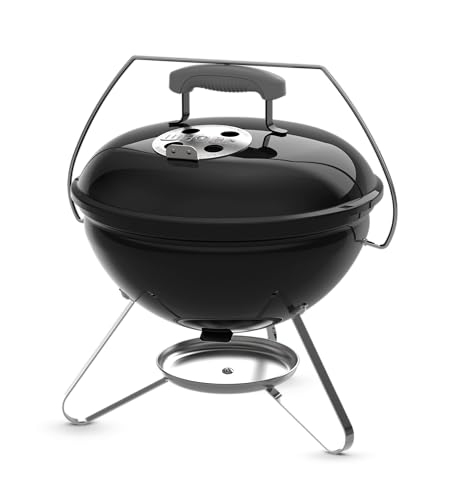
Weber Smokey Joe 14-Inch Portable Charcoal Grill — Best Budget
The Smokey Joe is the Weber kettle shrunk to picnic scale: a 14-inch porcelain-enameled bowl and lid, a plated grate, and dampers that work like its big brothers’. The Amazon listing confirms the current 14-inch portable model. It is the grill that lives in apartment closets and car trunks across the country because it asks for almost no space and no money to speak of, relative to the class.
It suits one or two campers, festival and beach cooks, and anyone adding a small charcoal option beside a gas setup. It does not suit groups — plan on four burgers at a time — and its low stance means table or ground-pad cooking only.
Strengths
- Kettle-grade enamel and dampers in the smallest practical package
- Light enough to carry with the camping tote in the other hand
- Burns a tiny amount of charcoal per cook — economical for two
Trade-offs
- 14-inch grate is a hard limit for groups
- Ash management in a small bowl needs care on windy sites
- No locking lid on the base design — transport it cool and upright
| Fuel | Charcoal |
| Size | 14-inch portable kettle (per Amazon listing) |
| Brand line | Weber Smokey Joe |
Small charcoal grills often fail on airflow: one token vent, a fire that either rages or dies. The Smokey Joe inherits the kettle’s damper logic, so a camper can actually control a small fire — vents open for searing, cracked for gentle cooking, closed to snuff the coals and save them. That control is why it cooks above its price class.
The honest limitations are size and transport discipline. It must cool fully before the trunk, and ash should be emptied into a metal container, not the campsite ground. Within those rules it is nearly indestructible, and for two-person trips it delivers genuine grilled flavor for the weight of a hardback book.
Best for: couples and solo campers wanting kettle quality in miniature / Not suited for: group cooking or careless pack-it-hot transport
Check on Amazon — check the current price on Amazon before you decide, because grill pricing moves with the season.

Cuisinart Chef’s Style Portable Propane Tabletop Gas Grill CGG-306P — Best Tabletop Gas
The CGG-306P is the tabletop gas grill we recommend when charcoal is banned, impractical or just not the mood. Its Amazon listing confirms the recipe: twin 10,000 BTU burners, 275 square inches of cooking area and a stainless steel body — a combination that gives genuine two-zone cooking in a box that sits on the campsite picnic table.
It suits campers cooking for three to five who want gas speed with real control, and boaters and tailgaters with a sturdy table. It does not suit anyone cooking directly on plastic folding tables — the base gets hot and needs a proper surface — and like all small-canister gas grills, long sessions argue for a bulk-tank adapter.
Strengths
- Twin burners allow a sear zone and a gentle zone — rare in tabletop size
- 275 sq. in. is family-sized for a portable
- Stainless body wipes down easily after campsite cooking
Trade-offs
- Needs a heat-safe, stable table — not every camp setup has one
- Small canisters are a consumable to plan and pack
- No legs or stand included in the tabletop concept
| Fuel | Propane gas |
| Burners | Twin 10,000 BTU burners (per Amazon listing) |
| Cooking area | 275 sq. in. (per Amazon listing) |
| Body | Stainless steel (per Amazon listing) |
Most tabletop gas grills have one burner and one temperature: optimistic. The CGG-306P’s twin burners change what is cookable at a campsite — thick chops sear on the left and finish on the right, corn roasts gently while burgers char, and the lid-down heat is even enough for foil-pack meals. The 275 square inches swallow a family dinner without batch juggling.
The trade-offs are logistics, not cooking. Feed it from a bulk tank on longer trips, set it on a proper surface, and let it cool before the latches close. Do those three things and it is the most capable small gas grill in this guide — the one we would choose for a week-long base camp where charcoal is off the table.
Best for: families base-camping where charcoal is banned or impractical / Not suited for: ultralight setups or plastic-table cooking
Check on Amazon — check the current price on Amazon before you decide, because grill pricing moves with the season.

Weber Jumbo Joe Charcoal Grill 18-Inch — Best for Groups
The Jumbo Joe splits the difference between the Smokey Joe and a full kettle: an 18-inch charcoal grill with a lid-locking carry handle design in the portable line, confirmed in the listing catalog. That extra diameter over the 14-inch portables is the difference between cooking for a family in one batch or two — and at a campsite, one batch means everyone eats together.
It suits group car camping, scout and team outings, and tailgates for five or six. It does not suit small trunks — measure before you commit — and it shares charcoal’s rules about fire bans and ash disposal.
Strengths
- 18-inch grate cooks a full group meal in one round
- Lid-lock handle design keeps it closed for carrying
- Full kettle damper control in a portable body
Trade-offs
- Bulkiest charcoal portable here — needs real trunk space
- More charcoal per cook than the mini kettles
- Low stance means table or ground-pad cooking
| Fuel | Charcoal |
| Size | 18-inch portable kettle (per Amazon listing) |
| Brand line | Weber Jumbo Joe |
Group camping exposes small grills cruelly: the first four burgers are eaten by the time the last four cook. The Jumbo Joe’s 18 inches fix the arithmetic while keeping kettle manners — real dampers, enamel durability, and enough bowl depth for a two-zone fire that can hold finished food warm at the edge. For a designated camp cook feeding the whole site, it is the charcoal pick.
It asks for space and charcoal in return. Pack it where it cannot roll, budget a proper bag of briquettes for a weekend, and assign the ash to a metal bucket. Groups that do those things get backyard-quality output at a picnic table, which is exactly the Jumbo Joe’s design brief.
Best for: group car campers and tailgaters feeding five or six / Not suited for: small cars or solo minimalists
Check on Amazon — check the current price on Amazon before you decide, because grill pricing moves with the season.

Char-Griller AKORN Jr. Portable Kamado Charcoal Grill and Smoker — Best for Base-Camp Smoking
Every other grill in this guide grills. The AKORN Jr. also smokes — its triple-wall insulated steel body and cast iron grates, per the Amazon listing, let it hold low temperatures for hours on very little charcoal. For base campers who stay three nights and want ribs or a pork shoulder at the site, it opens a menu no other portable here can touch.
It suits patient camp cooks and small groups at a fixed base. It does not suit move-every-day touring — it is the heaviest style of portable here — and kamado temperature management is a skill: easy to overshoot, slow to correct.
Strengths
- Insulation holds smoking temperatures with minimal charcoal and tending
- Sears hard when asked — cast iron grates plus high kamado heat
- One cooker covers the whole base-camp menu from breakfast to brisket-style cooks
Trade-offs
- Heaviest pick here; strictly a vehicle-based grill
- Small grate — smoking cuts fit, crowd grilling does not
- Learning curve on vent control for first-time kamado users
| Fuel | Charcoal |
| Body | Triple-wall insulated steel (per Amazon listing) |
| Grates | Cast iron (per Amazon listing) |
| Style | Portable kamado grill and smoker |
The AKORN Jr.’s campsite superpower is fuel economy over time. A kettle burns through charcoal on a long cook; the insulated kamado sips it, which matters when the nearest store is forty minutes away. Set it at smoking temperature in the morning and it largely minds itself while the camp hikes — a style of cooking no thin-wall portable can safely imitate.
Bring it when the trip has a base and a cook who enjoys the process. Skip it for one-night stops, where its weight and warm-up time buy nothing. Judged on the right trip, it is the most capable cooker in this guide; judged on the wrong one, it is ballast.
Best for: multi-day base camps wanting grilled and smoked food from one cooker / Not suited for: one-night stops or weight-conscious packing
Check on Amazon — check the current price on Amazon before you decide, because grill pricing moves with the season.
Comparison Table
| Pick | Badge | Key spec | Best for |
|---|---|---|---|
| Weber Go-Anywhere Portable Charcoal Grill | Best Overall | Rectangular charcoal portable, locking folding legs | car campers and picnickers cooking real meals for two to four |
| Coleman RoadTrip 285 Portable Stand-Up Propane Grill | Best Stand-Up Gas | 3-burner folding stand-up propane portable | base campers and tailgaters who cook full meals standing up |
| Weber Smokey Joe 14-Inch Portable Charcoal Grill | Best Budget | 14-inch portable charcoal kettle | couples and solo campers wanting kettle quality in miniature |
| Cuisinart Chef’s Style Portable Propane Tabletop Gas Grill CGG-306P | Best Tabletop Gas | Twin 10,000 BTU burners, 275 sq. in., stainless tabletop | families base-camping where charcoal is banned or impractical |
| Weber Jumbo Joe Charcoal Grill 18-Inch | Best for Groups | 18-inch portable charcoal kettle, locking carry design | group car campers and tailgaters feeding five or six |
| Char-Griller AKORN Jr. Portable Kamado Charcoal Grill and Smoker | Best for Base-Camp Smoking | Insulated steel kamado, cast iron grates | multi-day base camps wanting grilled and smoked food from one cooker |
Choose by trip style. One-night and picnic cooking favors the Smokey Joe or Go-Anywhere; family base camps favor the Cuisinart tabletop or the RoadTrip; groups need the Jumbo Joe’s diameter; and the AKORN Jr. is a specialty tool for campers who smoke. Fuel rules at your destination can overrule all of this — check them first, because the best camp grill is the one you are allowed to light.
How to Choose a Camp Grill
Start with your vehicle, not your appetite. Measure the space the grill can actually occupy — trunk floor, RV bay, truck bed corner — and shop inside that box. A grill that travels badly gets left at home, and a grill left at home has zero cooking area. Folding legs, locking lids and flat-packing shapes earn their keep every single trip.
Next, the campsite itself. Developed campgrounds give you a picnic table, which makes tabletop models practical; dispersed camping gives you ground, which favors grills with their own legs or a ground pad plan. Wind exposure matters more than most buyers expect: exposed sites punish open grills and reward deep, lidded designs that hold heat.
Capacity honesty
Portable grill capacity claims assume you enjoy playing Tetris with burgers. Realistically, a 14-inch round grate cooks for two, an 18-inch for four to six in one batch, and a 275 sq. in. tabletop gas grill feeds a family with modest juggling. If your camp is six hungry adults, buy for six — batch cooking at a campsite, in the dark, with mosquitoes, is nobody’s favorite memory.
Finally, decide who cleans. Charcoal means ash that must be fully cold and packed out or disposed of in designated containers. Gas means a grease tray that must be emptied before the grill tips into the trunk. Neither is hard; both are unforgiving if skipped. Pick the chore your group will actually do.
Charcoal vs. Propane at the Campsite
Charcoal wins on flavor, weight and simplicity. A charcoal portable has no regulator to fail, no hose to crack, and produces the smoke-kissed results people drive to campsites for. It loses on rules and routine: fire bans can idle it completely, lighting takes time and a chimney, and the fire must be fully out — cold to the touch where required — before you sleep or drive.
Propane wins on permission and convenience. Many fire-restricted sites still allow gas appliances with an on-off valve when charcoal is banned (always confirm locally — rules vary and change with conditions). It lights instantly for the first-night cook in the dark and shuts off the moment dinner ends. It loses on consumables: small canisters are a per-trip cost and a packing item, and flavor comes from the food rather than the fuel.
The seasoned answer is that the two fuels cover different trips. Charcoal for the relaxed weekend at a familiar site; propane for long tours, uncertain rules and fast evenings. Some of the best-equipped camp kitchens carry a small grill of each kind and decide at the trailhead.
Camp Grill Safety and Fire Rules That Actually Matter
Rules vary by park, forest and season, so treat this as the floor, not the law: cook only in designated areas where required, keep the grill on a stable, non-combustible surface, and never leave a lit grill unattended. During dry periods, expect charcoal restrictions to arrive before gas restrictions, and expect both to be enforced.
Ash deserves its own paragraph because it causes real campsite fires. Ashes can hold heat for many hours. Douse, stir and douse again, or let them cool completely in the closed grill, then transfer to a metal container with a lid for disposal or pack-out. Never dump ash on the ground, in a plastic trash bag, or near the tent — and never store a warm grill in a closed vehicle.
Carbon monoxide is the quiet rule: grills of every fuel type are outdoor-only appliances. Not in the tent, not in the vestibule, not in the RV with the vent open. Cook outside, in the weather, every time — and keep a small extinguisher or a bucket of water within reach while you do.
Packing the Camp Kitchen Around Your Grill
A camp grill is the center of a small system, and the system decides whether campsite cooking feels like a pleasure or a logistics exercise. Build it as one kit that lives together: the grill, its fuel, a chimney or lighter in a dry bag, long tongs and a spatula in a roll, a stiff brush, a metal container with a lid for ash, a small cutting board, and a headlamp — because camp cooking always ends in the dark at least once per trip. When the kit packs as one tote beside the grill, nothing essential gets left in the garage, which is the most common camp-cooking failure of all.
Fuel planning deserves its own habit. For charcoal, portion briquettes by the cook, not by the bag: a sandwich bag or small sack per meal keeps the big bag dry in the car and tells you at a glance whether the trip’s fuel matches the menu. For propane, carry one canister in use and one sealed spare, and mark the in-use one with a grease pencil line at the trip’s start — canister weight by hand is a guess, and the spare removes the stakes from guessing wrong.
Food packing is the other half of the system. Marinate at home in sealed bags that double as their own transport, freeze the second night’s meat solid so the cooler works less, and pack a ‘first night’ meal that needs no prep beyond the grill — because the first night always runs late, the tent always takes longer than remembered, and a grill that asks only for fire and ten minutes is the difference between dinner and despair. The picks in this guide were chosen partly on how gracefully they handle exactly that first-night test.
Finally, pack the cleanup before you need it. A small basin, biodegradable soap used well away from water sources, a scrub pad, and paper towels in a sealed bag turn the post-dinner hour into a short routine. Ash goes in the metal container, grey water is strained and scattered per local rules, and food scraps go in the animal-proof trash — every night, without exception. Campsites stay beautiful, and bears stay uninterested, when camp kitchens run this way.
Camp Grill Menus: Cooking Beyond Burgers
The camp grill graduates when the menu does. Burgers and sausages are the first night; the cooks who get the most from the picks in this guide plan one meal per trip that uses the grill as an oven and one that uses it as a stove top. As an oven — lid down, gentle zone ready — a camp grill roasts foil-packet meals with zero cleanup, bakes cornbread in a small cast iron skillet, and finishes a Dutch-oven-style cobbler over the last coals while dinner’s dishes soak. None of that needs a bigger grill; it needs the lid discipline and zone habits the how-to section teaches.
As a stove, the grate takes a skillet or a flat griddle plate beautifully: pancakes and bacon for the camp, fajitas with the peppers charring directly on the bars while the meat rests, or a one-pan hash that feeds everyone from the same surface. Tabletop gas models like the Cuisinart and the RoadTrip’s swap-top ecosystem make this second identity official, but a charcoal portable with a small skillet does the same job with more theater.
Plan the menu against the fuel you packed. Charcoal trips should front-load the ambitious cooks while the coal supply and the cook’s energy are high, and end with the simplest meal on the last night, when the light is going and the car gets packed in the morning. Gas trips can spread ambition evenly but should still respect canister arithmetic — the long, lidded roast belongs early in the trip if fuel is finite, not as the finale that discovers an empty canister.
The deeper point is that a camp grill is a creative constraint, not a limitation. One surface, one fire, a handful of ingredients and no fallback takeout: that is the exact environment where simple food tastes extraordinary, and why people remember campsite dinners out of all proportion to their complexity. Choose the grill that fits your car and your sites’ rules, learn its two or three tricks, and let the menu grow one dish per trip.
How to Set Up and Cook on a Camp Grill, Step by Step
A smooth campsite cook is mostly preparation. This sequence works for every pick in the guide.
- Scout the spot first: a level, non-combustible surface downwind of tents, away from dry grass and low branches, with room to work. Set the grill and confirm it does not rock before any fuel is involved.
- Check the rules for tonight, not last season: fire restrictions change with conditions, and the camp host or posted board is the authority.
- For charcoal: light a chimney on the grill grate or a fire-safe surface, wait until the coals are ashed over, then spread or bank them for your zones. For gas: connect the canister or tank outdoors, check connections by smell and sound, then light with the lid open.
- Preheat with the lid closed for ten minutes, brush the grate, and oil the food — not the grate — for the least sticking.
- Cook in an order: foods that hold well (sausages, vegetables) can go first and wait at the cool edge; quick foods (burgers, fish) go last so everything lands together.
- Rest meat in a covered pan while you toast buns or finish vegetables on the remaining heat — camp grills cool fast once the main cook ends, so use the heat you have.
- Close down safely: gas off at the valve first, then the knobs. Charcoal vents closed to starve the fire, lid on, and the grill left in place until it is cool before any packing begins.
The home habit that separates good camp cooks: do one full test cook in the driveway before the first trip. Every grill in this guide behaves slightly differently, and the driveway is a kinder classroom than a dark campsite.
Wind, the invisible ingredient
Wind steals more campsite dinners than bad grills do. It strips heat from open grates, bends gas flames, and blows charcoal ash across the site. Counter it with placement first: cook on the lee side of the car, a boulder or the picnic table’s wind shadow, with the grill’s lid hinge toward the wind so the lid itself becomes a shield when opened. On gas, keep the lid down and extend cooking times rather than cranking burners, which mostly heats the breeze. On charcoal, cluster coals tighter and expect to use the dampers more actively. A folding windscreen is worth its small pack space on exposed sites — it is the cheapest ‘upgrade’ in camp cooking.
Cooking for a group from a small grill
Small grills feed groups by sequencing, not by surface area. Cook in waves ordered by holding quality: sausages and thick vegetables first — they wait happily at the cool edge or in a covered pan — then chicken pieces, then the fast, must-be-hot items like burgers, fish and steak last, timed to land as people sit down. Keep a lidded pan or foil tent as your holding zone, rest meat in it, and let the grill run continuously rather than in cold-start batches. The cook eats last and eats best: the final wave is yours.
Common Buying Mistakes
- Packing charcoal where fire bans are in force. Check current restrictions for your destination; a banned grill is dead weight and a fine risk.
- Transporting a warm grill. Ash and grease stay hot far longer than the lid feels. Cool completely, empty safely, then pack.
- Buying for the biggest group you ever hosted. Most trips are two to four people. An oversized portable that stays home cooks nothing.
- Cooking on the plastic camp table. Tabletop grills need a heat-proof, stable surface. Carry a folding metal table or use the provided picnic table.
- Forgetting the small consumables. Lighter or matches in a dry bag, a spare canister, a brush, tongs, and a metal ash container — the grill is the easy part to remember.
- Skipping the driveway test cook. New grill plus dark campsite plus hungry group is a recipe for a memorable dinner for the wrong reasons.
Camp cooking forgives simple gear and punishes unprepared cooks. The checklist above is worth more than any upgrade.
Final Recommendation
For most campers, the Weber Go-Anywhere is the answer: it packs flat, locks shut, cooks for two to four with genuine two-zone control, and will outlast the tent it travels with. Budget buyers and couples should take the Smokey Joe and never feel under-equipped, while groups should step up to the Jumbo Joe’s 18 inches and eat together instead of in shifts.
When charcoal is banned or the trip is a long tour, the Cuisinart CGG-306P is the tabletop gas grill to pack, and the Coleman RoadTrip 285 serves base campers who want to cook standing up for a crowd. The AKORN Jr. remains the specialist’s choice for multi-day base camps with smoking on the menu. Match the grill to the trip you actually take most, and check the fire rules before every departure. Related shortlists below cover backyard, combo and budget angles if your cooking splits between home and camp.
Our top recommendations again, for convenience: Weber Go-Anywhere Portable Charcoal Grill, Coleman RoadTrip 285 Portable Stand-Up Propane Grill, Weber Smokey Joe 14-Inch Portable Charcoal Grill. Check the current price on Amazon for each before ordering, and add the cover that fits your pick to the same order.
Best Basic Grills Best Bbq Gas Grills Under $200 Best Bbq Combo Grills Best Bbq Grills For A Condo Best Bbq Grills Cleaner
Frequently Asked Questions
Are charcoal grills allowed at campsites?
Often, but not always. Many developed campgrounds allow charcoal in provided grills or your own contained grill, while dry conditions can trigger bans on charcoal before gas. Some sites require all cooking in designated fire rings. Always check the current rules for your specific destination before packing charcoal.
How do I dispose of ash at a campsite?
Let ash cool completely — ideally overnight in the closed grill — or douse it thoroughly with water and stir until cold. Transfer it to a metal container with a lid, then use the campground’s ash or trash disposal where provided, or pack it out. Never dump ash on the ground or into plastic bags while warm.
What size camp grill do I need for four people?
An 18-inch charcoal kettle or a tabletop gas grill around 275 square inches cooks a four-person main course in one batch. A 14-inch portable handles four people in two quick batches, which is fine for burgers and dogs but tedious for mixed menus.
Can I use a camp grill on a picnic table?
Tabletop models are designed for it, provided the table is sturdy and heat-tolerant — wooden picnic tables are the standard setup. Protect the surface with a heat-proof mat if in doubt, keep the grill stable, and never use a tabletop grill on plastic tables or inside any enclosure.
Is propane or charcoal better for a week-long trip?
Propane usually wins long trips: instant lighting after driving days, no ash logistics, and fewer fire-rule surprises. Charcoal wins short, settled trips where flavor is the point. Many tourers carry a compact gas grill for the week and save charcoal for home.
How do I keep a camp grill from rusting in storage?
Clean it before storing, not after: brush the grate, empty ash or grease, and let it dry fully. Store it indoors or under cover, with the lid vents cracked so moisture escapes. A light wipe of cooking oil on charcoal grates prevents the flash rust that appears over winter.
Can I cook on a camp grill at a rest stop or beach?
Often yes in designated picnic areas, but rules vary by jurisdiction and season, and some beaches ban charcoal while allowing gas. Use provided grills or pads where they exist, keep the grill attended, and dispose of ash only in marked containers. When no rule is posted, the conservative pattern — lidded grill, designated area, ash packed out — is the one to follow.
How much charcoal does a weekend of camp grilling take?
For a small portable cooking two dinners and a breakfast for two to four people, a modest bag is usually more than enough — small fireboxes are frugal, and banking coals for zones uses less than filling the bowl. Portion per meal at home so you can see the plan, and remember that unburned coals, fully extinguished and dry, can be reused.
What is the best first meal to cook on a new camp grill?
Sausages and vegetables. They forgive uneven heat, need no precise timing, show you the grill’s hot spots, and taste like a campsite should. Save the steaks for the second night, when you know the grill and the light is better.


