Disclosure: airfryerkitchensupply.com is reader-supported. When you buy through links on our site, we may earn an affiliate commission at no extra cost to you.
Where to buy
All six picks in this guide to the best briquette grills are current models from their manufacturers’ Amazon listings, verified before inclusion. Charcoal grills are heavy, awkward boxes, so check the listing for the current price on Amazon and the delivery details, and confirm whether the model you choose includes the cover and chimney starter you will want — most grills ship with neither, and both are close to essential with briquette cooking.
- Weber Original Kettle Premium Charcoal Grill, 22-Inch (Best Overall) — Check the current price on Amazon
- Weber Master-Touch Charcoal Grill, 22-Inch (Best Premium Kettle) — Check the current price on Amazon
- Char-Griller AKORN 20-Inch Kamado Charcoal Grill and Smoker (Best Kamado for Briquettes) — Check the current price on Amazon
- Dyna-Glo X-Large Premium Dual Chamber Charcoal Grill (DGN576SNC-D) (Best for Big Cookouts) — Check the current price on Amazon
- Broilmaster P3XF Premium Propane Gas Grill Head with Flare Buster (Best Gas Grill Over Briquettes) — Check the current price on Amazon
- Weber Original Kettle Charcoal Grill, 18-Inch (Best Compact) — Check the current price on Amazon
Searching for the best briquette grills means you have already made the most important decision in charcoal cooking: the fuel. Briquettes — the uniform pillows of compressed charcoal — burn slower, steadier, and more predictably than lump charcoal, which is why they remain the default fuel for kettle grills, kamados, and barrel cookers across the world. A grill that suits briquettes is one whose vents, grate height, and ash management let you exploit that predictability: banking coals for two-zone fires, arranging them in lines for long smokes, and holding a temperature for hours without heroics.
One clarification before the picks: this guide treats briquette grills as grills designed around the fuel, not merely grills that can burn it. Nearly any charcoal grill will accept a pile of briquettes, but the models below were selected because their bowls, vents, grates, and ash systems make arranged briquette fires — banked, snaked, or banked-and-held — behave predictably. That distinction is the difference between a grill that tolerates your technique and one that teaches it.
The category also includes a second family that deserves its place here: gas grills that cook over a bed of ceramic briquettes, which catch drippings, vaporise them for flavour, and spread the burner’s heat evenly across the grate. The Broilmaster pick represents that tradition. What unites all six picks is that the briquette — charcoal or ceramic — is the working medium between fire and food, and the grill is designed around it.
This guide explains what separates a good briquette grill from a generic charcoal box, translates the vent and grate features that matter into cooking outcomes, and covers the fire-building techniques that make briquettes shine. Every pick was verified against its manufacturer’s Amazon listing, and the specifications quoted come from those listings alone.
In this guide
Quick Picks
The six grills that do the most with a bag of briquettes — or a bed of ceramic ones.
Weber Original Kettle Premium Charcoal Grill, 22-Inch — Best Overall. The reference briquette grill: a 22-inch porcelain-enamelled kettle with a built-in lid thermometer, precise dampers, and the deepest accessory and knowledge ecosystem in charcoal cooking. Check price on Amazon
Weber Master-Touch Charcoal Grill, 22-Inch — Best Premium Kettle. The kettle, finished properly: a tuck-away lid holder that ends the where-do-I-put-the-lid dance, One-Touch cleaning, and upgraded grates and hardware for cooks who use the grill weekly. Check price on Amazon
Char-Griller AKORN 20-Inch Kamado Charcoal Grill and Smoker — Best Kamado for Briquettes. An insulated steel kamado that sips briquettes: triple-wall construction holds smoking temperatures on a small coal bed for hours, then climbs to steakhouse searing heat when the vents open. Check price on Amazon
Dyna-Glo X-Large Premium Dual Chamber Charcoal Grill (DGN576SNC-D) — Best for Big Cookouts. A dual-chamber barrel design that lets you run two briquette fires at two temperatures — steaks searing in one chamber while chicken finishes gently in the other. Check price on Amazon
Broilmaster P3XF Premium Propane Gas Grill Head with Flare Buster — Best Gas Grill Over Briquettes. The briquette idea, engineered into gas: a premium cast-aluminium grill head whose Flare Buster ceramic briquette system spreads heat evenly, vaporises drippings for flavour, and all but ends flare-ups. Check price on Amazon
Weber Original Kettle Charcoal Grill, 18-Inch — Best Compact. The 18-inch kettle for balconies, couples, and small households: the same briquette manners as its bigger brothers, in a footprint that fits where they cannot. Check price on Amazon
Most buyers should start with the Weber Original Kettle Premium and stop second-guessing; it is the reference design for a reason. It is also the grill whose size, fuel use, and learning curve fit the widest range of households, which is what a best-overall pick is supposed to mean. Read on if your cooking leans toward long smokes, big crowds, small patios, or the gas-and-briquette hybrid path.
How These Picks Were Chosen
Picks were chosen for briquette compatibility in the practical sense: a charcoal grate that holds a banked or arranged bed of briquettes without them cascading into the bowl vents, dampers with enough range to steer a briquette fire from smoking temperatures to searing ones, and ash handling that copes with the one thing briquettes produce more of than lump — ash. Models with flimsy vent controls or ash systems that clog mid-cook were passed over regardless of brand.
The second filter was construction honest to the fuel. Briquette fires burn long, which means the grill’s bowl, lid, and grates live at temperature for hours; porcelain-enamelled steel and cast iron, the materials in these picks, are the ones with decades of evidence behind them. Thin painted bowls that blister in a season did not make the list.
Finally, each pick had to be a current, verifiable product with manufacturer support — replacement grates, dampers, and ash tools available — because a charcoal grill is a ten-year purchase and its wear parts are consumables. One pick, the Broilmaster, was included deliberately as the category’s gas representative: its ceramic briquette bed is a designed feature, not an accessory, and for some buyers it is the right answer to this exact search.
The 6 Best Briquette Grills

Weber Original Kettle Premium Charcoal Grill, 22-Inch — Best Overall
If one grill defines briquette cooking, it is this one. The 22-inch kettle’s bowl geometry was shaped around a bed of briquettes: deep enough to bank coals against one wall for a two-zone fire, shallow enough that the cooking grate sits at the distance generations of cooks have calibrated their timing to. The Premium trim adds the details that matter on a briquette grill — a built-in lid thermometer so you steer the fire with information, and Weber’s ash handling that keeps the bowl vents breathing through a long cook instead of choking on briquette ash.
Strengths
- Bowl and vent design tuned by decades of briquette cooking
- Built-in thermometer makes fire management a measured activity
- Unmatched ecosystem of grates, baskets, and technique knowledge
Trade-offs
- Single grate level — no warming rack in the classic layout
- Lid thermometer reads lid air, not grate temperature
- Accessories you will want (chimney, baskets, cover) are separate purchases
| Size | 22-inch kettle |
| Thermometer | Built-in lid thermometer |
| Fuel | Charcoal briquettes (or lump) |
| Format | Kettle grill |
What the kettle teaches is control. Its dampers respond proportionally — a quarter-closed bottom vent lowers a briquette fire by a predictable step — so techniques like the two-zone fire, the snake arrangement for smoking, and the minion method all behave the way the books describe. Briquettes are the predictable fuel, and this is the predictable grill; the combination is why beginners improve fast on it and why experienced cooks keep one beside far more expensive equipment.
Durability is the quiet argument. Porcelain enamel over steel shrugs off the heat cycling of long briquette burns, the grates are replaceable wear parts rather than a death sentence, and the design’s sheer ubiquity means advice, parts, and accessories will exist for as long as you own it. For most households this is not the starter briquette grill; it is the only one they will ever need.
Best for: almost everyone — the default recommendation for briquette grilling and smoking / Not suited for: cooks who regularly feed eight or more from the grill alone
Check the current price on Amazon

Weber Master-Touch Charcoal Grill, 22-Inch — Best Premium Kettle
The Master-Touch takes the 22-inch kettle formula and removes its small daily frictions. The tuck-away lid holder is the headline: the lid slides into a bracket at the back instead of being hooked on the bowl edge or set on the ground, which matters more with every year of ownership than any specification suggests. One-Touch cleaning sweeps ash into the catcher with a lever, keeping the bowl vents clear through the ash-heavy reality of briquette fuel, and the overall hardware — grates, handles, wheels — is a step up in hand from the standard kettle.
Strengths
- Tuck-away lid holder solves the kettle’s oldest annoyance
- One-Touch ash system suits high-ash briquette fuel
- Same 22-inch cooking geometry and ecosystem as the classic kettle
Trade-offs
- Premium tier over the Original Kettle Premium for refinements, not more cooking area
- Still a single-level grate layout
- Colour and trim choices vary by listing — check the exact configuration
| Size | 22-inch kettle |
| Lid | Tuck-Away lid holder |
| Cleaning | One-Touch cleaning system |
| Fuel | Charcoal briquettes (or lump) |
Choose the Master-Touch if the kettle is your primary cooker rather than an occasional one. The refinements compound: a lid that parks itself, ash swept in seconds, and grates that feel like equipment rather than fittings make the weekly cook smoother, and smooth is what keeps a charcoal grill in regular use instead of ceding weeknights to gas. The fire behaviour is pure kettle — banked briquettes, responsive dampers, dependable two-zone control — so every technique in this guide applies unchanged.
It is also the better long-term buy for briquette devotees specifically, because briquette ash is the kettle’s main maintenance burden and this model was specified with that burden in mind. If your cooks run long and often, the One-Touch system alone justifies the step up.
Best for: frequent kettle cooks who want the refined, ash-friendly version of the classic / Not suited for: occasional grillers, for whom the standard kettle premium is the smarter spend
Check the current price on Amazon

Char-Griller AKORN 20-Inch Kamado Charcoal Grill and Smoker — Best Kamado for Briquettes
Kamados and briquettes are natural partners, and the AKORN is the accessible proof. Its triple-wall insulated steel body holds heat the way ceramic does, so a modest bed of briquettes maintains low smoking temperatures for hours with the vents barely open — the most fuel-efficient cooking in this roundup. Open the dampers and the same insulation works in reverse, letting the fire climb to the fierce temperatures that crust a steak properly. Cast iron grates complete the picture, holding the heat that makes those sear marks real rather than painted on.
Strengths
- Triple-wall insulation makes briquettes last for very long cooks
- Huge temperature range — low smoker to high-heat searing in one unit
- Cast iron grates for genuine sear performance
Trade-offs
- Costs more charcoal-cook attention at high heat — insulated fires overshoot if you chase them
- Steel body is durable but not the lifetime ceramic of premium kamados
- Temperature comes down slowly once hot; plan cooks accordingly
| Size | 20-inch kamado |
| Construction | Triple-wall insulated steel |
| Grates | Cast iron |
| Fuel | Charcoal briquettes (or lump) |
The AKORN changes the briquette maths. Where a kettle might burn through a chimney or two across a long smoke, the kamado’s insulation stretches a single load remarkably far, and the fire’s stability once settled is the best in this guide — set the vents, and the temperature trace flattens in a way kettle cooks envy. Briquettes, with their even size and steady burn, suit this precision better than irregular lump, which is why this pick is framed for them specifically.
It is also the most versatile cooker here per square foot: pizza at high heat, ribs at low heat, and everything between, in a footprint a kettle would fill alone. Buyers who want one charcoal unit to do every job, and who accept the kamado learning curve — small vent changes, patience on cool-downs — will find the AKORN the most capable briquette grill in the list.
Best for: efficiency-minded cooks who smoke long and sear hot in one compact unit / Not suited for: cooks who need to drop temperature quickly mid-cook or feed a crowd at once
Check the current price on Amazon
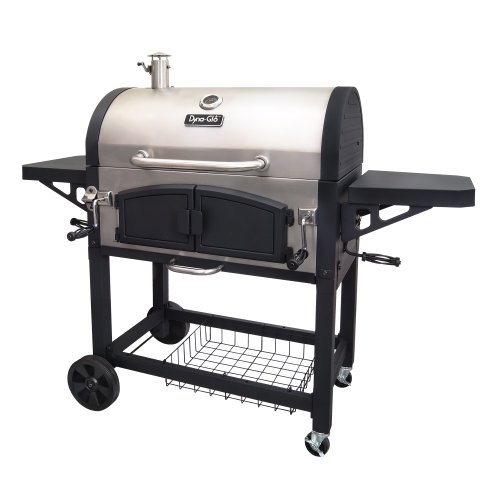
Dyna-Glo X-Large Premium Dual Chamber Charcoal Grill (DGN576SNC-D) — Best for Big Cookouts
The Dyna-Glo dual chamber answers the kettle’s one real limitation: a single fire means a single temperature. Its divided charcoal chamber lets you build two independent briquette fires — a fierce one for searing and a moderate one for finishing, or a smoking fire on one side and a holding fire on the other — inside one extra-large grill. For the cook feeding a crowd with a mixed menu, that is not a gimmick; it is the difference between serving everything hot and apologising for the chicken.
Strengths
- Dual chamber runs two briquette fires at different temperatures
- Extra-large format suits parties and batch cooking
- Direct and indirect cooking at the same time, in one unit
Trade-offs
- Two fires to build and manage — more charcoal, more attention
- Large footprint demands real patio space
- Less of a technique ecosystem than the kettle family
| Model | DGN576SNC-D |
| Design | Dual chamber charcoal grill |
| Size class | X-Large premium |
| Fuel | Charcoal briquettes (or lump) |
The dual chamber rewards planners. Light the hot side first for the sear items, let the gentle side’s briquettes settle to a steady glow, and the cook becomes a flow rather than a queue: sear, move, hold, serve. Briquette fuel flatters the design, because matched piles of uniform coals in each chamber behave symmetrically, and adjusting one side does not disturb the other’s established fire the way a single shared bed would.
Accept the costs honestly: this grill eats more charcoal than a kettle, asks you to mind two fires, and occupies the patio like furniture. Households whose grilling is mostly four burgers will never use its talents. Households whose grilling is a standing Saturday event for a dozen people will wonder how they managed without it.
Best for: party cooks running mixed menus who need two heat zones at full size / Not suited for: small households or small patios
Check the current price on Amazon

Broilmaster P3XF Premium Propane Gas Grill Head with Flare Buster — Best Gas Grill Over Briquettes
Broilmaster built its reputation on a simple conviction: gas grills cook better over briquettes. The P3XF’s Flare Buster system lays ceramic briquettes between the burner and the grate, where they absorb the burner’s output and re-radiate it evenly, catch drippings and return them as flavourful vapour, and shield food from the direct flame paths that cause flare-ups. The head itself is cast aluminium — the material that does not rust out — in the brand’s long-running premium format, sold as a head to mount on the cart or post configuration of your choice.
Strengths
- Ceramic briquette bed evens heat and suppresses flare-ups by design
- Cast aluminium head resists the corrosion that ends steel grills
- Drippings vaporise on the briquettes for charcoal-adjacent flavour
Trade-offs
- Sold as a grill head — cart or post mount is a separate decision
- Ceramic briquettes are a wear item that eventually needs refreshing
- Premium tier, and a different ownership style from disposable big-box gas grills
| Model | P3XF Premium grill head |
| Heat system | Flare Buster ceramic briquettes |
| Fuel | Propane gas |
| Construction | Cast aluminium head, black |
Cooking over the briquette bed feels different from the first use: the grate temperature evens out, the angry flare when fatty burgers go on simply does not arrive, and the flavour picks up the vaporised-dripping character that plain gas grills are criticised for lacking. It is the honest middle path for households that want briquette behaviour — even heat, flavour, forgiveness — with gas convenience and none of the ash.
Ownership is the other half of the Broilmaster proposition. These heads are built to be repaired rather than replaced, with burners, briquettes, and grates available as parts over long production runs. Buyers tired of the three-year big-box grill cycle will recognise the value immediately; the fuller Broilmaster story is covered in this programme’s dedicated guide to the brand.
Best for: gas grillers who want briquette-style even heat and flavour without charcoal / Not suited for: charcoal devotees — this is a different, equally valid path, not a substitute experience
Check the current price on Amazon
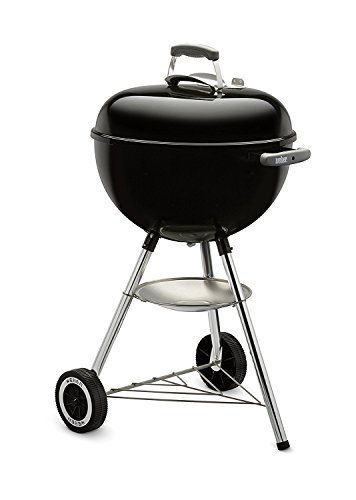
Weber Original Kettle Charcoal Grill, 18-Inch — Best Compact
Not every household needs 22 inches of grate, and the 18-inch Original Kettle is the honest small option: the same porcelain-enamelled bowl design, the same One-Touch cleaning, the same damper logic, scaled to the two-to-four-person cooks that make up most of grilling life. It burns a smaller bed of briquettes, heats faster, uses less fuel per cook, and stores in spaces — apartment balconies, small decks, a corner of the garage — that exclude its larger siblings.
Strengths
- Full kettle technique in a compact, fuel-sipping size
- One-Touch cleaning handles briquette ash easily
- Light and simple to move, store, and take along
Trade-offs
- Grate area limits batch size — a crowd means cooking in waves
- Two-zone fires are tighter; indirect space is modest
- No built-in thermometer on this classic configuration
| Size | 18-inch kettle |
| Cleaning | One-Touch cleaning system |
| Fuel | Charcoal briquettes (or lump) |
| Format | Classic kettle grill |
The 18-inch kettle teaches the same lessons as the 22 with cheaper tuition: less charcoal per fire, faster feedback, and cooks sized to weeknight reality. Its two-zone fire is a smaller stage — a modest bank of briquettes on one side, a chicken or a few chops on the other — but the technique is identical, and everything learned here transfers directly if a bigger kettle ever joins it. For couples, it is frequently the only grill that ever gets used, precisely because it asks so little.
It also travels. The kettle format at this size rides in a car boot to a campsite or a beach house without a packing strategy, which makes it the pick for renters and second-home owners as much as for balcony cooks. Small is a feature when the alternative is a big grill that stays home.
Best for: couples, balconies, and small households cooking for two to four / Not suited for: hosts cooking for six or more at once
Check the current price on Amazon
Comparison Table
Format explains the field: kettles for technique, the kamado for efficiency, the dual chamber for crowds, and the Broilmaster for gas convenience over a briquette bed.
| Pick | Badge | Key spec | Best for |
|---|---|---|---|
| Weber Original Kettle Premium Charcoal Grill, 22-Inch | Best Overall | 22 in kettle, built-in thermometer, porcelain-enamelled bowl | almost everyone — the default recommendation for briquette grilling and smoking |
| Weber Master-Touch Charcoal Grill, 22-Inch | Best Premium Kettle | 22 in kettle, Tuck-Away lid holder, One-Touch cleaning | frequent kettle cooks who want the refined, ash-friendly version of the classic |
| Char-Griller AKORN 20-Inch Kamado Charcoal Grill and Smoker | Best Kamado for Briquettes | 20 in insulated steel kamado, cast iron grates | efficiency-minded cooks who smoke long and sear hot in one compact unit |
| Dyna-Glo X-Large Premium Dual Chamber Charcoal Grill (DGN576SNC-D) | Best for Big Cookouts | Dual-chamber XL charcoal grill, two independent fires | party cooks running mixed menus who need two heat zones at full size |
| Broilmaster P3XF Premium Propane Gas Grill Head with Flare Buster | Best Gas Grill Over Briquettes | Cast aluminium head, Flare Buster ceramic briquette bed, propane | gas grillers who want briquette-style even heat and flavour without charcoal |
| Weber Original Kettle Charcoal Grill, 18-Inch | Best Compact | 18 in kettle, One-Touch cleaning | couples, balconies, and small households cooking for two to four |
How to Choose a Briquette Grill
Begin with the fire you intend to manage. A kettle gives you one versatile fire and the deepest technique support in charcoal cooking. A kamado gives you efficiency and range — the same briquettes lasting far longer — at the cost of slower temperature corrections. A dual-chamber or barrel grill gives you capacity and parallel fires for crowds. And a briquette-bed gas grill gives you the evenness and flavour logic of briquettes with push-button fuel. The right choice follows from your typical cook, not from specifications.
Then examine the three features that decide daily satisfaction. Vent control: dampers should move smoothly through a wide range and stay where you set them, because briquette fire management is vent management. Ash handling: briquettes produce substantially more ash than lump, so a grill that sweeps or collects ash without dismantling earns its keep on every long cook. Grate quality: heavy grates — cast iron or thick steel — hold the searing heat that briquettes, burning slightly cooler at the surface than lump, benefit from.
- Match format to your typical cook: kettle technique, kamado efficiency, barrel capacity, gas convenience
- Prioritise smooth, wide-range dampers — they are your temperature control
- Take ash handling seriously; briquettes are a high-ash fuel
- Heavy grates compensate for briquettes’ gentler surface heat
- Budget for a chimney starter and a cover with any charcoal pick
Size last, and size honestly. A 22-inch kettle feeds most families; an 18-inch serves couples better than a big grill serves anyone; and the dual-chamber’s capacity only pays when crowds are routine. Oversized grills burn oversized fires for undersized dinners, which wastes the fuel economy that makes briquettes attractive in the first place.
Briquettes vs Lump Charcoal: The Honest Comparison
Briquettes are manufactured for consistency: uniform size, uniform density, a burn that repeats from bag to bag and hour to hour. That consistency is their genius. A snake of briquettes burns along its length at a pace you can plan a brisket around; a banked pile holds a two-zone fire with a stable hot side; a kamado load lasts a predictable span. The costs are real and worth naming: briquettes produce more ash, which can choke airflow on very long cooks in poorly designed bowls, and they light a little slower and burn a touch cooler at peak than the best lump.
Lump charcoal is the opposite bargain: irregular, fast-lighting, fierce at peak, and variable — one bag’s fist-sized chunks are another’s gravel. Cooks who sear above all else often prefer it. For the grilling and smoking most households do — burgers, chicken, ribs, the occasional brisket — briquette predictability wins more cooks than lump’s peak heat does, which is why every charcoal pick in this guide was evaluated as a briquette grill first.
A note on quality within the category: plain briquettes without lighter-fluid impregnation are the ones to buy, lit in a chimney with paper or a cube rather than fluid, which keeps petroleum flavours out of the food and out of the neighbourhood’s air. Self-lighting briquettes have their place at a picnic with no chimney, but they are not the fuel to build a technique on.
Briquette Arrangements: Banked, Snake, and Minion Fires
The banked fire is the foundation: lit briquettes pushed to one side of the bowl, leaving the other side coal-free. It creates the two-zone setup described throughout this guide and suits about eighty percent of kettle cooking. Master it first. The snake is the smoking arrangement: unlit briquettes laid two wide and two tall in a long arc around the bowl’s edge, with wood chunks placed along the top and a few lit coals at one end. The fire travels the snake over many hours, igniting fresh coals as it goes, holding smoking temperatures with an evenness that feels like cheating the first time you watch it work.
The minion method serves kamados and long cooks: a bed of unlit briquettes with a small number of lit coals placed on top or in a centre well, so the fire grows downward and outward slowly. In the AKORN’s insulated body this produces exceptionally long, stable burns from a single load. All three arrangements share one principle — the fire should meet fresh fuel gradually, on a schedule set by the arrangement rather than by the cook returning with a chimney — and all three are only possible because briquettes are uniform. Irregular lump cannot be laid in a snake that burns at a predictable pace, which is the deepest reason this fuel owns the low-and-slow category.
Expect to calibrate each arrangement once per grill. A snake that holds your target in a kettle may run warmer in a kamado’s insulated body, where fewer coals do the same work. Write down the arrangement, the vent settings, and the result; two or three logged cooks turn these techniques from recipes into reflexes, and your grill becomes the predictable instrument the picks in this guide were chosen to be.
Grates, Lids, and the Small Hardware That Decides Satisfaction
Cooking grates are where specifications meet dinner. Heavy grates — the AKORN’s cast iron, the kettles’ substantial steel — store heat and return it to the food as sear marks and crust; light wire grates flex, shed food through wide gaps, and cool the moment a cold steak lands. Hinged grate sections, common in the kettle ecosystem, matter specifically to briquette cooks because they let you add coals or rearrange a banked fire mid-cook without lifting the food off — a small feature that changes long cooks from ordeals into routines.
Lids deserve the same scrutiny. A lid that seals reasonably, sits without rocking, and carries a thermometer you can read gives you an oven; a warped lid leaks the heat your briquettes made and turns vent settings into suggestions. None of the picks here suffers a bad lid, which is not a coincidence — it was a selection filter — but second-hand buyers should rock every lid they meet, because a dropped kettle lid is the most common hidden defect in the used market.
Finally, wheels, handles, and ash catchers sound like trivia until the first time you move a lit-adjacent grill, carry a hot lid, or knock an open ash pan across a deck. The picks here handle those moments with hardware that stays cool, rolls straight, and contains ash — the unglamorous engineering that separates a grill you keep for a decade from one you replace in three years. None of it photographs well, and all of it is felt every single cook, which is why experienced buyers run their hands over a grill’s hardware before they read its feature list.
Ceramic Briquettes in Gas Grills: How the Other Briquette Works
The gas-grill briquette bed solves the two oldest complaints about gas: hot spots and blandness. A layer of ceramic briquettes over the burner absorbs its output and re-radiates it across the full grate, so the corner of the grill cooks like the centre. Drippings that land on the hot ceramics vaporise instead of pooling and flaring, returning flavour to the food and calm to the cook. Systems like Broilmaster’s Flare Buster were engineered around exactly this behaviour, with the briquette tray designed as part of the grill rather than an aftermarket insert.
Ceramic briquettes are consumables on a long fuse: over seasons they absorb grease, crack, and lose their evenness, and refreshing the bed restores the grill’s manners in an afternoon. Owners of briquette-bed grills should treat that refresh as scheduled maintenance — the equivalent of a charcoal cook emptying ash — and cooks shopping second-hand should price a tired briquette bed into any used premium gas grill they consider.
How to Build and Manage a Briquette Fire
These steps cover the core skill every pick in this guide rewards: a controlled briquette fire, built in a chimney, arranged for the cook, and steered with vents.
- Measure the fuel to the cook: a full chimney for high-heat grilling, a partial chimney plus arranged unlit briquettes for smoking — measuring is what makes the next cook repeatable.
- Light in a chimney starter over paper or a starter cube, and wait until the top coals are ashed over; pouring early gives you a fire that is still changing its mind.
- Arrange the lit briquettes for the cook: spread evenly for direct grilling, banked to one side for a two-zone fire, or laid in a line against unlit coals for a long, travelling smoke.
- Set the cooking grate, close the lid, and open both vents fully for five minutes to stabilise, then close the bottom vent toward your target — roughly half for medium heat, a quarter for smoking temperatures.
- Cook with the lid on and the thermometer as your guide, adjusting the bottom vent in small steps and giving each change ten minutes to register before judging it.
- Use the top vent for fine control and smoke management, keeping it at least partly open so the fire breathes cleanly and the smoke stays sweet rather than stale.
- When the cook ends, close all vents to starve the fire; unburned briquettes that cool in the closed grill can be shaken free of ash and reused in the next fire — a small economy that adds up.
- Empty ash once the grill is fully cold, into a metal container, and store the container outdoors away from combustibles; briquette ash holds heat far longer than it looks like it should.
Master this sequence and every charcoal pick in this guide becomes predictable. The cooks who struggle with briquettes almost always skip the measuring or the waiting; the fuel itself is the most forgiving in outdoor cooking, and it rewards a repeatable routine with repeatable dinners. One habit separates consistent cooks from frustrated ones across every arrangement in this guide: change nothing during the first twenty minutes after the food goes on. The fire is establishing itself, the grill is absorbing heat, and early adjustments chase numbers that were still in transit. Patience at the start is what the steady middle of the cook is made of.
Common Buying Mistakes
Using lighter fluid instead of a chimney. Fluid flavours food, flares unpredictably, and makes fire-building a different event every time. A chimney starter costs little, works every time, and is the foundation of repeatable briquette cooking.
Spreading every fire evenly. An even bed is right for a tray of burgers and wrong for almost everything else. A two-zone fire — briquettes banked to one side — gives you a sear zone and a safe zone, and it is the single technique that improves home grilling most.
Ignoring ash until the vents clog. Briquettes are a high-ash fuel. Ash that buries the bowl vents starves the fire and masquerades as a fuel or grill problem. Sweep or empty ash between cooks, especially before long smokes.
Steering with both vents at once. Change one vent, wait, and observe. Cooks who move the top and bottom dampers together never learn which one did what, and their fires wander for years.
Buying the biggest grill for the smallest household. Oversized grills burn oversized fires. An 18-inch kettle cooking for two will out-perform a cavernous barrel at the same job, on a third of the charcoal.
Letting a gas grill’s ceramic briquettes rot in place. Grease-soaked, crumbling briquettes cause the flare-ups and hot spots the system exists to prevent. Refresh the bed when it darkens, cracks, or smells of old grease when heated.
Final Recommendation
The Weber Original Kettle Premium is the briquette grill to buy if you buy one: the reference design, the deepest knowledge base, and fire manners that make the fuel’s predictability pay. The Master-Touch is the same idea with its daily frictions removed, and it is the better buy for weekly cooks. The AKORN is the efficiency champion and the most versatile single unit here, while the Dyna-Glo dual chamber owns the big-cookout brief outright.
Choose the 18-inch kettle without embarrassment if your household is small — it is a complete grill, not a compromise — and consider the Broilmaster P3XF seriously if your household is done with charcoal but not with what briquettes do for food. Every pick here was verified and every one will cook well; the differences are about the cook you are, which is exactly what a buying guide should sort out. Buy the chimney starter with whichever charcoal pick you choose, keep the briquettes dry, and give the first three cooks the status of lessons rather than performances — by the fourth, the grill will feel less like equipment and more like a habit, which is the real destination of every recommendation in this guide.
The linked picks, for a final side-by-side check of current pricing: Weber Original Kettle Premium Charcoal Grill, 22-Inch, Weber Master-Touch Charcoal Grill, 22-Inch, Char-Griller AKORN 20-Inch Kamado Charcoal Grill and Smoker, Dyna-Glo X-Large Premium Dual Chamber Charcoal Grill (DGN576SNC-D), Broilmaster P3XF Premium Propane Gas Grill Head with Flare Buster, Weber Original Kettle Charcoal Grill, 18-Inch.
Related guides in this series: Best Broilmaster Grills Ever Made Best Big Charcoal Grills Best Built Charcoal Grills Best Basic Grills Best Box Smoker Grills
Frequently Asked Questions
Are briquettes or lump charcoal better?
For most cooking, briquettes: they burn longer, steadier, and more repeatably, which suits grilling and smoking alike. Lump lights faster and can burn hotter at peak, which some searing specialists prefer. Briquettes produce more ash, so they pair best with grills that handle ash well — as all the charcoal picks here do.
How many briquettes do I need for a cook?
A full chimney — roughly a hundred briquettes — covers high-heat grilling on a 22-inch kettle. Two-zone and smoking setups use fewer lit coals arranged against unlit ones. Measuring by the chimney rather than by the handful is what makes your fires repeatable from cook to cook.
How long do briquettes burn?
A full chimney of lit briquettes grills at high heat for the better part of an hour, and arranged fires burn far longer: a kettle snake commonly runs through a long smoking session on one load, and an insulated kamado stretches a modest load further still. Exact times depend on the grill, the vents, and the weather, which is why the arrangements section of this guide emphasises logging your own cooks.
Can I reuse leftover briquettes?
Yes. Close the vents when you finish cooking to starve the fire, and the unburned briquettes can be shaken free of ash and used in the next fire, usually topped up with fresh ones. Fully ashed coals are done and should be discarded once cold.
What is a two-zone fire and why does it matter?
Briquettes banked on one side of the grill create a hot direct zone and a cooler indirect zone. You sear over the coals, then move food to the safe side to finish without burning — the technique behind good chicken, thick steaks, and anything with a sugary sauce.
Do ceramic briquettes in a gas grill need replacing?
Eventually, yes. Over seasons they absorb grease, crack, and lose their ability to spread heat evenly; flare-ups returning to a previously calm grill is the classic symptom. Refreshing the bed is inexpensive maintenance that restores the grill’s original manners.
Why does my briquette fire keep going out?
Almost always airflow: ash burying the bowl vents, vents closed too far in pursuit of low temperature, or a lid opened so often the fire never settles. Clear the ash, open the bottom vent a step, and give changes time to register before adjusting again.
Are briquettes safe to cook over?
Yes, when used as directed: choose plain briquettes without lighter-fluid impregnation, light them in a chimney, and wait until they are fully ashed over before food goes on the grate. At that point the binders have burned off and what remains is charcoal heat. The same fully-lit rule is why fluid-lit fires should always burn down completely before cooking.


