Disclosure: airfryerkitchensupply.com is reader-supported. When you buy through links on our site, we may earn an affiliate commission at no extra cost to you.
Where to buy
All six of the best barbecue smokers grills below are current-production models sold on Amazon, and every ASIN was verified against the live Amazon catalog before publication — brand and model searched, returned listing title matched, link issued only on a confident match. These are substantial outdoor appliances; check price on Amazon and read the delivery and assembly notes on the listing in front of you before ordering.
- Char-Griller Texas Trio Gas & Charcoal Grill and Smoker — Check the current price on Amazon
- Oklahoma Joe’s Canyon Combo Dual Fuel Smoker and Grill — Check the current price on Amazon
- Oklahoma Joe’s Longhorn Offset Smoker and Grill — Check the current price on Amazon
- Masterbuilt Gravity Series 600 — Check the current price on Amazon
- Traeger Pro 22 Pellet Grill & Smoker — Check the current price on Amazon
- Kamado Joe Classic Joe Series II 18-inch — Check the current price on Amazon
The best barbecue smokers grills exist because most backyards do not want two religions. They want one machine that smokes a brisket on Saturday and grills burgers on Tuesday — a cooker that can hold a gentle smoking temperature for twelve hours and then, without a second appliance or a bag of excuses, put a real sear on a steak. This guide ranks the six machines that honestly do both jobs: a three-fuel combo barrel, a dual-fuel combo, a classic offset combo, a gravity-fed digital charcoal cooker, the pellet grill that defined dual duty, and a ceramic kamado that has been grilling and smoking in one shell for generations.
Judge this category with suspicion, because “smoker grill” is printed on a lot of boxes that do one job well and the other as a rumor. A grill with a smoke tube is not a smoker. A cabinet smoker that cannot exceed baking temperatures is not a grill. The honest dual-duty test is twofold: can it hold a true smoking band for a whole brisket cook with real smoke flavor, and can it produce genuine grilling heat — the kind that crusts a steak and crisps chicken skin — without accessories doing the heavy lifting? Every pick below passes both halves, though each leans: some are smokers that grill admirably, some are grills that smoke credibly, and the reviews say which is which, because your week will be built on the lean.
The second thing to understand is the workflow these machines enable. Combo cooking is not just two appliances in one frame; it is techniques neither appliance does alone — the reverse sear that smokes a thick steak low and finishes it over the same fire at full blast, the brisket that rests while its own cooker grills the corn, the chicken smoked at noon and crisped at serving. Buyers who cook that way get more than convenience from a combo. They get a repertoire.
In this guide
Quick Picks
- Best Overall Combo — Char-Griller Texas Trio: gas, charcoal, and an offset firebox plus a side burner across 1,390 square inches — every fuel and both jobs in one frame. Check the current price on Amazon
- Best Dual-Fuel Combo — Oklahoma Joe’s Canyon Combo: 3-burner propane and charcoal smoking/grilling across 1,031 square inches — weeknight gas, weekend charcoal, one cooker. Check the current price on Amazon
- Best Offset Combo — Oklahoma Joe’s Longhorn: 1,060 square inches of traditional offset smoker that grills in its own chamber when the smoke clears. Check the current price on Amazon
- Best Digital Combo — Masterbuilt Gravity Series 600: gravity-fed charcoal with fan control — smokes like an appliance, sears like a charcoal grill, because it is one. Check the current price on Amazon
- Best Pellet Combo — Traeger Pro 22: 572 square inches of 6-in-1 pellet cooking with an 18 lb hopper — the dual-duty original. Check the current price on Amazon
- Best Ceramic Combo — Kamado Joe Classic Joe II: one ceramic shell that smokes all day and sears at steakhouse heat, with cart and shelves included. Check the current price on Amazon
How These Picks Were Chosen
Every model was verified: brand and model searched, the returned listing title matched to the intended product, and only then was the ASIN linked. Specifications in the mini boxes come from those verified listing titles.
Scoring applied the two-half test rigorously. Smoking half: real smoke generation (wood, charcoal, or pellets — not flavor tubes), temperature stability across a long cook, and capacity for at least a brisket or a full rib load. Grilling half: honest high heat at the grate, enough direct-fire area for a family’s worth of burgers or steaks, and ignition or startup that a Tuesday evening tolerates. Then the combo-specific criteria: how the two halves interact (can you sear while you smoke, or must the jobs queue?), how many fuels and systems you are maintaining, and whether the frame gives you work space for the two-tray shuffle combo cooking involves. Finally, the usual durability and parts-support screen — combo machines have more parts than single-duty ones, and the brands here all support theirs.
Excluded: dedicated smokers with no grilling story, dedicated grills with a smoking rumor, and multi-unit outdoor kitchens. Everything here is one freestanding machine a household can buy once and cook everything on.
The 6 Best Barbecue Smokers Grills

Char-Griller Texas Trio — Best Overall Combo
The Texas Trio is the maximalist answer: a 3-burner gas grill, a charcoal grill, and a side firebox that turns the charcoal side into an offset smoker, plus a side burner, across 1,390 square inches, with push-button ignition on the gas side and dual temperature gauges watching the chambers. It is the only cooker in this guide that answers every fuel question with “yes” — gas for the Tuesday burgers, charcoal for the Saturday steaks, offset fire for the brisket — and it does each job as a real version of that cooker, not a simulation.
Strengths
- Three genuine cooking systems in one frame: the consolidation bargain of the category.
- Side burner handles sauces, beans, and sides while both main chambers work.
- Gas side means the combo never fails the weeknight test that kills most smokers’ usage.
Trade-offs
- As a pure smoker, its chamber is mid-size; dedicated offsets hold more and seal better after mods.
- Three systems means three cleanups and three sets of wear parts to stay ahead of.
- The largest ownership footprint in this guide — it is a patio decision, not a purchase detail.
- Cooking space: 1,390 sq in total (per Amazon listing)
- Configuration: 3-burner gas + charcoal grill + side firebox smoker + side burner, model 3070 (per Amazon listing)
The Trio’s ownership story is the household reset: the aging gas grill and the starter smoker leave, and one machine takes over the whole outdoor menu. Its smoking mode is an honest offset — real firebox, real splits or charcoal-and-chunks — so nothing about the Saturday cook is compromised, while the gas side keeps the machine in weekly use, which is where combo value compounds. If your patio hosts one cooker and your cooking spans everything, this is the frame to beat.
Best for: households consolidating all outdoor cooking into one high-capacity machine. / Not suited for: smoking specialists wanting a maximum-size dedicated chamber. Check the current price on Amazon
Oklahoma Joe’s Canyon Combo — Best Dual-Fuel Combo
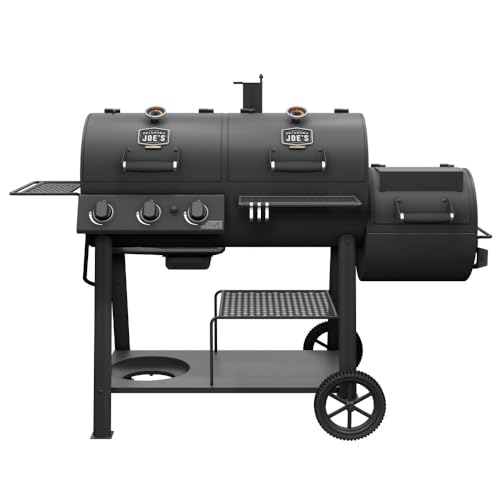
The Canyon Combo distills the combo idea to its two essential fuels: a 3-burner propane gas side and a charcoal side with smoker capability, sharing 1,031 square inches in one Oklahoma Joe’s frame. Where the Trio adds a third system and a burner, the Canyon keeps the proposition tighter — gas when time is short, charcoal and smoke when it is not — from the brand whose offset heritage shows in how seriously the charcoal side takes its smoking job.
Strengths
- The two fuels households actually use, without a third system to maintain.
- Oklahoma Joe’s firebox-and-chamber know-how applied to the charcoal/smoker side.
- 1,031 square inches is family-plus capacity in both modes.
Trade-offs
- No side burner; sauces and beans queue for chamber space or the kitchen stove.
- Combo sealing on the smoker side benefits from the usual gasket attention.
- Two fuel systems still means two maintenance rhythms.
- Cooking area: 1,031 sq in (per Amazon listing)
- Configuration: dual-fuel 3-burner propane gas and charcoal smoker/grill (per Amazon listing)
The Canyon is the combo for the cook who knows their own week: gas three nights, charcoal two, a smoking session most Saturdays. Its proportions respect that rhythm instead of selling a third capability that would mostly gather rust. In a category prone to feature inflation, that restraint — from a brand that could have added anything — is a recommendation in itself.
Best for: mixed-fuel households wanting one cooker without a third system. / Not suited for: cooks wanting a side burner or maximum offset capacity. Check the current price on Amazon

Oklahoma Joe’s Longhorn — Best Offset Combo
The Longhorn is the traditionalist’s combo: a full offset smoker — 1,060 square inches across its chamber and grilling surfaces — whose main chamber doubles as a charcoal grill when the fire moves from the firebox to beneath the grates. It is a smoker first and a grill second, and it makes no apology for the order: the offset side is a genuine, draft-honest barbecue pit, and the grill side is the same heavy chamber doing direct-heat duty.
Strengths
- True offset smoking — the deepest smoke in this guide — with no compromise hardware.
- Chamber grilling over charcoal gives the sear and capacity combo pellet machines cannot match for crowds.
- One fire system to learn, one to maintain: the simplest combo here mechanically.
Trade-offs
- Grilling requires building a charcoal fire — there is no push-button half to this combo.
- Traditional offset gradient applies in smoking mode; rotation is part of the craft.
- Long, heavy footprint that wants a permanent home.
- Cooking area: 1,060 sq in (per Amazon listing)
- Format: offset charcoal smoker and grill
The Longhorn buyer is not really buying a combo; they are buying an offset that also solves the grill question, which is how most offset owners actually live — the firebox sears the steaks while the chamber smokes, or the chamber grills the burgers while yesterday’s brisket rests. For the wood-and-charcoal household, it is the most honest machine in this guide, and its decade-scale ownership stories reflect that.
Best for: charcoal traditionalists wanting one cooker for smoking and grilling. / Not suited for: anyone needing a fast gas or electric half. Check the current price on Amazon

Masterbuilt Gravity Series 600 — Best Digital Combo
The Gravity Series 600 is the combo idea rebuilt with modern control: a gravity-fed charcoal hopper burns from the bottom under a digital fan controller, so the same machine that holds a smoking temperature all afternoon can climb to true grilling and searing heat on command — charcoal’s flavor and range with an appliance’s manners, across 600 square inches with WiFi monitoring. Of all the picks here, it covers the widest temperature territory in a single fuel.
Strengths
- Real charcoal smoke at low settings, real charcoal sear at high ones — no second fuel, no second machine.
- Digital control removes charcoal’s babysitting from both halves of the combo job.
- Faster temperature changes than any other charcoal format: smoke now, sear in minutes.
Trade-offs
- Fan, controller, and hopper seals are systems to maintain; it is the most mechanical charcoal cooker here.
- 600 square inches is mid-pack — crowd grilling takes batches.
- Electronics want a cover and a sheltered spot.
- Cooking space: 600 sq in (per Amazon listing)
- System: GravityFed charcoal hopper, digital control, WiFi (per Amazon listing)
The Gravity 600’s signature move is the same-session transition: ribs smoked low until tender, then the controller wound up and the same cooker finishing them with a charred glaze; a tri-tip smoked to temperature and reverse-seared without lighting a second fire. Cooks who think in those sequences will find this the most expressive tool in the guide — a charcoal grill and smoker that finally share one brain.
Best for: charcoal lovers wanting digital ease and the widest temperature range. / Not suited for: minimalists or maximum-capacity grillers. Check the current price on Amazon

Traeger Pro 22 — Best Pellet Combo
The Pro 22’s 6-in-1 claim — grill, smoke, bake, roast, braise, barbecue — is the pellet format’s founding argument, and at 572 square inches with an 18 lb hopper, a meat probe, and a 450°F ceiling, it remains the most proven version of it. A fan-driven pellet fire is a wood-fired convection oven: steady enough to smoke a brisket overnight, hot enough to grill the week’s burgers, even-tempered enough to bake a pizza or a cobbler without a second thought.
Strengths
- The most versatile single-fuel cooking in this guide — the oven jobs are real, not brochure filler.
- Controller consistency makes both halves of the combo nearly effort-free.
- Enormous owner community and parts support; the safest long-term pellet buy.
Trade-offs
- Searing is competent, not fierce — no direct flame path at the fire pot.
- Smoke flavor is the mild, clean pellet kind, lightest at grilling temperatures.
- Pellet storage and fire-pot cleaning are standing chores.
- Cooking space: 572 sq in (per Amazon listing)
- Hopper: 18 lb; max temperature 450°F; meat probe included (per Amazon listing)
Where the Pro 22 wins the combo argument is weekly usage: it is the machine most likely to be lit four nights out of seven, because every job it does starts with a dial. Households replacing both a grill and a smoker with one appliance should weight that behavioral truth heavily — the best combo is the one that is actually used as both, and no cooker in this guide has a longer record of being used as everything.
Best for: households wanting one appliance for smoking, grilling, roasting, and baking. / Not suited for: sear-first steak cooks or offset-smoke seekers. Check the current price on Amazon

Kamado Joe Classic Joe Series II — Best Ceramic Combo
The kamado is the original smoker-grill: a ceramic fire bowl that has done both jobs since long before the category had a name. The Classic Joe II brings 250 square inches of cooking space in an 18-inch ceramic shell on a cart with side shelves and stainless grates — a cooker that holds a smoking temperature on a single load of lump for longer than most briskets need, then opens its vents and climbs to a sear that charcoal grills envy.
Strengths
- The widest honest temperature range in this guide, from gentle smoke to fierce sear, in one vessel.
- Ceramic efficiency: minimal fuel, minimal weather sensitivity, decade-scale durability.
- Included cart and shelves make it a complete station rather than a starter kit.
Trade-offs
- 250 square inches is the tightest capacity here; combo cooking for crowds needs planning.
- Temperature overshoots are slow to forgive — you steer a kamado early or not at all.
- Heavy, and the ceramic wants gentle handling in any move.
- Cooking space: 250 sq in (per Amazon listing)
- Format: 18-inch ceramic kamado with cart, side shelves, stainless grates (per Amazon listing)
The Kamado Joe’s combo case is depth rather than breadth: for two to six people, there is no job it does second-best. Pizza at full blast, brisket at a whisper, steaks with a crust that gas grills dream about — the same fire bowl, the same afternoon. Households that cook small and cook everything will find it the most satisfying single purchase in this guide, and the one most likely to still be in service when everything else on the patio has been replaced twice.
Best for: small households wanting the deepest single-cooker repertoire. / Not suited for: crowd capacity or impatient temperature steering. Check the current price on Amazon
Comparison Table
| Pick | Badge | Key spec | Best for |
|---|---|---|---|
| Char-Griller Texas Trio | Best Overall Combo | 1,390 sq in, gas + charcoal + firebox + side burner | Total consolidation, every fuel |
| Oklahoma Joe’s Canyon Combo | Best Dual-Fuel Combo | 1,031 sq in, propane + charcoal | Weeknight gas, weekend charcoal |
| Oklahoma Joe’s Longhorn | Best Offset Combo | 1,060 sq in offset smoker/grill | Traditionalists, one fire system |
| Masterbuilt Gravity Series 600 | Best Digital Combo | 600 sq in, gravity charcoal, fan control | Smoke-to-sear in one session |
| Traeger Pro 22 | Best Pellet Combo | 572 sq in, 18 lb hopper, 450°F | One appliance for every job |
| Kamado Joe Classic Joe II | Best Ceramic Combo | 250 sq in ceramic, cart and shelves | Deepest range for small households |
How to Choose a Barbecue Smoker Grill
Start by naming your ratio. Count a typical month: how many cooks are grilling, how many are smoking, and how many are genuinely both? A household at eighty percent grilling should buy a grill-leaning combo (the pellet and gravity machines, or the gas-forward Trio) and let smoking be its second talent. A household at eighty percent smoking should buy a smoker-leaning combo (the Longhorn) and grill opportunistically. The fifty-fifty households are the kamado and Canyon buyers. Every disappointment in this category comes from buying the ratio backwards — a beautiful offset that mostly grills burgers badly, or a slick grill whose smoker mode is a rumor.
The sear test and the brisket test
Two questions cut through all combo marketing. The brisket test: can it hold the smoking band for ten-plus hours on real smoke fuel without heroic intervention? The sear test: can it put a dark, even crust on a thick steak — by direct flame, by fierce radiant heat, or by sheer temperature? Score every candidate on both before looking at a single feature list. The six here pass both; they differ in which test they ace and which they merely pass, and the reviews above are organized around exactly that difference.
Fuel count is a maintenance count
Each fuel in a combo is a system with its own storage, wear parts, and cleaning rhythm. The Trio’s three systems are three hobbies’ worth of upkeep, justified only if all three genuinely cook. The Longhorn’s single charcoal system is the lightest ownership in the guide. Pellet and gravity machines trade fuel simplicity for mechanical parts — augers, fans, controllers — that want dry storage and occasional service. Choose the maintenance portfolio you will actually service, because an unmaintained combo degrades into a single-duty cooker with extra doors.
Capacity in two currencies
Combo capacity must be counted twice: smoking area (food spread for airflow over hours) and grilling area (food spread for direct heat in minutes). They are not the same number used twice — a chamber that smokes four racks of ribs may grill eight burgers comfortably or twenty awkwardly. Check both figures against your real menus, and look at product photos for how the area is arranged: shelves that remove, grates that split, and fireboxes that grill are the flexibility features that matter in practice.
Parts and support matter double on a combo
A combo cooker has roughly twice the wear items of a single-duty machine — two fuel systems’ worth of grates, igniters, seals, and controls — so the brand’s parts catalog is not a footnote but a core specification. Every pick in this guide comes from a maker that sells its replacement parts openly and supports its frames for years, and that support is part of what you are buying: the burner that can be replaced in year five, the controller that is still stocked in year seven. When a no-name combo undercuts these brands, the discount is usually taken from exactly this invisible ledger — and it comes due precisely when the machine has become the center of your outdoor cooking.
How to Cook Combo-Style: The Reverse Sear and the Two-Stage Cookout
The reverse sear is the combo cooker’s signature technique, and it is worth learning on day one. Take a thick steak or a tri-tip: smoke it low, in the cooker’s gentle zone, until the interior is twenty degrees short of target — the meat takes on smoke while it warms evenly, edge to edge. Then move it to the machine’s fierce zone: the firebox grate on the offset, the wide-open kamado, the gravity cooker wound to its ceiling, the gas side of the Trio at full blast. Ninety seconds a side lays a crust over the smoked interior, and the result — pink from edge to edge under a charred, smoky shell — is something neither a grill nor a smoker produces alone.
The two-stage cookout generalizes the idea to a whole menu. Stage one, the smoke stage, runs the long items: brisket or butt started in the morning, ribs joining at midday, beans underneath catching drippings. Stage two, the grill stage, begins when guests arrive: the same machine, now hot, grills the corn, the sausages, the burgers for the kids, and crisps the chicken skin that the smoke stage left tender. Planning a cookout in stages — with the holding rest built in for the smoked items — is the skill that turns a combo cooker from a compromise into a strategy, and it is why owners of these machines talk about them the way they do.
Two-Zone Thinking: The Skill Every Combo Rewards
Every combo cooker is really a two-zone machine waiting to be used as one. In smoking mode, zones are the temperature neighborhoods — firebox end versus stack end, top rack versus bottom — and the skill is placing food by its needs instead of by convenience. In grilling mode, zones are direct versus indirect: a fierce side for searing and a safe side for finishing, rescuing, and holding. The cooks who get the most from these machines think in zones habitually: chicken starts indirect to render, finishes direct to crisp; ribs rest in the cool zone while steaks take the hot; vegetables wait in the gentle zone while the main event sears. Learn to see your cooker’s map — every model in this guide has one, and the reviews hint at each — and a single machine starts cooking like a whole outdoor kitchen.
Maintenance for Machines With Two Jobs
Combo cookers accumulate both jobs’ messes: smoking’s creosote and long-cook grease, grilling’s high-heat splatter and ash. The routine that keeps them honest is a merged one — grates brushed after grilling sessions, grease paths emptied after smoking sessions, ash out cold and regularly, and a seasonal deep pass that checks every system the machine owns: burners and igniters on gas sides, auger and fire pot on pellet machines, hopper slides and seals on the gravity cooker, gaskets and bands on the kamado, door seals and firebox floors on the offsets. The reward for the merged routine is a machine whose both halves stay honest; the penalty for skipping it is the classic combo failure, where one neglected system quietly retires and the cooker becomes the single-duty machine you tried not to buy.
The Asymmetry: Why Grills Smoke Badly and Smokers Grill Well
There is a structural reason this guide leans toward smokers that grill rather than grills that smoke. Smoking is the demanding direction: it requires a sealed chamber, controlled airflow, a fuel system that burns slowly and cleanly for hours, and grease management across a long cook. A machine engineered for that — an offset chamber, a kamado, a pellet fire pot, a gravity hopper — can almost always be driven hot for grilling, because heat is easy to add. The reverse is not true: a grill engineered for open-lid, high-heat cooking leaks air and heat from every seam, and asking it to hold a gentle smoking temperature for twelve hours is asking its design to be a different machine. Smoke tubes and pellet trays bolted into grills produce flavored grilling, which is a fine thing and not this guide’s subject.
The exceptions prove the logic. The gas-and-charcoal combo frames here earn their place because their smoking halves are real smokers — fireboxes and chambers, not accessories — sharing a frame with honest grills. The kamado is the ancient refutation of the whole distinction: one sealed, insulated vessel whose airflow control spans both jobs natively. When you shop this category, shop the smoking credentials first and the grilling credentials second, and you will rarely be disappointed in either direction.
Fuel Storage for Multi-System Households
Combo ownership quietly turns a patio corner into a fuel depot, and organizing it is part of the purchase. Charcoal wants a dry, sealed bin; pellets want the same, indoors if possible, because their failure mode — swelling into auger-jamming mush — is the most destructive in the category. Propane wants an upright, shaded, ventilated spot and a spare-tank policy. Wood chunks and splits want air circulation under a cover, off the ground. Households running the Trio or the Canyon should plan this depot deliberately: four fuels in random bags is how good cookers get fed bad fuel, and bad fuel is how good cookers get blamed. A single weatherproof deck box, subdivided by fuel, solves most of it — and makes the pre-cook check (what am I low on?) a glance instead of an archaeology dig.
Accessories That Make Combo Cooking Sing
Three accessories multiply every machine in this guide. First, a two-probe thermometer: one probe lives in the smoking chamber’s gentle zone, one in the meat, and during grill stage the grate probe becomes your sear-surface truth. Second, a heavy cast-iron grate or griddle plate that fits your cooker: it stores heat the way factory grates cannot, and it is the difference between grilled and seared on the pellet and gas machines especially. Third, a pair of wide, sturdy trays — the unglamorous shuttlecraft of two-stage cooking, carrying smoked items in, grilled items out, and everything to the table without a drip trail. Beyond those, a chimney starter for the charcoal machines and a fitted cover for whichever machine you chose complete the kit. Combo cooking rewards logistics more than gadgetry; equip the transitions and the food takes care of itself.
A Week on a Combo Cooker: How the Ratio Actually Lives
Monday is burgers — the gas side of the Trio, the pellet dial, the kamado’s quick chimney — because Monday’s requirement is speed with a little smoke in the background. Wednesday is chicken, and this is where combo thinking starts: thighs smoked low for forty minutes while the sides are prepped, then finished over direct heat so the skin crisps — two stages, one machine, no second fire. Friday might be pizza on the kamado at full blast or a reverse-seared tri-tip on the Gravity, the kind of cook that makes neighbors invent reasons to visit.
Saturday is the production: a butt or a brisket started in the morning on the smoking half, ribs joining at noon, and the grill half waking up in the afternoon for corn, sausages, and the inevitable extra chicken someone brought. Sunday is leftovers and a quiet cleaning pass — grates, grease, ash — that resets the machine for Monday. Read that week again and notice what never happened: nobody wished for a second cooker, nobody’s dinner waited on a fire being built from scratch twice, and the machine earned its patio space seven days out of seven. That week, in its ordinary variety, is the entire argument for the category — and the standard against which each pick in this guide was judged.
Weather, Winter, and the Combo Cooker
Combo machines face weather with two personalities, and the seasons expose both. In winter, the smoking halves diverge: the kamado’s ceramic barely notices the cold, the pellet machines burn more fuel and appreciate a sheltered corner, the offsets demand more splits and more attention, and the gas halves of the combo frames become the household heroes — instant heat when nobody wants to build a fire in a coat. Summer reverses the politics: charcoal and offset smoking comes into its glory, pellet machines sip fuel at smoking temperatures, and the gas side idles while the fire-driven cooking takes the calendar.
The practical upshot is that a well-chosen combo is a four-season answer in a way single-duty machines rarely are: whatever the weather makes difficult, the other half of the machine makes easy. Protect the investment accordingly — a fitted cover sized to the whole frame (combo covers are their own size category; measure), fuel stored dry, and electronics given the most sheltered orientation the patio allows. Owners who plan the weather story at purchase time are the ones still cooking the full repertoire in February.
Common Buying Mistakes
Believing the “smoker” label on a grill with a smoke tube. Real smoking needs real fuel burning at smoking temperatures for hours. If the smoke comes from an accessory, the cooker is a grill with a hobby. The test is a brisket’s timeline: ask whether the machine can hold the smoking band, unattended-ish, from breakfast to dinner — if the honest answer involves refilling a tube every hour, you are looking at flavored grilling, which is fine food and a different purchase.
Buying the ratio backwards. Grill-mostly households in offset combos and smoke-mostly households in grill combos both end up frustrated. Count your month’s cooks first. Be brutally literal about it: open your photos from the last two months and count the outdoor meals. Memory flatters our ambitions — everyone remembers the brisket and forgets the eleven weeknight burger and chicken dinners that are the actual center of a household’s outdoor cooking life.
Undercounting maintenance. Every fuel and system you add is a cleaning rhythm you own. Three-fuel machines are wonderful for households that will service three fuels. The honest way to decide is to picture the fourth month, not the first weekend: the gas burners with a season of drippings, the firebox with its ash, the pellet pot with its dust — and ask whether the household standing in front of you will cheerfully service all three on a Sunday morning, or quietly let one of them go.
Judging capacity once. Smoking area and grilling area are different currencies. Check both against your menus. A cooker that smokes a feast may still grill for six, and a wide grill may smoke awkwardly around a single brisket; the household that checks both numbers against its two real menus — the Saturday production and the Tuesday dinner — is the household that stays satisfied in year two.
Skipping the sear test in your head. If steak night matters, trace exactly how each candidate produces a crust. “Gets hot” and “sears” are different claims. Look for the mechanism — direct flame access, a firebox grate, ceramic radiant heat, a heavy plate — because crust is physics, and physics needs a mechanism, not a temperature number on a brochure.
Final Recommendation
For the household replacing everything, the Char-Griller Texas Trio is the combo summit; for the two-fuel rhythm, the Oklahoma Joe’s Canyon Combo. Traditionalists should take the Longhorn, technique-driven cooks the Masterbuilt Gravity Series 600, appliance-minded households the Traeger Pro 22, and small households wanting depth over breadth the Kamado Joe Classic Joe II. Whichever frame you choose, buy the cover that actually fits it in the same order, plan the fuel depot before the first cook rather than after the third, and schedule the first two-stage cookout within the first month — the machine’s whole point reveals itself in that one afternoon, and households that discover it early use their combo the way it was meant to be used for years. Continue through the cluster: Best Backyard Smokers, Best Barbeque Smokers, Best Bar Bq Smokers, Best Backyard Offset Smokers, Best Backyard Pellet Smokers, Best Bang For Buck High Capacity Smokers.
Frequently Asked Questions
Can one machine really smoke and grill well?
Yes — the six in this guide do, by different architectures: multi-fuel frames, offset chambers that grill, digitally controlled charcoal, pellet convection, and ceramic. What does not exist is a machine that is simultaneously the best smoker and the best grill at any price; combos trade the last increment of each specialty for the whole of both. For most households that trade is not a compromise at all, because the binding constraint on outdoor cooking is rarely the last increment of sear or smoke — it is patio space, budget, and the willingness to maintain two machines. One excellent dual-duty cooker, used constantly, outperforms a theoretical pair of specialists that crowd each other into neglect.
What is a reverse sear, and why do combo owners love it?
Smoking a thick cut low until it is nearly done, then searing it hot for the crust. It produces edge-to-edge doneness with a charred, smoky exterior — a result that needs both halves of a combo cooker in a single session. The details that make it work are simple: pull the meat a few degrees early because the sear adds heat, rest it briefly between stages if the schedule demands, and sear over the hottest, cleanest fire your machine makes rather than the first flames available. Master it on a tri-tip, where the shape gives you a range of doneness in one cut, and you will understand why combo owners build their steak nights around it.
Which fuel combination is easiest to own?
Single-fuel combos (charcoal offset/grill, pellet, kamado, gravity charcoal) carry the lightest maintenance. Dual- and triple-fuel frames add capability at the price of more systems to clean and service — worth it only if every fuel genuinely cooks in your house. A practical test: name the last three times you would have used the third system. If the answers come easily and recently, the big frame earns its complexity; if you are inventing occasions, the simpler machine will make you happier and your patio tidier, and the money saved buys a great deal of excellent meat.
Is a pellet grill a real smoker?
Yes — it burns real wood and holds smoking temperatures with unmatched consistency. Its smoke flavor is milder than charcoal or offset smoke, which is a trade to choose knowingly, not a disqualification. The mildness is also temperature-dependent: at smoking temperatures, especially in the first hours of a cook, pellet smoke is clearly present and genuinely woody; at full grilling heat it recedes to a background note. Cooks who want more smoke run the low stage longer and choose stronger pellet blends, and most find the gap closes to a matter of preference — which is why so many former offset owners end up pellet households without ever claiming the smoke is identical.
How much space does a combo cooker need?
Plan for the machine’s footprint plus working room on the firebox or fuel side, clearance from structures per the manual, and tray space beside it. The big frames in this guide are patio anchors; the kamado and pellet picks fit tighter corners. Measure with the lids and doors open, not closed — a firebox door that cannot swing fully because of a railing is a daily annoyance that a tape measure prevents for free — and leave a standing spot for the cook that is out of the smoke path and in reach of both halves of the machine.
What should my first combo cook be?
A two-stage classic: ribs smoked low, finished with a brief hot glaze, with corn grilled alongside at the end. It teaches both halves of the machine in one afternoon at forgiving stakes. Add one refinement for the second cook: a thick steak or a tri-tip, reverse-seared, because that single dish explains the entire category better than any description — smoke first, fire second, and a result your old single-duty cooker could not have produced in either direction. By the third cook, plan a full two-stage cookout with a holding rest built in, and the machine will have taught you its whole personality.


