Disclosure: airfryerkitchensupply.com is reader-supported. When you buy through links on our site, we may earn an affiliate commission at no extra cost to you.
Where to buy
All six of the best backyard smokers in this guide are current-production models sold on Amazon, most through their manufacturers’ own brand stores, and every ASIN below was verified against the live Amazon catalog before this guide was published. Start with these links, compare the fuel type against how you actually like to cook, and check price on Amazon before you order — backyard smokers go on seasonal rotation, and the listing in front of you is the only price that counts.
- Weber Smokey Mountain Cooker 22-inch — Check the current price on Amazon
- Masterbuilt 30-inch Digital Electric Smoker MB20071117 — Check the current price on Amazon
- Traeger Pro 22 Pellet Grill & Smoker — Check the current price on Amazon
- Oklahoma Joe’s Highland Offset Smoker — Check the current price on Amazon
- Kamado Joe Classic Joe Series II 18-inch — Check the current price on Amazon
- Pit Boss 3-Series Gas Vertical Smoker — Check the current price on Amazon
Finding the best backyard smokers is less about crowning one perfect cooker and more about matching a fuel and a format to the way your household actually eats. The backyard is the easiest place in the world to smoke meat well: you have room to work, a power outlet within reach, a hose for cleanup, and no requirement that the cooker fold into a truck bed. That freedom means the six machines below — a charcoal bullet, an electric cabinet, a pellet grill, a traditional offset, a ceramic kamado, and a propane vertical — can each be the right answer, depending on whether you want to tend a fire for the craft of it or press a button and go mow the lawn.
What separates a good backyard smoker from a frustrating one is not peak temperature or a long feature list. It is temperature stability across a ten-hour pork butt cook, enough grate space for the food you really cook (two racks of ribs and a chicken is a more honest test than a holiday brisket), seals that keep smoke on the meat instead of leaking it into the yard, and a cleanup routine you will still tolerate in year three. Every pick here was chosen against those tests, and every pick is a model with a deep owner community, available replacement parts, and a track record measured in seasons rather than launch-week enthusiasm.
One honest note before the picks: there is no fuel type that wins on flavor, convenience, and cost at the same time. Charcoal and wood give the deepest smoke and demand the most attention. Pellet and electric cookers trade a little of that depth for near-oven consistency. Propane sits in the middle — real fire, real smoke from chips, far less tending than charcoal. Read the trade-offs under each pick with your own weekends in mind, because the best backyard smoker is the one you will still be lighting in November.
In this guide
Quick Picks
- Best Overall — Weber Smokey Mountain Cooker 22-inch: the charcoal bullet that has taught more people to smoke than any other cooker, with two full grates, a water pan that forgives mistakes, and heat control through simple dampers. Check the current price on Amazon
- Best for Beginners — Masterbuilt 30-inch Digital Electric Smoker MB20071117: set the temperature digitally, load chips through the side loader without opening the door, and let 710 square inches of rack space handle family-size cooks while you learn. Check the current price on Amazon
- Best Pellet — Traeger Pro 22 Pellet Grill & Smoker: 572 square inches, an 18 lb hopper, a meat probe, and 6-in-1 versatility that covers weeknight grilling as well as Saturday smoking. Check the current price on Amazon
- Best Offset — Oklahoma Joe’s Highland Offset Smoker: a traditional horizontal offset with 900 square inches of cooking area for cooks who want to run real wood splits and learn fire management properly. Check the current price on Amazon
- Best Premium Ceramic — Kamado Joe Classic Joe Series II 18-inch: ceramic heat retention, a cart with side shelves, and stainless grates in a cooker that smokes low and sears hot in the same session. Check the current price on Amazon
- Best Propane — Pit Boss 3-Series Gas Vertical Smoker: a four-rack vertical cabinet on propane, in the red hammertone finish, for cooks who want real-flame heat with a valve instead of a fire to feed. Check the current price on Amazon
How These Picks Were Chosen
Every product in this guide was verified on the date recorded in the sourcing notes: the brand and model were searched, the returned listing title was matched against the product we intended to recommend, and only then was the ASIN used for links. If a model could not be matched with confidence, it did not get a link. That process sounds bureaucratic, but it is what keeps a guide like this from sending you to a discontinued variant or a look-alike listing.
Beyond verification, the picks were scored on five practical criteria. First, temperature stability: how evenly and how long the cooker holds a smoking temperature in the 225–275°F band where most barbecue lives. Second, honest capacity: grate area measured against real food — whole packer briskets, multiple pork butts, racks of ribs laid flat — not against the manufacturer’s most optimistic arrangement. Third, smoke quality: whether the fuel and airflow design actually lays smoke flavor on the food rather than merely heating it outdoors. Fourth, build and support: steel or ceramic quality, gasket and door fit, and whether the brand sells replacement grates, probes, and controllers years later. Fifth, total ownership effort: fuel cost per cook, cleanup time, and how much storage and weather protection the cooker demands in a real backyard.
We deliberately spread the six picks across fuel types instead of crowning six variations of the same machine. Backyard cooks do not agree on how involved they want to be, and a guide that pretends otherwise is not useful. What the six share is a floor: none of them is a thin, leaky, one-season cooker, none depends on an app to perform its basic job (apps appear here as bonuses, never as requirements), and every one of them can produce a brisket you would serve to guests without apologizing.
The 6 Best Backyard Smokers

Weber Smokey Mountain Cooker 22-inch — Best Overall
The Weber Smokey Mountain is the cooker that backyard smoking culture was largely built on, and the 22-inch version earns Best Overall because it removes the capacity ceiling that makes the smaller bullets feel cramped. Two cooking grates stacked over a water pan give you room for a full packer brisket on one level and pork butts or ribs on the other, and the porcelain-enameled kettle holds heat with a steadiness that surprises people who assume charcoal means constant work. Once the dampers are dialed in, a WSM will cruise in the smoking band for hours on a single load of briquettes, sipping fuel and asking almost nothing of you.
Strengths
- Two full-size grates mean brisket-plus-butts cooks without Tetris; ribs fit flat instead of draped over racks.
- The water pan buffers temperature swings and keeps the cooking environment humid, which forgives beginner mistakes.
- Porcelain-enameled steel shrugs off weather and cleans up faster than painted finishes; parts and accessories are everywhere.
Trade-offs
- Accessing the lower grate mid-cook means lifting the top grate and food with it — plan cook order around that.
- The door and section joints leak some smoke until gaskets or a few cooks’ worth of seasoning tighten things up.
- No electronics: temperature control is your damper hand, and there is no probe readout beyond the lid thermometer.
- Format: vertical bullet charcoal smoker
- Grates: dual cooking grates (per Amazon listing)
- Body: porcelain-enameled kettle with temperature control dampers
The deeper reason the WSM keeps winning is airflow design. The bullet shape creates a gentle convective loop, the water pan sits exactly where it can absorb the direct blast from the coals, and the three bottom dampers give you graduated control instead of the single crude vent cheaper bullets offer. Experienced owners run it with a minion-method charcoal load — a ring of unlit briquettes with a handful of lit ones on top — and get cook times that rival pellet grills, with deeper smoke flavor from real charcoal and wood chunks buried in the ring. It is also the most documented smoker on earth: whatever problem you hit at hour six, someone has photographed the fix.
Best for: cooks who want real charcoal flavor, big capacity, and a cooker that can run nearly unattended once dialed in. / Not suited for: anyone who wants push-button startup or hates handling charcoal and ash. Check the current price on Amazon

Masterbuilt 30-inch Digital Electric Smoker MB20071117 — Best for Beginners
If the goal is smoked food on the table this weekend with the shallowest possible learning curve, this is the pick. The Masterbuilt 30-inch digital electric cabinet gives you 710 square inches of cooking space across chrome racks, a digital control panel that holds the temperature you set, and the feature that defines the line: a side wood chip loader that lets you add smoke wood without opening the door and dumping your heat. For a first smoker, that combination — set the temp, load chips from outside, watch the clock — removes nearly every beginner failure mode except overcooking, and the built-in temperature readout helps there too.
Strengths
- Digital temperature control holds the smoking band without fire management of any kind.
- Side wood chip loader adds smoke without opening the door, so heat and moisture stay inside.
- 710 square inches over multiple chrome racks handles a family cook — several chickens, a butt and ribs, or trays of wings.
Trade-offs
- Electric heat plus chips gives a cleaner, lighter smoke profile than charcoal or splits; bark purists will notice.
- Cabinet-style cooking means no searing — this is a dedicated smoker, not a grill replacement.
- Needs an outdoor outlet within cord reach and should be kept covered; electronics and weather are not friends.
- Cooking space: 710 sq in (per Amazon listing)
- Controls: digital panel with side wood chip loader
- Racks: chrome smoking racks
Where this Masterbuilt quietly shines is consistency across a year of cooking. Electric elements do not care about wind, ambient cold, or whether you loaded the charcoal ring perfectly, so the ribs you make in October taste like the ribs you made in June — a trait beginners undervalue until they have fought a charcoal cooker through a breezy evening. The cabinet format also suits the foods many households actually smoke most: salmon, cheese-adjacent appetizers at low settings, jerky, sausage, and poultry, all of which reward steady moderate heat more than they reward smoke intensity. Think of it as the training-wheels pick that many owners never bother to outgrow.
Best for: first-time smokers, apartment-adjacent patios with outlet access, and anyone smoking fish, poultry, and party batches. / Not suited for: competition-style bark chasers or anyone needing a cooker that also grills. Check the current price on Amazon

Traeger Pro 22 Pellet Grill & Smoker — Best Pellet
The Traeger Pro 22 is the pellet grill that defined the category for backyard buyers: 572 square inches of cooking space, an 18 lb hopper that covers long cooks without refilling, a meat probe wired into the controller, and a top temperature of 450°F that lets it grill burgers on Tuesday after smoking a brisket on Saturday. Its 6-in-1 pitch — grill, smoke, bake, roast, braise, barbecue — is marketing language for a real truth, which is that a fan-controlled pellet fire is a convection oven that happens to burn wood, and it is genuinely good at all of those jobs.
Strengths
- Controller-fed pellet fire holds set temperatures with oven-like consistency; the included meat probe tracks the food, not just the chamber.
- 18 lb hopper is sized for overnight brisket cooks without a 3 a.m. refill.
- True dual duty: hot enough to grill, steady enough to smoke, so it can be the only cooker on a small patio.
Trade-offs
- Pellet smoke flavor is real but milder than charcoal or offset smoke, especially at higher temperatures where pellets burn clean.
- Moving parts — auger, fan, hot rod — mean more maintenance and more things that can fail than a charcoal bullet.
- Pellet consumption rises in cold weather; winter cooks burn noticeably more fuel per hour.
- Cooking space: 572 sq in (per Amazon listing)
- Hopper: 18 lb (per Amazon listing)
- Max temperature: 450°F, with meat probe included (per Amazon listing)
The Pro 22’s real advantage is behavioral: it gets used. Owners light it on weeknights because startup is a dial turn and shutdown is a cycle, not an ash-management project. That usage pattern matters more to most households than the last increment of smoke depth. Pellet choice is your main flavor lever — hickory and oak blends for beef, fruitwoods for pork and poultry — and keeping the hopper dry and the fire pot vacuumed every few cooks keeps the fire honest. If your backyard cooking splits evenly between grilling and smoking, this is the most rational single purchase in the guide.
Best for: households wanting one cooker that grills weeknights and smokes weekends with minimal tending. / Not suited for: purists chasing offset-level smoke or anyone far from a reliable pellet supply. Check the current price on Amazon

Oklahoma Joe’s Highland Offset Smoker — Best Offset
The Highland is the traditionalist’s pick: a horizontal barrel cooking chamber with a firebox bolted to the side, 900 square inches of cooking area, and nothing between you and the fire but your own judgment. An offset burns charcoal or wood splits in the firebox and draws heat and smoke across the food by convection, and when it is run well it produces the deepest, cleanest smoke flavor of any format in this guide. It also demands the most of the cook — feeding splits, watching the fire, managing the stack damper — which is exactly the point for the people who love it.
Strengths
- Real wood-split fire delivers the benchmark smoke flavor and bark that other formats imitate.
- 900 square inches of grate space swallows multiple briskets or a party’s worth of ribs.
- Heavy, simple construction with no electronics: anything that wears can be wire-brushed, re-seasoned, or replaced.
Trade-offs
- Fire management is a rhythm, not a setting — expect to add fuel and check the fire every 45–60 minutes.
- Factory door seals leak until seasoned or gasketed; temperature varies from firebox end to stack end, so food rotation matters.
- It is a big, heavy footprint that wants a permanent spot, not patio Tetris.
- Cooking area: 900 sq in (per Amazon listing)
- Format: horizontal offset charcoal/wood smoker and grill
Running a Highland well is a learnable skill with a clear curriculum: build a coal bed first, feed small splits rather than big logs, keep the fire small and hot rather than large and smoldering, and judge the smoke by its color — thin and pale blue is the goal, thick white means the fire is starving. Owners who add a charcoal basket and seal the doors with inexpensive gasket tape report a cooker that settles down considerably. What you are buying here is not convenience; it is the full craft of barbecue in a backyard-sized, honestly priced barrel, and for the right cook that is the entire appeal.
Best for: aspiring pitmasters who want to learn real fire cooking and value flavor over convenience. / Not suited for: set-and-forget cooks or anyone whose schedule cannot absorb hourly fire checks. Check the current price on Amazon

Kamado Joe Classic Joe Series II 18-inch — Best Premium Ceramic
The kamado is the oldest cooker design in this guide and, in ceramic form, arguably the most capable. The Classic Joe Series II wraps an 18-inch ceramic fire bowl in a cart with side shelves and stainless steel grates, with 250 square inches of primary cooking space that cooks far larger than the number suggests because the dome shape radiates heat evenly and the ceramic mass holds temperature like a brick oven. Lit in the morning, a kamado will hold a smoking temperature on a single load of lump charcoal for longer than most cooks need, then open its vents and climb to steak-searing heat in the same session.
Strengths
- Ceramic insulation delivers unmatched fuel efficiency and stability, in summer heat and winter cold alike.
- One cooker that genuinely smokes low and sears hot — brisket Saturday, pizza or steaks Sunday.
- Cart, side shelves, and stainless grates are included rather than sold as the accessory ladder cheaper kamados climb.
Trade-offs
- 250 square inches is the tightest capacity in this guide; big rib counts require rib racks and planning.
- Ceramic is heavy and does not love being moved; pick its home carefully.
- Overshooting a target temperature is easy and correcting it is slow — the same insulation that holds heat holds mistakes.
- Cooking space: 250 sq in (per Amazon listing)
- Format: 18-inch ceramic kamado grill and smoker with cart and side shelves
- Grates: stainless steel (per Amazon listing)
The ownership experience is where the Kamado Joe justifies its premium tier. Lump charcoal burns clean and produces little ash, the gasketed dome seals smoke in instead of leaking it, and the cooker sips fuel so efficiently that a bag of lump lasts through many cooks. It is also the most weather-indifferent cooker here: where thin steel loses heat to a January wind, ceramic barely notices. Buyers who cook for two to six people and value versatility and efficiency over raw grate area will find this the most satisfying long-term purchase in the guide.
Best for: smaller households wanting one premium cooker for smoking, roasting, baking, and searing with minimal fuel. / Not suited for: cooks feeding crowds or anyone who needs to move the cooker often. Check the current price on Amazon
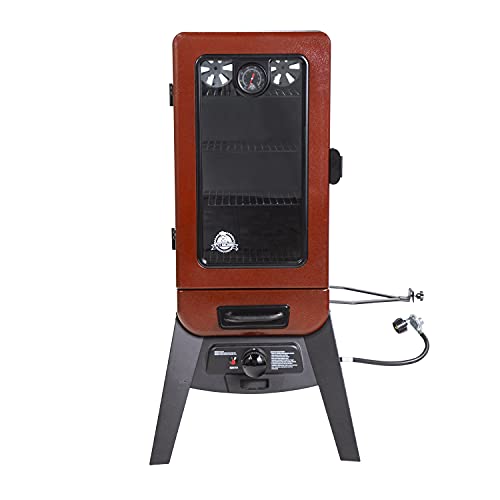
Pit Boss 3-Series Gas Vertical Smoker — Best Propane
Propane verticals are the quiet workhorses of backyard smoking, and the Pit Boss 3-Series is the pick for cooks who want real-flame heat without feeding a fire. The vertical cabinet stacks four racks in a tall chamber, the burner runs off a standard propane tank, and the wood chip tray smolders over the flame to lay smoke on the food. In the red hammertone finish (model 10773) it also happens to be the best-looking cooker in this guide, which matters more than people admit for something that lives on the patio year-round.
Strengths
- Propane heat is instant, adjustable with a valve, and indifferent to wind compared with charcoal.
- Four vertical racks suit the foods cabinets do best: hanging sausages, stacked ribs, trays of wings and jerky.
- No ash, no charcoal storage, no electricity — a tank and a chip tray are the whole fuel system.
Trade-offs
- Vertical cabinets have a smaller footprint per rack; wide briskets may need trimming or a diagonal fit.
- Smoke comes from chips that need periodic replenishment for long cooks.
- Temperature control is analog — a valve and a gauge — so expect a wider band than digital electric or pellet controllers.
- Format: vertical propane gas smoker, four-rack cabinet (per Amazon listing line)
- Finish: red hammertone, model 10773
The honest case for propane is the Tuesday-evening test: you can light this smoker, stabilize it, and have chicken thighs smoking inside twenty minutes, with shutdown being a valve turn and a cool-down. For households that smoke often but briefly — wings, chops, salmon, a single pork butt — that rhythm beats every other format. Keep a spare tank or a gauge on the primary, because the one unforgivable propane failure is an empty tank at hour five of a brisket, and it is entirely preventable.
Best for: frequent, shorter smokes and cooks who want flame heat with valve-simple control. / Not suited for: cooks wanting digital precision or maximum brisket width per rack. Check the current price on Amazon
Comparison Table
| Pick | Badge | Key spec | Best for |
|---|---|---|---|
| Weber Smokey Mountain 22-inch | Best Overall | Dual grates, water pan, porcelain-enameled bullet | Charcoal flavor with near set-and-forget manners |
| Masterbuilt 30-inch Digital Electric | Best for Beginners | 710 sq in, digital control, side chip loader | First smoker, fish, poultry, party batches |
| Traeger Pro 22 | Best Pellet | 572 sq in, 18 lb hopper, 450°F max | One cooker for grilling and smoking |
| Oklahoma Joe’s Highland | Best Offset | 900 sq in horizontal offset | Learning real wood-fire barbecue |
| Kamado Joe Classic Joe II | Best Premium Ceramic | 250 sq in ceramic, cart and shelves included | Efficiency, versatility, small households |
| Pit Boss 3-Series Gas Vertical | Best Propane | Four-rack vertical propane cabinet | Frequent shorter smokes, valve-simple control |
How to Choose the Right Backyard Smoker
Start with the cook, not the cooker. Count the mouths at your biggest regular cook, not your biggest imaginable one. A household that smokes two racks of ribs and a chicken most weekends needs roughly 400–600 square inches of usable grate; a household that hosts brisket-and-butts cookouts should be shopping the 700–1,000 square inch class or accepting multiple batches. Vertical cabinets cheat this math pleasantly — four racks in a small footprint hold more food than the footprint suggests — but each rack is smaller, so measure your widest regular item (a full rack of spareribs, an untrimmed brisket) against rack dimensions, not headline area.
Fuel is a lifestyle decision
Charcoal rewards involvement with flavor. Bullets like the Smokey Mountain are the forgiving end of charcoal; offsets like the Highland are the deep end. Pellet cookers convert smoking into an appliance experience — the flavor is a step milder and the consistency is a step better, and for most households that trade is correct. Electric cabinets are the mildest smoke and the easiest operation, ideal where open flame is restricted or where fish, cheese, and jerky dominate the menu. Propane splits the difference: real flame, quick starts, no ash, at the cost of analog control. None of these is the “right” answer in the abstract; the right answer is the one whose Saturday-morning routine you will still enjoy in year two.
Temperature range and control
Most smoking happens between 225°F and 275°F, jerky and fish lower, poultry higher for skin. Digital controllers (the Masterbuilt electric, the Traeger) hold a set point within a narrow band and are the safest choice for overnight cooks. Analog systems — dampers on charcoal, a valve on propane — wander more but teach you the cooker faster. Whatever you choose, budget for a decent dual-probe thermometer eventually; lid gauges on every format are approximate, and the meat’s internal temperature is the number that actually decides dinner.
Build quality signals that matter
Run your eyes over four things in photos and in person: door and lid fit (visible gaps mean smoke and heat leaks), grate material (porcelain-enameled steel and stainless outlast bare chrome), the grease path (every smoker makes grease; good ones route it to a cup instead of the patio), and the parts catalog (a brand selling replacement controllers, grates, and gaskets today will probably sell them in five years). Weight is a rough proxy for steel thickness on metal cookers, and ceramic buyers should check that the cart and hinge feel as engineered as the dome.
Budget tiers, honestly framed
Backyard smokers sort into an entry tier (simple electrics, bullets, and propane cabinets), a mid tier (pellet grills, offsets, and larger cabinets), and a premium tier (ceramic kamados and high-end pellet machines). The sensible rule is to buy within the tier of your commitment: a first smoker from the entry tier that you use weekly beats a premium cooker that intimidates you into grilling instead. Remember the running costs too — charcoal and wood chunks, pellets by the bag, propane by the tank, electricity by the hour — because the cheapest cooker to buy is not always the cheapest to feed for five years.
Running costs over five years
Sticker price is only the first payment. A charcoal bullet sips inexpensive briquettes and a few chunks per cook; an offset burns charcoal plus splits and is the thirstiest format here; pellet cookers consume roughly a pound or more of pellets per hour at smoking temperatures, more in winter; propane cabinets sip fuel but add tank exchanges; electrics are the cheapest per hour where electricity rates are ordinary. None of these costs should scare you off a format you love — barbecue fuel is cheaper than the meat it cooks — but a household smoking twice a week should do the five-year math before choosing, because the ranking by purchase price and the ranking by ownership cost are not the same list.
How to Set Up and Run Your First Backyard Smoke
Whatever format you chose, the first cook follows the same arc. One: season the cooker. Run it empty at a moderate smoking temperature for two to three hours with a light load of your fuel and a handful of smoke wood; this burns off manufacturing residues and lays the first layer of seasoning on the interior. Two: pick a forgiving first meat — pork butt is the classic because its fat and connective tissue forgive temperature swings that would ruin a brisket. Three: set up your fuel for duration, not for heat. Charcoal cookers get a full ring or basket arranged for a slow burn; pellet hoppers get filled past halfway; propane tanks get checked; chip trays get loaded before the meat goes on, not after.
Four: stabilize before you cook. Bring the cooker to temperature and let it sit there for twenty minutes until the smoke runs thin and pale — thick white smoke is unburned volatiles and will paint your food bitter. Five: put the meat on cold-side-up (fat toward the heat source on most formats), close the lid, and then practice the hardest skill in barbecue: leaving it closed. Every peek costs heat and time. Six: cook to internal temperature and feel, not to the clock — a pork butt is done when a probe slides in with almost no resistance, and that moment arrives on the meat’s schedule. Seven: rest the meat, tented, at least thirty minutes for small cuts and an hour for big ones; the rest is part of the cook, not a delay before it. Eight: while the cooker is still warm, empty ash once fully cold, wipe grates, and empty the grease cup — ten minutes now saves an hour of chiseling later.
Smoke Wood, Fuel, and Flavor Pairing
Fuel is half the recipe in backyard smoking, and each format in this guide burns it differently. Charcoal bullets and offsets want wood in chunk form — fist-sized pieces buried in the charcoal so they smolder steadily instead of flaming. Pellet cookers take their wood as the fuel itself, so the pellet blend is the flavor decision: a bag labeled as a blend usually mixes a base wood like oak or alder with the named flavor wood, which is fine, but single-species pellets give a clearer signal when you are learning what each wood does. Electric and propane cabinets burn chips, which smolder fast and hot; expect to reload them during long cooks and expect a lighter smoke ring as the honest trade for the convenience.
Pairing woods to food is simpler than the charts suggest. Hickory is the assertive all-rounder for pork and beef, easy to overdo on poultry. Oak is the brisket standard — strong enough for a fourteen-hour cook, clean enough not to dominate. Mesquite is the strongest common wood and belongs on beef in small doses; on chicken it can turn medicinal. Apple and cherry are the gentle fruitwoods: apple for pork and poultry, cherry for color as much as flavor, since cherry smoke paints mahogany tones onto ribs and chicken skin. Pecan sits between hickory and fruitwood and is the safest single wood to own if you only buy one bag. The working rule for beginners is to halve whatever amount of wood you think you need — you can add smoke next cook, but you cannot take it out of this one.
Fuel storage quietly decides how good your cooks are. Charcoal and pellets are both sponges: a bag left open in a damp garage produces weak fires, temperature swings, and in pellet cookers, auger jams from swollen pellets. Store both in sealed bins off the floor, keep propane tanks upright and outdoors, and buy wood chunks from sources that store them dry — kiln-dried chunks light predictably, while chunks that sat in rain steam instead of smoldering for the first hour. None of this is glamorous, and all of it shows up on the plate.
Placement, Weather, and Year-Round Backyard Smoking
Where the cooker lives matters almost as much as which one you buy. Every smoker in this guide needs clearance from siding, fences, and overhangs — follow the manual’s distances, keep the cooker on a non-combustible surface, and think about where the smoke drifts relative to your own windows and the neighbors’ before the first cook, not during it. Wind is the main environmental enemy: it steals heat from thin steel, pushes charcoal cookers hot on the windward side, and can blow out low propane flames. A spot sheltered on two sides, without being enclosed, is the backyard sweet spot, and it is why the same cooker can feel temperamental on one patio and rock-steady on another.
Cold weather separates the formats honestly. Ceramic kamados and well-sealed bullets shrug off winter; pellet cookers burn more fuel and benefit from an insulation blanket; thin-steel offsets demand more splits and more attention; electrics hold temperature but stretch recovery times after every door opening. Rain is manageable for all of them with a cover for storage and common sense during cooks — electronics and pellet hoppers are the parts to shield. The cooks who smoke year-round are not tougher than everyone else; they just placed the cooker well, stored the fuel dry, and chose a format whose winter behavior they understood before the first frost.
Finally, plan the workflow around the cooker: a small side table or shelf for trays and probes, a lidded metal bin for ash once it is fully cold, and a clear path from cooker to kitchen that does not cross the dog’s favorite route at brisket-o’clock. These details sound domestic because they are — backyard smoking is a household routine, and the setups that survive are the ones designed like one.
Maintenance That Keeps a Backyard Smoker Honest
A smoker’s second year is decided by habits from its first. After every cook: brush the grates while warm, empty the grease cup or tray, and once ash is completely cold — a full day later, not an hour — move it to a metal container, because ash holds embers and moisture, and wet ash is corrosive to steel. Every few cooks: check the parts your format depends on. Pellet owners vacuum the fire pot and confirm the auger runs free; electric owners wipe the door seal and check the element for grease buildup; propane owners inspect the burner ports for spider nests and rust; charcoal owners clear the vents so dampers move through their full range.
Once a season, do the deeper pass. Scrape the interior walls of heavy creosote flakes (a thin seasoned layer is flavor and protection; thick flaking layers fall on food). Inspect gaskets and door seals and replace any that have gone hard or torn — a failed seal shows up as temperature you cannot control and smoke leaking from everywhere except the stack. Touch up exterior paint chips on steel cookers before rust gets a foothold, check kamado bands and hinge bolts for tension, and run a full empty burn to confirm the cooker still stabilizes at your usual settings. None of this takes an afternoon, and all of it is the difference between a five-year cooker and a two-year disappointment that gets blamed on the brand.
Common Buying Mistakes
Buying capacity for the party you throw once a year. Oversized cookers burn more fuel for everyday cooks and crowd the patio for 51 weeks to serve one weekend. Buy for your regular cook and borrow or batch for the annual blowout.
Choosing fuel by flavor rankings alone. The deepest smoke in the world does you no good if tending the fire makes you stop cooking. More households abandon offsets for pellet grills than the reverse, and it is not because they stopped liking smoke.
Trusting the lid thermometer. Every format’s built-in gauge reads the air where it sits, which is not where your meat sits. A simple probe thermometer prevents both undercooked chicken and cremated ribs.
Skipping the cover and the dry spot. Controllers, pellets, and charcoal all hate moisture. A cover and a sensible storage spot double the practical life of any cooker in this guide.
Judging by headline square inches. Area split across four narrow racks is not the same as area on two wide grates. Match the rack geometry to the food you actually cook.
Final Recommendation
For most backyards, the Weber Smokey Mountain 22-inch is the recommendation to beat: real charcoal flavor, serious capacity, and manners gentle enough for a first year of smoking. If you want the easiest possible start, take the Masterbuilt 30-inch Digital Electric and spend your attention on rubs and timing instead of fire. Households wanting one cooker for everything should buy the Traeger Pro 22. Choose the Oklahoma Joe’s Highland if the fire itself is the hobby, the Kamado Joe Classic Joe II if you want premium efficiency for a smaller household, and the Pit Boss 3-Series if quick propane starts fit your weeknights. Keep exploring the cluster: Best Backyard Offset Smokers, Best Backyard Pellet Smokers, Best Backyard Heavyduty Smokers, Best Affordable Backyard Smokers, Best Barbecue Smokers Grills, Best Barbeque Smokers.
Frequently Asked Questions
What size smoker does a typical backyard household need?
For most households, 500–700 square inches of usable grate covers weekly cooking for four to eight people. Go larger only if you regularly cook whole briskets alongside other meats, and remember vertical cabinets fit more food per square foot of patio than horizontal barrels.
Which fuel gives the strongest smoke flavor?
Wood splits in an offset give the deepest smoke, followed by charcoal with wood chunks, then pellets, then chips in propane or electric cabinets. Stronger is not automatically better — poultry and fish often taste better with the lighter smoke of the milder formats.
Can a pellet grill really replace a separate grill?
For most weeknight grilling, yes. A pellet grill that reaches 450°F or beyond handles burgers, chops, and chicken well, though charcoal and kamado cookers still sear steaks harder. Many owners keep a small kettle for searing and let the pellet grill do everything else.
How long does a pork butt take, and can I cook it overnight?
Plan roughly an hour to an hour and a half per pound at smoking temperatures, with wide variation by cooker and meat. Overnight cooks are safest on pellet and electric cookers with stable controllers and plenty of fuel; charcoal bullets like the Smokey Mountain also handle them well once you trust your damper settings.
Do I need to season a new smoker?
Yes — one empty burn at smoking temperature with a little smoke wood burns off factory oils and coatings and starts the protective seasoning layer. It takes an afternoon and noticeably improves both flavor and rust resistance.
What is the first accessory worth buying?
A dual-probe digital thermometer: one probe for the grate, one for the meat. It improves results on every cooker in this guide more than any rub, injector, or gadget, and it makes your second cook dramatically better than your first.


