Disclosure: airfryerkitchensupply.com is reader-supported. When you buy through links on our site, we may earn an affiliate commission at no extra cost to you.
Where to buy
The fastest way to confirm current availability for a best 220 volt heater is to check the linked picks below on Amazon, because 220-volt-class appliances are sold in smaller runs than their 120-volt counterparts and individual listings change configuration without much warning. Every linked pick in this guide was cross-checked against the Amazon listing data available to us, and the voltage claim in each review comes from that listing’s own title — not from a similar model, a different size in the same range, or a seller’s marketing banner. Where a promising product’s listing did not state its voltage clearly, we kept it in the guide as a pick with no purchase link, and we tell you exactly what to verify on the nameplate or spec sheet before you spend anything.
Cadet Energy Plus Electric Wall Heater, 1600W, 240V — check price on Amazon
Cadet Com-Pak Twin Electric Wall Heater, 4000W, 240V — check price on Amazon
Cadet Com-Pak Twin Electric Wall Heater, 3000W, 240V — check price on Amazon
CSC152TW Electric Wall Heater Complete Unit with Thermostat, 1500W, 240/208V — check price on Amazon
Cadet Com-Pak Electric Wall Heater CSC102W, 1000W, 240/208V, Without Thermostat — check price on Amazon
Dr. Infrared Heater DR-966 240-Volt Hardwired Heater, 3000/6000W — check price on Amazon
The best 220 volt heater is not a space heater you plug in — it is a hardwired 240-volt wall heater, and the distinction is the entire category. North American ‘220 volt’ means the 240V circuit (208V in some buildings), and the heaters built for it are permanent appliances: recessed wall units with fan-forced output from 1,000 to 4,000 watts, wired into the building, controlled by wall or built-in thermostats, heating rooms that a 1,500W plug-in could never hold. Every pick in this guide has its 240V or 240/208V rating printed in its verified listing title. If you arrived here looking for something to plug into a normal outlet, the honest redirect is that you want a 120V space heater guide — this one is for buyers with a circuit, a wall, and a room that needs real heat.
Why hardwire at all? Three reasons, in order of importance. Capacity: a 240V circuit carries two to nearly three times the wattage of a plug-in, so one wall heater does the work of two or three portables without the cord hazards. Permanence: the heater is always there, thermostat-held at temperature, with no storage, no tipping risk, and no outlet occupied. And control: hardwired heaters pair with proper line-voltage thermostats — programmable and smart included — turning dumb resistance heat into scheduled, zoned comfort. A bedroom wing, a basement, an addition, a bathroom remodel: these are the rooms this category owns.
The six picks span the sensible range: Cadet’s Energy Plus and Com-Pak lines dominate, as they dominate the real market, from a 1,000W compact to a 4,000W twin for large rooms; a CSC152TW complete unit with built-in thermostat covers the all-in-one case; and a Dr. Infrared hardwired shop heater represents the utility end. Sizing and circuit maths get full sections below, because in hardwired heat the correct wattage on the correct circuit is the product — everything else is sheet metal.
In this guide
Quick Picks
Best Overall — Cadet Energy Plus Electric Wall Heater, 1600W, 240V. Cadet’s modern wall heater formula: 1,600 verified 240V watts with a digital thermostat built in — the balanced default for bedrooms and living spaces.
Check the current price on Amazon
Best for Large Rooms — Cadet Com-Pak Twin Electric Wall Heater, 4000W, 240V. The big gun of the Com-Pak line: a twin-fan 4,000W, 240V unit with thermostat, aimed squarely at large rooms.
Check the current price on Amazon
Best Mid-Size Large-Room Pick — Cadet Com-Pak Twin Electric Wall Heater, 3000W, 240V. The 3,000W twin: most of the big unit’s air-moving ability at three-quarters of the draw — the proportionate choice for medium-large rooms.
Check the current price on Amazon
Best All-in-One Complete Unit — CSC152TW Electric Wall Heater Complete Unit with Thermostat, 1500W, 240/208V. A complete-unit Cadet-format heater — can, element and thermostat in one part number — honestly dual-rated at 1,500W on 240V and 1,125W on 208V, BTU figures included.
Check the current price on Amazon
Best Compact Pick for Wall-Thermostat Systems — Cadet Com-Pak Electric Wall Heater CSC102W, 1000W, 240/208V, Without Thermostat. The small end of the Com-Pak line: 1,000W at 240V (750W at 208V), sold without a thermostat precisely so it can join a proper wall-thermostat system.
Check the current price on Amazon
Best Utility and Shop Pick — Dr. Infrared Heater DR-966 240-Volt Hardwired Heater, 3000/6000W. A dual-output hardwired utility heater — 3,000 or 6,000 watts on verified 240V — for shops, garages and commercial spaces inside the home’s orbit.
Check the current price on Amazon
How These Picks Were Chosen
Verification ran under the standing rule: search by brand and model, match the returned listing title, link only where the title states the voltage — 240V or 240/208V — and the wattage we claim. That filter excluded the category’s confusions: 120V Com-Pak siblings with near-identical names (they exist, and one appears in our raw search results as a warning), plug-in ‘wall heaters’ of a few hundred watts, and any unit whose title quoted watts without volts.
We balanced the list across room sizes and control styles: with and without built-in thermostats, single and twin fan configurations, and one shop-format outlier for utility spaces. Cadet’s dominance of the list reflects the market’s reality — it is the default North American hardwired wall-heater brand, with the service network to match — rather than any editorial favouritism. Wattage and BTU figures are quoted only as printed in verified titles, including the dual-voltage derating where a title states it.
The 6 Best 220 Volt Heaters
Cadet Energy Plus Electric Wall Heater, 1600W, 240V — Best Overall
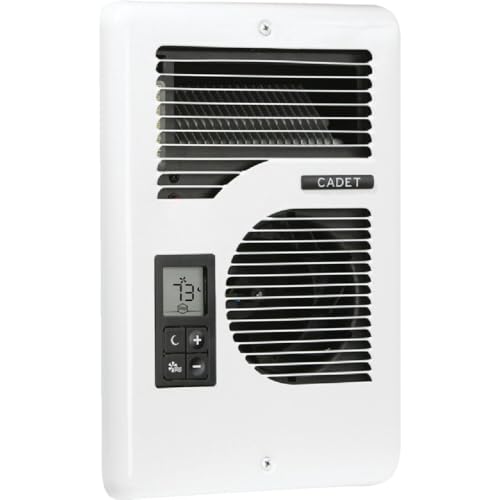
The Energy Plus is what a hardwired wall heater looks like when it is designed as a room appliance rather than a utility box: 1,600 watts on a verified 240V rating, a digital thermostat integrated into the unit, and fan-forced delivery in a recessed wall format. Sixteen hundred watts suits the category’s heartland — bedrooms, nurseries, home offices, bathrooms of ordinary size — holding temperature precisely instead of swinging it, because the digital control cycles intelligently rather than by a bimetal strip’s guesswork.
Built-in digital control also deletes the thermostat line item and the wall box that goes with it, which simplifies both the install and the budget; the trade is that the sensing happens at the unit, low on the wall — acceptable in the small-to-medium rooms this wattage serves. On a 240V circuit, 1,600 watts draws about 6.7 amps, a gentle continuous load that most properly planned circuits absorb alongside a second unit. For the standard use case this guide is mostly read for — a cold bedroom or addition that needs permanent, quiet, controlled heat — this is the pick to beat.
Strengths
- Digital thermostat built in — precise control with no separate thermostat purchase
- 1,600W at a title-verified 240V rating: the heartland size for bedrooms and offices
- Recessed wall format: permanent, cordless, out of the way
Trade-offs
- Sensing at the unit rather than across the room
- Fan-forced delivery is audible — light sleepers should audition the class before committing a bedroom
- 1,600W is a single-room answer; large open spaces need the twin models below
| Specification | Detail (from verified listing) |
|---|---|
| Output | 1600W (per verified listing title) |
| Voltage | 240V (per verified listing title) |
| Control | Digital thermostat (per verified listing title) |
| Type | Electric wall heater (per verified listing title) |
Best for: bedrooms, nurseries, offices and bathrooms needing permanent controlled heat / Not suited for: large open-plan rooms, or silent-heat purists — consider baseboard convection instead
Check the current price on Amazon

Cadet Com-Pak Twin Electric Wall Heater, 4000W, 240V — Best for Large Rooms
Some rooms simply need watts. A large basement family room, an open-plan addition, a master suite over a garage — these are 4,000-watt rooms, and Cadet’s Com-Pak Twin is built for them: twin fan configuration, 4,000 watts on a verified 240V rating, thermostat included in the unit’s brief, and ‘Large Room’ stated in the title as its intended duty. Twin fans move the air volume that a single fan cannot, spreading heat across a big floor plate instead of scorching the air near one wall.
The electrical and acoustic honesty: 4,000 watts draws about 16.7 amps at 240V, which as a continuous load wants a dedicated 240V circuit sized with proper margin — a 25-amp-class conversation with your electrician, not an afterthought on a shared run. And twin fans make twin fan noise; in a family room or workshop that is background, in a bedroom it may not be. Choose this unit for the rooms where its capacity is the point, place the thermostat thoughtfully, and it will hold a big space at temperature through weather that sends lesser heaters into permanent catch-up.
Strengths
- Highest output in the guide — 4,000W of verified 240V heat
- Twin fans move large-room air volumes properly
- Thermostat included per the verified title
Trade-offs
- ~16.7A continuous draw — dedicated, correctly sized circuit required
- Fan noise scales with size; not a bedroom-first design
- Oversizing a small room with it buys short-cycling and discomfort
| Specification | Detail (from verified listing) |
|---|---|
| Output | 4000W (per verified listing title) |
| Voltage | 240V (per verified listing title) |
| Configuration | Twin (per model name in verified title) |
| Intended use | Large room (per verified listing title) |
Best for: large basements, additions and open-plan rooms that defeat smaller heaters / Not suited for: bedrooms and small rooms — the Energy Plus or the 3,000W twin are the proportionate picks
Check the current price on Amazon
Cadet Com-Pak Twin Electric Wall Heater, 3000W, 240V — Best Mid-Size Large-Room Pick
The 3,000W Com-Pak Twin exists because most ‘large’ rooms are not that large. At 3,000 verified 240V watts with twin fans and a thermostat, it covers the medium-large band — generous bedrooms, modest basements, L-shaped living spaces — with headroom to spare, while drawing about 12.5 amps: a continuous load that fits a 20-amp-class dedicated 240V circuit with proper margin, a meaningfully easier electrical proposition than its 4,000W sibling.
That proportionality is the review’s whole argument. Oversizing hardwired heat does not create comfort; it creates cycling — short, hot blasts followed by cooldowns — and wastes the circuit capacity that a second room’s heater might have used. If the room’s honest heat-loss maths lands between 2,500 and 3,500 watts, this is the correct unit in the line, full stop. It shares the family’s recessed format, serviceability, and fan character, including the family’s honest noise profile: present, purposeful, and better suited to living spaces than to a light sleeper’s bedroom wall.
Strengths
- 3,000W twin-fan output sized for the real medium-large room
- ~12.5A draw fits a 20-amp-class dedicated circuit with margin
- Thermostat included per the verified title
Trade-offs
- Still a dedicated-circuit appliance — no casual installs
- Fan noise is part of the format
- Rooms at the true large end will find it working hard on the coldest nights
| Specification | Detail (from verified listing) |
|---|---|
| Output | 3000W (per verified listing title) |
| Voltage | 240V (per verified listing title) |
| Configuration | Twin (per model name in verified title) |
| Intended use | Large room (per verified listing title) |
Best for: medium-large rooms whose honest sizing lands under the 4,000W unit’s territory / Not suited for: genuinely large or leaky spaces, where undersizing is the more expensive mistake
Check the current price on Amazon

CSC152TW Electric Wall Heater Complete Unit with Thermostat, 1500W, 240/208V — Best All-in-One Complete Unit
The CSC152TW’s appeal is completeness and specification honesty. It is sold as a complete unit with thermostat — the wall can, heater and control under one part number, which is how replacements and straightforward new installs want to be bought — and its verified title prints the full dual-rating story: 1,500 watts and 5,120 BTU at 240 volts; 1,125 watts and 3,840 BTU at 208. That second line is the one buyers in 208V buildings must size with, and its presence in the title is exactly the transparency this guide rewards.
At 1,500 watts it sits in the same heartland as the Energy Plus, serving bedrooms, bathrooms and small living spaces, with a conventional thermostat rather than the Cadet’s digital control — simpler, proven, and sensing at the unit. The complete-unit format also makes it a natural like-for-like replacement in the enormous installed base of this heater style: measure the existing can, compare part numbers, and the swap can be measured in minutes of wall work rather than hours. For new installs wanting the classic format with nothing else to order, this is the tidy pick.
Strengths
- Complete unit with thermostat — one part number, nothing else to buy
- Full dual rating in the title: watts and BTU at both 240V and 208V
- Classic format suits the huge installed base for like-for-like replacement
Trade-offs
- Conventional thermostat control rather than digital precision
- Output at 208V is a quarter lower — size with 1,125W in 208V buildings
- Unit-mounted sensing, as with all built-in thermostat models
| Specification | Detail (from verified listing) |
|---|---|
| Output | 1500W at 240V / 1125W at 208V (per verified listing title) |
| Heat | 5120 / 3840 BTU (per verified listing title) |
| Voltage | 240/208 volt (per verified listing title) |
| Format | Complete unit with thermostat (per verified listing title) |
Best for: straightforward single-room installs and like-for-like replacements in this heater format / Not suited for: buyers wanting digital or smart control — pair a wall thermostat model instead
Check the current price on Amazon

Cadet Com-Pak Electric Wall Heater CSC102W, 1000W, 240/208V, Without Thermostat — Best Compact Pick for Wall-Thermostat Systems
A heater sold ‘without thermostat’ is not an incomplete product — it is a component in a better system, and the CSC102W is the clearest example in this guide. At 1,000 watts on 240V (750 at 208V, both BTU figures printed in the verified title), it is sized for the small rooms — bathrooms, entryways, small bedrooms, hallways — where a wall heater’s job is background comfort. Paired with a wall-mounted line-voltage thermostat, ideally a programmable or smart model sensing at sitting height across the room, it delivers more accurate comfort than any unit-mounted control can.
This is also the format multi-room projects want: several modest heaters on properly planned circuits, one coherent control scheme, no duplicated built-in thermostats fighting the wall stat. The disciplines are the format’s own — you must actually buy and wire the thermostat, and the circuit maths must sum every unit on the run. For a single small room with a simple brief, the complete-unit picks above are less work. For a renovation thinking in zones, this little heater is the professional’s building block.
Strengths
- Honest dual rating with BTU at both voltages in the verified title
- Designed for wall-thermostat systems — better sensing, zoned control
- 1,000W size suits bathrooms and small rooms without oversizing
Trade-offs
- Thermostat is a genuine additional purchase and wiring task
- 1,000W is small-room duty only
- Requires the planner’s mindset — casual single-room buyers should take a complete unit
| Specification | Detail (from verified listing) |
|---|---|
| Output | 1000W at 240V / 750W at 208V (per verified listing title) |
| Heat | 3415 / 2560 BTU (per verified listing title) |
| Voltage | 240/208 volt (per verified listing title) |
| Thermostat | Not included — wall thermostat required (per verified listing title) |
Best for: zoned renovations and small rooms joining a wall-thermostat system / Not suited for: buyers wanting one box, one install, nothing else to order
Check the current price on Amazon

Dr. Infrared Heater DR-966 240-Volt Hardwired Heater, 3000/6000W — Best Utility and Shop Pick
Not every 240V heater belongs in a bedroom wall. The DR-966 is a hardwired shop and commercial heater whose verified title states its formula plainly: 240 volts, two output levels at 3,000 and 6,000 watts, aimed at garages, shops and commercial spaces. The dual output is the practical heart of it — low gear for maintaining a workspace’s background temperature, high gear for bringing a cold-soaked shop up to working conditions — in a surface-mounted format that does not ask you to open a wall cavity.
At 6,000 watts the draw is 25 amps at 240V, a continuous load for a properly sized dedicated circuit; at 3,000 watts it is half that, which is the setting it will live on in milder weather and smaller spaces. This is a utility appliance in character as well as name — fan noise, industrial finish, and controls chosen for gloved hands are all in character, and all reasons it is not the pick for a nursery. Inside its brief, it is the most flexible heater in this guide, and the natural bridge to our dedicated garage-heater roundup for buyers whose ‘room’ has a workbench in it.
Strengths
- Two output levels — 3,000/6,000W — for background and boost duty
- Surface-mount hardwired format: no wall cavity required
- Purpose-built for shops and commercial spaces, per the verified title
Trade-offs
- 25A draw at full output — dedicated circuit, professionally sized
- Utility character: noise and finish are workshop-grade, not bedroom-grade
- Oversized in every sense for ordinary domestic rooms
| Specification | Detail (from verified listing) |
|---|---|
| Output | 3000 / 6000 watt (per verified listing title) |
| Voltage | 240 volt, hardwired (per verified listing title) |
| Use | Shop, garage, commercial (per verified listing title) |
Best for: workshops, garages and utility spaces needing switchable background and boost heat / Not suited for: bedrooms and living rooms — the Com-Pak and Energy Plus picks exist for those
Check the current price on Amazon
Comparison Table
| Pick | Badge | Key spec | Best for |
|---|---|---|---|
| Cadet Energy Plus Electric Wall Heater, 1600W, 240V | Best Overall | 1600W / 240V with digital thermostat | bedrooms, nurseries, offices and bathrooms needing permanent controlled heat |
| Cadet Com-Pak Twin Electric Wall Heater, 4000W, 240V | Best for Large Rooms | 4000W / 240V twin | large basements, additions and open-plan rooms that defeat smaller heaters |
| Cadet Com-Pak Twin Electric Wall Heater, 3000W, 240V | Best Mid-Size Large-Room Pick | 3000W / 240V twin | medium-large rooms whose honest sizing lands under the 4,000W unit’s territory |
| CSC152TW Electric Wall Heater Complete Unit with Thermostat, 1500W, 240/208V | Best All-in-One Complete Unit | 1500W @240V / 1125W @208V, complete unit | straightforward single-room installs and like-for-like replacements in this heater format |
| Cadet Com-Pak Electric Wall Heater CSC102W, 1000W, 240/208V, Without Thermostat | Best Compact Pick for Wall-Thermostat Systems | 1000W @240V / 750W @208V, no thermostat | zoned renovations and small rooms joining a wall-thermostat system |
| Dr. Infrared Heater DR-966 240-Volt Hardwired Heater, 3000/6000W | Best Utility and Shop Pick | 3000/6000W / 240V hardwired | workshops, garages and utility spaces needing switchable background and boost heat |
How to Choose a 220 Volt Heater: Watts per Room, Honestly Calculated
Hardwired heat sizing starts with a rule of thumb and ends with honesty about the room. The rule: roughly 10 watts per square foot for a normally insulated room with standard ceilings — 1,500W for 150 sq ft, 3,000W for 300. The honesty: raise it for rooms over garages, rooms with large glass, high ceilings, and cold-climate exposure; lower it for interior rooms wrapped in heated space. The picks here map onto that maths cleanly — 1,000–1,600W for small-to-medium rooms, 3,000W for medium-large, 4,000W for genuinely large — and the most common buying error is not arithmetic but optimism: choosing the size for the room you wish you had.
Fan-forced wall heaters and convection baseboards divide the category by feel. Fan-forced units — everything in this guide — warm a room fast, mix the air, and make audible fan noise doing it. Convection baseboards are silent and slower, and they own a wall’s full length. Bedrooms with light sleepers lean convection; bathrooms, basements, additions and any room you want warm quickly lean fan-forced. Many good houses use both, by room, on purpose.
- Sum the circuit before the shopping: continuous heating loads are capped at 80% of breaker rating.
- Dual-rated units make less heat at 208V — size with the lower figure in 208V buildings.
- Unit-mounted thermostats sense at the heater; wall thermostats sense the room. Choose per room size.
- One heater per room, sized to the room, beats one hero heater and a cold corridor.
Finally, think in zones. The great advantage of hardwired electric heat is that every room is its own zone with its own thermostat and schedule — bedrooms cooler by day, bathrooms warm at 6 a.m., the addition off when unused. That zoning, done with programmable or smart line-voltage thermostats, is where hardwired heat’s running costs become competitive with its convenience.
The Circuit Section: What a 240V Heater Actually Asks of Your Panel
Convert every pick to amps — watts divided by volts — and apply the continuous-load rule: fixed heating should not exceed 80% of the breaker’s rating. A 1,500W heater draws 6.25 amps, comfortable on a 15-amp 240V circuit with room for a second modest unit. A 3,000W unit draws 12.5 amps and wants a 20-amp-class circuit largely to itself. A 4,000W unit draws 16.7 amps and needs a circuit sized above that with margin. The 6,000W setting on the shop pick draws 25 amps and is a 40-amp-class conversation. None of this is negotiable or brand-specific; it is the physics every electrician will apply, and planning with it from the start is what separates a smooth install from a panel-upgrade surprise.
Two further panel realities deserve daylight. First, spare capacity is finite: a panel already carrying an electric range, dryer, water heater and air conditioning may have little left, and a load calculation — which your electrician performs — is the authority, not the count of empty breaker slots. Second, 208V buildings change the arithmetic: the same heater draws less current and produces roughly a quarter less heat, which the dual-rated titles in this guide state openly. Size the room with the 208V wattage and the circuit with the 208V amps.
All connection work — breakers, runs, junctions — is licensed electrical work in most jurisdictions, performed to the manufacturer’s instructions and local code. This guide’s consistent position is that the electrician is part of the product: budget for the visit as surely as for the heater.
Thermostats and Control: Where Comfort Is Actually Decided
A resistance heater is a simple device; the thermostat is its brain, and the brain’s placement decides comfort. Built-in thermostats — digital on the Energy Plus, conventional on the CSC152TW complete unit — sense at the heater, low on the wall. In small rooms the error is negligible and the simplicity is real. In larger rooms, the air at the heater reaches temperature while the far side is still cool, and a wall thermostat at sitting height across the room is the correct instrument. That is why the CSC102W is sold without one: it expects to join a wall-thermostat system.
Line-voltage is the non-negotiable word: the thermostat must be rated to switch 240V heater current directly, and its wattage rating must meet or exceed the load it controls. Within that rule, the ladder climbs from mechanical dials through electronic and programmable models — setback schedules suit bedrooms and bathrooms beautifully — to smart line-voltage thermostats with app control, several of which carry 120–240V ratings in their verified titles in our wider research. For a whole-house hardwired scheme, standardising on one smart thermostat family across rooms is the decision owners consistently report as the one that made the system feel modern.
Where Hardwired Heat Wins: The Rooms and the Renovation Moments
Hardwired 240V heat earns its installation cost in specific, recognisable situations, and naming them helps buyers outside them save their money. The first is the chronically cold room: the bedroom over the garage, the north-facing addition, the basement corner that the ducted system has never reached. A correctly sized wall heater with its own thermostat does not ask the rest of the house to overheat so one room can be comfortable — it simply gives that room its own climate, permanently, which is why this category is a renovation staple rather than an appliance purchase. The second situation is the bathroom remodel, where a quiet 1,000–1,600W unit on a timer or programmable stat turns the coldest morning room into the warmest, on schedule, without a duct run that the house’s structure would never have allowed.
The third situation is the property play: rentals, accessory dwellings and outbuildings where a separate, meterable, tenant-proof heating zone is worth more than central efficiency. Electric hardwired heat has no flue, no fuel delivery, no annual combustion service, and a per-room granularity that landlords and ADU owners prize; its higher per-unit energy cost is the known trade, softened substantially by zoning and setback schedules. The fourth is the phased renovation, where rooms are finished one at a time over years — hardwired units let each finished room be heated properly from its first winter, without waiting for a whole-system project that may be half a decade away.
The honest counter-list matters too. A well-ducted house with one mildly cool room usually wants duct balancing or a small supplemental fix, not a new circuit. A home chasing the lowest possible heating bill at whole-house scale should price heat pumps before resistance heat. And a renter, obviously, is in neither this guide’s market nor its permission structure. Hardwired 240V heat is a superb tool inside its brief — permanent, zoned, controllable warmth for defined rooms — and this guide’s picks are chosen to serve exactly that brief rather than to be sold to everyone with a chilly corner.
Maintenance and Troubleshooting: Keeping Hardwired Heat Honest
Hardwired heaters ask little and forgive much, but the little they ask is specific. Dust is the standing enemy: fan-forced wall units ingest room air and deposit its dust on elements and fan blades, where it insulates, smells scorched at season’s start, and in quantity becomes a genuine hazard. The annual ritual — power off at the breaker, grille removed, dust vacuumed and brushed from the element and fan, grille refitted — takes fifteen minutes per unit and is the difference between a heater that smells faintly of warm dust for one evening each October and one that trips protections in January. Baseboard-style convection in the wider family wants the same attention along its fins, with the added rule that nothing stored against it during summer stays there when the season turns.
Troubleshooting follows a short, safe decision tree. A unit that produces no heat at all: check the breaker, then the thermostat’s call for heat, then — with power off and only if you are qualified — the obvious connection faults; beyond that, it is a service call, because element and control diagnosis on a 240V appliance is professional work. A unit that heats weakly has usually lost an element stage or is starved by dust; a unit that cycles rapidly is often sensing its own discharge because furniture or a relocated thermostat has put it in the blast. Noise changes are information too: a fan that newly rattles or grinds is announcing a bearing or an obstruction, and catching it early is a fan replacement rather than a heater replacement.
Keep the paperwork loop closed. Note the breaker number, wattage and install date on the unit’s documentation as the how-to section advised, and add the maintenance dates as they happen. When a unit finally reaches replacement age, that record turns the like-for-like decision — the CSC-format picks exist largely to serve it — into a morning’s errand rather than a research project. Hardwired heat’s deepest virtue is that it disappears into the building; a thin file of notes is what lets it disappear safely.
Smart Control on a Budget: Getting Scheduling Without Replacing the Heaters
One of this category’s underappreciated virtues is that intelligence can be added at the thermostat rather than the heater. A house full of perfectly good hardwired wall heaters — including the component-style picks in this guide — becomes a scheduled, zoned, app-controlled system by changing only the thermostats, a project measured in an afternoon per room rather than a renovation per wall. For owners of existing hardwired stock, that is the correct upgrade path, and it reframes the no-thermostat CSC102W’s role in this guide: it is the pick for buyers building new who intend that end-state from the start, with the wall stat chosen once, well, for the whole scheme.
Choose the thermostat fleet with the same load discipline as the heaters. Every line-voltage thermostat carries a maximum load rating, and the fleet decision must respect the largest circuit each unit will switch — standardising on a model rated comfortably above your biggest heater load keeps spares simple and mistakes impossible. Scheduling strategy then does the economic work: bathrooms warm before the alarm, bedrooms set back through the working day, living spaces pre-heated for the evening, and the whole house’s resistance heat — the expensive kind, kilowatt for kilowatt — spent only in rooms, at hours, where a person is present to feel it.
That last principle is where hardwired heat’s reputation for expense is honestly answered. Resistance heat is costly per unit of warmth and superb per unit of control. A zoned, scheduled hardwired system in a house where rooms are used at different times can cost less to run than its reputation suggests, while the same heaters left at one temperature around the clock will confirm every warning ever printed about them. The heaters in this guide are the muscle; the thermostat fleet is the judgement. Buy both halves of the system.
A Note on Renters, Landlords and Split Incentives
Hardwired heat sits at an interesting point in rental economics, and both sides of the lease benefit from understanding it. For landlords, zoned electric heat offers a rare combination: no combustion appliances to service, no fuel system to maintain, per-unit control that ends the classic dispute about one thermostat serving a whole building, and — where metering allows — heating costs that follow the tenant who uses them. The installation cost is real but amortises across tenancies in a way that portable heaters provided by tenants, with their cord and tip-over risks, never do; several jurisdictions’ insurers and fire officers quietly prefer the hardwired arrangement for exactly those safety reasons. For tenants in hardwired-heated homes, the operating manual is this guide’s zoning gospel in miniature: heat the rooms you occupy, set back the ones you do not, and the resistance-heat bill becomes a manageable line rather than a winter shock. Both sides win when the system is explained at move-in — a five-minute thermostat tour is worth a season of comfortable, economical use, and landlords who provide it report fewer complaints than any equipment upgrade they have tried.
One Last Check Before Ordering
Before any heater in this guide is ordered, run the four-point check one final time: the room’s wattage maths is written down; the total amps sit inside the circuit’s continuous ceiling with the electrician’s agreement; the thermostat plan — built-in, wall, or smart — is chosen and rated for the load; and the voltage on the listing matches the building’s actual service, 240V or 208V, with the output figure taken from the matching line of the rating. Four yeses make an installation. Anything less makes a cold room with a story attached.
How to Install a Hardwired Wall Heater (Planning Overview)
A planning overview for scoping and briefing — the circuit and connection work is licensed electrical work in most jurisdictions, and recessed units must follow the manufacturer’s framing and clearance instructions exactly.
- Confirm the circuit: heater amps against the 80% continuous ceiling, breaker and wire sized by the electrician, panel capacity verified.
- Choose the wall: an interior or exterior wall section free of plumbing and wiring conflicts, positioned for air circulation, not behind a door or furniture.
- For recessed units, fit the wall can between studs per the manufacturer’s template, maintaining all stated clearances from insulation and framing.
- Run the 240V supply to the unit and, where the design uses one, to the wall thermostat location.
- Connect heater and thermostat per the wiring diagram for the chosen control scheme — connections in approved boxes, grounding as required.
- Fit the grille, restore power, and commission: verify fan operation, thermostat cycling, and even warmth across the unit’s face.
- Run the room through a cold evening and check the far corner against the thermostat setting; adjust control placement expectations — or the plan for a second unit — on evidence.
Label the breaker with the room and heater wattage. Hardwired heat is invisible infrastructure; the label is how the next owner learns it exists.
Common Buying Mistakes
Shopping for a ‘220V heater’ and buying a 120V sibling. Com-Pak-style lines sell near-identical 120V models. The voltage in the verified title — 240V or 240/208V — is the only safe evidence.
Oversizing for pride. A 4,000W unit in a 150 sq ft bedroom short-cycles and discomforts. Size to the room’s maths, not to the catalogue’s maximum.
Undersizing the circuit. Continuous loads are capped at 80% of breaker rating. Sum every heater on the run before the electrician visit, not during it.
Letting a built-in thermostat judge a big room. It senses at the heater. Large rooms deserve wall thermostats at sitting height — or the no-thermostat component picks designed for them.
Mixing thermostat voltage classes. A low-voltage furnace thermostat cannot switch 240V heater current. Line-voltage, load-rated models only.
Blocking the heater with furniture. Fan-forced wall heaters need their air path. A sofa against the grille wastes the heat and risks the unit.
Final Recommendation
Start with the room’s maths and the panel’s verdict, and the pick usually makes itself: the Energy Plus for the standard bedroom-or-office brief, the CSC152TW complete unit for a tidy all-in-one install, the CSC102W as the building block of a wall-thermostat zone system, the 3,000W twin for medium-large rooms, the 4,000W twin when the room is genuinely big, and the DR-966 when the ‘room’ is a workshop. Every one of them is a verified 240V appliance — no plug-in pretenders, no voltage guessed from a sibling model.
Buyers whose heating problem is specifically a glass sunroom should continue to the Best 220 Volt Baseboard Heater For 3 Season Room guide, where silent convection is the right tool, and those heating a workspace at scale will find the ceiling-mounted tier in the Best 220 Volt Garage Heater roundup.
Best 220 Volt Garage Heater Best 220 Volt Baseboard Heater For 3 Season Room Best 220 Volt Air Conditioner Best 20 Gallon 220 Volt Water Heater Best 220 Volt Hot Tub
Frequently Asked Questions
Is a 220 volt heater the same as a 240 volt heater?
In North America, yes: the service is 240V (208V in some buildings), equipment is labelled 240V or 240/208V, and ‘220’ is the common shorthand. Every pick here carries its 240V-class rating in its verified listing title.
Can I plug a 240V wall heater into an outlet?
No. These are hardwired appliances on dedicated circuits, installed to code. Plug-in heaters are the 120V class, capped at 1,500W — a different category entirely.
What size heater does my room need?
Roughly 10 watts per square foot for a normally insulated room, adjusted up for glass, height and exposure, and down for interior rooms. Then check the total against your circuit’s continuous-load ceiling before ordering.
Why do some heaters make less power on 208V?
Resistance output falls with the square of voltage: a 1,500W-at-240V unit makes about 1,125W at 208V. The dual-rated picks print both figures in their titles — size with the one that matches your building.
Built-in or wall thermostat — which is better?
Built-in is simpler and fine in small rooms. Wall thermostats sense the room where you sit and enable zoning and smart control; larger rooms and multi-room projects should use them, with component heaters like the CSC102W.
How many wall heaters can share one circuit?
Add their amps and keep the total at or under 80% of the breaker’s rating. Two 1,500W units (12.5A combined) fit a 20-amp 240V circuit on that rule; a 4,000W unit effectively wants a circuit of its own. Your electrician makes the final call.