Disclosure: airfryerkitchensupply.com is reader-supported. When you buy through links on our site, we may earn an affiliate commission at no extra cost to you.
Where to buy
Every verified pick in this guide to the best 12 volt batteries is sold through Amazon, where stock, configuration and seller details are shown on the live listing. Use the links in the Quick Picks, in each review and in the comparison table to check the current price on Amazon before you buy, because configurations, pack counts and included accessories change more often than product names do. If a pick in this guide is marked prose-only, that is deliberate: we could not confirm that exact product through the verification process described below, so we describe its tier and role honestly instead of inventing a link for it.
Finding the best 12 volt batteries starts with a question most listings never ask: what job is the battery actually doing? A 12 volt battery that starts an engine, a 12 volt battery that runs a trolling motor for six hours, and a 12 volt battery that stores solar power for a cabin are three different products wearing the same voltage label, and buying the wrong one is the most common and most expensive mistake in this category. This guide sorts the category by job first and by brand second.
The market splits into three chemistries that matter. Flooded and AGM lead-acid batteries are the budget and mid-range workhorses: heavy, tolerant of simple chargers, and happiest when you only use roughly half their rated capacity. LiFePO4 lithium batteries cost more per case but deliver nearly all of their rated capacity, weigh about half as much, and last many times longer in cycle terms — which is why they now dominate RV, marine and solar upgrades. Small sealed lead-acid batteries in the 5Ah to 12Ah range form a third world entirely: alarm panels, UPS units, fish finders, ride-on toys and field equipment, where the battery is a component, not a power system.
The six picks below were verified one by one through the process described in the next section, and they deliberately span those three worlds: two proven AGM house batteries, two modern LiFePO4 upgrades, one value AGM standard, and one compact 50Ah option for portable work. If your use is specialised — an RV house bank, a golf cart, an inverter system, solar storage — the linked companion guides in the Final Recommendation go deeper on that single job. This page is the honest map of the whole territory.
The verified shortlist, for convenience:
- Renogy 12V 100Ah Deep Cycle AGM Battery
- LiTime 12V 100Ah Group 31 LiFePO4 Deep Cycle Battery
- Renogy 12V 200Ah Deep Cycle AGM Battery
- Renogy 12V 100Ah LiFePO4 Lithium Battery (Mini Size)
- Mighty Max ML100-12 12V 100Ah SLA AGM Battery
- Newport 12V 50Ah Deep Cycle AGM Marine Battery
In this guide
Quick Picks
Renogy 12V 100Ah Deep Cycle AGM Battery — Best Overall AGM. The default house battery for RV, cabin, marine and solar work: a true deep-cycle AGM in the standard 100Ah class, from the brand that has defined this category for years, with a low self-discharge rate that suits seasonal storage. Check the current price on Amazon.
LiTime 12V 100Ah Group 31 LiFePO4 Deep Cycle Battery — Best Overall LiFePO4. The lithium upgrade most buyers should start with: a Group 31 LiFePO4 with a 100A BMS, weather sealing and generous series/parallel expansion, delivering close to its full rated capacity every cycle. Check the current price on Amazon.
Renogy 12V 200Ah Deep Cycle AGM Battery — Best High-Capacity AGM. Double the capacity in a single case: a 200Ah AGM for larger house banks where one big battery is simpler than paralleling two smaller ones. Check the current price on Amazon.
Renogy 12V 100Ah LiFePO4 Lithium Battery (Mini Size) — Best Compact Lithium. A mini-size 100Ah LiFePO4 that fits where a Group 31 will not: same lithium advantages in a smaller footprint for vans, small boats and tight battery lockers. Check the current price on Amazon.
Mighty Max ML100-12 12V 100Ah SLA AGM Battery — Best Value AGM. The straightforward value standard: a 100Ah SLA AGM with internal-thread terminals, widely used for solar, backup and mobility systems where brand premium buys nothing extra. Check the current price on Amazon.
Newport 12V 50Ah Deep Cycle AGM Marine Battery — Best Portable AGM. Half the size, genuinely portable: a 50Ah deep-cycle AGM built for trolling motors, kayaks and small boats where a 100Ah case is simply too much battery to move. Check the current price on Amazon.
How These Picks Were Chosen
Every pick in this guide was cross-checked against Amazon’s own catalogue data before a link was added: we searched by brand and model, matched the returned listing title to the product described, and only then recorded the ASIN used in the links. A product we could not match with confidence is described as a prose-only pick with no purchase link, rather than given a guessed link. Specifications quoted in the mini spec boxes come only from the verified listing titles — nothing is copied from marketing pages we could not confirm.
Selection balanced four criteria. First, fitness for the stated job: deep-cycle construction for cycling work, not a starting battery relabelled. Second, honest capacity: rated amp-hours at a stated discharge basis, in a standard group size that fits real battery boxes and trays. Third, system compatibility: terminals, charger profiles and expansion limits (series and parallel) that a normal owner can actually work with. Fourth, support reality: a brand with a track record in this exact category outranks a cheaper unknown with identical headline numbers.
Two standing rules shape everything below. There are no static prices anywhere in this guide — battery pricing moves with promotions and pack counts, so each linked pick says to check the current price on Amazon instead. And there are no fixed star ratings or review counts, for the same reason: those numbers change constantly and a printed number would be wrong within weeks. What does not change is the physics in the buying guide, and that is where your decision should be made.
The 6 Best 12 Volt Batteries, Reviewed

Renogy 12V 100Ah Deep Cycle AGM Battery — Best Overall AGM
If you want one lead-acid battery that does almost every 12 volt job competently, this is it. The Renogy 100Ah AGM is a genuine deep-cycle design — built to be discharged and recharged repeatedly — in the 100Ah size that battery boxes, RV trays and solar cabinets are designed around. It is the battery other picks in this guide are measured against.
| Specification | Detail (from verified listing title) |
|---|---|
| Chemistry | AGM lead-acid, deep cycle |
| Capacity | 100Ah (12V) |
| Self-discharge | 3% rate (per verified title) |
| Max discharge current | 1100A (per verified title) |
Strengths
- True deep-cycle AGM construction for repeated cycling, not a starting battery in disguise
- Standard 100Ah class fits the widest range of trays, boxes and existing systems
- Low self-discharge suits vehicles and cabins that sit unused between trips
Trade-offs
- Heavy, like every 100Ah lead-acid battery — plan the lift and the mounting
- Only about half the rated capacity is comfortably usable if you want long cycle life
- No built-in monitoring; state of charge needs a shunt or voltmeter discipline
In practice this battery earns its place through predictability. It accepts charge from ordinary smart chargers, alternator systems with proper regulation, and solar charge controllers set to an AGM profile, and it tolerates the vibration and tilt of vehicle and boat installations because the electrolyte is absorbed rather than free liquid. For a single-battery RV or a modest solar bank it is the lowest-risk purchase in the category.
The honest limitation is arithmetic, not quality. Budget your loads around roughly 50Ah of comfortable daily use from this battery, not 100Ah, and it will serve for years; drain it flat regularly and no lead-acid battery at any price will. Buyers who know they need the full capacity daily should look at the lithium picks below instead of buying a second AGM and hoping.
Best for: RV house power, cabin solar, marine house banks and general deep-cycle work on a sensible budget / Not suited for: weight-critical portable use or daily deep discharges to empty
Check the current price on Amazon — check price on Amazon for the exact configuration, terminal type and pack count before ordering.
LiTime 12V 100Ah Group 31 LiFePO4 Deep Cycle Battery — Best Overall LiFePO4
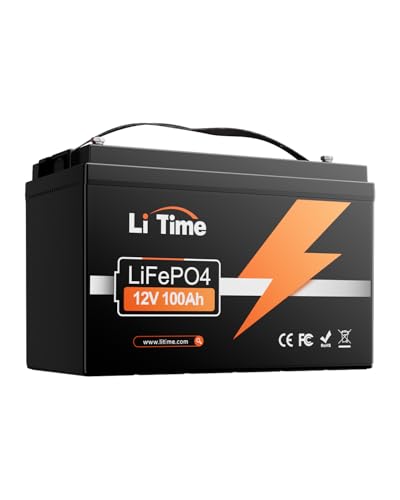
LiTime built its reputation by making LiFePO4 boring in the best way: standard group sizes, a properly rated internal battery management system, and expansion limits stated plainly. This Group 31 100Ah model is the lithium pick for buyers replacing a lead-acid house battery one-for-one in the same tray.
| Specification | Detail (from verified listing title) |
|---|---|
| Chemistry | LiFePO4 lithium |
| Capacity | 100Ah, 1280Wh (per verified title) |
| BMS | 100A built-in (per verified title) |
| Expansion | Up to 4P4S (per verified title) |
| Protection | IP65 waterproof (per verified title) |
Strengths
- Nearly the full 100Ah is usable, roughly doubling real capacity versus a same-size AGM
- Around half the weight of the lead-acid battery it replaces
- Series and parallel expansion to 4P4S lets a bank grow without replacing the first battery
Trade-offs
- Needs a lithium-compatible charger profile; an old converter may undercharge it
- Higher upfront cost per case than AGM, repaid over cycle life rather than immediately
- Cold-weather charging limits apply, as with all LiFePO4 — check the BMS protections for winter use
The case for this battery is total cost per delivered cycle, and it is strong: the verified listing rates it for a very high cycle count at partial depth of discharge, and because lithium tolerates deep discharge, a single 100Ah lithium routinely replaces two 100Ah AGMs in real daily use. The 100A BMS also matters for inverter users — it sets the honest ceiling for continuous draw, and 100A at 12V is roughly a 1,000-watt-class inverter load with margin handled correctly.
Fit is the other quiet advantage. Group 31 is one of the most common large battery sizes in RVs and boats, so trays, boxes and cables usually carry over. Verify your charger before ordering, not after: a lithium profile or an adjustable smart charger turns this into a drop-in upgrade, while a fixed lead-acid-only converter will leave it chronically undercharged.
Best for: RV, marine and solar owners upgrading from AGM who want full usable capacity and room to expand / Not suited for: buyers whose charger cannot support a lithium profile and who will not upgrade it
Check the current price on Amazon — check price on Amazon for the exact configuration, terminal type and pack count before ordering.

Renogy 12V 200Ah Deep Cycle AGM Battery — Best High-Capacity AGM
Some systems are better served by one large battery than by a parallel pair: fewer interconnects, one age, one state of charge. The Renogy 200Ah AGM is the single-case answer, aimed at bigger RV house banks, off-grid cabins and backup systems where 100Ah units would multiply quickly.
| Specification | Detail (from verified listing title) |
|---|---|
| Chemistry | AGM lead-acid, deep cycle |
| Capacity | 200Ah (12V) |
| Self-discharge | 3% rate (per verified title) |
| Max discharge current | 2000A (per verified title) |
Strengths
- 200Ah in one case simplifies wiring and keeps the bank matched by construction
- Same trusted deep-cycle AGM line as the 100Ah pick, scaled up
- Low self-discharge suits standby and seasonal systems as well as daily cycling
Trade-offs
- Very heavy — a two-person lift and a tray that genuinely supports it are mandatory
- A single point of failure: one failed battery takes the whole bank down
- Same lead-acid rule applies: plan around roughly half the nameplate for daily cycling
Choose this battery when the alternative is two 100Ah AGMs in parallel and you value simplicity over redundancy. Interconnect cables, matched ageing and balanced charging all get easier with one case, and the footprint, while large, is smaller than two separate batteries plus their cabling. It is a particularly good fit for a fixed cabin or a permanently installed RV bank that will not be moved by hand often.
Do not choose it for anything portable, and do not choose it without measuring. Check the tray dimensions and the weight rating of the compartment floor, and think through how it will be removed in five years’ time. Capacity you cannot safely install or service is not capacity at all.
Best for: larger fixed house banks, off-grid cabins and backup systems wanting one big AGM case / Not suited for: portable power, tight compartments or anyone who must move the battery alone
Check the current price on Amazon — check price on Amazon for the exact configuration, terminal type and pack count before ordering.
Renogy 12V 100Ah LiFePO4 Lithium Battery (Mini Size) — Best Compact Lithium
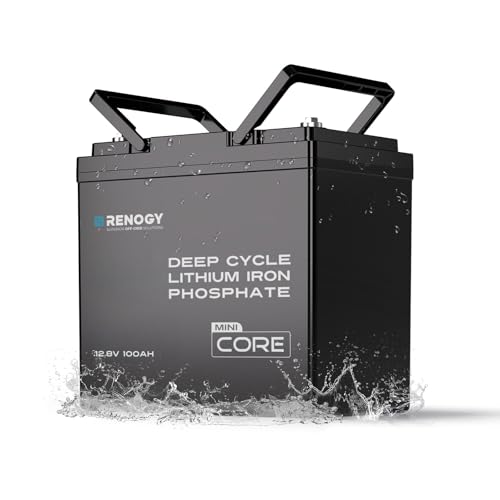
Not every battery compartment was designed for a Group 31 case. Renogy’s mini-size 100Ah LiFePO4 keeps the full 100Ah capacity and a 100A BMS while shrinking the footprint, which makes it the lithium pick for campervans, small boats and retrofits where the big case simply does not fit.
| Specification | Detail (from verified listing title) |
|---|---|
| Chemistry | LiFePO4 lithium |
| Capacity | 100Ah (12V) |
| BMS | 100A built-in (per verified title) |
| Protection | IP65 waterproof (per verified title) |
| Form factor | Mini size (per verified title) |
Strengths
- Full 100Ah lithium capacity in a smaller-than-Group-31 footprint
- Sealed, weather-resistant case suits marine and van installations
- Same drop-in logic as larger lithium picks: near-full usable capacity, half the weight of AGM
Trade-offs
- Non-standard size means aftermarket trays and boxes may need adaptation
- Still requires a lithium charging profile to reach full charge
- Premium positioning within the 100Ah lithium class
Measure-first buyers will appreciate this battery most. Van conversions in particular often inherit a battery locker sized for an old 75Ah or 80Ah lead-acid unit, and a mini 100Ah lithium can double real usable energy in that same hole without carpentry. The IP65 sealing also removes a worry in boats and in vans where the battery lives under a bed near condensation.
The trade-off to respect is mounting. A non-standard case still needs to be restrained properly — a loose lithium battery is lighter than a loose AGM, but it is still a hard object with terminals that must never short. Budget for straps or a fabricated tray as part of the install, not as an afterthought.
Best for: campervans, small boats and tight lockers that cannot take a Group 31 case / Not suited for: standard Group 31 trays where the larger, cheaper case already fits
Check the current price on Amazon — check price on Amazon for the exact configuration, terminal type and pack count before ordering.
Mighty Max ML100-12 12V 100Ah SLA AGM Battery — Best Value AGM
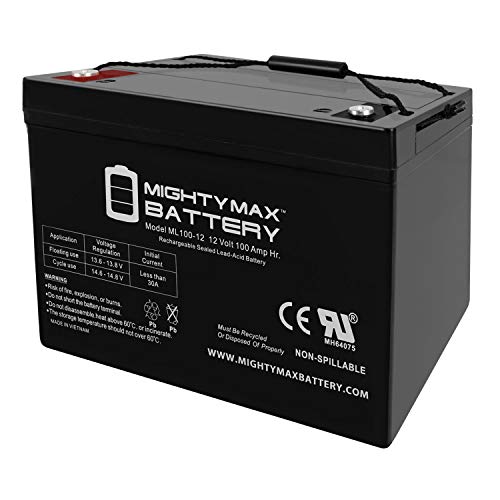
Mighty Max’s ML100-12 is the battery equivalent of a plain work shirt: a 12V 100Ah sealed lead-acid AGM unit with internal-thread terminals, sold in single packs, and used in everything from small solar banks to backup and mobility systems. It exists to deliver the standard specification at a value-tier position.
| Specification | Detail (from verified listing title) |
|---|---|
| Chemistry | SLA AGM lead-acid |
| Capacity | 100Ah (12V) |
| Terminals | Internal thread (INT) (per verified title) |
| Pack | 1 count (per verified title) |
Strengths
- Standard 100Ah SLA specification at a value-tier position in the market
- Internal-thread terminals make clean, secure cable connections easy
- Widely stocked single-pack format simplifies one-for-one replacements
Trade-offs
- Value-tier support and documentation are thinner than the premium brands
- Same lead-acid usable-capacity and weight realities as every AGM rival
- Check terminal hardware is included or order it with the battery
This is the right buy when the system is simple, the budget is real, and the battery will be treated as a consumable with a planned replacement cycle — a small solar shed system, a backup bank, a gate or pump system. In those roles, paying a brand premium for features you will never use is its own kind of waste, and a standard SLA unit from a high-volume seller is a rational choice.
Where it is the wrong buy is in a hard-cycling daily system you depend on, where cycle life differences compound and support matters. Be honest about which system you own. Either way, follow the same rule as the premium AGMs: size for half the nameplate in daily use and recharge promptly after discharge.
Best for: budget solar, backup and utility systems built around the standard 100Ah SLA format / Not suited for: demanding daily deep-cycle systems where premium cycle life pays for itself
Check the current price on Amazon — check price on Amazon for the exact configuration, terminal type and pack count before ordering.

Newport 12V 50Ah Deep Cycle AGM Marine Battery — Best Portable AGM
Portability changes the battery maths completely. Newport’s 50Ah AGM is a deep-cycle battery sized for one job done well: powering a trolling motor on a kayak, jon boat or small craft for a day, then being carried to the charger by one person without drama.
| Specification | Detail (from verified listing title) |
|---|---|
| Chemistry | AGM lead-acid, deep cycle |
| Capacity | 50Ah (12V) |
| Intended use | Trolling motors, kayaks and small boats (per verified title) |
Strengths
- One-person portable weight class while remaining a true deep-cycle design
- Right-sized for trolling motors: a full day for most small-craft use without excess case
- Sealed AGM construction tolerates boat movement and needs no watering
Trade-offs
- 50Ah is quickly outgrown if you add loads beyond the trolling motor
- Lead-acid weight still applies — lighter than 100Ah, not light in absolute terms
- Frequent deep discharges shorten life; lithium is the upgrade path for daily hard use
Sizing down is underrated advice. Many small-boat owners buy a 100Ah battery ‘to be safe’ and then pay for it in weight on every launch, every carry and every charge. A 50Ah deep-cycle battery matched honestly to a trolling motor’s draw is the better tool: enough endurance for typical sessions, half the burden, and a lower replacement cost when age eventually catches up.
If your sessions keep getting longer, treat this as the gateway pick rather than a failure: the same system design — charger, wiring, battery box — scales directly to the lithium options in this guide when you are ready, and the 50Ah AGM remains useful as a backup or for a second craft.
Best for: kayaks, jon boats and small craft running a trolling motor for a day at a time / Not suited for: house banks, inverter systems or multi-load boats
Check the current price on Amazon — check price on Amazon for the exact configuration, terminal type and pack count before ordering.
Comparison Table
| Pick | Badge | Key spec | Best for |
|---|---|---|---|
| Renogy 12V 100Ah Deep Cycle AGM Battery | Best Overall AGM | 100Ah AGM deep cycle, 3% self-discharge | RV house power, cabin solar, marine house banks and general deep-cycle work on a sensible budget |
| LiTime 12V 100Ah Group 31 LiFePO4 Deep Cycle Battery | Best Overall LiFePO4 | 100Ah LiFePO4, 100A BMS, 1280Wh, 4P4S | RV, marine and solar owners upgrading from AGM who want full usable capacity and room to expand |
| Renogy 12V 200Ah Deep Cycle AGM Battery | Best High-Capacity AGM | 200Ah AGM deep cycle, single case | larger fixed house banks, off-grid cabins and backup systems wanting one big AGM case |
| Renogy 12V 100Ah LiFePO4 Lithium Battery (Mini Size) | Best Compact Lithium | 100Ah LiFePO4, mini size, IP65, 100A BMS | campervans, small boats and tight lockers that cannot take a Group 31 case |
| Mighty Max ML100-12 12V 100Ah SLA AGM Battery | Best Value AGM | 100Ah SLA AGM, INT terminals | budget solar, backup and utility systems built around the standard 100Ah SLA format |
| Newport 12V 50Ah Deep Cycle AGM Marine Battery | Best Portable AGM | 50Ah AGM deep cycle, portable marine | kayaks, jon boats and small craft running a trolling motor for a day at a time |
Read the table by job, not by headline capacity. The two AGMs at 100Ah and 200Ah deliver roughly half their nameplate comfortably each day; the two LiFePO4 picks deliver nearly all of theirs. That single fact explains most price differences in this category and most disappointed-buyer stories: a 100Ah lithium and a 100Ah AGM are not the same amount of usable energy, and any comparison that ignores depth of discharge is rigged from the start.
Weight tells the same story from the other side. If the battery moves — into a boat, out of a van, up cabin steps — lithium’s weight advantage or the smaller 50Ah AGM will matter more than any specification. If the battery is installed once and left for years, AGM’s weight is a one-day problem and its lower upfront cost is a permanent saving. Match the chemistry to the calendar, not to fashion.
Understanding Amp-Hours, Watt-Hours and Depth of Discharge
Amp-hours are the category’s headline number and its most misunderstood one. A 100Ah rating means the battery delivered that charge under a specific test — commonly a 20-hour discharge, which means a gentle 5-amp draw. Draw faster and a lead-acid battery delivers noticeably less than its rating, an effect described by Peukert’s law; lithium is far less affected. This is why the same battery can feel generous powering lights and disappointing powering a heavy inverter load, and why honest sizing uses your real draw rate, not the brochure rate.
Watt-hours cut through the confusion when comparing across voltages: multiply amp-hours by nominal voltage. A 12V 100Ah battery stores about 1,200 watt-hours on paper — the LiTime pick in this guide states 1,280Wh from its 12.8V nominal lithium voltage, which is one reason lithium listings quote watt-hours so prominently. When you shop for any 12 volt battery, converting everything to watt-hours and then applying the usable fraction for the chemistry gives the only comparison that never lies.
Depth of discharge is where the money lives. A lead-acid battery discharged to half its capacity every cycle will deliver several times the total lifetime energy of the identical battery discharged to empty every cycle. Lithium reverses the tolerance: deep discharge is its normal working range. Neither fact is a flaw — but a buying decision that ignores depth of discharge is a decision made with the most important number missing.
Terminals, Group Sizes and the Unglamorous Details That Decide Fit
Group size is the battery world’s sizing standard: it fixes the case dimensions and usually the terminal layout. Group 24, 27 and 31 dominate RV and marine work; smaller SLA sizes follow their own conventions for alarm and UPS service. Measure your tray, note the height clearance including cables, and confirm the terminal type — automotive post, marine wing-nut, or internal thread like the Mighty Max pick — before ordering. A battery that almost fits is a battery that does not fit.
Cable condition matters as much as battery condition. Undersized or corroded cables drop voltage under load, which looks exactly like a weak battery and has sent many healthy batteries back as ‘defective’. When you replace a battery, inspect the full path: terminals, lugs, fuse holder, disconnect switch and ground point. Cleaning and re-torquing that path during a battery swap is the cheapest performance upgrade in any 12 volt system.
Finally, plan the fuse. A main fuse or breaker close to the positive terminal, sized for the cable and the largest load, protects the wiring — which is what fuses are for. Batteries can deliver enormous short-circuit current; the verified titles in this guide quote maximum discharge figures in the thousands of amps for the large AGM picks, which is a safety fact as much as a specification.
Battery Monitors, Testing and Knowing the Truth About State of Charge
Voltage alone is a poor fuel gauge, especially under load. A rested lead-acid battery’s voltage correlates loosely with charge; a lithium battery’s voltage stays nearly flat through most of its range and tells you almost nothing until it is nearly empty. This is why serious systems use a shunt-based battery monitor, which counts current in and out and reports state of charge as a percentage you can plan around. For any battery in this guide beyond the smallest standby uses, a monitor costing a fraction of the battery’s price is the highest-value accessory in the system.
Testing a suspect battery follows a disciplined order. Charge it fully with the correct profile, let it rest disconnected for several hours, then measure resting voltage. Apply a known load and watch the voltage behaviour over an hour. A battery that rests correctly but collapses under a modest load has lost capacity or gained internal resistance; a battery that will not reach full charge points first at the charger and connections. Most ‘mystery failures’ resolve at one of these steps, and the written baseline from commissioning day turns guesswork into comparison.
Keep records. Installation date, charger settings, storage dates and any deep-discharge events, noted in a phone or a notebook, are what separate a battery that ‘died young’ from a system problem you can actually fix. Manufacturers’ support conversations also go better with dates and voltages than with impressions — another unglamorous habit that pays for itself the first time it is needed.
Recycling, Warranties and the End of a Battery’s Life
Every battery in this guide is recyclable and none belongs in household waste. Lead-acid has the most mature recycling loop in any consumer product — cores are routinely accepted by sellers and auto shops, often against the replacement purchase. Lithium batteries go through electronics and battery recycling channels rather than the lead-acid loop; check the maker’s guidance and never puncture or incinerate a damaged lithium unit. Returning the old battery is part of the purchase, and planning its route out when the new one goes in is the mark of a finished job.
Warranties deserve a sober read. A warranty covers defects, not physics: a battery cycled to empty daily, cooked in a hot compartment or chronically undercharged has been consumed, not wronged, and support conversations go better when your records show correct charging and reasonable use. Keep the purchase record, the install date and your charger settings together — the same notebook discipline recommended at commissioning — and a genuine defect becomes easy to demonstrate.
End of life announces itself gradually: shorter runtimes, faster voltage sag under familiar loads, and longer charges that deliver less. When two of those three appear together after a verified full charge, plan the replacement on your schedule rather than the battery’s — ideally before the trip, the season or the outage where it would have mattered most.
How to Choose the Best 12 Volt Batteries for Your Actual Job
Start with the load, written down. List everything the battery must run, its draw in amps or watts, and the hours per day it runs. Multiply amps by hours to get amp-hours per day, then size the battery so that daily use is no more than about half the rated capacity for lead-acid, or about eighty percent for LiFePO4. That one calculation, done honestly, prevents most bad purchases in this category — most ‘bad batteries’ were actually undersized systems.
Next, classify the job. Starting work (engine cranking) needs high burst current and shallow discharge; a starting or dual-purpose battery belongs there, not a deep-cycle unit. Cycling work (house loads, trolling, solar) needs deep-cycle construction. Standby work (alarms, UPS, gates) needs low self-discharge and a float-capable charger. Many disappointed buyers own a perfectly good battery of the wrong class.
Then check the physical system: group size and tray dimensions, terminal type and cable lengths, and the charger’s supported profiles. A lithium battery on a lead-acid-only charger, or an oversize case in a small locker, fails before chemistry ever gets a chance. Finally, decide the expansion path. If the bank may grow, choose a battery whose maker explicitly permits the series or parallel configuration you will need, and buy matched units when the time comes rather than mixing ages and brands.
AGM vs LiFePO4: The Honest Trade-Off
AGM wins on upfront cost, charger simplicity and cold tolerance while charging. It loses on weight, usable capacity per rated amp-hour, and total cycles. For a system used on occasional weekends, stored for months, and charged by an existing converter, AGM is often the economically correct answer — the lithium advantage is paid for in cycles you may never use.
LiFePO4 wins on usable capacity, weight, charge speed and lifetime cost per cycle. It loses on upfront cost and demands a compatible charger plus respect for low-temperature charging limits. For daily cycling — full-time RV living, off-grid homes, working boats — the arithmetic reverses completely and lithium is usually the cheaper battery over its life. Neither chemistry is ‘better’; they are answers to different calendars.
Whichever you choose, do not mix chemistries in one bank, do not mix old and new batteries in one bank if you can avoid it, and do not believe any listing that promises lead-acid capacity at lithium weight. Physics does not discount.
How to Install and Commission a New 12 Volt Battery Safely
1. Prepare and inspect. Charge the new battery fully with a charger matched to its chemistry before installation. Inspect the case for shipping damage, confirm the terminal type matches your cables, and gather eye protection, insulated tools and baking-soda solution for lead-acid work. Photograph the old wiring before disconnecting anything.
2. Remove the old battery correctly. Switch off all loads and chargers. Disconnect the negative cable first, then the positive, and insulate both ends so they cannot touch a terminal accidentally. Lift with your legs or with help — a 100Ah lead-acid battery is a serious weight — and set the old battery aside for recycling; most sellers and auto shops accept cores.
3. Install and secure the new battery. Set the battery in the tray, confirm ventilation for lead-acid installations, and restrain it with the tray strap or hold-down so it cannot move in transit. Connect the positive cable first, then the negative, and tighten terminals firmly without over-torquing. A loose terminal causes more field failures than any defect inside the battery.
4. Configure the charger. Select the correct profile — AGM, flooded, or lithium — on every charging source: shore charger, solar controller, and DC-to-DC charger if fitted. Set the absorption and float voltages to the battery maker’s specification. This step is where lithium upgrades most often go wrong, and it costs nothing to do right.
5. Commission with a known load. Run a familiar load and watch the voltage behaviour, or better, fit a shunt-based battery monitor and reset it at full charge. Record the date, the charger settings and the resting voltage in a notebook kept with the system. Future troubleshooting becomes dramatically easier when the healthy baseline is written down.
Safety note: never short the terminals, never charge a visibly damaged or swollen battery, and never install a lead-acid battery in a sealed unventilated box. If a battery becomes hot, swells or vents during charging, disconnect power from a safe distance and let it cool before handling.
Common Buying Mistakes
Buying by voltage alone. ’12 volt’ describes almost every battery in this guide and almost nothing about fitness. Buy by job class, usable capacity and group size, in that order.
Draining lead-acid to empty. Treating a 100Ah AGM as 100 usable amp-hours halves its life or worse. Size the bank so daily use stays near half the nameplate, or buy lithium and use its real capacity honestly.
Ignoring the charger. The best battery on the wrong charger profile undercharges, overcharges or never fills. Verify every charging source supports the chemistry before the battery arrives.
Mixing batteries in a bank. Old with new, AGM with lithium, or different capacities in parallel all force the weakest unit to set the performance and age the rest early. Build banks from matched units bought together.
Skipping the restraint and the fuse. An unrestrained battery in a moving vehicle is a hazard, and an unfused main cable is a fire risk. A hold-down strap and a correctly sized fuse near the positive terminal are cheap, non-negotiable parts of the job.
Final Recommendation
For most buyers, the decision resolves cleanly. Choose the Renogy 100Ah AGM if you want the proven, charger-friendly default for RV, cabin, marine or solar house power. Choose the LiTime Group 31 LiFePO4 if you cycle daily, count weight, or want the full rated capacity usable — and the Renogy Mini LiFePO4 if that same upgrade must fit a smaller locker. The Renogy 200Ah AGM serves big single-case banks, the Mighty Max ML100-12 serves honest budget systems, and the Newport 50Ah serves portable trolling work.
If your job is narrower than ‘general’, go to the specialist guide before ordering: the RV guide sizes house banks around real RV loads, the inverter guide matches batteries to inverter draw and surge, and the solar guides work through panel-to-battery sizing for storage and off-grid systems.
Best 12 Volt Batteries For An Rv
Best 12 Volt Batteries For Inverters
Best 12 Volt Batteries For Solar Storage
Best 12 Volt Batteries For Solar Off Grid
The verified picks, one last time for convenience:
- Renogy 12V 100Ah Deep Cycle AGM Battery — Best Overall AGM
- LiTime 12V 100Ah Group 31 LiFePO4 Deep Cycle Battery — Best Overall LiFePO4
- Renogy 12V 200Ah Deep Cycle AGM Battery — Best High-Capacity AGM
- Renogy 12V 100Ah LiFePO4 Lithium Battery (Mini Size) — Best Compact Lithium
- Mighty Max ML100-12 12V 100Ah SLA AGM Battery — Best Value AGM
- Newport 12V 50Ah Deep Cycle AGM Marine Battery — Best Portable AGM
Best 12 Volt Batteries For An Rv
Best 12 Volt Batteries For Inverters
Best 12 Volt Batteries For Solar Storage
Best 12 Volt Batteries For Solar Off Grid
Frequently Asked Questions
How long will a 12V 100Ah battery run my loads?
Divide by your actual draw. A 100Ah battery running a steady 5-amp load lasts about 20 hours on paper — but plan on roughly half that for lead-acid if you want the battery to live, and about 16 hours for LiFePO4. Convert watts to amps by dividing by 12: a 120-watt load draws about 10 amps before inverter losses.
Can I replace a lead-acid battery with LiFePO4 directly?
Physically, usually yes if the group size fits. Electrically, only if every charger in the system offers a lithium profile or suitable adjustable settings. Check the shore charger, solar controller and alternator charging path before ordering, and expect to upgrade at least the settings, sometimes the charger itself.
What is the difference between a starting battery and a deep cycle battery?
A starting battery delivers a large burst for seconds and is recharged immediately; its thin plates suffer if deeply discharged. A deep cycle battery delivers moderate current for hours and tolerates repeated deep discharge. Using each for the other’s job shortens its life dramatically.
How should I store a 12 volt battery over winter?
Charge it fully, disconnect all loads, and store it cool. Lead-acid self-discharges slowly and should be topped up every few months or kept on a maintainer. LiFePO4 is best stored partially charged per the maker’s guidance, with the system switched off. Never store any battery discharged.
Can I connect 12 volt batteries in series or parallel?
Parallel connection (12V, more capacity) and series connection (24V or 48V, same capacity) are both legitimate when the battery maker permits the configuration and the units are identical in model, age and state of charge. Follow the maker’s stated limits — for example the LiTime pick in this guide is rated for up to 4P4S expansion.
Why did my new battery fail early?
The common causes are chronic undercharging, repeated over-discharge, a charger set to the wrong chemistry, loose or corroded terminals, and heat. Before blaming the battery, verify the charger profile and measure resting voltage after a full charge and a rest period — the notebook baseline from commissioning makes this diagnosis far easier.
Should I buy one large battery or two smaller ones?
Electrically they can be equivalent; practically they differ in handling, redundancy and fit. Two smaller units are easier to lift and isolate, one large unit is simpler to wire and ages as a single matched block. Choose by your compartment, your back and whether a single point of failure matters in your application — and if you parallel two units, buy them identical and at the same time.