Disclosure: airfryerkitchensupply.com is reader-supported. When you buy through links on our site, we may earn an affiliate commission at no extra cost to you.
Where to buy
The fastest way to confirm current availability for a best 220 volt garage heater is to check the linked picks below on Amazon, because 220-volt-class appliances are sold in smaller runs than their 120-volt counterparts and individual listings change configuration without much warning. Every linked pick in this guide was cross-checked against the Amazon listing data available to us, and the voltage claim in each review comes from that listing’s own title — not from a similar model, a different size in the same range, or a seller’s marketing banner. Where a promising product’s listing did not state its voltage clearly, we kept it in the guide as a pick with no purchase link, and we tell you exactly what to verify on the nameplate or spec sheet before you spend anything.
DR. INFRARED HEATER DR-910F 10,000-Watt 240V Garage Heater — check price on Amazon
COMFORT ZONE 10,000W 240V Ceiling Mount Garage Heater (Grey) — check price on Amazon
Dura Heat EWH9615 240V Hard-Wired Garage Heater, 10,000 Watt — check price on Amazon
CTSC 10000W Garage Heater, 240V, with ECO and Timer — check price on Amazon
COMFORT ZONE 5000-Watt Fan-Forced Ceiling Mount Garage Heater (Grey) — check price on Amazon
InoKraft 5000W Electric Garage Heater, 240V with NEMA 14-50P Plug — check price on Amazon
The best 220 volt garage heater is, in practice, a 240-volt hardwired ceiling heater, and the reason is simple arithmetic. A plug-in 120V space heater is capped at 1,500 watts, which in a cold garage is a rounding error. A 240V circuit unlocks 5,000 to 10,000 watts of fan-forced heat — enough to take a two or three-car garage from finger-numbing to workable in a reasonable time, and to hold it there while you work. Every pick in this guide is in that class, with 240V printed in its verified listing title: five hardwired units and one plug-in model on a 50-amp plug, because the plug-versus-hardwired decision is the first real fork in this purchase.
Respect the circuit before anything else, because this category’s most common buying disaster is electrical optimism. A 10,000-watt heater draws about 42 amps at 240 volts; as a continuous load it needs a circuit and breaker sized well above that draw — this is a 60-amp-class installation, not the 30-amp dryer circuit many garages happen to have. A 5,000-watt unit draws about 21 amps and fits a far wider range of real panels. Neither fact is a flaw; both are physics, and the reviews and the circuit section below keep them in front of you, because the correct heater is the biggest one your panel can honestly feed, not the biggest one on the page.
The second decision is behavioural. Fan-forced ceiling units heat air and move it, which suits garages: fast warm-up, thermostatic control, nothing hot at floor level where fuel, solvents and cardboard live. Mounting height, thermostat placement, and whether the unit’s controls are on the box, on a remote, or in an app all change daily life with the heater more than another few hundred watts would. The six picks span the sensible range — two sizes, several control philosophies, one plug-in exception — so you can match the heater to the garage you actually have.
In this guide
Quick Picks
Best Overall — DR. INFRARED HEATER DR-910F 10,000-Watt 240V Garage Heater. The heavy-duty benchmark: 10,000 verified 240V watts, wall or ceiling mounting, and a remote-controlled thermostat from a brand built around hardwired heat.
Check the current price on Amazon
Best Commercial Workhorse — COMFORT ZONE 10,000W 240V Ceiling Mount Garage Heater (Grey). Comfort Zone’s commercial ceiling unit: the same 10,000W / 240V hardwired class, in a no-nonsense grey steel box aimed at garages, workshops and warehouses.
Check the current price on Amazon
Best Steel-Body Value in the 10kW Tier — Dura Heat EWH9615 240V Hard-Wired Garage Heater, 10,000 Watt. Dura Heat states the deal in its title with unusual bluntness: no plug, hardwired install required — 10,000 watts, 34,120 BTU, steel body, remote and thermostat, rated to heat up to 1,200 sq ft.
Check the current price on Amazon
Best Feature-Rich 10kW Pick — CTSC 10000W Garage Heater, 240V, with ECO and Timer. The connected-generation entry in the big tier: remote, timer, an ECO function and external-thermostat readiness on a verified 240V / 10,000W ceiling unit.
Check the current price on Amazon
Best for Typical Panels — 5,000W Hardwired — COMFORT ZONE 5000-Watt Fan-Forced Ceiling Mount Garage Heater (Grey). The realistic default for most garages: 5,000 hardwired 240V watts with three heat settings, drawing about 21 amps — a circuit most panels can actually provide.
Check the current price on Amazon
Best Plug-In Pick — No Hardwiring — InoKraft 5000W Electric Garage Heater, 240V with NEMA 14-50P Plug. The exception that proves the rule: a 5,000W ceiling heater that plugs into a 50-amp NEMA 14-50 receptacle — the same outlet an EV charger or range uses — with remote, digital thermostat, timer and ECO mode.
Check the current price on Amazon
How These Picks Were Chosen
Verification used Amazon listing data under the programme’s rule: search by brand and model, match the returned listing title, and link only where the title itself states 240V and the wattage claimed. That excluded the swarm of 120V ‘garage heaters’ — radiant panels and milk-house units wearing garage language — whose titles confess 120V the moment you read them, plus heaters quoting wattage with no voltage at all. What survived is the genuine hardwired class from recognised heater brands and the current generation of feature-rich ceiling units.
We balanced the list by electrical commitment as much as by brand: a 10,000W tier for large, cold garages with panels to match (Dr. Infrared, Comfort Zone, Dura Heat, CTSC), and a 5,000W tier for the far more common panel reality, in both hardwired (Comfort Zone) and plug-in (InoKraft, on a NEMA 14-50P) forms. Features were credited only as stated in verified titles — remote control, timers, ECO modes, thermostat arrangements — never borrowed from a sibling model.
The 6 Best 220 Volt Garage Heaters

DR. INFRARED HEATER DR-910F 10,000-Watt 240V Garage Heater — Best Overall
Dr. Infrared Heater built its name on exactly this class of product, and the DR-910F is its flagship shop heater formula: 10,000 watts on a verified 240V hardwired supply, heavy-duty construction, wall or ceiling mounting, and a thermostat you control by remote rather than by ladder. In a three-car garage or a working shop, that combination is the point — maximum heat, mounted out of the way, adjusted from the bench. Ten thousand watts is roughly 34,000 BTU of fan-forced heat, which changes a cold-soaked garage’s personality in a way no 1,500W plug-in ever will.
The commitment is equally flagship-sized. At full output this unit draws about 42 amps continuously, so it belongs on a properly sized dedicated circuit — a 60-amp-class installation in typical practice — run by an electrician who has seen the panel first. If your panel cannot feed it, the honest move is down to the 5,000W tier, not a hopeful install. For garages that can feed it, the remote thermostat is the daily-life feature that matters most: pre-heat from the house, hold a steady working temperature, and drop to a freeze-protect level overnight without touching the unit.
Strengths
- Maximum verified output in the guide — 10,000W at 240V
- Remote-controlled thermostat: adjust from the bench, not a ladder
- Wall or ceiling mounting flexibility for awkward garages
Trade-offs
- Needs a high-amperage dedicated circuit — panel assessment first, always
- Hardwired install; electrician cost is part of the purchase
- Oversized and wasteful for a small single garage — size down instead
| Specification | Detail (from verified listing) |
|---|---|
| Output | 10,000 watt (per verified listing title) |
| Voltage | 240V, hardwired (per verified listing title) |
| Mounting | Wall/ceiling (per verified listing title) |
| Control | Remote-controlled thermostat (per verified listing title) |
Best for: large garages and working shops whose panels can feed a 60-amp-class circuit / Not suited for: small garages, or any panel without serious spare capacity — take a 5,000W pick
Check the current price on Amazon
COMFORT ZONE 10,000W 240V Ceiling Mount Garage Heater (Grey) — Best Commercial Workhorse
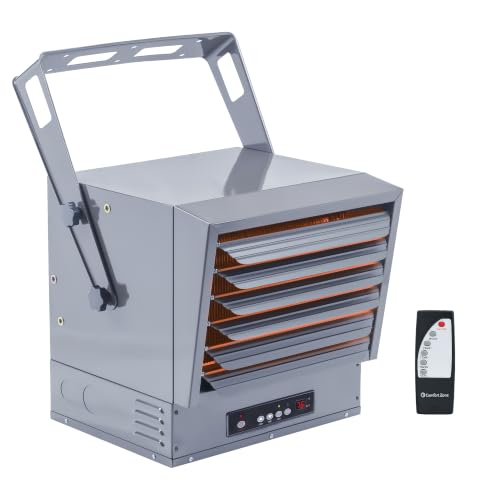
Comfort Zone’s pitch is in its verified title and it is refreshingly plain: a 240V hardwired, 10,000W commercial heater with fan-forced heating, ceiling-mounted, for large garages, workshops and warehouses. No app, no ecosystem — a steel box that makes a great deal of heat and moves it around the room. For buyers whose priority is dependable warmth in a working space rather than features, that plainness is the appeal, and Comfort Zone’s long presence in the heater aisle means the design is a known quantity.
It shares the tier’s electrical reality exactly: roughly 42 amps at full output, a dedicated high-amperage circuit, an electrician’s visit, and a panel conversation before purchase. Ceiling mounting keeps the heater clear of vehicles, benches and stored fuel — a safety property, not just a convenience, in a garage. Choose it over the Dr. Infrared if you prefer simple unit-mounted commercial controls and a workhorse brief; choose the Dr. Infrared if the remote thermostat will genuinely change how you use the space.
Strengths
- Straightforward commercial design from an established heater brand
- Full 10,000W fan-forced output on verified 240V hardwired supply
- Ceiling mount keeps heat source away from floor-level hazards
Trade-offs
- Same heavy circuit requirement as every 10,000W unit here
- Fewer creature comforts — no app or remote ecosystem in the title’s offer
- Fan-forced noise is part of the class; this is a workshop tool, not a living-room appliance
| Specification | Detail (from verified listing) |
|---|---|
| Output | 10,000W (per verified listing title) |
| Voltage | 240V, hardwired (per verified listing title) |
| Mounting | Ceiling mount (per verified listing title) |
| Use | Garages, workshops, warehouses (per verified listing title) |
Best for: working garages and small warehouses wanting maximum heat with simple controls / Not suited for: feature-seekers wanting app control, or panels that cannot feed the tier
Check the current price on Amazon

Dura Heat EWH9615 240V Hard-Wired Garage Heater, 10,000 Watt — Best Steel-Body Value in the 10kW Tier
Dura Heat’s title deserves credit for the two words this category most needs: ‘NO PLUG’. The EWH9615 is a hardwired 240V install, and the listing says so upfront, alongside the rest of its honest specification — 10,000 watts, 34,120 BTU, two power settings, a steel body, remote control, thermostat, and a claimed heating area up to 1,200 square feet. That coverage figure, like all such figures, assumes a reasonably insulated space; a leaky, uninsulated garage will see less. But the specification culture is exactly right, and the two power settings give the unit a lower gear for mild days and smaller electrical appetite when full output is unnecessary.
As a value-positioned member of the 10kW tier, it trades the flagship brands’ polish for the same fundamental physics: fan-forced heat at roughly 42 amps maximum draw, on a dedicated circuit sized for continuous duty. The steel body suits workshop knocks. If your garage is large, your panel is capable, and your priorities are heat-per-commitment rather than brand refinement, this is a rational place to land. The install rules do not soften with the price: electrician, correct breaker and wire, thermostat placed sensibly away from the unit’s own blast.
Strengths
- Title states the hardwired reality upfront — ‘NO PLUG’ — plus full BTU and coverage figures
- Two power settings add flexibility for mild days
- Steel body and remote control at the value end of the tier
Trade-offs
- Manufacturer coverage figure assumes decent insulation — derate for leaky garages
- Value tier fit and finish trail the flagship brands
- Full 10,000W circuit requirement applies unchanged
| Specification | Detail (from verified listing) |
|---|---|
| Output | 10,000 watt, 2 power settings (per verified listing title) |
| Heat | 34,120 BTU (per verified listing title) |
| Voltage | 240 volt, hardwired — no plug (per verified listing title) |
| Coverage | Up to 1,200 sq ft (per verified listing title) |
Best for: large garages with capable panels, prioritising heat output and straightforward specification / Not suited for: small garages, or buyers wanting app-based control
Check the current price on Amazon

CTSC 10000W Garage Heater, 240V, with ECO and Timer — Best Feature-Rich 10kW Pick
CTSC represents the newer school of garage heater: the same 10,000W, 240V hardwired ceiling-mount physics as the workhorses, wrapped in controls that assume you will programme the heater rather than merely switch it. The verified title lists remote control, a timer, an ECO function, and readiness for an external thermostat. That last feature is quietly the most professional one here — an external wall thermostat senses temperature where people work, not at the ceiling where heat pools, and it is the control arrangement experienced installers prefer.
ECO mode and the timer change the economics of a big heater in real use: holding a garage at a modest background temperature and boosting before work sessions costs far less than either full-time heat or cold starts. The caveats are the tier’s usual ones — the circuit must still be a serious dedicated installation, and a newer brand’s long-term support is less proven than the established names. For the buyer who will actually use scheduling and external sensing, those features are worth more than brand heritage; for the buyer who wants a dial and a decade, the Comfort Zone is the honest alternative.
Strengths
- External thermostat ready — the pro control arrangement, sensing at working height
- ECO function and timer for background-heat economics
- Remote control included, per the verified title
Trade-offs
- Newer brand — long-term parts support less proven
- Full 10,000W circuit requirement, unchanged by the smart features
- Feature set is wasted if you will only ever switch it on and off
| Specification | Detail (from verified listing) |
|---|---|
| Output | 10000W (per verified listing title) |
| Voltage | 240V, hardwired (per verified listing title) |
| Controls | Remote, timer, ECO function, external thermostat ready (per verified listing title) |
| Mounting | Ceiling mount, fan-forced (per verified listing title) |
Best for: scheduled-use garages — pre-heat before sessions, background heat between — with a capable panel / Not suited for: set-and-forget buyers who prefer the simplest possible controls
Check the current price on Amazon

COMFORT ZONE 5000-Watt Fan-Forced Ceiling Mount Garage Heater (Grey) — Best for Typical Panels — 5,000W Hardwired
This is the pick the majority of garage owners should buy, and the reason is electrical honesty. At 5,000 watts the draw is about 21 amps at 240V — a continuous load that fits a 30-amp-class dedicated circuit, which vastly more panels can supply than the 10,000W tier’s demands. Comfort Zone’s unit adds three heat settings (3,000, 4,000 and 5,000 watts, per the verified title), so the heater can idle through mild days at lower power and still take a standard two-car garage from cold to workable when asked. Ceiling-mounted and fan-forced, it keeps the heat source away from everything a garage floor contains.
What does 5,000 watts feel like in practice? In an insulated or moderately leaky two-car garage in a temperate-to-cold climate, it is the difference between working in gloves and working in shirtsleeves, reached in tens of minutes rather than hours. In a large, uninsulated, genuinely cold-climate garage, it is a take-the-edge-off heater, and the 10,000W tier — or insulation first — is the honest answer. That framing, not the wattage headline, is how to choose between the tiers, and the buying guide below gives you the insulation-first argument in full.
Strengths
- Fits real panels: ~21A draw suits a 30-amp-class dedicated circuit
- Three heat settings (3,000/4,000/5,000W) stated in the verified title
- Established brand, hardwired commercial ceiling format
Trade-offs
- Half the flagship tier’s output — large, leaky, cold garages will want more
- Hardwired install still requires an electrician
- Unit-class controls rather than app/remote ecosystem
| Specification | Detail (from verified listing) |
|---|---|
| Output | 5,000 watt, 3 settings: 3,000/4,000/5,000W (per verified listing title) |
| Voltage | 240V, hardwired (per verified listing title) |
| Mounting | Ceiling mount, fan-forced (per verified listing title) |
| Use | Garages and workshops (per verified listing title) |
Best for: typical two-car garages and typical panels — the balanced default for most buyers / Not suited for: three-car or uninsulated cold-climate garages needing the 10,000W tier
Check the current price on Amazon

InoKraft 5000W Electric Garage Heater, 240V with NEMA 14-50P Plug — Best Plug-In Pick — No Hardwiring
InoKraft’s insight is that a growing number of garages already have the right receptacle: the NEMA 14-50, installed for an EV charger, a welder, or a range-style outlet. This heater ships with that plug, per its verified title, turning installation into mounting the ceiling bracket and plugging in — no electrician visit for the connection itself, provided the existing circuit genuinely is a 50-amp circuit in good condition. The feature list is the modern one: remote control, digital thermostat, 24-hour timer, ECO mode, overheat protection, and 10 AWG cord, all stated in the title.
Two disciplines keep this pick honest. First, the receptacle must be real: a 14-50 outlet on a correctly sized breaker and wire run, not an adapter fantasy — and never a dryer-outlet conversion cable arrangement improvised at home. Second, sharing matters: if the outlet exists for your EV, the heater and the car cannot use it at once, so the daily choreography needs thought. For renters with a suitable existing outlet, and for owners who want the heater removable, this is the most flexible pick in the guide — the same 5,000W physics as the hardwired Comfort Zone, with a plug where the permanence used to be.
Strengths
- Plugs into an existing 50A NEMA 14-50 receptacle — no hardwired connection
- Full modern control set: remote, digital thermostat, 24H timer, ECO mode
- Removable and renter-friendlier than any hardwired pick
Trade-offs
- Requires a genuine, correctly wired 14-50 circuit — verify before relying on it
- Shares the outlet with whatever else uses it — EVs especially
- Newer brand; support depth less proven than the established names
| Specification | Detail (from verified listing) |
|---|---|
| Output | 5000W (per verified listing title) |
| Voltage | 240V with NEMA 14-50P plug (per verified listing title) |
| Controls | Remote, digital thermostat, 24H timer, ECO mode (per verified listing title) |
| Cord | 10 AWG wire (per verified listing title) |
Best for: garages with a genuine existing 50A receptacle — EV households, renters, anyone avoiding hardwiring / Not suited for: garages without a suitable receptacle, where a hardwired install is the correct path anyway
Check the current price on Amazon
Comparison Table
| Pick | Badge | Key spec | Best for |
|---|---|---|---|
| DR. INFRARED HEATER DR-910F 10,000-Watt 240V Garage Heater | Best Overall | 10,000W / 240V hardwired, remote thermostat | large garages and working shops whose panels can feed a 60-amp-class circuit |
| COMFORT ZONE 10,000W 240V Ceiling Mount Garage Heater (Grey) | Best Commercial Workhorse | 10,000W / 240V ceiling mount | working garages and small warehouses wanting maximum heat with simple controls |
| Dura Heat EWH9615 240V Hard-Wired Garage Heater, 10,000 Watt | Best Steel-Body Value in the 10kW Tier | 10,000W / 240V, 34,120 BTU | large garages with capable panels, prioritising heat output and straightforward specification |
| CTSC 10000W Garage Heater, 240V, with ECO and Timer | Best Feature-Rich 10kW Pick | 10,000W / 240V with ECO + external thermostat ready | scheduled-use garages — pre-heat before sessions, background heat between — with a capable panel |
| COMFORT ZONE 5000-Watt Fan-Forced Ceiling Mount Garage Heater (Grey) | Best for Typical Panels — 5,000W Hardwired | 5,000W / 240V hardwired, 3 settings | typical two-car garages and typical panels — the balanced default for most buyers |
| InoKraft 5000W Electric Garage Heater, 240V with NEMA 14-50P Plug | Best Plug-In Pick — No Hardwiring | 5,000W / 240V plug-in (NEMA 14-50P) | garages with a genuine existing 50A receptacle — EV households, renters, anyone avoiding hardwiring |
How to Choose a 220 Volt Garage Heater: Start at the Panel, Not the Product Page
The panel decides your tier. A 10,000W heater draws about 41.7 amps at 240V; heating is a continuous load, so the circuit must be sized with the standard continuous-duty margin — in practice a 60-amp-class dedicated circuit. A 5,000W heater draws about 20.8 amps and fits a 30-amp-class circuit on the same logic. Before ordering anything, have an electrician confirm what your panel can actually spare; older 100-amp services with electric ranges, dryers and water heaters may already be spoken for. The heater you can feed beats the heater you cannot, every single time.
Next, be honest about the building. Insulation is the cheapest wattage: a garage door kit, sealed gaps, and an insulated ceiling can move a garage down a whole heater tier. The manufacturers’ coverage figures in this category assume reasonable construction. An uninsulated three-car garage in a cold climate will humble a 5,000W unit and make a 10,000W unit merely adequate; the same units in an insulated two-car are generous. Measure the space, note the construction, and if the honest answer is ‘leaky and huge’, spend the first money on the envelope and the rest on the heater.
- Decide the tier by panel capacity and garage size together — not by wattage envy.
- Prefer ceiling mounting: heat starts high, mixes down, and stays clear of floor hazards.
- Place the thermostat at working height, away from the unit’s discharge — external thermostat arrangements exist for exactly this reason.
- Plan the warm-up pattern: timers and ECO/background modes cost less than cold starts and full-time heat.
Finally, controls are a lifestyle choice. A workshop used every evening wants scheduling and remote pre-heat; a garage used on Saturday mornings wants a dial that works with gloves. Match the control philosophy to the routine and the heater will feel right for a decade.
Hardwired vs Plug-In 240V: Which Installation Is Right?
Hardwired is the category’s default for good reasons: a permanent, high-amperage connection with no plug contacts to heat up, no cord to damage, and no ambiguity about the circuit’s purpose. It is also permanent — an electrician’s visit to install, and another to remove — and it is the only route at the 10,000W tier, because no common receptacle-and-plug arrangement serves that load in a garage context. Five of the six picks here are hardwired, including both 5,000W Comfort Zone-class units.
The plug-in exception works because of one specific receptacle: the NEMA 14-50, a 50-amp configuration common for EV charging and ranges. A 5,000W heater on that plug draws about 21 amps — comfortably within the circuit’s continuous capability — and gains removability and renter-friendliness. The traps are improvisation: dryer outlets are a different configuration (14-30) with a smaller circuit behind them, and adapter cables between high-amperage configurations are not an acceptable way to feed a continuous heating load. If the genuine 14-50 circuit is not already there, price the electrician’s hardwired install against adding the receptacle — they are closer than most buyers expect, and hardwired usually wins on merit.
Whichever route you choose, the circuit is dedicated. A garage heater at these wattages does not share its circuit with the freezer, the compressor, or the EV — not because of fussiness, but because continuous loads and breaker physics do not negotiate.
Sizing Honestly: What 5,000 and 10,000 Watts Feel Like in a Real Garage
Translate watts into experience. Five thousand watts is about 17,000 BTU — comparable to a modest room air conditioner’s heating cousin — and in an insulated two-car garage it will typically lift the space from near-freezing to workable in well under an hour and hold it comfortably. Ten thousand watts doubles that, and is the tier for three-car spaces, high ceilings, frequent door openings, and genuinely cold climates. Both tiers assume the door stays shut while you work; a garage with the door open in January is an outdoor space with a roof, and no heater in this guide pretends otherwise.
Fan-forced delivery matters as much as wattage. These units heat air and throw it, which mixes the room and avoids the scorching-near, freezing-far gradient of radiant-only heat — but the fan also means noise, roughly at conversation-competing levels at full blast in the louder models, and moving air on a dusty shop. If your garage doubles as a finishing space for paint or varnish, plan the heater’s duty cycle around the finishing, not through it: warm the space, switch off, finish, ventilate as the product requires.
One safety constant closes the section: garages contain fuel, solvents, paints and vehicles. Keep heaters mounted with their clearances, never use them to dry solvent-soaked materials, and treat any heater’s overheat protection as a last resort rather than a feature to rely on. The ceiling mount that every pick here uses is the first and best safety decision in the category.
Warm-Up Routines: Using a Big Heater Without Paying for Heat You Don’t Use
The economics of garage heat are decided by routine more than by equipment. A 10,000W heater run continuously through a cold month is a serious line on the electricity bill; the same heater used with intent — background freeze protection at a low setting, scheduled pre-heat before work sessions, full output only while you are actually in the space — delivers nearly all of the comfort for a fraction of the energy. This is why the guide weighs timers, ECO modes and external thermostats so heavily in its picks: in this category, controls are not features, they are the operating budget wearing a user interface.
Build the routine around thermal reality. A cold-soaked garage — tools, benches, vehicles and slab all at outdoor temperature — takes time to feel warm even after the air temperature rises, because every surface drinks heat. Pre-heating thirty to sixty minutes before a session is worth more than a bigger heater switched on as you walk in. Conversely, the slab and contents, once warm, coast kindly: a garage used on consecutive days needs less recovery than one heated once a week, which argues for background heat in working winters rather than heroic weekend warm-ups. The heaters’ thermostats should be set for the pattern, not the fantasy: freeze protection around 40–45°F for idle periods protects plumbing, paint and batteries; working temperature is a session setting, not a lifestyle.
Two habits protect the equipment itself. First, keep the intake and discharge paths clear — garages accumulate stored clutter against every wall and, eventually, against heaters; a ceiling mount helps, but ladders and lumber still migrate. Second, give the unit an annual once-over before the cold season: dust blown out, connections checked by someone qualified, thermostat behaviour verified. A fan-forced heater moving dusty garage air ingests that dust; the five-minute clean is the difference between a heater that smells faintly of toast each November and one that trips its overheat protection in January.
Garage-Specific Safety: Fuel, Fumes and the Heater’s Place in the Room
A garage concentrates the things heaters should not meet: petrol in cans and in vehicle tanks, solvent-soaked rags, paint and adhesives off-gassing, cardboard and timber stacked against walls, and vehicles themselves arriving with hot exhausts and dripping road slush. The ceiling-mounted, fan-forced format shared by every pick in this guide is the first safety decision precisely because it lifts the hot element and the ignition-capable components up and away from the floor zone where fuel vapours — heavier than air — pool. That placement logic should be defended after installation: when storage creeps upward on shelving toward the heater, the clearance the manual specifies is the line that does not move.
Ventilation during use is the second discipline, and it is about the work, not the heater. These are electric units — no combustion, no carbon monoxide from the heater itself — but the garage’s other activities produce their own atmospheres: running engines, welding, solvent work and finishing all demand their own ventilation regimes, and a recirculating fan-forced heater will happily distribute whatever is in the air to every corner. The correct sequence for finishing work is the one the sizing section described: warm the space, switch off, finish, ventilate as the product requires. The heater is infrastructure, not a participant in every process the room hosts.
Finally, treat the electrical installation as safety equipment in its own right. A dedicated circuit, correctly sized breaker, sound connections and a labelled panel are what stand between a hardworking appliance and the one bad evening in a decade of service. If the heater ever trips its breaker repeatedly, discolours its grille, or smells of hot electrics rather than hot dust, the answer is an electrician and a service call — not a bigger breaker, which is the single most dangerous improvisation available in this entire category.
Choosing Between the Picks: A Decision Walk-Through
Run the decision in the order the guide teaches and it resolves quickly. First, the panel: if an electrician confirms a 60-amp-class circuit is available, the 10,000W tier is open to you; if the honest spare capacity is a 30-amp-class circuit, your tier is 5,000W and no product page should talk you out of that fact. Second, the garage: measure it, note its insulation and ceiling height, and be honest about the coldest day you actually intend to work in it — a garage used for January engine work in a northern climate is a different brief from one used for autumn woodworking in a temperate one. Those two answers, panel and purpose, eliminate most of this list before preference enters the room.
Within the 10,000W tier, preference is about control philosophy. The Dr. Infrared’s remote thermostat suits the owner who pre-heats from the house and adjusts from the bench. The Comfort Zone suits the owner who wants the heater to be infrastructure — set, forget, and service annually. The Dura Heat suits the specification-led buyer who wants the numbers stated plainly and the budget pointed at output. The CTSC suits the scheduler: ECO background heat, timers, and an external thermostat sensing at working height. None of these is the wrong answer; each is the right answer to a different description of the same cold room.
Within the 5,000W tier the fork is permanence. The hardwired Comfort Zone disappears into the building and asks nothing for a decade. The InoKraft asks only for a genuine 14-50 receptacle and gives back removability — the renter’s route, the seasonal route, the route for a garage whose layout is still evolving. What neither tier forgives is the skipped first step: every dissatisfied owner in this category either fed the heater from an inadequate circuit or asked it to heat a building it was never sized for. The walk-through exists so that your name stays off that list.
A Note on Heating a Garage With an EV in It
The modern garage increasingly contains an electric vehicle, and that fact interacts with this purchase twice. Electrically, the EV charger and the garage heater are the two largest loads many homes own, and they are frequently wanted at the same hours — the car charging overnight, the garage warming before a morning session. Panels and load-management devices can arbitrate that overlap, but only if it is planned: tell the electrician about both loads in the same conversation, because a panel assessed for the heater alone may be a panel that resents the charger later. Thermally, the EV is a mild ally — a large battery and a recently driven car bring some warmth into the space — but the battery also prefers the moderate temperatures a background-heated garage provides in winter, which makes the ECO and background modes in this guide’s picks a small, genuine benefit to the car as well as the workshop. Two technologies, one circuit plan, one comfortable room: that is the contemporary version of this entire category.
How to Install a Hardwired Garage Heater (Planning Overview)
This overview lets you plan the project and brief an electrician precisely. The circuit and connection work is licensed electrical work in most jurisdictions; what follows describes a competent installation’s sequence, not a invitation to improvise one.
- Confirm the panel’s spare capacity and the circuit size for the chosen heater’s continuous draw, with an electrician, before purchase.
- Choose the ceiling position: central to the work area, clear of the door’s travel and storage lofts, with the manufacturer’s clearances from walls and ceiling.
- Mount the bracket into structure — joists or blocking, never drywall alone — and hang the unit with help; these are heavy steel boxes.
- Run the dedicated circuit from panel to unit (or to the junction point the design requires), with breaker and wire sized for the continuous load.
- Connect the heater and any external thermostat per the manufacturer’s diagram; thermostat at working height, out of the discharge stream.
- Commission: run the heater through its settings, confirm the fan and thermostat cycle correctly, and check that the breaker and connections stay cool under sustained full load.
- Set the routine: background/freeze-protect level for idle days, working temperature scheduled or switched before sessions.
Label the breaker ‘GARAGE HEAT’ and note the heater’s wattage and circuit on the unit itself. The next person to service that panel — often you, in five years, mid-winter — will move faster for it.
Common Buying Mistakes
Assuming the dryer circuit can run a 10,000W heater. A 30-amp dryer circuit is roughly half the story. Ten thousand watts needs a 60-amp-class dedicated circuit. The panel conversation comes first.
Buying watts before insulation. Sealing and insulating the garage can drop you a full tier — and every future heating hour gets cheaper too.
Mounting the thermostat in the heater’s blast. A thermostat bathed in discharge air short-cycles the unit and leaves the far side cold. Sense at working height, away from the stream — or use an external thermostat arrangement.
Improvising plug adapters. High-amperage heating loads are never fed through adapter cables or mismatched receptacles. Genuine 14-50 circuit or hardwired — those are the options.
Sharing the heater’s circuit. Continuous heating loads get dedicated circuits. The freezer, compressor and EV each need their own plan.
Heating with the door open and blaming the heater. An open garage door makes the space outdoors. No wattage in this guide wins that fight.
Final Recommendation
Most garages should buy the 5,000W tier: the hardwired Comfort Zone for permanence and simplicity, or the InoKraft if a genuine NEMA 14-50 receptacle already exists and removability matters. Step up to 10,000 watts only when the garage is large, leaky or genuinely cold — and only after the panel confirms it can feed the tier: the Dr. Infrared for its remote thermostat, the Comfort Zone for commercial plainness, the Dura Heat for specification-forward value, or the CTSC when scheduling and external thermostat sensing fit your routine.
However you land, keep the order of operations sacred: panel, envelope, heater, controls. Buyers heating the house side of the wall as well will find the same circuit logic in our Best 220 Volt Heater roundup, and sunroom owners should pair this guide with the Best 220 Volt Baseboard Heater For 3 Season Room picks — glass rooms and garages are the two places 240V heat earns its keep.
Best 220 Volt Heater Best 220 Volt Baseboard Heater For 3 Season Room Best 220 Volt Air Conditioner Best 220 Volt Deep Fryer Best 20 Gallon 220 Volt Water Heater
Frequently Asked Questions
Is a ‘220 volt’ garage heater the same as 240 volt?
Yes in North American practice: the service is 240V, equipment is labelled 240V, and ‘220’ is the shopper’s shorthand. Every pick here states 240V in its verified listing title.
What size breaker does a 10,000W garage heater need?
The heater draws about 41.7 amps continuously at 240V, and continuous loads require circuit capacity above the draw — in practice a 60-amp-class dedicated circuit. Have an electrician confirm against your panel and local code.
Is 5,000 watts enough for a two-car garage?
For an insulated or moderately leaky two-car garage, generally yes — it will lift the space to working temperature and hold it. For a large, uninsulated, cold-climate garage, treat it as edge-removal and consider insulation or the 10,000W tier.
Can I plug a garage heater into my dryer outlet?
No. Dryer receptacles are a different configuration on a smaller circuit, and adapter arrangements are not acceptable for continuous heating loads. The only plug-in pick here uses a genuine 50-amp NEMA 14-50 receptacle.
Hardwired or plug-in — which is better?
Hardwired is the permanent, default-correct choice and the only route at 10,000W. Plug-in on a genuine 14-50 circuit wins on removability and renter-friendliness at the 5,000W size.
Where should the heater be mounted?
On the ceiling, central to the work area, clear of the door’s path and storage, with the thermostat at working height out of the discharge stream. Ceiling mounting also keeps the heat source away from floor-level fuel and solvents.