Disclosure: airfryerkitchensupply.com is reader-supported. When you buy through links on our site, we may earn an affiliate commission at no extra cost to you.
Where to buy
The fastest way to confirm current availability for a best 220 volt air conditioner is to check the linked picks below on Amazon, because 220-volt-class appliances are sold in smaller runs than their 120-volt counterparts and individual listings change configuration without much warning. Every linked pick in this guide was cross-checked against the Amazon listing data available to us, and the voltage claim in each review comes from that listing’s own title — not from a similar model, a different size in the same range, or a seller’s marketing banner. Where a promising product’s listing did not state its voltage clearly, we kept it in the guide as a pick with no purchase link, and we tell you exactly what to verify on the nameplate or spec sheet before you spend anything.
LG 18,000 BTU Window Air Conditioner, Dual Inverter, 230V — check price on Amazon
Frigidaire 18,000 BTU Smart Window Air Conditioner with Heater, 208/230V — check price on Amazon
Keystone 12,000 BTU Window Air Conditioner with Supplemental Heat, 230V — check price on Amazon
LG 14,000 BTU Through-the-Wall Air Conditioner, 230/208V — check price on Amazon
TCL 14,000 BTU Smart Through-the-Wall Air Conditioner with Heater, 230V — check price on Amazon
LG 18,000 BTU Window Air Conditioner with Heat, 230/208V — check price on Amazon
Finding the best 220 volt air conditioner starts with translating the request into the language the industry actually uses. North American homes do not have a 220-volt receptacle standard for air conditioners; they have 208/230-volt circuits — the same higher-voltage service that runs an electric range or dryer — and every legitimate product in this category is labelled 230V or 230/208V. Shoppers say ‘220’, nameplates say ‘230’, and they mean the same circuit. What matters is the reverse error: a 115-volt window unit must never be adapted onto a 230-volt circuit, and a 230-volt unit will not run from a standard wall outlet. This guide covers only units whose verified listing titles state their 230-volt-class rating outright.
Why shop this category at all? Because cooling capacity follows voltage. The familiar 115-volt window units top out around 12,000–14,000 BTU before their current draw becomes unreasonable; the 230-volt class is where 14,000–18,000 BTU window and through-the-wall units live, cooling 700–1,000 square feet from a single appliance. If you have a large open-plan living space, a workshop, or a through-the-wall sleeve already installed from an older unit, this is your category — and the circuit, usually a dedicated 230V run with a specific plug face, is part of the purchase.
All six picks below were verified with the voltage printed in the listing title itself — 230V or 230/208V, in black and white. They split into window units and through-the-wall units, with and without supplemental heat, and with varying levels of smart control. None of them is a portable or a mini-split; those are different guides. Read the circuit section carefully before ordering: the plug face and breaker on a 230V AC circuit are not interchangeable decorations, and matching them is the difference between a Saturday install and a return shipment.
In this guide
Quick Picks
Best Overall — LG 18,000 BTU Window Air Conditioner, Dual Inverter, 230V. The strongest all-round 230V window unit we verified: dual-inverter compressor, 18,000 BTU, WiFi and voice control, and an Energy Star designation printed right in the listing title.
Check the current price on Amazon
Best Smart Pick with Supplemental Heat — Frigidaire 18,000 BTU Smart Window Air Conditioner with Heater, 208/230V. A four-season appliance in one window: 18,000 BTU cooling, a 16,000 BTU supplemental heater, dehumidification and Wi-Fi — with the 208/230V rating printed in the verified title.
Check the current price on Amazon
Best Mid-Size Pick with Heat — Keystone 12,000 BTU Window Air Conditioner with Supplemental Heat, 230V. The right-size answer for medium rooms: 12,000 BTU cooling plus 11,000 BTU supplemental heat on a title-verified 230V rating, aimed at spaces up to 550 square feet.
Check the current price on Amazon
Best Through-the-Wall Pick — LG 14,000 BTU Through-the-Wall Air Conditioner, 230/208V. For the millions of rooms with a wall sleeve already cut: a 14,000 BTU through-the-wall unit, 230/208V verified, cooling up to 700 square feet with electronic controls and remote.
Check the current price on Amazon
Best Smart Through-the-Wall Pick — TCL 14,000 BTU Smart Through-the-Wall Air Conditioner with Heater, 230V. The sleeve-unit upgrade path: TCL adds WiFi, voice control, a heater and dehumidifier to the 14,000 BTU through-the-wall format, 230V verified in the title.
Check the current price on Amazon
Best for Year-Round Large Rooms — LG 18,000 BTU Window Air Conditioner with Heat, 230/208V. LG’s heat-equipped big unit: 18,000 BTU cooling for up to 1,000 square feet plus a heat mode, on a 230/208V title-verified rating, with remote and 24-hour timer.
Check the current price on Amazon
How These Picks Were Chosen
Verification in this category followed the programme’s standing rule: search by brand and model, match the returned title, and only attach a purchase link when that title states the voltage class we are claiming. Every pick here carries 230V or 230/208V in its verified title. Units that were merely ‘probably’ 230V because a sibling model is — a common trap, since several of these ranges also sell 115V versions at lower BTU — were excluded from linked picks entirely.
We then balanced the list across the real buying shapes: high-capacity inverter window units for quiet efficiency, smart units with app control, through-the-wall units for existing sleeves, and heat-equipped models for shoulder-season rooms. Capacity claims are quoted from the verified titles, including the square-footage figures manufacturers print there, and the reviews flag where those figures assume favourable conditions.
The 6 Best 220 Volt Air Conditioners
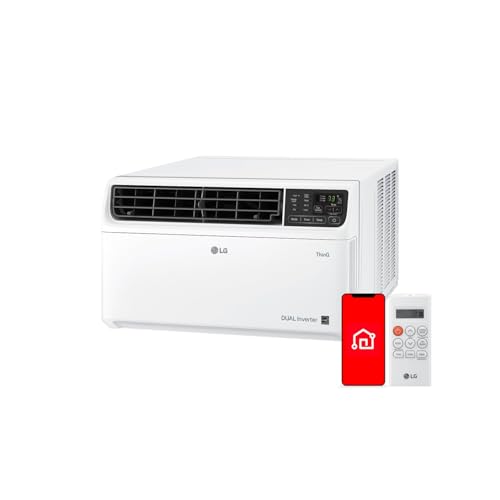
LG 18,000 BTU Window Air Conditioner, Dual Inverter, 230V — Best Overall
Inverter compressors changed what a big window unit feels like to live with. Instead of slamming on and off at full power, a dual-inverter unit like this LG ramps and idles, holding temperature with less noise and less energy — and the verified title backs the spec sheet story: 18,000 BTU, 230V, Dual Inverter, Energy Star, WiFi and remote, with LG ThinQ plus Alexa and Google Assistant compatibility. For a large living area, open-plan floor, or a primary bedroom suite that needs real capacity without a mini-split installation, this is the benchmark pick of the category.
The ownership details matter as much as the headline. An 18,000 BTU window unit is heavy — plan a two-person install with a proper support bracket, and confirm the window frame and sill can carry it. The 230V circuit must match the unit’s plug and breaker requirements exactly; if your room’s 230V outlet was wired for an older unit, compare faces before delivery day. Once installed, the inverter’s quiet low-speed running makes it the rare big unit you can sleep near, and app scheduling means it can pre-cool the room before you get home instead of blasting afterward.
Strengths
- Dual-inverter efficiency and quiet running, with Energy Star stated in the verified title
- Full smart stack: WiFi, ThinQ app, Alexa and Google Assistant, per the verified title
- 18,000 BTU of verified capacity for large rooms from a single window unit
Trade-offs
- Heavy unit — two-person install and a support bracket are effectively mandatory
- Needs the correct dedicated 230V circuit and plug face; not a standard outlet appliance
- Inverter electronics make out-of-warranty repairs pricier than a basic unit’s
| Specification | Detail (from verified listing) |
|---|---|
| Capacity | 18,000 BTU (per verified listing title) |
| Voltage | 230V (per verified listing title) |
| Compressor | Dual Inverter (per verified listing title) |
| Controls | WiFi, remote, voice control via Alexa/Google (per verified listing title) |
Best for: large living spaces that need quiet, efficient, app-controlled cooling on a 230V circuit / Not suited for: small bedrooms, 115V-only rooms, or anyone who cannot verify their 230V plug and breaker first
Check the current price on Amazon
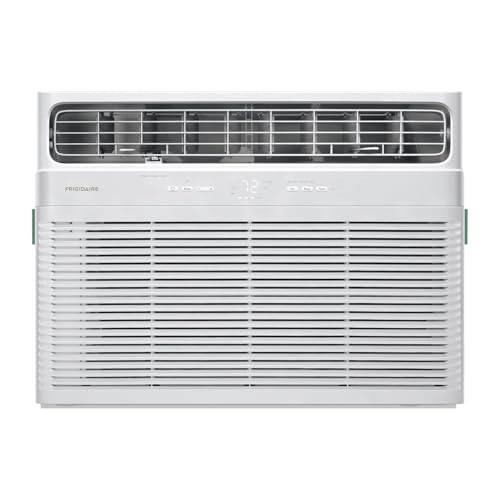
Frigidaire 18,000 BTU Smart Window Air Conditioner with Heater, 208/230V — Best Smart Pick with Supplemental Heat
Frigidaire’s entry answers the buyer who wants one appliance to own the room year-round. The verified title spells out the package: 18,000 BTU of cooling for spaces up to 1,000 square feet, a 16,000 BTU heater for shoulder seasons, a dehumidifier mode for muggy days that are not quite hot, and Wi-Fi with remote control. The 208/230V rating is printed in the title itself, which also matters for buyers in 208V buildings — this unit explicitly covers both, rather than leaving you to wonder.
Set expectations about the heat correctly: a 16,000 BTU electric heater element in a window unit is supplemental heat — excellent for taking the chill off a room in October or warming a workshop before you start, not a replacement for a heating system in January. Used that way, it is genuinely valuable, because it lets one 230V circuit serve a room across three seasons. The smart controls are the other quiet win: scheduling a garage apartment or a rental unit’s climate from an app is the difference between comfort and a phone call.
Strengths
- Cooling, supplemental heat, and dehumidification in a single 208/230V unit
- Wi-Fi app control and remote, per the verified title
- Manufacturer-stated coverage up to 1,000 sq ft in the verified title
Trade-offs
- The heater is supplemental — it will not carry a room through deep winter alone
- Large, heavy window unit; bracket and two-person install apply
- More modes and electronics mean more to service over a long life
| Specification | Detail (from verified listing) |
|---|---|
| Cooling | 18,000 BTU (per verified listing title) |
| Heating | 16,000 BTU supplemental (per verified listing title) |
| Voltage | 208V/230V (per verified listing title) |
| Coverage | Up to 1,000 sq ft (per verified listing title) |
Best for: rooms that need one 230V appliance to cool in summer and take the chill off in spring and autumn / Not suited for: homes needing primary winter heat, or small rooms where 18,000 BTU is wild oversizing
Check the current price on Amazon

Keystone 12,000 BTU Window Air Conditioner with Supplemental Heat, 230V — Best Mid-Size Pick with Heat
Not every 230V shopper needs 18,000 BTU. Oversizing a window unit buys short cycling, clammy air, and noise; Keystone’s 12,000 BTU model is the disciplined choice for the medium rooms its verified title describes — living rooms and apartments up to 550 square feet. It keeps the category’s signature extras: 11,000 BTU of supplemental heating and a dehumidification mode, on a 230V rating printed in the title. For a one-room apartment, a large bedroom, or a home office over a garage, this is frequently the correct appliance rather than merely the cheaper one.
Why does a 12,000 BTU unit need 230V at all, when 115V units reach similar ratings? Because at this capacity a 230V circuit runs the compressor with comfortable electrical headroom, and because many of these installs replace older 230V units on existing circuits. If your room already has the 230V outlet from a previous heat/cool unit, this Keystone drops into that ecosystem directly. As with the Frigidaire, treat the heat as a shoulder-season supplement and the dehumidifier as a comfort feature for damp, mild weather.
Strengths
- Correctly sized for medium rooms — avoids the short-cycling of an oversized 18,000 BTU unit
- Supplemental heat and dehumidification included, per the verified title
- 230V rating printed in the verified title; suits existing 230V heat/cool circuits
Trade-offs
- Supplemental heat only — not a primary heat source
- Still a substantial window unit requiring secure mounting
- Fewer smart features than the LG and Frigidaire flagships
| Specification | Detail (from verified listing) |
|---|---|
| Cooling | 12,000 BTU (per verified listing title) |
| Heating | 11,000 BTU supplemental (per verified listing title) |
| Voltage | 230V (per verified listing title) |
| Coverage | Up to 550 sq ft (per verified listing title) |
Best for: medium rooms up to roughly 550 sq ft on an existing 230V circuit, especially rentals and one-room apartments / Not suited for: large open-plan spaces, or anyone expecting the heater to replace a heating system
Check the current price on Amazon
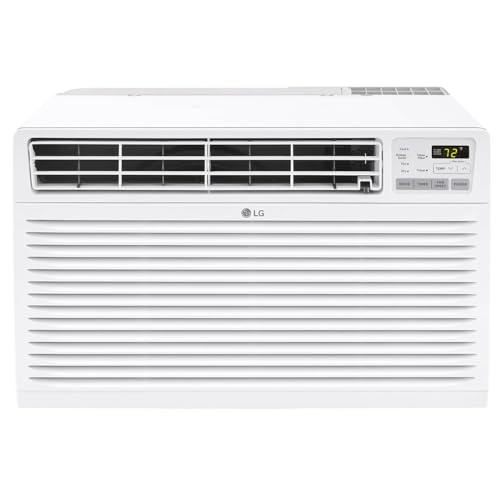
LG 14,000 BTU Through-the-Wall Air Conditioner, 230/208V — Best Through-the-Wall Pick
Through-the-wall units are their own discipline. The hole already exists — a standard sleeve in an apartment, condo, or older home — and the job is to fill it with a unit that seals properly, drains correctly, and matches the sleeve’s dimensions. This LG is built for exactly that: 14,000 BTU, a 230/208V rating in the verified title, coverage stated at 700 square feet, electronic controls and a remote. It is the natural replacement pick when the old sleeve unit dies and the circuit behind it is the 230V-class feed those sleeves almost always have.
Two checks decide success here. First, sleeve compatibility: measure the existing sleeve’s interior dimensions and confirm this chassis fits or that the correct sleeve is used — a loose fit leaks air and invites water problems. Second, the electrical match: confirm the receptacle inside or near the sleeve matches the unit’s plug and the breaker’s rating. Get those two right and a through-the-wall replacement is one of the most satisfying installs in this guide, because the heavy construction work was done decades ago.
Strengths
- Purpose-built for existing wall sleeves — the correct replacement form factor
- 230/208V rating covers both residential and many multi-unit buildings, per the verified title
- Electronic controls and remote included, per the verified title
Trade-offs
- Sleeve dimensions must be verified — not every chassis fits every sleeve
- Through-the-wall installs are semi-permanent; sealing and drainage must be done properly
- No supplemental heat in this model — cooling only
| Specification | Detail (from verified listing) |
|---|---|
| Capacity | 14,000 BTU (per verified listing title) |
| Voltage | 230/208V (per verified listing title) |
| Coverage | Up to 700 sq ft (per verified listing title) |
| Format | Through-the-wall (per verified listing title) |
Best for: apartments, condos and homes with an existing wall sleeve and 230V-class feed / Not suited for: window installs, or rooms with no sleeve and no appetite for cutting the wall
Check the current price on Amazon
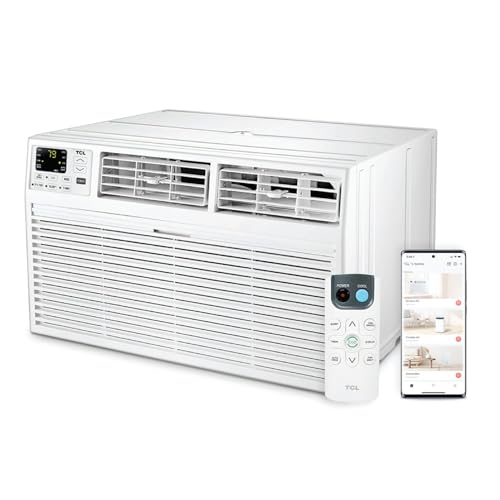
TCL 14,000 BTU Smart Through-the-Wall Air Conditioner with Heater, 230V — Best Smart Through-the-Wall Pick
TCL’s through-the-wall entry is for the buyer replacing a dumb sleeve unit and wanting the modern control stack in the same hole. The verified title lists the package: 14,000 BTU, 230V, WiFi, a heater function, dehumidifier, remote, and Alexa plus Google Assistant compatibility. In a rental, a guest suite, or an elderly parent’s apartment, that connectivity is not a gimmick — it lets the room be pre-cooled before arrival and checked without a site visit.
The same sleeve disciplines from the LG pick apply — measure the sleeve, confirm the plug and breaker — with one addition: the heater here, like all window-class electric heat, is supplemental. It will hold a room comfortably through cool nights and shoulder seasons; it is not sized as sole heat for a cold-climate winter. Buy it as a smart cooling unit that also takes the edge off, and it will not disappoint. Buy it as a furnace, and January will correct you.
Strengths
- Smart control stack — WiFi and voice assistants — in a through-the-wall chassis
- Heater and dehumidifier modes extend the unit beyond cooling season
- 230V rating stated plainly in the verified title
Trade-offs
- Sleeve fit and electrical match must be confirmed before ordering
- Heater is supplemental, not primary heat
- Smart features depend on the room’s WiFi coverage reaching the unit
| Specification | Detail (from verified listing) |
|---|---|
| Capacity | 14,000 BTU (per verified listing title) |
| Voltage | 230V (per verified listing title) |
| Extras | Heater, dehumidifier, WiFi, Alexa/Google (per verified listing title) |
| Format | Through-the-wall (per verified listing title) |
Best for: sleeve-equipped rooms where remote/app control genuinely matters — rentals, guest suites, carers checking on family / Not suited for: buyers wanting primary winter heat, or sleeve sizes this chassis does not fit
Check the current price on Amazon
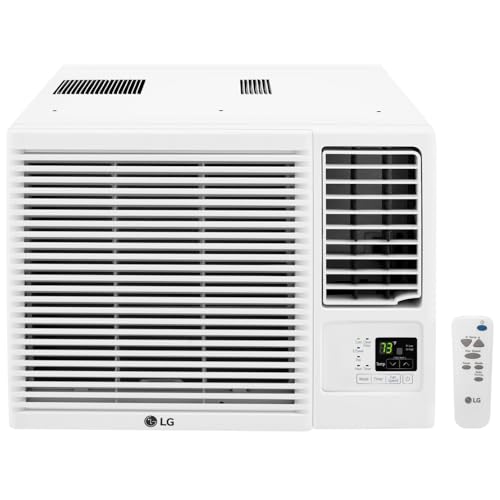
LG 18,000 BTU Window Air Conditioner with Heat, 230/208V — Best for Year-Round Large Rooms
This LG is the straightforward year-round workhorse of the list: the verified title promises 18,000 BTU of cooling for spaces up to 1,000 square feet, a heat mode for the shoulder seasons, a remote, two speeds, and a 24-hour timer, all on a 230/208V rating that suits both house and multi-unit wiring. Where the dual-inverter flagship wins on refinement and efficiency, this unit wins on simplicity — conventional controls, a timer you can set in seconds, and capacity that shrugs at big rooms, basements, and open-plan apartments.
Basements deserve a specific mention, because the title names them and the use case is real: a large finished basement on a 230V circuit gets both summer cooling with dehumidifying effect and autumn chill removal from one appliance. The disciplines are the category’s usual ones — two-person install, support bracket, exact plug-and-breaker match — plus one sizing caution: in a small room this much capacity short-cycles and feels clammy. Match the BTU to the room using the guide below, and this is the dependable, no-drama pick.
Strengths
- Full 18,000 BTU capacity with a heat mode for shoulder seasons
- Simple, proven control scheme: remote, 2 speeds, 24-hour timer, per the verified title
- 230/208V rating covers homes and many apartment buildings
Trade-offs
- Conventional compressor — louder and less efficient at part load than the dual-inverter pick
- Heat mode is supplemental, not a heating system
- Oversized for small rooms; short-cycling hurts comfort and humidity control
| Specification | Detail (from verified listing) |
|---|---|
| Cooling | 18,000 BTU (per verified listing title) |
| Voltage | 230/208V (per verified listing title) |
| Coverage | Up to 1,000 sq ft (per verified listing title) |
| Controls | Remote, 2 speeds, 24-hour timer (per verified listing title) |
Best for: large rooms and finished basements needing strong cooling plus shoulder-season warmth, with simple controls / Not suited for: small bedrooms, or buyers prioritising inverter quietness and efficiency
Check the current price on Amazon
Comparison Table
| Pick | Badge | Key spec | Best for |
|---|---|---|---|
| LG 18,000 BTU Window Air Conditioner, Dual Inverter, 230V | Best Overall | 18,000 BTU dual inverter, 230V | large living spaces that need quiet, efficient, app-controlled cooling on a 230V circuit |
| Frigidaire 18,000 BTU Smart Window Air Conditioner with Heater, 208/230V | Best Smart Pick with Supplemental Heat | 18,000 BTU cool + 16,000 BTU heat, 208/230V | rooms that need one 230V appliance to cool in summer and take the chill off in spring and autumn |
| Keystone 12,000 BTU Window Air Conditioner with Supplemental Heat, 230V | Best Mid-Size Pick with Heat | 12,000 BTU + 11,000 BTU heat, 230V | medium rooms up to roughly 550 sq ft on an existing 230V circuit, especially rentals and one-room apartments |
| LG 14,000 BTU Through-the-Wall Air Conditioner, 230/208V | Best Through-the-Wall Pick | 14,000 BTU through-the-wall, 230/208V | apartments, condos and homes with an existing wall sleeve and 230V-class feed |
| TCL 14,000 BTU Smart Through-the-Wall Air Conditioner with Heater, 230V | Best Smart Through-the-Wall Pick | 14,000 BTU smart TTW with heat, 230V | sleeve-equipped rooms where remote/app control genuinely matters — rentals, guest suites, carers checking on family |
| LG 18,000 BTU Window Air Conditioner with Heat, 230/208V | Best for Year-Round Large Rooms | 18,000 BTU with heat, 230/208V | large rooms and finished basements needing strong cooling plus shoulder-season warmth, with simple controls |
How to Choose a 220 Volt Air Conditioner: Circuits, Plugs and BTU Honesty
Start at the wall, not at the product page. A 230V air conditioner needs a dedicated 230V circuit ending in the specific receptacle face its plug is built for — there are several 230V plug patterns, differentiated by amperage and by whether a neutral is present, and they are deliberately non-interchangeable. Photograph your existing outlet and compare it to the plug in the listing photos; if they differ, the choices are an electrician’s receptacle swap on a suitable circuit or a different unit. Adapters between 230V faces are not an acceptable plan, and adapting a 230V unit down to a 115V outlet is not a thing that exists.
Then size by the room, with the manufacturer’s square-footage as a ceiling rather than a promise. Those figures assume reasonable insulation, standard ceiling height, and moderate sun load. Add capacity for west-facing glass, kitchens, high ceilings, and rooms over hot garages; subtract for shaded, well-insulated bedrooms. The failure modes are asymmetric: an undersized unit runs forever and loses on the hottest afternoon, while an oversized unit short-cycles, cools the air without wringing out humidity, and leaves the room cold and clammy. The 12,000 BTU Keystone exists in this guide precisely because not every 230V room wants 18,000 BTU.
- Confirm the circuit: dedicated 230V, correct breaker size, correct receptacle face for the unit’s plug.
- Choose window vs through-the-wall by what the room already has — never cut a wall to avoid buying a window bracket.
- Treat supplemental heat as three-season comfort, not as a heating system.
- Plan the install crew: every unit here is a two-person lift with a bracket or sleeve work.
Finally, weigh the compressor type. Inverter models like the LG flagship cost more and reward you every hour they run — quieter, steadier, cheaper to operate at part load, which is most hours. Conventional models cost less, are simpler to service, and cycle audibly. For a bedroom, the inverter premium is usually money well spent; for a workshop that runs flat-out on hot afternoons, it matters far less.
Window vs Through-the-Wall: Getting the Form Factor Right
A window unit is a seasonal, reversible install: bracket, sash support, side panels, done. It suits renters with permission, rooms with a suitable double-hung window, and anyone who wants the unit out in October. Its weaknesses are the window it blocks, the seal quality at the side panels, and security — a poorly braced big unit is both a leak and a liability. Every 230V window pick here is heavy enough that the support bracket is not optional equipment, whatever the box implies.
A through-the-wall unit lives in a metal sleeve set into the wall, which makes it the landlord-and-condo standard: nothing in the window, a cleaner seal, and a permanent, tidy look. The cost is commitment — the sleeve size dictates your replacement choices for decades, and a bad sleeve seal lets in air and water exactly where you cannot see it. When replacing, measure the sleeve’s inside width, height and depth, confirm whether the new chassis needs its own sleeve, and check where condensate drains. The two through-the-wall picks here exist because that installed base is enormous and its owners are exactly the people type this query.
One electrical note unites both formats: the receptacle for a sleeve unit is often inside or directly below the sleeve, wired decades ago for whatever the original unit drew. Verify breaker size against the new unit’s requirements rather than assuming continuity — a previous owner’s handiwork is not a specification.
What 208/230V Means for Apartments and Older Buildings
Some picks here are rated 230V only; others state 230/208V. That second number matters in many apartment and condo buildings, schools, and commercial spaces, where three-phase distribution delivers 208 volts to each unit instead of 240. A 230/208V-rated air conditioner is explicitly built to run on either; its capacity dips slightly at 208V, which manufacturers account for in their ratings. If your building is 208V — ask the super or check the panel schedule — choose a pick whose verified title includes the 208 rating, like the LG through-the-wall or the Frigidaire, rather than gambling on a 230V-only unit.
This is also why this guide insists on title-verified voltage instead of family reputation. The same model line often includes 115V, 230V-only, and 230/208V variants at different capacities.
Operating Costs, Noise and Living With a Big 230V Unit
The running-cost story of this category is written by part-load behaviour. Air conditioners spend most of their hours at partial demand — maintaining temperature on a warm evening, not fighting the season’s hottest afternoon — and that is where inverter and conventional compressors part company. The dual-inverter LG modulates down and sips; a conventional unit cycles fully on and fully off, paying a start-up penalty each time and wearing its components with every cycle. Over a long cooling season in a primary living space, that difference is the largest operating-cost lever available to you, larger than any single efficiency rating printed on a box, and it compounds with the comfort difference: steady, quiet, dehumidifying part-load running is simply nicer air.
Noise deserves the same realism. Every window and through-the-wall unit puts its compressor in the room’s envelope; there is no outdoor unit to exile the sound to. Manufacturers’ quiet claims describe their best fan speed on their best day. In practice, an 18,000 BTU unit on high is a presence in the room — conversation continues, television volume rises a notch — while the inverter’s low-speed cruise is the class’s quiet triumph. Bedroom buyers should weight the inverter pick accordingly, and everyone should check the mundane details that decide whether a unit rattles: a rigid bracket, tight side-panel seals, and a sash locked down firmly remove most of the buzz that owners blame on the appliance itself.
Finally, plan the unit’s whole year, not just July. A 230V unit with a heat mode earns its wall space across three seasons; a cooling-only unit in a removable window mount can come out in autumn and return the window’s light. Through-the-wall owners should budget a proper exterior cover or the unit’s own winter sealing routine, because a sleeve is a hole in the house’s thermal envelope twelve months a year. Filters are the one maintenance constant across every pick: wash or replace them on the manufacturer’s schedule, because a choked filter quietly taxes capacity, efficiency and coil health in every month the unit runs.
Installation Day Realities: Brackets, Seals and the First Week
The difference between a 230V window unit that feels built-in and one that feels perched is decided in the first hour. The support bracket must be anchored into structure, not trim; the unit must sit with the manufacturer’s specified outward tilt so condensate leaves by the rear rather than finding the interior wall; and the side panels must be sealed as an air barrier, not merely closed — foam, weatherstripping and, where the kit allows, a bead of exterior sealant at the outer joints. Every decibel of rattle and every degree of lost performance in these units traces back to one of those three details far more often than to the appliance itself, which is why the guide’s install sequence lingers on them.
Through-the-wall installs have their own first-week discipline. The sleeve’s exterior grille and flashing decide whether wind-driven rain finds the wall cavity; the interior seal decides whether winter air whistles through in January. After the first heavy rain, check inside the sleeve and below it for any sign of water — a five-minute inspection that catches a flashing mistake while it is still a tube of sealant rather than a rot repair. Condensate behaviour deserves the same early attention: confirm the drain path actually drains, because a unit that pools water breeds smell, slime and eventually a service call that no warranty conversation enjoys.
Finally, register the product, photograph the rating plate — plug configuration, amperage, voltage — and file both with the manual. These units live a decade or more, and when a breaker, a receptacle or a replacement decision arises in year nine, that photograph answers in seconds the questions this whole guide is built around.
Heat Mode Reality Check: Getting the Most From a Dual-Season Unit
Three of this guide’s picks carry a heater, and using that heater well is a skill distinct from using the cooling well. Electric resistance heat in a window or sleeve unit is at its best in the shoulder seasons and in short, purposeful bursts: warming a bedroom before waking, taking a workshop from raw to tolerable for a morning’s project, holding a basement room above the clammy threshold in October. In those roles it is genuinely economical, because it heats one room to comfort instead of firing a whole-house system for one occupied space. The timer functions on these units exist for exactly this pattern — set the warm-up before the alarm, not after the shivering starts.
The same heater misused is a disappointment with a meter attached. Asked to hold a large, leaky room at comfort through a cold-climate January, it runs continuously at full draw, achieves a mediocre temperature, and costs more than the heating system it was meant to spare. The guide’s repeated ‘supplemental’ label is not legal caution; it is the operating envelope. Buyers in genuinely cold regions should read the heat mode as a three-season bonus on a cooling purchase, and buyers in mild-winter regions — the Gulf, the Southwest, coastal California — may fairly read it as near-primary heat for a single room. Climate, as ever in this category, is part of the specification.
One practical pairing completes the picture: the dehumidifier mode. In humid shoulder seasons there are weeks when the room is not hot but is unpleasantly damp, and running cooling to dry it overshoots into chill. The dehumidify modes on the Frigidaire and TCL picks exist for those weeks, wringing moisture at modest energy cost. Owners who discover that mode in their first autumn consistently report it as the feature they did not know they were buying — a fitting note to end on for a category whose real value is measured across the whole calendar, not just the hottest fortnight.
A Note on Replacing an Older 230V Unit
A large share of this category’s buyers are not choosing fresh — they are replacing a dead 230V unit, often urgently, in the first hot week of the year. Replacement has one great advantage and one hidden trap. The advantage: the circuit, the bracket or sleeve, and the room’s sizing are all known quantities, proven by the outgoing unit’s years of service, so a like-for-like capacity choice is evidence-based rather than estimated. The trap: the outgoing unit’s plug and breaker were correct for that unit, and the replacement’s requirements must be checked against them rather than assumed identical — manufacturers change plug configurations between generations, and the middle of a heatwave is the worst possible time to discover it. Photograph the old rating plate and receptacle before ordering, compare them line by line with the new unit’s specification, and the replacement becomes the easiest install in this guide instead of the most frustrating one.
How to Install a 230V Window Air Conditioner Securely
A 230V window unit install is a lifting-and-sealing job with one electrical rule that outranks all others: the unit plugs into the matching dedicated receptacle, full stop — no extension cords, no adapters, no exceptions. Everything below assumes the circuit has already been verified against the unit’s plug and breaker requirements.
- Verify the receptacle face matches the unit’s plug and the breaker matches the unit’s stated requirements; if either is wrong, stop and call an electrician.
- Fit the support bracket to the sill per its instructions and confirm it is level or tilted fractionally outward for condensate drainage, as the unit’s manual specifies.
- With a second person, lift the unit onto the bracket and slide it into position; secure it to the bracket and frame with the provided hardware.
- Lower the window sash behind the unit’s top rail, install the sash lock, and fit the side panels, sealing gaps with the included foam and weatherstripping.
- Check the unit’s own tilt — most window units drain through the rear; pooling inside the room means the tilt is wrong.
- Plug directly into the wall receptacle, run the unit on its highest cooling setting, and confirm cold air, normal fan sounds, and condensate appearing outside rather than inside.
- After the first day, re-check the bracket screws and seals; big units settle, and a five-minute re-tighten prevents a season of rattles.
Keep the manual with the plug and breaker details noted on the cover. When this unit is replaced in a decade, that note is the difference between a like-for-like swap and starting the circuit investigation from zero.
Common Buying Mistakes
Buying by BTU headline without checking the plug face. 230V receptacles come in several non-interchangeable patterns. A perfect unit with the wrong plug is a return, not an install.
Assuming a ‘220’ search means any big unit qualifies. Plenty of 14,000 BTU units are 115V. Only a stated 230V or 230/208V rating — in the title, as with every pick here — makes it a match for your circuit.
Oversizing for a small room. An 18,000 BTU unit in a 300 sq ft bedroom short-cycles and leaves the air clammy. Match capacity to the room.
Skipping the support bracket. These units are heavy and cantilevered. The bracket is structural, not an accessory.
Counting on the heat mode as winter heating. Window-unit electric heat is supplemental. It owns October and April; it does not own January.
Ignoring 208V buildings. If your building runs 208V, buy a pick rated 230/208V. The rating is printed for a reason.
Final Recommendation
For most buyers, the LG dual-inverter 18,000 BTU is the pick: verified 230V, quiet, efficient, and smart. If the room also needs shoulder-season warmth, choose between the Frigidaire for its fuller smart package and the LG heat model for simple, timer-driven dependability — and take the Keystone instead if the room is medium-sized, because correct sizing beats headline capacity. Sleeve owners should stay in their lane: the LG through-the-wall for a like-for-like replacement, the TCL when app control and a heater make the upgrade worthwhile.
Every route starts at the receptacle. Confirm the circuit, the breaker and the plug face first, and the rest of this purchase is easy. The same circuit discipline runs through the rest of the 240-volt family — see our guides to the Best 220 Volt Heater picks for hardwired room heating and the Best 220 Volt Garage Heater roundup if the space you are conditioning is a workshop.
Best 220 Volt Heater Best 220 Volt Garage Heater Best 20 Gallon 220 Volt Water Heater Best 220 Volt Hot Tub Best 220 Volt Baseboard Heater For 3 Season Room
Frequently Asked Questions
Is a 220 volt air conditioner really a 230 volt one?
Yes, in North American practice. Homes have 240V service (208V in some buildings), equipment is labelled 230V or 230/208V, and ‘220’ is the everyday shorthand shoppers use. Every pick in this guide has its 230V-class rating printed in its verified listing title.
Can I plug a 230V air conditioner into a normal outlet with an adapter?
No. A 230V unit needs a dedicated 230V circuit with the matching receptacle face. Adapters do not change the voltage, and a 115V outlet cannot run it. An electrician can tell you whether a suitable circuit exists or can be added.
How many BTU do I need?
Use the manufacturer’s square-footage as a ceiling: roughly 12,000 BTU for up to ~550 sq ft, 14,000 for ~700, and 18,000 for up to ~1,000, then adjust for sun load, kitchens, and high ceilings. Oversizing causes clammy short-cycling; undersizing loses on the hottest days.
What is the difference between window and through-the-wall units?
Window units mount in a window on a bracket and are removable; through-the-wall units slide into a permanent wall sleeve. They are not interchangeable — buy the format your room is built for, and for sleeve replacements, measure the sleeve first.
Can the heat mode replace my heating system?
No. The heater in these units is supplemental electric heat — ideal for shoulder seasons and chilly mornings, not sized or priced to heat through deep winter.
My building has 208V. Which picks work?
Choose a pick whose verified title states 230/208V — here, the Frigidaire window unit, the LG through-the-wall, and the LG 18,000 BTU with heat. Confirm with your building management if you are unsure which service you have.