Disclosure: airfryerkitchensupply.com is reader-supported. When you buy through links on our site, we may earn an affiliate commission at no extra cost to you.
Where to buy
The fastest way to confirm current availability for a best 20 gallon 220 volt water heater is to check the linked picks below on Amazon, because 220-volt-class appliances are sold in smaller runs than their 120-volt counterparts and individual listings change configuration without much warning. Every linked pick in this guide was cross-checked against the Amazon listing data available to us, and the voltage claim in each review comes from that listing’s own title — not from a similar model, a different size in the same range, or a seller’s marketing banner. Where a promising product’s listing did not state its voltage clearly, we kept it in the guide as a pick with no purchase link, and we tell you exactly what to verify on the nameplate or spec sheet before you spend anything.
Rheem 18kW 240V Tankless Electric Water Heater — check price on Amazon
Rheem RTEX-24 24kW 240V Electric Tankless Water Heater — check price on Amazon
ThermoMate 8kW 240 Volt Tankless Water Heater — check price on Amazon
CAMPLUX 6000W 240V Tankless Electric Water Heater — check price on Amazon
Shopping for the best 20 gallon 220 volt water heater runs into an awkward truth almost immediately: the compact tank market in the United States is dominated by 120-volt plug-in mini-tanks, while the hardwired 240-volt end of the category is dominated by tankless units. Genuine 20-gallon-class tanks wired for 240 volts exist in manufacturer catalogues, but their Amazon listings frequently omit the voltage from the title entirely — which means a buyer who trusts a search-result headline can easily order a 120-volt tank for a 240-volt circuit, or the reverse. This guide is built around that problem. We separate what the listing data actually proves from what it merely implies.
The second thing to understand is the language. North American homes do not really have ‘220 volt’ service in the modern sense; they have 240-volt split-phase service (208 volts in some commercial and multi-unit buildings), and ‘220 volt’ survives as everyday shorthand for that higher-voltage circuit. Appliance nameplates are printed 240V or 208/240V. So throughout this guide, a verified 240V listing is treated as the correct match for a buyer searching ‘220 volt’, and we flag the rare product that is genuinely configured differently. What we will not do is relabel a 120-volt mini-tank as a 220-volt product, however convenient that would be for filling a list.
Our six picks therefore split honestly into two groups. Two are true tank-style units in the 18–20 gallon class whose listings we verified as products but whose voltage the listing title does not state — they are not linked, with a clear instruction to confirm the element voltage on the nameplate or spec sheet before buying. The other four are 240-volt tankless and point-of-use units whose voltage is printed in the verified listing title itself; they are the realistic linked alternatives for buyers whose real need is ‘a compact hardwired water heater on my 240-volt circuit’ rather than a tank of exactly twenty gallons. Read the buying-guide sections before deciding which group you actually belong to.
In this guide
Quick Picks
Best True 20-Gallon Tank Pick — Verify Voltage First — AO Smith EJCS-20 Residential Electric Water Heater. The headline act for anyone who truly needs a tank in this size class: a residential 20-gallon-class electric tank from a major water-heater brand. Its verified listing title does not print a voltage, so treat it as a verify-before-you-buy pick, not a confirmed 240V unit.
Best Lowboy Near-20-Gallon Tank — Verify Voltage First — GE 18 Gallon Side Port Lowboy Electric Water Heater. An 18-gallon lowboy — the short, wide tank format that fits under counters and in crawlspaces — with side ports and an adjustable thermostat. Like the AO Smith, its verified title is silent on voltage, and GE sells a separate explicitly-120V 18-gallon model, so verification is essential.
Best Verified 240V Whole-House Alternative — Rheem 18kW 240V Tankless Electric Water Heater. A whole-house-class tankless unit whose verified title states 240V outright. If your real requirement is ‘compact hardwired hot water on a 240V circuit’ rather than a tank of a specific size, this is the strongest linked pick here.
Check the current price on Amazon
Best Verified 240V High-Output Alternative — Rheem RTEX-24 24kW 240V Electric Tankless Water Heater. The step up from the 18kW unit: 24 kilowatts of verified-240V tankless capacity for homes whose flow demands or cold inlet water make the smaller unit marginal.
Check the current price on Amazon
Best Verified Point-of-Use 240V Pick — ThermoMate 8kW 240 Volt Tankless Water Heater. A point-of-use tankless unit with its output honestly printed in the title: 1.56 GPM at a 35°F rise, 240 volts, ETL certified. Right-sized for one sink or a light-duty single fixture near the panel.
Check the current price on Amazon
Best Budget Verified 240V Point-of-Use Pick — CAMPLUX 6000W 240V Tankless Electric Water Heater. The entry point of the verified-240V tankless class: 6,000 watts, hardwired, ETL listed, with its modest 1.07 GPM at 35°F rise printed in the title. A hand-washing and light-sink specialist.
Check the current price on Amazon
How These Picks Were Chosen
Every product here was checked against the airfryerkitchensupply.com catalogue connection: we searched by brand and model, matched the returned listing title to the product we intended to write about, and took the ASIN from that response. A pick only received an Amazon dp link when its returned title explicitly carried the voltage we are claiming — 240V in this category.
We also applied three practical filters. First, capacity honesty: a 2.5-gallon mini-tank is not a 20-gallon alternative and was excluded, however good its reviews culture might be. Second, circuit realism: we note the breaker and wiring implications of each class, because a 240V tankless unit drawing serious amperage is not a drop-in swap for a small tank. Third, recovery expectations: a small tank and a point-of-use tankless behave very differently at a shower, and the reviews say so plainly rather than letting a buyer discover it mid-renovation.
The 6 Best 20 Gallon 220 Volt Water Heaters (and the Honest Alternatives)
AO Smith EJCS-20 Residential Electric Water Heater — Best True 20-Gallon Tank Pick — Verify Voltage First
A. O. Smith is one of the default names in North American water heating, and the EJCS-20 sits in exactly the niche this search describes: a compact residential electric tank in the 20-gallon class, the size typically chosen for a small apartment, an accessory dwelling, a workshop sink-and-shower combo, or a point-of-use boost for a distant bathroom. A tank this size stores enough hot water for one shower at a time with recovery in between, which is either perfectly adequate or completely wrong depending on your household rhythm — the buying guide below walks through that maths in detail.
The honest complication is voltage. The listing data we verified confirms the product and its class, but the title does not state whether the unit, as configured on that listing, is a 120-volt or a 240-volt element model. Compact tanks are sold in both configurations, sometimes under near-identical names. So this pick carries no purchase link and a clear instruction: before ordering anywhere, open the manufacturer’s specification sheet for the exact model suffix and confirm the element voltage and wattage match your circuit. If the spec sheet says 240V, this is the most straightforward true-tank answer to the keyword. If it says 120V, walk away and use the tankless picks below instead.
Strengths
- A genuine tank in the exact 20-gallon class the search asks for, from a major brand with a real service network
- Stored hot water behaves predictably — no minimum-flow activation issues like tankless units
- Simple, familiar technology any plumber can service with standard parts
Trade-offs
- Verified listing title does not state voltage — nameplate/spec-sheet confirmation is mandatory before purchase
- Tank standby losses: it keeps 20 gallons hot around the clock whether you use them or not
- Recovery after the tank is drawn down takes time; back-to-back showers will outrun it
| Specification | Detail (from verified listing) |
|---|---|
| Type | Tank-style residential electric water heater (per verified listing) |
| Capacity class | 20 gallon class (per model designation EJCS-20) |
| Voltage | Not stated in verified listing title — confirm on spec sheet before ordering |
Best for: buyers who genuinely need a small storage tank and will verify the 240V configuration on the spec sheet before ordering / Not suited for: anyone who wants a confirmed-240V product with one click — use the linked tankless picks instead
Unlinked pick: no purchase link, for the reason explained above. Verify the voltage on the manufacturer’s spec sheet before ordering this class of product anywhere.
GE 18 Gallon Side Port Lowboy Electric Water Heater — Best Lowboy Near-20-Gallon Tank — Verify Voltage First
The lowboy format exists for one reason: height. A standard 20-gallon tank is too tall for under-counter kitchen installs, low crawlspaces, and some utility closets, so manufacturers squash the tank into a shorter, wider cylinder. GE’s 18-gallon side-port lowboy is squarely in that tradition, and the side-mounted ports suit the tight plumbing runs these installs usually involve. Eighteen gallons versus twenty is a distinction without a practical difference — recovery and element size matter far more than those two gallons — so this unit belongs in any honest version of this roundup.
Voltage discipline matters even more here, because the same search that returned this lowboy also returned a GE 18-gallon model whose title explicitly says 120 volt plug-and-play. Two near-identically-sized GE tanks, two different electrical personalities. The lowboy’s verified title does not state its voltage, so we will not guess: hardwired lowboys in this class are commonly 240V, but ‘commonly’ is not verification. Check the model number against GE’s specification sheet, confirm the element rating, and only then commit. If it confirms 240V, this is the best-fitting tank here for a height-restricted 240-volt install.
Strengths
- Lowboy profile fits under counters and into low crawlspaces where a standard tank cannot stand
- Side ports simplify plumbing in tight retrofits
- Adjustable thermostat confirmed in the verified listing title
Trade-offs
- Voltage not stated in the verified listing title — and an explicitly 120V GE sibling exists, so guessing is genuinely risky
- 18 gallons is the small end of the class; recovery discipline matters
- Lowboy tanks can be awkward to drain and service in the very tight spaces they are bought for
| Specification | Detail (from verified listing) |
|---|---|
| Type | Lowboy tank-style electric water heater (per verified listing) |
| Capacity | 18 gallons (per verified listing title) |
| Connections | Side port (per verified listing title) |
| Voltage | Not stated in verified listing title — confirm before ordering |
Best for: height-restricted installs — under counters, crawlspaces — on a circuit whose voltage you have confirmed against the spec sheet / Not suited for: buyers who cannot verify the exact model configuration, or who need guaranteed 240V out of the box
Unlinked pick: no purchase link, for the reason explained above. Verify the voltage on the manufacturer’s spec sheet before ordering this class of product anywhere.
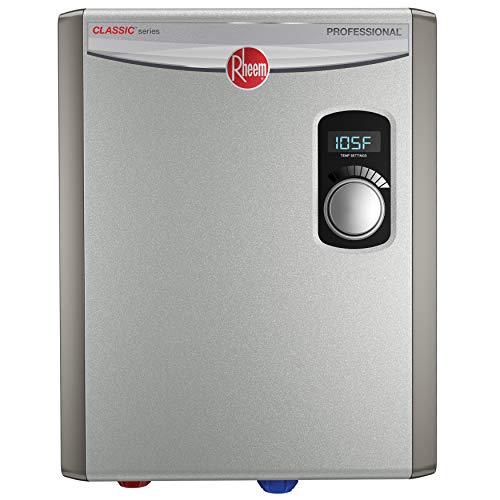
Rheem 18kW 240V Tankless Electric Water Heater — Best Verified 240V Whole-House Alternative
This is the pivot pick of the guide: instead of storing twenty gallons, it heats water on demand at 18 kilowatts, and its verified listing title states 240V plainly — no nameplate detective work required. Rheem’s mid-size tankless electrics are aimed at small homes, condos, and point-of-use clusters, delivering continuous hot water at modest flow rates rather than the burst-then-recover pattern of a small tank. For a single bathroom or a small household that showers sequentially, that trade is often a genuine upgrade: no standby losses, no running dry mid-shower at low flow, and a wall-mounted footprint a fraction of a tank’s.
The discipline this unit demands is electrical, not hydraulic. An 18kW load is a serious circuit commitment — this is a hardwired appliance that belongs on a properly sized dedicated breaker arrangement installed to code, and older panels may need professional assessment first. Flow expectations also need honesty: tankless output falls as incoming water gets colder and as you open more fixtures at once. In a warm-climate single-bath home it can feel endless; feeding two simultaneous showers in a cold-climate winter is beyond what this class promises. Size it with the temperature-rise maths in the buying guide, not with optimism.
Strengths
- Voltage verified in the listing title itself: 240V, no ambiguity
- Continuous hot water at modest flow — no tank to empty
- Wall-mounted, frees the floor space a 20-gallon tank would occupy, and no standby heating losses
Trade-offs
- 18kW electrical demand may require panel work — budget for an electrician, not just the unit
- Output drops with cold inlet water and simultaneous fixtures
- No stored reserve: a power cut means no hot water at all
| Specification | Detail (from verified listing) |
|---|---|
| Type | Tankless electric water heater (per verified listing) |
| Power | 18kW (per verified listing title) |
| Voltage | 240V (per verified listing title) |
Best for: small homes and condos on a healthy 240V panel that want continuous hot water without a tank / Not suited for: households running two showers at once, or panels with no spare capacity
Check the current price on Amazon
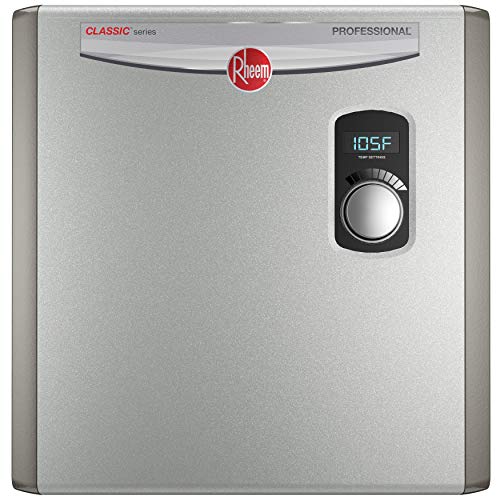
Rheem RTEX-24 24kW 240V Electric Tankless Water Heater — Best Verified 240V High-Output Alternative
The RTEX-24 exists for the buyer who did the temperature-rise maths on the 18kW class and found it wanting — a colder climate, a second bathroom that occasionally overlaps, or a soaking tub that draws hard. At 24 kilowatts on a verified 240V listing title, it pushes meaningfully more hot water per minute at a given temperature rise, which is the only honest way to compare tankless units. Rheem’s RTEX line is a known quantity in this category, with replaceable elements and a service ecosystem that generic imports cannot match.
Everything said about electrical discipline for the 18kW unit applies here with emphasis. Twenty-four kilowatts is a very large residential load; expect multiple dedicated breakers, heavy-gauge wiring, and a panel capacity conversation with a licensed electrician before purchase, not after delivery. Installation cost can rival the unit cost, and pretending otherwise is how these projects go wrong. Bought with open eyes, though, this is the pick that most convincingly replaces not just a 20-gallon tank but the whole small-tank compromise: continuous delivery, compact wall footprint, and a brand behind it.
Strengths
- Highest verified output in this guide — 24kW on a title-verified 240V listing
- Better cold-climate and overlapping-fixture performance than the 18kW class
- Established brand with serviceable, replaceable heating elements
Trade-offs
- Very heavy electrical requirements; panel upgrades are a realistic possibility
- Oversized for a single low-flow point of use — you would be paying for capacity you never draw
- Like all tankless electrics, output is still finite: it is not a boiler for a large multi-bath house
| Specification | Detail (from verified listing) |
|---|---|
| Type | Tankless electric water heater, RTEX-24 (per verified listing) |
| Power | 24kW (per verified listing title) |
| Voltage | 240V (per verified listing title) |
Best for: colder climates and small homes with overlapping hot-water draws that outgrow the 18kW class / Not suited for: single-sink point-of-use jobs, or any panel that has not been professionally assessed
Check the current price on Amazon

ThermoMate 8kW 240 Volt Tankless Water Heater — Best Verified Point-of-Use 240V Pick
Point-of-use is where small 240V tankless units make their most honest case. Mounted under or near the sink it serves, this ThermoMate eliminates the long wait — and the long pipe run of cooled water — that a distant central heater imposes, and its verified listing title does something we wish more listings did: it prints the flow at a stated temperature rise, 1.56 gallons per minute at 35°F, alongside the 240-volt rating and ETL certification. That single line lets a buyer do real maths instead of reading adjectives.
Use it for what it is. One bathroom sink, a kitchen prep sink, a workshop hand-wash station, or a small wet bar are fair game; a shower is where expectations must be managed, because a shower’s flow at a winter temperature rise will exceed what 8 kilowatts can deliver. Self-modulating control, noted in the title, helps it sip power on small draws rather than slamming full wattage for a hand rinse. Hardwired 240V installation still applies — smaller than the whole-house units, but the same code, breaker, and licensed-work rules.
Strengths
- Flow-at-rise printed in the verified title (1.56 GPM at 35°F) — real sizing data, not marketing
- ETL certification stated in the listing title
- Self-modulating control trims power draw on small demands
Trade-offs
- Strictly point-of-use: one modest fixture, not a bathroom group
- Still a hardwired 240V install despite its small size
- Performance in cold-inlet winters shrinks exactly when you want it most
| Specification | Detail (from verified listing) |
|---|---|
| Type | Point-of-use tankless electric (per verified listing) |
| Power | 8kW (per verified listing title) |
| Voltage | 240 volt (per verified listing title) |
| Output | 1.56 GPM at 35°F rise (per verified listing title) |
Best for: a single sink or light fixture close to the unit, where killing the wait for hot water is the whole job / Not suited for: showers, tub fillers, or any multi-fixture duty
Check the current price on Amazon

CAMPLUX 6000W 240V Tankless Electric Water Heater — Best Budget Verified 240V Point-of-Use Pick
CAMPLUX built its name on compact water heating, and this 6,000-watt unit is the honest floor of the 240V point-of-use category. The verified title states the essentials without embroidery: 240V, hardwired, ETL listed, self-modulating, and 1.07 gallons per minute at a 35°F temperature rise. That output defines its world precisely — hand washing, a utility sink, a coffee-station feed, a small bathroom basin in a mild climate. Within that world it is a tidy solution: no tank idling warm all day, a temperature display on the unit, and a footprint that disappears under a sink.
Outside that world it will disappoint, and the review would be dishonest not to say so. A shower is beyond it. A cold-climate kitchen sink at full flow in January is beyond it. The right mental model is ‘instant warm water for small draws near the panel’, and buyers whose need matches that model get exactly what the listing promises. As with every 240V appliance in this guide, installation is hardwired electrical work: correct breaker, correct wire gauge, code-compliant — ideally by a licensed electrician, full stop.
Strengths
- Lowest-commitment verified 240V point-of-use option here — title states voltage, hardwired format and ETL listing
- Self-modulating with a temperature display, per the verified title
- Output honestly specified at 1.07 GPM at 35°F rise
Trade-offs
- The smallest output in the guide; strictly light-duty single-fixture work
- Budget-brand long-term parts support is thinner than Rheem’s
- Cold inlet water cuts its already modest flow further
| Specification | Detail (from verified listing) |
|---|---|
| Type | Point-of-use tankless electric (per verified listing) |
| Power | 6000W (per verified listing title) |
| Voltage | 240V, hardwired (per verified listing title) |
| Output | 1.07 GPM at 35°F rise (per verified listing title) |
Best for: hand-washing and light sink duty near the panel on a tight budget / Not suited for: showers, busy kitchen sinks, or cold-climate whole-bathroom hopes
Check the current price on Amazon
Comparison Table
| Pick | Badge | Key spec | Best for |
|---|---|---|---|
| AO Smith EJCS-20 Residential Electric Water Heater | Best True 20-Gallon Tank Pick — Verify Voltage First | 20-gallon-class tank; voltage not stated in listing | buyers who genuinely need a small storage tank and will verify the 240V configuration on the spec sheet before ordering |
| GE 18 Gallon Side Port Lowboy Electric Water Heater | Best Lowboy Near-20-Gallon Tank — Verify Voltage First | 18-gal lowboy, side port; voltage not stated in listing | height-restricted installs — under counters, crawlspaces — on a circuit whose voltage you have confirmed against the spec sheet |
| Rheem 18kW 240V Tankless Electric Water Heater | Best Verified 240V Whole-House Alternative | 18kW tankless, 240V verified in title | small homes and condos on a healthy 240V panel that want continuous hot water without a tank |
| Rheem RTEX-24 24kW 240V Electric Tankless Water Heater | Best Verified 240V High-Output Alternative | 24kW tankless, 240V verified in title | colder climates and small homes with overlapping hot-water draws that outgrow the 18kW class |
| ThermoMate 8kW 240 Volt Tankless Water Heater | Best Verified Point-of-Use 240V Pick | 8kW point-of-use, 240V, 1.56 GPM @ 35°F rise | a single sink or light fixture close to the unit, where killing the wait for hot water is the whole job |
| CAMPLUX 6000W 240V Tankless Electric Water Heater | Best Budget Verified 240V Point-of-Use Pick | 6kW point-of-use, 240V hardwired, ETL listed | hand-washing and light sink duty near the panel on a tight budget |
How to Choose a 20 Gallon 220 Volt Water Heater Without Buying the Wrong Voltage
The single most consequential decision in this category is made before brands are even discussed: confirm what your circuit actually is and what the product actually is. In North American homes, the circuit people call ‘220’ is 240-volt split-phase service (208V in some buildings). A water heater element rated 240V is the correct match; an element rated 120V connected to that circuit is a fire-and-failure scenario, and a 240V element fed 120V will produce roughly a quarter of its rated heat — the classic ‘new water heater barely gets warm’ mystery. This is why this guide refuses to infer voltage from a product family: sibling models in this category genuinely ship in both voltages.
Next, decide tank versus tankless by behaviour, not by fashion. A 20-gallon tank delivers a strong burst — a proper shower — then needs recovery time; it suits one person, a guest suite, or an ADU with staggered use. Tankless delivers a modest flow indefinitely; it suits the same small households when draws are sequential and flow rates are low, and it wins on standby losses and footprint. Where buyers go wrong is expecting a small tank to serve a family bathroom or a point-of-use tankless to serve a shower. Neither failure is the product’s fault; both are sizing failures made at the kitchen table.
- Check your panel before your cart: a 240V tank typically needs a dedicated 240V circuit; whole-house tankless units need far more. Get the panel assessed first.
- Read flow claims as ‘gallons per minute at a stated temperature rise’ — a flow number without a rise is marketing, not data.
- Measure the space, including drain access and the clearance to pull an anode rod or element later.
- Plan the drain: every tank needs a drain pan and a route for the T&P valve discharge, by code.
Finally, think about total installed cost, not unit cost. For hardwired 240V work, the electrician’s visit, the breaker, and possibly a panel upgrade are part of the real price of every pick in this guide — the tankless ones especially. A slightly more expensive unit on an adequate panel is cheaper than a bargain unit that triggers a panel replacement you did not budget for.
Tank vs Tankless at This Size: Recovery, Rise and Real Showers
A 20-gallon tank’s shower maths is simple: at a typical mixed draw, you have roughly one comfortable shower’s worth of stored hot water, after which recovery — reheating the tank — takes meaningful time. Households that shower back-to-back will feel the wall. A tankless unit never ‘runs out’, but its ceiling is flow: exceed its gallons-per-minute at your winter temperature rise and the water arrives lukewarm, indefinitely. Neither is better in the abstract; they fail in opposite directions, and your household’s pattern decides which failure you would rather never meet.
Temperature rise is the number that quietly governs everything. In a warm-climate home, incoming water might need only a 35–40°F lift to reach shower temperature; in a northern winter, the lift can be 70°F or more, which halves a tankless unit’s effective output. That is why the verified listings that print flow at a stated rise — as the ThermoMate and CAMPLUX picks do — are so much more useful than a bare ‘GPM’ headline, and why the same tankless unit can be a hero in Florida and a disappointment in Minnesota.
One more practical layer: hard water. Tankless heat exchangers and small tank elements both suffer scale, but the maintenance differs — tankless units want periodic descaling, tanks want anode-rod attention and occasional sediment flushing. If your water is hard and your maintenance discipline is honest-to-goodness poor, the humble tank’s tolerance may serve you better than a precision tankless unit slowly choking on scale.
Sizing the Circuit: What 240 Volts Actually Demands
Every pick in this guide is a hardwired 240V appliance, and the circuit is part of the product whether the listing mentions it or not. A small 240V tank typically draws in the range its element dictates and sits on a dedicated two-pole breaker sized to that element and the wire run. Point-of-use tankless units at 6–8kW draw substantially more than a tank element. Whole-house tankless units at 18–24kW draw more than many entire homes used a generation ago, and commonly require multiple breakers and a panel with genuine spare capacity.
The rules that keep this safe are not optional decoration: breaker and wire gauge are matched to the load and to each other, continuous loads are derated properly, connections are made in approved boxes, and local code governs — which is why this guide’s consistent advice is a licensed electrician for the install or at minimum for the panel assessment. If an electrician tells you the panel cannot support the 24kW pick, that is not upselling; it is the physics of your service entrance talking.
Also check the nameplate on delivery day, before the box is opened fully and certainly before anything is wired. Model suffixes in this category encode voltage and element configuration, and warehouses ship the wrong sibling often enough that a thirty-second nameplate check is the cheapest insurance in the whole project. If the nameplate voltage does not match your circuit, stop — returns are annoying, but a mismatched element is dangerous.
Running Costs and Lifespan: What a Compact 240V Heater Costs You Over a Decade
Purchase price is the smallest number in water heating; the decade is the bill. A small storage tank spends most of its energy budget on standby — reheating water that cooled in the tank and pipes whether anyone showered or not. Insulation quality, ambient temperature of the closet or garage it sits in, and how much hot water the household actually draws decide whether standby is a nuisance or the dominant cost. A tankless unit inverts the profile: almost no standby, but every draw is paid at full heating rates, and in hard-water homes the descaling maintenance is a recurring appointment rather than an optional extra. Neither profile is universally cheaper — a low-use guest suite favours tankless economics, while a small household with daily, predictable draws often finds the simple tank’s total cost perfectly competitive once installation is counted.
Lifespan follows maintenance more than brand. A storage tank’s anode rod is a sacrificial component designed to corrode so the tank does not; checking it on the manufacturer’s schedule and replacing it when spent is the single highest-value habit in tank ownership, alongside an annual drain-and-flush to clear sediment that insulates the bottom and bakes onto elements. Tankless units trade the anode for a heat exchanger that scales: in hard water, periodic descaling with a pump and a descaling solution is the equivalent habit, and skipping it shows up first as temperature fluctuation and error codes, later as a replacement exchanger. Whichever class you buy from this guide, write the maintenance dates on the unit at install time — the appliance that gets its cheap annual attention is the one still working in year twelve.
One more long-horizon consideration is parts culture. The tank picks here come from manufacturers with national service networks and standard, cross-compatible elements and thermostats — a plumber’s van stock, not a special order. The budget tankless picks invert that: excellent value at purchase, thinner parts pipelines later. For a primary home appliance, that difference is worth real money and should be weighed alongside the specification, which is why this guide keeps a major-brand presence in every class it recommends rather than chasing the lowest headline in each tier.
Point-of-Use vs Whole-House: Placing the Heater Where the Wait Disappears
Where a compact water heater lives matters as much as what it is. The classic failure of small-home hot water is not capacity but distance: the heater sits in a garage or basement, the bathroom sits forty feet of pipe away, and every handwash begins with a long run of cooled water down the drain while the hot water travels. A point-of-use unit — the ThermoMate and CAMPLUX picks in this guide — abolishes the journey by moving the heat to the fixture. That is why a modest 6–8kW unit at the sink can feel more luxurious than a large central heater: the wait, not the temperature, was the complaint all along.
The sophisticated layout for small homes is often hybrid: a central unit sized for showers and laundry, plus a point-of-use booster at the one distant fixture that misbehaves. The booster idles at almost nothing, kills the wait at that sink, and lets the central unit be sized for real demand rather than for pipe runs. When you plan such a layout, the circuit maths from this guide’s sizing section applies per unit — two 240V appliances are two circuit conversations, not one — and the honest move is to have the electrician assess both in a single visit, because the marginal cost of the second assessment is trivial next to a second call-out.
Whichever layout you choose, record it. A simple sketch of which unit feeds which fixture, with breaker numbers noted, taped inside the electrical panel or the heater’s own documentation pocket, turns future troubleshooting from archaeology into reading. Small water heaters are bought in a spirit of improvisation more often than most appliances; the households that document them are the ones still happy with them in year eight.
How to Install a Compact 240V Water Heater Safely (Overview for Planning)
This overview exists so you can plan the job, scope an electrician’s quote, and recognise a competent install — it is not a substitute for the manufacturer’s instructions or local code, and if any step exceeds your licence or comfort, the correct move is to hire the professional for that step. Water heaters combine three unforgiving systems at once: high-amperage electricity, pressurised hot water, and scald risk.
- Shut off the existing unit’s breaker and verify the circuit is dead with a tester before touching anything; also close the cold-water supply.
- Drain the old tank fully through a hose to a safe discharge point, then disconnect plumbing and electrical connections.
- Position the new unit on a drain pan where required, level it, and confirm clearances for future element and anode service.
- Make the water connections, including the temperature-and-pressure relief valve with a code-compliant discharge pipe routed to a safe drain.
- Fill the tank completely and purge air from a hot tap before energising — never power a dry tank or a tankless unit without water flow established, as elements can fail in seconds.
- Have the 240V circuit connected per the nameplate: matched breaker and wire gauge, proper grounding, connections in an approved junction box.
- Restore power, set the thermostat to a safe delivery temperature (120°F is the standard scald-conscious setting), and check every joint for leaks over the first hour.
- For tankless picks, follow the manufacturer’s commissioning sequence, verify flow activation at the furthest fixture, and set the outlet temperature at the unit.
Write the install date and element/breaker details on a label on the unit. Future-you, standing in front of a lukewarm shower in three years, will be grateful for the thirty seconds it took. And keep the spec sheet: it is the document that proves the voltage question this whole guide revolves around.
Common Buying Mistakes
Assuming the voltage from the product photo or family name. Compact tanks ship in 120V and 240V siblings under near-identical names. The nameplate and spec sheet are the only authorities — which is why two picks in this guide are deliberately unlinked.
Feeding a shower with a point-of-use tankless unit. A 6–8kW unit’s flow at a winter temperature rise cannot sustain a shower. Match the appliance class to the fixture, not to the price tag.
Ignoring the panel until the unit arrives. Whole-house tankless loads can exceed a small panel’s spare capacity. Assess first; a returned water heater is a heavy, wet inconvenience.
Energising a dry tank. Powering elements before the tank is full and purged destroys them almost immediately. Fill, purge, then power — in that order, every time.
Skipping the drain pan and T&P discharge route. When a small tank fails it fails wet, often in a closet or under a counter. The pan and discharge pipe are cheap insurance required by code for good reason.
Setting the thermostat by feel. Too cool invites tepid showers and, in storage tanks, bacterial concerns; too hot is a scald risk. Set a measured 120°F delivery and adjust deliberately.
Final Recommendation
If you need a true tank in this size class, the AO Smith EJCS-20 and the GE 18-gallon lowboy are the right shapes of answer — but both demand the same homework: confirm the exact configuration’s voltage on the manufacturer’s spec sheet before money moves, because their verified listings do not print it. If that homework reveals a 120V configuration, do not force the fit. Move to the verified-240V tankless picks: the Rheem 18kW for a small home’s continuous supply, the RTEX-24 where climate or overlap demands more, and the ThermoMate or CAMPLUX point-of-use units for single-fixture duty near the panel.
Whichever route you take, the circuit is half the purchase. Budget the electrician, respect the panel’s verdict, and check the nameplate on delivery day. Buyers comparing the wider 240-volt family will also want our guides to the Best 220 Volt Heater category for hardwired room heat and the Best 220 Volt Garage Heater roundup for workshop-scale loads — the same voltage discipline applies in both.
Best 220 Volt Heater Best 220 Volt Garage Heater Best 220 Volt Hot Tub Best 220 Volt Air Conditioner Best 220 Volt Baseboard Heater For 3 Season Room
Frequently Asked Questions
Is a ‘220 volt’ water heater the same as a 240 volt one?
In North American homes, effectively yes. The service is 240 volts (208 in some buildings), and ‘220’ is legacy shorthand. Appliance nameplates read 240V or 208/240V. What matters is never connecting a 120V-rated element to that circuit.
Why are two picks in this guide unlinked with no buy link?
Because their verified listing titles do not state a voltage, and compact tanks are sold in both 120V and 240V configurations. Rather than guess, we present them with explicit instructions to confirm the configuration on the manufacturer’s spec sheet first.
Can a 20-gallon tank handle a family bathroom?
It can handle one shower at a time with recovery gaps. Back-to-back showers, or a shower plus laundry, will outrun it. Larger households need a bigger tank or a properly sized tankless unit.
Will an 18–24kW tankless unit work on any 240V panel?
No. Those are very large loads that often need multiple dedicated breakers and real spare panel capacity. A licensed electrician should assess the panel before you buy.
What does ‘1.56 GPM at 35°F rise’ actually mean?
The unit can deliver 1.56 gallons per minute while raising the water temperature 35 degrees. In winter, when you need a bigger rise, the delivered flow is lower. It is the most honest sizing number a tankless listing can give you.
Can I install a 240V water heater myself?
Plumbing and electrical codes govern this work, and 240V hardwired connections plus pressurised hot water are an unforgiving combination. Many owners hire a licensed electrician and plumber; at minimum, follow the manufacturer’s instructions and local code exactly.