Disclosure: airfryerkitchensupply.com is reader-supported. When you buy through links on our site, we may earn an affiliate commission at no extra cost to you.
Where to buy
Shopping for the best 120 volt window air conditioner? The fastest way to buy any pick in this guide is through Amazon, where stock, delivery options and returns are handled in one place. Start with our top recommendation, the LG 12,000 BTU Dual Inverter Smart Window AC (Check the current price on Amazon), then compare it with the Frigidaire 12,000 BTU Smart Window AC with Wi-Fi (Check the current price on Amazon) if your needs lean the other way. Every product named below was cross-checked against the manufacturer listings available through Amazon’s catalog data before it earned a place here, and prices are deliberately not printed in this article because they change too often to stay honest — use the check-price links to see today’s figure before you decide.
The best 120 volt window air conditioner is, for most homes, simply a good window air conditioner — because standard window units in the sizes bedrooms and living rooms need already run on ordinary 115/120V household circuits. The category only gets confusing at the extremes: very large units step up to higher-voltage circuits, and very small rooms get oversold cooling they do not need. The six picks below, all verified in Amazon’s catalog data, cover the honest range — from a 5,000 BTU small-bedroom unit to the 12,000 BTU class that anchors the companion guide in this series — with the size-matching discipline that decides whether a window AC feels like relief or like an expensive fan.
Two ideas run through every review. First, size to the room: an undersized unit runs forever and never catches up on a hot afternoon, while an oversized unit short-cycles, cools the air without wringing out the humidity, and leaves the room cold and clammy. Second, modern inverter and smart models have changed what ‘good’ means — quieter operation and steadier temperatures are now available in the same window, and for bedrooms they are worth more than raw BTU bragging.
All six picks are 115/120V-class window units from the category’s major makers — LG, Frigidaire, GE and Midea — spanning mechanical simplicity to dual-inverter smart flagship. Spec boxes repeat only listing-stated facts such as capacity and coverage; no prices and no fixed ratings are printed, so use the check-price links for today’s figure.
In this guide
Quick Picks
LG 12,000 BTU Dual Inverter Smart Window AC — Best Overall. The modern flagship pattern: dual-inverter quiet and efficiency, smart control, and 12,000 BTU for rooms up to about 550 square feet. Check the current price on Amazon.
Frigidaire 12,000 BTU Smart Window AC with Wi-Fi — Best Smart Alternative. Frigidaire’s connected 12,000 BTU answer with eco mode, three fan speeds and quiet operation claims aimed at living spaces. Check the current price on Amazon.
GE 12,000 BTU Smart Window Air Conditioner — Best Install Experience. GE’s 12,000 BTU smart unit leads with its quick install kit — the big-unit pick for buyers who dread the mounting job. Check the current price on Amazon.
Midea 10,000 BTU U-Shaped Smart Inverter Window AC — Best for Bedrooms. The cleverest design in window cooling: a U-shape that lets the window close into the unit, sealing out noise for genuinely quiet bedrooms. Check the current price on Amazon.
Frigidaire 8,000 BTU Window AC with Remote — Best Mid-Size Room Pick. The honest middle rung: 8,000 BTU for the standard bedroom or home office up to about 350 square feet, with remote and eco mode. Check the current price on Amazon.
GE 5,000 BTU Window AC for Small Spaces — Best Small Room Value. The small-room answer: 5,000 BTU with simple manual controls for bedrooms and offices up to about 150 square feet. Check the current price on Amazon.
How These Picks Were Chosen
Picks were chosen to form a sizing ladder rather than six versions of the same unit: a correct answer for a small bedroom, a mid-size room, a large living space, and the quiet-seeker and smart-home variants in between. Every model is a verified listing from a major cooling brand with published capacity and coverage figures, and each states its 115/120V-class household operation in the listing or model specification.
Within each size step, ranking favored the features that change daily life — inverter quietness, WiFi control where it is genuinely useful, energy-saving modes, and installation kits that respect old windows — over feature-list length. The result is a ladder you can climb by room size and stop at the rung that fits, which is how window ACs should be bought.
The 6 Best 120 Volt Window Air Conditioners

LG 12,000 BTU Dual Inverter Smart Window AC — Best Overall
Dual-inverter technology is the biggest real advance in window cooling in a generation: instead of a compressor that slams on and off, it idles at variable speed, holding temperature steadily at a whisper and sipping power between peaks. LG’s 12,000 BTU dual-inverter unit packages that with WiFi control, voice-assistant compatibility and an ENERGY STAR badge — the complete answer for a large bedroom or living room on a standard 115V circuit.
Strengths
- Dual inverter: quieter, steadier and more efficient cooling
- Smart control via app and voice assistants
- Full 12,000 BTU for the 550 sq ft class on household power
Trade-offs
- Heavier and pricier tier than basic units of the same BTU
- Smart setup is wasted if you will never open the app
- Oversized for small bedrooms — size down the ladder instead
| Capacity | 12,000 BTU |
| Voltage | 115V |
| Coverage | Up to 550 sq ft |
| Certification | ENERGY STAR |
In a living room or a large primary bedroom, this is the unit that disappears: it cools the space, then settles into a low hum you can hold a conversation and watch television over — the complaint that defined window ACs for fifty years, engineered away. The efficiency story compounds over a summer of daily use, and the app control means the room is cool when you arrive, not twenty minutes after.
It is also the easiest pick to buy wrong by excess: in a 150-square-foot bedroom it will short-cycle and leave humidity behind. The ladder exists for a reason — take this flagship for the rooms it is sized for, and the smaller picks below for the rest of the house.
Ownership of the LG 12,000 BTU Dual Inverter Smart Window AC settles into a predictable rhythm after the first month. The buyers who stay happiest with it are the ones whose daily pattern matches its stated strength — large bedrooms and living rooms up to about 550 sq ft — and who set it up once, properly, instead of adjusting it constantly. Keep the documentation and purchase record with the house paperwork, follow the maker’s maintenance schedule rather than your memory of it, and the Up to 550 sq ft specification that justified the purchase keeps delivering quietly in the background.
Best for: large bedrooms and living rooms up to about 550 sq ft / Not suited for: small bedrooms or app-averse buyers
Check on Amazon — and remember to check price on Amazon on the day you buy, because this category is discounted in waves rather than all at once.

Frigidaire 12,000 BTU Smart Window AC with Wi-Fi — Best Smart Alternative
Frigidaire’s smart 12,000 BTU unit is the other major-brand route to connected cooling at this size: Wi-Fi control, eco mode, three fan speeds and a remote, in a package tuned for quiet living-room manners. Households already running Frigidaire appliances — or who simply prefer its control layout — get the same size class as the leader with a different, equally credible badge.
Strengths
- Wi-Fi control and remote for pre-cooling rooms
- Eco mode trims running costs between peaks
- Three fan speeds and an established brand’s support
Trade-offs
- Conventional compressor cycling versus the leader’s dual inverter
- Same big-unit weight and install effort
- Smart features need a stable home network to shine
| Capacity | 12,000 BTU |
| Coverage | Up to 550 sq ft |
| Control | Wi-Fi, remote, eco mode |
| Fan | 3 speeds |
The honest comparison with the LG is inverter versus conventional: the Frigidaire cools the same room to the same temperature, with slightly more noticeable on-off cycling and noise character, and typically a friendlier position in the category’s pricing landscape. For a living room that is occupied in the evening and empty all day, app pre-cooling plus eco mode covers the real-world brief completely.
Bedrooms are where the inverter’s quiet earns its premium; living spaces are where this unit’s balance makes sense. Match the pick to the room’s hours and your noise sensitivity, and either flagship will serve a decade of summers.
Living with the Frigidaire 12,000 BTU Smart Window AC with Wi-Fi long-term is mostly about respecting what it is not. It was chosen here for living rooms wanting smart pre-cooling at this size; asked to serve instead as a solution for light sleepers in the same room as the unit, it would feel like a lesser product through no fault of its own. Within its brief, expect the ordinary virtues of a well-matched purchase: no drama, no recurring expense beyond normal upkeep, and no reason to think about the category again for years. That uneventfulness is the real product in mature appliance categories, and it is what the verification work behind this guide — checking the listing, the specification and the fit — was designed to buy you.
Best for: living rooms wanting smart pre-cooling at this size / Not suited for: light sleepers in the same room as the unit
Check on Amazon — and remember to check price on Amazon on the day you buy, because this category is discounted in waves rather than all at once.

GE 12,000 BTU Smart Window Air Conditioner — Best Install Experience
Big window units fail at the window, not the compressor: they are heavy, awkward, and unforgiving of old sashes. GE’s 12,000 BTU smart model attacks exactly that with a quick install kit designed to make mounting faster and more secure, then adds the expected Wi-Fi control, voice compatibility and energy-efficient operation for rooms up to 550 square feet.
Strengths
- Quick install kit reduces the big-unit mounting ordeal
- Wi-Fi and voice control for pre-cooling and scheduling
- Full-size cooling for large rooms on household power
Trade-offs
- Still a two-person lift — the kit helps, gravity remains
- Conventional cycling versus dual-inverter smoothness
- App ecosystem is one more account for the household
| Capacity | 12,000 BTU |
| Coverage | Up to 550 sq ft |
| Control | Wi-Fi, Alexa/Google compatible |
| Install | Quick install kit included |
Renters and older-home owners should weight the install story heavily: a unit that mounts securely without heroic carpentry, and comes back out cleanly in autumn, is worth real money over a decade of seasonal swaps. GE’s kit is the differentiator here, and the cooling behind it is the full-size, smart-controlled equal of its rivals.
Choose it over the LG if installation anxiety outranks absolute quiet, and over the Frigidaire if the kit’s security matters more than small feature differences. At this size class, all three flagships cool; they differ in the experience around the cooling, and GE’s experience starts at the window.
A practical note for GE 12,000 BTU Smart Window Air Conditioner owners: the first season teaches you the settings and habits that suit your household, and they are rarely the factory defaults or the reviewer’s guesses. Take the small time to learn its responses — how it behaves on the hottest, coldest or busiest days, depending on the category — and record what works. Households that do this stop fiddling and start simply enjoying the purchase, which is the point at which a well-chosen product disappears into daily life and earns the word ‘best’ in the only sense that finally matters.
Best for: renters and older windows needing a secure big-unit install / Not suited for: bedrooms where inverter quiet is the priority
Check on Amazon — and remember to check price on Amazon on the day you buy, because this category is discounted in waves rather than all at once.

Midea 10,000 BTU U-Shaped Smart Inverter Window AC — Best for Bedrooms
Midea’s U-shaped design rethinks the window AC’s worst trait: the open, rattling, noise-leaking window it forces on you. The U straddles the sill so the window closes down into the unit, putting glass and sash between you and the compressor — and the result is the quietest category of window cooling, wrapped around an efficient inverter drive, for rooms up to about 450 square feet.
Strengths
- U-shape lets the window close — dramatically quieter rooms
- Inverter efficiency with smart app and voice control
- You can still open the window on mild days, unlike fixed installs
Trade-offs
- Bracket install is a different process — read the manual first
- 10,000 BTU caps it below the largest living rooms
- The design’s premium tier within its size class
| Capacity | 10,000 BTU |
| Coverage | Up to 450 sq ft |
| Design | U-shaped inverter, window closes into unit |
| Control | Smart, Alexa/Google compatible |
For a bedroom, this is arguably the best pick in the entire guide regardless of the ladder: sleep is the use case window ACs have historically ruined, and the U-shape’s closed-window quiet changes the category from endurance to comfort. The inverter holds temperature without the 3 a.m. compressor clunk, and on the first cool evening of September you can simply raise the window like the unit is barely there.
The bracket system asks for a careful first install and a compatible window, so measure and read before ordering. Get past that Saturday morning, and every night after is the payback.
The Midea 10,000 BTU U-Shaped Smart Inverter Window AC also rewards a moment’s thought about its place in the wider home. Products in this category interact with circuits, rooms, routines and other appliances, and the owners who plan those interactions — rather than discovering them — report the smoothest years. Its U-shaped inverter, window closes into unit headline specification is only the beginning of the fit; the rest is your household’s pattern, which no manufacturer can design for and which this guide’s buying sections exist to help you match. Chosen with that match in mind, this is a pick you should expect to recommend to a neighbor without qualifiers.
Best for: bedrooms and noise-sensitive rooms up to 450 sq ft / Not suited for: very large living rooms or incompatible window styles
Check on Amazon — and remember to check price on Amazon on the day you buy, because this category is discounted in waves rather than all at once.
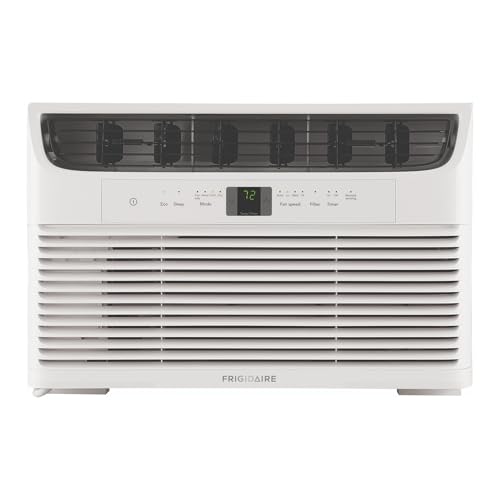
Frigidaire 8,000 BTU Window AC with Remote — Best Mid-Size Room Pick
Most bedrooms in most homes are this size, which makes the 8,000 BTU class the quiet workhorse of window cooling. Frigidaire’s version covers it with the features that matter — remote control, eco mode, three fan speeds, auto restart after outages — without asking buyers to fund smart features they may never configure. It is the ladder’s sensible middle: enough cooling, honestly sized, simply controlled.
Strengths
- Correct size for the most common bedroom and office dimensions
- Remote, eco mode and auto restart cover daily life
- Simpler and lighter than the 12,000 BTU flagships
Trade-offs
- No WiFi — pre-cooling means timers, not an app
- Conventional compressor noise character
- Undersized for open-plan or very sunny large rooms
| Capacity | 8,000 BTU |
| Coverage | Up to 350 sq ft |
| Control | Remote, eco mode, 3 fan speeds |
| Feature | Auto restart |
Sizing discipline pays its biggest dividend here. An 8,000 BTU unit in a 300-square-foot bedroom runs long, steady cycles that dehumidify properly — the room feels dry and cool rather than cold and damp — and it does so at a purchase tier and weight that make seasonal installation a one-person job in many windows. The remote and eco mode handle the daily rhythm without a single app download.
Step up only if the room is bigger, sunnier or more crowded than the standard case; step down only for genuinely small rooms. For the median bedroom in the median home, this rung of the ladder is where the money is best spent.
Durability in this category is less about drama than about accumulation: small correct behaviors, repeated. For the Frigidaire 8,000 BTU Window AC with Remote, that means the maintenance the manual specifies, the operating pattern its design assumes, and prompt attention to the first odd noise, smell or behavior change rather than the tenth. Products asked to work within their design envelope, and maintained on schedule, routinely outlast their expected service life; products ignored or misapplied just as routinely do not. The gap between those outcomes is owner behavior, and it is entirely within your control from the day the box arrives.
Best for: standard bedrooms, offices and nurseries up to 350 sq ft / Not suited for: large or open-plan spaces
Check on Amazon — and remember to check price on Amazon on the day you buy, because this category is discounted in waves rather than all at once.

GE 5,000 BTU Window AC for Small Spaces — Best Small Room Value
Small rooms are where oversizing does its worst damage, and this GE is the corrective: a true 5,000 BTU unit with manual controls and an easy install kit, sized for the small bedroom, nursery, dorm or home office up to about 150 square feet. No app, no menu — two honest knobs and a window that stops being a sauna.
Strengths
- Correctly sized for small rooms — proper dehumidifying cycles
- Manual controls anyone can use, nothing to configure
- Light, easy install with kit included
Trade-offs
- Manual controls mean no scheduling or remote
- Will not touch a mid-size room on a hot day
- Basic feature set is the point — and the limit
| Capacity | 5,000 BTU |
| Coverage | Up to 150 sq ft |
| Controls | Manual, 2 cooling modes |
| Install | Easy install kit included |
There is a particular misery in a small bedroom cooled by an oversized unit: freezing blasts, then clammy stillness, all night. The 5,000 BTU GE avoids it by simply being the right size, running the long gentle cycles that wring humidity out and hold a steady temperature a small room can actually sleep in. Its manual controls are a feature for guest rooms, rentals and anyone’s grandmother.
Buy it for the room it names and no larger — a 200-square-foot room on a still, humid night will expose its limits honestly. Within its brief, it is the best-value rung on this ladder and the easiest install in the guide.
Finally, a word on value over time for the GE 5,000 BTU Window AC for Small Spaces. The purchase figure — which you should check on the day you buy, since this guide deliberately prints none — is only the first term in the real cost: energy or consumables, maintenance, and the cost of a wrong first choice replaced early. A pick matched to small bedrooms, dorms, nurseries and offices up to 150 sq ft, bought once and kept for its full service life, is almost always the cheapest way to own anything in this category. That long view, rather than any single feature, is the standard this guide applied when ranking it among the six.
Best for: small bedrooms, dorms, nurseries and offices up to 150 sq ft / Not suited for: any room beyond its coverage or smart-control seekers
Check on Amazon — and remember to check price on Amazon on the day you buy, because this category is discounted in waves rather than all at once.
Comparison Table
Use this table to shortlist, not to decide on its own. The differences that matter most in daily use — the ones covered in the buying-guide sections after the table — are rarely the headline numbers, so read the row for any pick you are serious about alongside its full review above (Check the current price on Amazon for the top pick).
| Pick | Badge | Key spec | Best for |
|---|---|---|---|
| LG 12,000 BTU Dual Inverter Smart Window AC (Check on Amazon) | Best Overall | 12,000 BTU, 115V, dual inverter, ENERGY STAR, 550 sq ft | large bedrooms and living rooms up to about 550 sq ft |
| Frigidaire 12,000 BTU Smart Window AC with Wi-Fi (Check on Amazon) | Best Smart Alternative | 12,000 BTU, Wi-Fi, eco mode, cools 550 sq ft | living rooms wanting smart pre-cooling at this size |
| GE 12,000 BTU Smart Window Air Conditioner (Check on Amazon) | Best Install Experience | 12,000 BTU, Wi-Fi, quick install kit, 550 sq ft | renters and older windows needing a secure big-unit install |
| Midea 10,000 BTU U-Shaped Smart Inverter Window AC (Check on Amazon) | Best for Bedrooms | 10,000 BTU, U-shaped inverter, ultra quiet, 450 sq ft | bedrooms and noise-sensitive rooms up to 450 sq ft |
| Frigidaire 8,000 BTU Window AC with Remote (Check on Amazon) | Best Mid-Size Room Pick | 8,000 BTU, remote, eco mode, cools 350 sq ft | standard bedrooms, offices and nurseries up to 350 sq ft |
| GE 5,000 BTU Window AC for Small Spaces (Check on Amazon) | Best Small Room Value | 5,000 BTU, manual controls, easy install kit, 150 sq ft | small bedrooms, dorms, nurseries and offices up to 150 sq ft |
How to Choose a 120 Volt Window Air Conditioner by Room Size
Use the coverage ladder, then adjust for reality. The baseline mapping in this guide — roughly 5,000 BTU to 150 square feet, 8,000 to 350, 10,000 to 450, 12,000 to 550 — assumes standard ceilings and ordinary sun exposure. Then correct: add capacity for a south- or west-facing wall of glass, a kitchen’s cooking heat, a top-floor room under a hot roof, or regular occupancy by several people; subtract for a shaded, north-facing, well-insulated room. When a room falls between sizes, prefer the smaller unit in humid climates — longer cycles dehumidify better — and the larger only where heat load is genuinely extreme.
Confirm the electrical side, which at these sizes is mercifully simple: units in this guide’s classes run on standard 115/120V household outlets, but a window AC is a heavy continuous load, so give it a circuit that is not already sharing a hair dryer, microwave or space heater, and never use an extension cord. Finally, measure the window itself — width, sash style and sill — against the unit’s stated window requirements before ordering; the best-chosen AC that does not fit its window cools nothing.
Inverter vs Conventional, Smart vs Simple: What Actually Matters
The inverter question is really a noise and steadiness question. Dual-inverter and inverter models hold temperature with less cycling, less noise and better efficiency; conventional models cool the same room to the same set point with more audible on-off character and somewhat higher running costs. Bedrooms and light sleepers should pay for inverter quiet — ideally in the Midea U-shape’s closed-window form — while a living room used in the evening may never notice the difference the premium buys.
Smart control follows the same logic. WiFi earns its place if you will pre-cool on a commute, manage a rental, or schedule around time-of-use electricity pricing. If the unit serves a bedroom on a predictable rhythm, a remote and a timer do the same job with zero setup. Buy the control style you will actually use, and spend the difference on correct sizing — the hierarchy in this category is size first, noise second, connectivity third.
Installation and Seasonal Care for Window Units
A window AC’s performance is half installation. The unit must tilt very slightly outward per its manual so condensate drains outside, sit sealed with the included foam and panels so cooled air is not leaking around the chassis, and be supported as its weight class demands — big units deserve their brackets, not optimism. Seal gaps obsessively: a quarter-inch slot along a sash can waste a meaningful share of a small unit’s output and invites insects to share your summer.
Seasonally, clean or wash the filter monthly in season — airflow is cooling capacity — and store the unit indoors or covered with the window properly closed for winter. Before each season’s first run, check the cord and plug for damage, confirm the drain path is clear, and let a stored unit sit upright for a while before starting it. These small rituals are why some households get fifteen summers from a window unit and others get three.
How to Install a Window Air Conditioner Securely
Window AC installation is a classic two-person Saturday job for the big units and a one-person job for the small ones. The sequence below is the shared discipline across the brands in this guide; your unit’s manual and window kit always govern the specifics.
- Measure the window opening and confirm it falls inside the unit’s stated width and sash requirements before unboxing.
- Inspect the window frame and sill for rot or weakness — a 12,000 BTU unit is a heavy, vibrating load to hang on a failing sash.
- Fit the mounting bracket or install kit first, level and secure, following the kit’s instructions for your window type.
- With a helper for larger units, lift the AC into place, set it on the bracket, and confirm the slight outward tilt the manual specifies for drainage.
- Extend the side panels and seal every gap with the included foam and weatherstripping; check from outside with a flashlight for light leaks.
- Lower the sash into its channel or the U-unit’s slot, fit the sash lock or security bracket, and add any anti-tip support the kit provides.
- Plug directly into a wall outlet — never an extension cord or power strip — on a circuit without other heavy loads.
- Run the unit through all fan speeds and cooling, listen for rattles, and adjust seals or shims until it runs quietly.
- After the first day of cooling, recheck the tilt, the seals and the condensate drip path outside.
Live with the unit for a week and tune: most households find their real set point is a degree or two warmer than their first guess once humidity is properly removed, which saves energy every night after. If the room feels cold but clammy, the unit is likely oversized or the fan is set to blast-and-stop — favor longer, gentler cycles and let dehumidification do its work.
Dehumidification: The Half of Cooling Nobody Advertises
An air conditioner is two machines in one box: a cooler and a dehumidifier, and in humid climates the second job matters more. Comfort at 78°F and low humidity beats discomfort at 74°F and swamp air, which is why the sizing discipline in this guide keeps repeating itself — a correctly sized unit runs long, steady cycles that continuously wring moisture from the air, while an oversized unit satisfies the thermostat in short blasts and leaves the room’s moisture almost untouched. This is also the hidden virtue of inverter models: by idling at low speed instead of switching off, they keep the coil cold and the dehumidification running between temperature demands. When you read the picks in this guide, translate ‘long gentle cycles’ as ‘dry air’, and many of the rankings — the U-shape for bedrooms, the mid-size Frigidaire over a bigger unit for a standard room — explain themselves. Buy cooling capacity for your heat load, but buy cycle length for your humidity, and you will be comfortable at temperatures, and power bills, that surprise you.
Window ACs and the Electrical System of an Older Home
Older homes bless window ACs with windows and curse them with wiring. A window unit is among the largest continuous loads a household circuit carries, and in a house where one circuit serves a bedroom, a bathroom and part of a hallway, adding a 12,000 BTU unit to a hair dryer and a space heater’s old habits will find the breaker’s limit on the first hot morning. The fixes are ordinary: know which outlets share a circuit before the season starts, give the AC the circuit’s priority while it runs, keep the plug and outlet in good condition — a warm plug is a message, not a nuisance — and, for a permanent big unit in a panel with room, let an electrician price a dedicated circuit. It is unglamorous spending that converts a summer of nuisance trips into a summer of silence from the breaker box, and it protects the unit itself, whose compressor prefers honest voltage to the sag of an overloaded line.
Two Rooms, One Unit: Air Movement Tricks That Actually Work
Every household eventually asks a window AC to cool beyond its room, and the physics answer is: it can help, with air movement, within limits. A fan placed to push cooled air toward the adjacent room — low, since cold air pools — genuinely extends comfort into a connected space with an open door, especially in the evening when the whole home’s load is falling. What does not work is expecting the unit to condition a closed room, or a floor above or below, or a space around two corners: cooled air is heavy, lazy and easily stopped. The honest solutions for a second real room are a second, smaller unit — the 5,000 and 8,000 BTU rungs of this guide’s ladder exist for exactly this — or accepting a comfort gradient, cool in the main room and merely pleasant in the next. Households that plan the gradient deliberately, sleeping in the cooled room and letting the rest of the home ride warmer, get most of a second unit’s benefit for none of its cost.
A Season With a Window AC: The Owner’s Calendar
Window cooling has a calendar, and owners who keep it get the long service lives this category is capable of. Spring: install or recommission, with fresh seals, a cleaned filter, a checked cord and a first run before the heat arrives to find any problem while it is still a nuisance rather than an emergency. Summer: the monthly filter ritual, a mid-season check that the outdoor side is draining and unobstructed, and set-point discipline — one honest temperature, held, instead of daily thermostat arguments the compressor pays for. Autumn: the decision, made deliberately, to remove and store the unit indoors with the window restored to full insulation, or to cover and seal it in place where removal is impractical. Winter: nothing — which is itself the point of the autumn decision done well. Kept on that calendar, a good window unit from this guide’s ladder is a ten-to-fifteen-summer appliance. Ignored, the same unit is a three-summer disappointment with a clogged filter and a leaking sash. The calendar is free; only the neglect is expensive.
Common Buying Mistakes
Oversizing for a faster cool-down
A bigger unit does cool the air faster — and then stops, leaving humidity behind and a room that feels clammy at a low temperature. Correct sizing with long, steady cycles is what comfort actually is. Buy the rung of the ladder your room measures, not the one your impatience prefers.
Undersizing to save money
The opposite error is worse on the hottest day of the year: a small unit runs at maximum for twelve hours, never reaches set point, and wears itself out doing it. If your room has big sun load or a hot roof, step up a size honestly.
Running a window AC on an extension cord
Window units are heavy continuous loads. Extension cords and power strips are a genuine overheating risk and are prohibited by every manual in this category. If the outlet is not where the window is, the answer is an electrician or a different window — never a cord.
Skipping the seals
Unsealed side gaps leak the air you just paid to cool and whistle while doing it. Ten minutes with the included foam at install pays back every hour of every day the unit runs.
Ignoring the filter all summer
A clogged filter strangles airflow, cuts cooling, ices coils and inflates the power bill. Monthly filter care in season is the cheapest performance upgrade in this entire guide.
Final Recommendation
Match the room and the choice makes itself: the LG dual-inverter for large rooms and quiet flagship performance, the Frigidaire smart unit as its living-room alternative, the GE 12,000 for install-anxious big windows, the Midea U-shape for bedrooms where sleep is sacred, the Frigidaire 8,000 for the standard bedroom, and the little GE 5,000 for small rooms that deserve correct sizing. Every one runs on ordinary household power — the 120V brief is satisfied by the category itself at these sizes.
Measure the room, measure the window, check the circuit, and order once. A correctly sized window AC is one of the highest comfort-per-dollar purchases a home can make.
Keep researching the wider category with these related guides from our Batteries & Voltage coverage: Best 12000 Btu 550 Sq Ft 115 Volt Window Air Conditioner Energy Star Best 12000 110 Volt Ductless A C Best 120 Volt Thermostat Best 120 Volt Ventless Dryer Best 120 Volt Washer And Dryer Combo
Shortlist for a final comparison: check price on Amazon for the LG 12,000 BTU Dual Inverter Smart Window AC; check price on Amazon for the Frigidaire 12,000 BTU Smart Window AC with Wi-Fi; check price on Amazon for the GE 12,000 BTU Smart Window Air Conditioner; check price on Amazon for the Midea 10,000 BTU U-Shaped Smart Inverter Window AC; check price on Amazon for the Frigidaire 8,000 BTU Window AC with Remote; check price on Amazon for the GE 5,000 BTU Window AC for Small Spaces; — one link per pick, so you can compare today’s terms across the full shortlist before deciding.
Frequently Asked Questions
Do window air conditioners need a special 120V circuit?
Units in the sizes in this guide run on standard 115/120V household outlets — that is the normal design for window ACs up to the largest sizes here. What they do need is a circuit not already loaded with other heavy appliances, and a direct wall-outlet connection with no extension cord.
What size window AC do I need for a 12×15 bedroom?
That is 180 square feet — the 8,000 BTU class is the comfortable answer for an average room of that size, giving long dehumidifying cycles without short-cycling. A very sunny or top-floor version of the same room might justify stepping up; a shaded one will be perfectly served at 8,000 BTU.
Are inverter window ACs worth it?
For bedrooms and heavily used living rooms, yes: they run quieter, hold temperature steadier and use less energy over a season. For a guest room used a dozen nights a year, a conventional unit at the right size is the smarter spend. Usage hours decide the payback.
Why does my window AC make the room cold but clammy?
Almost always oversizing or short cycles: the air reaches set point before the coil has run long enough to wring out humidity. Run longer, gentler cycles, avoid the coldest blast settings, and if you are replacing the unit, size down a rung.
Can I leave a window AC installed all winter?
You can, with a proper cover and sealed gaps, but removing and storing it indoors preserves the unit and the window’s insulation value. In cold climates, removal is the better default — and another argument for choosing a model whose install kit makes the seasonal swap easy.
How loud is a window air conditioner, really?
Conventional units are clearly audible — part of the room’s soundscape. Inverter models are substantially quieter, and the U-shaped design, which lets the window close into the unit, is the quietest form of window cooling because the glass itself blocks compressor noise. For light sleepers, that design is worth prioritizing over raw BTU.